nonsingular. The elements of the vector P of the mixing proportions for the populations sum up to 1.
ABSTRACT
This study investigated the performance of the heteroscedastic discriminant function under the non-optimal condition of unbalanced group representation in the populations. The asymptotic performance of the classification function with respect to increased Mahalanobis’ distance (under this condition) was considered. Results obtained have shown that the misclassification of observations from the smaller group escalates when the sample size ratio 1:2 is exceeded (for small sample sizes). Results also show more sensitivity to sample size than the distance function when the data set is balanced, while the performance of the function in the classification of the underrepresented group improved by increasing the distance function. More robustness with unbalanced data was also observed with the Quadratic Function than the Linear Discriminant Function.
Keywords: Heteroscedastic, Unbalanced data, Discriminant function, prior probabilities, Misclassification
2000 Mathematics Subject Classification: 62H30, 62C05, 00A72.
and θi consists of the elements of μi and the (1/2)P(P + 1) distinct elements of Σi (i =1, ..., g). It is assumed that each Σi is
EFFECTS OF SAMPLE SIZE RATIO ON THE PERFORMANCE
OF THE QUADRATIC DISCRIMINANT FUNCTION
A. ADEBANJI1, S. NOKOE2 AND S. ADEYEMI3
1Department of Mathematics, Kwame Nkrumah University of Science and Technology, Kumasi, Ghana. Email: [email protected]
2Wisconsin International University College, Accra, Ghana. Email: [email protected].
3Tibotec-Virco BVBA, Belgium. Email: [email protected]
Journal of Natural Science, Engineering
and Technology
ISSN—2277-0593
© FUNAAB 2010
Erratum
INTRODUCTION
In this study we restrict ourselves to the two group classification problem when the covari-ance structures and mean vectors are unequal. We define two groups and with Multivariate Normal density functions and respectively.
and where and . The
group conditional density fi(Xi, θi) is given by
and θi consists of the elements of μi and the (1/2)P(P + 1) distinct elements of Σi (i =1, ..., g). It is assumed that each Σi is
nonsingular. The elements of the vector P of the mixing proportions for the popula-tions sum up to 1.
Observations from these groups constitute the training sample. A classification
func-tion will be constructed using the training sample on the basis of which future observa-tions (of unknown group memberships) will be classified. This is done by comparing the function to a predetermined cut-off value. The procedure is often utilized (but not lim-ited to) the Social Sciences, Medical sciences, Education and Psychology.
(2.1) This reduces to
(2.2)
This is a quadratic classification function here after referred to as the Quadratic Discrimi-nant
Function (QDF). This function contains population parameters and the sample estimates will be obtained from the training data. is the general equation. Equation (2.2) above can be written as
Q(x) = x/ Ax + b/ x + c (2.3)
Where
(2.4)
The quadratic
(2.5)
is the squared Mahalanobis’ distance be-tween x and μi with respect to Σ.
The cut-off point is determined by the log ratios of the costs of misclassification and prior probabilities. We define
as the cost of misclassifying an observed vector as belonging to group Ri when it ac-tually belongs to Rj and C(j|i) as the con-verse.
Consequently, C(i|i) = C(j|j) = 0. Also, the
assumption C(j|i) = C(i|j) is the exception and not the norm in practice. This rule is however regularly applied when the misclas-sification costs are unknown.
Let Pi i=1, 2 be the prior probability of an
observation belonging to group Ri and this
information is often obtained from the train-ing sample composition. An observed P-variate vector x is assigned to R1 if
EFFECTS OF SAMPLE SIZE RATIO ON THE PERFORMANCE OF...
(2.6)
The total probability of misclassification (TPM) gives a measure of the performance of the function. This is a proportion of misclassified observations from the training sample and is given as
(2.7)
Denote where and are the distributions that generated the train-ing samples, the TPM ustrain-ing the QDF will be represented as
(2.8) where
A(R0) = (1/2)[C2(R0)-1 – C1(R0)-1] (2.9)
b(R0) = C1(R0)-1T1(R0)-1 – C2(R0)-1T2(R0)-1 (2.10)
c(R0) = (1/2)log(|C2(R0)||C1(R0)| +(1/2)(T2(R0)/C2(R0)-1T2(R0)
− T1(R0)/C1(R0)-1T1(R 0)) (2.11)
This is analogous to the quadratic function and equations 2.9 to 2.11 are the values of a lo-cation function T at the distributions and .
That is, and .Similarly, C1(R0) and C2(R0) are the
values of the covariance matrix function C at the distributions and .
Thus, and when the data follows a normal
distribution,
T1(R0) = μ1, T2(R0) = μ2, C1(R0) = Σ1 and C2(R0) = Σ2 (Joossens[5]).
McFarland and Richards[7] have provided exact misclassification probabilities for the finite sample from a normal distribution. The future data is supposed to be a normal mixture of
The Simulation Experiment
W e c o n s i d e r t w o p o p u l a t i o n s
and with
μ1 =[0,0,0,0] and μ2 = [δ,0,0,0], Σ1 =I and Σ2 = kI. For our case we set k = 6 (Adebanji and Nokoe[1]) and δ = 1, 2, 3 and 4. Dif-ferent values of δ are considered to see if there is any observable change in the per-formance of the functions from very close samples to well separated samples. Twenty one sample sizes (ranging from 25 to 500) are generated for and the number of corresponding observations generated from is determined by the sample size ratio composition under consideration. We con-sider = 1:1, 1:2, 1:3 and 1:4; that is from balanced to extremely unbalanced data sets. The large sample sizes are considered in order to enable us observe the perfor-mance of the QDF when the population parameters are known.
The four sample size ratio combinations were considered for every value of δ under consideration. Random samples are generat-ed and 100 replications of each sample specification is generated using SAS V(8) (1996). The large number of replications minimizes between sample variability. The QDF is constructed and the leave-one-out error rate estimation procedure (Lachembruch and Mickey[6])is used for estimating the TPM.
Results of Simulation
In the results, the total probability of mis-classification (averaged over 100 replications) is denoted as decimals, and the associated standard deviations (SD) are also denoted as decimals. The coefficient of variation (CV) (denoted as percentages) are presented. Re-sults are also presented for different values of δ and sample size ratio combinations. Scheme 1: Equal Sample sizes ( =1:1)
When the sample size ratios are equal, the performance of the function for group G1 with an identity covariance structure is slight-ly better than that for G2 with the covariance structure Σ=kI though not significantly
dif-ferent in values. Higher reduction in error rates and SD was observed for increased sample sizes than for increase in the δ value. The results
stabilized around sample size 1200 beyond which no significant improvement was rec-orded in the performance of the function. Scheme 2: Unequal Sample sizes (
=1:2)
The ratio of the error rates for was 1:5 and this increased to 1:10 when the sam-ple size 1200 was attained for δ=1. This high misclassification of the under-represented group underscored the improvement in the performance of the function as can be ob-served from the total error rates. The SD shows a steady decline to sample size 900 at the training data and the observations of unknown group membership. This gives a TPM for the mixture as
TPM(R0, R) = P1 C(2|1)(R0, R) + P2C(1|2)(R0, R) (2.12)
The theoretical derivations have been provided by Jossens[5], McFarlan and Richards [7] and McLachlan [8].
which it stabilizes. The CV reduces more gradually to sample size 1200 and remained stable afterwards. For δ=2, the ratio was 1:3 for smaller sample sizes and 1:6 when the
sample size 1200 was attained. For δ=3, the ratio increased to 1:4 and similar results was observed for δ=4. The group error rates for this scheme are presented in table 4.1.
EFFECTS OF SAMPLE SIZE RATIO ON THE PERFORMANCE OF...
Table 1: Group Error for δ = 1, 2, 3 and 4( = 1 : 2)
δ = 1 δ = 2 δ = 3 δ = 4
n1 Sample Size
G1 G2 G1 G2 G1 G2 G1 G2
25 75 0.306 0.065 0.231 0.086 0.146 0.082 0.115 0.053 50 225 0.305 0.047 0.230 0.047 0.151 0.048 0.114 0.031 75 225 0.305 0.032 0.225 0.043 0.151 0.047 0.114 .029 100 300 0.304 0.033 0.228 0.044 0.170 0.037 0.113 0.030 200 600 0.303 0.029 0.228 0.042 0.148 0.046 0.113 0.027 300 900 0.302 0.026 0.227 0.040 0.168 0.036 0.113 0.028 400 1200 0.301 0.027 0.225 0.040 0.157 0.039 0.112 0.027 Scheme 3: Unequal Sample sizes
( =1:3)
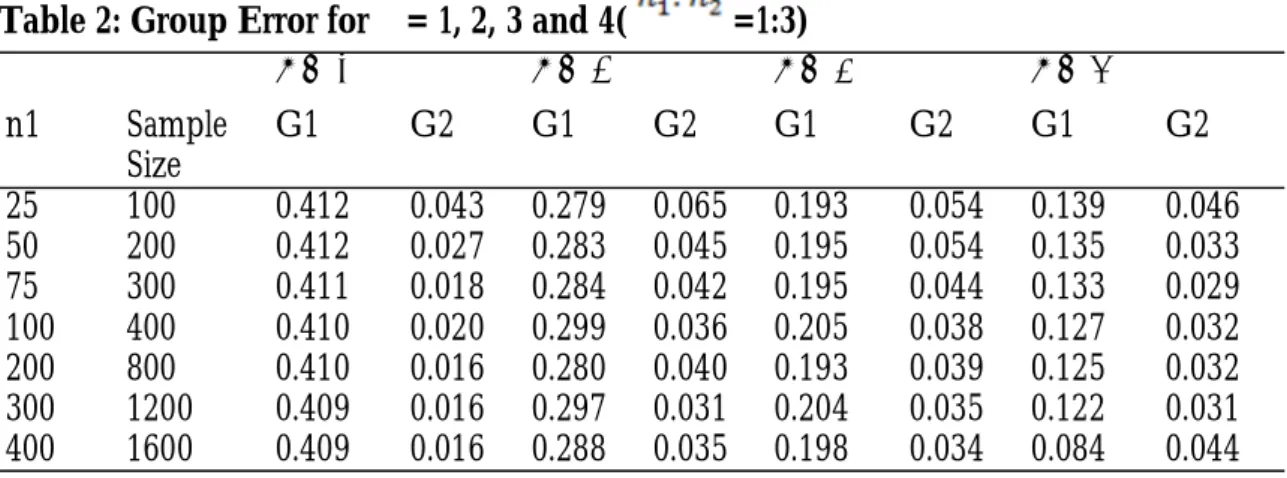
The ratio of the error rates for δ = 1 increased from 1:9 to 1:26 at sample size 1200, for δ = 2, it rose from 1:4 to 1:9. At δ
= 3, the change was from 1:4 to 1:6 and 1:2 to 1:4 for δ = 4. The high error rate for the
smaller group further underscores the per-formance of the function. There was a steady reduction in the SD until sample size 800 beyond which it remained relatively constant. A similar pattern was observed for the CV which recorded only a slight improvement beyond sample size 800. Refer to table 4.2 below for the group error rates.
Table 2: Group Error for δ = 1, 2, 3 and 4( =1:3)
δ = 1 δ = 2 δ = 3 δ = 4
n1 Sample
Size
G1 G2 G1 G2 G1 G2 G1 G2
25 100 0.412 0.043 0.279 0.065 0.193 0.054 0.139 0.046 50 200 0.412 0.027 0.283 0.045 0.195 0.054 0.135 0.033 75 300 0.411 0.018 0.284 0.042 0.195 0.044 0.133 0.029 100 400 0.410 0.020 0.299 0.036 0.205 0.038 0.127 0.032 200 800 0.410 0.016 0.280 0.040 0.193 0.039 0.125 0.032 300 1200 0.409 0.016 0.297 0.031 0.204 0.035 0.122 0.031 400 1600 0.409 0.016 0.288 0.035 0.198 0.034 0.084 0.044
Scheme 4: Unequal Sample sizes
( =1:4)
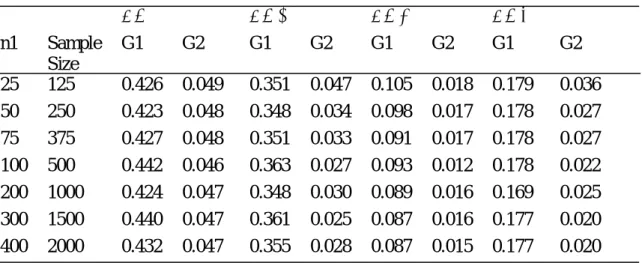
The widening in the gap of the ratio was not as rapid as had earlier been
observed. For δ = 1 the increase was from 1:9 to 1:11, while for δ = 2, 3 and 4 the rec-orded values were 1:4 to 1:7, 1:6 to 1:8 and 1:5 to 1:9 respectively. See table 4.3 below for details of change in
error rates.
Table 3: Group Error for δ = 1, 2, 3 and 4(n1 : n2=1:4)
δ = 1 δ = 2 δ = 3 δ = 4
n1 Sample
Size
G1 G2 G1 G2 G1 G2 G1 G2
25 125 0.426 0.049 0.351 0.047 0.105 0.018 0.179 0.036
50 250 0.423 0.048 0.348 0.034 0.098 0.017 0.178 0.027
75 375 0.427 0.048 0.351 0.033 0.091 0.017 0.178 0.027
100 500 0.442 0.046 0.363 0.027 0.093 0.012 0.178 0.022
200 1000 0.424 0.047 0.348 0.030 0.089 0.016 0.169 0.025
300 1500 0.440 0.047 0.361 0.025 0.087 0.016 0.177 0.020
400 2000 0.432 0.047 0.355 0.028 0.087 0.015 0.177 0.020
Figures
The graphs for the total (mean) error rates, standard deviation (SD) and coefficient of variation are presented in a series of figures 1.1 to 4.3. Figures 1.1, 1.2 and 1.3 are the graphs of the mean error rates, SD and CV for the balanced data set. Figures 2.1, 2.2
and 2.3 represent the mean error rates, SD and CV for sample size composition
=1:2. The graphs for sample size ratios 1:3 and 1:4 are presented in figures 3.1 to 3.3 and 4.1 to 4.3 respectively.
DISCUSSION
When the data set is balanced, the QDF benefits more from increase in sample size than increase in the distance function. More robustness was also observed in using the function for unbalanced data over the linear discriminant function (Adebanji et al) [2]. The performance of the function in classify-ing unbalanced data also improved signifi-cantly when the between group squared dis-tance is relatively large (i.e. data sets are well separated). The performance however dete-riorates in classifying the smaller group when the total sample size is large.
CONCLUSION
In conclusion, using of the QDF for the classification of unbalanced data will not be recommended beyond sample size ratio 1:2 when the data sets are relatively close, and ratio 1:3 when the observations are well separated (subject to moderate sample size).
Adebanji, A.O., Nokoe Sagary, S.K.
2004. Evaluating the Quadratic Classifier, Proceedings of the Third International Workshop on contemporary problems in Mathematical Physics, 3: 369-394.
Adebanji, A.O., Adeyemi, S., Iyaniwura, O. Effects of sample size ratio on the
Line-ar Discriminant Function, International
Jour-nal of Modern Mathematics, 3(1): 97-108.
http://ijmm.dixiewpublishing.com/
Fisher, R.A. 1936. The Use of Multiple
Measurements in Taxonomic Problems,
An-nals of Eungenics, 7: 179-188.
Fisher, R.A. 1938. Statistical Utilization of
Multiple Measurements, Annals of Eugenecs 8, 376-386.
Joossens, K. 2006. Robust Discriminant
Analysis, Ph.D. Thesis of the Katholieke Uni-versity, Leuven, Belgium, 31-46.
Lachenbruch, P.A., Mickey, M.R. 1968.
Estimation of error rates in discriminant analysis, Technometrics, 10: 1-11.
McFarlan, R.H. Richards, D. 2002.
Ex-act Misclassification Problems for Plug-in Normal Discriminant Functions: The Heter-ogeneous Case, Journal of Multivariate Analysis, 82: 229-330.
McLachlan, G.A. 1992. Textbook of Discrimi-nant Analysis and Statistical Pattern Recognition,
Wiley Series in Probability and Mathematical Statistics.
Murray, G.D. 1977. A Cautionary Note on
Selection of Variables in Discriminant Analy-sis, Applied Statistics, 26(3): 246-250.
EFFECTS OF SAMPLE SIZE RATIO ON THE PERFORMANCE OF...