LESSONS LEARNED FROM TWO SOCIAL MARKETING HIV PREVENTION INTERVENTIONS
by
Trudy K. Singzon, MD April 13, 2005
A Master's paper submitted to the faculty of the University of North Carolina at Chapel Hill in partial fulfilhnent of the requirements for the degree of Master of Public Health in
the School of Public Health, Public Health Leadership Program.
TABLE OF CONTENTS
I. Introduction ...•... II. Background ...•... ,
A. Defining the problem ...•••...••.•...
"-B. The Research Question ...•••...•...•.••.•.. 6
C. Social Marketing ...•...•...•... 7
III. A Systematic Review of the Literature ...••.••...•..•.. IO A. Cochrane Database of Systematic Reviews ...••.••••.••.•... l l B. A Meta-analysis •.•...•.•..••...•.••.•.••... 12
C. A Research synthesis ...•.••.•.••...••..••.•....•.... 13
D. Randomized Controlled Trials to date ....•••.••...•.• 13
IV. Methods ..•...•••••.•••••...•...•.••.••.•.••.•... 20
A. Inclusion Criteria ...•.•.••.•..••...•.•.••.•... 20
B. Evaluation Questions ...••..•....•.••...•.•.•.••.••.•.•. 21
C. Data Collection Tool ...••.•••..•.•...•...••• 22
D. Data Sources ...••.•.•...•••••••.••. 23
E. Contacting the Programs ...••••.••.•...•....••... 23
F. Data Analysis •...•••..•.••.••... 24
V. Program Descriptions •••...••...••.•••••••.•.•.•... 25
A. The APPLE project ...•..•.••...•...••••... 25
B. The ACCESS project ...•.••.••...•..••• 26
VI. Results .••.•.••.•.•..•.•...•.••••.••.••.•.•... 27
A. Design ••.••.••.•.•.••.•.••...•.•.•.••.••.•.•.••.•.•.•... 27
B. Implementation ...••.•.•.••.•..•... 39
C. Evaluation ••••.•.••.•.••..•.•.•.•...•••..•.•••.••.•.•.•.•... .43
D. Final Words ofWisdom .•..•.•.••..••.••...•....•...••....••.•.••.... 46
VII. Discussion .•.•..•.•...•...•.••.•.••.••.•.•...•... .47
A. Lessons Learned ...•.••••.••••..•.•... .47
B. Implications for Practice and Policy ...•.••.•.•••••... 54
C. Future Research ...•...••.••.•...•...•.•••.•.••.•.•..•... 55
Acknowledgements ••••..••.••.•..•.•••.••...•.•..•..•..•... 55
I. INTRODUCTION
HIV/AIDS continues to be a problem in the United States and the epidemic continues to change. As the incidence ofHIV decreases in some populations as a result of awareness and testing campaigns, the rate of infection has been increasing in others. Despite the fact that we have learned much about the transmission ofHN and important risk factors such as unprotected sexual intercourse are known, the disease continues to affect hundreds of thousands in the U.S. alone. Since the early days of the epidemic, HN prevention efforts have seen modest results. Behavior is difficult to change and we have learned that mere dissemination of information is not adequate to change behavior. New challenges to HN prevention efforts have been encountered as the epidemic shifts to high-risk populations that are frequently poor, marginalized, and thus, difficult to reach with traditional public health interventions. Thus, we need to come up with new and creative ways to reach high-risk populations since traditional methods and messages do not appear to be effective. In this paper, I critique social marketing as a possible solution to creating effective HN prevention interventions targeted to high-risk U.S. populations. The purpose of this paper is to investigate the lessons learned from HIV prevention interventions in the U.S. that used social marketing approaches.
First, I present some background information by reviewing the current CDC statistics on the incidence and prevalence ofHN and AIDS in the U.S. to attempt to define the problem. I then briefly discuss the health disparities seen in HIV AIDS and the adolescent and young adult population. A review of these statistics should explain why I chose African American
adolescents and young adults as my population of interest. I then introduce my research question and explore the concept of social marketing. A systematic review of the literature introduces the HIV prevention strategies that have been tried in the past and which strategies have been found
to be evidence-based. Since they are my population of interest, I review the HN prevention interventions that have focused on African American adolescents and young adults with a focus on randomized controlled trials since they are the current gold standard of clinical trials. I also include a meta-analysis and a research synthesis that focus on behavioral strategies.
Lastly, I describe my methods including inclusion criteria, evaluation questions, data sources used, difficulties contacting the programs, and data analysis and I give brief program descriptions for the HIV social marketing prevention interventions evaluated in this paper. My evaluation has two main components. I first evaluate the interventions using specific criteria to discern whether or not a program in fact used social marketing techniques. Then I offer more general lessons learned from the experiences of the interventions and offer my perspective on implications for practice and policy as well as areas for future research.
II. BACKGROUND
DEFINING THE PROBLEM
U.S. HIV/AIDS Incidence and Prevalence
According to the Centers for Disease Control and Prevention (CDC), there are an estimated 850,000 to 950,000 people currently living with HN in the United States1 but these numbers are most likely to be underestimated. The current estimates ofHIV infections are only based on data from the 32 states that used confidential, name-based reporting ofHIV and AIDS cases for greater than or equal to four years (2000-2003). Thus both the incidence and prevalence numbers frequently cited by the CDC are likely to be underestimated.1 In 1994, the CDC began supporting a uniform system for national HN/ AIDS surveillance and at this time, only 25 states required confidential reporting of persons with HIV infection and this did not include several large states, e.g., California, Illinois, New York, and Washington? Since then, analyses have
been possible on data from 32 states, however, according to the CDC, this accounts for only 49% of the national total of AIDS diagnoses during the same period and thus might not be nationally representative.1 Also, data from states with the highest AIDS morbidity in 2003 (e.g., California and New York) were not included in these analyses. Thus, the CDC prevalence and incidence statistics must be considered with these limitations in mind.
Based on the CDC data from 32 states during 2000 to 20031, approximately 70% of all new infections each year occur among men. Men who have sex with men (MSM) represent the largest proportion of new infections ( 61% ), followed by high-risk heterosexual contact (17 .3%) and IV drug use (IDU) (14.6%). The largest proportion of new infections in females was high-risk heterosexual contact (77.7%), followed by IDU (19.4%). Since the beginning of the
epidemic through December 2000, 774,467 AIDS cases and 448,060 deaths have been reported in the U.S.3 Since the use ofhighly active antiretroviral therapy (HAART) starting in 1996, advances in HIV treatment have led to declines in AIDS deaths and have slowed the progression from HIV to AIDS.
Since the peak ofHIV in the mid-1980s, the overall incidence ofHIV in the U.S. has declined but this decrease is primarily due to changes in the behavior of white homosexual men older than 30 years.4 Among young blacks and Hispanics, the incidence reduction in men who have sex with men (MSMs) and injection drug users (IDUs) in their 20s has been offset by the increased incidence in teenagers and heterosexual men. 5 In addition to those who have been tested and are aware of their status, the CDC estimates that approximately 180,000 to 280,000 (approximately 25%) persons who are HIV positive in the U.S. are unaware of their serostatus.1 Thus, the HIV/AIDS epidemic in the U.S., which began primarily among white gay men, is now
propagated by young people who exhibit high-risk sexual behavior and drug use, many of whom are not aware that they are infected.
Disparities in HIV/AIDS
Racial and ethnic disparities in HIV are illustrated in the HIV incidence statistics and are seen in both genders. Ethnic minorities account for the majority of new infections and are out of proportion to their representation in the population. According to the CDC data from 2000-2003 (from 32 states), more than half of new HIV infections occur among non-Hispanic blacks (51.3%) though they represented only 13% of the U.S. population of those states during these four years. Hispanics account for approximately 15% of the estimated new HIV infections. Approximately I in 50 African American men and I in 160 African-American women are
estimated to be infected with HIV, compared to I in 250 white men and I in 3000 white women. 6 Sixty-four percent of new infections among U.S. women occur in African American women and 18% occur in Hispanic women, even though they comprise only one fourth of U.S. women. According to the CDC, the rates among non-Hispanic black females were 19 times the rate among non-Hispanic white females.
In addition to the HIV statistics, the disparity in burden ofHIV/AIDS can also be estimated from reports from diagnosed AIDS cases. While African Americans and Hispanics make up approximately 25% of the U.S population, they represent approximately 57% of reported AIDS cases in the U.S. since 1981. Minority women have been disproportionately affected by HIV/ AIDS. The proportion of all AIDS cases reported among adult and adolescent women has more than tripled, with African-Americans and Hispanics accounting for more than three fourths of the AIDS cases reported to date7
Disparities in HIV/ AIDS are also revealed in mortality statistics. According to the CDC, in the United States, HIV -related death has the greatest impact on young and middle-aged adults, particularly racial and ethnic minorities. In 1991, HIV I AIDS became the leading cause of death among African-American men aged 24-44 in the United States. In 1999, HIV/AIDS became the third leading cause of death among African-American women in the same age group8 As
illustrated in the National Vital Statistics Report in 2002 (this is the most recent report available) which is based on 2000 data, HIV is the seventh cause of death in all races, both sexes, ages 20-24 years and is the eighth most common cause of death in blacks, both sexes, ages 15-19 years. According to the 2000 data, HIV disease is the number one cause of death for black females, ages 25-34 years. 9 As of December 2000, the cumulative U.S. death toll was 206,909 in whites,
158,892 in blacks, and 77,698 in Hispanics.
Since, according to the CDC data, more than half of new HIV infections occur among non-Hispanic blacks, and the disparities are reflected not only in HIV incidence data but also in AIDS statistics and AIDS mortality data, my population of interest is the African American population. I find it particularly concerning that HIV disease is the number one cause of death for black females, ages 25-34, according to the 2000 data. But, despite the existence of many interventions that target women, I focus on interventions that include both young men and women since sexual relations are between them and are often complicated by male-female dynamics. Furthermore, I focus specifically on African American adolescents and young adults for reasons that will be explained in the next section.
HIV in the adolescent and young adult population
The CDC recognizes that many of the young adults who are dying from HIV/AIDS were likely infected in their teens and twenties. Thus, it follows that prevention efforts should be
targeted to this age group. The long and asymptomatic period between HIV infection and the identification of AIDS via AIDS-defining illnesses makes it difficult to estimate the number of HIV-infected adolescents. tO Estimates ofHN-positive adolescents have ranged between
112,000 and 250,000.11 It has been estimated that at least half of all new HIV infections in the U.S. are among people under 25 (about 20,000).12 These statistics most likely grossly
underestimate the actual incidence and prevalence ofHIV infections since only 32 states track HIV infections. Thus, HIV prevention among adolescents and young adults should continue to be a priority. Another reason to target this age group is that while some will contract HN during adolescence, many more will develop patterns of behavior during this period that may place them at risk throughout their lives. 13 Thus, HN prevention interventions that focus on behavior change should target this young population to prevent these patterns of behavior from
developing.
When targeting adolescents and young adults, prevention efforts should focus on high-risk groups such as African Americans and Latinos since marked disparities in HIV incidence, AIDS cases, and mortality (described earlier in detail) can be seen in these groups. Based on the current statistics, HIV prevention interventions that successfully target minority adolescents and young adults should continue to be a priority and these statistics are the basis for my choice of population of interest: African American adolescents and young adults.
THE RESEARCH QUESTION
Despite decades ofHN prevention interventions, the U.S. HIV/AIDS epidemic continues with increasing disparities and new challenges. My choice to focus on social marketing programs is based on the limited success of past HIV prevention interventions and the suggestion that a targeted approach may be more effective with at-risk or highly ostracized populations such as
those disproportionately affected by HN/AIDS.14 Social marketing is the application of marketing practices to nonprofit and social purposes such as a public health concern.15 This technique has not been fully explored in the U.S. while, for decades, social marketing techniques have been used successfully by public health programs throughout Africa, Asia, North American and South America.15 New and innovative approaches are needed to address increasing
HN/AIDS racial disparities by reaching these marginalized U.S. populations. The use of these marketing practices serves to persuade a target group to adopt an idea, product, or behavior by using techniques of media. This technique could serve to be very useful with difficult-to-reach populations, such as my population of interest, by creating interventions that are customized specifically to reach that population.
The purpose of this paper is to investigate the lessons learned from two HIV prevention interventions that used social marketing approaches. All programs that met the following criteria were considered for inclusion: 1) programs that were found to have most (if not all) of the components of social marketing, 2) programs that included an evaluation component, 3) articles published in English, 4) articles published after 1990. According to a systematic review
performed by Darcie Mersereau in the fall of 2003, only two such programs exist. These two programs are the focus ofthis program evaluation.
SOCIAL MARKETING
Before the term social marketing was coined in 1971, a sociologist, G.D. Wiebe,
stimulated a shift in ideas about the realm of marketing when he posed this provocative question in a 1952 paper: Why can't brotherhood be sold like soap?16 Wiebe concludes from his analysis of various social campaigns that society's aspirations can be sold through the application of marketing techniques. The term social marketing was coined by Philip Kotler in 1971 and this
term was defined by Kotler and Gerald Zaltman as "the design, implementation, and control of programs calculated to influence the acceptability of social ideas, and involving considerations of product, planning, pricing, communication, distribution and marketing research."17 This definition gave rise to the mnemonic "four Ps"- product, price, place, and promotion- with which social marketing is commonly associated.
The theory of social marketing was first put into practice within the international development arena in the 1960s and 1970s. During this time, various programs used social marketing techniques to promote immunization, family plarming, agricultural reforms, and nutrition in various developing countries. According to Walsh et a!, much of the important research and development done to advance social marketing applications to health has taken place in the international family planning field. Many of these family plarming social marketing programs built on the experiences of projects funded by the U.S. Agency for International Development (USAID) and the Ford Foundation. Many subsequent social marketing projects were later funded by these two agencies.
This initial interest in social marketing in the international development community began to expand to other areas of health promotion and disease prevention. Numerous projects to reduce cardiovascular disease risk, such as the National Heart, Lung, and Blood Institute
(NHLBl)-sponsored national campaigns to reduce levels of hypertension and cholesterol, used the term social marketing. Others did not use this term, but began to incorporate concepts and technology from the business sector to their projects. Today, a wide range of U.S. federal agencies as well as state and local governments and a significant number of nonprofit
organizations have all adopted social marketing approaches. UN AIDS and the World Bank are both incorporating social marketing techniques into their prevention efforts.
In practice today, there exists some confusion about what social marketing is and what it is not. A search using the key word social marketing in PubMed in March 2004 yielded over 700 articles. In a review of health promotion literature between 1982 and 1996, Hill found 93 articles involving social marketing that were of three general types: case studies, tool applications, and conceptual debates18 Walsh et a! asserts that among specialists in the field, "definitions and disciplinary boundaries seem relatively clear and straightforward" and but she concedes that "in the health literature the concept of social marketing is still elastic and elusive."19 A common misconception is that social marketing is synonymous with advertising or mass media campaigns. Most experts in the field would agree that while social marketing has its roots in social advertising, it has since expanded into other areas such market research, attention to product development, and the use oftechniques to facilitate motivational exchanges.19• 32
Based on the modest results of most HIV prevention interventions, I submit that new ideas are necessary to make these interventions more effective. My attraction to social marketing as a method of designing and delivering an HIV prevention intervention is three-fold. First, this technique has been used successfully in developing countries for several decades and is
recognized by several funding agencies such as USAID as an appropriate and an effective methodology. Secondly, the social advertising aspect allows for a shift in social and cultural norms (e.g., condom use, smoking, use of seat belts) and thus can impact not only the individual-level but also higher-individual-level determinants of health such as community-individual-level, organizational-individual-level and population-level. Lastly, a social marketing approach allows the intervention designer to customize the intervention to the specific high-risk population that one is hoping to impact. I offer this approach as a possible strategy to create more effective HN prevention interventions
that will allow planners to focus on specific populations to decrease the disparities seen in this disease.
III. SYSTEMATIC REVIEW OF THE LITERATURE
Prior to proposing a new strategy, I feel it is necessary to briefly review the strategies that have already been employed. Although a number of strategies have been tried or proposed worldwide such as STI' control (through both behavior change and condom use), reducing risk inN drug users, treatment ofBacterial Vaginosis (BV) (Africa), topical microbicides (trials ongoing), the diaphragm (trials planned), male circumcision (trials ongoing), antiviral therapy with people with HN (trials ongoing), and vaccines (trials ongoing), many of these strategies are still in the trial phases and many ofthem are most applicable to the epidemics in developing countries or specific to the Africa epidemic (e.g., treatment of BV). The strategies most often used with U.S. populations are behavior change (e.g., risk reduction) and condom use.
According to many authors, prevention of sexual and substance-use risk acts remains the most effective strategy against HIV infection.12 According to the CDC, the majority (92%) of identified seropositive youth are infected via sexual transmission20 Adolescent females are more likely to acquire HIV heterosexually than other methods ofHIV transmission. Thus, sexual transmission is the primary behavior that is targeted by most adolescent HIV prevention
programs in the U.S., with substance abuse as a second targeted behavior. Thus, my systematic review of the literature will focus on interventions that seek to change sexual risk taking behaviors. I also attempted to focus on those interventions that focused on African American
'Note: Sexually Transmitted Infections (STis) has replaced Sexually Transmitted Diseeases (STDs) in the current
literature. However, these two terms are interchangeable and since this is a recent change, many publications will
use "STDs" instead. Thus, I have used STI wherever possible, excluding direct quotes from papers that used the
term "STD."
adolescents and/or young adults, but in the absence of interventions specifically targeted to that population, more general interventions are also discussed.
THE COCHRANE DATABASE
A search of the Cochrane database21 in March 2005 using keywords "HIV" and
"prevention" identified 140 possible systematic reviews. Ofthese, most of the articles were not, in fact, related to HIV prevention (Ill), seven were related to the treatment of opportunistic infections, six were related to mother-to-child transmission, three dealt with the types of treatment for HIV, three related to HN in IDUs, two dealt with HN testing, two related to nutritional supplements for persons living with HIV, one related to post-exposure prophylaxis (PEP), one dealt with MSM and six were related to HIV prevention but were only protocols.
I will briefly sururnarize findings that focus on behaviors other than condom use that affect the sexual transmission ofHN. One systematic review studied the use ofnonoxynol-9 and found an increase instead of a decrease HN transmission to women, thus the use ofthis is no longer recommended with condoms. Another looked at male circumcision and HIV and found no evidence to support male circumcision as a means of preventing HN (observational studies had previously suggested that male circumcision might prevent HN transmission). There is currently no systematic review or meta-analysis in the Cochrane database that specifically relates to
adolescents or young adults and HN prevention, although there is one protocol that deals with behavioral interventions for decreased HIV infection in racial and ethnic minorities in high-income economies. The remaining studies that are related to behavioral strategies and condom use are briefly discussed below.
A search of the Cochrane database in March 2005 revealed a systematic review that examined population-based STI interventions and their impact on HIV. While the authors
concluded that there is limited evidence from randomized controlled trials for STI control as an effective HIV prevention strategy, they also concluded that "improved STI treatment services
were shown [emphasis added] to rednce HIV incidence in an environment characterized by an
emerging HIV epidemic, where STI treatment services are poor and where STis are highly prevalent."22 I would characterize my population of interest, African American adolescents and young adults, as primarily existing in precisely these types of environments.
A search of the Cochrane database in March 2005 revealed a systematic review that examined condom effectiveness in reducing heterosexual HIV transmission.23 This review, based on studies done mostly outside of the U.S., concluded that consistent use of condoms results in 80% reduction in HIV incidence. Even prior to the publication of this review in 2003, most of the HIV prevention interventions in the U.S. that have targeted adolescents and young adults have focused on abstinence education, safer sex education (e.g., condom use education) or both and have assessed self-reported condom use and other behaviors (e.g., multiple sex
partners) as outcome measures.
A META-ANALYSIS
A search ofPubMed (MEDLINE) in March 2005 using MESH terms "HIV" and "prevention" and various additional searches using keywords "HIV," "prevention," "African American," "minority," and "adolescent" and limits of"Meta-analysis," "English," and "human" identified only one meta-analysis that relates to behavioral interventions to prevent HIV in African American adolescents. This meta-analysis examined sixteen behavioral HIV prevention interventions in the U.S. reported during 1992-1998 and demonstrated a statistically significant protective effect of sexual risk-reduction interventions, both in- and out-ofthe classroom, on sexual risk behavior. 24 The authors ofthis study found more protective outcomes were
associated with interventions that took place in groups with I 00% ethnic similarity and propose that this is possibly an indicator of the importance of cultural fit with the approach to this sensitive topic. This concept of the importance of "cultural fit" adds to the appeal of a social marketing approach to HIY prevention. A customized intervention, as is developed using social marketing techniques, would strive to provide this cultural fit by matching the intervention to the specific population.
A RESEARCH SYNTHESIS
A search ofPubMed (MEDLINE) in March 2005 using MESH terms "HIV" and "prevention" and various additional searches using keywords "HN," "prevention," "African
American," "minority," and "adolescent" and limits of"review," ~'English," and "human"
identified one review, a research synthesis by Johnson et al, that sought to summarize studies that have tested the efficacy ofHIV sexual risk-reduction interventions in adolescents. While this synthesis did not focus on interventions that targeted African American adolescents, the authors found that intensive behavioral interventions reduced sexual risk.25 The interventions reviewed increased skill acquisition, sexual communications, and condom use and decreased the onset of sexual intercourse of the number of sexual partners. This review included studies with
experimental designs and did not focus on gender or racial differences in the effects of the various interventions, however, it does add to the evidence that these types of behavioral interventions can reduce sexual risk.
RANDOMIZED CONTROLLED TRIALS (RCTs)
The prior review provides evidence that condom use does in fact decrease the
transmission ofHIY and that behavioral interventions can reduce sexual risk. Since RCTs are the current gold standard of clinical trials, I reviewed all of the RCTs available on MEDLINE that
have focused on HIV prevention intervention efforts in my population of interest: African American adolescents or young adults. Due to the limited nature of such focused studies, I have also included those in which the majority of subjects were African American adolescents or young adults. A search ofPubMed (MEDLINE) in March 2005 using MESH terms "HIV" and "prevention" and various additional searches using keywords "HIV," "prevention," "African American," "minority," and "adolescent" identified possible RCTs. Only three RCTs were found that focused on African American adolescents or young adults or in which the majority of the subjects were African American adolescents. These three interventions are:
DiClemente RJ, Wingood GM, Harrington KF, Lang DL, Davies SL, Hook EW, Oh MK, Crosby RA, Hertzberg VS, Gordon AB, Hardin JW, ParkerS, Robillard A. Efficacy of an HIV Prevention Intervention for African American Adolescent Girls: A Randomized Controlled Trial. JAMA. July 14, 2004. Vol292, No.2.
Boekeloo BO, Schamus LA, Simmens SJ, Cheng Tl, O'Connor K, and D'Angelo LJ. A STDIHJV prevention trial among adolescents in managed care. Pediatrics. 1999; 103:107-115.
Jemmott J, Jemmott L, Fong F. Abstinence and safer sex HIV risk-reduction interventions for African
American adolescents. JAMA. 1998;279: 1529-1536.
These are briefly discussed below.
A randomized controlled trial by DiClemente et a! sought to evaluate the efficacy of an intervention to reduce sexual risk behaviors, STis, and pregnancy and enhance mediators of HIV-preventive behaviors in sexually experienced African American girls aged 14 to 18 years.26 All participants received four 4-hour group sessions. The intervention sessions emphasized ethnic and gender pride, HIV knowledge, communication skills, condom use skills, and healthy relationships. The control group received sessions that emphasized exercise and nutrition. The participants completed a self-administered questionnaire and an interview, demonstrated condom application skills, and provided specimens for STI testing. The primary outcome measure was consistent condom use. Secondary outcome measures included sexual behaviors, observed
condom application skills, incident STI infection, self-reported pregnancy, and mediators of HIV -preventive behaviors. Outcome assessments were made at 6- and 12-month follow-up.
These authors report that participants in the intervention reported using condoms more consistently in the 30 days preceding the 6-month assessment (75.3% vs. 58.2%), at the 12-month assessment (73.3% vs. 56.5%) and over the entire 12-12-month period (adjusted odds ratio 2.01; 95% CI, 1.28-3.17; p = 0.003). Additionally, participants in the intervention reported using condoms more consistently in the 6 months preceding the 6-month assessment (61.3% vs.
42.6%), at the 12-month assessment (58.1% vs. 45.3%) and over the entire 12-month period (adjusted odds ratio 2.30; 95% CI, 1.51-3.50; p < 0.001). Adolescents in the intervention were also more likely to use a condom at last intercourse, were less likely to have a new vaginal sex partner in the past 30 days, and were more likely to apply condoms to sex partners. Adolescents in the intervention had better condom application skills, a higher percentage of
condom-protected sex acts, fewer uncondom-protected vaginal sex acts, and higher scores on measures of mediators. The authors of this study concluded that "interventions for African American adolescent girls that are gender-tailored and culturally congruent can enhance HIV -preventive behaviors, skills and mediators and may reduce pregnancy and Chlamydia infection."
This study has several limitations that are commonly seen with HIV prevention
interventions. One of these limitations is the reliance on self-reported outcome measures. In their discussion, the authors recognize this as a limitation but state that previous research has
established the validity and reliability of self-reported sexual behavior, specifically for young African American women. Another limitation is the study's generalizability to other populations. The authors conclude that "the findings may not be applicable to African American adolescent girls with different sociodemographic characteristics or risk profiles." The third limitation was
that the small sample size hindered the ability to detect a difference in incident STis. This would otherwise serve as an important secondary outcome and an independent marker for sexually risky behavior that would also increase exposure to HIV.
A randomized controlled behavioral intervention trial by Boekeloo et al sought to determine if STI risk assessment (including HN) and education tools provided as part of office-based primary care reduce adolescent risky sexual behaviors and increase condom use.27 The study subjects were 12 to 15 year olds in the Washington DC area and were members of health maintenance organizations. Study physicians were all pediatricians in five practice sites in the Washington DC area. Of the 219 study subjects, approximately 60-70% of each study group was African American (control and intervention). The educational materials described the potential for STI and HIV infection from vaginal, oral, and anal sexual behaviors and how to lower risks through barrier protection or abstinence. The visits of control group adolescents were
unsupported by study educational tools.
The authors report a positive impact on adolescent-reported condom use at 3 months (92% intervention vs. 57% control) which had dissipated by 9 months (71% intervention vs. 70% control). However, at the 9-months follow-up, more control than intervention group adolescents reported seeing signs of a possible STI in the last 6 months (5.9% control vs. 1.1% intervention). There were no statistically significant differences in signs of a possible STI between control and intervention at the 3-month follow-up. The authors assert that these results suggest that the cumulative effect of the increases in adolescent awareness and condom use was a decrease in sexual risk. 27
The main outcome measure for this study was adolescent-reported sexual intercourse and condom use. Although randomized controlled trials generally have low susceptibility to bias in
comparison to other study designs (e.g., cohort studies, case-control studies), relying on self-report is subject to recall bias and social desirability bias. For example, those adolescents who had STI symptoms at 9 months may be more willing or more likely to report lack of condom use than those without STI symptoms simply because they have symptoms and are more likely to recall their unprotected sexual encounters. Alternatively, they might be more likely to report condom use simply because they know they had been told that this would reduce their risk of STis/HN and this is the socially desirable answer. The participants' responses could be intentionally or unintentionally in accurate. However, in this case, the magnitude and the direction that this bias may have affected the outcome is unknown. The main conclusion of this study relies on an association between self-reported STI symptoms as an indicator of sexual risk. Although this has biological validity, it is affected by the biases of self-reported information.
Another limitation of this study is its generalizability to other populations. This STI/HIV intervention study took place in Washington DC where the rates of early sexual activity are among the highest in the nation28 These results may not be generalizable to a more suburban or rural population. Also, the findings are not generalizable to adolescents whose parents refused their participation (134 out of 524 subjects prior to randomization). The authors also concede that their findings may not be generalizable to adolescents without health insurance and without telephones. Since 60-70% of the study subjects were African American, the study results may not be generalizable to non-African American adolescents. However, this study may be valued if the results are reproducible in similar high-risk urban populations, such as our population of interest: African American adolescents and young adults.
A randomized controlled trial by Jemmott et al29 examined the effects ofHIV risk-reduction interventions on the sexual risk behaviors of young inner-city African American
adolescents. This 1998 study, which included an abstinence intervention and a safer-sex
intervention that stressed condom use, is considered to be the first randomized controlled trial of an abstinence intervention. (Although two previous studies found significant effects of
abstinence interventions, they were not randomized controlled trials, hence, not the current gold standard.30'31) The authors based the intervention on cognitive-behavioral theory. They assert that in contrast to past abstinence interventions, theirs is not vulnerable to many common criticisms since the intervention provided accurate information, did not portray sex in a negative light, and was not moralistic.
The primary outcome measures for this study were self-reported sexual behaviors in the previous 3-months, including sexual intercourse, condom use, and unprotected sexual
intercourse. These were assessed via confidential questionnaires before the intervention, and at 3-, 6-, and 12-month follow-ups. The secondary outcomes included potential mediators of the effects of interventions on HIV risk-associated sexual behavior. These variables, based on various cognitive behavioral models, included such beliefs as condom-use prevention beliefs, condom-use hedonistic beliefs, condom availability beliefs, etc. For example, one item measured condom-use self-efficacy as follows: "I am sure that I can use a condom ifi have sex."
Adolescents in the abstinence group were significantly less likely to report having sexual intercourse in the 3 months after the intervention than were those in the control group (OR 0.45, 95% CI 0.23-0.86) and marginally less likely to report such behavior than were those in the safer-sex group (OR 0.54, 95% CI 0.28-1.07). At the 12-month follow-up, self-reported
frequency of condom use was higher in the safer-sex group (62.5%) than in the abstinence group (41.2%) or the control group (51.2%). Adolescents in both HIV-prevention groups scored significantly higher in HIV risk-reduction knowledge than did those in the control group. In
addition, adolescents in the safer-sex group scored significantly higher than did those in the abstinence group. Although this study found both HIV -prevention interventions to be effective, the authors found that safer-sex interventions may be especially effective with sexually
experienced adolescents and may have longer-lasting effects.
This study suffers from some of the same weaknesses as did the other two studies. The outcomes are measured using self-report in the form of questionnaires which is subject to recall bias and/or social desirability bias with unknown effects on the outcome. However, unlike Boekeloo et a!, these authors directly address the issue. They state that if participants' self-reports were biased, the intervention effects should be strongest among those participants with the greatest tendency to give socially desirable responses. They conclude that contrary to this, self-reported sexual behavior and changes in self-reported sexual behavior were unrelated to a standard measure of social desirability response bias and that this is consistent with at least 2 other studies.
Another limitation that this study shares with the other studies is its generalizability. The study setting was urban (Philadelphia, P A) and thus, generalizability to suburban and rural settings is questionable. The authors state that it is also unclear whether the intervention effects would be observed in white adolescents. However, since urban African American adolescents are considered to be a high-risk population for STis and HIV, and happen to be our population of interest, finding a prevention strategy that specifically targets this population would be a useful tool in the fight against the spread ofHIV infection.
In conclusion, a systematic review of the literature provides us with strong evidence that condom use is an effective way to reduce HIV transmission and that behavioral interventions can reduce sexual risk. However, the best published studies that have focused on behavior
change have only had modest results that are often short-term. Thus, new and innovative approaches are necessary to decrease the disparity in HIV/AIDS.
IV. METHODS
As mentioned previously, my choice to focus on social marketing programs is based on the limited success of past HIV prevention interventions in the past and the suggestion that a targeted approach may be more effective with at-risk or highly ostracized populations such as my population of interest: African American adolescents and young adults.14 Thus, I performed a meta-evaluation of two identified HIV prevention interventions done in the U.S. that focused on African American adolescents and/or young adults to examine whether or not they had indeed used social marketing techniques and to determine the lessons learned from these interventions.
INCLUSION CRITERIA
The two programs included in this evaluation were identified using a systematic search of articles published after 1990 from the various different databases including Medline,
CINAHL, Psych Info, and Social Sciences Index databases. Limits included English language articles only and articles published after 1990. Key words used in the searches included social marketing, (this is also a MESH term), condom use, cultural norms, STI prevention, HIV
prevention, and contraception. Articles including the following topics were reviewed: the use of
social marketing to modify cultural norms about health, social marketing campaigns in Latin America that use machismo to promote condom use, cultural norms about condom use (African-American and Latino), condom use among these groups for STI prevention vs. contraception (which is more effective), any article that discussed the use of social marketing to increase condom use, and any article that discussed the use of social marketing with our target audience.
Specific inclusion criteria included: 1) programs that were found to have most (if not all) ofthe components of social marketing, 2) programs that included an evaluation component, 3) articles published in English, 4) articles published after 1990. According to a systematic review performed by Darcie Mersereau in the fall of2003, only two such programs exist. These two programs were chosen because they were found to have most of the necessary components of social marketing, they were the only two programs to include an evaluation component, and they met the other inclusion criteria.
EVALUATION QUESTIONS
The evaluation questions fall into two main categories: 1) those to evaluate the interventions using specific criteria to discern whether or not a program in fact used social marketing techniques, and 2) those questions regarding challenges and successes at each step of the intervention (design, implementation, and evaluation) to glean more general lessons learned.
I used the following "benchmarks"32 proposed by Andreasen for identifying an
approach that could, in his words, "legitimately be called social marketing"32 to compose various questions for the data collection tool:
1. Behavior-change is the benchmark used to design and evaluate interventions.
2. Projects consistently use audience research to (a) understand target audiences at the outset of interventions (i.e.,formative research), (b) routinely pretest intervention elements before they are implemented, and (c) monitor interventions as they are rolled out.
3. There is carefttl segmentation of target audiences to ensure maximum efficiency and effectiveness in the use of scarce resources.
4. The central element of any influence strategy is creating attractive and motivational exchanges with target audiences.
5. The strategy attempts to use all four Ps of the traditional marketing mix; for example, it is not just advertising or communications. That is, it creates attractive benefit packages (products) while minimizing costs (price) wherever possible, making the exchange
convenient and easy (place) and communicating powerful messages through media relevant to- and preferred by- target audiences (promotion).
6. Carefiil attention is paid to the competition faced by the desired behavior.
I used these benchmarks to create questions specific to social marketing teclrniques to discern whether or not each intervention used these techniques in their design, implementation, and evaluation and therefore, according to Andreasen could "legitimately be called social
marketing."
In addition to questions that were specific to social marketing techniques, I included questions to elicit more general lessons learned. Most of these questions were structured questions such as:
Have any of the following methods been used to establish objectives? 1) analysis of existing data
2) literature review
3) original needs assessment 4) focus groups
5) consultation with community leaders.
I then included a more open-ended component such as: Were any other methods used? If so, which ones? I also included open-ended questions about the various aspects of the intervention
including (but not limited to) questions about the project's stated objectives, community
involvement, challenges, factors that enabled success, and the transferability of elements at each stage of the program. All of the questions can be reviewed in the data collection tool.
DATA COLLECTION TOOL
Please see Appendix A for the semi-structured interview tool used to assess the social marketing evaluation criteria (indicated on the tool as "Andreasen 1 ","Andreasen 2", etc.) as well as other aspects of the project to determine strengths and challenges of each phase ofthe project: design, implementation and evaluation.
DATA SOURCES
The intent of this program evaluation was to include both primary data collection and secondary data for each project:
I) Primary data: qualitative data was obtained through interviews with Principle Investigators (Pis) for each program using the semi-structured data collection tool, and 2) Secondary data: A review of program documents including published articles, progress reports, program description, program objectives or stated goals.
However, both Pis declined to send secondary data so this analysis of secondary data was limited to published articles. Each PI identified all the articles that had been published about their
project. Thus, the analyses were based on the qualitative data obtained through the semi-structured phone interview with the PI for each project and on a systematic review of the published articles about each program.
CONTACTING THE PROGRAMS
Each PI was initially contacted via emailed Introductory Letter (see Appendix B) and this was followed by a telephone call and/or email. The Pis were given a choice as to how they would like to give me their data. Each PI independently requested that the data collection tool be completed by telephone interview instead of merely filling out the form as a questionnaire and mailing it back to me so the infom1ation for each program was collected in this manner. I encountered many challenges with both Pis to set up the phone interviews. Despite delays with the interviews, both eventually took place and I was able to gather valuable information from each program PI.
DATA ANALYSIS
I performed a systematic review of the published articles for each program and incorporated the information into the data collection tool for each. The following published articles were reviewed for each project:
The APPLE Project
Santelli JS, Kouzis A, Hoover D, Polascek M, Celentano DD. Stages of Behavior Change for Condom Use:
The Influence of Partner type, Relationship, and Pregnancy Factors. F amity Planning Perspectives, 1996;28;101-107.:
Santelli JS, Davis M, Celentano DD, Crump AD, Burwell LG. Combined Use of Condoms with Other Contraceptive Methods. Family Planning Perspectives, 1995;27:74-78.
Santelli JS, Celentano DD, Rozsenich C, Crump AD, Davis D, Polacsek M, Augustyn M, Rolf J, McAlister AL, Burwell L. Interim Outcomes for A Commrmity-Based Program to Prevent Perinatal HIV
Transmission. AIDS Education and Prevention, 1995;7:210-220.
Polacsek M, Celentano DD, O'Campo P, Santelli JS. Correlates of Condom Use Stage-of-Change: Implications for Intervention. AIDS Education and Prevention, 1999;11 :38-52.
Nebot M, Celentano DD, Burwell LG, Davis A, Davis M, Polacsek M, Santelli JS. AIDS and Behavioral
Risk Factors in 'Nomen in Inner City Baltimore: A Comparison of Telephone and Face to Face Surveys. J Epidemiology Community Health, 1994;48:412-8.
Orr ST, Celentano DD, Santelli JS, Burwell LG. Depressive Symptoms and Risk Factors for HIV Acquisition Among Black Women Attending Urban Health Centers in Baltimore. AIDS Education and
Prevention, 1994;6:230-236.
Santelli JS, Burwell LG, Rozsenich C, Augustyn M, Celentano DD, Rolf JE, Wallach R, Beverly B. Surgical Sterilization Among Women and Condom Use- Baltimore 1989-1990. Morbidity Mortality
Weekly Report, CDC. 1992;41:568-575.
The ACCESS Project
Futterman DC, Peralta L, Rudy BJ, Wolfson S, Guttmacher S, Rogers AS, and the Project ACCESS Team of the Adolescent Medicine HIV/AIDS Research Network. The ACCESS (Adolescents Connected to Care,
Evaluation, and Special Services) Project: Social Marketing to Promote HIV Testing to Adolescents,
Methods and First Year Results From a Six City Campaign. J of Adolescent Health, 2001 ;29S:l9-29.
I then emailed each program PI with their respective data collection tool for their review. Any changes or clarifications to the information were made during the interviews. Each interview lasted approximately one hour. I took detailed notes during each interview on a copy of the data collection tool for that project. Because the majority of the questions were structured and only a
few questions were open-ended, this was not difficult. After each interview, I typed my hand-written notes into the data coJiection tool. I then performed triangulation on the information in the published articles and the interview data to arrive at my results.
V. PROGRAM DESCRIPTIONS
In this paper, I evaluate two programs: 1) The AIDS Prevention for Pediatric Life Enrichment (APPLE) project, a five-year effort in a predominantly African-American
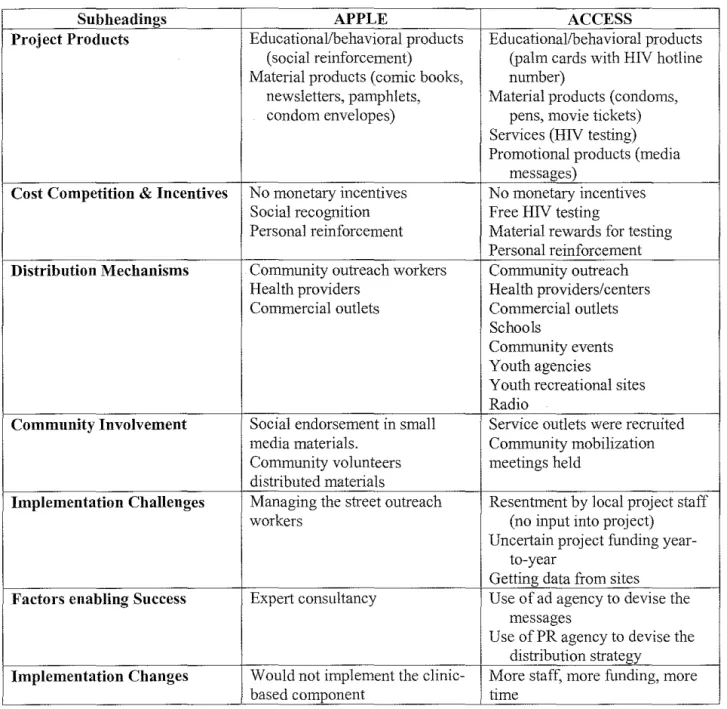
community in Baltimore, MD, and 2) The ACCESS Project: "HJV. Live with it. Get Tested!" campaign that was initially developed in NYC and later assimilated in five other large urban centers. I give a brief description of each project below and a comparison table of the project components can be found in Appendix C, Figure 1.
THE APPLE PROJECT
The AIDS Prevention for Pediatric Life Enrichment (APPLE) project is a community-based program to prevent perinatal HIV infection by preventing infection in women. This project was a five-year effort that took place in a predominantly African American community in
Baltimore. The primary behavioral objective was to increase the use of condoms by commtmity members. The primary prevention component combined small media with interpersonal
communication (five hundred face-to-face interviews by street outreach workers) and the survey instrument queried HIV knowledge, attitudes, and self-reported risk behaviors as well as
awareness ofthe project materials and messages.
The goal of the small media campaign was to produce and publicize a few basic HIV risk-reduction messages (e.g., condom use) in the form of role model stories. This project targeted women of childbearing age as the primary audience of the health-promotion materials, but the small media were designed to model social acceptance of condom use by both females
and males. The primary behavioral change outcome assessed in the study was reported use of a condom at last sexual intercourse. Secondary behavioral changes included inquiring as to a sexual partner's STI history, rejecting sex for fear of STI or HN transmission, and avoiding sexual encounters when condoms were not available.
THE ACCESS PROJECT
The ACCESS (Adolescents Connected to Care, Evaluation, and Special Services) project used a social marketing approach to promote HIV testing to adolescents. The "HJV Live with it. Get Tested!" campaign was used to identify and link to care, the thousands ofHN infected youth who are unaware of their HIV serostatus. The authors state that the campaign is "based on theories and practices of social marketing and the premise that direct, relevant
promotion ofHN testing to youth can 'normalize' HN testing. In a publication about this study, the stated objectives of the project were to change youth attitudes about HIV testing and promote more routine testing practices to health providers with the project goal of improving HN
counseling, testing and care among at-risk youth.
Project ACCESS was launched within the Adolescent Medicine HIV/ AIDS Research Network (AMHARN) as a multi-city program in 1999 and was repeated and expanded in 2000. After two years of piloting in New York City, the project was expanded to five more cities with high HIV rates in youth: Baltimore, Los Angeles, Miami, Philadelphia, and Washington D.C. The lead agency in each city was a comprehensive adolescent HIV medicine and research program participating in AMHARN. In the ACCESS project, the quantitative outcomes included the number of calls to the local telephone hot lines, numbers of youth receiving HIV counseling and testing at participating sites, and numbers of positive youth identified during the period.
VI. RESULTS
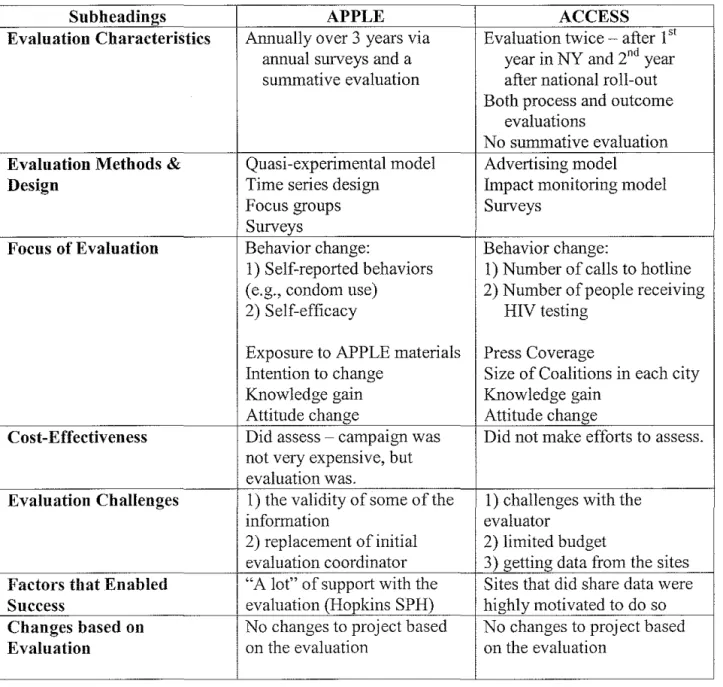
In this section, 1 compare and contrast the two programs by reporting my results using the same general organizational structure as the data collection tool with the following main sections: Objectives and Design, Implementation, and Evaluation. A table of each section of results is also provided at the beginning of each section, organized by subheadings and key summary points for each project. Most of the results that relate to the Andreasen criteria appear in the Objectives and Design section and these components will be identified in the tables as "(AI)", "(A2)", etc. In the text, the criteria will appear as they were written by Andreasen and introduced in the methods section.
OBJECTIVES AND DESIGN
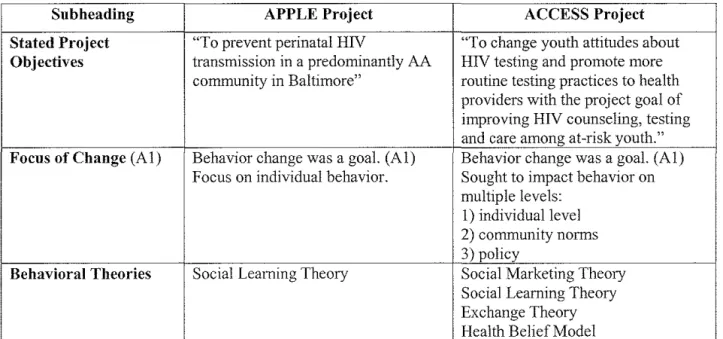
See Table 1 (below) for the results of the Objectives and Design section. Table 1: Objective and Design Results
Subheading APPLE Project ACCESS Project
Stated Project "To prevent perinatal HIV "To change youth attitudes about Objectives transmission in a predominantly AA HIV testing and promote more
community in Baltimore'' routine testing practices to health
providers with the project goal of improving HIV counseling, testing and care among at -risk youth." Focus of Change (A!) Behavior change was a goal. (A!) Behavior change was a goal. (A!)
Focus on individual behavior. Sought to impact behavior on multiple levels:
I) individual level 2) community norms 3) policy
Behavioral Theories Social Learning Theory Social Marketing Theory Social Learning Theory Exchange Theory Health Belief Model
Subheading APPLE Project ACCESS Project
Target Populations "women at risk for HN" e.g., AA "youth who are disproportionately women, and "young women" "under infected with HIV: sexually active
35 years of age" youth of color in high seroprevalence
communities, particularly heterosexual females and homosexual/bisexual males" "adolescence" was defined as ages
13 to 24
Segmentation of Target AA females with segmentation for Three priorities regarding
Population (A3) analysis by age, education, marital segmentation (listed in order of
status, ever pregnant, employment priority):
status, and telephone service. I) age
2) urban
3) youth of color
Formative Research Analysis of existing data Analysis of existing data
(A2a) Literature reviews Literature reviews
Focus groups Focus groups
Interviews Interviews with providers
Needs assessment Consultation with community leaders
Consultation with community leaders Community maj>ping
Pretesting of the Each product was tested prior to use The advertising concepts were tested
Interventions (A2b) via focus groups. for local relevance in each city through focus groups and feedback from youth.
Motivational Thought was given to creating Thought was given to creating
Exchanges (A4) attractive and motivational exchanges attractive and motivational
with target audiences. exchanges with target audiences.
Social Marketing All four Ps were incorporated. All four Ps were incorporated.
Theory: The Four Ps Promotion was most important. Promotion was most important.
(AS) Products were secondary. Products were secondary.
Price - it was important to offer free
HN testing.
Positioning, the fifth P, was also very important.
Competition (A6) Thought was not given to the Thought was given- they were
competition faced by the desired aware that they were up against the
behavior. notion of sex without consequences
Communication Community surveys (telephone and Ad agency picked radio stations with
Channel Use street surveys) were used to choose the right (target) demographic
the communication channel to population.
communicate with their target
population.
Community Involved in planning and research Community was not involved until
Involvement phase of the campaign via an advisory the implementation phase. group
Barriers to Involving Competition from other projects in Very directed project (no room for
the Community the area, e.g., teen pregnancy input) created resentment among
Concern about "research" some of the local agencies
Subheading APPLE Project ACCESS Project
Project Maintenance This was not a long-term goal since This was a long-term goal, but they this was always a demonstration were not sufficiently funded to do
project. this.
Pilot Testing Pilot was not tested in its entirety. Pilot was tested, but evaluation was not completed.
Design Challenges I) Overcoming denial ofHIV I) Forging new ground made it 2) Finding creative people to make difficult to get buy-in from the
marketing materials funders
3) People who are good with street 2) Difficult to get buy-in from local outreach are not necessarily good agencies due to resentment
employees 3) Staffing challenging as NY -based
staff ran the national campaign as well as the one in the Bronx Factors that enabled I) The community was supportive I) The idea was innovative
Successes 2) The timing was good 2) They had support from key people
- ad agency, funding agency 3) They worked with people who knew the population and were committed to making a difference Transferability Small media and street outreach All of the design (since this was
designed to roll out to other cities) Design Changes Drop the case management piece Push for longer funding periods
Stated Project Objectives
The stated objective of the APPLE project was "to prevent perinatal HIV transmission in a predominantly African American community in Baltimore" while the stated objective of the ACCESS project was "to change youth attitudes about HIV testing and promote more routine testing practices to health providers with the project goal of improving HIV counseling, testing, and care among at-risk youth." The campaign designers of the APPLE project did not report objectives in a measurable (quantified) format because they "just wanted to see a difference, to increase condom use." In contrast, the campaign designers of the ACCESS project did report objectives in a measurable format. These designers had process measures including I) the number and type of organizations participating in each level of the local campaigns, 2) youth participation as outreach workers or in campaign events, and 3) venues and the extent of message dissemination through community outreach and paid advertising. The quantitative outcomes
included the number of calls to the local telephone hot lines, numbers of youth receiving HIV counseling and testing at participating sites, and numbers of positive youth identified during that period.
Focus of Change
Both projects met the first Andreasen criterion in that they both had a behavior change as one of their benchmarks used to design this intervention. Both projects acknowledged that individual behavior and community norms and activities were the focus of change in their campaigns. But the APPLE project emphasized individual behavior change. The ACCESS project sought to impact multiple levels: 1) individual behavior- increased HN testing by individuals, 2) community norms and activities- to make HIV testing a normal part of
adolescent health, and 3) policy- "we did a lot of outreach to the media." The PI for this project told me that they wanted to influence key decision-makers (politicians, providers, agencies) that free HIV testing was important. She described how she had been trying to get free HIV testing in the NYC area but the local agencies and politicians did not want to do this since "it was still a politically touchy subject." So instead of trying to convince them to do it, they decided to
implement a program that would "just do it." They wanted to influence people "from above and below." She said, "we thought it would be that much more effective if they heard from us that we thought they should be offering free HIV testing and then read an article in the New York Times about it."
Behavioral Theories
Both projects used behavioral theories to guide the formation of their objectives and to inform the design of their projects. According to the Pis, both projects relied on Social Learning Theory. The ACCESS project also noted use of Exchange Theory and the Health Belief Model.
But the main theory that was used for the project design ofthe ACCESS project was Social Marketing Theory. The main message was to link sex to HN risk in a youth-oriented way with these messages: 1) use condoms, and 2) get tested.
Target Populations
The target groups of each intervention were similar and aimed to impact those populations at high-risk for HN infection. The APPLE project targeted their campaign to "women at risk for HN" such as African American women, and focused their prevention activities on "young women" who they defined as "women under 35 years of age." This
definition was chosen, instead of"women of reproductive age," to capture those on the younger end of the spectrum who may be sexually active, but not yet menstruating. This age group was chosen because this was perceived to be the highest risk category. The ACCESS project defined their primary target group as "youth who are disproportionately infected with HN: sexually active youth of color in high seroprevalence communities, particularly heterosexual females and homosexual/bisexual males." This group chose the standard definition of adolescence as their target age group, ages 13 to 24, since "they are a very vulnerable population in terms ofHIV and they are not receiving the messages that are out there targeting adults."
The APPLE proj eel defined a secondary target group as African American men because "they're the ones using the condoms." The ACCESS project defined a secondary target group as health care providers. This group was added after the 1999 pilot from feedback received from youth and the providers themselves. This secondary audience was chosen to explore their practices in terms of offering HIV testing and their perceived barriers to providing HIV
counseling and testing services to adolescents. This group was also chosen "to recruit service outlets." This idea stemmed from the theory of market readiness- that it is not enough just to
make youth aware, but providers must also remember to offer free HIV testing to adolescents who come to them seeking care. Thus, service outlets must be identified and/or created.
Segmentation of Target Population
The third Andreasen criterion requires that there is careful segmentation of target audiences to ensure maximum efficiency and effectiveness in the use of scarce resources. In
terms of segmentation, all participants in the APPLE project were African American females and segmentation for analysis was by age, education, marital status, ever pregnant, employment status, and telephone service. However, the participants were not segmented in terms of the messages delivered. The segmentation was done in this manner to identifY women at highest risk and compare the two communities. For the ACCESS project, age was the number one
segmentation. Urban was second prioritized segmentation and youth of color was the third. The segmentation was done in this manner to target those who are disproportionately infected with HIV.
Formative Research
The second Andreasen criterion has three parts. The first part of the second Andreasen criterion requires that projects consistently use audience research to understand target audiences at the outset of interventions (i.e., formative research). Both projects used audience research to
understand the target audiences. The APPLE project used focus group discussions and interviews to inform their role model stories. Focus group information was also used to inform the basic approach to the intervention. An example of this is that the project staff started with Tupperware parties as a venue for HIV risk reduction and, according to this PI, in one of the focus groups the women responded, "We don't do groups." So they changed the intervention to street outreach and adopted a communication approach using small media instead. The ACCESS project used
focus groups, interviews with providers and literature reviews to inform the design oftheir project.
The APPLE project used various sources of information to establish their project objectives including analysis of existing data (e.g., the HIV data), literature review, original needs assessment, focus groups, and consultation with community leaders. They also worked with the medical care community, community health centers and public school principals. Another form of formative research that was used was the Tony Whitehead community mapping of social structures in the community. The headquarters of this intervention was in the basement of a local African American church. The ACCESS project used many of the same sources and methods including analysis of existing data (e.g., on the number of kids tested), literature reviews (on social marketing and HIV literature), focus groups and consultation with community leaders. They also used local health department information.
Pretesting of the Interventions
The second part of the second Andreasen criterion requires that audiences consistently use audience research to routinely pretest intervention elements before they are implemented.
Both Pis reported that audience research was used to routinely pretest intervention elements before they were implemented. The APPLE project PI stated that each product was tested prior to use via focus groups. This method was chosen over survey methods due to the rapid tum-around time that can be achieved with focus groups. The published article about the ACCESS project states that "the advertising concepts were tested for local relevance in each city through focus groups and feedback from youth and adjusted accordingly." The PI for this project
elaborated on this and gave the example that in Miami, "hittin' it," a phrase used in the ACCESS project materials, was interpreted by the kids as domestic violence whereas this is a phrase to
indicate sexual activity in New York City. So there was an issue with distinguishing local youth culture from national youth culture. Thus, each time a new campaign rolled out in each new city, focus groups were used to test the messages. In addition to experimental testing of alternative message formats, other methods used were informational consultation with community members. I was told by this PI that each city knew who their partners would be; there was a local coalition of agencies and providers who had been doing work in this area for at least five years. Thus, in each city, there was a coalition that the project consulted.
The third part of the second criterion is discussed in the evaluation section.
Motivational Exchanges
The fourth criterion proposed by Andreasen states that the central element of any influence strategy is creating attractive and motivational exchanges with target audiences. Both
projects reported that thought was given to creating attractive and motivational exchanges with their target audiences. The ACCESS project PI stated that "much attention was given to framing promotional materials in the "'language' of urban youth." To give youth a voice, they held local youth speak-outs at each project site. They would usually involve a local theater group that would do a performance on a "hot issue." Then a moderator would ask the kids to respond to this. The experts on stage, the youth panelists, were kids and local kids were also in the audience. Any adults that were present sat in the audience. In addition to giving the kids a voice, these events were also used as an organizing tool for local agencies and to get more media attention. These speak-outs were done in New York City each year and in each of the other cities at least once. They also published a zine (a youth-friendly magazine), The Deal, which is now in its 41h edition and was distributed to about 250,000 people this year.