Pandemic Influenza and Support from Community Volunteer Organizations: How The Civil Air Patrol Can Help Local Communities During a Pandemic
By
Paul Meade
A Master’s Paper submitted to the faculty of the University of North Carolina at Chapel Hill
in partial fulfillment of the requirements for the degree of Master of Public Health in
the Public Health Leadership Program.
Chapel Hill
2010
_________________________________ Advisor Signature/Printed Name
_______________________________________ Second Reader Signature/Printed Name
Table of Contents
1. Abstract……….3
2. Pandemic Influenza ………4
a. History of Pandemics ……….4
b. H5N1 – The Threat of Avian Flu ………..6
c. A-H1N1 – Recent Pandemic ………8
d. Containment Measures………10
3. Role of Community Volunteer Organizations ………...18
a. Types of Community Volunteer Organizations ………18
b. The Civil Air Patrol ………...19
4. Developing a Contingency Plan ……….…21
a. Work Environment ……….……..21
b. Home Environment ………..……22
c. Community Environment ………..…..23
d. Civil Air Patrol Contingency Plan ……….….………24
5. Developing a Response Plan – The Civil Air Patrol ……….…….27
a. Key Assumptions ……….…..27
b. Target Capabilities ……….……….31
c. Capabilities of the Civil Air Patrol ……….…33
d. Concepts of Operation and Risk Management ……….….………36
e. Organization and Assignment of Responsibilities ……….…39
f. Administration and Logistics ……….………45
g. Activation Triggers and Deployment of Response Plan ……….…..48
h. Interaction with State Agencies and Other Volunteer Organizations ….50 i. Post-Incidence Assessment ……….….52
6. Ethical and Legal Issues ………53
a. Protecting Volunteers ……….53
b. Duty to Perform – Duty to Rescue ………...57
7. Case Study - The State of Michigan and the Civil Air Patrol ……….……..59
8. Implications for Public Health ……….…..61
Abstract
Volunteer organizations can have a significant impact within a community,
especially during times of a disaster. Natural disasters like flooding, hurricanes, and
tornados can strike at anytime and the ability of a community to recover is often
dependent on the level of volunteerism provided to that community. Influenza
pandemics, while considered somewhat of a natural disaster, present a unique set of
challenges for disaster recovery. With many natural disasters the infrastructure is
compromised, but with a pandemic, the infrastructure remains intact while human
resources are compromised during the attack. As such, community volunteer
organizations need to develop a Contingency Plan before they can prepare their
Response Plan to assist the community. The Contingency Plan is designed to address
high levels of absenteeism during a pandemic while maintaining their usual operations.
It also seeks to protect those volunteers against succumbing to the virus while
performing their duties. The Response Plan defines how the volunteer organization will
provide assistance to the community during the pandemic. The Civil Air Patrol, a
volunteer organization providing emergency services to local communities, can provide
assistance to state Public Health departments by transporting basic and medical
supplies to either local Health Units or directly to people in need. By entering into formal
or informal partnerships with state and local agencies, a volunteer organization can
participate in the coordinated effort to help with relief and recovery during a pandemic
attack on a community. This paper addresses how community volunteer organizations,
and in particular the Civil Air Patrol, can develop a Contingency Plan and a coordinated
pandemic. Since Public Health officials are instrumental in coordinating efforts during an
influenza pandemic, it is important for Public Health practitioners to have a sound
understanding of how community volunteer organizations can provide assistance in
addressing the needs of the public during such disasters.
Pandemic Influenza History of Pandemics
Influenza epidemics are not uncommon. Each year the flu will come and go,
resulting on average 36,000 deaths in United States. Most of those deaths are the very
young and the elderly. Every so often a virulent strain will develop and cause a
pandemic. A pandemic is a worldwide outbreak that affects many countries all at once.
There are three conditions necessary to meet the definition of a pandemic flu: 1) the
virus must be a new strain whereby people have little or no immunity, 2) the replication
of this virus must cause serious illness, and 3) there must be efficient human-to-human
transmission (WHO, 2009). Depending on the severity of such an influenza outbreak,
the degree to which containment measures are successful can often be a function of the
healthcare delivery system’s ability to handle such an outbreak, as well as the degree to
which citizens are willing to comply with some of these measures. The CDC developed
a Pandemic Severity Index similar to the Saffir-Simpson Hurricane Index (HHS, 2007)
which has five categories based on the case-fatality ratio (CFR). For instance, a
Category 1 has a CFR of less than 0.1% and is the usual category for seasonal flu, a
Category 2 has a CFR of 0.1% to 0.5% and a Category 5 has a CFR of 2% or greater.
heard about the Bubonic Plague that ravished the European population in the Middle
Ages (the “Black Death.”). There have been outbreaks of measles, smallpox, cholera,
typhus, yellow fever, typhoid, scarlet fever, and polio that have been recorded
throughout time. Influenza exits as three main types: Influenza A, Influenza, B, and
Influenza C. While Influenza B and C generally cause a milder flu and are not
associated with pandemics, Influenza A can infect birds, pigs, horses, other animals,
and humans. Wild birds are natural hosts for these viruses and only Influenza A viruses
infect birds. Influenza A viruses are divided by subtypes based on two proteins on their
surfaces: hemagglutinin (15 types) and neuraminidase (9 types), for example H1N1,
H5N1, etc. Subtypes of Influenza A currently circulating among humans worldwide
include H1N1, H1N2, and H3N2. Usually infected wild birds do not become sick, but
when the virus is passed to domestic poultry, the birds become sick and can die. Avian
Flu currently affecting fowl in China is one such type of Influenza A (H5N1) (CDC,
2010).
Among the first flu pandemics to be recorded occurred in the winter of 1732,
1774, 1857, 1873, 1918, 1957 (Asian Flu), and 1968 (Hong Kong Flu). Both the Asian
flu and the Hong Kong Flu were Category 2 pandemics. The most severe of all flu
pandemics recorded to date occurred in 1918. The flu of 1918 (also known as the
Spanish Flu, or Purple Death) was different from all other influenza outbreaks in that
instead of killing the very young and elderly, this virus (H1N1) attacked and killed people
of all ages, especially those between 20 and 34 years of age. This was the only known
Category 5 influenza pandemic estimated to have a CFR of over 5%. Since influenza
attributable to the influenza virus of 1918 are lacking. From this three-wave attack of the
H1N1 virus, estimates of deaths range from 50 – 100 million worldwide, and 500,000 –
750,000 in the U.S. (Barry, 2005). This pandemic influenza attacked about 900 million
people worldwide (population at that time was 1.8 billion), killing as many as 100 million
people in less than 12 months. No pandemic of any disease has ever resulted in so
many deaths in so short a period of time. AIDS has resulted in 23 million deaths in 25
years; the Spanish Flu killed 100 million in less than 12 months. More people died from
this pandemic flu than were killed in both World War I & II, combined. Eighty percent of
the deaths among U.S. soldiers fighting in World War I were attributed to influenza.
There were more deaths from the Spanish Flu than those caused by over 100 years of
the Bubonic Plague (Geiger, 2006).
Since the 1918 flu there have been two other flu outbreaks to reach pandemic
status: 1) the Asian Flu in 1957 (H2N2), and 2) the Hong Kong Flu in 1968 (H3N2). Both
pandemics were considered mild, with 70,000 and 34,000 deaths, respectively (CDC,
2009).There have been other strains of influenza A detected in recent years, such as
H7N2 in New York and Virginia in 2002, H9N2 in China and H7N7 in the Netherlands in
2003, and H7N3 in Canada in 2004.However, the new strain to emerge from Hong
Kong in 1997 that is causing the greatest amount of concern is H5N1, also known as
Avian Flu.
H5N1 – The Threat of Avian Flu
At this point in time, the H5N1 virus has not met the third criterion of a pandemic,
have been 492 reported cases in 15 countries with 291 deaths (WHO, 2010). This is a
case-fatality rate (CFR) of 60%, as compared to the flu of 1918, which had a mortality
rate of only 5% and killed nearly 100 million people. At this time, human infection with
Avian Flu is through direct contact with infected fowl, both wild and domesticated.
If H5N1 can achieve efficient human-to-human transmission with an attack rate
similar to that of the 1918 flu (38%) and maintain its mortality rate of 60%, then in a
world populated with 6.8 billion people there could be as many as 2.6 billion people sick
with the flu and 1.6 billion people dead. Of course, no one believes that this virus would
maintain a mortality rate of 60% once it mutated to efficiently transmit from human to
humans; however, even if we assume a mortality rate of 5% for H5N1, similar to that of
the H1N1 strain of 1918, the potential number of deaths would still be 136 million
worldwide and 6 million in the United States.
The healthcare system in many countries throughout the world would be unable
to handle 2.6 billion people becoming very sick with influenza, let alone handle 136
million deaths (at a mortality rate of only 5%). Very few countries experiencing natural
disasters are able to manage adequate healthcare services during such events, and
one as potentially devastating as Avian Flu would likely result in a complete collapse of
the healthcare system. Even in the United States, if a pandemic with a CFR of 5%
(Category 5) struck, 117 million Americans would succumb to the flu resulting in 6
million deaths (attack rate = 38%). It is very unlikely the healthcare system in the U.S.
will be able to cope with this event and communities across the nation would be in dire
need for basic and medical supplies. The potential for an avian flu pandemic (H5N1) to
Department of Homeland Security views pandemic influenza as both the most likely and
most lethal of all threats facing the United States (HHS, 2005). Luckily, to date, the
H5N1 virus has not achieved efficient human-to-human transmission, but if the current
A-H1N1 virus circulating the globe comingles with the deadly H5N1 virus, the result
could be a deadly pandemic of catastrophic proportions.
A-H1N1 – Recent Pandemic
In April 2009, the news of a new strain of influenza A affecting people throughout
Mexico created a serious concern throughout the WHO, CDC, and the media. Once the
WHO raised the level of activation to Phase 4, the news media created tremendous
“noise” among the public. When the strain was isolated and genetically characterized, it
was identified as an H1N1 variant (A-H1N1), and the media were quick to label the new
strain as the Swine Flu (similar to the strain the occurred in 1976). While this strain was
similar to that of 1918, and of the Swine Flu in the 70’s, it appeared to be less virulent
(CFR of less than 0.1% making it a Category 1) (CDC, 2009). As vaccine manufactures
rushed to begin production of a vaccine from the WHO seed, it was nearly impossible to
develop, test, and manufacture enough vaccine to deal with a pandemic that would hit
in the Fall. With Herculean efforts from several vaccine manufacturers, an effective
vaccine against this new A-H1N1 strain became available by October 2009. Usually,
during a pandemic, the new strain overwhelms the typical seasonal flu strain and one
victor emerges; however, during the Fall of 2009, there were both influenza A strains
competing for victims. Likewise, there were two different vaccines offered in the Fall; the
confusion by people as to which vaccine they should take, or if they should take both.
Another issue was the fact that this new A-H1N1 strain was among the least virulent
strains ever seen in a pandemic, and people were uncertain if they should risk taking a
vaccine that was rushed through development and clinical testing, and that could pose
unwanted side effects. By March of 2010, the flu season had drawn to a close, and 60
Million Americans had become infected with Influenza A, there were 256,000
hospitalizations, and 12,000 deaths (CDC, 2010). Interestingly, 11,000 of those 12,000
deaths were in people under 65 years of age, which is in contrast to those deaths
typically seen during seasonal flu. Worldwide, the WHO reported that in March of 2009
there were 213 countries with confirmed cases of A-H1N1 and 16,931 deaths (WHO,
2010). The new vaccine being prepared for the 2010 flu season will protect against
A-H1N1, H3N2, and a strain of influenza B (CDC, 2010). This should lessen the confusion
over which vaccine to take during the pre-season immunization period. As was stated at
the beginning of this paper, in a typical flu season, the United States usually records
about 36,000 deaths, but the A-H1N1 saw only 12,000 deaths. Was this because of the
younger, and presumably healthier, age group that was attacked, was it because of the
relatively mild flu that resulted from this strain, or was it successful containment
measures and vaccination that yielded a lower mortality rate than expected?
Undoubtedly, all three elements contributed to a mild flu season with lower mortality
rates, and less serious symptoms. But did we get lucky? Are we being lulled into
complacency so if and when the next one hits us, we will exhibit lackadaisical behavior.
Influenza A viruses are notorious for co-mingling their RNA to create new strains, and if
facing a new Category 5 pandemic. For the purposes of this paper, the assumption is
that a community volunteer organization, such as the Civil Air Patrol, would be prepared
to respond to requests for assistance by Public Health officials for any influenza
pandemic (Category 1-5), but the higher the category the more likely state Public Health
authorities would call on the assistance of the CAP. The influenza pandemic of
2009/2010 with the variant A-H1N1 strain was a Category 1 and considered quite mild.
Thus, very little disruption occurred to state Public Health divisions to warrant additional
support from community volunteer organizations. Should a more severe pandemic
strike, the need for additional assistance would necessitate greater demand of these
volunteer organizations.
Containment Measures
There are six major approaches to containing an epidemic or pandemic: 1)
vaccines, 2) anti-viral medication and other medical interventions (i.e. ventilators), 3)
quarantine and isolation procedures, 4) social distancing, 5) sanitary measures, and 6)
education and information dissemination.
Vaccines
Influenza vaccines, for the most part, still rely on chicken eggs to produce
material, and yields are typically low and slow (WHO, 2010). So, when a pandemic
suddenly strikes, it usually will take a manufacturer 5-6 months to produce sufficient
quantities of vaccines to protect the general public. Initially, there are vaccine shortages
prioritize the usage of such limited supplies. As vaccine manufacturers were scrambling
to develop an effective agent against H5N1, the new A-H1N1 strain was emerging in
Mexico in the Spring of 2009. When it became apparent that the A-H1N1 strain was
developing into a pandemic, the WHO alerted countries to prepare for a pandemic,
albeit not the one they expected. Suddenly, vaccine manufacturers raced to produce an
effective agent against this novel strain. Fortunately, the A-H1N1 flu appeared in April,
which is at the end of the typical flu season in the Northern Hemisphere. During the
summer months, manufacturers were able to produce vaccines in sufficient quantities to
get ready for the Fall flu season of 2009. Since the A-H1N1 flu was considered fairly
mild, many people elected not to receive the vaccine, which resulted in a surplus. Had
the strain been more virulent, it is likely there would have not been enough vaccines to
cover the population and rationing based of defined guidelines would have been
implemented in most countries (CDC, 2010) Once again, we may have been lucky. If a
new Category 5 strain emerges in the height of the Fall flu season, communities could
be faced with a serious disaster.
Anti-Virals and other Medical Interventions
The United States government has been stockpiling the anti-viral medicine,
oseltamivir (Tamiflu) for several years, and currently this stockpile would only cover
about 3% of the existing population (CDC, 2009). While other countries have begun
stockpiling well before the U.S. began, the highest level for any country is about 25% of
their citizens (Geiger, 2006). Oseltamivir has been shown to be effective against most
agent, even in the A-H1N1 strain. One of the limitations of the anti-viral agents currently
on the market is that for this drug to work it is best taken within the first 36-48 hours
after appearance of flu symptoms. This means that someone would have to have their
own personal stockpile of oseltamivir to take and administer to family members
immediately upon exhibiting flu symptoms. But as described by one survivor of the 1918
pandemic, “people didn’t want to believe that they could be healthy in the morning and
dead by nightfall”(Barry, 2005). A more virulent strain of Influenza A can attack and kill
very quickly, so waiting 36-48 hours to take oseltamivir could be too late for some
people, even if they were to get it ahead of time.
If 100 million Americans become sick with a new virulent strain of H5N1 (avian
flu), a large portion will show up at the emergency department of their local hospital.
Currently in the United States, there are only 945,000 hospital beds (American Hospital
Association, 2009). So even if only 10% of the 100 million people appear in the
emergency department there would only be a hospital bed for 1 in 10. And that bed is
likely to be already occupied by someone previously admitted for some other illness,
since at any one time occupancy of hospital beds is about 70%. A disaster of this
magnitude would quickly overwhelm the hospital system. Today, in the United States
there are 105,000 ventilators, and at any one time 70,000 are in use (Osterholm, 2005).
This means that of the 1 in 10 lucky enough to get a hospital bed, only 10% of those
admitted would have access to a ventilator. Access to vaccines, anti-virals, hospital
beds, and ventilators would have to be rationed during a severe pandemic. Who will
make these decisions? Will these policies be made public? Will the public participate in
These are all ethical, moral, and legal questions to be addressed prior to the arrival of a
severe influenza pandemic. Yet, despite these rationing measures, many people will be
left to fend for themselves during such a disaster, and social injustices will escalate
within communities.
Quarantine and Isolation
State governments have control over healthcare delivery, which includes public
health. State legislatures assign powers to administrative agencies and may grant
specific powers to local boards of health to exercise certain containment measures,
such as quarantine and isolation (Harris, 2008). Isolation is usually reserved for those
individuals with an active form of a communicable disease; whereas, quarantine is
usually reserved for those individuals within a location (i.e. home, workplace, institution)
that have been exposed to in infected person. Both quarantine and isolation can be
legally enforced by the state’s police powers. States also require healthcare
professionals to report outbreaks of communicable diseases. So each state, through its
police powers, can issue a mandatory quarantine and isolation order to protect the
public.
The Centers for Disease Control and Prevention (CDC) commissioned experts in
public health law to prepare a model act, known as the Model State Emergency Health
Powers Act (Harris, 2008).Addressed in this model are such issues as the appropriate
role of law enforcement authorities in responding to a public health emergency,
rationing of scarce resources in an emergency, criteria for declaring a state of
2006). Each state has been asked to develop a flu pandemic preparedness plan. It
involves a complex set of initiatives between federal and state agencies, as well as
other responder organizations, such as community volunteer organizations. The degree
to which a state is deemed adequately prepared for a pandemic will determine the
amount of support received from the CDC’s Strategic National Stockpile (SNS), a cache
of medical supplies to aid communities during a disaster. Part of this planning involves
guidelines for quarantine and isolation measures, and when Public Health officials will
evoke these rules.
Social Distancing
Another approach to containment for influenza pandemics is to implement social
distancing initiatives. In 1918, the spread of the Spanish Flu was so severe that many
municipalities prohibited public gatherings. Michigan Governor Albert Sleeper in the
Fall of 1918 proclaimed, “public gatherings of every description be discontinued”
(Baulch, 1996). All public gatherings were banned, such as schools, churches, theaters,
conventions, etc. Even funerals for those victims of the flu were confined to a handful of
people, or delayed until a later date.
Many flu pandemic preparedness plans across the United States call for similar
social distancing approaches. This time, in addition to the usual public gatherings, many
businesses would close during a pandemic. The economic impact of such measures
would be enormous, not just in the U.S., but throughout the world.
Given the quarantine and isolation restrictions, and the social distancing
medical supplies and food to people will become a tremendous challenge. In 1957, only
10% of meals we eaten outside the home, but today that figure is almost 40% (Barry,
2005). So many Americans confined to their homes might not be prepared to stock
enough food to last a full quarantine period of 15-30 days. Who will deliver food and
supplies to those with restricted movement? In 1918, people were denied access to
public transportation unless they wore a mask to cover their face. Some cities went as
far as to fine people seen in public without a face mask, and even placing them in jail for
extended periods of time (a form of forced quarantine). People fearful of the continued
spread of the Spanish Flu demanded laws against public sneezing, coughing, or nose
blowing. If public health officials enforce social distancing during the next pandemic,
given the highly mobilized society we live in, would they be effective or even enforced?
Sanitary Measures
According to the World Health Organization, children are the main vectors for
influenza (WHO, 2009). Children are able to shed flu viruses for up to six days before
they begin to show symptoms, and with uncovered sneezing and coughing, it is not long
before a child brings home the flu. In fact, it is said that during each flu season, children
kill their grandparents (Greger, 2006).
While many sanitary measures were adopted during the pandemic of 1918,
frequent hand washing may have yielded the greatest outcome. One of the largest
sources of flu contamination is our hands. Most people when sneezing or coughing
cover their mouth and nose with their hands, then go around inoculating people and
worse sources of contagion are our fingers.” Learning to sneeze or cough in the inner
elbow area of one’s arm or sleeve will prevent contamination to one’s hand. In the
absence of a vaccine or anti-viral medicine, the single most important step people can
take to prevent getting the flu is to wash their hands frequently (Greger, 2006).
Despite the ineffectiveness of gauze facemasks worn my many in 1918, the use
of N95 masks or surgical masks may afford some protection against larger respiratory
particles during an influenza pandemic. Surgical masks are less expensive than N95
ones, and require frequent changing, but if the virus becomes truly airborne, they would
be less effective than N95 masks. The strategy used during the SARS outbreak was
surgical masks for the sick, and N95 masks for the healthy (Greger, 2006).
Basic sanitary measures, coupled with social distancing and quarantine/isolation, could
represent the greatest non-pharmacological containment measures available to most
people, especially since very few people will be lucky enough to receive a vaccine or
anti-viral medicine, let alone a hospital bed or ventilator.
Information and Education
One of the greatest tools a public health professional can use to help keep
citizens safe is information. Educating people about the risks and providing them with
knowledge about what to do during an influenza pandemic is vital to minimizing deaths.
In 1918, public health officials, or even government officials, were stating that the
Spanish Flu was not serious and no one should unduly worry. But when millions of
people became sick and thousands began dying, the public became exceedingly
government officials kept denying there was a problem, even presenting false
information to the WHO. And even after the lessons learned about being truthful during
SARS, several countries have lied about H5N1 attacks to avert a potential economic
disaster (Barry, 2005).
When pandemics occur and information is not forthcoming, the result is often
massive racism and discrimination (Barry, 2005). For instance, during the Spanish Flu
of 1918, many white people blamed immigrants, Native Americans, and blacks; even
the government blamed Spain by calling it the Spanish Flu when the virus likely
originated in the United States (Institute of Medicine, 2005). This level of discrimination
was seen again during the aftermath of Hurricane Katrina in New Orleans
(Congressional Report, 2007). And the poor are almost always made to suffer
disproportionately, since they lack the resources to obtain medical supplies and basic
necessities, or to stockpile food and water. There is a delicate balance between
informing and alarming a public. The Swine Flu incidence in the 70s led to a disbelief
that the world could be at the mercy of a virus. The greatest casualties of the Swine Flu
scare were people suffering adverse reactions to a vaccine given to thousands of
people believed to be at risk. Likewise, during the 2009 A-H1N1 pandemic the media
created a scare among the public, and when the flu symptoms were found to be
relatively mild, mistrust once again surfaced among the public.
Every community has a myriad of volunteer organizations that support various needs
within the communities they serve. Volunteer organizations typically fall into the
following categories:
Environment
Emergency Services and Disaster Relief
Politics
Education
Government
Religion
Community Support
Health and Public Health
Mental Health
Military
Volunteer organizations, usually non-profit, rely heavily on fund raising within the
community to support their missions. Others rely state and municipal funding to support
their programs. Many cluster together under the United Way banner to share in the pool
of donations. While some focus mostly on the youth, some focus on the elderly. Others
focus on being the voice of the disenfranchised and fighting for social justice. All play a
critical role in supporting the community. There are 1,823 volunteer organizations in the
State of North Carolina (Volunteer Match, 2010).Of these, about 60 provide services in
emergency services, such as disaster relief.
The level of commitment to a volunteer organization varies enormously, since
many members hold a full-time day job. After spending a full day at work and devoting
volunteers place such responsibility to a community organization lower on their priority
list.
The Civil Air Patrol
The Civil Air Patrol is a voluntary, non-profit, national organization that is the
official Auxiliary of the United States Air Force. CAP was founded in December 1941 by
over 150,000 citizens concerned about the defense of America’s coastline during World
War II. On July 1, 1946, President Truman established CAP as a federally chartered,
benevolent civilian corporation. It serves three primary missions for America: 1)
Emergency Services, such as Search and Rescue and Disaster Relief, 2) Cadet
Programs, for youths from 12-21 years of age, and 3) Aerospace Education for the
community (Civil Air Patrol, 2010).
The Civil Air Patrol is a nonprofit, 501(c)3 corporation, divided into eight
geographic regions consisting of 52 Wings (each of the 50 states, Puerto Rico, and the
District of Columbia). There are approximately 60,000 members, with about a third
being cadets. With the largest fleet of single-engine aircraft in the world, CAP owns 530
corporate aircraft, along with more than 4,000 member-owned aircraft. Volunteers fly in
excess of 120,000 hours each year. CAP also maintains a fleet of 950 emergency
service vehicles for training and mission support. In support of Emergency Services,
CAP conducts over 85% of all inland search and rescue in the U.S., and members save
an average of 100 lives each year. The Civil Air Patrol provides disaster relief support to
local, state, and national disaster relief organizations. Members volunteer to transport
The communication network within CAP is the most extensive in the nation, and is used
to support emergency services.
In support of disaster relief, the Civil Air Patrol can assist the nation in many
ways. Volunteer members continuously train for service using the National Incidence
Management System (NIMS) approach, and practicing through disaster simulations in
both tabletop and field exercises. Developed by U.S. Homeland Security and adopted
by the Federal Emergency Management Agency (FEMA) and by most emergency
responders, including the police, fire departments, EMS, military, and even Public
Health officials involved in disaster planning, provides a systematic, proactive approach
to guide departments and agencies at all levels of government, nongovernmental
organizations, and the private sector to work seamlessly to prevent, protect against,
respond to, recover from, and mitigate the effects of incidents, regardless of cause,
size, location, or complexity, in order to reduce the loss of life and property and harm to
the environment (FEMA, 2010). Since members of the Civil Air Patrol come from varied
backgrounds of skills and experiences, including medicine and public health, they can
also serve as back-up personnel for a variety of administrative functions to assist other
public and private organizations. During Hurricane Katrina, CAP supported disaster
relief efforts by sending hundreds of volunteers (both adults and cadets) and flying
thousands of hours of missions. During an influenza pandemic, members can transport
medical supplies, or even basic supplies such as food and water, to citizens who may
be unable to leave their homes. They could fly vital supplies across the state to areas of
immediate need. And given the skills and experiences of some of the CAP members,
absenteeism levels are high. Other support areas could be in communications, such as
supplementing tactical communication systems, and assist in the sharing of information
to the public.
Developing a Contingency Plan
Contingency Plans are developed by individuals, groups, organizations, and
communities to address potential disruptions to normal daily activities during a disaster,
and what precautions can be taken to avoid such disruptions. A typical influenza
pandemic has an attack rate of approximately 40%, with a mortality rate that can vary
from 0.1% to greater than 5%, and a duration of 6-8 weeks within a given geographic
area (CDC, 2009). The more virulent the strain (higher morbidity and mortality) the
greater the need to develop a Contingency Plan that addresses precautions and
disruptions to the normal operations within households, businesses, and communities.
Work Environment
The primary purpose of an Influenza Contingency Plan is to ensure people are
protected against succumbing to the virus as much as possible, while the organization
continues to function in as normal a manner as can be expected during such conditions.
In the work environment, employers develop Contingency Plans to account for high
absenteeism during a pandemic, offer protective measures to those who continue to
work, and re-deploy key individuals in critical functions to maintain business operations.
There are many tools employers can use to develop appropriate Contingency Plans,
influenza pandemic, many companies developed Contingency Plans to cope with
potential disruptions that threatened operations, and this came during one of the worst
economic downturns across the globe. A company suffering absenteeism as high as
40% could easily become crippled in trying to maintain normal operations. Many
workers will refuse to come to work when family members are home suffering from a
severe flu, so anticipating such high rates of absenteeism and developing contingency
plans to account for key personal being unavailable to perform critical duties becomes
sound business practices. A key component of an Influenza Contingency Plan is to
ensure adequate protective measures are in place to minimize the spread of infection in
the workplace.
Home Environment
Similar to protecting the work environment, it is equally necessary to have a
Contingency Plan for the home. Since running a household takes planning and the
implementation of daily activities to keep everything running smoothly, having a
Contingency Plan should everyone become ill with the flu is critical. Who will assume
the daily duties of cooking, washing, cleaning, and other essential elements should the
entire household become too sick to fulfill these duties? During the Spanish Flu of 1918,
children starved to death when both parents had died and no one came to check on
them. Once again, the CDC offers resources to help families develop home
Contingency Plans (CDC, 2010). Most people when confronted with a family that has
become severely ill from the flu will elect to stay at home and tend to the sick rather
when a home has been quarantined by state authorities, household members have no
choice but to stay confined to their home. This makes contingency planning even more
important, since obtaining basic and medical supplies present considerable challenges.
Community Environment
How does a community develop a Contingency Plan? If a person’s first loyalty is
to family, then to the company that employs that person, the last place to receive
volunteer support is the community. Yet, it is often the community that has the greatest
need during a pandemic since members of that community need support, such as basic
and medical supplies. Volunteers are critical to keep communities functioning,
especially during disasters like Hurricane Katrina. But when people are needed at home
and at work during these difficult times, there are few to help out. In a situation like this,
often volunteers from outside that community appear to give a lending hand. In fact,
during Hurricane Katrina, most of the volunteers were from outside New Orleans, and
during the first year after the hurricane hit, there were over 550,000 volunteers and over
600,000 volunteers during the second year, according the Corporation for National and
Community Services (USA Today, 2008). One volunteer, Dr. Cranmer, MD MPH, stated
that one of the greatest challenges when arriving at New Orleans to volunteer her
services was the need for coordination among all the volunteers (Cranmer, 2005). But
during a pandemic that sweeps across an entire nation, there may be no one to come to
the rescue of a community in need. So contingency planning may be valuable within a
community in order to maintain public services, but if no one is left to actually volunteer,
volunteer organizations that are dedicated to disaster relief, such as the American Red
Cross, the Peace Corps, the Salvation Army, and the Civil Air Patrol. These
organizations are always ready and willing to help when disaster strikes, but since no
one is immune to a new pandemic attack, even these organizations may have their
army of volunteers decimated by the flu virus.
Civil Air Patrol Contingency Plan
Since the Civil Air Patrol is a volunteer organization, developing a Contingency
Plan to maintain normal operations during a pandemic is less relevant than a private or
public business. Nonetheless, in order to assist state and local agencies during such a
pandemic, it is important for the Civil Air Patrol to have a plan to deal with those
volunteer members who will be unable to assist with the Response Plan. Up to 40% of
people within any organization can be expected to be absent either from having
influenza, or due to providing care to someone else. In any given Wing (state) there are
staff members whose primary responsibilities are at the Wing level, and there are those
who are involved at the field operations level (Group or Unit). At the Wing level, there
can be 30-50 members within defined roles that support the three primary missions, in
addition to administrative and other functional areas. Within a squadron or unit level
there are often both cadet and officer volunteers and the size of the unit varies between
less than 10 to well over 100.
At the Wing level, there is an Emergency Services (ES) Officer that coordinates
all Disaster Relief activities. The ES Officer works for the Director of Operations and
Since the Civil Air Patrol follows the National Incident Management System (NIMS),
there are several individuals that can fill in various functions should members be absent
for a mission. At the unit level there is less redundancy, so when 30-40% of unit
members are absent with the flu it is more difficult to find suitable members to assume
additional responsibilities. The Wing staff tends to meet one day a month, whereas, unit
members tend to meet one day a week. Most members can carry on their duties and
responsibilities remotely (at home or at work), so if social distancing prohibits CAP
members from attending regular meetings, the organization would still be able to
function reasonably well at both the Wing and field levels. At the Wing level, staff
functions are often 2-3 deep, so if there is a high level of absenteeism there can be
members to assume higher level duties.
As part of the Contingency Plan for a Wing within CAP, precautions should be
carried out to avoid unnecessary gatherings at all levels. All members should adopt
non-pharmacological interventions during a pandemic, especially when meetings are
necessary. Where appropriate, hand sanitizers and N-95 facemasks should be made
available. All members should ensure proper hand washing procedures and proper
sneezing and coughing techniques to minimize transmission. Wherever activities can be
organized remotely, this should take precedence over meeting in person, especially for
essential personnel. A list of critical and essential staff should be developed in advance
of the influenza outbreak, with fallback personnel for each important area. Even during
an influenza pandemic response, the Civil Air Patrol might be called upon to provide
routine Emergency Services independent of the support provided to state agencies for
members to adjust for high absenteeism and unexpected emergency missions. An
Emergency Response Priority List should be prepared by Emergency Services to know
which activities will take precedence over others. For instance, would delivering medical
supplies to a family isolated in a rural area take precedence over a request to search for
a downed airplane, or the search for a missing person?
Each Wing should assign a Pandemic Coordinator who will maintain records of
members infected with the virus, or members who are unable to volunteer their
services. This Coordinator should collaborate closely with the Emergency Services
Officer and the Director of Operations to determine responsiveness to requests for
services. The Coordinator should also assess the potential impact on outside resources
that CAP depends upon for services, such as supplies, travel, communications, etc.
This Coordinator should also be responsible for keeping the membership up-to-date
with appropriate information from state and local health departments regarding the
pandemic. Additional field staff should be identified that could help at the Wing level and
be trained quickly to accept additional responsibilities (cross training). The Pandemic
Coordinator should also develop procedures and policies to deal with members who
may be suspected of having the flu and are wishing to volunteer their services. The
Coordinator should also develop a plan for obtaining non-pharmacological supplies for
the members who volunteer their services for the Pandemic Response Plan, such as
facemasks, hand sanitizers, etc. The Coordinator should be the primary contact person
for dealing with state and local public health agencies and emergency management
agencies to participate in responding to needs. And lastly, the Coordinator should be
Developing a Response Plan – Civil Air Patrol
Key Assumptions
Before a Response Plan can be developed, a set of key assumptions should be
developed, such as how many volunteers are likely to be available to respond to a
request for assistance, how extensive will the demands for assistance be, what will be
the geographic area needing assistance, how many hours of volunteer work will be
required, what funding will be available for supplies, etc. Depending on the need by the
state and other agencies, a range of scenarios should be created to understand the
scope of responsiveness based on capabilities. During an influenza pandemic,
epidemiological assumptions also need to be built into the scenarios, such as the
prevalence and virulence of the virus, the attack rate and case-fatality rate, the duration
of symptoms, the likelihood of isolation and quarantine procedures, etc. There are also
social and environmental issues to consider, such as: will some members of the
community be disproportionately affected by the pandemic, will there be civil unrest
within the community, will all areas across the state be impacted at the same time, are
some locations more difficult to access, will supplies become more difficult to obtain,
etc? A list of planning assumptions will need to be created in order to prepare various
scenarios. A key component of NIMS is the Planning Section, which is responsible for
developing a set of assumptions and situations to anticipate a changing landscape
throughout a disaster. The Civil Air Patrol would be able to participate with other
Emergency Management agencies throughout the state to develop a coordinated set of
identifying vulnerabilities and risk assessment developed for the U.S. Special Forces by
the American International Securities Corporation, known as the CARVER
methodology, the Civil Air Patrol can determine key assumptions about using responses
and the risks associated with these resources (Taylor, 2002). CARVER stands for
Criticality, Accessibility, Recuperability, Vulnerability, Effects, and Recognizability.
The first part of criticality looks at what elements of the Response Plan are critical
to fulfilling the mission. For instance, if too many volunteer members become ill or need
to care for family members who are ill, then there might be an insufficient number to
form an aircrew or ground team to carry out the mission. Another example might be if
businesses close due to excessive illnesses and fuel shortages occur, there may be no
fuel to fly aircraft or drive vans. Determining what is critical to fulfill the missions must be
part of the risk assessment. Contingency plans would need to be developed for each
situation that poses a risk to critical elements of a Response Plan.
Accessibility to assets represents the second part of this model, and relates to
how accessible would the assets be should barriers hinder the mission. For instance, if
a ground team is unable to fulfill a mission due to an insufficient number of team
members and the aircraft or van cannot be mobilized, how accessible would this asset
be to other teams? A plan would need to be prepared to assess the risk of asset
accessibility on an ongoing basis. Accessibility might also address the ability of team
members to access internal supplies if storage facilities are closed, thus placing the
mission at a potentially unacceptable risk.
Recuperability relates to the ability of systems, processes, and people to recover.
services, it is important to determine how quickly these services will return to order so
that missions can be fulfilled in a timely manner. For instance, the Wing might have 25
ground teams ready to be mobilized for various missions at the beginning of the
Response Plan implementation; however, midway through the Plan only 15 teams can
be deployed due to illness or absenteeism of the volunteers. Then after two more
weeks, the number of ground teams might be restored to 20. Alternatively, if the
influenza sweeps across the state in an organized pattern, resources may become
unavailable in one geographic region for 2-3 weeks while another region is at full
capacity, but over time, the region impacted earlier may recover as the next region is
demobilized for a period of time. Therefore, preparing a recuperability plan for resources
will help prepare for a meaningful Response Plan.
Regardless of how much care is built into a Response Plan to account for risks,
certain processes and resources will inherently have vulnerabilities or weaknesses that
much be addresses in the risk assessment. A vulnerability of the Civil Air Patrol to
respond could be a reduced staff to fulfill the mission. This is particularly important if
attempts are made to cover an entire state and volunteers are directly impacted by the
flu in those geographic areas most in need of assistance. Finding volunteers to
complete a mission by acquiring medical or basic supplies from one staging area and
delivering them to various points in the community where people might be unable to
leave their homes could prove impractical if sufficient volunteers are not available. Since
the most likely form of assistance CAP might provide to state and local communities is
delivering medical and basic supplies, the greatest vulnerability would be people
during an influenza pandemic, other than on a temporary basis if they are located too
remotely to be redeployed quickly.
The next element addressed by the CARVER approach is the effect on services
or systems during a pandemic. One possible concern is the exposure of volunteers to
the virus in the course of performing their duties, and then the subsequent infection of
those they service. Every time a CAP volunteer comes into contact with anyone during
the mission there is a risk of exposure. This risk could translate into the entire response
team becoming infected and, in turn, infecting other CAP volunteers at mission base.
This transmission risk could quickly impair the entire mission if too many volunteers are
disabled by the flu. This effect could be devastating for the Response Plan, so
measures should be undertaken to minimize exposure of volunteer response teams to
other members essential to the overall mission. One protective measure that could be
employed during the Response Plan is to have two qualified pilots in each air crew in
the event that one pilot suddenly becomes ill (i.e. nausea, vomiting, blurred vision, etc).
Likewise, van crews could have two qualified drivers should one become too ill to drive.
Lastly, the element of recognizability relates to the planning team and the response
teams to recognize all the risks and vulnerabilities present in the situation, and to
develop contingency plans to adapt to changes in the scenarios. The Civil Air Patrol
trains for disaster relief, and most of these disasters are environmental
(weather-related, such as floods, hurricanes, tornados), or accidents (i.e. chemical spills,
large-scale airplane crashes, etc). Within CAP, currently very little training takes place for
biological disasters, such as an influenza pandemic, and as such it will be difficult to
instance, reducing risk to exposure to the virus might mean not shaking hands upon
greeting fellow volunteers, being careful not to touch surfaces that might be
contaminated without protective barriers (i.e. latex gloves), such as door knobs, door
bells, hand railings, etc., and keeping a safe distance (7-8 feet) from people who may
be infected with the virus. If the virus mutates and becomes more transmissible by air,
additional precautions might have to be adopted to minimize risk.
In order to develop a proper response list of activities to support state and local
communities, it is important to understand all the risks associated with each activity and
have contingency plans to respond to a changing environment. Using the CARVER
model to identify those risks will help with the planning assumptions in developing a
Response Plan. Unlike many static disasters that take place in a single event, an
influenza pandemic can be a very dynamic situation changing repeatedly and impacting
resources over time and location. Thus, the implementation of a Pandemic Response
Plan can be running smoothly one week, be completely disabled the next week, and
then recover to some level of functionality another week. A proper Pandemic Response
Plan will take into account such a changing landscape and be ready to adapt to all
potential scenarios.
Target Capabilities
The Federal Emergency Management Agency, under a mandate from the U.S.
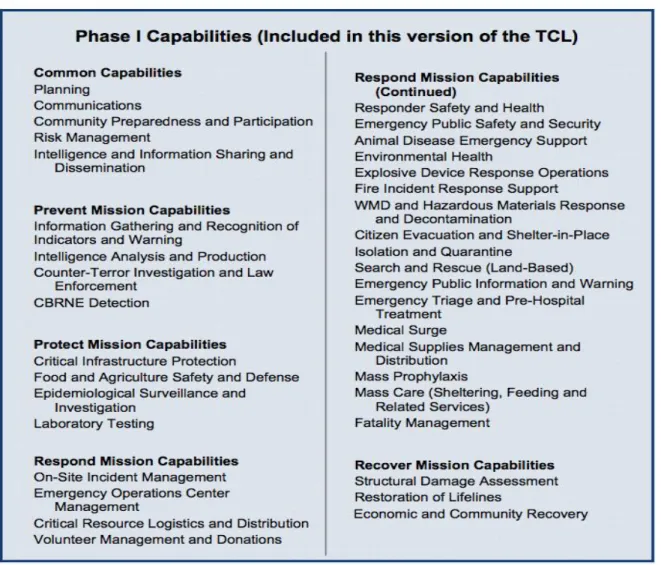
Department of Homeland Security, has developed a set of Target Capabilities (Table 1)
that are used by public health officials, emergency responders, and emergency
Protect, Respond, and Recover. FEMA developed a set of 37 core capabilities in 2007,
which were updated in 2009, in order to establish national guidance for preparing for
major all-hazards events (FEMA, 2009).
Table 1. Target Capabilities developed by U. S. Department of Homeland Security
There are five Common Capabilities that encompass the primary capabilities of
disaster preparedness that all emergency responder organizations should follow when
The Civil Air Patrol can provide services in many of the target capabilities;
however, the most likely areas of support called upon by state and communities would
be 1) Critical Resource Logistics and Distribution, 2) Medical Supplies Management and
Distribution, 3) Search and Rescue, and 4) Emergency Operations Center
Management. The Civil Air Patrol could provide assistance in distributing basic and
medical supplies either between centers or directly to people in the community. Support
could also come from infrastructure staffing support in the Emergency Operations
Centers, especially if there are high levels of absenteeism among the emergency
response staff. Since the Civil Air Patrol has an excellent communications system,
support could also come from supplementing the Emergency Management
communications capabilities.
Capabilities of the Civil Air Patrol
The Civil Air Patrol has developed a set of capabilities to fulfill its three primary
missions: 1) Emergency Services, 2) Cadet Programs, and 3) Aerospace Education. In
addition to these missions, the Civil Air Patrol can provide assistance to state and local
communities in the following areas: 1) transporting supplies (via air or ground), 2)
conducting aerial surveillance and assessment of designated disaster areas, 3) using
an extensive communications network, 4) deploying volunteers to assist in various
functions to support infrastructure staffing needs (both adults and cadets), and 5)
conducting search and rescue missions.
Members of CAP participate in ongoing training exercises, participate in group
presentations and lectures to their local communities in a variety of areas, and advance
in specialty areas through study and experience. Since members are volunteers, they
come from various backgrounds and levels of experience, such as military, private
sector, public sector, and other volunteer organizations. In addition to the skills and
experiences they bring from their professional lives, they acquire new skills within the
Civil Air Patrol. Some acquire highly specialized skills in defined areas and others gain
a broader experience in a variety of areas. Many members have command and
leadership experience, and others have sound technical and administrative skills. CAP
has a national training system to ensure consistency across the entire organization.
CAP has members from professional fields, such as physicians, nurses, lawyers,
accountants, social workers, teachers, EMS personnel, commercial airline pilots, law
enforcement officers, etc. As such, should state and local municipalities require support
staff during a pandemic that has a significant effect on human resources, CAP
members may be in a position to lend assistance in a variety of functional areas. In
addition, the CAP cadets can also volunteer to help with staffing needs in several
areas.
As mentioned previously, the Civil Air Patrol conducts missions in Emergency
Services, and is frequently tasked by the U.S. Air Force to conduct Search and Rescue
missions related to private aviation. The Civil Air Patrol also works closely with other
agencies and organizations, such as the U.S. Coast Guard Auxiliary, the local law
enforcement offices, and EMS organizations, such as Community Emergency
The CAP disaster relief services most relevant during an influenza pandemic
include transportation of medical and basic supplies (by air or ground), contributing to a
communication network, volunteering for infrastructure staffing needs, and distributing
information. While CAP is sometimes asked to assist with crowd control during
community events, should civil unrest manifest during a moderate to severe pandemic
the Civil Air Patrol would be unable to conduct any policing role due to the Posse
Comitatus Act of 1878, which is a federal statute prohibiting the military from direct
participation in certain civilian law enforcement activities (United States Code, 1878).
Prior to being asked to assist with infrastructure staffing needs, it will be
necessary to take an inventory of skills and experiences of the members willing to
volunteer for this task to ensure competency in the various functional areas. Despite
the need for ancillary staff during a pandemic, it is very likely that CAP members active
in the workforce will be asked to fill in for high levels of absenteeism, thus diminishing
the time they may have for volunteer services.
The assets that could be available to state and local communities fall into four
categories:
a. Aircraft (fixed-wing, single-engine airplanes)
b. Vehicles (vans and mini-vans)
c. Communications Equipment (fixed and remote radios)
d. Human Resources (adults and cadets)
Across the United States, the Civil Air Patrol has approximately 550 aircraft, and
its members fly about 110,000 hours each year (Civil Air Patrol, 2009). CAP also owns
mission support. CAP performs aerial reconnaissance for Homeland Security (HLS).
During routine disaster relief missions, the Civil Air Patrol provides services to local,
state, and national organizations, and typically transports time-sensitive medical
materials, such as blood products and body tissues, critical personnel, and urgent
medical supplies.
CAP maintains the most extensive High Frequency (HF) and Very-High
Frequency (VHF) communications network in the nation, in addition to other
communication devices, such as 800 Hz radios, Inter-Squad Radios (ISR), etc. This
communication network can act as either a primary network or as a supplemental one.
With dedicated frequencies provided to CAP, all of the CAP volunteers can be on a
single network for communications, yet have the flexibility to link with other ES
communication systems.
Nationally, the Civil Air Patrol has almost 60,000 volunteer members, with about a
third being cadets from the ages of 12 to 18 years old (Civil Air Patrol, 2009). Each
member willing to volunteer time to support a Pandemic Response Plan could be
mobilized to assist in critical infrastructure staffing needs at various agencies. Cadets
can play a role in administrative support to state and local agencies, and adults may
have qualifications to assume some functional responsibilities. Providing staffing
support during a moderate to severe pandemic could ultimately prove to be the greatest
Concept of Operations and Risk Management
The next part of the Response Plan is the development of how the operations will
function to support the community needs. The concept of operations defines the
missions, and then necessary actions needed to implement the Response Plan. One of
the first elements of this operational plan is to create an Operational Risk Management
(ORM) plan, which is a decision-making tool to systematically help identify operational
risks and benefits and determine the best courses of action for any given situation (FAA.
2000). Should the Civil Air Patrol be asked to provide assistance to state and local
communities, a risk assessment must be made to evaluate any hazards that might be
present while fulfilling those duties. The Civil Air Patrol follows the Operational Risk
Management (ORM) plan adopted by the military. This process follows six steps to
develop the plan: 1) Identify the hazards, 2) Assess the risks, 3) Analyze risk control
measures, 4) Make control decisions, 5) implement risk control measures, and 6)
Supervise and review. In order to minimize exposure to the virus during support
activities, each response team should conduct an appropriate ORM plan prior to
completing a mission. For instance, if a CAP team is asked to deliver food and water to
a family under self-quarantine, the team should identify any possible risks of being
exposed to an infected person, the distance they will be from that person, the possibility
of that infected person coughing or sneezing in their vicinity, the direct contact they may
have with an infected person or someone suspected to be infected, the availability of
non-pharmacological interventions pre and post exposure, and the subsequent contact
they may have with other members of their team, other CAP members outside of their
An overall ORM plan should be developed by the Pandemic Coordinator, in
cooperation with Incident Commanders and Mission Coordinators, before responding to
any requests for assistance. This plan should identify all the potential hazards for any
member of a response team, be it an aircrew or a ground team. This ORM plan should
not only address the risks associated with contacts that are potentially infected with the
influenza virus (directly or indirectly), but also other potential hazards that they may
encounter throughout the mission. For instance, if vital medical supplies are scarce and
in high demand, and people are aware that CAP volunteers are carrying such vital
supplies, it might be possible that desperate citizens will attempt to steal such supplies,
and inflict bodily harm to volunteer members in the process. Thus, the general ORM
should take into account all circumstances that are possible in any situation. Having
accurate and up-to-date information is critical to appraising the situation as the
pandemic unfolds within a given community. The ORM should have a priority ranking of
risks based on the incidence levels of infection, the seriousness of the illness, and the
amount of civil unrest of the population. There should also be an element of the plan
where the risks outweigh the benefits and the mission is called off.
Another important area the general ORM should take into account is the illness
rate of CAP volunteers. While it can be assumed that 30-40% of volunteer members will
become ill with the flu, the situation could change quickly whereby there is an
insufficient number of members to support a response team in a given geographic area,
especially if a team member becomes infectious and spreads the virus to other
teammates. Development of the general ORM plan should be deliberate and carefully
probability and severity of each hazard with appropriate control decisions. In addition to
the general ORM Plan developed for the Wing, each team implementing a mission
should develop a time-critical ORM Plan that will address any immediate risks
encountered throughout the mission. Before accepting a mission, the Team Leader will
have a checklist of potential hazards based on the most current information of the
situation. The Team Leader in coordination and concurrence with the Incident
Commander or Operations Section Chief recommends whether to proceed or cancel the
mission. Frequent radio communication will be vital during each mission to ensure the
IC and Pandemic Coordinator is aware of any changes to the situation.
Organization and Responsibilities
One of the critical elements of implementing a volunteer community organization
Response Plan is to define the organizational structure and the roles and
responsibilities of each of the volunteers. The Civil Air Patrol would create a structure
consistent with the National Incident Management System (NIMS), since this is the
structure Public Health officials and Emergency Management officials would deploy
during a disaster, such as an influenza pandemic (FEMA, 2008). Since the lead agency
would be the Department of Public Health, the Civil Air Patrol, like any other community
volunteer organization, would create a structure appropriate for the level of support
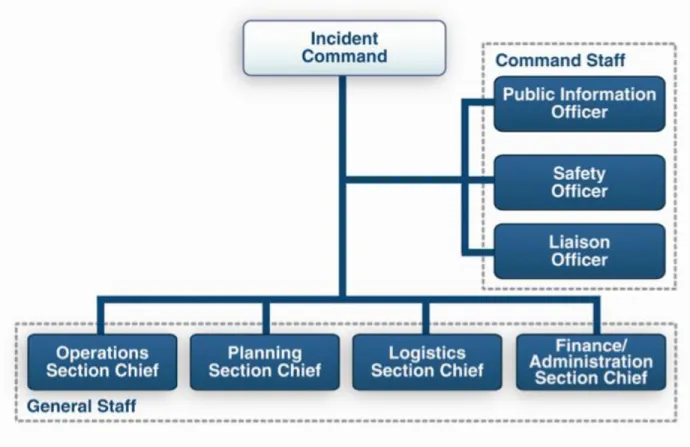
needed by the Incident Commander (IC) (Figure 1). For instance, if Public Health
officials simply required the Civil Air Patrol to deliver medical supplies and vaccines to
local Health Units across the state, then the appropriate structure adopted would likely
Operations Branch, 2) Planning Section to develop an Incident Action Plan, 3) Logistics
Section to manage the assets, 4) Finance Section to handle all expenditures, 5) a
Safety Officer, 6) a Public Information Officer, and 7) a Liaison Officer to interact with
the lead IC. Should the requirements expand to need vans delivering basic supplies,
like food and water, to various communities, then the structure would expand to include
Figure 1. Incident Command System: Command Staff and General Staff
a Ground Branch under the Operations Section, with appropriate transportation crews
ready to become deployed for various missions. Consistent with the NIMS approach,
the structure expands and contracts to fit the needs of the situation. Establishing
many members will simply be unavailable to volunteer given family or work
commitments. Thus, the structure needs to be flexible and adapt to various members
becoming unavailable to fulfill missions during phases of the pandemic. Once the
missions are defined, the appropriate organizational structure can be delineated with
clear responsibilities for each participant, and back-up plans for those who become ill
and unable to fulfill their missions throughout the Response Plan.
A Pandemic Flu Response Plan prepared by the Civil Air Patrol can include both
primary and secondary missions. The four primary missions identified in this Pandemic
Response Plan are: 1) transportation of medical supplies, 2) transportation of basic
supplies (i.e. food and water), 3) supplement infrastructure staffing needs, and 4)
providing routine disaster relief services. The two secondary missions are: 1)
information sharing, and 2) ancillary communications.
The first primary mission is to assist state and local agencies with the
transportation of medical supplies and critical personnel (public health officials,
healthcare professionals, law enforcement personnel, etc). Medical supplies, such as
vaccines or anti-viral agents could be transported from a central depot to local Health
Units, or healthcare institutions, or between local Health Units to nearby institutions and
clinics, depending on the needs identified by Public Health officials. The assets
available for this mission are CAP aircraft and vehicles. If medical supplies need to be
flown due to critical time-sensitive issues then an aircrew can be mobilized fairly quickly.
A CAP or state vehicle can deliver the medical supplies to the nearest airport and the
aircrew can fly the medical supplies to the determined destination. There are weight
this mission is to be as responsive as possible in order to deliver the supplies as quickly
as possible. Medical supplies may include pharmacological and non-pharmacological
interventions, such as anti-virals, vaccines, facemasks, gloves, hand sanitizers,
ventilators, and any other supplies of a medical nature.
The next primary mission involves transporting basic supplies like food and
water. While this mission is similar to the first one, it differs in that volumes and weights
might become a factor. Certainly when it comes to air transportation of personnel in
addition to assigned aircrew and these basic supplies, weight plays a primary role
since the small aircraft of CAP have weight limitations. On the other hand, the CAP
vehicles are able to carry more material. Most missions will likely be from depot to
homes, rather than depot to depot due to the volume restrictions of CAP vehicles.
Again, the goal of this mission is to be responsive and deliver supplies as quickly as
possible, especially if some of the goods are perishable.
The third primary mission is to supplement infrastructure staffing needs. The
greatest need during a pandemic is people, since many are ill and cannot come to
work, or fulfill their duties. Members of the Civil Air Patrol come from all walks of life
and have a variety of skills and experiences, including Public Health, Medicine,
Nursing, EMS, etc. In addition, the volunteers of the Civil Air Patrol are assigned
various duties within the organization and continue to develop new skills. Thus, if the
infrastructure within a state or community begins to collapse due to absenteeism, CAP
members could volunteer their time to helping maintain the systems and processes
needed during a pandemic. While it is true that those members with full time jobs may