International Agricultural Economics and Sustainable Development
Award- 2015
Guidelines in Training Needs
Analysis
Prof. Dr. C. Sekhar
Professor in Agricultural Economics
and
Prof. Dr. A. Pounraj
Professor in Agricultural Extension
Department of Social Sciences
Horticultural College and Research Institute
Tamil Nadu Agricultural University
Periyakulam-625 604, India
International Library for Thesis
Indexed on: March, 2015
All Rights Reserved with International Library for Thesis
Ph ton
GUIDELINES IN TRAINING NEEDS ANALYSIS
Prof. Dr. C. Sekhar
Professor in Agricultural Economics
And
Prof. Dr. A. Pounraj
Professor in Agricultural Extension
Department of Social Sciences
Horticultural College and Research Institute
Tamil Nadu Agricultural University
Ph ton
This is Possible
Because of the
Tears of
Our Parents!
Ph ton
Preface
Preface
I express my sincere and heartfelt thanks to my Guide, Dr. R. Krishnaveni, Professor, PSG Institute of Management, PSG College of Technology, Coimbatore for her invaluable guidance, motivation and constant support extended throughout the period of study.
I’m extremely grateful to Thiru. Vibhu Nayar, IAS, Project Director, IAM WARM Project
for permitting me to carry out this study.
I am equally indebted to the Vice Chancellor and the Registrar, Tamil Nadu Agricultural University who have permitted me to accomplish this task under Open and Distance Learning with Indira Gandhi National Open University, New Delhi
I am also thankful to Dr. K. Uma, Associate Professor, Dr. P. Balaji, Assistant Professor,
Dr. S. Gurunathan, Senior Research Fellow, Mr.Jagadeesh Selvam, Junior Research Fellow, Department of Agricultural and Rural Management, Tamil Nadu Agricultural University, Coimbatore for their continued assistance in shaping this publication.
I wish to express my sincere thanks to my children J. S. Paarry and J.S. Thenndrall who use to criticize and extend indirect support in accomplishing this task.
Last but not the least, the services extended by Ms. S. Dhanalakshsmi, Home Maker who had contributed both directly and indirectly to the author in shaping the publication useful to the scientific and student community.
I extend cheerful, warmth and heartfelt thanks to the ALMIGHTY for the courage, conviction and blessings to execute such tasks throughout my life
Ph ton
Table of Contents Page No.
Synopsis 1
Chapter – I. Introduction to the Study 7
1.1 Training and Visit (TV) System 8
1.2.Broad Based Extension (BBE) 8
1.3. Need for Training 9
1.4. Elements of Training 9
1.5. Training Needs Analysis 9
1.5.1. Training Needs Analysis Involves 10
1.5.2. Training Needs Assessment (TNA) 10
1.5.3. Objectives of TNA 12
1.5.4. TNA Communication 12
1.5.5. TNA Methods 13
1.5.5.1. Interview Method 13
1.5.5.2. Group Discussions 13
1.5.5.3. Questionnaire and Conduct of Survey 13
1.5.5.4. Job Analysis 15
1.5.5.5. Task Analysis 15
1.5.5.6. Business Change Analysis 15
1.5.5.7. Evaluating Role Design 16
1.5.6. Approaches to Training Needs Analysis 16
1.5.7. Training Needs Analysis – The Case of IAM WARM Project 18
1.6. Training Strategy 19
1.7. Importance of Training 19
1.8. Standard Types of Training 20
1.8.1. Apprenticeship Training 20
1.8.2. Job Training 20
Ph ton
1.8.4. Understudy Practices 20
1.8.5. Internships 21
1.8.6. Training Programmes 21
1.9. Bridging Gap Between Training and Work Practices 21
1.10. Training Evaluation 22
1.10.1 Purposes of Training Evaluation 22
1.10.2 Process of Training Evaluation 22
1.10.2.1 Before Training 22
1.10.2.2 During Training 22
1.10.2.3 After Training 23
1.11. IAM WARM Project 23
1.11.1. Project Impacts 24
1.12. Objectives of the Study 24
1.13. Research Methodology 25
1.14. Scope of the Study 25
1.15. Limitations of the Study 26
1.16. Chapter Scheme 26
Chapter – II. Concepts and Review 28
2.1 Employment 29
2.2 Training 30
2.3 Training Needs 31
2.4 Satisfaction 32
2.5 Job Satisfaction 32
2.6 Evaluation 34
2.7 Learning 34
2.8 Behaviour 36
2.9 Knowledge 37
2.10 Skill 37
Ph ton
2.12 Review of Past Studies 39
Chapter – III. Design of the Study 43
3.1 Selection of the Study Area 43
3.2 Sampling Design 43
3.3 Method of Collection of Data 46
3.4 Study Period 46
3.5 Tools of Analysis 46
3.5.1 Percentage Analysis 46
3.5.2 Scaling Techniques 46
3.5.3 Kirkpatrick's Four Levels of Evaluation 47 Chapter – IV. The Survey Instrument for Training Needs Analysis 50 Chapter – V. TNA - The Case of World Bank Project 73
5.1 Profile of IAM WARM Project 73
5.2 Project Description 75
5.3 Project Development Objectives and Key Indicators 75
5.3.1 Selected Key Performance Indicators 76
5.4 Project Components 76
5.4.1 Component A: Irrigation Systems Modernization in a Sub-basin
Framework 76
5.4.1.1 Sub-Component A1 Tank Systems Modernization 76
5.4.1.2 Sub-Component A2 Other Irrigation Systems Modernization 76
5.4.2 Component B Agricultural Intensification and Diversification 77
5.4.2.1 Sub-Component B1 Tank Systems 78
5.4.2.2 Sub-Component B2 Other Systems 78
5.4.3 Component C Institutional Modernization for Irrigated Agriculture 79
5.4.4 Component D Water Resources Management 80
5.4.5 Component E Project Management Support 81
5.5 Lessons Learnt and Reflected in the Project Design 81
5.5.1 Participation of Stakeholders 81
Ph ton
5.6 Implementation 82
5.6.1 Partnership Arrangements 82
5.6.2 Institutional and Implementation Arrangements 83
5.7 Monitoring and Evaluation of Outcomes 83
5.8 Sustainability 84
5.8.1 Institutional Sustainability 84
5.8.2 Social and Environmental Sustainability 84 Chapter VI. The Revelations of Training Needs 86
6.1 Components of IAM WARM Project 86
6.1.1 Participants of IAM WARM Project 88
6.1.2 Finding Plan of IAM WARM Project 89
6.1.3 Implementation of IAM WARM Project 90
6.1.4 Physical Progress Made in Water Resources Organization (WRO) 91
6.1.5 Physical Progress Made in Department of Agriculture 92
6.1.6 Progress Made in Department of Horticulture and Plantation Crops 94
6.1.7 Progress Made in Agricultural Engineering Department 95
6.1.8 Achievements Made By Tamil Nadu Agricultural University 96
6.1.9 Achievements Made in the Department of Agricultural Marketing and
Agribusiness 98
6.1.10 Achievements Made in Department of Animal Husbandry and Dairying 99
6.1.11 Achievements Made in Fisheries Department 100
6.2 General Characteristics of the Respondents 101
6.2.1 Annual Income of the Respondents 101
6.2.2 Distribution of Age of the Respondents 102
6.2.3 Educational Qualification of the Respondents 102
6.2.4 Distribution of Respondents 103
6.2.5 Experiences of the Respondents 103
6.3 Details of Nature and Type of Training Conducted 104
Ph ton
6.3.2 Details of Training Attended by Line Department Officials under
IAM WARM Project 106
6.3.3 Level of Satisfaction on the Trainings 106
6.3.4 Performance and Confidence Level 107
6.3.5 Relevance of Training 107
6.3.6 Effectiveness of Training 108
6.3.7 Duration of the Training Program 109
6.3.8 Perception on the Training Programs 109
6.3.9 Perception on the Effectiveness of Training 110
6.4 Knowledge and Skill Level 110
6.4.1 Knowledge and Skill before Attending the Training Program 111
6.4.2 Knowledge and Skill After Attending the Training Program 112
6.5 Training Needs Assessment (TNA) 113
6.5.1 Training Needs of IAM WARM Project Officials 113
6.5.2 Type of Training Preferred 114
6.5.3 Venue of Training Preferred 115
6.5.4 Training Methods Preferred 116
6.5.5 Training Institutions Preferred 117
6.6 Impact of Training Program 118
Level 1: Reactions 119
Level 2: Learning 120
Level 3: Behaviour 121
Level 4: Results 123
Ph ton
Chapter – VIII. A Model Format for TNA Report 136
Ph ton
Table
No. List of Tables Page No.
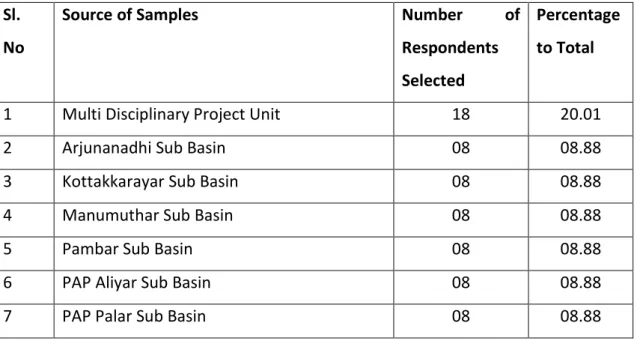
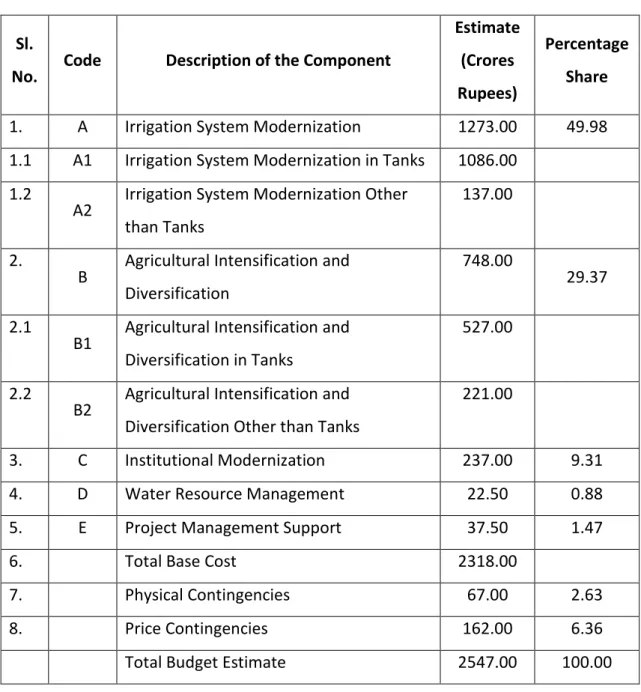
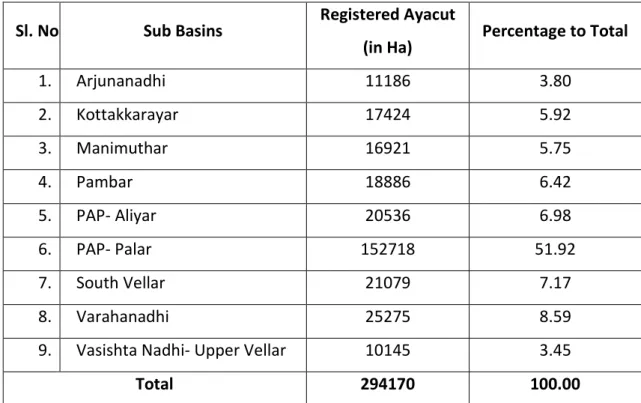
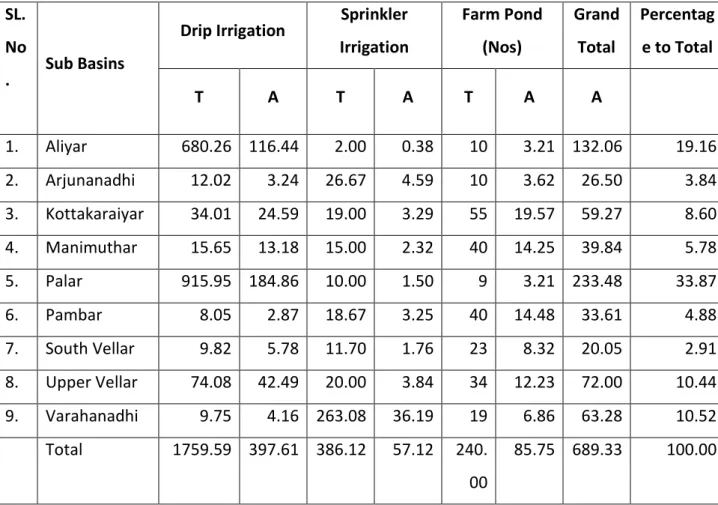
1. Details of Selection of Samples in the Study Area 45 2. Multidimensional Scaling Technique 47 3. Components of IAM WARM Project 87 4. Details of Investment Shared by Line Departments 88 5. Financing Plan of IAM WARM Project 89 6. Details of Sub Basins Taken up for Implementation 90 7. Sub-Basin wise Physical Progress in Water Resources
Organization 91
8. Sub-Basin wise Physical Progress Made in Department
Agriculture 93
9. Sub-Basin wise Physical Progress in Department of
Horticulture and Plantation Crops 94 10. Physical Progress Made in Agricultural Engineering
Department 95
11. Sub-basin wise Physical Progress made in Tamil Nadu
Agricultural University (TNAU) 97 12. Sub-Basin wise Physical Progress in Department of Agricultural
Marketing and Agribusiness 98
13. Sub-basin wise Physical Progress in Department Animal
Husbandry and Dairying 99
14. Sub-Basin wise Physical Progress made in Fisheries
Department 100
15. Annual Income of the Respondents 102 16. Age of the Selected Respondents 102 17. Educational Qualification of the Respondents 102 18. Distribution of Respondents According to Different Line
Departments 103
19. Experience of Respondents in Other Schemes /Projects 104 20. Details of Training Conducted During 2007-08 105 21. No. of Trainings Attended by the Respondents 106 22. Level of Satisfaction with the Training Program among the
Respondents 107
23. Training Provides Performance and Confidence Level of
Ph ton
24. Relevance of Training to the Nature of Task 108 25. Evaluation on Effectiveness and Mode of Training 108 26. Duration of the Training Program 109 27. Perception on Training Availed by the Respondents 110 28. Perception on the Effectiveness of the Training 110 29. Level of Knowledge and Skill before Attending the Training
Program 111
30. Level of Knowledge and Skill after Attending the Training
Program 112
31. Training Needs of Development Officials of IAMWARM Project 114 32. Type of Training Preferred by the Respondents 115 33. Venue of Training Preferred by the Respondents 115 34. Training Method Preferred by the Respondents 116 35. Training Institutions Preferred by the Respondents 117 36. Evaluation of Donald Kirkpatrick Tool Level 1 : Reaction 119 37. Evaluation of Donald Kirkpatrick Tool Level 2: Learning 120 38. Evaluation of Donald Kirkpatrick Tool Level 3: Behavioral
Ability Assessment Before and After Training 122 39. Rice Productivity Due to Adoption of SRI Technology 123 40. Constraints Faced by Development Officials 124
Ph ton
Sl. No. List of Figures Page No.
1 Level of Knowledge and Skill before Attending the
Training 112
2 Level of Knowledge and Skill after Attending the
Ph ton 1
How to Prepare a Synopsis – A Model
SCHOOL OF MANAGEMENT STUDIES
INDIRA GANDHI NATIONAL OPEN UNIVERSITY (IGNOU) MAIDEN GARHI, NEW DELHI – 110068
TITLE OF THE PROJECT: Training Needs of Development Officials Working
Under Tamil Nadu Irrigated Agriculture
Modernization and Water Bodies Restoration and Management (IAM WARM) Project
INTRODUCTION
Training is the process by which the desired knowledge, skill, attitude and ideas are inculcated, fostered and reinforced in human.
Training has been recognized as an important input in improving the professional competence of human resource personnel / extension personnel for effective transfer of technology from lab to land. In agriculture and allied sectors, transfer of technology is done through a group of extension personnel with a defined extension system. In our extension system, change agents are still the main and most credible source of information and they advice on technology.
Training is the process of assisting a person for enhancing ones efficiency and effectiveness at work by improving and updating his professional knowledge by developing skills relevant to his work and cultivating appropriate changes in the behavioral attitude towards work and people. Hence training is considered to be a vital component. The efficient training programme is therefore one of the essential requirements for an effective organization.
Training and Visit system was introduced during 1974 in India and 1980 in
Tamil Nadu. The system was characterized by the “single role” of disseminating crop technologies alone by the extension workers through prescheduled fixed visits to the
Ph ton 2
selected contact farmers, regular and periodical trainings of the extension functionaries at various levels, single line of command and improved linkage between the extension and research systems.
Broad Based Extension
As a result of the Training &Visit effort, the production and productivity of crops have increased manifold. But the strongest extension network of the Department of Agriculture has been focusing mainly on crop technologies without making efforts to transfer the technologies of allied enterprises. Similarly, other line departments with comparatively less number of extension personnel under their fold have also been engaged in the transfer of their respective technologies such as animal husbandry or horticulture or sericulture separately as water-tight compartments. Accordingly, no development department either separately or jointly could so far formulate and transfer location specific and need based package of agriculture and allied enterprises technologies in a comprehensive manner to the farming community. Keeping this in forefront, the Government of India has recently advocated the Broad Based Extension System (BBES) which envisages the transfer of agriculture and allied enterprise in an integrated manner. Effective coordination and linkage among all the development departments is therefore, vital especially at the grass root level to meet the above requirements.
Training Strategy
Broad based Agricultural Extension has to be viewed as a holistic approach to move beyond the traditional crop production emphasis to include all land based activities. However, the technology transfer from lab to land has not gained much momentum and stagnation in production and productivity could be observed over a decade. Several crores of rupees have been invested for developmental departments. But all had ended up in vein. Hence, in this context, effort has been taken to identify the major issues behind the stagnation in productivity and the need based training and other issues to be documented for giving the strategies in the form of capsules to increase the rate of transfer of technologies and to create appropriate linkages between the farm and the lab and the lab and the farm.
Ph ton 3
IAM WARM Project
Irrigated Agriculture Modernization and Water Bodies Restoration and Management (IAM WARM) Project is going to be implemented in 63 River Sub Basins covering an ayacut area of 5.85 lakh ha at a cost of Rs. 2547 crores with the assistance of World Bank in Tamil Nadu during 2007 to 2013. It has five components viz.,
A. Improving irrigation system performance at the bulk level, i.e., diversion weirs, anicuts, supply channels, tank storages, tank bunds, spill weirs and sluices, main canals, branch canals, distributaries and minors.
B. Promoting the use of water saving on-farm irrigation technologies and of agricultural intensification and diversification efforts in response to market demands and agri-business opportunities.
C. Strengthening the institutional capacity for irrigation management at the state and the water user level.
D. Strengthening water resource management E. Project management support.
The project will be implemented over a period of six years. To have an integrated approach, the line departments and their functionaries have been brought under one fold to support the activities enshrined in different components. The main implementing agencies will be the Water Resource Organization (WRO), Agricultural Engineering, Agriculture, Horticulture and Agricultural Marketing Departments, Tamil Nadu Agricultural University, and Animal Husbandry and Fisheries Departments, with the management support and co-ordination provided by the Multi-Disciplinary Project Unit (MDPU) established at the head quarters of Tamil Nadu.
Project Impacts
At full development, the project is expected to increase annually the crop production of major crops/commodities such as food grains (340,000 t), oilseeds (407,720 t), pulses (10,700 t), fruits and vegetables (365,000 t), sugarcane (2,083,300 t), green fodder (1,032,600 t), milk (587, 000 t) and inland fish (22,500 t). The net present incremental financial benefits arising from incremental agricultural
Ph ton 4
production will be Rs12.4 billion in 2006 prices (T-7). It is estimated that around 50,000 rural farm jobs will be created annually following the implementation of the project. Average farm income for one ha holding farmer is estimated to increase by about Rs. 11,500 per year at full development, and about 56,000 rural poor farm households in the project sub-basins are expected to be benefited. To realize the impacts enshrined in the project, training is one of the important component to be given priority. In this context, assessing the knowledge level, skill and the training needs of developmental officials of line departments to achieve the targeted impacts is of paramount importance. Hence, the following specific objectives are framed in the study.
Objectives of the Study
• To identify the components of project activities proposed by development officials under IAM WARM project.
• To identify the strength of the departments delineated above and the knowledge and skill level of development officials in the ex-ante situation.
• To identify the training needs of Development Officials and the training package if any enshrined under IAM WARM project.
• To identify the training gaps and the needs to fulfill the project impacts to be achieved during the post project situation.
• To find out the problems as perceived by the Development Officials to strengthen the training programme more effective.
RESEARCH METHODOLOGY
A well structured and pre tested questionnaire was prepared for the purpose of data collection. The questionnaire covers training needs, content of training, knowledge and skill of respondents, educational status, duration, methods of training, training gaps, problems faced in implementation etc. Mailed questionnaire and personal survey methods were used for the purpose of data collection. Secondary data is also collected from the records maintained at different Departments. The questionnaire was mailed to the nodal officers of line
Ph ton 5
departments and personal interview method was employed among other respondents. In all 100 respondents were aimed at but only 90 turned up and considered in this study. Ultimately the filled questionnaire received from 90 respondents was subjected to statistical analysis.
Scope of the Study
Need is a gap between ‘what is’ and ‘what ought to be’. When the gap is narrowed down, one gets satisfaction and confidence in carrying his work. The success of increasing behavioral change of the extension personnel largely depends on the training programme underwent. Training is one of the ways to prepare an individual to meet his need.
Since the present study is to be conducted at state level, it would be very useful to the State Department of Agriculture, Horticulture, Agricultural Engineering Department, Fisheries, Animal Husbandry, Agricultural Marketing and Water resources organization officials. One of the objectives of the study is to find out the subject matter areas related to training need both in knowledge and skill level. This would elaborate on which areas the Development officials have most needed training and least needed training. This study would largely help the trainers to train the Development officials in the main and sub areas they perceived important. Training needs of Development Officials may vary according to their personal characteristics. Their relationship with the training needs of Development Officials would help the trainers to select the trainees based on certain criterion. It would also help the trainers to know the content, methods, duration and venue preferred most and if necessary to change their present mode of training. Results of this study would be very useful to Agriculture and Allied Sectoral Departments including Tamil Nadu Agricultural University to conduct the training programme.
Limitations of the Study
The study was conducted at state level within a short span of time and resource available for the researcher. The study was confined based on the agro-climatic divisions and district wise. The limitations such as conveyance, physical facilities, sample size, time and finance which a student researcher would normally
Ph ton 6
encounter were also not ruled out in the study. Yet, sincere attention was paid to make the study objective, definite, systematic and purposive to the extent possible.
Ph ton 7
CHAPTER - I
Introduction
CHAPTER -I INTRODUCTION 1. Training
Training is a specialized function of human resource management. Every organization needs to have a well-trained people to perform the activities. As jobs have become more complex, it is necessary to raise the skill levels of employees. Training is important to organizations because it can make accomplishment of overall goals possible.
Training has been recognized as an important input in improving the professional competence of human resource personnel / extension personnel for effective transfer of technology from lab to land. In agriculture and allied sectors, transfer of technology is done through a group of extension personnel with a defined extension system. In our extension system, change agents are still the main and most credible source of information and they advice on technology.
Training is the process of assisting a person for enhancing ones efficiency and effectiveness at work by improving and updating his professional knowledge by developing skills relevant to his work and cultivating appropriate changes in the behavioral attitude towards work and people. Hence training is considered to be a vital component. The efficient training program is therefore one of the essential requirements for an effective organization.
The dictionary meaning for training says that people, animals and even plants can be brought to a desired standard of efficiency, condition or behavior by instruction and practice. According to D S Beach, training is the organized procedure by which people learn knowledge and / or skill for a definite purpose. According to Ferris (1971) Training was a systematic development of knowledge, skills and
Ph ton 8
attitudes required by an individual to perform adequately a given task or job. In simple terms, the training and development refers to the imparting of specific skills attitude and knowledge to an employee.
A formal definition of Training and Development is any attempt to improve current or future employee by increasing an employee’s ability to perform through learning, usually by changing the employee’s attitudes or increasing his or her skills and knowledge. Organizations are using training initiatives to enhance the capacity of the organizations to meet their business objective (Kim 2007)
1.1 Training and Visit (TV) System
Training and Visit (TV) Systemwas introduced during 1974 in India and 1980 in Tamil Nadu. The system was characterized by the “single role” of disseminating crop technologies alone by the extension workers through prescheduled fixed visits to the selected contact farmers, regular and periodical trainings of the extension functionaries at various levels, single line of command and improved linkage between the extension and research systems.
1.2. Broad Based Extension (BBE)
As a result of the Training and Visit (TV) effort, the production and productivity of crops have increased manifold. But the strongest extension network of the Department of Agriculture has been focusing mainly on crop production technologies without making efforts to transfer the technologies of allied enterprises. Similarly, other line departments with comparatively less number of extension personnel under their fold have also been engaged in the transfer of their respective technologies such as animal husbandry or horticulture or sericulture separately as water-tight compartments. Accordingly, no development department either separately or jointly could so far formulate and transfer location specific and need based package of agriculture and allied enterprises technologies in a comprehensive manner to the farming community. Keeping this in forefront, the Government of India has recently advocated the Broad Based Extension System (BBES) which envisages the transfer of agriculture and allied enterprise in an integrated manner. Effective coordination and linkage among all the development
Ph ton 9
departments is therefore, vital especially at the grass root level to meet the above requirements.
1.3. NEED FOR TRAINING
The need for training and development is determined by the employee’s performance deficiency as follows
TDN = (SP – AP)
Where,
TDN is the Training and Development Needs
SP is the Standard Performance and
AP is the Actual Performance
Employee training and development is not only an activity that is desirable but also an activity that an organization must commit its resources to maintain a viable and knowledgeable work force.
1.4. ELEMENTS OF TRAINING
The training involves the following four elements. They are
• Identifying Training Needs in light of the overall goals of the organization and the specific requirements of individuals
• Designing and delivering the training to meet those needs of the organization
• Planning, Organizing, Recording and Monitoring the training that takes place in the organization
• Evaluation of the Training for its effectiveness
1.5. TRAINING NEEDS ANALYSIS (TNA)
A training need is defined as a shortage of skills or abilities, which could be reduced or eliminated by means of training and development. Training needs hinder employees in the fulfillment of their job responsibilities or prevent an organization
Ph ton 10
from achieving its objectives. They may be caused by a lack of skills, knowledge or understanding, or arise from a change in the workplace (Web Reference 1)
Training needs analysis identifies training needs at employee, departmental or organizational level in order to help the organization to perform effectively. The aim of training needs analysis is to ensure that training addresses existing problems, is tailored to organizational objectives, and is delivered in an effective and cost-efficient manner.
1.5.1. Training Needs Analysis Involves:
• Monitoring current performance using techniques such as observation, interviews and questionnaires
• Anticipating future shortfalls or problems
• Identifying the type and level of training required and analyzing how this can best be provided.
1.5.2. Training Needs Assessment (TNA)
Training need assessment is defined as an effort that analyses and diagnoses the organization, task and person, to determine if a cure is necessary and what cure is the most likely to produce the desired results (Goldstein 1993). According to Tracey (2004) TNA is breaking down a need to identify its causes and its relationships with other needs which is none of the means of identifying current or projected skills or deficits among employees. The Purpose of a TNA is to outline at the start of a project how the organizational objectives will be realized through the delivery of a staff training program that will focus on improved and or changed skills, knowledge and / or attitudes of those directly involved or affected by the change. As well as analyzing training needs at an individual level, the process must consider the links to both functional and organizational objectives.
The TNA encompasses forming training objectives and influences how training will be developed, delivered and evaluated (Goldstein 1993). TNA should be the first step in the training process which serves as the basis for the training decisions
Ph ton 11
(Tannenbaum and Yukl 1992, Taylor et.al 1998). The methods for TNA normally depend upon the available resources and senior management desire for quickness in gathering information (Clarke 2003). TNA is very essentially and not performing it will lead to wastage of training budget (Cicada (2010). The benefits of TNA are increasing the commitment of management and probable participants to the training and development; making the training function to be apparent; best use of available resources, clarifying organizational issues and devising strategies to get the training benefits ( Warshauer 1998).
In the case of an implementation of Water Resource Management Project, a rigorous approach to TNA will assist the organization to address the wider issues of Change Management. This will be addressed by enabling the training team to address the staff needs fully, meaning not just in terms of the new technical skills that are required, but also in terms of other key factors associated with the Change. The changes may be of the following
• Personal Change
• Attitudinal Change
• Role Related information
• Information at Project Organizational level
• Information at Departmental level
• Information at Project team level
• Information at Process and procedural and Methodological aspects
• Impact highlights and
• The effects on organizational structure
• Staff resourcing issues
The TNA process will facilitate the identification of training requirements, the planning of associated training activities and the development of the training resource plan, early in the project cycle.
Ph ton 12
1.5.3. OBJECTIVES OF TRAINING NEEDS ANALYSIS
The training program can be designed to ensure that the training is
• Linked clearly to organizational objectives, project benefits and expected outcomes;
• Incorporated into the wider Project, Resource and implementation plans;
• Designed to support and promote the messages contained within the Business Change
Management and Communication Strategies of the Water Resource Management Project
• Developed to address individual training requirements, in terms of both knowledge and preferred learning style, and according to accepted training principles supported by the organization
• Cognizant of restrictions and limitations, whether due to organizational, individual and or political factors, that affect the training approach adopted
• An employee may be seemingly struggling with their multiple workload norms would call for time management training and the same may also be examined
1.5.4. TRAINING NEEDS ANALYSIS COMMUNICATION
Communications before, during and following TNA work should be carefully planned and completed so that your findings do not come as a shock to people. Completing TNA can also provide a good opportunity
• To raise awareness
• To begin to manage expectations and
• To build committed involvement to the program
The following aspects of communication should be consistent with the business change and communication activities
Ph ton 13
• The Line managers of project implementing agency to be trained
• Socialization of Participants of the training
• Interim evaluation regarding their performance in practical applications
• Imparting appropriate methods to infuse need based skills
• Final evaluation of training and the trainees for redesigning the training materials / Program
1.5.5. TNA Methods
The TNA data collection methods can include one or more of the following as appropriate to the specific organization involved in the project and the target audience. There were different methods of data collection. They are
• Personal Interviews
• Group Discussions
• Focus Group Discussion
• Designing of Questionnaire and conducting survey
• Job Analysis
• Task Analysis
• Technical Review and Documentation
• Business Change Analysis
• Evaluating the Role Redesign
1.5.5.1. Interview Method
• It provides immediate feedback
• Ability to explore/ Check responses with the individual respondent
• Time consuming and
• Lower coverage of respondents
1.5.5.2. Group Discussions
• It provides immediate feedback
• Ability to explore/ Check responses with the individual respondent
• Help members of the group to deepen their understanding of the issues
1.5.5.3. Questionnaire and Conduct of Survey • Larger audience with different view points
Ph ton 14
• Data analysis can be time consuming
• Difficult to develop unambiguous questionnaire
• May not allow for freedom comments
• A Model of Job Analysis Questionnaire is furnished below for collection of data
1.5.5.3.1. A MODEL QUESTIONNAIRE FOR JOB ANALYSIS NAME:
JOB TITLE:
LENGTH OF TIME IN THE JOB: MINISTRY / ORGANIZATION: DIVISION / DEPARTMENT:
ADDRESS FOR COMMUNICATION: PHONE NUMBER (0):
MOBILE NUMBER:
POSITION IN THE ORGANIZATION:
AIMS / OBJECTIVES YOU ARE AIMED TO ACHIEVE: MAIN JOB ACTIVITIES:
AUTHORITY UNDER WHICH YOU ARE APPOINTED: PROBLEM SOLVING RESPONSIBILITY:
DECISION MAKING RESPONSIBILITY:
CONTRIBUTIONS FOR THE DEVELOPMENT OF THE DEPARTMENT: STAFF MANAGEMENT RESPONSIBILITY:
RESPONSIBILITY FOR REPRESENTING YOUR ORGANIZATION: KNOWLEDGE, SKILL AND EXPERIENCE IN PLANNING:
KNOWLEDGE, SKILL AND EXPERIENCE IN DISCHARGING MANAGERIAL FUNCTIONS: AREAS OF MANAGEMENT IN WHICH YOU ARE EXPERT AND HOW BEST YOUR SERVICES CAN BE UTILISED IN THE MINISTRY / DEPARTMENT / DIVISION:
INTER-DEPARTMENTAL COORDINATION:
Ph ton 15
1.5.5.4. Job Analysis
• Systematic gathering and analysis of information about the job is a prerequisite. The Job analysis process involves gathering of such information as; What the worker does?
• How the Worker does the Job?
• Why the Worker does it?
• The materials, equipment, tools and procedures used in the conduct of he work;
• The physical activities involved in the performance of the work;
• The conditions under which the work is performed;
• Typical work incidents and work patterns.
• Job analysis provide realistic evaluation of the actual environment and the requirements of the work aimed at
• In situation of change may not reflect the new requirements of the job
Each of these pieces of information is essential; it is not sufficient to merely list a series of tasks or duties, because each piece of information is used in determining the level of work and responsibility and the knowledge, skill and abilities needed to perform them to an acceptable level of proficiency.
The process of assembling and recording information on such essential characteristics of jobs is known as job analysis. Job analysis should be undertaken by trained job analysts working in close collaboration with managers and job holders.
1.5.5.5. Task Analysis
• Task Analysis is carried out whether the individual is assigned with the right job or not
• Need to verify with the data collected and the sample should be checked thoroughly
• Task Analysis is a distinct identifiable work activity which comprises a logical and necessary step in the performance of a job
1.5.5.6. Business Change Analysis
Ph ton 16
• Difficult to find out where more change is planned
• Rely on Visioning of new job processes
1.5.5.7. Evaluating Role Redesign
• Provides a view of how the new work processes are expected to operate and the resulting change in knowledge and skills required
• Evaluating on the competencies required
The TNA conducted in respect of a change program often what is required is access to the key people who possess the information on the change rather than a very broad coverage. Sometimes work will be necessary to bring together those planning the changes with those with practical experience of the current roles to help determined the changes in competencies required in the new situation
Response rates are improved good communication; in particular ensuring people know the format for the method; the time that it will take; the purpose of the TNA and the intended use of the data collected. Methods which involve personal contact and active engagement with the responder, while more time intensive, usually provide a better response rate and richer data than more passive approaches
1.5.6. Approaches to TNA
An approach to TNA process can take many forms, depending on the nature, scope and complexity of the project. The table delineated below demonstrates one such approach in four clear steps.
Table 1 Approach and Methods to Training Needs Analysis
Sl. No Approach Methods 01 Undertake a
Structured
Interview with the Project Director
Scope of the project
• Time of Start and Completion of the Project
• Number of Organizations Involved
• Geographical Location of sites
• Number of Staffs per Organization
Ph ton 17
• Budget, Resources and Facilities Available
Evaluation Plan
• Measurable benefits identified
• Method and timescales of benefit measurement
• Changes to current working practices
• Changes in Job Roles and Organizational Design
Goal Analysis
• What are the goals of the project / organization
• What does good performance look like
• What do the target staff need to be able to do
Task Analysis
• What are the major tasks given
• What are the sub tasks to be assigned additionally
Course Objectives
• What do the participants able to achieve the tasks identified
Delivery Methods
• What delivery methods are deemed appropriate and why
02 TNA Report to Confirm
• Scope
• Evaluation plans
• Data Gathering approach
• Analysis of Target Groups
• Delivery methods
• The TNA Plan including timescales 03 TNA Undertaken • Data gathering tool is designed
• Name of the trainees, job types and locations identified by project manager or Director
• Data gathering exercise undertaken
• Results analysed and reported 04 TNA Process • TNA Report Produced
Ph ton 18
Completed • Verification of the Report for planning another training
• Conduct of SWOT Analysis
• Revising the Report if needed
1.5.7. Training Needs Analysis – The Case of TN IAM WARM Project
The World Bank sponsored Tamil Nadu Irrigated Agriculture Modernization and Water Bodies Restoration and Management Project (TN IAM WARM) is implemented in Tamil Nadu between 2007 and 2013 at a cost of Rs 2547 Crores to improve irrigation service delivery including adoption of modern water saving irrigation technologies and agricultural practices; agriculture intensification and diversification; enhancing market access and agribusiness opportunities and strengthening institutions dealing with water resources management. The institutions participated in the project are delineated below
• Water Resources Organization of Government of Tamil Nadu
• Department of Agriculture, Government of Tamil Nadu
• Department of Horticulture and Plantation Crops, Government of Tamil Nadu
• Department of Agricultural Marketing and Agribusiness
• Department of Fisheries, Government of Tamil Nadu
• Tamil Nadu Agricultural University, Coimbatore
• Department of Animal Husbandry and Veterinary Services
• Agricultural Engineering Department of Government of Tamil Nadu
The respective departmental initiatives are to be implemented in the sub basins of Tamil Nadu on convergence mode at the farm holdings for enhancing productivity. Under the head of Agricultural Intensification and Diversification, the participating departments like Department of Agriculture, Department of Horticulture and Plantation Crops, Tamil Nadu Agricultural University and other stakeholder departments have projected the technologies to enhance production, productivity and in turn to enhance the farmer’s income. Enhancing productivity and the farmer’s income automatically called for enhancing the capability and skill up date to the
Ph ton 19
subordinate or implementing officers of the technologies. In this regard, whether the skill enhancement and up date has enhanced the productivity and the farmer’s income or not is in question. For that, analysis on the training components and the training need analysis become important. So far none of the institutions or agencies has conducted such Training Needs Analysis under IAM WARM Project. Hence this paper is attempted.
1.6. Training Strategy
Broad based Agricultural Extension has to be viewed as a holistic approach to move beyond the traditional crop production emphasis to include all land based activities.
However, the technology transfer from lab to land has not gained much momentum and stagnation in production and productivity could be observed over a decade. Several crores of rupees have been invested for developmental departments. But all had ended up in vein. Hence, in this context, effort has been taken to identify the major issues behind the stagnation in productivity and the need based training and other issues to be documented for giving the strategies in the form of capsules to increase the rate of transfer of technologies and to create appropriate linkages between the farm and the lab and the lab and the farm.
1.7. Importance of Training
Every organization needs to have well trained employee and experienced people to perform the activities that have to be done. Every modern management has to develop the organization through the human resources development. Employee training is the most important sub-system of human resources development. Training is a specialized function and also one of the fundamental operative functions for human resource development for the development of marketing. Training improves changes and moulds the employee knowledge, skill, behaviour, aptitude towards the requirement of the job and the organization. Thus, the training bridges the difference between job requirements and employee job specifications. Training is an essential human resource development (HRD) function of any organization. Hence, training is important to develop the employee and make
Ph ton 20
him suitable to the job and works towards value addition to the company through HRD. (www.hrmguide.net)
Advanced Technological Training (ATT) increases the productivity by way of acquiring adequate knowledge through training. Specific training program given to the specified employees periodically may minimize resistance to change in the organizations. It encourages self-development, self confidence and helps to avoid stress, tension, frustration and conflict. Motivating the individual and provides information for improving their knowledge, attitude and communication skills. Perfect training program helps to eliminate fear in attempting new tasks when the sales representative achieving target for the new product. (www.icfai.org)
1.8. Standard Types of Training
While a vide variety of training programmes is used in different organizations according to the requirements and size of their manpower, the types of persons to be trained, some standard practices are followed by most organizations. Some of the principal common types of training are
1.8.1. Apprenticeship Training
It is used by most organizations for skill or craft training has also been made compulsory by law as prevailed in engineering and medicines and other industrial undertakings. The Industrial Training Institutes and the Polytechnic Colleges normally attach their students with the industrial undertakings for Apprenticeship training.
1.8.2. Job Training
Job training usually uses on-the-job or school methods
1.8.3. Supervisory Training
Usually emphasizes conference and group procedures, as also other method.
1.8.4. Under Study Practices
These are commonly used for middle management and even for senior executive positions in an organization.
Ph ton 21
1.8.5. Internships
Internship is used for training in staff departments
1.8.6. Training Programmes
Training programs are carried on by special institutions for proficiency in various branches of management. They can be short term programs or full time Two to Three year courses.
1.9. Bridging Gap between Training and Work Practices
It is quite common that training activities of any organization are largely measured by number of training programs conducted per year or number of training programs per employee per annum which does not reflect quality of the training program. In addition to quantity, quality needs are to be taken as a measure of evaluating training activities of any organization. But various studies showed that there is always a wide gap between these two. As the gap widens, effectiveness of the training decreases. This gap is mainly because in many organizations training is imparted routinely and also for the fulfillment of the fancy figures only without proper assessment of its impact on the organization. It is commonly believed that nicely executing a function is taken much significantly than evaluating positive impact of the training program.
1.10. Training Evaluation
Many organizations do not realize the need to evaluate the training development programs once the session ends. The most probable reasons any management cites for ignoring the crucial “evaluation” stage are lack of time, resources or tools. As organizations are increasingly adopting training development programs, there is a pressing need for evaluating the same. The process of examining a training program is called training evaluation. Training evaluation checks whether training has created the desired effect. Training evaluation ensures that candidates implement their learning in their respective workplaces, in the regular work routines. Training is a transforming process that requires some output in the form of Knowledge, Skills and Attitudes (KSA)
Ph ton 22
Nowadays, training is an investment because the departments such as marketing and sales, human resource, production, finance, etc., depends on training for its survival. So the training provides the opportunity to raise the profile development activities in the organization.
1.10.1 Purposes of Training Evaluation
The five main purposes of training evaluation are:
Feedback: It helps in giving feedback to the candidates by defining the objectives
and linking it to learning outcomes.
Research: It helps in ascertaining the relationship between acquired knowledge,
transfer of knowledge at the work place and training.
Control: It helps in controlling the training program because if the training is not
effective, then it can be dealt with accordingly.
Power Games: At times, the top management (higher authoritative employee) uses
the evaluative data to manipulate it for their own benefits.
Intervention: It helps in determining that whether the actual outcomes are aligned
with the expected outcomes.
1.10.2. Process of Training Evaluation
1.10.2.1.Before Training
The learner’s skills and knowledge are assessed before the training program. During the start of training, employees generally perceive it as a waste of resources because at most of the times employees are unaware of the objectives and learning outcomes of the program. Once aware, they are asked to give their opinions on the methods used and whether those methods confirm to the candidates preferences and learning style.
1.10.2.2.During Training
It is the phase at which instruction is started. This phase usually consist of short tests at regular intervals.
Ph ton 23
1.10.2.3.After Training
It is the phase when learner’s skills and knowledge are assessed again to measure the effectiveness of the training. This phase is designed to determine whether training has created the desired effect at individual department and organizational levels. (www.hrmaster.com)
1.11. IAM WARM (World Bank) Project
Irrigated Agriculture Modernization and Water Bodies Restoration and Management (IAM WARM) Project is going to be implemented in 63 River Sub Basins covering an ayacut area of 5.85 lakh ha at a cost of Rs. 2547 crores with the assistance of World Bank in Tamil Nadu during 2007 to 2013. It has five components viz.,
A. Improving Irrigation System Performance at the bulk level, i.e., diversion weirs, anicuts, supply channels, tank storages, tank bunds, spill weirs and sluices, main canals, branch canals, distributaries and minors.
B. Promoting the use of water saving on-farm irrigation technologies and of Agricultural Intensification and Diversification Efforts in response to market demands and agri-business opportunities.
C. Strengthening the Institutional Capacity for Irrigation Management at the state and the water user level.
D. Strengthening Water Resource Management E. Project Management Support.
The project will be implemented over a period of six years from 2007 to 2013. To have an integrated approach, the line departments and their functionaries have been brought under one fold to support the activities enshrined in different components. The main implementing agencies will be the Water Resource Organization (WRO), Agricultural Engineering Department, Department of Agriculture, Department of Horticulture and Plantation crops, Department of Agricultural Marketing and Agribusiness, Tamil Nadu Agricultural University, Department of Animal Husbandry and Department of Fisheries with the
Ph ton 24
management support and co-ordination provided by the Multi-Disciplinary Project Unit (MDPU) established at Chennai the head quarters of Tamil Nadu. Currently the IAMWARM project is being implemented in sub basins during the year 2007- 2008 onwards.
1.11.1. Project Impacts
At full development, the project is expected to increase annually the crop production of major crops/commodities such as food grains (340,000 tonnes), oilseeds (407,720 tonnes), pulses (10,700 tonnes), fruits and vegetables (365,000 tonnes), sugarcane (2,083,300 tonnes), green fodder (1,032,600 tonnes), milk (587, 000 tonnes) and inland fish (22,500 tonnes). The net present incremental financial benefits arising from incremental agricultural production will be Rs12.4 billion in 2006 prices (PAD, 2006). It is estimated that around 50,000 rural farm jobs will be created annually following the implementation of the project. Average farm income for one ha holding farmer is estimated to increase by about Rs 11,500 per year at full development, and about 56,000 rural poor farm households in the project sub-basins are expected to be benefited. To realize the impacts enshrined in the project, training is one of the important component to be given priority. In this context, assessing the knowledge level, skill and the training needs of developmental officials of line departments to achieve the targeted impacts are of paramount importance. Hence, the following specific objectives are framed in the study.
1.12. Objectives of the Study
1. To identify the components of project activities proposed by development officials under IAM WARM project.
2. To identify the strength of the departments delineated above and the knowledge and skill level of development officials in the ex-ante situation. 3. To identify the training needs of Development Officials and the training
package if any enshrined under IAM WARM project.
4. To identify the training gaps and the needs to fulfill the project impacts to be achieved during the post project situation.
Ph ton 25
5. To find out the problems as perceived by the Development Officials to strengthen the training programme more effective.
1.13. Research Methodology
A well structured and pre tested questionnaire was prepared for the purpose of data collection. The questionnaire covered training needs, content of training, knowledge and skill of respondents, educational status, duration, methods of training, training gaps, problems faced in implementation etc. Mailed questionnaire will be used for the purpose of data collection. The questionnaire will be mailed to all the 100 respondents. Ultimately the filled questionnaire received from 100 respondents will be subjected for statistical analysis.
1.14. Scope of the Study
Need is a gap between ‘What is’ and ‘what ought to be’. When the gap is narrowed down, one gets satisfaction and confidence in carrying his work. The success of increasing behavioral change of the extension personnel largely depends on the training program underwent. Training is one of the ways to prepare an individual to meet his need.
Since the present study is to be conducted at state level, it would be very useful to the State Departments of Agriculture, Horticulture, Agricultural Engineering, Fisheries, Animal Husbandry, Agricultural Marketing and Water Resources Organization officials. One of the objectives of the study is to find out the subject matter areas related to training need both in knowledge and skill level. This would elaborate on which areas the Development officials have most needed training and least needed training. This study would largely help the trainers to train the Development officials in the main and sub areas they perceived important. Training needs of Development Officials may vary according to their personal characteristics. Their relationship with the training needs of Development Officials would help the trainers to select the trainees based on certain criterion. It would
Ph ton 26
also help the trainers to know the content, methods, duration and venue preferred most and if necessary to change their present mode of training. Results of this study would be very useful to Agriculture and Allied Sectoral Departments including Tamil Nadu Agricultural University to conduct the training program.
1.15. Limitations of the Study
One of the general drawbacks could be the tendencies of the respondents to filter or amplify the information. The respondents did not maintain proper records about attended scheduled training calendar. They could furnish the data required from their memory. Therefore the data collected were subjected to recall bias. To minimise recall bias, utmost care was taken by administrating repeated questions and appropriate answers were drawn from the respondents. However, the above limitations would not affect much on the inferences drawn in respect of the objectives specified.
1.16. Chapter Scheme
Chapter I – Introduction
Introduction focuses on importance of Training, Objectives , Scope, Methodology, Limitations of the Study
Chapter II- Concepts and Review
It highlights important concepts and reviews related to study
Chapter III- Design of the Study
It focuses on sampling design, tools of analysis and models used in the study.
Chapter IV- Description of IAMWARM Project
It highlights principal component of IAM WARM Project design, implementation, monitoring and evaluation of outcomes and economic, social and environmental sustainability.
Chapter V- Findings and Discussion
The results are discussed under components of IAM WARM Project general characteristics of respondents, nature and type of training, knowledge and skill level of development officials, training needs of officials, impact of training and constraints faced by the officials.
Ph ton 27
Chapter VI- Summary and Conclusion
Summarises important findings and highlights the recommendations for action.
Ph ton 28
Chapter II
Concepts On Training Needs
CHAPTER II
CONCEPTS ON TRAINING NEEDS
A comprehensive knowledge about the concepts related to the research problem would help a person, to have a better understanding on that research problem. In this context, the brief review made on the concepts and the past studies, which have a direct or indirect bearing on the present study, were included in this chapter. An attempt was also made to conceptualize them for the present study.
The Concepts Reviewed are,
1. Employment 2. Training
3. Training Needs 4. Satisfaction 5. Job Satisfaction 6. Evaluation 7. Learning 8. Behaviour 9. Knowledge 10.Skill
11.Attitude
Ph ton 29
2.1 Employment
Srivastava (1966) stated that agricultural employment included labour spent
on crop production and other farm work, labour gratis and those exchanged in farm work.
According to Bishnoi (1966), employment referred to a state of being engaged in production activities.
Mouly (1972) defined employment as a situation in which remuneration in
cash or kind was received in exchange for active, direct and personal participation in the production process.
Sen (1975) viewed employment as one which gave income to those
employed and yielded output. It also gave a person the recognition of being engaged in something worthwhile.
Smith (1976) opined employment as a state in which a person combined
his/her physical and/ or mental efforts with other resources including other human efforts in a production process.
Marly (1977) suggested that employment should be defined in terms of
work, as employment was only the interpretation within a given social and institutional framework of the basic action of work which has two features, (i) it perceived as duty, (ii) satisfaction derived from it is indirect in the sense that a work was not done for its own sake as in game or hobby but for the reward in cash or kind.
Visaria (1980) counted all those who had worked for at least ten days or
more during the month of interview or season preceding the survey as employed. According to Jain (2003), if a person worked at least for one hour but less than four hour he considered to had been employed for half day, if he worked four hours or more during a day he is considered as employed for whole day.
Sharma (2004) opined thatemployment was a contract between two parties,
one being the employer and the other being the employee. In this relationship, the employer conceives of a productive activity, generally with the intention of creating
Ph ton 30
financial revenues, and the employee contributes labour to the enterprise, usually in return for payment. Employment also exists in the public, non-profit and household sectors. An employer is any entity that hires employees; it could be a person, a company, an organization or a corporation.
According to Labour Force Survey (LFS), (2006) people aged 16 or over were classified as employed, even if they had done at least one hour of work in the reference week or were temporarily away from a job (for example, if they are on holiday). The number of people in employment was considered to differ from the number of jobs in the economy, because some employed people hold more than one job.
Gangaiah et al., (2006) stated that the employment was the entire service of
an individual performed for some kind of wage, under any type of contract.
In the present study employment was the contract between two parties, one being employee other being the employer in the case firm.
2.2 Training
According to Ferris (1971) training was a systematic development of knowledge, skills and attitudes required by an individual to perform adequately a given task or job.
Raymond Noe et al., (1975) opined that training meant for the planned and
organized activity of a consultant to impart skills, techniques and methodologies to employers and their employees to assist them in establishing and maintaining employment and a place of employment which was safe and healthful.
According to Robertson (1976), training refers to the acquisition of knowledge, skills, and competencies as a result of the teaching of vocational or practical skills and knowledge that relate to specific useful competencies. It forms the core of apprenticeships and provides the backbone of content at technical colleges and polytechnics. In addition to the basic training required for a trade, occupation or profession, observers of the labor-marketrecognize today the need to continue training beyond initial qualifications: to maintain, upgrade and update skills
Ph ton 31
throughout working life. People within many professions and occupations may refer to this sort of training as professional development.
Schermerhom et al., (1986) stated that training was the process of making
proficient through instruction and hands-on practice in the operation of equipment, including respiratory protection equipment, that was expected to be used and in the performance of assigned duties.
According to Madaan (1992) training was the learning process that involves the acquisition of knowledge.
Jeff (2001) viewed that training may not be quite the outcome you were
aiming for, but it will be an outcome, not what you dream of doing, but it’s having the knowledge to do it.
According to Strake (2002), training was about knowing where you stand (no matter how good or bad the current situation looks) at present, and where you would be some point of time.
Wayne (2003) suggested that training was activity leading to skilled behavior
and it was not you want in life, but it knew how to reach it, not where you want to go, but it knew how to get there.
In the present study, training referred to maintain upgrade and update skills throughout working life and has specific goals of improving employee's capability, capacity, and performance.
2.3 Training Needs
According to BNET Business Dictionary (2007) Shortage of skills or abilities could be reduced or eliminated by imparting training. Training needs hinder employees in the fulfilment of their job responsibilities and prevent an organization from achieving its objectives. They may be caused by a lack of skills, knowledge, or understanding, or arise from changes in the workplace. Training needs are identified through training needs analysis.
Ph ton 32
2.4 Satisfaction
According to Dowling et al.,(1992) satisfaction meant for the act of satisfying, or the state of being satisfied; gratification of desire; contentment in possession and enjoyment; repose of mind resulting from compliance with its desires or demands.
Riding et al., (1992) suggested that satisfaction was the settlement of a
claim, due, or demand; payment; indemnification; adequate compensation.
Prahalad (1993) viewed satisfaction as the
• The fulfillment or gratification of a desire, need, or appetite.
• Pleasure or contentment derived from such gratification.
• A source or means of gratification.
Sohn (1994) suggested that satisfaction was the employer level of approval
when comparing a product's perceived performance with his or her expectations and discharge, extinguishment, or retirement of an obligation to the acceptance of the obligor, or fulfillment of a claim. While equated with performance, it implies compensation or substitution whereas performance denotes doing what was actually promised.
According to Barta (1992) satisfaction was the sense of achievement and the fulfillment of a need.
Gregersen, (2004) defined satisfaction as the contentment you feel when
you have done something right.
For the purpose of this study, satisfaction related with workers how happy with the training and working environment and also makes workers feel like part of a family or team.
2.5 Job Satisfaction
According to Aguirre (1992), job satisfaction was a contentment (or lack of it) arising out of interplay of employee's positive and negative feelings toward his or her work.