Anderson-Doze 1
The Zero Suicide Program (ZSP) as a
Strategy for Reduction and Prevention of Suicides
Among Active Duty United States Air Force Members:
A Program and Evaluation Plan
By
Lt. Col. Elizabeth Anderson-Doze MD
A Master’s Paper submitted to the faculty of the University of North Carolina at Chapel Hill in
partial fulfillment of the requirements for the degree of Master’s in Public Health in the
Public Health Leadership Program
Chapel Hill
2014
_____________________________________
Advisor:
_____________________________________
Date
_____________________________________
Second Reader:
_____________________________________
Anderson-Doze 2
Table of Contents
Abstract ………5
Introduction National priorities and the current political climate…………5
Military Comparisons…………6
Stakeholders, finances, feasibility……….8
Program Plan and Evaluation Plan………..9
Theories and Models of Relevance………...9
Social Cognitive Theory…………...10
Diffusion of Innovations Theory………….11
Systematic Review………...12
Introduction…………..12
Research Question…………12
Methods………….12
1. Risk of Suicide and Related Adverse Outcomes after Exposure to a Suicide Prevention Programme in the US Air Force: Cohort Study23…………...14
Anderson-Doze 3 3. The functions of Social Support as Protective Factors for Suicidal ideation in a
Sample of Air Force Personnel26…………20
Goals and Objectives………..25
Logic Model……….29
Program Implementation Activities…………...31
Budget Proposal…………...31
Source of Funding………...31
Personnel Costs/Fringe Benefits………….31
Equipment costs………...32
Website/Training…………..32
Travel…………32
Office supplies/Marketing………....32
Other Costs………...33
Rationale and Approach to Evaluation………33
Evaluation Study Design………….33
Evaluation Methods………….35
Evaluation Planning Tables…………36
Anderson-Doze 4
Dissemination………..42
Discussion………42
References………....46
Appendices A. Glossary of Terms…………55
B. Study Characteristics of Programs Reviewed……….....57
C. Logic Model Table…………...58
D. Budget Proposal…………...59
E. USAF Suicide Data…………..61
Anderson-Doze 5
Abstract
The problem of suicide among our military members is one of growing concern for military commanders and political leaders alike.1,2,3,4 Traditionally the national suicide rates have usually remained higher than that of the military at about 20 per 100,000.5 Depending on whose calculations to believe though, it appears that the rate of rise in suicides is much higher in military members than among their civilian counterparts.6
Although not as high as the United States Army (USA), rates among members of the United States Air Force (USAF) have also been on the rise.7 The only formal program instituted by the USAF to counteract suicides is the USAF Suicide Prevention Program (SPP) launched over 18 years ago in 1996. Although it may have had a positive effect in the years immediately following its launch, recent figures both published and unpublished suggest that effect no longer seems to be present.7
This paper begins with a review of existing suicide prevention programs by first outlining the results of a systematic review of the published literature. A proposed Zero Suicides Program (ZSP) model to update and improve the current existing SPP, will then be introduced. This will be accomplished with a focus on causal factors possibly unique to the USAF, by describing its relevant theory basis, goals and objectives, implementation, logic model and evaluation plan. Implementation of the ZSP will be accomplished by meeting a series of short and long term objectives, with an eventual goal of wide spread dissemination to the Air Force and military wide community.
Introduction
Anderson-Doze 6 In recent years the rates of suicides among members of the military and recent veterans of the wars in Afghanistan and Iraq have been at the forefront of national news and been put under scrutiny by the popular media.1,2,3,4,8 Political pundits and all manner of “expert” ex-military members as well as current brass alike, have weighed in with their opinions and thoughts on the so called epidemic of suicide ravaging our military forces.3 With this have come varied opinions as to whether such an epidemic really exists or if the whole issue is being overblown.
Because of wide variation and inconsistencies regarding the definition of suicide and even of violence, the Centers for Disease Control (CDC) published a document in 2011 to
standardize the meaning of these terms and quoted the World Health Organization’s definition of violence as, “The intentional use of physical force or power, threatened or actual, against oneself, another person, or against a group or community, that either results in injury, death,
psychological harm, maldevelopment or deprivation.”9,10
According to the CDC, in 2010, suicide was the tenth leading cause of death across all age groups and when broken down further, was the third leading cause of death for individuals ages 15 to 24 years, and the second leading cause of death for those ages 25 to 34.5 Since 1999, rates of suicide among persons ages 10 and older have been on the rise across both sexes. This trend has been steepest among those ages 45 to 54 and has been more gradual but just as consistent in the 25 to 44 year old age group.11 From 1991 until 1999 there was actually a
national decreasing trend of suicides per the findings of the CDC and the National Violent Death Reporting System (NVDRS) Surveillance Report.5, 12
Anderson-Doze 7 In March of 2014 the first findings from the USA Study to Assess Risk and Resilience in Service members (STARRS), was published in the Journal of the American Medical Association (JAMA). This was the largest mental health resilience study ever conducted as a partnership between the USA and the National Institutes of Mental Health (NIMH) branch of the National Institutes of Health (NIH).1 The impetus for this study stemmed from concerns over seemingly alarming upward trends of suicide, especially in the USA.
The leading cause of death, after combat, among USAF members is currently suicide12 and the Department of Defense (DOD) is taking this fact very seriously. At the 2009 second annual Suicide Prevention conference in Washington D.C., sponsored by the Veteran’s
Administration (VA) and the Defense Department, the previous Chairman of the Joints Chief of Staff, Admiral Mike Mullen voiced his concern for the problem. He admitted that there was to date, no evidence linking repeated deployments to suicide rates and that the military wide suicide rate at that time, was 12.5 per 100,00013. The suicide problem is highest among USA personnel and higher still among veterans under the age of 25 who leave the military. Rates for the Army averaged about 22 per 100,000 compared with the national average for men, of 20 per 100,000. Yet among young Army vets the rate was as high as 80 per 100,000, based on the latest
published data in 2011.15 For the same year the Air Force rates were 13.27 per 100.000.14, 15
Anderson-Doze 8 to a personal firearm. As with national figures, suicide rates among active duty Airmen have been on a steady rise since 2000 but appear to have stabilized in the last three years of the report. Female members who attempted suicide were much higher at 36% compared with 8% of females actually completing a suicide.16 This is again consistent with national data and trends.3
In March 2005 the Deployment Health Assessment (DHA) and Post Deployment Health Re-Assessment (PDHRA) program came on line among all branches of the military. This was mandated by the DoD as the result of issues raised by members of Congress regarding the impression that high numbers of members of the armed forces with mental and physical injuries, were returning from the war theater. The assessment is conducted via a face to face interview between a deploying or deployed member and a health care provider, prior to each deployment, just before re-deployment from the war zone and back to the member’s home base assignment, 60 days post re-deployment and 180 days re-deployment17. While the original main focus of the development of the DHA/PDHRA tool was identification and treatment of military members with physical injuries and mental health trauma or Post Traumatic Stress Disorder (PTSD), it was also designed to help identify those at risk for suicide and thus help to decrease those death rates.
Stakeholders, finances, feasibility
The problem of suicide among military members is not easy to assess and may be different among the various services and also different among active duty members,
reserve/guard members and veterans. Thus there is not, it seems, a “one size fits all” solution to the problem. Since the issue of suicides is such a high profile one, hopefully funding for
implementation of or improvement to an existing but poorly functioning program will be
Anderson-Doze 9 could be accomplished in this paper. The focus will therefore be on evaluating the problem as it exists currently among the active duty members of the USAF, and the formulation of a potential program to decrease the current upward trends. Any application of suggestions outlined in this paper would, of course, require the buy-in of key stakeholders in the DoD, active duty Air Force Commanders and their Airmen.
Program Plan and Evaluation Plan
As a program planning and evaluation plan this paper is composed of two major parts. In the program planning section the results of a systematic review of the existing literature is described with a focus on the only current suicide program in use by the USAF. A proposal to update this program with the ZSP model is then introduced by explaining the chosen theories of relevance, the goals and objectives and a logic model further detailing stages of implementation. After the ZSP has been in place long enough for all short term goals and objectives to be met then the evaluation plan will be implemented. This plan and its accompanying logic model are outlined here along with a discussion of Institutional Review Board (IRB) considerations and a final summary.
Theories and Models of Relevance
Anderson-Doze 10 This paper will focus on devising an appropriate program for the identification of and reduction of suicides among active duty Air Force members, and will use the Social Cognitive Theory and Diffusion of Innovations Theory as population-based approaches.18
Social Cognitive Theory
The belief that a person has the ability to exercise control over situations is a common way that psychosocial influences can have an effect on one’s health and well-being. People cannot recover from relapses and setbacks unless they believe they are able to combine self-efficacy with goals. Only then will they be able to mobilize themselves to change poor health habits and persevere in this change.19 These are hallmarks of Social Cognitive Theory. In this theory personal environmental and behavioral factors all interact with, and influence each other.18
There are certain “core determinants” of the Social Cognitive Theory. These include the knowledge of certain health risks based on certain behaviors, the perception of self-efficacy, expected health benefit outcomes, the perceived facilitators around them, and the possible societal impediments to their desired change that may exist.19
Anderson-Doze 11 Force members’ decisions to end their lives.11, 5, 16 Devising a plan that utilizes the Social
Cognitive Theory would therefore be critical to the success of a suicide prevention program for this specialized cohort of individuals.
Diffusion of Innovations Theory
In order to promote the major components of theories three components need to be considered. There should first be a Theoretical Model that identifies the means of producing effective change and what should be part of this psychosocial process. Secondly there needs to be a Translational and Implementational Model that translates theory into action. Then finally, a Social Diffusion Model to promote and facilitate adoption of the psychosocial programs, to different cultures and societies.19 Diffusions of Innovations Theory first defines the innovation idea or solution for the issue at hand, devises a method of communicating this information broadly, aligns itself with groups of like-minded individuals who adopt the plan, and determines the time period of implementation.18
By its very nature the military community is unique in its ability to adopt new
Anderson-Doze 12 The goal of this paper will be to incorporate these theories and models into a practical, efficient, and cost effective evaluation and planning program which will be relatively seamless to implement, and acceptable by military commanders and their subordinates.
Systematic Review
Introduction
Apart from combat, suicide is the leading cause of death among active duty USAF members.12 Some of the top suicidal triggers for military members are issues with personal intimate relationships, financial hardship, legal issues and social isolaton.16,20 A few papers have been written evaluating suicide preventive measures in the Air Force but as yet there are no published systematic reviews on suicide prevention, among active duty military members, specifically looking at these triggers. To date, existing systematic reviews have looked at interventions targeting persons at “high risk” for suicide such as those with a history of suicide attempts, a diagnosis of depression and in treatment for other mental health disorders, as well as the incarcerated. Military suicide data show that the majority of those committing this act have never been seen by a mental health professional and were not on anyone’s “radar” as a potential suicide risk.16, 21
Research Question
Anderson-Doze 13 For the search methodology several databases were accessed via the University of North Carolina – Health Sciences Library. An electronic search for studies published between 2003 and 2013 was conducted in PubMed, the Cochrane Library, Google Scholar, the Database of
Abstracts of Reviews of Effects (DARE), Up To Date, ClinicalKey, Psyclit, and Web of Science. Various Air Force Instructions, Department of Defense, Department of Veteran’s Affairs,
Centers for Disease Control and National Institutes of Health databases were also accessed. Key words and terminology used for the search were, “Suicide prevention" and (military or "air force"), “Suicide prevention” AND “Military,” “Suicide prevention” AND “United States Air Force,” and “Suicides” AND “Military.” Also conducted was a manual search of the citations of each article. Studies were chosen for inclusion as part of the review based on their titles and abstracts. Other inclusion criteria were:
1. Active duty members in the United States Air Force
2. Suicide prevention aimed at all age groups, genders and ethnic groups among the targeted population
3. All study design types
4. Non clinical/non patient population
5. All suicide prevention programs in place for the United States Air Force established and evaluated between 2003 and 2013 – looking at the post 9/11 period
6. Published in English - only interested in the US Air Force
Anderson-Doze 14 social connectedness interventions for prevention of suicides in young and middle-aged adults.21 The final systematic review remains unpublished, however, as it was not able to be located. The proposed review would also not have been specific to the military. Three other systematic reviews on suicide prevention, written between 2005 and 2010 were found. Again none were specific to the USAF and one included data on veterans as well as on foreign militaries, therefore not meeting the inclusion critera.32,33,34 A total of 9 other articles on suicides among active duty USAF members were reviewed but of this number 5 were general articles focusing on risk factors and trends, another focused on suicide prevention for members diagnosed with post-traumatic stress disorder (PTSD), and only 3 met the final criteria for USAF suicide prevention. The second paper published in 2010 was a follow up to the first one published in 2003. The third was a study and not a program evaluation. However, because the key question of interest was consistent with the research question of this paper, it is being included.
Summary of program/studies (see Table 3)
1. Risk of Suicide and Related Adverse Outcomes after Exposure to a Suicide Prevention Programme in the US Air Force: Cohort Study23
Anderson-Doze 15 seeking mental health care, enhancing the understanding of mental health issues and risks of suicide by educating the community, and keeping the issue of suicide prevention always current with Commanders. Community wide educational models were instituted in 1996 and measures were put in place to help remove the stigma and possible punitive consequences of seeking mental health care. After 5 years of data the authors of this paper conducted a cohort study to analyze the effects of the program.
Methods
This was a cohort “quasi-experimental” design study with before intervention and after intervention cohorts. The study population included 5,260, 292 Air Force personnel on active duty between 1990 and 2002. Knox, et al, assigned in an un-randomized and non-blinded fashion, the population of Airmen on active duty from 1990 to 1996, as the unexposed cohort and considered 1997 to 2002 to be the exposed cohort. Trend analyses of suicide rates and related outcomes (homicide, accidental death, and moderate and severe family violence) was conducted with the x2 test along with the Mantel-Haenszel statistic looking for linear trends in increasing or decreasing levels of suicide. Relative risks were also calculated as the ratio of the outcome of interest between the exposed and unexposed groups. Potential confounders of demographic shifts, such as increased numbers of women, more African Americans, and higher proportions of higher ranking individuals, all protective factors, were considered. Other
confounders also considered were marital status as well as those medically separated or retired from the Air Force due to a diagnosis of mental illness. A historical document review of all relevant Air Force Instructions (AFIs) was also conducted.
Anderson-Doze 16 According to this study the relative risk reduction of suicide among the cohort exposed to the intervention was 33%. The trend analysis data showed there were statistically significant linear trends for reductions of all outcome measures with the exception of mild family violence, which increased. When the potential confounders were analyzed no statistical differences in the demographic distribution or the numbers of mental health diagnoses of both cohorts were found, with theexception of marital status. There was a slight increase in the proportion of unmarried members (excess relative risk of 18%).
Discussion
Anderson-Doze 17 Some drawbacks to this study included one common to most suicide studies, of low statistical power due to traditionally few numbers when suicide is the outcome. For this reason randomized trials evaluating suicide are not feasible. There was also no traditional “Table 1” or summary of the demographics of the study populations before and after the intervention, in table form. Tepper et al. in their critical assessment of this study note that the national suicide trends in the United States were not included and that during that time period US rates declined as much as 23%, concluding that some of the results found by Knox et al, may have been due at least in part to national trends. They also note that trends within the USAF were already on the decline before implementation of the AFSPP in 1996.31
2. The US Air Force Suicide Prevention Program: Implications for Public Health Policy25
Five years after their initial cohort study on the topic, Knox, et al, returned to re-assess the results of the AFSPP. Rates of Air Force suicides for a 27 year time span from 1981 to 2008 were evaluated. Over this period of time many external factors such as 9/11, the wars in Iraq and Afghanistan and downsizing of the forces were in play. The main objectives of this study were to determine if Air Force suicide rates had continued to trend downwards since 1997, when the program was launched. It was also to determine to what extent the Air Force military
installations were in compliance with implementation of the program. One of the major aims of the AFSPP was to lessen the stigma of seeking mental health care. The working assumption that led to the creation of the program was that Airmen who kill themselves often exhibited signs of suicidal tendencies and so if early access to treatment was available, and sought out, then this could have a positive effect. By educating the public the creators of the program also hoped to make suicide therefore a population wide issue and not just a matter of individual concern.
Anderson-Doze 18 For this study the researchers used an Intervention Regression Model (Stochastic
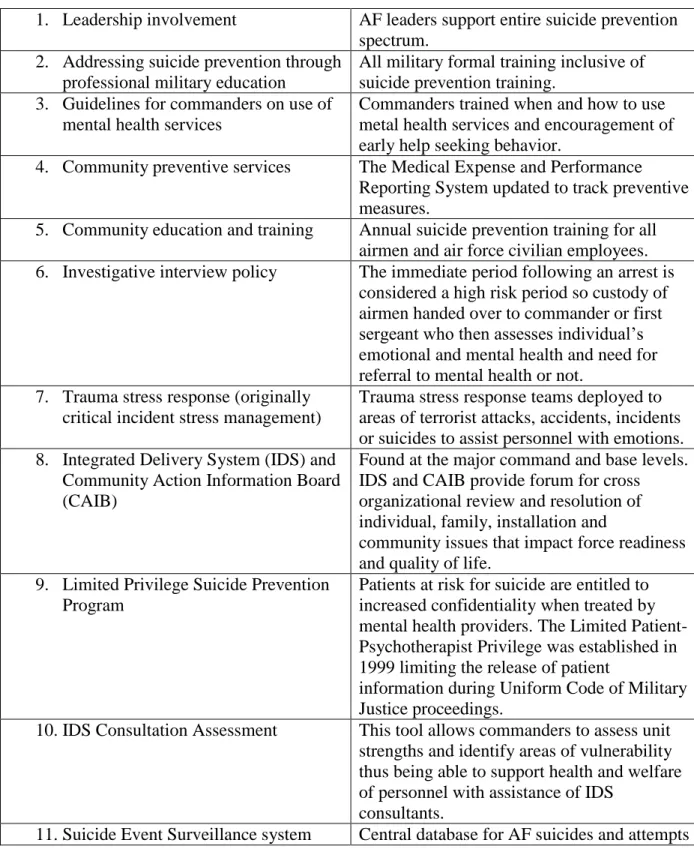
Dependency type) to assess the quarterly suicide rates over the previous 11 years as well as to predict future suicide rates. They looked back at a 16 year period prior to implementation, and the post intervention time frame. This was once again a non-blinded and non-randomized study but despite this the risk of selection bias was minimal since the study population was comprised of 100 percent of confirmed suicides during the study time period. Population size was a possible confounder and thus was adjusted for in the analysis using the regression model. To determine compliance with establishment of each of the 11 initiatives of the AFSPP an implementation appraisal survey was first conducted in 2004. These initiatives were further clustered into seven prevention domains also known as indicator or operational measures. These included (1)
leadership involvement, (2) continuous professional military training, (3) development of guidelines for Commanders, (4) ongoing community education, (5) development of Integrated Delivery System (IDS) and Community Action Information Boards (CAIB), (6) enhancement of community health services, and (7) instituting policies. The researchers then constructed an index by combining the values of the measured variables and then using these to calculate implementation scores for each of the seven domains. To reduce measurement bias researchers were blinded to the responses of Air Force Commanders from different installations who responded to the 11 initiatives survey in 2004 and the 11 initiatives checklist (a refined version of the survey) in 2006. Data were received both from the local base levels as well as from the nine Major Commands.
Results
Anderson-Doze 19 Between 1997 and 2007 this decrease in suicide rates was consistently maintained except for a statistically significant upward spike (P <0.001) noted in 2006. Using risk indicators the
researchers predicted a suicide rate of 9.3 per 100,000 for 2008. They also established “normal” indices based on standard deviations from the forecasted rate. Rates less than or equal to one standard deviation from the 2008 rate or <12.1 per 100,000 were considered to be “indicators of concern.” If the rates were one standard deviation greater than the norm (12.1-14.8 per 100,000) they were categorized as “indicators of warning.” Finally rates greater than two standard
deviations from the norm (>14.8 per 100,000) were identified as “critical indicators of a change in the pattern of suicide rates.” Median implementation rates of the seven prevention domains in 2004 across all military installations was only 56%. In 2006 however the median rates of two of the seven domains was at 100% for 95% of all the bases, and “high levels” of the other five domains in at least half of the other bases.
Discussion
Anderson-Doze 20 Since its implementation in 1997 the AFSPP has been modified and continuously
improved. Over this same time period the overall size of the Air Force has been reduced.
Population size was therefore a factor that was adjusted for during analysis. The researchers state that before this correction they found that the relationship between the declining population and suicides, although inverse, was non-significant. From this they assumed that there must not have been a very strong linear relationship between the exposure of fewer Airmen to perform the same duties and the outcome of interest.
A major goal of the AFSPP was to change the culture of mental health by
“institutionalizing” it thus reducing the stigma associated with seeking mental health care. Data collected by the DoD showed that in 1998 9.5% of Airmen received mental health care while in 2002 that number had risen to 13.5% and stayed at 13.3% in 2005. It is difficult to ascertain however, if these percentages are staying high because of an increased rate of mental health issues or because the AFSPPs goal of earlier and more frequent use of mental health services are being realized. The author’s also noted that 97% of Air Force personnel who took advantage of these services did not suffer any adverse effects on their careers.
Anderson-Doze 21 1. Leadership involvement AF leaders support entire suicide prevention
spectrum. 2. Addressing suicide prevention through
professional military education
All military formal training inclusive of suicide prevention training.
3. Guidelines for commanders on use of mental health services
Commanders trained when and how to use metal health services and encouragement of early help seeking behavior.
4. Community preventive services The Medical Expense and Performance Reporting System updated to track preventive measures.
5. Community education and training Annual suicide prevention training for all airmen and air force civilian employees. 6. Investigative interview policy The immediate period following an arrest is
considered a high risk period so custody of airmen handed over to commander or first sergeant who then assesses individual’s emotional and mental health and need for referral to mental health or not.
7. Trauma stress response (originally critical incident stress management)
Trauma stress response teams deployed to areas of terrorist attacks, accidents, incidents or suicides to assist personnel with emotions. 8. Integrated Delivery System (IDS) and
Community Action Information Board (CAIB)
Found at the major command and base levels. IDS and CAIB provide forum for cross organizational review and resolution of individual, family, installation and
community issues that impact force readiness and quality of life.
9. Limited Privilege Suicide Prevention Program
Patients at risk for suicide are entitled to increased confidentiality when treated by mental health providers. The Limited Patient-Psychotherapist Privilege was established in 1999 limiting the release of patient
information during Uniform Code of Military Justice proceedings.
10.IDS Consultation Assessment This tool allows commanders to assess unit strengths and identify areas of vulnerability thus being able to support health and welfare of personnel with assistance of IDS
consultants.
11.Suicide Event Surveillance system Central database for AF suicides and attempts
Anderson-Doze 22 3. The functions of Social Support as Protective Factors for Suicidal Ideation in a Sample of Air Force Personnel26
This study by Bryan and Hernandez looked at social support, both tangible and
psychological, as a means of suicide reduction among Air Force members. Per this paper, suicide was on the rise among members of the military including the Air Force and had jumped up from 8.9 per 100,000 in 2008 (better than the projection by Knox et al. of 9.3 per 100,000) to 15.5 per 100,000 in 2012. Studies by Chioqueta & Stiles in 200727 and Kaslow in 200528 show there is an inverse relationship between suicidal ideation/attempts and social support. In this paper the researchers defined social support in four ways, Tangible support, Belonging,Appraisal support and Esteem support. The first type of social support referred to the practical support of assistance from an individual or individuals to include financial assistance, help with household chores, helping with immediate short term problems, etcetera. Belonging included a sense of having companionship and importance to someone else. Appraisal support was defined as constructive feedback and emotional validation by peers and supervisors. Esteem support was the belief or faith in one’s abilities to overcome. The perception of belongingness and connectedness was shown to correlate with decreased suicidal ideation among military veterans enrolled in college, and also among active duty members during deployment.29 The specific questions posed by this paper were to determine which of the social support functions were associated directly or indirectly with lower suicide ideation and which caused a decrease effect of emotional distress on suicide.
Method
Anderson-Doze 23 ranging in age from 19-50, at two Air Force bases in the southern United States. There was no blinding or randomization in the selection of participants who were recruited during Security Forces unit formations at their respective bases. “Volunteers” completed several measures including the Beck Scale for Suicidal Ideation-Worst (BSSI-W), the Beck Scale for Suicidal Ideation-Current (BSSI-C), the Anxiety Depression Distress Index-27 (ADDI-27), and the Interpersonal support Evaluation List (ISEL). Generalized liner regression modeling for a Zero-inflated Poisson distribution (ZIP) was used for the analysis because 18 Airmen or 6.6% of the sample showed signs of current suicidal ideation on the BSSI-C (score>0). The ZIP model uses a combination of two regression models at the same time and divides those who are actively suicidal with a score above 0 from those who are not.
Results
Of the Airmen who were currently suicidal, 88.9% were male and 77.8% were non-Hispanic Caucasian with an average age of 25.78 years. 19.4% of the Airmen had positive scores on the BSSI-W indicating a history of past suicidal ideation. Of this number 81.1% were male and 75.5% were non-Hispanic Caucasian. Regression models were applied to each social support function separately and the covariates of age, gender, worst-point suicidal ideation, and
emotional distress were entered into the models. A final regression model indicated that only esteem and tangible social support were directly linked to a lesser degree of suicidal ideation. Additionally it appeared that tangible support lessened any effect of emotional distress on suicidal ideation.
Anderson-Doze 24 In general, Airmen with the perception of greater social support had a decreased rate of suicidal ideation and among those with an increased risk the social support function with greatest benefit was esteem support. Furthermore it appeared that Airmen who had emotional distress seemed to be at higher risk of suicide if that emotional distress was also coupled with lack of tangible support. The researchers therefore suggested that easy access to concrete resources by those at risk of suicide could help to lower incidence of this problem. The social support function of belonging was not found to be linked with suicidal ideation which seems to contradict earlier findings by Van Orden et al. in 2010.30 However thwarted belongingness has been postulated to be composed of two areas, that of the absence of reciprocal care (a form of tangible assistance), and loneliness.
Anderson-Doze 25
Summary
Due to the very specific nature of the research question, the availability of studies with the major outcome of suicide prevention generally among USAF members or using certain modalities is quite limited. Each of the three had different study designs but none used any blinding or randomization opening the large possibility for selection and measurement bias. None of the studies were randomized controlled trials which would be expected, considering the outcome of interest. None of the studies addressed the issue of harms, either actual or postulated. The only actual program in existence and in current use by the USAF was assessed by the first two studies which both seemed to indicate some degree of success with the reductions of suicides as a result of implementation. One reason for this initial success was possibly the function of making suicides an Air Force wide issue involving participation of leadership, Commanders and Airmen. By moving it out of the sole purview of Air Force medicine the consciousness of the non-medical community was raised, and lay persons were better aware of signs and symptoms to watch for. The third and most recent study seemed to contradict this success however, although some critical citations were missing to support certain claims made. This was also not a program implementation paper as explained previously. Hopefully a pending Cochrane systematic review looking at the outcome in question among adults of a similar age to those in the Air Force will shed more light on the social isolation question and ways to further reduce suicidality.21
Goals and Objectives
Goal: Prevent suicides in the United States Air Force through early identification and intervention, with the establishment of the Zero Suicides Program (ZSP).
Anderson-Doze 26 1. Introduction and Development – An implementation team will brief the ZSP model to
the current Air Force Medical Support Agency/ Suicide Prevention Program Manager (AFMSA/SG3OQ) and if required, the Air Force Community Action Information Board (CAIB) Chair and the Deputy Secretary of Defense (Health Affairs) of the Air Force. Brief proposed new education and training SPP updates to the Air Force Deputy Chief of Staff for Manpower, Personnel and Services (AF/A1) and garner support. Obtain
guidance or permission to approach the Wing Commander (Wing CC) at a targeted base to initiate the ZSP, as a pilot project. Brief 100% of Commanders, First Sergeants and Senior Noncommissioned Officers (SNCOs) on all aspects of the program.
By month 3:
Activities: Obtain Institutional Review Board (IRB) consent from the Defense Health Agency/Tricare Management Activity office (DHA/TMA) to perform the pilot project. Activities: Introduce the ZSP model to the targeted Air Force base location. Brief the Wing CC, the Wing Command Chief, the Installation CAIB Chair and then members of the CAIB, on the ZSP.
By month 6:
Activities: Hire the ZSP Program Manager (PM) and Suicide Prevention Provider (SPPr) and identify an active duty military SPPr alternate to be appointed by the Military
Treatment Facility Commander (MTF/CC). Obtain a contract with an External Evaluator/statistician to compile and analyze data for analysis. Begin transfer of
Anderson-Doze 27 2. Training – The IDS ZSP sub-committee will develop updates to the current web based
training program for eventual inclusion in the Advanced Learning System (ADLS) or its equivalent. Design final training curricula for Airmen and awareness program for family members. Finalize training plans for dental and medical providers to include the use of suicide screening tools. Finalize also the use of screening and triage tools to be used by the SPPr. Provide monthly data and progress report briefings on training progress to the IDS and CAIB Chair.
By month 6:
Activities: Fifty percent of all Airmen and civilians will complete general initial ZSP training (web based) while a similar percentage of medical and dental providers will also complete the provider specific portion. The exception will be all newcomers to the base who will receive training from the PM or an interim PM at their mandatory newcomers’ orientations.
Activities: Conduct community briefings to educate family members. Strongly encourage family members to accompany newcomers to monthly mandatory training. Hold separate monthly suicide awareness events, especially for family members, in association with Family Advocacy (FA) and the base chaplain’s office.
By month 18:
Activities: The ZSP model will be in place for a year at the targeted base. By this time all dental and medical providers and ninety percent of all other personnel will have ZSP training completed.
Anderson-Doze 28 Activities: With the program in place for 24 months, the base will have 100% of all personnel with at least 6 months on station, trained.
3. Marketing – Launch a public relations informational campaign to educate the base wide population, focusing on the problem of suicide in the Air Force and the goal of “blazing a new trail” for the rest of the Air Force community to follow.
By month 6:
Activities: Saturate multi-media sites such as Armed Forces Network News (AFN), Air Force Times, Base magazines etc. with regular suicide awareness messages.
Activities:By month 6, update local suicide prevention hotlines with the SPPr contact information.
Activities: By month 6, ensure widespread dissemination of suicide prevention educational/awareness information.
4. Data collection – Reportdata analysis of suicidal risk referral rates and completed suicide rates monthly to the IDS and CAIB.
By month 6:
Activities: Obtain a contract with a statistician to compile and analyze data at critical time points of this pilot study.
Activities:Begin collection of data regarding numbers of referrals by medical/dental providers to the SPPr, referrals from commanders and referrals from other entities/self-referrals. Also perform data collection of suicide attempts and completed suspected suicides.
Anderson-Doze 29 Activities: The ZSP model will be in place for a complete year and there will be a 20% increase in the numbers of Airmen referred to the SPPr and/or mental health services. Activities: Produce and present to the Wing CC and the CAIB, initial data analysis reports regarding any trends with the target base population.
Activities:Make a follow-up presentation to the AFMSA/SG3OQ, the CAIB Chair and the Deputy Secretary of Defense (Health Affairs) of the Air Force.
Long Term Objectives: 1. By month 60:
The ZSP will be in place at the targeted test site for 54 months and Air Force wide for 48 months. There will be a decrease in suicides Air Force wide by 20% of most recent pre 2014 confirmed statistics, or 8 per 100,000. There will be increases in mental health or SPPr referrals by 50% over most recent pre 2014 Department of Defense Suicide Event Report (DoDSER) rates.
2. By years 7-10:
The ZSP will be the benchmark program for all branches of the military. A zero tolerance for suicide culture will be the norm. Suicide rates will be maintained below 5 per
100,000.
Logic Model
Assumptions
Anderson-Doze 30 suicide prevention program keep these differences in mind. The current AFSPP established in 1996, is the only formal program for suicide prevention ever implemented by the Air Force.4 The contribution of frequent deployments to suicide risk remains controversial but has not shown a positive correlation.5,7 Air Force leadership is concerned about suicide trends and would be willing to consider a complementary adjustment to a prevention program that has not changed in the past 17 years.
(See Appendix C for Logic Model Table).
Program Implementation
Activities
Anderson-Doze 31 The long term objective of reaching suicide goals of less than five per 100,000 and
becoming the benchmark suicide prevention program will be achieved by obtaining the full support of the DoD, expanding the ZSP to all USAF installations, vigilant oversight of all aspects of the program and a changing cultural attitude towards suicides.
Budget Proposal
The next several paragraphs summarize the proposed budget for the ZSP outlined in detail in Appendix D.
Source of Funding
The total initial short term funding to establish the ZSP model at the targeted base will be $213,549.67 in the first year then $254,739.67 the second year, for a total of $468,289.34. One hundred percent of these funds will be provided from DoD sources.
Personnel Costs/Fringe Benefits: $401,413.34
Ideally the positions of PM and SPPr will be civilian government employees at the pay-scale General Service (GS) levels of at least GS-12 and GS-9 respectively. Proposed salaries for these positions were based on 2014 rates in the Washington D.C. area for a GS-12 (step 10) and GS-9 (step 1). A budget based on a 2 year pilot project would normally be staffed with
Anderson-Doze 32 track and discuss at risk members monthly, as well as review findings of psychological autopsies of any completed suicides.
In this budget a provision is also made for contract services towards the end of the 24 month period for data analysis and evaluation of the ZSP. The purpose of program evaluation will be key to decisions to expand the ZSP Air Force wide.
Equipment Costs: $4,600
Initial costs for computers and communication devices will total $4,600. Costs for phones and pagers could be even less if these devices are leased with a contract and not purchased up front.
Website/Training: $0
The IDS community action sub-committee will incorporate training for the ZSP into the pre-existing suicide prevention training already in place on the ADLS site. Additional monthly training at Newcomer’s Orientations and to Air Force Commanders and family members will be included as part of the regular duties of both the PM and SPPr.
Travel: $4,200
Funds will be allocated for annual travel for both the PM and SPPr for the purpose of conference attendance and other temporary duty assignments.
Office Supplies/Marketing: $29,200
Anderson-Doze 33 clinic waiting rooms and exam rooms. The PM will have representation at every health fair and public on-base event. In conjunction with anti- drinking campaigns at the start of long weekends and holidays, the PM will oversee distribution of suicide prevention materials, at the base entrance and exits. The PM and SPPr will also work with the chaplain’s office to host family member events for the purpose of suicide prevention education. At risk families will also be identified for extra support. Those considered at risk are those with deployed members, chronic or long term illness, financial constraints, marital/relationship issues and legal problems. Some events could also be held in conjunction with deployed support functions already in existence. Other Costs: $28,876
A portion of the allocated budget in this category will go towards provision of temporary housing. The PM and ZaWG will work with representatives from housing and the Air Force Inn/billeting office to provide “safe haven” accommodations or priority on base lodging for “potential risk” military members identified as such by the SPPr, and at the discretion of the appropriate Commander. The bulk of funds in this category will be for the program evaluation further detailed in the evaluation portion of this paper.
Rationale and Approach to Evaluation
Anderson-Doze 34 question on the target audience, is an integral part of the program establishment.36 The major reasons to evaluate the ZSP will be to gauge the effects on the community such as morale levels, increased SPPr referrals, and thus decreasing suicide rates.
Ideally data collection will begin simultaneously with the launch of the ZSP and so out of necessity the PM should act as the program’s internal evaluator. However, to maintain program integrity and have an overall objective assessment an external consultant should also be brought on board. The consultant will need to have expertise in data analysis, a good working knowledge of military policies and procedures, and be experienced and comfortable moving between the civilian community and the military world. Having an external consultant will also help to maintain program transparency and provide credibility.
The stakeholders for the ZSP will be first of all the military Airmen on the base for whom the program will be designed. Base leadership would also be obvious stakeholders. To bring representatives of all stakeholders into one cohesive group an Evaluation Stakeholder
Workgroup (ESW) should be formed.35 For the ZSP the already established ZaWG would serve the same purpose. Among its duties would be the collection, assessment and presentation of data. The ZaWG would also make recommendations for adjustments to the ZSP as needed depending on the outcomes and results of ongoing evaluation, to the ZSP sub-committee. Other important stakeholders will also be leadership at the DoD level who would ultimately be making the final decisions at the end of the primary 48 month evaluation process, whether to expand the ZSP or not.
Anderson-Doze 35 potential challenge could be the pressure to show the program as successful due to the high visibility the ZSP will engender.
Evaluation Study Design
To maintain transparency, final decisions about the details of the ZSP evaluation study design should be made by the ZaWG as early in the program implementation phase as possible.35 Based on the prior evaluation of the current program in use in the USAF it will make sense to repeat a quasi-experimental study design for the ZSP. This will generally involve comparison of the same Air Force cohort, before and after intervention with the ZSP. More specifically it will be consistent with the “One group, time series design” or the “Single time series design.” This design is used with a single population of individuals with data collected at different time intervals before, and then following the intervention37. One disadvantage of this design will include instrumentation, where post implementation data is collected using different
methodology or with some tools not available in the pre-implementation period.37 Other possible biases could include regression to the mean, maturation and history.37
Evaluation Methods
The evaluators of the ZSP will largely use quantitative methods to determine the internal and potential external validity of the program. Referral rates to the SPPr and mental health clinic will be assessed from the hospital data base. Morale levels will be gauged by gleaning
information from the Health Related Behaviors Survey of Active Duty Military Personnel (HRB). This will obviate the need for the design and implementation of a new survey system and so presents a clear advantage. This web based survey is conducted DoD wide and is
Anderson-Doze 36 survey completion by those sampled is highly encouraged by Commanders.38 Information on the mental health and morale of Airmen deployed within 3 years of the evaluation will also be able to be obtained from results of the PDHRA.17 Additionally, psychological tools and
questionnaires already in use like the Meaning in Life Questionnaire (MLQ)39, the ADDI-2740 and the Interpersonal Support Evaluation List (ISEL)41 will also be utilized. Other measurements of morale will include the assessment of the levels of participation by Airmen at voluntary or non-mandatory unit social events. Additionally secondary data will be retrieved from medical records and other organizational records on the numbers of suicide attempts and completed suicides, during the 24 months before and after the intervention.
The use of some of the data collection methods outlined here will be susceptible to some amount of bias such as response bias by participants who could either consciously or
subconsciously give answers to questions in a manner they feel may be more “politically correct.”37 This will therefore be something the evaluators will have to keep in mind while collecting and performing their analyses of the data.
EVALUATION PLANNING TABLES
Table 2
Short Term Objective #1: Introduction and Development of ZSP to targeted base: EVALUATION
QUESTIONS
PARTICIPANT EVALUATION
METHOD
Was the ZSP approved by the leadership at the AFMOA/AFMSA or DoD level for implementation at
the targeted base?
ZSP implementation team
Air Force leadership policy letter or memorandum supporting initiation of the
Anderson-Doze 37 By 3 months were all
commanders and Senior NCOs briefed by the implementation team?
IDS ZSP community action sub-committee
members and ZSP implementation team
Minutes of CAIB and IDS
If required was IRB approval obtained prior to
the initiation of the pilot study at the targeted base?
ZSP implementation team
IRB official decision statement
By 6 months were the ZSP PM and SPPr hired and was
a contract made with an External
Evaluator/statistician?
IDS ZSP community action sub-committee
members and ZSP implementation team
Organizational Records, interviews with staff in those
positions
Did the PM and ZSP community action sub-committee begin to assume implementation duties from the original implementation
team?
IDS ZSP community action sub-committee
members and ZSP implementation team
Organizational Records, IDS minutes, interviews of
committee members
Was the ZaWG formed? IDS ZSP community action sub-committee members and ZaWG
Organizational Records
What improvements could be made to the implementation
process?
Wing CC, Command Chief, IDS ZSP community action
sub-committee members, ZaWG, PM and SPPr
Interviews, Focus Groups
Short Term Objective #2: Training: A web based training plan will be initiated and all airmen will undergo mandatory training. All provider training will be finalized.
EVALUATION QUESTIONS
PARTICIPANT EVALUATION
Anderson-Doze 38 By 6 months, did at least
half of all Airmen and civilians complete initial
web based training and did at least half of all
providers complete specific clinical prevention training?
Education and Training, PM Organizational Records Training Logs
Were monthly training stats briefings given to the
CAIB and IDS?
PM, IDS Organizational Records
IDS and CAIB minutes
Were community awareness events held in conjunction with FA and the Chaplain’s office?
IDS, PM, Chaplain, FA Interviews
Focus Groups, IDS minutes
By 18 months had at least 90% of all airmen at 100%
of providers received ZSP training?
Education and Training, PM Organizational Records Training Logs
By 30 months had 100% of all personnel except for
newcomers received ZSP training?
Education and Training, PM Organizational Records Training Logs
What went well with the training?
Education and Training, PM Interviews Focus Groups What about the training
could be improved?
Ed Education and Training, PM Interviews Focus Groups Do Commanders, Airmen,
and providers feel easier about referring members or seeking ZSP help for
themselves?
PM, SPPr, ZaWG, Commanders, Airmen, providers
Interviews Focus Groups
Anderson-Doze 39 Short Term Objective #3: Marketing:
EVALUATION QUESTIONS
PARTICIPANT EVALUATION METHOD
By 6 months were all available media in the
base community promoting suicide awareness measures?
PM, Base Public Relations Observation Data Collection
Interviews
Were suicide hotlines updated with SPPr and updated information and
were more calls being received?
PM, SPPr, mental health rep Observation Data Collection
Were any problems encountered with promotional campaigns?
PM, Base Public Relations Observation Data Collection
Surveys What sort of feedback has
been received from the community and how can
things be improved?
PM, IDS, Chaplain, mental health, SPPr
Interviews Focus Groups
Surveys w/ Written Open-Ended Questions
Short Term Objective #4: Data collection: EVALUATION
QUESTIONS
PARTICIPANT EVALUATION METHODS
By 12 months after the ZSP implementation was
there at least a 20% increase in the numbers of at risk referrals to the SPPr &/or mental health?
PM, SPPr, ZaWG, mental health
Anderson-Doze 40 Are presentations on
the progress of the program scheduled to be made to AFMOA or
the DoD?
PM, Wing CC Interviews
How has the ZSP been received by the base
community?
PM, IDS, ZaWG, Community and family members,
Chaplain
Surveys Interviews Focus Groups What can be improved? PM, IDS, ZaWG, Community
and family members, Chaplain
Surveys Interviews Focus Groups What activities failed
and which ones exceeded? Why?
PM, IDS, ZaWG, Community and family members,
Chaplain
Surveys Interviews Focus Groups
Long Term Objective #1: By month 60, the ZSP will have been implemented Air Force wide and in place for 2 years:
EVALUATION QUESTIONS
PARTICIPANT EVALUATION
METHODS
Was the goal of Air Force wide implementation of the ZSP achieved by year
3 of the initial implementation at the
original target base?
AFMSA representative Organizational Records
Was the goal of an increase in at risk referrals
of at least 50%, to preventive services, met?
AFMSA representative Organizational Records
Has the goal of a 20% reduction in Air Force suicides compared to
Anderson-Doze 41 2012 rates, been
achieved? By years 7-10 were suicide rates of less than 5 per 100,000 being met and maintained in the USAF?
AFMSA representative Organizational Records
Is zero tolerance for suicides the norm in Air
Force communities and has the USAF achieved bench mark status among
the military services?
AFMSA representative
Focus Groups HRB Survey38
Institutional Review Board Considerations
The success or failure of the ZSP will become apparent as a result of research conducted by both an internal evaluator as well as an external consultant during this critical phase of
program evaluation. Because one of its major goals is dissemination of a successful program Air Force wide and also generalization to other branches of the military and pseudo-military civilian organizations, results of the ZSP evaluation will have to be submitted to the IRB via the
Anderson-Doze 42 the evaluation study. This will explain their rights, potential risks, what their information will be used for, how it will be kept confidential and to whom they will be able to air grievances and ask questions.37 A substantial amount of information will be gleaned from medical records and so all program staff will also need to complete Health Insurance Portability and Accountability Act (HIPAA) training.42
Although the evaluation research period will be the most critical phase requiring IRB approval, initiation of the IRB review process will take place at the start of the implementation process of the ZSP.
Dissemination
At the end of the initial 48 month implementation phase, and upon completion of initial evaluation study, the PM in the position of internal evaluator along with the external consultant will present the results to identified stakeholders. Initial presentations will be made to the Wing CC as well as to members of the CAIB. The information will also be disseminated to the rest of the base via Commander’s Calls and civilian group town hall meetings. DoD leadership will also be given a formal presentation of findings both written as well via power point or equivalent methods. Results will also be submitted for publication in military medical and other review journals and also presented at national military and civilian national medical meetings.
Discussion
Anderson-Doze 43 in Afghanistan and Iraq, as early in fact as 2000.23,16 However the SPP is far superior to every other suicide prevention currently in use by the DoD and has in its own right already established “benchmark status” as demonstrated by its adoption for use by some foreign militaries.46, 47 The recent initial publications of the STARRS study highlight a few details of suicide risk among Soldiers. The study by Nock, et al showed that the majority of Soldiers with suicidal thoughts at any time had actually had these thoughts prior to enlistment. The study also reported that about a third of soldiers already enlisted and with post-enlistment suicide attempts had been diagnosed with a mental health disorder prior to enlisting.1 In a separate study researchers hypothesized that perhaps the rise in suicidality among USA Soldiers is due to the admission of more members with mental health problems, increased admission waivers being granted to members with
previous felony convictions and also to the Werther Effect from the plethora of news coverage of the suicides.48
Data from the Air Force seem to indicate that mental health statistics similar to the Army may exist. For Airmen who attempted or completed suicides, the average rates of behavioral health diagnoses from 2009 to 2011 were 67.0% and 41.3% respectively.16 The national burden of mental health illness in the United States per the National Institutes of Mental Health (NIMH) is 26.2% but the civilian suicide rates for this population are still much higher than the USAF at greater than 90%.49
Anderson-Doze 44 postulate that perhaps easier access to firearms, a more lethal means of suicide, could explain this difference.1 This is still debatable however, as the data show that these are personal weapons and not military issue being used.16 It is unclear at this time whether or not pre-enlistment rates of suicidal ideation among Air Force recruits is comparable to Army enlistees. Clearly the screening practices of all military recruitment processes needs closer scrutiny and some adjustments may need to be made to more easily identify those with a greater potential for suicide.
Anderson-Doze 45 higher levels in all aspects of their lives, to exhibit lower levels of emotional distress and have less suicidal ideation. They also found that Airmen with greater access to tangible social support from others also had higher life functioning.52
The subject of suicides in the USAF and other branches of the US military is a complex one and thus no simple or easy fix exists. It must be attacked from different strategic angles in battle plan mode and treated as the war it is. The ZSP write out seeks to build on the existing SPP with specialized focus on the most frequently occurring commonalities found among Air Force suicidal decedents and attempters. The Air Force must also strive to foster a greater change in it’s cultural approach to suicides. The AFSPP has been partly successful in helping to remove the stigma associated with seeking mental health services through education and public service messages. However much work remains and though many suicide completers will still not seek direct help from a mental health provider many will see another type of provider without expressing depressive symptoms or revealing the real reason for their visit.53 The ZSP will give providers the tools needed to find these Airmen and create a more stream lined and efficient referral path for those needing help. Commanders and first line supervisors will also receive more relevant training and have direct access to the suicide specialist on base for immediate help/advice when required. The ZSP will also focus on improving the Wingman culture among peers by streamlining and standardizing the mentorship program as well as through outreach and community based initiatives. As the name implies the ultimate goal of the ZSP on base will be to have zero suicides, monitored quarter by quarter, and thus establish the USAF SPP as the
Anderson-Doze 46
References
1. Suicide in the military: Army-NIH funded study points to risk and protective factors http://www.nih.gov/news/health/mar2014/nimh-03.htm. For Immediate Release:
Monday, March 3, 2014
2. Quil Lawrence. June 20, 201312:08 PM. At A Texas Base, Battling Army's Top Threat: Suicide.
http://www.npr.org/2013/06/20/192827902/at-a-texas-base-battling-armys-tragic-top-threat-suicide
3. Fareed Zakaria talks to General Peter Chiarelli about fighting military suicide by taking away guns from at-risk soldiers.
On GPS, a General on the dangers of guns Updated Tue December 3, 2013.
http://www.cnn.com/video/data/2.0/video/bestoftv/2013/12/03/exp-gps-guns-chiarelli-sot.cnn.html
4. 2012 military suicides jumped to record 349; some see problem worsening as troops come home Published January 14, 2013. Associated Press
http://www.foxnews.com/us/2013/01/14/2012-military-suicides-jumped-to-record-34-some-see-problem-worsening-as-troops/
5. "Suicide: Facts at a Glance." Centers for Disease Control and Prevention. Centers for Disease Control and Prevention, n.d. Web. 21 Jan. 2014. <http://www.cdc.gov/>. 6. James Dao and Andrew Lehren, May 15, 2013.
Baffling Rise in Suicides Plagues the U.S. Military
http://www.nytimes.com/2013/05/16/us/baffling-rise-in-suicides-plagues-us-military.html?pagewanted=all&action=click&module=Search®ion=searchResult
Anderson-Doze 47 ch%2F%3Faction%3Dclick%26region%3DMasthead%26pgtype%3DHomepage%2
6module%3DSearchSubmit%26contentCollection%3DHomepage%26t%3Dqry635
%23%2Fsuicides%2Bin%2Bthe%2Bmilitary%2F365days%2F&_r=0
7. James Dao and Andrew Lehren, May 16, 2013.
In Calculation of Military Rates, the Numbers Are Not All Straightforward
http://www.nytimes.com/2013/05/16/us/in-calculation-of-military-rates-the-
numbers-are-not-all-straightforward.html?action=click&module=Search®ion=searchResults%230&v
ersion=&url=http%3A%2F%2Fquery.nytimes.com%2Fsearch%2Fsitesearch%2F%3
Faction%3Dclick%26region%3DMasthead%26pgtype%3DHomepage%26module%
3DSearchSubmit%26contentCollection%3DHomepage%26t%3Dqry635%23%2Fsui
cides%2Bin%2Bthe%2Bmilitary%2F365days%2F
8. Crosby, A., L. Ortega, and C. Melanson. "Self-directed Violence Surveillance: Uniform Definitions and Recommended Data Elements." Self Directed Violence Surveillance - Uniform Definitions and Recommended Data Elements n.d.: n. pag. Centers for Disease Control and Prevention. National Center for Injury Prevention and Control - Division of Violence Prevention, Feb. 2011. Web. 19 Jan. 2014. <http://www.cdc.gov/>.
9. Krug EG, Dahlberg LL, Mercy JA, Zwi AB, Lozano R, eds . World report on violenceand health . Geneva: World Health Organization;
10."National Suicide Statistics at a Glance." Centers for Disease Control and
Anderson-Doze 48 11.Parks, S., L. Johnson, D. McDaniel, and M. Gladden. Surveillance for Violent
Deaths - National Violent Death Reporting System, 16 States, 2010. Publication no. 1. 1st ed. Vol. 63. Atlanta: CDC, 2014. Centers for Disease Control and Prevention - Morbidity and Mortality Weekly Report. US Dept of Health and Human Services, Centers for Disease Control and Prevention, 17 Jan. 2014. Web. 21 Jan. 2014. <http://wonder.cdc.gov/mmwr/mmwrmort.asp>.
12.Zoroya, Gregg. "Suicide Top Cause of Troops' Death after Combat." Air Force Times. N.p., 13 June 2012. Web. 21 Jan. 2014.
<http://www.airforcetimes.com/article/20120613/NEWS/206130312/Suicide-top-cause-troops-death-after-combat>.
13."Mullen Voices Concern with Military Suicide Rate." Defense.gov News Article: Mullen Voices Concern with Military Suicide Rate. United States Department of Defense, 13 Jan. 2010. Web. 21 Jan. 2014.
<http://www.defense.gov/news/newsarticle.aspx?id=57490>.
14.Zoroya, Gregg. "Suicides of Young Vets Top Those of Active-duty Troops." USA Today. Gannett, 10 Jan. 2014. Web. 21 Jan. 2014.
<http://www.usatoday.com/story/news/nation/2014/01/10/suicide-veterans-rates-high-prevention/4393547/>.
Anderson-Doze 49 16.Luxton, D., J. Osenbach, M. Reger, D. Smolenski, N. Skopp, N. Bush, and G.
Gahm. DoDSER Department of Defense Suicide Event Report. Rep. N.p.: Department of Defense, n.d. 15 Nov. 2012. Web. 21 Jan. 2014.
17."Post-Deployment Health Reassessment (PDHRA) Program (DD Form
2900)." Post-Deployment Health Reassessment (PDHRA) Program (DD Form 2900). Department of Defense Deployment Health Clinical Center, n.d. Web. 25 Mar. 2014. <http://www.pdhealth.mil/dcs/pdhra.asp>.
18.Barbara Glimer, K. G. (Spring 2006). Theory at a Glance: A Guide for Health Promotion Practice, Department of Health and Human Services; National Institutes of Health.
19.Bandura, A. (2004). "Health promotion by social cognitive means." Health Educ Behav 31(2): 143-164.
20.Zamorski, M. A. (2011). "Suicide prevention in military organizations." International Review of Psychiatry 23(2): 173-180.
21.Goss, C. W., et al. (2012). "Social connectedness interventions for preventing suicide in young and middle‐aged adults." The Cochrane Library.
22.Martin, J. S., et al. (2013). "Marital status, life stressor precipitants, and
communications of distress and suicide intent in a sample of United States Air Force suicide decedents." Arch Suicide Res 17(2): 148-160.
23.Knox, K. L., Litts, D. A., Talcott, G. W., Feig, J. C., Caine, E. D. (2003). "Risk of suicide and related adverse outcomes after exposure to a suicide prevention
programme in the US Air Force: cohort study." British Medical Journal 327.
Anderson-Doze 50 38.
25.Knox, K. L., et al. (2010). "The US Air Force Suicide Prevention Program: Implications for Public Health Policy." Am J Public Health 100(12): 2457-2463 26.Bryan, C. J. and A. M. Hernandez (2013). "The functions of social support as protective factors for suicidal ideation in a sample of air force personnel." Suicide
Life Threat Behav 43(5): 562-573.
27.Chioqueta, A. P. and T. C. Stiles (2007). "The relationship between psychological buffers, hopelessness, and suicidal ideation: identification of protective factors." Crisis 28(2): 67-73
28.Kaslow, N. J., et al. (2005). "Social risk and protective factors for suicide attempts in low income African American men and women." Suicide Life Threat Behav 35(4): 400 - 412
29.Bryan, C. J. (2011). "The clinical utility of a brief measure of perceived burdensomeness
and thwarted belongingness for the detection of suicidal military personnel." J Clin Psychol 67(10): 981-992.
30.Van Orden, K. A., et al. (2010). "The interpersonal theory of suicide." Psychol Rev
117(2): 575-600.
31.Tepper, M, st al. (2003). “Suicide prevention in the USAF.” British Medical Journal. Available from http://www.bmj.com/cgi/eletters/327/7428/1376 (accessed 10
February 2014).
Anderson-Doze 51 33.Mann, J., et al. (2005). "Suicide prevention strategies: A systematic review." Jama
294(16): 2064-2074.
34.Martin, J., et al. (2009). "A comparative review of US military and civilian suicide behavior: implications for OEF/OIF suicide prevention efforts." Journal of Mental Health Counseling 31(2): 101-118.
35.Developing an Effective Evaluation Report: Setting the Course for Effective Program Evaluation." Www.cdc.gov. : Centers for Disease Control and Prevention, National Center for Chronic Disease Prevention and Health Promotion, Office on Smoking and Health; Division of Nutrition, Physical Activity and Obesity, 2013., n.d. Web. 18 Mar. 2014.
<http://www.cdc.gov/tobacco/tobacco_control_programs/surveillance_evaluation/ev aluation_plan/pdfs/developing_evaluation_plan.pdf>.
36.W.K. Kellogg Foundation Evaluation Handbook. Battle Creek, MI: Foundation, 1998. Print.
http://www.wkkf.org/resource-directory/resource/2010/w-k-kellogg-foundation-evaluation-handbook accessed 18 March 2014
37.Issel, L.M. (2009). Health program planning and evaluation : a practical and systematic approach for community health. Sudbury, Mass., Jones and Bartlett Publishers.
38.Barlas, Frances, William Higgins, Jacqueline Pflieger, and Kelly Diecker. "2011 Department of Defense Health Related Behaviors Survey of Active Duty Military Personnel." Department of Defense Health Related Behaviors Survey. Department of Defense, Feb. 2013. Web. 26 Mar. 2014.