Jessica D. Dixon. Measles on Main Street, USA: How Public Health Events Affect Public Library Policy. A Master’s Paper for the M.S. in L.S degree. April, 2016. 65pages.
Advisor: Mary Grace Flaherty
This study describes a questionnaire survey of library directors, county librarians, and city librarians representing eighty-three of California’s one-hundred and seventy-nine total public library districts. The study was conducted to determine the effects, if any, of the 2015 Disneyland measles outbreak and California Senate Bill Number 277 on public library policy in California.
One library district changed an existing policy following the Disneyland outbreak, and another district changed an existing policy in response to the Senate Bill. No library districts added, eliminated, plan to change, plan to add, or plan to eliminate policies owing to either event. Three districts anticipate that these events will likely impact policies in the future. Although the events have yet to elicit many policy changes, public libraries should consider implementing such policies to strengthen the health of the communities they serve before governing bodies place pressure on them to do so.
Headings:
Public libraries
Libraries & disease outbreaks
Libraries & vaccine-preventable diseases
Library rules & policies
Libraries & community health
MEASLES ON MAIN STREET, USA: HOW PUBLIC HEALTH EVENTS AFFECT PUBLIC LIBRARY POLICY
by
Jessica D. Dixon
A Master’s paper submitted to the faculty of the School of Information and Library Science of the University of North Carolina at Chapel Hill
in partial fulfillment of the requirements for the degree of Master of Science in
Library Science.
Chapel Hill, North Carolina April 2016
Approved by
Table of Contents
Introduction ... 2
Literature Review... 7
The Anti-vaccination Movement: Motivations and Mitigations ... 7
Communities Respond to Crisis ... 10
Public Libraries as Community Anchors ... 11
Public Libraries Contributing to Public Health ... 13
From Public Policy to Library Policy ... 16
Methods... 20
Data Collection ... 20
Sample ... 20
Data Analysis ... 21
Results ... 22
Disneyland Outbreak ... 23
Senate Bill Number 277 ... 28
Discussion ... 32
Limitations ... 38
Conclusion ... 40
Bibliography ... 43
Appendix A: California Public Libraries Survey... 53
Appendix B: Initial Letter ... 59
Appendix C: Initial Email ... 60
Introduction
Thanks to the measles vaccination program that began in 1963, the United States
declared measles eradicated in 2000, meaning 12 months or longer passed with no
continuous disease transmission occurring in the country (“Frequently Asked Questions
about Measles in the U.S.,” 2015). Despite this, every year, unvaccinated travelers, be
they Americans or tourists, bring the disease into the United States. The disease can then
be spread to other unvaccinated people or people whose immunity has decreased over
time. Since 2000, such importations of the disease have resulted in as few as 37 cases in
2004 to as many as 668 cases in 2014 (“Frequently Asked Questions about Measles in the
U.S.,” 2015). According to the Centers for Disease Control and Prevention, “[h]igh
sustained measles vaccine coverage and rapid public health response are critical for
preventing and controlling measles cases and outbreaks” (“Frequently Asked Questions
about Measles in the U.S.,” 2015). Without this sustained coverage, measles could once
again become endemic to the United States, which refers to “constant presence of
diseases or infectious agents within a given geographic area or population group”
(“Endemic Diseases,” n.d.).
One of the primary reasons for this increase in reported measles cases is a
corresponding increase in the number of people “refus[ing] vaccines for religious,
U.S.,” 2015). Those who opt out of vaccination for themselves or their children are often
referred to as “anti-vaxxers” and are part of a larger anti-vaccination movement
(“anti-vaxxer,” n.d.). Andrew Wakefield’s now retracted article “Ileal-lymphoid-nodular
hyperplasia, non-specific colitis, and pervasive developmental disorder in children,”
published in The Lancet in 1998, fueled this movement, causing “widespread hysteria about a possible connection between the [MMR] vaccine and autism spectrum disorder
(ASD)” (Novella, 2010). Despite the retraction, due to the inability to recreate the study,
a lack of disclosure of conflicts of interest on Wakefield’s part, and “[a] decade of
subsequent research…sufficiently clear[ing] the MMR vaccine of any connection to
ASD” as well as Wakefield losing his medical license (Novella, 2010), the movement has
still gained the support of celebrities and public figures such as Jenny McCarthyi, Jim
Carrey, Mayim Bialik, Alicia Silverstone, and Donald Trump, who, despite being “all for
vaccinations” in 2012 also “thought there might be something to the idea that they are
linked to autism” (THR Staff, 2014). It is important to note that other celebrities and
public figures, including Kristen Bell and Hillary Clinton, have come to the defense of
vaccines, making the debate over vaccination highly visible in the media (Chai, 2015).
Media visibility only grew after news broke that in Orange County, California, the
theme park Disneyland was at the epicenter of a measles outbreak (Barbash, 2015). The
Centers for Disease Control and Prevention define an outbreak of measles as “a chain of
transmission of three of more linked cases” (Clemmons, Gastanaduy, Fiebelkorn, Redd,
& Wallace, 2015). This chain, which began in late December 2014 and ended in April
2015, consisted of 111 cases in seven states, Canada, and Mexico (Clemmons et al.,
vaccination rate among people who were exposed to the measles during the outbreak was
no higher than 86%, and it might have been as low as 50%” (Kaplan, 2015). An
immunization rate of 95% is needed to establish herd immunity for measles (Loving,
2015). According to Loving, herd immunity occurs “[w]hen a high percentage of the
population is vaccinated, [making] it…difficult for infectious diseases to spread because
there are not many people who can be infected” (2015). Herd immunity protects those
who cannot safely be vaccinated due to medical reasons. People who lack a fully
functional immune system, who are on chemotherapy, who have HIV, who are too young
to be vaccinated, who are too old to be vaccinated, and who are extremely ill fall into the
category of people relying on herd immunity for protection (Loving, 2015).
Shortly after the Disneyland outbreak ended, the California Senate proposed an
amendment to their current vaccination laws for schoolchildren. Current California law
allows for exemption from immunizations based on medical reasons or personal beliefs
(Brown, 2015). Senate Bill Number 277, approved by California governor Jerry Brown
on June 30, 2015, will “eliminate the exemption from existing specified immunization
requirements based upon personal beliefs” (Brown, 2015). The bill goes into effect July
1, 2016 and will prevent “any private or public elementary or secondary school, child day
care center, day nursery, nursery school, family day care home, or development center”
from “unconditionally admitting…for the first time or admitting or advancing any pupil
to the 7th grade level, unless the pupil has been immunized as required by the bill”
(Brown, 2015). Although it is unclear whether this was in direct response to the outbreak,
it could not have been timelier. A national poll from May 2015 reports “two out of every
higher than it was one year ago,” and “35% of parents [polled] more strongly support
vaccination requirements for daycare and school entry” (C.S. Mott Children’s Hospital,
2015).
Some parents are speaking up on their own to support stricter vaccination
requirements. California father Carl Krawitt has asked the superintendent of his son’s
school district to “keep unvaccinated children out of school” (Lewin, 2015). Krawitt,
whose six-year-old son Rhett was diagnosed with leukemia in 2010, told the New York
Times, “What we need to do, for all our children, is increase the herd immunity” (Lewin,
2015). Krawitt insists that stopping at the school level is not enough. He advocates that
“the library, the playground, the airport, [and] the whole community” are places where
diseases like measles can spread (Lewin, 2015). His concern of disease spreading at the
library is not unfounded. In late February 2015, the City of Berkeley’s Public Health
Department posted a notice of possible measles exposure at branches of the Berkeley
Public Library (Taylor, 2015). Although health officials later ruled out the exposure, the
Public Health Department took the opportunity as a chance to remind library patrons to
make sure they are up to date on their vaccinations and to have their children vaccinated
too (Taylor, 2015).
Although much attention has been paid in regards to vaccination policies in
schools and other child care facilities, Krawitt and the Berkeley Public Library incident
broach the subject of where public libraries stand in this debate. The American Library
Association defines a public library as
available to the public; 4) the facilities necessary to support such a collection, staff, and schedule; and 5) is supported in whole or in part with public funds” (“Certified Public Library Administrator® Program » Definition of a Public Library,” n.d.).
The state of California boasts 182 public library systems, many of which consist of
numerous branches (“California Public Libraries,” 2015). As California finds itself at the
center of the vaccination debate, current events beg the question: have the 2015 Disneyland outbreak and Senate Bill Number 277 affected public library policies in California?
Notes
Literature Review
Because the research catalysts are recent events, rather than illustrate similar
studies, the literature provides a landscape through which the research travels. To begin
with, the context of the anti-vaccination movement must be understood in terms of the
motivations behind it and mitigations for it. Once that path is clear, the next stop in the
journey is community response to crises of a public health nature or otherwise. The
public library as community anchor serves as the bridge to public libraries contributing to
the public health of their communities. The journey concludes on the road from public
policy to library policy, at the end of which are the research questions.
The Anti-vaccination Movement: Motivations and Mitigations
Without the current anti-vaccination movement, it is likely that neither the
Disneyland outbreak nor the passing of the Senate Bill would have occurred. Therefore, it
is necessary to both understand what currently motivates the movement and how it can be
mitigated. As stated earlier, Andrew Wakefield’s article was retracted in 2010 (Novella,
2010), yet the movement remains strong even in the face of extensive research showing a
distinct lack of a causal relationship between the MMR vaccine and autism (Institute of
Medicine (U.S.) & Stratton, 2012). A change in attitude towards vaccines motivates the
movement. Those who oppose vaccines may do so because they are more familiar with
Orenstein, & Koplan, 2013). The diseases are no longer common, thanks to vaccines;
therefore, the population does not clearly recall the dangers the diseases pose. Such
perceived risks and benefits are hallmarks of the Health Belief Model (Calandrillo, 2004;
Omer et al., 2013). Some people “misperceive or over perceive” the risk, resulting in
those risks being weighed more heavily than the benefits of vaccines (Calandrillo, 2004).
Myths surrounding vaccines, particularly the MMR vaccine, contribute to these perceived
risks and benefits (Horne, Powell, Hummel, & Holyoak, 2015), even though the myths,
such as vaccines causing autism, have been shown to be inaccurate (Institute of Medicine
(U.S.) & Stratton, 2012). Similarly, attempting to convince proponents of the movement
that these beliefs are myths does not work (Horne et al., 2015; Leask, 2015). Research
indicates that providing evidence that the MMR vaccine does not cause autism has no
strong effect on beliefs, positively or negatively (Horne et al., 2015). Traditionally, the
movement has been viewed as a whole, thus strategies to change the beliefs of
anti-vaxxers are generalized rather than specific. Generalized strategies do not work, because
people’s personal, religious, and philosophical beliefs vary greatly between communities
(Calandrillo, 2004; Lawrence, Hausman, & Dannenberg, 2014; Wang, Clymer,
Davis-Hayes, & Buttenheim, 2014). Nationwide, nonmedical exemptions, referring to
exemptions based on personal, religious, or philosophical beliefs, have trended upward
(Wang et al., 2014). Overall, parents who choose not to vaccinate their children and,
therefore, seek nonmedical exemptions typically fall into the following category:
Caucasians of high socioeconomic status who are skeptical of the government and
Despite the movement’s prevalence, strategies for successful mitigation exist
(Calandrillo, 2004; Horne et al., 2015; Lawrence et al., 2014; Leask, 2015; Omer et al.,
2013). Many mitigation strategies hinge on changing the public image of vaccines
(Calandrillo, 2004; Horne et al., 2015; Lawrence et al., 2014; Leask, 2015). Most
campaigns that attempt this focus on the people in the movement when time and energy
should instead be dedicated to the reemergence of vaccine preventable diseases (Horne et
al., 2015; Leask, 2015). Mitigation techniques need to explicitly aim to increase
opportunities to vaccinate as well as provide more tailored information about vaccines
and the dangers of not vaccinating for specific communities (Horne et al., 2015;
Lawrence et al., 2014; Leask, 2015). More positive attitude changes are associated with
highlighting disease risks instead of highlighting vaccine safety among parents and
nonparents (Horne et al., 2015). Other options for mitigation exist in the form of limiting
allowed exemptions and making the exemption process more complicated than simply
indicating that exemption is sought (Calandrillo, 2004). Disease eradication through
immunization is possible, but only if campaigns to do so use a “go big and go fast”
methodology (Omer et al., 2013). It must happen on a global scale with abundant human
and financial resources as well as a sense of urgency (Omer et al., 2013). Public policy is
often seen as the best way to achieve all of these mitigation strategies, and therefore will
be discussed on its own later. The effects and motivators of the anti-vaccination
movement can be mitigated, but it will take more than politicians and public health
Communities Respond to Crisis
Communities must be prepared to respond to crises stemming from public health
events as well as other disaster scenarios. Community crisis response relies on
collaboration between government agencies, community organizations, businesses, and
citizens (Carrier, Yee, Cross, & Samuel, 2012; Eisenman et al., 2014; FEMA, 2011;
Joshi, 2010; Kapucu, 2008; Stajura et al., 2012; Wells et al., 2013). The Federal
Emergency Management Agency (FEMA) encourages communities to employ a Whole
Community approach in which citizens, emergency management, organizational leaders,
community leaders, and government officials work together to understand and meet the needs of their community, in the process enabling everyone involved to “determine the
best ways to organize and strengthen their assets, capacities, and interests” (FEMA,
2011). The Whole Community approach offers communities not only a sense of security
when facing a disaster but also strengthens resilience to bounce back following a crisis
situation (FEMA, 2011; Kapucu, 2008). Community-based emergency preparedness
coalitions serve a similar function specifically for health response during a crisis.
Hospitals, local public health departments, emergency response agencies, ambulatory
clinics, and long-term care providers comprise these coalitions (Carrier et al., 2012).
Engaging in community preparedness minimizes the need for federal intervention.
The Los Angeles County Public Health Department of California, in collaboration
with community, academic, government, and business partners, developed the Los
Angeles County Community Disaster Resilience (LACCDR) project in 2010 (Eisenman
et al., 2014; Wells et al., 2013). The goal of LACCDR is to increase community
community engagement and input which motivates and informs all action plans
associated with LACCDR (Eisenman et al., 2014; Wells et al., 2013). This project could
serve as a model for other communities and could even be expanded to include response
to public health emergencies.
Crisis planning and response does not always begin and end with partnerships
created by government agencies. Faith based and community organizations have been
involved in all stages of disaster planning and response (Joshi, 2010; Stajura et al., 2012).
In fact, these organizations have been so involved in the processes in their communities
that federal policies now specifically address their inclusion in Emergency Preparedness
and Response (Joshi, 2010). However, their value is not always realized at the local
government level. In fact, many faith based and community organizations feel they are
underutilized (Stajura et al., 2012). Public Health Departments often provide these
organizations with information to disseminate to their communities rather than forming
relationships with the organizations. The relationships, according to those organizations,
are far more important that just providing the resources (Stajura et al., 2012). Community
engagement is necessary to facilitate crisis response and community resilience. As
important community members, it is logical to include public libraries in these efforts.
Public Libraries as Community Anchors
Public libraries act as community anchors, not only meeting the information needs
of their communities but strengthening and building those communities which they serve
(Hildreth, 2012; Horrigan, 2015; Rosa, 2015; Scott, 2011a, 2011b; Senville & others,
2009). Community members recognize this value as well. More than two-thirds of
and closing these libraries would be detrimental (Horrigan, 2015; Rosa, 2015).
Americans cite their public libraries as “improving the quality of life in a community”
and “provid[ing] many people with a chance to succeed” (Rosa, 2015). The impact of
public libraries is particularly felt by low income Hispanics, African Americans, and
Caucasians (Horrigan, 2015). Because Americans recognize and feel the value of their
public libraries, the libraries are then afforded the opportunity to contribute to the
strengthening and support of their communities.
With the help of public libraries, communities become better versions of
themselves. Libraries contribute to building communities in five areas: information
access, social inclusion, civic engagement, connection of resources to community
members, and economic vitality (Scott, 2011a, 2011b). Information access broadens
global awareness within communities, supports school success, and enables libraries to
offer patron education. Social inclusion is encouraged because the library offers a place
for people from all walks of life to gather informally and exchange information for free.
Libraries also offer programming which enables community involvement and minimizes
social isolation. Most importantly, social inclusion is maximized because public libraries
are primarily free to use. Community driven book groups, technology, and programs
encourage community involvement. Information and resource provision to community
groups, small businesses, the unemployed, refugees, and immigrants bridges the gap
between the resources and the patrons for whom they are intended. The same is true of
caring for and educating children and providing and assisting with access to health
information, government services, nonprofit services, and other general information.
redevelopment and balancing their own needs with the greater needs of the community
when building new libraries or moving old ones (Scott, 2011a, 2011b). All in all, there is
much the public library does and can do to strengthen and better its community, thereby
further proving its value.
Public libraries already play a critical role in their communities following
disasters. They provide crucial information regarding recovery and assistance as well as
offer a safe haven for community members during emergencies (Bishop & Veil, 2013;
Halsted, Clifton, & Wilson, 2014). It is therefore not only natural but logical for public
libraries to actively participate in responding to public health events in their communities.
Public Libraries Contributing to Public Health
Public libraries can further strengthen their communities by improving the overall
health. In fact, public libraries currently contribute to the public health of their
communities (Albright & Gavigan, 2014; Broering, Chauncey, & Miller, 2012; Carlson
et al., 2006; Clifton, Jo, & Jackson, 2012; Concannon, Rafferty, & Swanson, 2011;
Eastwood & Goldman, 2007; Freedman & Nickell, 2010; Johnson, Johnson, Clark,
Schirwian, & Thomas, 2006; LaValley, 2009; Lukenbill, 1994; Malachowski, 2014;
Malkin & Feingold, 2014; Ren, Cogdill, & Potemkin, 2009; Roy et al., 2014; Rubenstein,
2012; Woodson, Timm, & Jones, 2011). As early as the late 1800s, public libraries saw that they could improve their communities’ health through promoting hygiene
(Rubenstein, 2012). Such promotion was initially taken on as a social mission that led to
collaboration between public libraries and other entities beginning in the 1940s in order
to further that mission. Collaboration and health promotion grew during the 1970s and
libraries began targeting specific populations (Rubenstein, 2012). Both collaboration and
population targeting drive most, if not all, public library health outreach and promotion
today (Albright & Gavigan, 2014; Broering et al., 2012; Carlson et al., 2006; Clifton et
al., 2012; Concannon et al., 2011; Freedman & Nickell, 2010; Johnson et al., 2006;
LaValley, 2009; Lukenbill, 1994; Malachowski, 2014; Malkin & Feingold, 2014; Ren et
al., 2009; Roy et al., 2014; Woodson et al., 2011).
Health promotion and outreach takes place both inside and outside of the physical
confines of the library. Health promotion that takes place within the library ranges from
developing specialized programming to embedding health professionals such as nurses in
the library proper (Eastwood & Goldman, 2007; Malachowski, 2014; Malkin & Feingold,
2014; Woodson et al., 2011). In 2011, the Pima County Public Library founded a
partnership with the local public health department that resulted in embedding a public
health nurse (PHN) in the library. The PHN offers services such as helping patrons apply
for health insurance, introducing afterschool snack programs, performing physical
assessments, providing first aid, and even administering influenza vaccines (Malkin &
Feingold, 2014). New services are tailor made for specific communities within the library
system. This project demonstrates a "unique way to meet the needs of the community and
improve the health of all involved" through partnership (Malkin & Feingold, 2014).
In some instances, outside organizations seek out public libraries for
collaboration. Louisiana State University Health Sciences Center at Shreveport sought
the help of Shreve Memorial Public Library System in Shreveport, Louisiana, to
implement a program for preschool and early elementary children from low-income
hours with books and activities focusing on a particular health theme. Themes included
general wellness, germ prevention, nutrition, and exercise (Woodson et al., 2011). Those
involved report the rewards of the project as being threefold: educational and fun health information for the children, replicable health programming for the children’s librarians,
and a template for future health outreach for Medical Library staff (Woodson et al.,
2011). Nearly 800 children attended the nine story hours between June 24, 2009 and
April 13, 2010, demonstrating the power that collaboration cultivates.
Although they may be a bit harder to organize, public health promotion programs
that libraries engage in outside of the library space reaches new patrons who may not be
able to visit the library or may be unaware of the library’s services (Broering et al., 2012;
Ren et al., 2009; Roy et al., 2014). In 2008, the San Diego Public Library, Pacific College
of Oriental Medicine Library, San Diego county LGBT organization The Center, the
Third Avenue Charitable Organization of the First Lutheran Church, and seven other
community organizations formed an alliance to create an HIV/AIDS Health Information
Outreach Service in San Diego to showcase the National Library of Medicine’s (NLM)
authoritative HIV/AIDS resources. Free computer access training was held in the
community at participating libraries but also in churches, community centers, and even
clinics. The array of targeted populations included “lesbian, gay, bisexual, transgender
(LGBT) population, teenage youths, parents, and residents of diverse racial, cultural and
ethnic backgrounds” (Broering et al., 2012). More than 2,500 individuals attended the
training sessions. Once again, collaboration holds the key to success.
External health outreach also targets specific populations such as children. The
Public Library in Laredo, Texas, in 2008 on a health promotion project for families and
children (Ren et al., 2009). The program was designed to provide fun, interactive health
programming for children during the summer. The partnership grew to include Laredo’s Parks and Leisure Department, allowing the library’s bookmobile to take health programs
directly to summer day camps, reaching 815 children (Ren et al., 2009). In addition to the bookmobile, the libraries hosted a children’s health fair which 334 community members
attended. Booths offered free immunizations as well as information about “environmental
safety, animal safety and control, nutrition, and children’s and women’s health” along
with costumed characters with whom children could have their pictures taken (Ren et al.,
2009). The Laredo Children’s Museum provided hands-on activities and the fire
department offered tours of a fire engine and ambulance. The library took the opportunity
to display their consumer health resources. Those involved view the project as a success
since it reached a total of 1,149 children and families (Ren et al., 2009). Ultimately, projects like this one educate patrons, contribute to the community’s public health, and
showcase the library as a hub of health information.
Although public libraries are taking the initiative to partner with public health
departments and community organizations to promote and provide health information,
that does not mean that policies are specifically in place to address public health events.
However, public policies exist regarding such events, so it is possible that these public
policies could influence public library policies addressing health and public health events.
From Public Policy to Library Policy
As stated previously, policies can provide a sound method for mitigating the effects
Massachusetts passed the first vaccination law in the United States in 1809, requiring that
the general public be inoculated for smallpox (Salmon et al., 2006). An early anti-vaxxer,
Henning Jacobson, challenged the law, but the Court upheld the right of states to implement vaccination laws and made it clear that “the protection of the health of the
public supersedes certain individual interests” (Salmon et al., 2006). In the face of the
continuing anti-vaccination movement, states are beginning to consider stricter
immunization policies (Bradford & Mandich, 2015; Hedden, Jessop, & Field, 2012;
Lillvis, Kirkland, & Frick, 2014; J. McCarthy, 2014; Wang et al., 2014; Yang, Barraza, &
Weidenaar, 2015). Because research indicates that those states where acquiring
immunization exemption is easiest have the highest rates of exemption (Wang et al.,
2014), more stringent policies that limit exemptions or make filing for exemption more
difficult could help curtail the rise in exemptions and resulting measles cases (Bradford &
Mandich, 2015; Calandrillo, 2004). As of 2016, West Virginia, Mississippi, and
California are the only states that allow medical exemptions exclusively with no option
for philosophical or religious exemptions (Yang et al., 2015). Senate Bill Number 277’s
passage could prevent another outbreak like the one that occurred at Disneyland in early
2015. Because of the size and influence, both social and political, of California, the bill
could trigger a trend in policies enforcing stricter immunization for school children (M.
McCarthy, 2015; Yang et al., 2015). This trend is further supported by another national
trend of state lawmakers responding proactively to “data on the high rates of
unvaccinated children and subsequent, preventable disease outbreaks” especially when
highly likely that more states will begin adopting stricter immunization policies that
could have an effect on public library policies.
Public policies impact public libraries (Collins, 2015; Jaeger, Bertot, Thompson,
Katz, & DeCoster, 2012; Jaeger, Gorham, & Bertot, 2014; Jaeger, Gorham, Sarin, &
Bertot, 2013; McCook & Barber, 2002). This is currently the case, has historically been
the case, and will presumably continue to be the case. Federal policies concerning
Internet access, digital literacy, and digital inclusion acknowledge that public libraries are
the primary resource for providing these services to unserved, underserved, and
disadvantaged populations (Jaeger et al., 2012). Public libraries also played a major role
in supporting health insurance enrollment when the Affordable Care Act (ACA) went
into effect (Collins, 2015). The National Network of Libraries of Medicine (NN/LM),
whose mission is to “advance the progress of medicine and improve the public health by
providing all U.S. health professionals with equal access to biomedical information and
improving the public's access to information to enable them to make informed decisions
about their health” (“About Us,” n.d.), trained public libraries to assist their patrons in
understanding and navigating heathcare.gov. Lydia N. Collins, Consumer Health
Coordinator for NN/LM Middle Atlantic Region, provided trainings in her region.
Despite her own contributions to the success of public libraries in the Middle Atlantic Region, Collins emphasizes public libraries’ “strength in the ability to provide
nontraditional services to their communities” and adds that they “should be recognized for their tremendous efforts and dedication” to supporting their patrons when following
Although California’s library laws do not discuss public library policies for public
health events or concerns, that does not mean individual libraries have not developed,
amended, or repealed their own policies. The literature indicates that public policy is
increasingly addressing dropping immunization rates. It also clearly demonstrates that
other legislation has been enacted with public libraries in mind, and public libraries
respond to government policies. That being said, current literature fails to address how
public health events affect the creation, management, and elimination of public library
policies, be they related to health, collection development, management, or general
library services. In light of the recent events surrounding measles and immunization rates
in California in 2015, research is needed to address the following research questions:
1 – Have the 2015 Disneyland outbreak and Senate Bill Number 277 affected public library policies in California?
Methods
Data Collection
To answer the research questions, a survey was designed and disseminated using
the survey software Qualtrics. Most of the survey questions were close-ended, yielding
quantitative data, and were supplemented with open-ended questions to provide context
in the form of qualitative data. To reduce the risk of the researcher’s personal bias
influencing the survey results, questions focused heavily on direct response to the two
events explicitly mentioned in the question – the Disneyland measles outbreak and the
Senate Bill – as well as pre-existing and planned library policies. For the complete
survey, please see Appendix A.
Sample
As the research question specifically asks about public libraries in California, the
researcher employed purposive sampling, targeting only those public libraries in the state
of California. The sample consisted of the main branches of all 179 public library
systems in the state whose contact information was pulled from the publicly available
California Public Library Directory (“California Public Libraries,” 2015).
The researcher made Initial contact with the sample libraries using print letters
informing the directors of these systems about the study and coming survey link. This
method was used as research has shown that informing participants of an online survey
2013). Letters were sent on January 8, 2016. A copy of the initial letter can be found in
Appendix B. Although many of the letters were delivered and inspired those librarians to
express their interest in the forthcoming survey, fourteen letters were returned as
undeliverable; the last of these was returned to the researcher more than two months after
the initial mailing date. A blast email containing a link to the survey was sent to all of the
main branch directors or managers on January 13, 2016, targeted follow-up emails were
issued to non-responders only every Friday at 8:00 AM PST. These targeted follow-ups
consistently resulted in a spike in participation on Friday mornings and afternoons.
Additional emails were sent throughout the process when librarians requested that the
survey link be sent to a different email or when an email bounced back as undeliverable.
The first email as well as the targeted email text can be found in Appendixes C and D.
The researcher closed the survey on February 10, 2016.
Data Analysis
Qualtrics was used to create the survey, and its report feature was used for survey
evaluation. Due to the consistent nature of the responses, the researcher chose not to
evaluate the data for statistical significance. In most cases, as will be demonstrated in the
Results section, all or nearly all of the respondents answered in the same way. Tables and
graphs were created from the reports. The supplemental qualitative data was sparse, thus
the researcher chose to evaluate the responses on a case by case basis. Many of those
responses will be included verbatim in the Results or Discussion section of this paper.
The data gained from this survey will be used to suggest the next step for librarians and
Results
Of the 179 library directors, county librarians, and city librarians surveyed, 87
opened the survey link and elected to start the survey. However, not all 87 of these
individuals answered the survey in part or in its entirety. Of those who started the survey,
83 librarians, or 46.46% of the total number surveyed and 95.4% of those who started the
survey, answered the first question. The true response rate of those who started and
completed the survey came to 81 librarians, equating to 45.25% of the survey population,
93.1% of those who started the survey, and 97.59% of those who answered the first
question. The following results are only indicative of those library districts whose
directors completed the survey.
Before addressing the specific policy impacts from the Disneyland outbreak and
Senate Bill, survey participants were asked three background questions:
To the best of your knowledge, during the last five years, has there been a
measles outbreak within the area served by your library system?
Does your library system currently have a policy in place regarding sick
patrons?
Does your library system currently have a policy in place regarding
vaccines?
Survey responses reveal that, among the 83 districts whose director answered the first
system within the last five years. Another 11 (13.25%) do not know if an outbreak has
occurred, and the remaining 60 (72.29%) report no measles outbreaks in their service
area during the last five years. Three librarians initially indicated that their libraries have
a policy in place regarding sick patrons; however, when asked to elaborate on the policy,
one librarian stated that “yes” was mistakenly selected. Given this correction, only two
(2.44%) of the eighty-two library districts whose directors responded to this question
have policies which refer to specific patrons in some way. A librarian from the pool of 80
respondents without a policy in place emailed the researcher to make it known that sick patrons are “handled on a case by case basis, consulting agencies for support.” Only one
(1.23%) district out of eighty-one represented districts currently has a policy in place
regarding vaccines. This leaves 98.77% of represented districts without any policy in
place explicitly mentioning vaccines in some way.
Disneyland Outbreak
Participants were asked to convey their familiarity with the Disneyland measles outbreak on a scale ranging from “Not at all familiar” to “Slightly familiar” to
“Moderately familiar” to “Very familiar”. Even if a respondent selected “Not at all
familiar” they were still allowed to continue through the questions, as it is possible that,
while not personally familiar with the details, the event may still have impacted their
library district in some way. The majority of participants (74.04%) reported either slight
or moderate familiarity with the event. Five respondents had no familiarity with the event
familiarity can be found in Figure 1.
Figure 1 Reported Familiarity with the 2015 Disneyland measles outbreak
The next series of questions asked directors about the effects of the 2015 Disneyland
measles outbreak on library policy:
Has your library system changed any existing policies as a result of the 2015
Disneyland measles outbreak?
Has your library system created any new policies as a result of the 2015
Disneyland measles outbreak?
Has your library system eliminated any policies as a result of the 2015 Disneyland
measles outbreak?
Does your library system currently plan to change any existing policies as a result
of the 2015 Disneyland measles outbreak?
Does your library system currently plan to create new policies as a result of the
2015 Disneyland measles outbreak?
0 5 10 15 20 25 30 35
Not at all familiar Slightly familiar Moderately familiar Very familiar
Number of Responses
Does your library system currently plan to eliminate any policies as a result of the
2015 Disneyland measles outbreak?
Do you anticipate that the 2015 Disneyland measles outbreak will affect your
library system's policies in the future?
Eighty-one participants responded to each of these except for the question asking about
anticipated future impact, to which eighty participants responded. One library (1.23%)
indicated that an existing policy or existing policies had been changed in response to the
outbreak. Neither this library nor any others reported plans to change any existing
policies in response to the outbreak. None of the participating library districts created any
new policies as a result of the 2015 Disneyland measles outbreak nor do they plan to
create new policies in response. Likewise, no library system eliminated any policies as a
result of the outbreak nor do they plan to eliminate any existing policies. Despite this lack
of changing, creating, or eliminating policies, three (3.75%) of eighty librarians anticipate
that the outbreak will affect their systems’ policies in the future. Table 1 contains a
complete breakdown of the responses to this series of questions.
POLICY RESPONSE TO THE 2015 DISNEYLAND MEASLES OUTBREAK
Yes No Total Number of Responses
POLICIES CHANGED 1 80 81
POLICIES CREATED 0 81 81
POLICIES ELIMINATED
0 81 81
PLAN TO CHANGE 0 81 81
PLAN TO CREATE 0 81 81
PLAN TO ELIMINATE 0 81 81
ANTICIPATE FUTURE IMPACT
3 77 80
Following the policy questions, librarians were asked about other aspects of
librarianship affected by the Disneyland outbreak. In ten instances, respondents did report
that the outbreak affected other aspects of librarianship, but it should be noted that
librarians had the option to select more than one affected area. Collection development
was cited as affected in one instance, reference and user services in three, administrative
tasks in one, and “other” in five. Those who selected “other” explained that the outbreak
had affected the following aspects of librarianship within their library districts: public inquiries;
staff concerns;
ensuring that sick staff do not come to work;
installing additional hand sanitation stations;
working with Human Resources and Risk Management to provide staff with
information on vaccines and other health concerns; and sanitization of toys in the children’s section.
The affected aspects of librarianship, including policies, for both the Disneyland outbreak
Figure 2 Aspects of librarianship affected by the Disneyland outbreak and Senate Bill
Before moving on to questions about Senate Bill Number 277, the librarians were
asked if any patrons in their districts have asked that the library system make changes as
a result of the outbreak. Three (3.75%) of eighty respondents said that yes, patrons have
asked that the system make changes in response. Table 2 contains the responses to the
questions addressing patron requests for change regarding both the Disneyland outbreak
and Senate Bill.
HAVE PATRONS ASKED FOR CHANGE
Yes No Total Number of Responses
IN RESPONSE TO 2015 DISNEYLAND
MEASLES OUTBREAK
3 77 80
IN RESPONSE TO SENATE BILL NO. 277
1 70 71
Table 2 Breakdown of responses to questions about patron requests for change
0 1 2 3 4 5 6
Policies Program Development Collection Development Reference and User Services Administrative Tasks Other
Number of Responses
Affected Aspects of Librarianship
Senate Bill No. 277
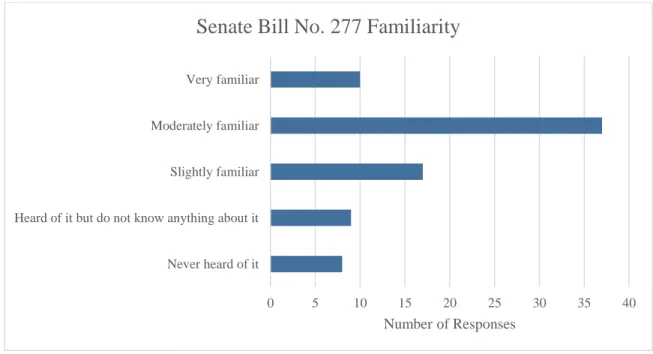
Senate Bill Number 277
Similar to the questions addressing the Disneyland outbreak, the portion of the survey dedicated to California Senate Bill Number 277 began by evaluating librarians’
familiarity with the bill. In this case, response options included “Never heard of it,”
“Heard of it but do not know anything about it,” “Slightly familiar,” “Moderately
familiar,” and “Very familiar.” These options were created because, unlike with the
Disneyland outbreak which was heavily reported on not only in California but globally,
the Senate Bill, even in California, may still dwell in the realm of obscurity. Those eight
(9.9%) of eighty-one individuals who had never heard of the bill were directed to the end
of the survey with no further questions asked. Nine (11.1%) respondents reported that
they had heard of the bill, seventeen (21%) were slightly familiar with the bill, and 10
(12.3%) were very familiar with the bill. The majority of participants (45.7%) indicated
mild familiarity with the bill. The graphical depiction of their responses is available in
Figure 3 Reported familiarity with Senate Bill Number 277
The remaining survey questions asked participants about the effects of the bill on
library policy:
Has your library system changed any existing policies as a result of Senate Bill
No. 277?
Has your library system created any new policies as a result of Senate Bill No.
277?
Has your library system eliminated any policies as a result of Senate Bill No.
277?
Does your library system currently plan to change any existing policies as a result
of Senate Bill No. 277?
Does your library system currently plan to create any new policies as a result of
Senate Bill No. 277?
Does your library system currently plan to eliminate any policies as a result of
Senate Bill No. 277?
0 5 10 15 20 25 30 35 40
Never heard of it Heard of it but do not know anything about it Slightly familiar Moderately familiar Very familiar
Do you anticipate that Senate Bill No. 277 will affect your library system's
policies in the future?
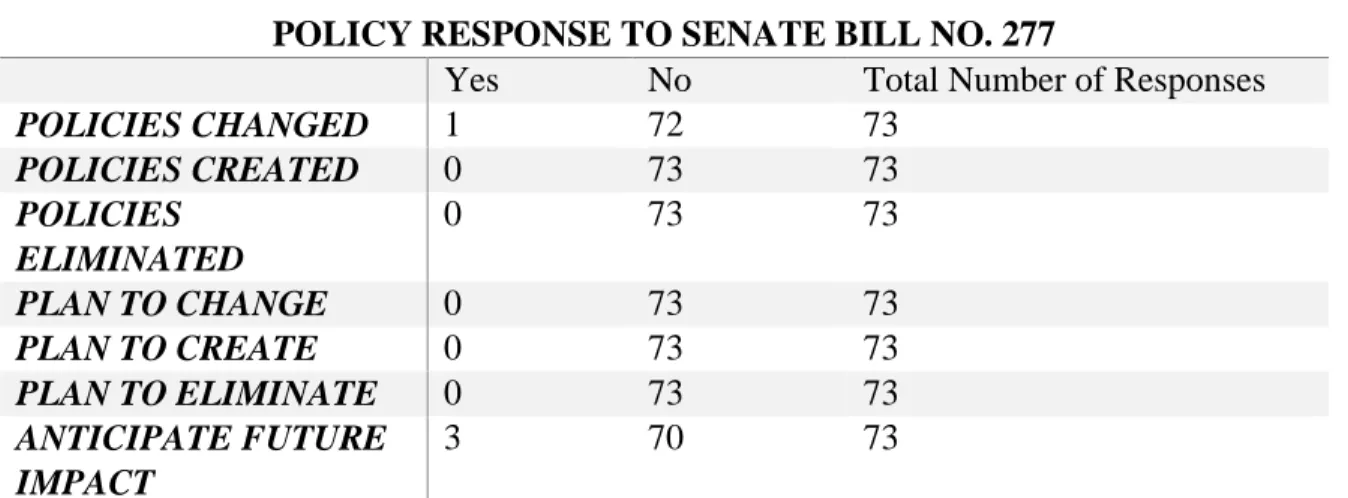
One (1.37%) librarian of the seventy-three directed to the remaining questions said that
changes had been made to an existing policy or existing policies in light of the bill. This
was not the same librarian that reported changes due to the Disneyland outbreak;
however, no further explanation of the changes was given. No districts plan to change
policies because of the bill. No libraries created any new policies as a result of the bill nor
do they plan on creating new policies as a result of it. Likewise, zero libraries reported
eliminating existing policies because of the bill, and zero plan on eliminating any because
of it. As with the Disneyland outbreak, three districts (4.11%) anticipate that Senate Bill
Number 277 will affect their systems’ policies in the future. Table 3 breaks down the
responses to policy questions regarding the bill.
POLICY RESPONSE TO SENATE BILL NO. 277
Yes No Total Number of Responses
POLICIES CHANGED 1 72 73
POLICIES CREATED 0 73 73
POLICIES ELIMINATED
0 73 73
PLAN TO CHANGE 0 73 73
PLAN TO CREATE 0 73 73
PLAN TO ELIMINATE 0 73 73
ANTICIPATE FUTURE IMPACT
3 70 73
Table 3 Breakdown of responses to questions regarding the effect of Senate Bill No. 277 on library system policies
Participants indicated that areas of librarianship other than policies were affected
by the Senate Bill. Multiple options were once again available for this question. One
district cited changes to program development, two to collection development, four to
concerns. Figure 2 above describes these reported aspects, including policies, for both the
Senate Bill and Disneyland outbreak.
The final survey question, answered by 72 participants, asked if patrons have
requested the library make changes in response to Senate Bill Number 277. One librarian
acknowledged patrons have asked that the corresponding library system make changes as
a result of the bill. This response, along with the responses from the same question for the
Discussion
Before examining the direct effects of the two major events in question, it was important
to establish a baseline of measles exposure and pre-existing policies for participating
library districts. In terms of outbreaks in the last five years, it was not surprising to the
researcher to see that some of the participating systems had experienced outbreaks. It
was, however, somewhat unexpected that nearly as many, 11 compared to 12
participants, did not know if an outbreak had occurred within their service area. There are
numerous reasons why this might be the case, but it does seem to the researcher that the
directors, county librarians, and city librarians should be informed of the events in their
community, including those pertaining to public health, to the best of their ability. It is
important to note, though, that some of the librarians invited to participate were either
new to their role or filling in on an interim basis. When asked about existing policies in
relation to sick patrons, one librarian remarked that the system has “approached the local
health officer regarding potential infectious patrons and let him handle the issue.” The
one librarian whose district already had a vaccination-related policy conveyed that said
policy “[does] not allow medical procedures, including vaccines, on site” and “is mostly
in place related to appropriate use of conference rooms.” These responses set the stage
for event specific policies, letting the researcher know that, among the participating
libraries, there was little in place before the events pertaining to vaccine-preventable
The survey of California public library systems set out to answer the following
questions:
1. Have the 2015 Disneyland measles outbreak and Senate Bill Number 277 affected public library policies in California?
2. If so, how have public library policies been affected?
Among the 81 librarians who responded to the questions regarding changing, creating, or
eliminating policies in response to the Disneyland outbreaks, 80 library systems made no
changes, additions, or eliminations. Only one library system changed an existing policy
or policies, and, unfortunately, this library did not elaborate on the changes when
prompted to do so. From this it can be gleaned that at least one library system in
California changed at least one policy due to the outbreak, but it is impossible to know
the extent of that change without further explanation from the participant. No librarians
who participated in the survey reported any new policies, eliminated policies, nor plans to
change, add, or eliminate policies, despite slightly more than 93.8% of the respondents
feeling slightly, moderately, or very familiar with the event. Three do anticipate an
impact of policies in the future though. When asked to elaborate on future effects, one
librarian stated, “We are in California. We know that we have some issues with immunity
and vaccine coverage. We will need to think about how we can manage our foot traffic if there is a local outbreak in our service area.” Another echoed a similar sentiment, noting
that “[c]hanges will be based on information from our emergency management
department and what they deem necessary to include in future policy.” The third librarian
who expects an impact is already “working more closely with [the local] health
who may have been exposed to a communicable disease at one [of the library’s events].”
That system is also working towards accurate and timely identification of communicable
diseases in its libraries. These three responses suggest that while policy impacts are
uncommon among survey participants at this time, the event could potentially affect
library policies in the future, especially if vaccination rates continue to drop and
outbreaks continue to occur. Another factor that could play into whether the Disneyland
outbreak affects policies in the future arises from library patrons. Three participants have
had patrons ask for changes because of the outbreak. If more districts begin receiving
requests from patrons, they will eventually have to respond to the requests of the public
in some way. Libraries should at least consider policies as one way of addressing such
requests for change.
As with the Disneyland outbreak, only one librarian answered that at least one
existing policy had changed as a result of Senate Bill Number 277. In this instance, only
73 librarians were asked to respond to questions regarding changes, additions,
eliminations, and plans for changes, additions, or limitations. As stated in the Results
section of this paper, those who indicated that they had never heard of the Senate Bill
were directed to the end of the survey with no further questions asked. Once again, the
librarian who answered that a policy had changed did not provide any elaboration when
prompted to do so. Therefore, the results show that at least one library in the state has had
policies or a policy affected, but the nature of the effect remains unclear. In the case of
the bill, 79% of participants felt slightly, moderately, or very familiar with the event. It is
not surprising to the researcher that this percentage is lower than that associated with
attention that the outbreak associated with the brand name Disney did. In addition to only
one librarian reporting policy change, no librarians created new policies, eliminated
existing policies, or planned to change, add, or eliminate. Once more, three of the
seventy-three respondents do anticipate an effect from the bill in the future. While two of
these respondents cited keeping “in compliance [with] legal mandates” and “most likely
develop[ing] policies that reflect the intent of the Senate Bill,” one librarian saw a vastly
different impact. When asked to elaborate on future effects, this librarian said, “More
families may choose to homeschool their children, which may lead to an increase in the
number of children and groups utilizing the library in the earlier hours of the day.” In that
particular case, policies addressing use of library space may need to be amended to
ensure that these homeschooled children have a quiet, safe place to work. The researcher,
possibly due to personal bias, expected any detailed response to comment on policies
related to public health. The remark on the possible increase in the number of children
being homeschooled, however, highlights the complex nature of possible impact of the
Senate Bill on public libraries.
As mentioned previously, public libraries exist to provide services to their
communities without discrimination. However, they are also primarily administered at
the county or city level. This suggests that Californian public libraries could be put into a
precarious situation wherein they must comply with any local regulations while also
maintaining services for individuals who may feel targeted by those regulations. One librarian pointed out that “[i]t is a very fine line between patron rights and public safety.”
The possibility exists that this line is in part responsible for the library systems that
policies relating to vaccines or vaccine-preventable diseases. Although the survey did not
provide the option to elaborate when a question was answered with “no,” one librarian
sent a personal email to the researcher in order to share the answer to an inquiry about
policies for unvaccinated children from a different library district. The researcher asked
for and was granted permission to share the following as it speaks directly to the dichotomy of the library’s duty to individual patrons and the patron population:
In a nutshell the policy is “we don’t discriminate.” We did not bar people with HIV or that happened to be [homosexual] when everyone was frothing at the mouth about the AIDS epidemic, we did not shun people that spoke Chinese and had a cough when everyone was frantic about SARS, we did not kick people out that had immigrated from Africa when everyone was going on about Ebola, and we certainly do not post signs during flu season saying that if you have not had your flu vaccination for the year you can’t come in (even though this is this is statistically far more of a risk to your baby in [story time] than someone without a measles vaccination).
The Library’s role is not to “protect” one class of people from another (in this case the “vaccinated” from the “unvaccinated”, although any “us [versus] them” can be inserted here).The [L]ibrary’s role is to provide access to all classes [of] people. If you are considering drawing a line in the sand based on a statistically tiny number of actual cases of measles and the mindset that every unvaccinated child is just some ticking time bomb waiting to explode (which is biologically untrue), then how will you move that line in the future? Will future lines be veiled as “medical security”, “national security”, or some other “security”? Which “them” will it aim to exclude?
As the response expresses, the public library exists for everyone in its community, and, if
the library is to be a safe place for one patron, it must be a safe place for all of them. The
situation becomes even more complex when patrons ask for change based on events such
as the Disneyland outbreak and Senate Bill, which the survey reveals has happened in at
least three systems for the outbreak and at least one system for the bill. Setting up
specific policies, rather than tackling instances of communicable illnesses, vaccines, or
other sensitive topics on a case-by-case basis, could ease the stress on the librarians
respond to patron or staff inquiries. While creating these policies would certainly take a
great deal of thought and planning, they could go a long way to, at the very least, keep
patrons aware of the health happenings in their library or set up an appropriate plan of
action in the event a public health emergency takes place in the library setting.
Another option available to libraries who feel stuck between protecting rights and
protecting public safety is collaboration with local public health departments. In this way,
libraries can provide accurate, timely information about vaccines and vaccine-preventable
diseases to their patrons. This approach allows for quality information to be disseminated
in the neutral environment cultivated by public libraries. A patron may be inclined to
review information about vaccines in the trusted library that said patron would have overlooked in a more intimidating, stressful, or unfamiliar environment such as a doctor’s
office or the public health department. Offering educational materials to patrons provides
libraries with the opportunity to contribute to public health in their communities without
encroaching on the individual rights of the patrons, because the patrons maintain the
ability to make their own decisions regarding immunization and their families. Both
policy creation and collaboration could contribute to the other aspects of librarianship
that were selected by participants as having been affected by the Disneyland outbreak and
Senate Bill such as program development; collection development; reference and user
services; and administrative tasks. Some possibilities of how policies could be used
include:
guiding development of programs on “hot” or controversial topics;
outlining when material on major events or the subjects of major events should be
detailing best practice of how to discuss “hot” or controversial topics with
patrons;
or supplying a framework, similar to a disaster plan, for library operations during
public health events.
Public health officials, through collaboration, could play a major role in developing
policies as well as contributing to programs, consulting on the quality of material for the
collection, training staff to discuss public health events, or preparing staff for public
health emergencies. While some libraries indicated budding or future partnerships, it
would probably benefit all public libraries and public health departments to develop close
relationships. For libraries, collaboration means protecting patron rights while still
keeping them abreast of public health issues. For health departments, it represents another
avenue for reaching community members and improving public health.
Limitations
California is unique from other states in that it has been at the center of the vaccine
debate for quite some time; therefore, responses and understanding of the events which
inspired the survey could be drastically different in another part of the country which has
seen few or no outbreaks of vaccine-preventable diseases. By not surveying each
individual library in the state, it is impossible to know exactly what efforts have been
taken, are being taken, or will be taken in response to the events. It is for these reasons
that the researcher never attempts to generalize the survey results.
The recency of the events in question, while ensuring that they are fresh in the
minds of many, may be the reason why they have not had much impact on the
went into effect mere days before the survey link was emailed to the sample, timing could
have played a part in why some of the participants had never heard of or were unfamiliar
with the Senate Bill and its implications for unvaccinated school children. As the bill
does apply to the entire state of California, it may be informative to inspect any impact on
public libraries after the bill has been in effect for a few years.
When researching any controversial topic, it is impossible to completely eliminate
personal bias on the part of the researcher and respondents. Although the researcher
attempted to build the survey free of bias, it may still have influenced what questions
were asked or how they were asked. Personal bias surely underscored the researcher’s
initial viewing of the responses at least in part. Likewise, personal biases and
self-reporting on the part of the respondents could have influenced how they read a particular
question. Furthermore, beliefs about the subject matter might have contributed to whether
or not those initially sampled elected to participate. Among those who did choose to
participate, their own feelings toward vaccinations or understanding of them might
determine what, if any, actions are taken in their systems. Strong beliefs may have led to
self-selection bias in terms of who chose to respond. Future researchers interested in this
Conclusion
In consideration of decreasing vaccination rates and increasing instances of
vaccine-preventable diseases, the researcher undertook a study to determine the effects of
public health events on public library policy. A review of the literature exposed a gap in
the literature concerning the role that major public health events play in the development
of public library policy. To begin addressing this gap, a survey was disseminated to 179
library directors, county librarians, and city librarians representing each of California’s
public library districts in order to determine whether public library policies in the state of
California have been affected by the 2015 Disneyland measles outbreak or Senate Bill
Number 277. Although the survey reveals that public library policies in California have
seen little effect from the Disneyland measles outbreak and Senate Bill thus far, at least
among survey participants, this does not mean that further research on the subject is
unwarranted. Quite the contrary is true. This research lays the groundwork for future
inquiries both of the public libraries in California as well the public libraries in other
states and possibly other countries where anti-vaccination sentiments are prevalent or on
the rise.
The next step for researchers interested specifically in California’s libraries is to
find out precisely why policies have not been more widely affected. At this time, it
remains unclear as to what factor or factors are responsible. It may also be beneficial to
response to the events addressed in the survey and work directly with that library to
evaluate what policies are currently in place that could be changed or eliminated as well
as conceive new policies that promote public health in the library while maintaining the
neutral, welcoming environment for which public libraries are known. A similar project
could explore the efforts of a library system in a hotspot of decreasing vaccination
compared to one in an area known for higher vaccination rates.
As the survey results reveal that other aspects of librarianship have been affected
by the Disneyland outbreak and Senate Bill, the researcher feels it is worth exploring
how, in particular, collection development; reference and user services; program
development; and administrative tasks have been affected. Any changes to these areas of
public library practice could potentially inform the development of new policies
pertaining to public health event response or response to other community events.
Public libraries act as community anchors, and part of anchoring a particular
community involves understanding not only what community members want but also
what they need, and what is missing from the resources currently available to them. To
meet these wants and needs, to fill the gaps, library directors, county librarians, and city
librarians, must have intimate familiarity with their patrons and the happenings within the
community. For large districts, this can be extremely difficult, since patrons from
different parts of the district are likely to have different wants and needs. Collaboration
once again presents a solution to this obstacle. Partnerships with government agencies
and other community-driven institutions such as civic centers, recreation centers, and
district. When it comes to protecting both the individual rights of patrons as well as
protecting the community as a whole, partnerships cannot be overstressed.
Perhaps public libraries have not actively responded to declining vaccination rates
as of yet, but it seems unlikely that this will remain the case forever. If globally
broadcasted outbreaks of vaccine-preventable disease continue to occur and more states
adopt stricter immunization laws, a day may come when local governments feel the
pressure to institute regulations or mandates pertaining to the entities they manage such
as public libraries for the sake of public safety similar to those regulations and mandates
concerning schools and school-aged children. As such, libraries would be better prepared
to protect the rights of patrons as laid out in the Library Bill of Rights if policies are
already in place to do so. Regardless of the future of vaccine-preventable disease
outbreaks and immunization laws in the United States, public libraries are uniquely
qualified to actively participate in and contribute to the health and safety of their
Bibliography
About Us. (n.d.). Retrieved from https://nnlm.gov/about.
Albright, K. S., & Gavigan, K. (2014). Information Vaccine: Using Graphic Novels as an
HIV/AIDS Prevention Resource for Young Adults. Journal of Education for
Library and Information Science, 55(2), 178.
Anti-vaxxer. (n.d.). Oxford Dictionaries. Retrieved from
http://www.oxforddictionaries.com/us/definition/american_english/anti-vaxxer.
Barbash, F. (2015, January 22). Disneyland measles outbreak strikes in anti-vaccination
hotbed of California. The Washington Post. Retrieved from
http://www.washingtonpost.com/news/morning-mix/wp/2015/01/22/disney-measles-outbreak-strikes-in-anti-vaccination-hotbed-of-california/.
Bishop, B. W., & Veil, S. R. (2013). Public Libraries as Post-Crisis Information Hubs.
Public Library Quarterly, 32(1), 33–45. http://doi.org/10.1080/
01616846.2013.760390.
Bradford, W. D., & Mandich, A. (2015). Some State Vaccination Laws Contribute To
Greater Exemption Rates And Disease Outbreaks In The United States. Health
Affairs, 34(8), 1383–1390. http://doi.org/10.1377/hlthaff.2014.1428.
Broering, N. C., Chauncey, G. A., & Miller, J. (2012). HIV/AIDS Health Information
Outreach Service in San Diego. Journal of Consumer Health On the Internet,