A SYSTEMATIC REVIEW OF BREASTFEEDING OUTCOMES AMONG GLOBALLY RESETTLED AFRICAN AND MIDDLE EASTERN REFUGEE WOMEN
by
Susanna E. Epling
A paper presented to the faculty of The University of North Carolina at Chapel Hill in partial fulfillment of the requirements for the degree of Master of Public Health in the Department of
Maternal and Child Health
Chapel Hill, North Carolina
DATE
Approved by: ____________________________
____________________________
2
Abstract
This paper systematically reviews the literature on breastfeeding outcomes and
challenges for resettled African and Middle Eastern refugee/immigrant mothers. It is crucial to
know what breastfeeding practices refugee women retain or adopt upon resettlement in their host
country, how these practices change over time, where and how to best intervene, and which
breastfeeding education/support is most needed. Thirty-two studies (18 observational, 16
qualitative) were included in this review. The findings indicate that there is a high breastfeeding
initiation rate, a high duration rate, and low breastfeeding exclusivity after resettlement. The
results also indicate a deterioration in breastfeeding initiation and duration practices the longer a
woman has been in her country of resettlement. Additional research is needed on breastfeeding
in Middle Eastern refugee women as well as appropriate interventions and strategies for
3
Table of Contents
ABSTRACT……….2
TABLE OF CONTENTS……….3
INTRODUCTION/BACKGROUND………..4
METHODS………..8
Search Strategy………8
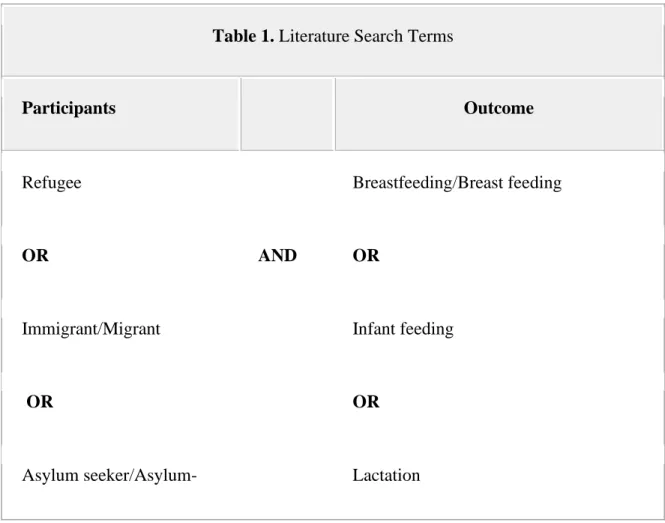
Table 1. Literature Search Terms……….8
Inclusion and Exclusion Criteria………..8
Data Analysis/Synthesis………...9
RESULTS………..10
Identification of Systematic Review Articles………10
Characteristics of Included Studies………10
Table 2. Characteristics of studies included in the review (n=34)……….12
Quality Appraisal………...16
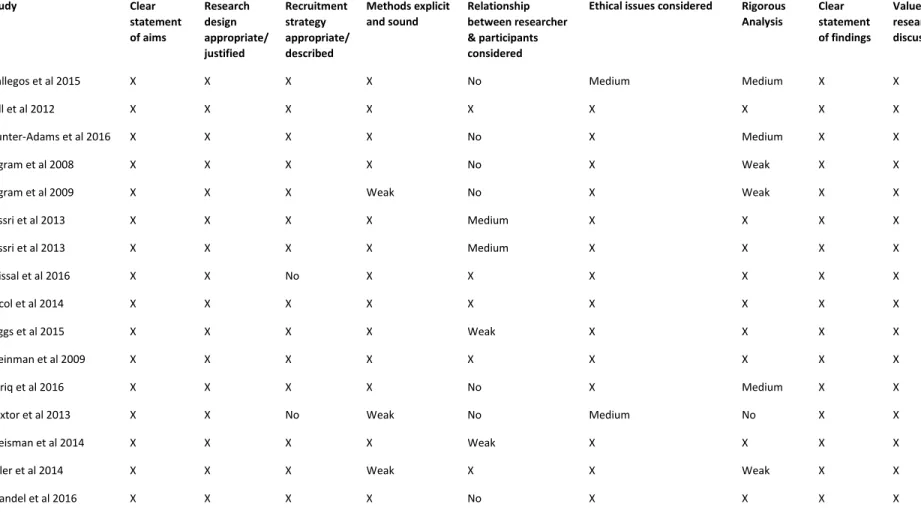
Table 3. Quality appraisal of included qualitative studies (n=16)……….18
Table 4. Quality appraisal of included observational studies (n=17)………19
Breastfeeding Initiation………..20
Breastfeeding Duration………..21
Breastfeeding Exclusivity………..22
Themes Identified………..24
Positive Attitude towards Breastfeeding………24
Exclusivity/Supplementation/Complementary Feeding………24
Acculturation………..26
Structural Issues……….26
Breastfeeding education/advice……….27
DISCUSSION………28
CONCLUSION/RECOMMENDATIONS………31
4
Introduction/Background
The aim of this systematic review was to examine the available literature on
breastfeeding outcomes and challenges for African and Middle Eastern refugee/immigrant
mothers resettled in (predominantly) developed countries. The particular outcomes of interest
were breastfeeding initiation, duration, and exclusivity, in addition to identified breastfeeding
challenges and barriers. The primary question guiding this review was: Do resettled
refugee/immigrant mothers from the Middle East and Africa have optimal levels of breastfeeding
initiation, duration, and/or exclusivity, and what are the barriers preventing optimal levels of
these outcomes?
The importance of breastfeeding in both affluent and resource-poor settings is widely
recognized in the world of global health. Since 2001, the World Health Organization has
recommended initiation of breastfeeding within one hour of birth, exclusive breastfeeding to six
months, and continued complementary breastfeeding until 2 years of age or beyond.1 In 2012
the World Health Assembly approved a Comprehensive Implementation Plan for Maternal,
Infant and Child Nutrition, which includes a goal of increasing exclusive breastfeeding rates to at
least 50% by 2025.2 The Every Woman Every Child movement begun by the UN in 2010 set
targets related to early childhood development linked to nutrition, including breastfeeding, and
also supports breastfeeding as a key priority in being able to achieve many of the new
Sustainable Development Goals.3 Furthermore, the recent Lancet breastfeeding series released in January 2016 has continued to highlight the ongoing relevance and importance of
breastfeeding in today’s world.
Another topic on the stage of global health and human rights in recent years is the
5 Turkey, Jordan, and Europe. Displacement and migration are key factors that disrupt
breastfeeding as recommended by the WHO. Refugees are a distinct category of immigrants
whose numbers are growing due to the ongoing unrest present in many parts of the world today,
in particular in Africa and the Middle East.4 In the mid-year 2016 UNHCR report, 8 out of the top 10 source countries for refugees were Middle Eastern and African countries, with Syria,
Afghanistan and Somalia accounting for 54% of all refugees worldwide. 5 Additionally, the vast
majority of these displaced people are women and children.5
Displaced peoples can choose to register through the UNHCR process and become
legally designated “refugees” eligible for resettlement to a third country.5 Not all countries
participate in the UNHCR resettlement program, but main participants include the United States,
Canada, Australia, and the Nordic countries.4 Refugees who opt for resettlement are referred to
one of these countries via UNHCR and are ultimately granted permanent settlement.6 Additional countries accept refugees through their own immigration/asylum-seeking processes such as
Germany, France, and the United Kingdom. This review broadly uses the terms refugees and
resettlement to refer to individuals displaced from their countries and living in new host
countries via either the UNHCR or other immigration processes.
Refugees face a unique combination of life stressors. Many refugees have suffered loss of
family members, possessions, and livelihoods.7,8 Refugees simultaneously encounter a change in
social structure and cultural support in leaving their home country to resettle in another nation.7,8 Refugee women, in particular, are often more vulnerable to isolation and a weakened support
structure upon resettlement, as the men are frequently those who become employed, learn the
6 Refugees also face challenges both in gaining access to healthcare and health information
in their country of resettlement. Language barriers can be challenging for many refugees seeking
to make health appointments or gain health education.9 Even when refugees do have contact with healthcare professionals, the health information given may not always be culturally
appropriate or understandable for refugees.9,10 Language again becomes a key barrier if a provider is unable to use interpretation services and has to rely on limited communication or
unprofessional interpreters such as the patient’s family members or friends.
As refugees are resettled in host countries, they also face the ongoing process and
challenge of acculturation that is present in the experience of any immigrant or migrant in a new
country. Refugees must navigate the acculturation process in which they voluntarily or
involuntarily begin to choose which pieces of their own culture are possible or desirable to
retain, and which pieces of the new host culture can be adopted in their new lives.11 There is a large body of literature discussing what is often called the “healthy immigrant” effect or the
“immigrant paradox”. The healthy immigrant effect refers to the phenomenon in which
immigrants typically have better health outcomes and health practices than the native-born
population. This effect has been found in immigrants in the U.S.,12,13 Canada,14,15 and Europe.16
In any health research conducted with migrants to a new country, in this case
breastfeeding outcomes with refugees, it is important to note this effect. Breastfeeding practices
in resettlement are likely a unique combination of both native country practices
(pre-resettlement) and host country practices (post-(pre-resettlement). It was hypothesized that most
literature would show recently resettled refugees having higher rates of breastfeeding initiation
7 refugees who had lived in the country of resettlement for longer periods of time. It was also
hypothesized that breastfeeding exclusivity would be low for refugees post-resettlement.
The basis for these hypotheses was a large body of literature/data on typical breastfeeding
outcomes in African and Middle Eastern countries, in combination with literature on the healthy
immigrant paradox. Refugees are coming from countries with typically very high rates of
breastfeeding initiation.17,18 Initiation is nearly universal in the African countries of interest (country selection detailed in Methods inclusion/exclusion criteria section), and also very high
(80-90% range) in countries such as Syria and Iraq.17 Breastfeeding duration is also
well-documented as being extensively long in these areas. Median duration in recent datasets for all
countries always exceeds 1 year, and in some countries is even longer than 2 years.17,18 In contrast, breastfeeding exclusivity is known to be relatively short in duration in Africa and the
Middle East. Early supplementation is common, and median lengths of exclusivity are typically
around 1-4 months in these areas.17,18
In light of these breastfeeding practices in the country of origin, it is crucial to know what
breastfeeding practices refugee women retain or adopt upon resettlement in their host country. It
is also important to determine how these practices change over time, where and how to best
intervene, and which breastfeeding education/support is most needed.
Methods
Search Strategy
A systematic search of 4 electronic databases (PubMed, Scopus, Anthropology Plus, and
Family & Society Studies Worldwide) was conducted in January 2017 using key search terms
8 also conducted via Google Scholar. The reference lists of included studies were also hand
searched. All study designs were eligible for inclusion.
Inclusion and Exclusion Criteria
Studies were included if they: (1) involved mothers aged 18 or older; (2) involved
mothers from the Middle East/Africa; (3) involved mothers who were identified as refugees,
immigrants, migrants, or asylum-seekers (4) assessed breastfeeding initiation, duration, or
exclusivity challenges and practices in resettlement (5) were published between January 2006
and 2017. The Middle East and Africa were specifically selected as these regions are the
primary sources of refugee populations in the last decade, and will continue to be the nations
Table 1. Literature Search Terms
Participants Outcome
Refugee Breastfeeding/Breast feeding
OR AND OR
Immigrant/Migrant Infant feeding
OR OR
Asylum
seeker/Asylum-seeker
9 from which displaced mothers are coming in the future (see Background on the current refugee
crisis). Specifically, studies were only included if they (a) stated that they included women from
a country of origin for refugees in the top 10 from 2006-2016 or (b) if they were large,
population-level studies that used a broad category such as “African” or “Middle Eastern”.4 “Middle East” was used to reference mothers from refugee top source countries: Syria, Iraq, Iran,
and Afghanistan. “African” was used to reference mothers from top refugee source countries:
Somalia, South Sudan, Sudan, Democratic Republic of the Congo, Eritrea, Burundi, and Central
African Republic.
Although the populations of specific interest in this literature review was
UNHCR-defined refugee women, this definition is not commonly known, and many different terms are
used to describe refugees without understanding the full legal context associated with each term.
For this reason, all terms that could potentially denote a refugee woman were included. Many
studies interchangeably used terms such as “immigrant” and “refugee” or clearly discussed
refugee women (i.e. from Somalia) but did not refer to a legal status. I felt that requiring a study
to correctly use legal terminology would unnecessarily limit relevant studies with the relevant
populations of interest.
All major outcomes of breastfeeding (initiation, duration, and exclusivity) were included
to identify which area(s) are particularly of relevance for displaced populations. The cut-off year
of 2006 was selected as the populations and characteristics of refugees are constantly shifting,
and this literature review sought to identify the most current information (i.e. from the past
decade) to inform future practice with similar refugee groups in the future.
Studies were excluded if they (1) reported on refugee mothers not from the
10 countries/regions that were not yet resettled in a host country (i.e. in women still in a refugee
camp or protracted emergency setting). I did not exclude any studies based on the country of
resettlement, although most refugees do primarily resettle in developed countries. Of the selected
studies, the only host country that is not considered to be “developed” is Jordan. Two studies
were included from this host country, as many Middle Eastern refugees are resettling there, and
also due to the extreme lack of literature on breastfeeding with resettled Middle Eastern refugees.
I reviewed the title and abstract of each article for relevance against the inclusion and
exclusion criteria. The full texts of potentially eligible articles were retrieved and assessed to
determine eligibility. Of the studies identified in the systematic search, 34 met the inclusion
criteria.
Data Analysis/Synthesis
For quantitative studies, characteristics and findings across the predominant outcomes of
interest (i.e. breastfeeding initiation, duration, and exclusivity) were synthesized narratively.
Qualitative studies that also included a quantitative reporting on these outcomes were included in
the quantitative narrate synthesis.
For qualitative studies, thematic analysis was conducted by identifying common themes
from the results reported and according to the primary outcomes of the research. I noted each
theme identified by any study with a qualitative component and assessed which themes were
common across studies. Themes identified in at least 3 studies were considered noteworthy and
were reported in the results.
11 Based on the PubMed, Scopus, Anthropology Plus, Family & Society Studies
Worldwide, and Google Scholar search using the search terms outlined in Table 1, I found
articles of relevance. After the title and abstract screening of the articles, I excluded articles that
did not fit the inclusion criteria. Articles were often excluded due to discussing refugee
populations outside of the scope of this review, discussing African American and not African
populations, or discussing refugee populations still in emergency settings such as refugee camps
or displaced locations within their home countries.
I screened the remaining articles by reading the full text of each article and further
excluding articles that did not meet the inclusion criteria. With the remaining studies I then read
all of the reference lists to identify any further studies missed from the database/Google Scholar
searches. The final number of studies was 34.
Results
Characteristics of Included Studies
Table 2 summarizes the characteristics including sample size, study setting, population
nationality, study aim, study method, and exposure/outcomes of interest. Around 50% (n=16) of
the studies were qualitative and 50% (n=18) were observational studies (cross-sectional and
cohort). The main study locations were in developed/industrialized resettlement countries such as
the United States (n=8), Australia (n=6), the United Kingdom (n=5), Canada (n=5) and other
European countries (Denmark (n=1) Ireland (n=2) Italy (n=1) Norway (n=2) Spain (n=1)
Switzerland (n=1)). Germany, a country currently receiving the highest number of new asylum
applications worldwide,19 did not have any literature available on breastfeeding with immigrants
12 Africa). The ratio of quantitative to qualitative research for the top four resettlement countries
was: Australia 3:5, Canada 3:5, UK 1:5, and US 4:8. Research was more heavily weighted in
qualitative studies.
The main refugee/immigrant populations represented in studies were “African” (either
generally listed as Africa, sub-Saharan Africa, North Africa, non-native/foreign-born black)
(n=14), Somali (n=11), Iraqi (n=7), and Congolese (n=6). However, out of all the studies, only
10 included/were focused on Middle Eastern populations, while the majority (n=24) were
focused on African populations. None of the studies involving Middle Eastern participants were
with women from Syria. Of studies with African populations that listed specific populations
within the study (n=15) a majority (n=8) were specifically focused on Somali women. None of
the studies involving African participants were with women from Central African Republic,
Eritrea, or South Sudan. The number of participants in the qualitative studies ranged from 10 to
115 participants. Within the observational studies, the number of participants ranged from 80 to
267,468.
13
Table 2a. Characteristics of observational studies included in the review (n=18)
Author Year (Study Type) Location Population Nationality Population Study Aim Method
Bandyopadhyay et al 2010 (Cross sectional survey administered within randomized trial)
Australia The Middle East, Africa, North Africa, Europe, the former USSR, South Asia, South and Central America and the Caribbean
9796 Australia-born, 460 overseas born w/proficient English, 184 overseas-born w/less proficient English at 6 months postpartum in Victoria (Aug 2000-Feb 2002)
To compare the post-childbirth experiences of Australian-born and immigrant mothers from non-English speaking countries.
Postal survey part of a large community randomised trial
Busck-Rasmussen et al 2014 (Cross sectional-population level)
Denmark Iraq, Afghanistan; Turkey, Pakistan, Lebanon, Morocco; Denmark; Former Yugoslavia; Lebanon/Palestine; Other Nordic
Population based. 42420 infants born 2002–2009 and living in 18 selected Danish municipalities.
To describe breastfeeding practices and to compare the risk of suboptimal breastfeeding of women living in Denmark according to country of origin, and further to examine how socioeconomic position and duration of stay in the country affected this risk.
Data from the Danish Health
Visitor’s Child Health Database linked with data on maternal socio-demographic info from Danish population-covering registries.
Castro et al 2014 (Cross-sectional data from a cohort study)
Ireland African; Irish, Irish traveller, any other white background, any other black background, Chinese, any other Asian background, and other, including mixed background
11,134 mothers of nine-month-old infants in Ireland
To analyze differences in breastfeeding and complimentary feeding behaviors between Irish and non-Irish mothers residing in the ROI, as well as the role of acculturation on these behaviors, using the national longitudinal study, Growing Up in Ireland (GUI).
Cross-sectional data from Growing Up in Ireland, a nationally representative cohort study of 9-month-old infants residing in Ireland. Sampling frame from the Irish Child Benefit Registers.
Correa-Velez 2011 (Cross sectional; Mixed methods using chart audits and surveys with some qualitative questions)
Australia Sudan, Somalia, Burundi, DRC, Liberia, Ethiopia, Kenya, Sierra Leone
83 chart audits of African-born women who gave birth at MMH in 2006; 23 surveys of African-born women who gave birth at the MMH Brisbane hospital in 2007-08, & 168 hospital staff member surveys
To determine the key elements that characterize a best practice model of maternity care for women from refugee backgrounds
Consultations
with key stakeholders; 2006 hospital chart audit; Surveys (quant. & qual. Questions)
Dennis et al 2013 (Cohort) Canada Africa; Canada; Asia/Oceania; North America; Europe; Latin America
1,875 women in the Toronto, Montreal, & Vancouver areas (219 refugee, 454 asylum seeker, 588 non-refugee immigrant, 614 Canadian)
To examine and compare predictors of breastfeeding duration among migrant and Canadian-born women.
Longitudinal study in 12 hospitals. Questionnaires completed at 1 and 16 weeks postpartum.
Dennis et al 2014 (Cohort) Canada Africa; Canada; Asia/Oceania; North America; Europe; Latin America
1,875 women in the Toronto, Montreal, & Vancouver areas (219 refugee, 454 asylum seeker, 588 non-refugee immigrant, 614 Canadian)
To examine and compare predictors of breastfeeding exclusivity among migrant and Canadian-born women.
Longitudinal study in 12 hospitals. Questionnaires completed at 1 and 16 weeks postpartum.
Farchi et al 2016 (Cross sectional) Italy Africa; Central/Eastern Europe, South/Central America, Asia; Italy; industrialized countries
6506 women (18.7% immigrant) who had a healthy newborn in Lazio hospitals in the month of October (2006-2011)
To evaluate differences in breastfeeding initiation rates by maternal place of birth among women giving birth in one of 14 hospitals in Lazio, Italy, between 2006 and 2011.
14 Grewal et al 2015 (Cross sectional) Norway Somalia; Iraq 107 Somali-born mothers, 80
Iraqi-born mothers with a 6-month-old infant and living in 1/3 counties (March 2013- Feb 2014)
To examine breast-feeding and complementary feeding practices during the first 6 months of life among Norwegian infants of Somali and Iraqi family origin.
Semi-quantitative FFQ
Hawkins et al 2008 (Cohort) United Kingdom
black African; Arab; British/Irish white, Pakistani or Bangladeshi, black (black Caribbean, other black), Indian, other white (such as white European, North American), other
6478 British/Irish white mothers and 2110 mothers from ethnic minority groups
To compare health behaviors during pregnancy (smoking and alcohol consumption) & after birth (initiation and duration of breast feeding) between British/Irish white mothers & mothers from ethnic minority groups; to examine whether indicators of acculturation (generational status, language spoken at home, length of residency in the UK) were associated with these behaviors.
Housed within Millennium Cohort Study (September 2000-January 2005): prospective study of children born in the UK in the new century. First contact at child aged 9 months. Second contact child aged 3 years.
Lee et al 2009 (Cohort) United States Foreign-born black; Hispanic whites; non-Hispanic native-born African Americans; Puerto Ricans; other Hispanics
1,140 women attending prenatal care visits at Philadelphia Department of Public Health District Health Centers
To investigate how maternal sociodemographic & infant characteristics, household environment, & health behaviors are related to breastfeeding initiation and duration among low-income, inner-city mothers, with a specific focus on differences in breastfeeding behavior by race/ethnicity & nativity status.
Data from a community-based, longitudinal study of women in Philadelphia, PA (n=51,140); 1 prenatal interview and 2 postpartum interviews per woman
Madanet et al 2007 (Cross sectional)
Jordan Iraq 80 Iraqi refugee women,
currently residing in Amman, Jordan, ages 18+ who had given birth within the last year.
To evaluate the level of access of Iraqi refugee women to breastfeeding education and support, sources of education and support, and perceived barriers to breastfeeding by using the Theory of Planned Behavior.
Cross-sectional survey
McCarter-Spaulding 2009 (Cohort) United States Africa; United States 152 women of African descent (15 African, 137 African American) in postpartum hospitalization at a large urban hospital in New England
To determine whether breastfeeding self-efficacy predicts the duration and pattern of breastfeeding in a sample of Black women of African descent.
Interviewed at postpartum hospitalization, then followed monthly for 6 months or until complete weaning.
Merewood et al 2006 (Cross sectional)
United States Non-U.S. born black; White (U.S. born; non-U.S. born); Asian (non-U.S. born; non-non-U.S. born); Black, U.S. born; Hispanic (U.S. born; non-U.S. born)
67,884 singleton births in Massachusetts of children with a gestational age of >24 to < 42 weeks to mothers aged 15-39
To compare breastfeeding initiation rates among preterm and term infants in Massachusetts in 2002 and to determine the effect of maternal race/ethnicity and birthplace on breastfeeding initiation rates among term and preterm infants.
Electronic birth certificate data from Massachusetts Community Health Information Profile, an online dept. of public health database.
Merten et al 2007 (Cross sectional) Switzerland DRC; Somalia; Switzerland; Tunisia; Angola; Morocco; Brazil; Peru; Dominican Republic; Philippines; Sri Lanka; Thailand; Vietnam; Albania; Bosnia-Herzegovina; Croatia; Kosovo; Macedonia; Serbia /Montenegro; Turkey; Austria; France; Germany; Italy; Netherlands; Poland; Portugal; Russia; Spain; UK; U.S.
37332 mother-child pairs (29832 non-Swiss, 7500 Swiss) who delivered in Swiss Baby-Friendly Hospitals from 2000-2002
To investigate differences in reproductive health outcomes such as preterm deliveries, Caesarean sections, and breastfeeding initiation for mother-child pairs of various nationalities, and the influence of level of education.
Routinely collected monitoring data from Swiss Baby-Friendly Hospitals.
Neault et al 2007 (Cross sectional) United States Africa, Mexico, Central America, Caribbean, South America, Asia/Pac. Islands, Other
3,592 immigrant mothers (Sept 1998-June 2004) w/ infants aged 0-12 months in emergency depts or pediatric clinics in 6 sites (Baltimore;
To examine the associations between breastfeeding and child health outcomes among citizen infants of mothers immigrant to the United States.
15 Minneapolis; Washington, DC;
Boston; Little Rock; and LA)
Nolan et al 2014 (Cross sectional data from a cohort study)
Ireland Africa 9,700 infants (Infant Cohort);
7,200 children (Child Cohort)
To examine the evidence for a ‘healthy immigrant’
effect with respect to breastfeeding behaviour.
Nationally representative micro-data from two cohorts of children
Rio et al 2011 (Cross sectional) Spain sub-Saharan Africa; Spanish; Latin America; Eastern Europe; Morocco; Chinese; other
267,468 women w/ registered births in 2005-06 in Catalonia & Valencia
To explore the association between the
geographical origin of the women and the establishment of breastfeeding in Spanish hospitals.
Birth data
Wilson-Mitchell et al 2013 (Cross Sectional)
Canada Africa; Middle East; Others 453 uninsured & insured immigrant, refugee, & migrant women who delivered at 2 Greater Toronto Area hospitals between 2007-2010
To explore the relationships between insurance status and various perinatal outcomes.
Data from chart review of hospital medical records
Table 2b. Characteristics of qualitative studies included in the review (n=16)
Author Year (Study Type) Location Population Nationality Population Study Aim Method
Gallegos et al 2015 (Qualitative) Australia Liberia, Sierra Leone, Burundi, DRC 31 (3 Sierra Leone; 9 Liberia including 1 man; 4 Burundi; 15 DRC)
To explore the experience of breastfeeding among refugee women from Liberia, Sierra Leone, Burundi and the DRC living in two major capital cities in Australia.
Individual interviews or focus group discussion (participation in only one or the other)
Hill et al 2012 (Qualitative) United States Somalia 18 Somali women who were
more than 20 weeks pregnant or had recently delivered in the last 2 years
To describe Somali immigrant women’s health care
experiences and beliefs regarding pregnancy and birth in the United States.
Four focus group interviews
Hunter-Adams et al 2016 (Qualitative)
South Africa DRC, Somalia, Zimbabwe 23 Congolese, Somali and Zimbabwean mothers living in Cape Town (interviews) and 48 migrant Somalis, Congolese, & Zimbabwean men or women (9 focus group discussions; 3 w/men, 6 w/women).
To explore the perspectives of infant feeding amongst cross-border migrants in Cape Town, South Africa.
Semi-structured in-depth interviews and focus group discussions
Ingram et al 2008 (Qualitative) United Kingdom
Somalia, Afro-Caribbean, South Asia 23 mothers from Somali (5), Afro-Caribbean (3) & S. Asian (9) communities or young mothers (5), who had a baby within the previous 10-18
To explore the barriers to exclusive breastfeeding to 6 months with black and minority ethnic groups and with young mothers, and the strategies for overcoming these barriers, including peer support.
16 months & who had breastfed
for at least a few weeks
Ingram et al 2009 (Qualitative) United Kingdom
Somalia; United States 10 Somali residents and 10 community representatives & healthcare professionals.
To identify the health needs of the Somali community in Bristol.
Semi-structured interviews; Focus groups
Jessri et al 2013 (Qualitative mixed methods as provided a survey at end of FG)
Canada Iran; Iraq; Kuwait; Saudi Arabia 22 mothers born and raised in the Middle East (6 Iranian, 4 Iraqi, 6 Kuwaiti, 6 Saudi) with a healthy infant less than 1 year of age
To examine Arab & Iranian refugee/immigrant mothers’
experiences, perceptions and cultural norms that shape complementary feeding practices and their actual infant feeding practices after settlement in Canada, and the cultural considerations of health care professionals.
Focus groups (4)
Jessri et al 2013 (Qualitative mixed methods as provided a survey at
end of FG) Exploring…
Canada Iran; Iraq; Kuwait; Saudi Arabia 22 mothers born and raised in the Middle East (6 Iranian, 4 Iraqi, 6 Kuwaiti, 6 Saudi) with a healthy infant < 1 year
To examine the barriers to following complementary feeding guidelines among Middle Eastern mothers and the cultural considerations of practitioners from an emic perspective.
Focus groups (4)
Missal et al 2016 (Qualitative) United States Somalia 12 immigrant Somalis in a
Midwestern metropolitan area who birthed in the last 3 yrs
To explore Somali immigrant new mothers’ experience
of childbirth in Minnesota.
Semi-structured interviews
Nicol et al 2014 (Qualitative) Australia Iraq; Sudan; Afghanistan; DRC; Burundi;
Rwanda; Burma; Kuwait
39 parents, grandparents, guardians of humanitarian entrant or asylum-seeker children <5 yrs old from (Burma (16), Iraq/Kuwait (9), Sudan (5), Afghanistan (3), Burundi (2), DRC (2), Rwanda (2)) & 5 community nurses
To provide a deeper understanding of the refugee experience related to early oral health by exploring pre-school refugee families (i) understanding of ECC and child oral health, (ii) experiences of accessing dental services and (iii) barriers and enablers for achieving improved oral health.
Community based participatory qualitative methodology using focus groups
Riggs et al 2015 (Qualitative) Australia Assyrian Chaldean (N. Iraq), Iraq; Lebanon; Pakistan
115 migrants from Iraq, Lebanon, and Pakistan
To identify the sociocultural influences on child oral health in refugee and migrant communities.
Focus groups and semi-structured interviews
Steinman et al 2009 (Qualitative) United States Somalia 37 Somali mothers of at least one child < 19 months old, residing in the greater Seattle area
To explore Somali mothers’ beliefs and practices
around infant feeding and education, towards developing a culturally informed infant nutrition curriculum for health providers.
Focus groups
Tariq et al 2016 (Qualitative) United Kingdom
sub-Saharan Africa 23 HIV-positive African women
born in sub-Saharan Africa, who were pregnant or had recently given birth 2010-11
To examine, for the first time in the UK, decision-making about infant feeding among African women living with HIV.
Semi-structured interviews
Textor et al 2013 (Qualitative) United States Somalia; Mexico; United States 4 Mexican & 5 Somali immigrant women who birthed at this hospital in Minnesota (interviews). 10 supporting nurses & lactation educators (focus groups).
To examine whether cultural beliefs affect breastfeeding.
17 Treisman et al 2014 (Qualitative) United
Kingdom
Sudan, DRC, Rwanda, Uganda, Ivory Coast, Zimbabwe,
12 African women diagnosed with HIV during pregnancy living in the London vicinity
To explore the experience of African women living in the United Kingdom after being diagnosed with HIV during pregnancy.
Demographic questionnaire; Semi-structured interviews
Tyler et al 2014 (Qualitative) Australia Sudan 10 Sudanese refugee mothers
who birthed & breastfed both in Africa & Australia, & had the last baby within the past 2 yrs
To highlight and compare immigrant Sudanese women’s infant feeding choices and patterns before and after moving to a regional city in Queensland, Australia.
Semi-structured interviews
Wandel et al 2016 (Qualitative) Norway Somalia 43 Somali mothers in Oslo; 21
mothers of a 6 month old (±2 months) born in Norway (interviews). 22 mothers of a 24-mth-old (focus groups)
To explore infant feeding practices among Somali-born mothers in Norway, and the ways in which they navigate among different information sources.
18 Quality Appraisal
I assessed the quality and bias of each study in the review using different tools depending
on the study type (see Table 3). All of the included studies were either qualitative or
observational cohort or cross-sectional studies. For qualitative articles I used guidance from
Cochrane tools on assessing qualitative research (Hannes) as well as the Critical Appraisal Skills
Programme (CASP) Checklist.20,21 The quality assessment table for qualitative articles show assessment of bias within each article in regards to study aims, appropriate methodology,
appropriate research design, recruitment strategy, data collection, relationship between
researcher and participants, ethical issues, rigorous data analysis, a clear statement of findings,
and value of the research. For cross-sectional descriptive studies I utilized the Quality
Assessment Tool developed by the National Institute of Health.22 The quality assessment table
for these studies show assessment of study aims, recruitment, participant description,
measurement outcomes, data collection, and outcome analysis.
An area of strength across both quantitative and qualitative studies was that all studies
clearly defined a research question or had a clear statement of the aims of the study. The
observational studies (n=18) all clearly defined and specified their population, defined inclusion
and exclusion criteria, and selected their subjects from the same population during the same time
period. The vast majority had high participation rates as they were either population-level studies
(n=7) or had a greater than 50% response rate (n=9). Only three studies did not justify their
sample size or discuss its power, two had a weak justification, and the remainder (n=13) had
adequate or strong justification. The exposure of interest across the majority of studies (n=16)
was immigrant/nativity status. An area of weakness is that only seven studies did take into
19 factors of acculturation. A second area of weakness was that some studies (n=5) did not define
their breastfeeding outcome measures at all, or gave weak or vague definitions. Finally, six
studies did not measure or adjust for any confounders.
The qualitative studies (n=16) all clearly justified their reasons for selecting a qualitative
approach, gave a clear statement of their findings, and discussed the value of their research. An
area of weakness was in recruitment. Two studies did not describe their recruitment
methods/strategy at all. The remaining studies (n=14) did describe their recruitment methods,
but many (n=10) described recruitment heavily or solely reliant on authority/influential figures in
the participants’ lives (i.e. resettlement agencies, health providers, etc.). These studies did not
describe the potential for undue influence to be exerted by authority figures in pressuring
participants into participation for fear of loss of services or assistance. When working with such
a vulnerable population, this is a significant concern. A second area of weakness was the lack of
reflexivity or acknowledgment of potential bias on the part of the researcher (n=9). Two studies
did not describe consent, and 1 study only had ethics approval for one site of their focus groups.
Several (n=3) studies did not indicate that they had more than one analyst during the analysis
process, several more (n=4) had very weak descriptions of their analysis methods, and one study
20
Table 3. Quality Appraisal of included qualitative studies (n=16)
Study Clear statement of aims
Research design appropriate/ justified
Recruitment strategy appropriate/ described
Methods explicit and sound
Relationship between researcher & participants considered
Ethical issues considered Rigorous Analysis
Clear statement of findings
Value of research discussed
Gallegos et al 2015 X X X X No Medium Medium X X
Hill et al 2012 X X X X X X X X X
Hunter-Adams et al 2016 X X X X No X Medium X X
Ingram et al 2008 X X X X No X Weak X X
Ingram et al 2009 X X X Weak No X Weak X X
Jessri et al 2013 X X X X Medium X X X X
Jessri et al 2013 X X X X Medium X X X X
Missal et al 2016 X X No X X X X X X
Nicol et al 2014 X X X X X X X X X
Riggs et al 2015 X X X X Weak X X X X
Steinman et al 2009 X X X X X X X X X
Tariq et al 2016 X X X X No X Medium X X
Textor et al 2013 X X No Weak No Medium No X X
Treisman et al 2014 X X X X Weak X X X X
Tyler et al 2014 X X X Weak X X Weak X X
21
Table 4. Quality appraisal of included observational studies (n=17)
Study: Research question clearly stated Population specified and defined Participation rate >=50% Subjects selected from same/similar population during same time period Inclusion/Exclusion prespecified & uniform
Sample size justification, power description, or variance/effect estimates provided Mention different levels of exposure as related to outcome Exposure measures defined, valid, reliable, and consistently implemented Outcome measures clearly defined, valid, reliable and consistently implemented Confounders measured and statistically adjusted
Bandyopadhyay et al 2010 (Cross sectional survey within randomized trial)
X X 60.5% X X Weak No X X Medium
Busck-Rasmussen et al 2014 (Cross sectional-population level)
X X N/A X X X X X X X
Castro et al 2014 (Cross-sectional data from a cohort study)
X X 69% X X X X X X X
Correa-Velez 2011 (Cross-sectional)
X X 95.8%
refugees, 26.4% healthcare workers
X X X No X No No
Dennis et al 2013 (Cohort)
X X 82.10% X X X X X X Weak
Dennis et al 2014 (Cohort)
X X 82.10% X X X X X X X
Farchi et al 2016 (Cross- sectional)
X X N/A X X No Weak X X X
Grewal et al 2015 (Cross sectional)
X X No X X X X X X X
Hawkins et al 2008 (Cohort)
X X 79% X X X X X X X
22 Madanet et al 2007
(Cross sectional)
X X No X X No No Weak Weak No
McCarter-Spaulding 2009 (Cohort)
X X 59% X X No X X X No
Merewood et al 2006 (Cross sectional)
X X N/A X X X No X Weak X
Merten et al 2007 (Cross sectional)
X X N/A X X X No X X X
Neault et al 2007 (Cross sectional)
X X 80% X X X X Weak X X
Nolan et al 2014 (Cross sectional)
X X N/A X X X X X X X
Rio et al 2011 (Cross sectional)
X X N/A X X X No X No X
Wilson-Mitchell et al 2013 (Cross Sectional)
23 Breastfeeding Initiation
Quantitative studies measuring breastfeeding initiation rates (initiating at all versus not
initiating) overall reported high levels of initiation in refugee women. Two studies in the
U.S.23,24 reported initiation rates of 88.1% and 81.3% for African immigrants, in addition to studies in Canada,25 the UK 26and Ireland 27which also reported initiation rates in the 80’s. Two Norwegian studies reported 93% initiation rates for Somalis and Iraqis and another a 100%
initiation rate for Somalis.28,29Studies in Ireland,30 Switzerland,31 Spain,32 Australia,33-35 and Canada36 also reported initiation rates ranging from 90% to universal initiation.
Six studies specifically presented findings that refugees/immigrants are more likely to
initiate breastfeeding than mothers in populations in country of resettlement including the U.K,
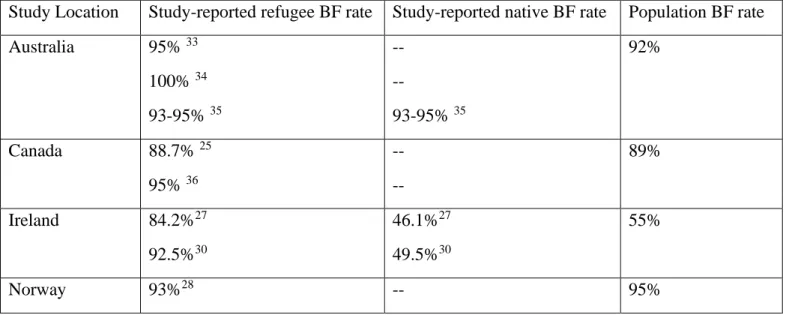
26the U.S.,24,37 Spain, 32Ireland,27 and Switzerland31. Table 4 summarizes the breastfeeding
initiation rates presented in the studies for immigrant and host groups, in comparison to
national-level initiation rates.
Table 4. Study-reported breastfeeding initiation rates for refugee/immigrants & natives, & population rates38
Study Location Study-reported refugee BF rate Study-reported native BF rate Population BF rate
Australia 95% 33
100% 34 93-95% 35
--
--
93-95% 35
92%
Canada 88.7% 25
95% 36
--
--
89%
Ireland 84.2%27
92.5%30
46.1%27 49.5%30
55%
24
100%29 --
Spain 90%32 80.3%32 77%
Switzerland 94%31 92%31 94%
United Kingdom 86%26 69%26 81%
United States 88.1%23
81.3%24
--
68%24
79%
Two studies reported that there were not significant differences in breastfeeding initiation
rates between immigrant/ethnic groups. In Italy, a population-level study showed no significant
ethnic differences in initiation between non-Italian immigrant/refugee groups.39 In Australia, another study showed high initiation across all immigrant/refugee groups with no significant
difference between the groups.35 These findings are particularly salient in light of the many studies that did show a significant difference between ethnic minority/refugee initiation rate and
the host population.
Multiple studies also measured levels of acculturation in immigrant women, either by
recording how long women had been in the country or by studying immigrants versus first or
second generation descendants. Although most of these studies examine exclusivity (discussed
below), Hawkins et al26 did find that first and second generation women were less likely to
initiate breastfeeding than recent immigrants to the U.K., and Castro et al30 and Nolan et al27also found that length of time in Ireland reduced significantly the odds of initiating breastfeeding.
Breastfeeding Duration
It is important to note for examining duration and exclusivity results in the studies that
25 in 2001. Several countries had prior standards of 4 months, and did not adopt the WHO
recommendation until a later time (such as 2005 in Canada and 2003 in the United Kingdom).
Some of the data collected in studies included in this review were from periods that still had a
national 4 month recommendation, which can lead to a discrepancy in measurement between
some studies in regards to duration and exclusivity.
A primary focus of breastfeeding studies with refugees/immigrants measuring duration
was in comparison to duration rates of the host country at the time of the study. Two quantitative
studies examined differences in breastfeeding duration between immigrant populations overall
(including African and Middle Eastern as ethnic categories) and the host country. In the United
Kingdom and Australia they found immigrants to be more likely to breastfeed than the host
population at 4 and 6 months respectively.26,35 Several studies in Canada and the U.S.
specifically reported on African populations, showing African mothers to be more likely to have
longer breastfeeding duration than their host population37,40,41
However, two studies in Norway and Denmark showed Somalis and Iraqis (in Norway)
and Afghanis (in Denmark) to be less likely than Norwegian and Danish mothers to be
breastfeeding at 6 and 4 months respectively.28,42 Both of these studies acknowledge that they
took place in countries that have relatively high rates of breastfeeding compared to the rest of
Europe, the United States, Canada, or Australia. Additionally, the study in Denmark did not
report an increased risk for total breastfeeding cessation with Iraqi refugees, and when an
adjusted model was run the risk of breastfeeding cessation for Afghanis disappeared as well.42
In addition to the acculturation effect they found with initiation (see previous section)
Busck-26 Rasmussen et42 al also observed an acculturation effect on breastfeeding duration, but the results
were less clear due to an unusually high breastfeeding duration rate in the host country,
Denmark. Several qualitative studies observed that mothers had strong intentions43 to breastfeed for 1-2 years and also reported/observed practices of breastfeeding for periods of time around 1-2
years.34,44
Breastfeeding Exclusivity
Twelve studies (6 qualitative, 6 quantitative) examined breastfeeding exclusivity in
refugee/immigrant women. In general, the studies showed low breastfeeding exclusivity among
refugee women, varied exclusivity at hospital discharge, and early introduction of foods and/or
liquids. As stated in the introduction, these practices would be expected based on native practices
in most Middle Eastern and African countries.
Two studies reported high (88-93%) breastfeeding exclusivity rates at discharge (usually
between 1.5 to 2 days after birth) among refugee women from the Middle East & Africa,25 and from Sudan, Somalia, Burundi, and the DRC.33 However, this measurement may be limited by
women’s understanding and self-reporting of exclusivity to nurses for entry into the hospital
records. Many themes identified in the subsequent section showed that practice and
understanding of exclusivity is likely very low. A more accurate measurement, defined as
nothing apart from breast milk until discharge, was reported in Switzerland with exclusivity rates
27 Only two studies in Norway and Canada examined exclusivity at four months and six
months, and reported rates of 7-44% exclusivity at four months for African and Iraqi
mothers,28,40 and rates of 0% for Somali and Iraqi mothers at six months.28 These studies also reported that refugee mothers reported lower exclusive breastfeeding rates than any other group40 and that early formula introduction was very common (34-44% by one month) 28Finally, one study in Ireland showed that around 15% of both Irish and African mothers were likely to
introduce foods early (prior to four months).30
Several qualitative studies also reported early introduction of food/drinks43, and very low
practice of exclusivity.36,45,46 One study specifically mentioned a low understanding of the term exclusivity, which upon explanation, led to zero refugee women as self-identifying as exclusive
breast-feeders from birth.29 Tyler et al34 reported lower use of formula in Africa versus in
resettlement in Australia.
Themes Identified
In addition to synthesizing quantitative results from the literature on breastfeeding
initiation, duration, and exclusivity, this systematic review also analyzed recurring themes
relating to breastfeeding as identified by refugee participants in the selected studies. Several
clear, dominant themes emerged and are described below.
Positive Attitude towards Breastfeeding
The strongest theme identified across the studies was that refugee/immigrant women
have a very positive view of breastfeeding. Eleven studies detailed participants specifically
stating that they believed breastfeeding to be good, were culturally supportive of the practice,
28 refugee women from: Liberia, Sierra Leone, Burundi, DRC, Somalia, Iran, Iraq, Afghanistan,
and Sudan who were resettled in Australia, South Africa, the U.S., Canada, Norway, and the
U.K.29,36,44,46-53
Also of interest is that there were zero refugee/immigrant women identified who stated
that breastfeeding was not good or who stated negative feelings towards having to breastfeed. In
fact, in two studies with HIV-positive African mothers, not being able to breastfeed in the U.K.
due to their HIV status was described by all participants as incredibly difficult, both emotionally
and culturally.52,53
Exclusivity/Supplementation/Complementary Feeding
A second predominant theme was the lack of agreement with, understanding of, or
practice of exclusive breastfeeding. Although formula was mentioned in relation to lack of
exclusivity, the majority of refugee/immigrant women identified
supplementation/complementary feeding in regards to non-formula liquids and foods such as
water, honey, sugar water, or solids. These practices are in line with native practices in Africa
and the Middle East prior to resettlement.
Five studies reported women who stated they felt the need to supplement (from Sudan,
Somalia, Burundi, and the DRC).29,45,47-49 Reasons for this need to supplement across studies included: not enough milk to feed the baby, colostrum not a good substance to feed a baby, the
desire to have very plump babies, and religious reasons for complementary feeding.
Eight studies reported women who believed they did not have enough milk to feed their
29 different specifically due to resettlement, and that dietary change or other environmental factors
caused them to have less breastmilk than they previously did in their home countries.34,48,51 Somali and Iraqi women also shared that they believed colostrum to be bad for the baby, and
thus had to feed the baby other foods until their milk came in.28,44,51
Women from Somalia and the DRC across five studies consistently shared that they
believed plump babies to be good. They discussed cultural pressure to have fat children. This
idea was often linked with statements about how wealth and plump babies were associated in
their home countries, and that in resettlement they now had the chance to adequately feed their
children.29,44,45,48,51
Finally, women from Iran, Iraq and Somalia across four studies mentioned Islam and its
association with complementary feeding.36,43,44,54 Women discussed wanting to be able to fast
during Ramadan, and the subsequent need they felt to supplement to ensure the baby received
enough food. Additionally, they mentioned feeding their babies either dates, honey, or
something sweet as soon as the baby was born, according to Muslim tradition.
Acculturation
The negative effects of acculturation and length of stay in the host country measured by
several quantitative studies in regards to initiation and duration26,27,30,42 are also supported by findings from several qualitative studies. Two studies report that mothers used formula to “fit in”
to a new host country that in which formula feeding is a social and cultural norm.34,48 Four studies reported women choosing to supplement with formula in resettlement solely due to the
30 using formula back in Africa due to money limitations and cultural norms, not due to a belief that
breastfeeding was inherently better or that formula was bad.29,34,47,48 Structural Issues
Women reported several structural and societal barriers to breastfeeding including
employment breastfeeding issues, a reluctance to publicly breastfeed, and lack of social support.
Several women highlighted the difficulty to work and breastfeed in South Africa and Canada,
citing this as a barrier to breastfeeding continuation.36,48 Additionally, women discussed reluctance or embarrassment to breastfeed in public because of lack of culturally appropriate
spaces and a perception that the host country population looked down on this practice and
breastfeeding in general.36,44,47,51
Finally, many women highlighted the lack of social support and social networks during
resettlement. This included feeling isolated from other women from their home country and
from host country women. Women often discussed the networks present for breastfeeding
mothers back in Africa or the Middle East, and how resettlement eliminated all of those
networks.29,35,36,54
Breastfeeding education/advice
A final thematic category identified in analysis was breastfeeding education/advice,
including: the value of breastfeeding education, conflicting advice from providers, choosing
community advice over providers advice, and barriers to accessing breastfeeding information and
services. Five studies reported similar results related to breastfeeding among refugee women
from Iraq and Somalia in which they indicated a strong desire for breastfeeding education from
31 discussed often receiving conflicting advice from providers (i.e. one nurse giving advice
different from another, etc.)36,44,51and this in turn leading to rejection of the provider advice altogether. They additionally shared a tendency to choose family or cultural community advice
over provider advice when the two were in conflict.29,36,44,55,56
Additionally, women from Sudan, Somalia, the DRC, Burundi, Iraq and Iran in eight
different studies all highlighted cultural and communication barriers to accessing breastfeeding
education and services.29,33,34,43,45,49,55,56 Cultural barriers were mentioned as a predominant issue. Women described breastfeeding advice from providers that did not take into account their
cultural background, religious ideology, or preferred feeding practices. Lack of interpretation
was also a barrier women listed, although written resources were not described as a barrier at all
(spoken advice was preferred). In two studies that interviewed health providers, the providers
also identified cultural and communication barriers as a key reason for not being able to
adequately give breastfeeding advice to refugee/immigrant women.33,51
Discussion
This systematic review is the first to investigate breastfeeding outcomes with resettled
refugee/immigrant women from Africa and the Middle East. The findings indicate that there is a
high breastfeeding initiation rate among these mothers, a high duration rate (relative to the
comparison host country rate), and low breastfeeding exclusivity. The results also indicate a
lower likelihood of breastfeeding as recommended by the WHO the longer a woman has been in
her country of resettlement, due to a variety of health communication, cultural, and structural
32 Although the largest amount of studies measured breastfeeding initiation (16 studies vs
10 for duration and 12 for exclusivity), the results suggest that breastfeeding initiation is actually
not the primary area of breastfeeding that is challenging for refugee women. Initiation appears to
remain strong for these women, even in spite of slight decreases over length of time in country.
The findings also suggest that duration may not be a primary area of struggle for refugee women.
The assessed literature suggested strong rates of duration.
In contrast, exclusivity from birth to six months is clearly an area where refugee women
from the Middle East and Africa have poorer outcomes than desired. This is not necessarily
related to their refugee status, but is likely a carryover of breastfeeding practices from their home
countries. One of the issues identified in this review is the lack of consistency in measuring
exclusivity and the need for exclusivity to be clearly defined to study participants both in order to
get accurate results in research, and for providers to be able to explain breastfeeding practices to
refugee women. Some studies measured exclusivity in terms of whether a woman used formula
or not. Others included solid food in the definition. Few studies were explicit about water,
honey, sugar drinks, etc. in regards to exclusivity. This oversight is particularly notable in the
qualitative research related to breastfeeding among refugee women from the Middle East and
African nations, as women reportedly supplementing with food and drink other than formula. In
light of the qualitative research and some of the quantitative studies, the results suggest that
breastfeeding exclusivity is extremely low, if practiced at all, in these populations.
Important additional themes identified in the analysis revolve around women’s desires to
have access to culturally relevant breastfeeding information, but the existence of many barriers
that keep them from doing so. Structural issues in countries of resettlement are suggestive of
33 evidence showing that breastfeeding initiation and duration outcomes worsen over time in
resettlement further demonstrate that systemic breastfeeding issues exist.
Although the studies included in this review represent an appropriate range of study
settings and study populations, limitations of the included studies are also evident. One limitation
of several studies included in the review are the massive grouping together of
ethnicities/nationalities. A study examining all African mothers versus a study on Somali
mothers specifically may have skewed results. Additionally, studies that grouped Middle
Eastern and African mothers together may not appropriately be doing so, as the difference in
breastfeeding practices between those two regions may be different in key ways. A second
limitation of studies is the varied definitions of breastfeeding outcomes. As previously
mentioned in the Results section, some studies defined duration to 4 months while others defined
it to 6 months. Some studies on exclusivity only mentioned formula supplementation, while
others had more extensive lists of potential complementary food/drink.
There are also several limitations of this systematic review, outside of the study
limitations. Just as studies may not be justified in lumping groups of different nationalities
together, it may be that grouping Middle Eastern and African women together in this review
could skew some of the results. Furthermore, the inclusion of descriptive studies in the review
makes quantifying qualitative results and grouping them with observational studies a potential
weakness. Another key limitation of the systematic review is that some of the presented findings
are based on exposures and outcomes that were often not the ‘main objective’ of the studies or
on anecdotal reports within the study findings. For example, two studies were specifically
34 Some of the strengths of this review include the use of multiple databases from different
disciplines outside of the traditional health sciences, including anthropology and sociology
databases. While including studies with several different breastfeeding exposures and outcomes
may be a limitation, it is also a strength as this review does not make any assumptions in regards
to which breastfeeding outcomes are most relevant for the desired population. Additionally,
because of the recent refugee influx over the last decade, only including studies from the last 10
years provides more relevant information to the current refugee populations and their struggles.
Conclusion/Recommendations
The results of this review have several implications for future research and for current
practitioners working with refugee women from the Middle East and Africa. First,
recommendations for future research are for additional research to fill in gaps with certain
populations and their breastfeeding outcomes. Women from many African countries, but
specifically women from Somalia, were well-represented in the literature, especially in
comparison to Middle Eastern women. There is an extreme lack of literature on Middle Eastern
refugee women and their breastfeeding challenges and outcomes. In particular, there was no
literature at all discussing resettled Syrian women and breastfeeding. As already highlighted,
Syria is the largest source of refugees and will likely continue to be so in the near future.
Resettlement countries already have received many Syrian women, and research is urgently
needed to assess their breastfeeding needs in resettlement.
Second, future research is also needed on appropriate interventions and strategies for
addressing breastfeeding disparities and for halting the “acculturation effect.” None of the
studies surveyed implemented or measured any kind of intervention or resource—all were
35 populations. We need to know appropriate ways to better implement breastfeeding education
(specifically on exclusivity) that is culturally relevant and understandable.
Finally, although there may not be evidence-based practices based on the literature to
recommend to practitioners, it is clear that even being aware of cultural norms can assist in
breastfeeding education. Health providers working in countries/areas where there are large
populations of African and Middle Eastern refugee women should be trained on cultural norms
and trends in breastfeeding with these populations. Incorporating understanding of feeding
practices and religious ideology will be immensely helpful in effectively reaching this
population. In conclusion, this review provides insight into the current breastfeeding status of
refugee/immigrant women from the Middle East and Africa, but also highlights the need for
additional research in several key gap areas.
References
1. Nutrition: Exclusive breastfeeding. World health organization website.
http://Www.who.int/nutrition/topics/exclusive_breastfeeding/en/. Accessed February 17, 2017.
2. World health assembly. Nutrition: Maternal, infant and young child nutrition: Draft
comprehensive implementation plan. http://Apps.who.int/gb/ebwha/pdf_files/WHA65/A65_11-en.pdf. published april 26, 2012. Accessed February 17, 2017.
3. Breastfeeding: A key to sustainable development. Every woman every child website. https://Www.everywomaneverychild.org/2016/08/05/breastfeeding-a-key-to-sustainable-development/. Published August 05, 2016. Accessed February 17, 2017.
4. Resettlement. UNHCR website. http://Www.unhcr.org/en-us/resettlement.html. Accessed February 23, 2017.
5. Mid-year trends 2016. UNHCR website.
36 6. U.S. refugee admissions program. U.S. department of state website.
http://Www.state.gov/j/prm/ra/admissions/index.htm Accessed February 24, 2017.
7. Hao L, Johnson RW. Economic, cultural, and social origins of emotional well-being. Res Aging. 2000;22(6):599-629. http://journals.sagepub.com/doi/abs/10.1177/0164027500226002. doi: 10.1177/0164027500226002.
8. Morris M, Sinnott J. Canadian research institute for the advancement of women website.
http://Www.criaw-icref.ca/sites/criaw/files/Immigrant%20%26%20Refugee%20Women%20Factsheet.pdf. published 2003. Accessed February 24, 2017.
9. Stewart M, Dennis CL, Kariwo M, et al. Challenges faced by refugee new parents from africa in canada. J Immigr Minor Health. 2015;17(4):1146-1156. doi: 10.1007/s10903-014-0062-3 [doi].
10. Guigne F, Duke P, Rourke L. Looking beyond literacy: Understanding and approaching barriers to refugee health in 2 cases of vitamin D-deficiency rickets. Can Fam Physician. 2013;59(6):607-608. doi: 59/6/607 [pii].
11. Schwartz SJ, Unger JB, Zamboanga BL, Szapocznik J. Rethinking the concept of acculturation: Implications for theory and research. Am Psychol. 2010;65(4):237-251.
https://auth.lib.unc.edu/ezproxy_auth.php?url=http://search.ebscohost.com/login.aspx?direct=tru e&db=pdh&AN=2010-08987-001&site=ehost-live&scope=site. doi: 10.1037/a0019330.
12. Argeseanu Cunningham S, Ruben JD, Narayan KM. Health of foreign-born people in the united states: A review. Health Place. 2008;14(4):623-635. doi:
10.1016/j.healthplace.2007.12.002 [doi].
13. Singh GK, Rodriguez-Lainz A, Kogan MD. Immigrant health inequalities in the united states: Use of eight major national data systems. ScientificWorldJournal. 2013;2013:512313. doi: 10.1155/2013/512313 [doi].
14. Beiser M. The health of immigrants and refugees in canada. Can J Public Health. 2005;96 Suppl 2:S30-44.
15. McDonald JT, Kennedy S. Insights into the 'healthy immigrant effect': Health status and health service use of immigrants to canada. Soc Sci Med. 2004;59(8):1613-1627. doi: 10.1016/j.socscimed.2004.02.004 [doi].
16. Moullan Y, Jusot F. Why is the 'healthy immigrant effect' different between european countries? Eur J Public Health. 2014;24 Suppl 1:80-86. doi: 10.1093/eurpub/cku112 [doi].
37 18. Where we work. demographic and health surveys DHS website.
http://Dhsprogram.com/where-we-work/country-list.cfm. Accessed march 23, 2017.
19. UNHCR global trends: Forced displacement in 2014.(2014, june). retrieved from http://Www.unhcr.org/556725e69.html#_ga=1.69381456.1983044706.1456002630.
20. Hannes K. chapter 4: Critical appraisal of qualitative research. in: Noyes J, booth A, hannes K, harden A, harris J, lewin S, lockwood C, eds. supplementary guidance for inclusion of qualitative research in cochrane systematic reviews of interventions. Version 1 (updated august 2011). Cochrane collaboration qualitative methods group; 2011.
http://Cqrmg.cochrane.org/supplemental-handbook-guidance. Accessed February 3, 2017.
21. Qualitative research checklist: 10 questions to help you make sense of qualitative research. Critical appraisal skills programme website.
http://Media.wix.com/ugd/dded87_29c5b002d99342f788c6ac670e49f274.pdf. Published May 2013. Accessed February 3, 2017.
22. Quality assessment tool for observational cohort and cross-sectional studies. National institutes of health website.
https://Www.nhlbi.nih.gov/health-pro/guidelines/in-develop/cardiovascular-risk-reduction/tools/cohort. Published March 2014. Accessed February 3, 2017.
23. Neault NB, Frank DA, Merewood A, et al. Breastfeeding and health outcomes among citizen infants of immigrant mothers. J Am Diet Assoc. 2007;107(12):2077-2086. doi:
S0002-8223(07)01801-9 [pii].
24. Merewood A, Brooks D, Bauchner H, MacAuley L, Mehta SD. Maternal birthplace and breastfeeding initiation among term and preterm infants: A statewide assessment for
massachusetts. Pediatrics. 2006;118(4):e1048-54. doi: 118/4/e1048 [pii].
25. Wilson-Mitchell K, Rummens JA. Perinatal outcomes of uninsured immigrant, refugee and migrant mothers and newborns living in toronto, canada. Int J Environ Res Public Health. 2013;10(6):2198-2213. doi: 10.3390/ijerph10062198 [doi].
26. Hawkins SS, Lamb K, Cole TJ, Law C, Millennium Cohort Study Child Health Group. Influence of moving to the UK on maternal health behaviours: Prospective cohort study. BMJ. 2008;336(7652):1052-1055. doi: 10.1136/bmj.39532.688877.25 [doi].
27. Nolan A, Layte R. The 'healthy immigrant effect': Breastfeeding behaviour in ireland. Eur J Public Health. 2015;25(4):626-631. doi: 10.1093/eurpub/cku177 [doi].