Assessing and Supporting Family Planning Innovation:
A Case Study of DKT Nigeria – Sayana Press
Alina Clarke Master’s Paper
Health Policy and Management University of North Carolina at Chapel Hill
2017-2018
Advisors:
Dr. Kristen Hassmiller Lich, PhD, MHA Associate Professor
Department of Health Policy and Management Gillings School of Global Public Health
University of North Carolina at Chapel Hill Dr. John Paul, PhD, MSPH
Professor
Department of Health Policy and Management Gillings School of Global Public Health
Abstract
DKT Nigeria is a nonprofit organization working to accelerate the uptake of a new injectable contraceptive, Sayana Press. DKT Nigeria integrates five innovative business activities (Social Marketing, Revenue Generation, Cross-Subsidization, Product Reengineering, and Optimized HR) across its
marketing, finance, and operating strategies to disseminate Sayana Press. This case study uses causal loop diagramming to synthesize data around the five innovative business activities in order to 1) Describe DKT Nigeria’s experience in executing its strategies for Sayana Press, and 2) Recommend additional data collection to further extend understanding of how to support the capacity of disruptive innovation for modern contraception uptake in Nigeria. The organization’s experience with Optimized
HR emerged as a key finding because of its relevance to the ability target non-consumption of modern contraception and capacity for market disruption. Recommendations for additional data collection and clarification are suggested as next steps to continue assessing and supporting the capacity for DKT
Nigeria’s disruptive innovation for Sayana Press uptake.
Introduction
Sub-Saharan Africa has the highest prevalence of unmet need for family planning with an
estimated 24% of women having the desire to delay or stop childbearing but reporting no contraceptive use (United Nations 2015). Despite technical advances in the quality and accessibility of family planning
methods, modern contraceptive products have failed to scale up for widespread use in Low and Middle Income Countries (LMICs), particularly in sub-Saharan Africa (Bradley et al., 2012). DKT targets this unmet need for family planning in LMICs by disseminating a variety of family planning products and
services through several different approaches. In Nigeria, one of the organization’s funded activities is to enhance uptake of Sayana Press, a new subcutaneous injectable contraceptive. DKT Nigeria’s
improve disseminate the product in a challenging setting. This case study seeks to analyze and define the “innovative-ness” of DKT Nigeria – Sayana Press using the theory of disruptive innovation and business model innovation.
The Theory of Disruptive Innovation and Business Model Innovation
The theory of disruptive innovation describes how different types of innovations address different user needs in a market. Sustaining innovations are newly invented products or services that are
better (higher quality or higher desirability) but are also more expensive than the incumbents
(Christensen, Raynor, & Mcdonald, 2015). Sustaining innovations tend to target higher end users market that are willing and able to pay more for a better product, ignoring the needs of lower-end users. In
contrast, new products or services that are not even marginally better than incumbents but still aim to target high end users are not innovative. Innovations with the capacity for market disruption are either
low end disruptions or new market disruptions. Low end disruptions provide a product or service that is good enough to meet users’ needs at a significantly lower price point than incumbents (Christensen et al., 2015). New market disruptions offer better products or services than incumbents and targets
non-consumption by meeting target users’ needs in a unique way, for example by making a process simpler or more convenient (Christensen et al., 2015).
Since low end disruptions and new market disruptions reach new and/or low-end users, the
business processes used to produce and/or disseminate the innovative product or service must often be re-organized in a unique and creative way (Christensen et al., 2015). These innovative business
processes, also known as business model innovation or BMI, can help facilitate disruptive innovation
non-consumption and facilitate access to health services for low-end users in a market (Bhattacharyya et al., 2010). Bhattacharyya et al. reviewed ten social enterprises that target poor populations (or low-end users) in LMICs and found that each enterprise integrated at least one “innovative” business activity
within its operating, finance, and marketing strategies (2010). The framework’s definition of BMI activities in LMICs is shown in Figure 1 in the Appendix. DKT Nigeria’s work with Sayana Press similarly integrates at least one innovative business activity across its marketing (Social Marketing), finance
(Revenue Generation and Cross-Subsidization), and operating (Product Reengineering and Optimized HR) strategies.
DKT Nigeria – Sayana Press
DKT Nigeria is a nonprofit organization that supports the dissemination and uptake of family planning services and products through 1) Private distribution channels through healthcare facilities and pharmacies, 2) Community-based distribution through its trained Community Health Extension Workers (CHEWs), known as DKT Bees, and 3) Social Marketing techniques. DKT Nigeria has been working to accelerate uptake of Sayana Press, in 7 southern Nigerian states (Lagos, Ekiti, Kwara, Ogun, Ondo, Osun, Oyo) since April 2015. DKT Nigeria receives grant funding for this work from the Bill and Melinda Gates Foundation, and the organization is evaluated within the portfolio supported by the Family Planning Country Action Process Evaluation at the Carolina Population Center.
Sayana Press is an innovative product that is more desirable (fewer side effects, smaller needle, easier administration) than its injectable incumbent Depo-Provera, and is more effective (lasts longer) than many other forms of family planning currently used in this setting. Sayana Press also costs more
affordability of the product to consumers, and thus may target non-consumption of modern
contraception with business model innovation. DKT Nigeria – Sayana Press may have the capacity to become a new market disruption.
This case study aims to appreciate DKT Nigeria’s integration of innovative business activities to enhance uptake of modern contraception in a challenging, LMIC context. This case study 1) Describes DKT Nigeria’s experience in executing its BMI strategies for Sayana Press, and 2) Recommends additional
data collection to further extend understanding of how to support the capacity of disruptive innovation for modern contraception uptake in Nigeria.
Methods
Document Review
A comprehensive document review of evaluation reports, System Support Maps, and grant
proposals was used to source the data for this case study. Data specifically pertaining to DKT Nigeria’s work to disseminate Sayana Press were included in analysis. Data were then organized according to relevance to each of the identified innovative business activities. Each data point was an association
describing the effect of a change in one activity/component on another.
Data Analysis
These associations were then used to develop four causal loop diagrams to visually represent
same or opposite effects of changes in one activity/component on another. Social Marketing, Product Reengineering, Optimized HR are the focal BMI activities for their own causal loop diagrams. DKT Nigeria’s experiences around Revenue Generation and Cross-subsidization for Sayana Press are
Data
Evaluation reports from the University of California, San Francisco provide insight into DKT Nigeria’s work with Sayana Press at two different time points. An overview report from the Bill and
Melinda Gates Foundation provide data on the aims of the program and the technical components of Sayana Press. DKT Nigeria’s grant proposal outline the program’s intended activities and aims. System Support Maps synthesize the supports, barriers, and wishes that Program Officers identified in their
reporting processes.
Institutional Review Board
The Institutional Review Board at the University of North Carolina at Chapel Hill deemed
FPCAPE’s research activities exempt from review.
Findings
DKT Nigeria’s experiences carrying out each of its five BMI activities are depicted in the four
causal loop diagrams in Figures 2-5 located in the Appendix. The invention of Sayana Press through Product Reengineering provided the opportunity to Optimize HR for community-based distribution of the injectable. Community-based distribution and facility-based distribution were the two pathways for
Sayana Press sales and Revenue Generation for this program. Word of mouth recommendations in community-based distribution and clinic providers’ support for Sayana Press were influential drivers of
user uptake. Sayana Press is more expensive than other forms of family planning currently used in this market, and that higher price was identified as a deterrent for user uptake. Another barrier for user uptake of Sayana Press is the cultural bias against family planning in this context. DKT Nigeria used BMI
other products sold in community-based distribution. Additional findings illuminated by each causal loop diagram analysis are listed below by BMI activity.
DKT Nigeria’s experience with Optimized HR for Sayana Press dissemination emerged as a key
finding because of its relevance to the program’s disruptive capacity to target non-consumption and the challenges that led to its current suspension. Table 1 details these findings in the Optimized HR section below.
Product Reengineering (Figure 2):
The invention of Sayana Press as a subcutaneous injectable was an improvement on the
incumbent intramuscular injectable, Depo-Provera, because of its comparatively better outcomes (fewer
side effects, easier administration) for users. The reduced side effects and easier administration encourage user uptake. Easier administration also increases clinic providers’ support for Sayana Press
for their patients and as that support from providers increases, user uptake also increases. One evaluation report stated “Providers confirmed users' accounts of switching from Depo, stating that previous Depo users were likely to switch to SP because of dissatisfaction with side effects experienced
with Depo. Some providers indicated that clients were particularly receptive to SP when told that it is likely to help ameliorate some of the negative side effects experienced with Depo.” The higher price of Sayana Press as a newly invented product negatively effects user uptake, but as user uptake of Sayana
Press increases it is hypothesized that the price of Sayana Press would drop. Sayana Press’ easier administration through a subcutaneous injection offers the opportunity for task shifting since CHEWs can be trained to give the injection. The potential for CHEWs to acquire the capacity to administer an
injectable contraceptive (a task that was previously exclusive to doctors and nurses) is an important facilitator for optimizing HR.
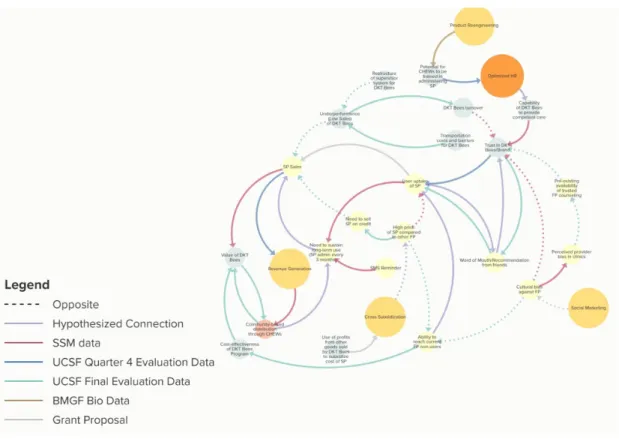
As the key finding of this case study, DKT Nigeria’s experience optimizing HR through training CHEWs to become DKT Bees and administers of Sayana Press are detailed in Table 1 below. It seems that the DKT Bees offered an opportunity to reach brand new users (current non-users of family
planning) with Sayana Press, however, this was a difficult task that the program struggled to carryout. One DKT Bee said “To enlighten, to convince [women] it is not easy. A lot of women are totally ignorant [about family planning,] and we have to start from scratch with them.” For new user uptake, word of
mouth was an important facilitator. One new user said “I have a friend that got [Sayana Press] and I made up my mind because she said it was okay.”
The product reengineering of Depo-Provera into the new product Sayana Press provides the potential for CHEWs to be trained to administer the injectable (unlike Depo-Provera which must be administered by a doctor or nurse). This potential for training and task shifting to CHEWs optimizes the human resources for injectable administration, which is
Trust in the DKT Bees/DKT Brand is multifaceted. The high turnover of DKT Bees decreases trust in the program and the brand and can cause women to lose a source of family planning. This high turnover results from DKT Bees
underperforming and failing to meet sales benchmarks. Transportation costs and barriers faced by DKT Bees were cited as a significant cause of underperformance. The introduction of “Queen Bees” as supervisors in August 2016 aimed to identify and address underperformance causes.
The cultural bias against family planning also decreases the ability to reach current family planning “non-users,” meaning women who currently do not use any form of contraception, particularly modern contraception. Reaching non-users and demographics with higher likelihoods of being non-users (e.g. lower-income, rural community) is referenced as a key component of the DKT Bees
Sayana Press needs to be administered every 3 months, so as user uptake increases and community-based distribution increases, the need for subsequent doses increases. DKT Nigeria has implemented an SMS reminder system to encourage sustained use. And ultimately, these additional doses and long-term use increases sales as well.
Revenue Generation and Cross Subsidization (Figure 4):
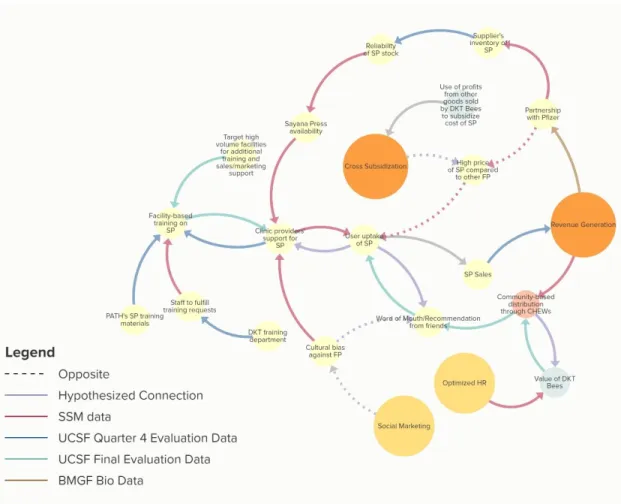
Community-based distribution and facility-based distribution are the two intended channels for
Sayana Press sales and revenue for this program. DKT Nigeria offers training and promotional materials on Sayana Press to providers at clinics and pharmacies in order to increase providers’ support for Sayana Press to increase user uptake. Providers’ support for Sayana Press was identified as an important driver
for user uptake and sales. One user said “My provider told me she has heard about [Sayana Press], that it works, and that I should just try it. I said okay, let me just give it a try.” Generating revenue through Sayana Press sales is an important factor for sustaining the program’s partnership with Pfizer that offers a reduced price for the product. That partnership is also an important component affecting the reliability and availability of Sayana Press stock, which help to increase providers’ support for Sayana Press in their facilities. DKT Bees also worked to reduce the price of Sayana Press by using their profits from other goods that they sold to subsidize Sayana Press costs.
Social Marketing (Figure 5):
While DKT Nigeria’s Social Marketing activities were not focused on the dissemination or uptake of Sayana Press, the intended impacts to reduce cultural bias through increased understanding and awareness of family planning options were relevant. The relationships depicted in Figure 5 demonstrate
that are barriers for DKT Nigeria’s media and communication campaigns. Restrictions on airing time permissions for family planning content, the use of the term family planning, and funding for family planning content developers are all thought to be associated with the cultural bias against family
planning. DKT Nigeria works to circumvent these restrictions by using slang words to talk about
forbidden content and leveraging collaborative partnerships with the Federal Ministry of Health and the State Ministry of Health. Working with medical doctors to co-create content and involving young staff in
content development are also ways that DKT Nigeria bolsters the impact of their social marketing activities.
Discussion
The presented analyses demonstrated an interconnectedness and interdependence of each of the BMI activities to accelerate the uptake of Sayana Press in this setting.
Optimized HR emerged as the key story of this case study. The DKT Bees’ intended capacity to
reach new users of family planning was an important factor in the cost-effectiveness of the program and the value-added by community-based distribution. The DKT Bees may have been able to target non-consumption by providing a simpler, more convenient, and more effective injectable option (Sayana
Press) to users. However, the DKT Bees faced significant challenges and struggled with consistent underperformance and low sales. The majority of Sayana Press sales came from facility-based
distribution where providers in clinics and pharmacies recommended Sayana Press to their
patients/customers. In this distribution, a large portion of the user uptake were “switchers,” women who were using another form of family planning (often Depo-Provera) and switched to Sayana Press.
While barriers such as transportation costs, supervisory structures, and turnover of DKT Bees were factors in the DKT Bees’ underperformance, it is also important to recognize the fragility of the drivers of user uptake for this program: word of mouth recommendation and trust in the DKT
Bees/Brand. Particularly in this context with strong cultural and religious biases against family planning, the diffusion of innovation in this community-based setting would be challenging and need time to take hold.
Limitations
The document review used a single coder to extract data, which may have introduced some bias. However, the wide variety of data sources reviewed would have mitigated some of this bias. This
case study also lacked the capacity to determine the strength of association identified in the document review. Follow-up interviews with on-the-ground staff would be a next step to determine that strength in future iterations of this work.
Conclusion
Using causal loop diagramming to analyze DKT Nigeria’s experiences disseminating Sayana Press was a useful way to bring together a wide variety of data from different sources and appreciate the
program’s integration of BMI activities. The program’s disruptive capacity is dependent on its ability to target non-consumption, which is unclear given the recent suspension of the DKT Bees. However, DKT Nigeria does integrate several innovative business activities across its marketing, finance, and operating
strategies to accelerate the uptake of Sayana Press.
To comprehensively assess the program’s capacity for market disruption, further investigation would need to be done to understand the supports and barriers for new user uptake and to determine
References
Bhattacharyya, O., Khor, S., Mcgahan, A., Dunne, D., Daar, A. S., & Singer, P. A. (2010). Innovative health service delivery models in low and middle income countries -what can we learn from the private sector? Health Research Policy and Systems, 8(24). Retrieved from
https://health-policy- systems.biomedcentral.com/track/pdf/10.1186/1478-4505-8-24?site=http://health-policy-systems.biomedcentral.com
Bradley, E. H., Curry, L. A., Taylor, L. A., Pallas, S. W., Talbert-Slagle, K., Yuan, C., … Pérez-Escamilla, R. (2012). A model for scale up of family health innovations in low-income and middle-income settings: a mixed methods study. BMJ Open, 2(4), e000987. https://doi.org/10.1136/bmjopen-2012-000987
Christensen, C. M., Raynor, M., & Mcdonald, R. (2015). What Is Disruptive Innovation? Retrieved from http://pedrotrillo.com/wp-content/uploads/2016/01/Whatisdisruptiveinnovation.pdf
Girotra, K., & Netessine, S. (2014). Four paths to business model innovation. Harvard Business Review, 92(7-8), 97-103.
Appendix
Table 1. Optimized HR causal loop diagram and findings
The product reengineering of Depo-Provera into the new product Sayana Press provides the potential for CHEWs to be trained to administer the injectable (unlike Depo-Provera which must be administered by a doctor or nurse). This potential for training and task shifting to CHEWs optimizes the human resources for injectable administration, which is
extremely important in rural and underserved areas with low health workforce capacity. Optimized human resources in this context provides DKT Bees (DKT Nigeria’s trained CHEWs) with the capability to provide competent care. This capability increases the market’s trust in the DKT Bees as well as the DKT Nigeria brand, and increases in this confidence leads to increased user uptake of Sayana Press. With more users taking up Sayana Press, Sayana Press sales increase. Trust in the DKT Bees/DKT Brand is multifaceted. The high turnover of DKT Bees decreases trust in the program and the brand and can cause women to lose a source of family planning. This high turnover results from DKT Bees
Cultural bias against family planning in this environment is another factor that affects women’s trust in the DKT Bees and the DKT Nigeria brand. With more cultural bias against family planning in general, there is less trust in the DKT Brand and the Bees as family planning providers. Pre-existing availability of trusted family planning counseling is also associated with less trust in DKT Bees (or less need for trust in DKT Bees) since those women already have trusted sources of competent care. The perception of provider bias (from the doctors or nurses in local clinics) decreases the trust of any pre-existing family counseling in the community, and general cultural bias increases that perception of provider bias. The cultural bias against family planning perpetuates a lack of pre-existing family planning counseling in the community, and creates a need for the DKT Bees to become that trusted source. DKT Nigeria’s work in Social Marketing aims to reduce the cultural bias against family planning. The cultural bias against family planning also decreases the ability to reach current family planning “non-users,” meaning women who currently do not use any form of contraception, particularly modern contraception. Reaching non-users and demographics with higher likelihoods of being non-users (e.g. lower-income, rural community) is referenced as a key component of the DKT Bees
Sayana Press contribute to the value of the DKT Bees program as an investment. Sayana Press sales generate revenue for DKT Nigeria. The high price of Sayana Press (in comparison to other available forms of contraception) impacts user uptake and particularly decreases the ability to reach current non-users of contraception. DKT Bees have had to sell Sayana Press on credit because the price was unaffordable to their customers, women in the community. DKT Bees use profits from other goods that they sell (other forms of family planning and even hair products) to offset the cost of Sayana Press, decreasing price paid by consumers and decreasing the need to sell Sayana Press on credit.
Figure 1. Business Model Innovations in Health Service Delivery (Bhattacharyya et al. 2010)
Figure 3. Revenue Generation and Cross-Subsidization causal loop diagram