20
Kirchhoff Plates:
TABLE OF CONTENTS
Page
§20.1. Introduction 20–3
§20.2. Plates: Basic Concepts 20–3
§20.2.1. Structural Function . . . 20–3 §20.2.2. Terminology . . . 20–4 §20.2.3. Mathematical Models . . . 20–5
§20.3. The Kirchhoff Plate Model 20–6
§20.3.1. Kinematic Equations . . . 20–6 §20.3.2. Moment-Curvature Constitutive Relations . . . 20–8 §20.3.3. Transverse Shear Forces and Stresses . . . 20–9 §20.3.4. Equilibrium Equations . . . 20–10 §20.3.5. Indicial and Matrix Forms . . . 20–11 §20.3.6. Skew Cuts . . . 20–12 §20.3.7. The Strong Form Diagram . . . 20–13
§20.4. The Biharmonic Equation 20–13
§20. Notes and Bibliography. . . 20–14 §20. Exercises . . . 20–16
§20.2 PLATES: BASIC CONCEPTS
§
20.1. Introduction
Multifield variational principles were primarily motivated by “difficult” structural models, such as plate bending, shells and near incompressible behavior. In this Chapter we begin the study of one of those difficult problems: plate bending.
Following a review of the wide spectrum of plate models, attention is focused on the Kirchhoff model for bending of thin (but not too thin) plates. The field equations for isotropic and anisotropic plates are then discussed. The Chapter closes with an annotated bibliography.
§
20.2. Plates: Basic Concepts
In the IFEM course [255] a plate was defined as a three-dimensional body endowed with special geometric features. Prominent among them are
Thinness: One of the plate dimensions, called its thickness, is much smaller than the other two. Flatness: The midsurface of the plate, which is the locus of the points located half-way between the two plate surfaces, is a plane.
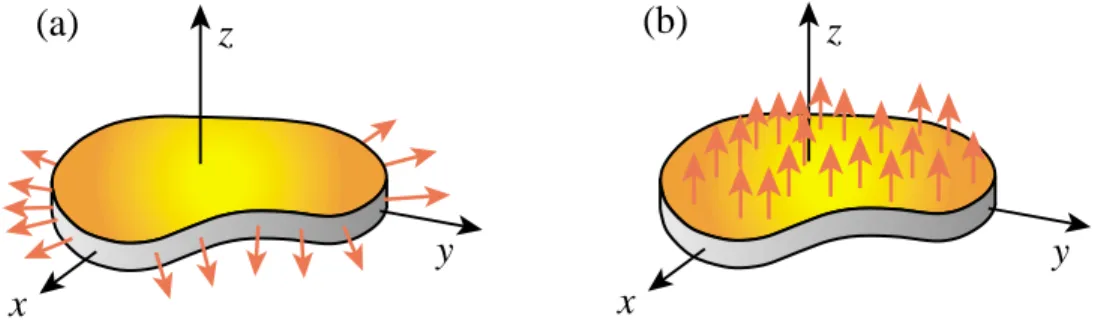
In Chapter 14 of that course we studied plates in a plane stress state, also called membrane or lamina state in the literature. This state occurs if the external loads act on the plate midsurface as sketched in Figure 20.1(a). Under these conditions the distribution of stresses and strains across the thickness may be viewed as uniform, and the three dimensional problem can be easily reduced to two dimensions. If the plate displays linear elastic behavior under the range of applied loads then we have effectively reduced the problem to one of two-dimensional elasticity.
x
y
z
(a)
x
y
z
(b)
Figure20.1. A flat plate structure in: (a) plane stress or membrane state, (b) bending state.
§20.2.1. Structural Function
In this Chapter we study plates subjected to transverse loads, that is, loads normal to its midsurface as sketched in Figure 20.1(b). As a result of such actions the plate displacements out of its plane and the distribution of stresses and strains across the thickness is no longer uniform. Finding those displacements, strains and stresses is the problem of plate bending.
Plate bending components occur when plates function as shelters or roadbeds: flat roofs, bridge and ship decks. Their primary function is to carry out lateral loads to the support by a combination of moment and shear forces. This process is often supported by integrating beams and plates. The beams act as stiffeners and edge members.
Ω Γ x y Mathematical Idealization Midsurface Plate Thickness h Material normal, also called material filament
(a) (b)
(c)
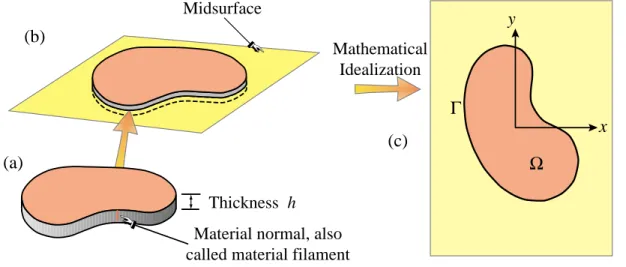
Figure20.2. Idealization of plate as two-dimensional mathematical problem.
If the applied loads contain both loads and in-plane components, plates work simultaneously in membrane and bending. An example where that happens is in folding plate structures common in some industrial buildings. Those structures are composed of repeating plates that transmit roof loads to the edge beams through a combination of bending and “arch” actions. If so all plates experience both types of action. Such a combination is treated in finite element methods by flat shell models: a superposition of flat membrane and bending elements. Plates designed to resist both membrane and bending actions are sometimes called slabs, as in pavements.
§20.2.2. Terminology
This subsection defines a plate structure in a more precise form and introduces terminology. Consider first a flat surface, called the plate reference surface or simply its midsurface or midplane. See Figure 20.2. We place the axes x and y on that surface to locate its points. The third axis, z is taken normal to the reference surface forming a right-handed Cartesian system. Axis x and y are placed in the midplane, forming a right-handed Rectangular Cartesian Coordinate (RCC) system. If the plate is shown with an horizontal midsurface, as in Figure 20.2, we shall orient z upwards. Next, imagine material normals, also called material filaments, directed along the normal to the reference surface (that is, in the z direction) and extending h/2 above and h/2 below it. The magnitude h is the plate thickness. We will generally allow the thickness to be a function of x,y, that is h =h(x,y), although most plates used in practice are of uniform thickness because of fabrication considerations. The end points of these filaments describe two bounding surfaces, called the plate surfaces. The one in the+z direction is by convention called the top surface whereas the one in the−z direction is the bottom surface.
Such a three dimensional body is called a plate if the thickness dimension h is everywhere small, but not too small, compared to a characteristic length Lcof the plate midsurface. The term “small”
is to be interpreted in the engineering sense and not in the mathematical sense. For example, h/Lc
is typically 1/5 to 1/100 for most plate structures. A paradox is that an extremely thin plate, such as the fabric of a parachute or a hot air balloon, ceases to structurally function as a thin plate!
§20.2 PLATES: BASIC CONCEPTS
A plate is bent if it carries loads normal to its midsurface as pctured in Figure 20.1(b). The resulting problems of structural mechanics are called:
Inextensional bending: if the plate does not experience appreciable stretching or contractions of its midsurface. Also called simply plate bending.
Extensional bending: if the midsurface experiences significant stretching or contraction. Also called combined bending-stretching, coupled membrane-bending, or shell-like behavior.
The bent plate problem is reduced to two dimensions as sketched in Figure 20.2(c). The reduction is done through a variety of mathematical models discussed next.
§20.2.3. Mathematical Models
The behavior of plates in the membrane state of Figure 20.1(a) is adequately covered by two-dimensional continuum mechanics models. On the other hand, bent plates give rise to a wider range of physical behavior because of possible coupling of membrane and bending actions. As a result, several mathematical models have been developed to cover that spectrum. The more important models are listed next.
Membrane shell model: for extremely thin plates dominated by membrane effects, such as inflatable structures and fabrics (parachutes, sails, balloon walls, tents, inflatable masts, etc).
von-K´arm´an model: for very thin bent plates in which membrane and bending effects interact strongly on account of finite lateral deflections. Proposed by von K´arm´an in 1910 [776]. Important model for post-buckling analysis.
Kirchhoff model: for thin bent plates with small deflections, negligible shear energy and uncoupled membrane-bending action. Kirchhoff’s seminal paper appeared in 1850 [416].1
Reissner-Mindlin model: for thin and moderately thick bent plates in which first-order transverse shear effects are considered. Reissner proposed his model for static analysis of moderately thick plates [624,625]. Mindlin’s version [493] was intended as a more accurate model for plate vibrations. The book of Timoshenko and Woinowsky-Krieger [739] follows Green’s exposition of Reissner’s theory in [316]. This model is particularly important in dynamics and vibration, since shorter wavelengths enhance the importance of transverse shear effects.
High order composite models: for detailed (local) analysis of layered composites including inter-lamina shear effects. See, for example, the book by Reddy [622] and references therein.
Exact models: for the analysis of additional effects (e.g., non-negligible normal stressσzz) using
three dimensional elasticity. The book of Timoshenko and Woinowsky-Krieger [739] contains a brief treatment of the exact analysis in Ch 4.
The first two models are geometrically nonlinear and thus fall outside the scope of this course. The last four models are geometrically linear in the sense that all governing equations are set up in the reference or initially-flat configuration. The last two models are primarily used in detailed or local stress analysis near edges, point loads or openings.
All models may incorporate other types of nonlinearities due to, for example, material behavior, composite fracture, cracking or delamination, as well as certain forms of boundary conditions. In
this course, however, we shall look only at the linear elastic versions. Furthermore, we shall focus attention only on the Kirchhoff and Reissner-Mindlin plate models because these are the most commonly used in statics and vibrations, respectively.
§
20.3. The Kirchhoff Plate Model
Historically the first model of thin plate bending was developed by Lagrange, Poisson and Kirchhoff. It is known as the Kirchhoff plate model, of simply Kirchhoff plate, in honor of the German scientist who “closed” the mathematical formulation through the variational treatment of boundary conditions. In the finite element literature Kirchhoff plate elements are often called C1 plate elements because that is the continuity order nominally required for the transverse displacement shape functions.
The Kirchhoff model is applicable to elastic plates that satisfy the following conditions.
• The plate is thin in the sense that the thickness h is small compared to the characteristic length(s), but not so thin that the lateral deflectionwbecomes comparable to h.
• The plate thickness is either uniform or varies slowly so that three-dimensional stress effects are ignored.
• The plate is symmetric in fabrication about the midsurface.
• Applied transverse loads are distributed over plate surface areas of dimension h or greater.2 • The support conditions are such that no significant extension of the midsurface develops. We now describe the field equations for the Kirchhoff plate model.
§20.3.1. Kinematic Equations
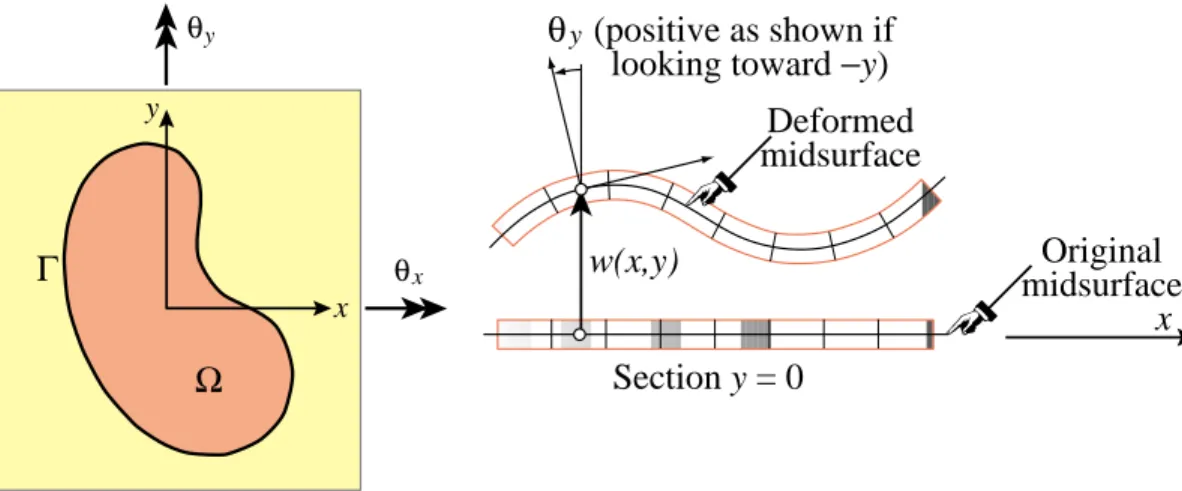
The kinematics of a Bernoulli-Euler beam, as studied in Chapter 12 of [255], is based on the assumption that plane sections remain plane and normal to the deformed longitudinal axis. The kinematics of the Kirchhoff plate is based on the extension of this to biaxial bending:
“Material normals to the original reference surface remain straight and normal to the deformed reference surface.”
This assumption is illustrated in Figure 20.3. Upon bending, particles that were on the midsurface z =0 undergo a deflectionw(x,y)along z. The slopes of the midsurface in the x and y directions are∂w/∂x and∂w/∂y. The rotations of the material normal about x and y are denoted byθx and
θy, respectively. These are positive as per the usual rule; see Figure 20.3. For small deflections and
rotations the foregoing kinematic assumption relates these rotations to the slopes: θx =
∂w
∂y, θy = − ∂w
∂x. (20.1)
2 The Kirchhoff model can accept point or line loads and still give reasonably good deflection and bending stress predictions for homogeneous wall constructions. A detailed stress analysis is generally required, however, near the point of application of the loads using more refined models; for example with solid elements.
§20.3 THE KIRCHHOFF PLATE MODEL Ω Γ x x y Original midsurface Deformed midsurface w(x,y) θ (positive as shown if looking toward −y) θ y Section y = 0 x y θ
Figure20.3. Kinematics of Kirchhoff plate. Lateral deflectionwgreatly exaggerated for
visibility. In practicew <<h for the Kirchhoff model to be valid.
The displacements{ux,uy,uz}of a plate particle P(x,y,z)not necessarily located on the
mid-surface are given by
ux = −z
∂w
∂x =zθy, uy = −z ∂w
∂y = −zθx, uz =w. (20.2) The strains associated with these displacements are obtained from the elasticity equations:
ex x = ∂ux ∂x = −z ∂2w ∂x2 = −zκx x, eyy = ∂uy ∂y = −z ∂2w ∂y2 = −zκyy, ezz = ∂uz ∂z = −z ∂2w ∂z2 =0, 2ex y = ∂ux ∂y + ∂uy ∂x = −2z ∂2w ∂x∂y = −2zκx y, 2ex z = ∂ ux ∂z + ∂uz ∂x = − ∂w ∂x + ∂w ∂x =0, 2eyz = ∂uy ∂z + ∂uz ∂y = − ∂w ∂y + ∂w ∂y =0. (20.3) Here κx y = ∂2w ∂x2 , κyy = ∂2w ∂y2, κx y = ∂2w ∂x∂y. (20.4)
are the curvatures of the deflected midsurface. Plainly the full displacement and strain fields are fully determined ifw(x,y)is given.
x y Bending moments (+ as shown) 2D view Bending stresses (+ as shown) Mxx Mxx Mxx M = Mxy σyy Myy Myy Myy yx Mxy Mxy Myx Myx x x y y h σxx σ = σxy yx x y z Top surface Bottom surface
Normal stresses Inplane shear stresses
x y dy dy dy dx dx dx
Figure20.4. Bending stresses and moments in a Kirchhoff plate, illustrating sign conventions.
Remark 20.1. Many entry-level textbooks on plates introduce the foregoing relations gently through geometric arguments, because students may not be familiar with 3D elasticity theory. The geometric approach has the advantage that the kinematic limitations of the plate bending model are more easily visualized. On the other hand the direct approach followed here is more compact.
Remark 20.2. Some inconsistencies of the Kirchhoff model emerge on taking a closer look at (20.3). For example, the transverse shear strains are zero. If the plate is isotropic and follows Hooke’s law, this implies
σx z =σyz = 0 and consequently there are no transverse shear forces. But these forces appear necessarily from the equilibrium equations as discussed in §20.3.4.
Similarly, ezz =0 says that the plate is in plane strain whereas plane stress: σzz =0, is a closer approximation to the physics. For a homogeneous isotropic plate, plane strain and plane stress coalesce if and only if Poisson’s ratio is zero. Both inconsistencies are similar to those encountered in the Bernoulli-Euler beam model, and have been the topic of hundreds of learned papers that fill applied mechanics journals but nobody reads.
§20.3.2. Moment-Curvature Constitutive Relations
The nonzero bending strains ex x, eyyand ex yproduce bending stressesσx x,σyyandσx yas depicted
in Figure 20.4. The stress σx y = σyx is sometimes referred to as the in-plane shear stress or the
bending shear stress, to distinguish it from the transverse shear stressesσx zandσyz studied later.
To establish the plate constitutive equations in moment-curvature form, it is necessary to make several assumptions as to plate material and fabrication. We shall assume here that
• The plate is homogeneous, that is, fabricated of the same material through the thickness. • Each plate lamina z =constant is in plane stress.
• The plate material obeys Hooke’s law for plane stress, which in matrix form is σ x x σyy σx y = E 11 E12 E13 E12 E22 E23 E13 E23 E33 ex x eyy 2ex y = −z E 11 E12 E13 E12 E22 E23 E13 E23 E33 κx x κyy 2κx y . (20.5)
§20.3 THE KIRCHHOFF PLATE MODEL
The bending moments Mx x, Myy and Mx yare stress resultants with dimension of moment per unit
length, that is, force. For example, kips-in/in = kips. The positive sign conventions are indicated in Figure 20.4. The moments are calculated by integrating the elementary stress couples through the thickness: Mx xd y = h/2 −h/2 −σx xz d y d z ⇒ Mx x = − h/2 −h/2 σx xz d z, Myyd x = h/2 −h/2 −σyyz d x d z ⇒ Myy = − h/2 −h/2 σyyz d z, Mx yd y = h/2 −h/2 −σx yz d y d z ⇒ Mx y = − h/2 −h/2 σx yz d z, Myxd x = h/2 −h/2 −σyx z d x d z ⇒ Myx = − h/2 −h/2 σyxz d z. (20.6)
It will be shown later that rotational moment equilibrium implies Mx y = Myx. Consequently only Mx x, Myy and Mx y need to be calculated. On inserting (20.5) into (20.6) and carrying out the
integrations, one obtains the moment-curvature constitutive relations M x x Myy Mx y = h3 12 E 11 E12 E13 E12 E22 E23 E13 E23 E33 κx x κyy 2κx y = D 11 D12 D13 D12 D22 D23 D13 D23 D33 κx x κyy 2κx y . (20.7) The Di j = Ei jh3/12 for i, j = 1,2,3 are called the plate rigidity coefficients. They have
dimension of force×length. For an isotropic material of elastic modulus E and Poisson’s ratioν, (20.7) specializes to Mx x Myy Mx y = D 1 ν 0 ν 1 0 0 0 12(1+ν) κx x κyy 2κx y . (20.8)
Here D= 121 E h3/(1−ν2)is called the isotropic plate rigidity.
If the bending moments Mx x, Myy and Mx y are given, the maximum values of the corresponding
in-plane stress components can be recovered from σmax,mi n x x = ± 6Mx x h2 , σ max,mi n yy = ± 6Myy h2 , σ max,mi n x y = ± 6Mx y h2 =σ max,mi n yx . (20.9)
These max/min values occur on the plate surfaces as illustrated in Figure 20.4. Formulas (20.9) are useful for stress driven design.
Remark 20.3. For non-homogeneous plates, which are fabricated with different materials, the essential steps are the same but the integration over the plate thickness may be significantly more laborious. (For common structures such as reinforced concrete slabs or laminated composites, the integration process is explained in specialized books.) If the plate fabrication is symmetric about the midsurface, inextensional bending is possible, and the end result are moment-curvature relations as in (20.8). If the wall fabrication is not symmetric, however, coupling occurs between membrane and bending effects even if the plate is only laterally loaded. The Kirchhoff and the plane stress model need to be linked to account for those effects. This coupling is examined further in chapters dealing with shell models.
x y
Transverse shear forces
(+ as shown) 2D view Qy Qy Qx Qx x x y y h σxz σyz x y z Top surface Bottom surface
Transverse shear stresses dy dy dx dx Parabolic distribution across thickness
Figure20.5. Transverse shear forces and stresses in a Kirchhoff plate, illustrating sign conventions.
§20.3.3. Transverse Shear Forces and Stresses
The equilibrium equations derived in §20.3.4 require the presence of transverse shear forces. Their components in the{x,y}system are called Qx and Qy. These are defined as shown in Figure 20.5.
These are forces per unit of length, with physical dimensions such as N/cm or kips/in.
Associated with these shear forces are transverse shear stressesσx z andσyz. For a homogeneous
plate and using an equilibrium argument similar to Euler-Bernoulli beams, the stresses may be shown to vary parabolically over the thickness, as illustrated in Figure 20.5:
σx z =σx zmax 1− 4z 2 h2 , σyz =σyzmax 1− 4z 2 h2 . (20.10)
in which the peak valuesσmax
x z andσyzmax, which occur on the midsurface z =0, are only function
of x and y. Integrating over the thickness gives the tranverse shear forces
Qx = h/2 −h/2 σx zd z= 23σx zmaxh, Qy = h/2 −h/2 σyzd z = 23σyzmaxh, (20.11)
If Qx and Qy are given, the maximum transverse shear stresses are given by
σmax x z = 3 2 Qx h , σ max yz = 3 2 Qy h . (20.12)
As in the case of Bernoulli-Euler beams, predictions such as (20.12) must come entirely from equilibrium analysis. The Kirchhoff plate model ignores the transverse shear energy and in fact predictsσx z = σyz = 0 from the strain-displacement (kinematic) equations (20.3). Cf. Remark
20.2. In practical terms this means that stresses (20.12) should be significantly smaller than the maximum inplane stresses (20.9) . If they are not, the Kirchhoff model is inappropriate, and one should move to the Reissner-Mindlin model, which accounts for transverse shear energy to first order.
§20.3 THE KIRCHHOFF PLATE MODEL y Qy Qx x x y z z dy dy dy dy dy dx dx dx dx dx Q +x ∂Qx ∂x Q +y ∂ Qy ∂y q ∂Mx x ∂x M +xx Mxx ∂Mx y ∂y M +xy Mxy ∂Myy ∂y M +yy Myy ∂Myx ∂x M +yx Myx (a) (b) Distributed transverse load (force per unit area)
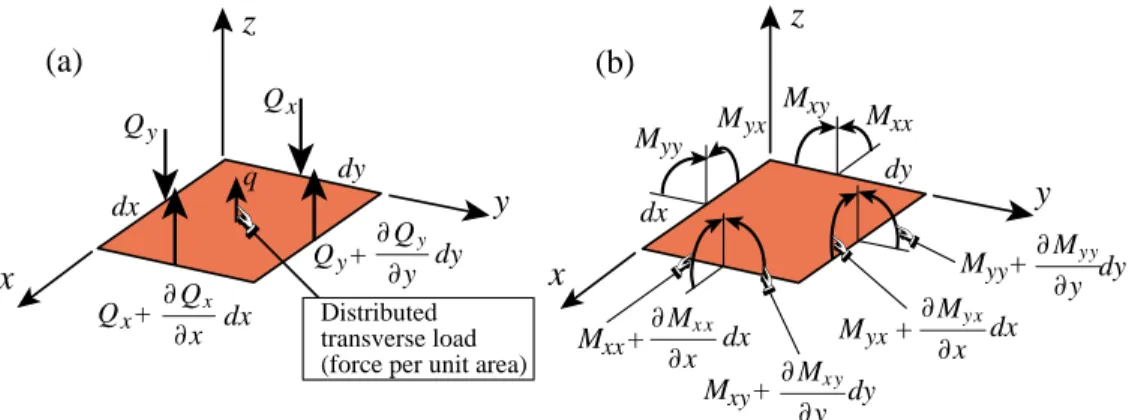
Figure20.6. Differential midsurface elements used to derive the equilibrium equations of a Kirchhoff plate.
§20.3.4. Equilibrium Equations
To derive the interior equilibrium equations we consider differential midsurface elements d x×d y aligned with the{x,y}axes as illustrated in Figure 20.6. Consideration of force equilibrium along the z direction in Figure 20.6(a) yields the transverse shear equilibrium equation
∂Qx
∂x + ∂Qy
∂y = −q, (20.13)
in which q is the applied lateral force per unit of area. Force equilibrium along the x and y axes is automatically satisfied and does not provide additional equilibrium equations.
Consideration of moment equilibrium about y and x in Figure 20.6(b) yields two moment differential equations: ∂Mx x ∂x + ∂Mx y ∂y = −Qx, ∂Myx ∂x + ∂Myy ∂y = −Qy. (20.14) Moment equilibrium about z gives3
Mx y = Myx. (20.15)
The four equilibrium equations (20.13) through (20.15) relate six fields: Mx x, Mx y, Myx, Myy, Qx
and Qy. Consequently plate problems are statically indeterminate.
Eliminating Qx and Qy from (20.13) and (20.14), and setting Myx = Mx y yields the following
moment equilibrium equation in terms of the applied load: ∂2M x x ∂x2 +2 ∂2M x y ∂x∂y + ∂2M yy ∂y2 =q. (20.16)
For cylindrical bending in the x direction we recover the well known Bernoulli-Euler beam equi-librium equation M =q, in which M ≡ Mx x and q are understood as given per unit of y width.
3 Timoshenko’s book [739] unfortunately defines M
yx so that Mx y= −Myx. The present convention is far more common
Table 20.1 Kirchhoff Plate Field Equations in Matrix and Indicial Form
Field Matrix Indicial Equation name
eqn form form for plate problem
KE κ=Pw καβ =w,αβ Kinematic equation
CE M=Dκ Mαβ = Dαβγ δκγ δ Moment-curvature equation
BE PTM=q Mαβ,αβ =q Internal equilibrium equation Here PT =[∂2/∂x2 ∂2/∂y2 2∂2/∂x∂y ]=[∂2/∂x
1∂x1 ∂2/∂x2∂x2 2∂2/∂x1∂x2],
MT =[ Mx x Myy Mx y]=[ M11 M22 M12],
κT =[κ
x x κyy 2κx y]=[κ11 κ22 2κ12].
Greek indices, such asα, run over 1,2 only.
§20.3.5. Indicial and Matrix Forms
The foregoing field equations have been given in full Cartesian form. To facilitate reading the existing literature and the working out the finite element formulation, both matrix and indicial forms are displayed in Table 20.1.
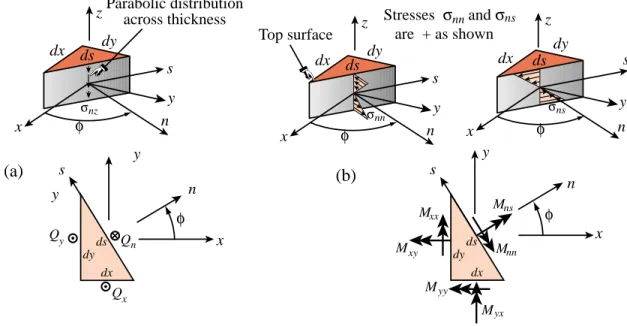
x n y Mxx Mns Myy Mxy Mnn Myx s dy ds dx dy ds dx φ φ φ x n y s φ σns x n x s s n y y σnn dy dy dx ds dx ds nn ns Stresses σ and σ are + as shown Top surface z φ x n s y dy dx ds z z Qn Qy Qx y Parabolic distribution across thickness σnz (a) (b)
Figure20.7. Skew plane sections in Kirchhoff plate.
§20.3.6. Skew Cuts
The preceding relations were obtained by assuming that differential elements were aligned with x and y. Consider now the case of stress resultants acting on a plane section skewed with respect to the x and y axes. This is illustrated in Figure 20.7, which defines notation and sign conventions. The exterior normal n to this cut forms an angleφwith x, positive counterclockwise about z. The tangential direction s forms an angle 90◦+φ with x.
§20.4THE BIHARMONIC EQUATION κ = P w P M = qT in Ω in Ω in Ω M = D κ Kinematic Constitutive Equilibrium Ω Γ Deflection w Transverse load q Curvatures κ Bending moments M
Figure 20.8. Strong Form diagram of the field equations of the Kirchhoff plate model.
Boundary condition links omitted: those are considered in te next Chapter.
The bending moments and transverse shear forces defined in Figure 20.7 are related to the Cartesian components by
Qn = Qxcφ +Qysφ,
Mnn = Mx xcφ2 +Myysφ2 +2Mx ysφcφ, Mns =(Myy −Mx x)sφcφ +Mx y(cφ2 −sφ2),
(20.17) in which cφ =cosφ and sφ =sinφ.
These relations can be obtained directly by considering the equilibrium of the midsurface triangles shown in the bottom of Figure 20.7. Alternatively they can be derived by transforming the wall stressesσx x,σx y,σx y,σx zandσyz to an oblique cut, and then integrating through the thickness.
§20.3.7. The Strong Form Diagram
Figure 20.8 shows the Strong Form diagram for the field equations of the Kirchhoff plate. The boundary conditions are omitted since those are treated in the next Chapter.
§
20.4. The Biharmonic Equation
Consider a homogeneous isotropic plate of constant rigidity D. Elimination of the bending moments and curvatures from the field equations yields the famous equation for thin plates, first derived by Lagrange4 D∇4w= D∇2∇2w =q, (20.18) in which ∇4 = ∇2∇2 ≡ ∂ 4 ∂x4 +2 ∂4 ∂x2∂y2 + ∂4 ∂y4, (20.19)
is the biharmonic operator. Thus, under the foregoing constitutive and fabrication assumptions the plate deflectionw(x,y)satisfies a non-homogeneous biharmonic equation. If the lateral load q vanishes, as happens with plates loaded only on their boundaries, the deflectionw satisfies the homogeneous biharmonic equation.
The biharmonic equation is the analog of the Bernoulli-Euler beam equation for uniform bending rigidity E I : E IwI V =q, in whichwI V =d4w/d x4. Equation (20.18) was the basis of much of early (pre-1960) work in plates, both analytical and numerical (the latter by either finite difference or Galerkin methods). After the advent of finite elements it is largely a mathematical curiosity, remembered (a la Proust) by a few old-timers.
Notes and Bibliography
There is not shortage of reading material on plates. The problem is one of selection. Selected English textbooks and monographs are listed below. Only books examined by the writer are commented upon. Others are simply listed. Emphasis is on technology oriented books of interest to engineers.
Ambartsumyan [18]. Deals with anisotropic fabrication of plates. Entirely analytical. See comments for Letnitskii’s below.
Calladine [119]. A textbook containing a brief treatment of plastic behavior of homogeneous (metal) plates. Many exercises; book is well written.
L. H. Donnell [189]. Unlike Timoshenko’s book, largely obsolete. Saving grace: contains the famous Donnell shell equations for cylindrical shells.
Gorman [314] . Devoted to plate vibrations.
Hussein [389]. Covers analysis and design of composite plates. Letnitskii [440] See comments for next one.
Letnitskii [441] Translated from Russian. One of the earliest monographs devoted to the anisotropic plates. Focus is on analytical solutions of tractable problems of anisotropic plates.5
Liew et al. (eds.) [445]. Dynamics and vibration of composite plates. Ling (ed.) [446]. Articles on composite plate constructions.
Love [449]. Still reprinted as a Dover book. A classical (late XIX century) treatment of elasticity by a renowned applied mathematician contains several sections on thin plates. Material and notation is outdated. Don’t expect any physical insight: Love has no interest in engineering applications. Useful mostly for tracing historical references to specific problems.
Lowe [450]. An elementary treatment of plate mechanics that covers a lot of ground, including plastic and optimal design, in 175 pages. Appropriate for supplementary reading in a senior level course.
Morley [498]. This tiny monograph was motivated by the increasing importance of skew shapes in high speed aircraft after World War II. Compact and well written, still worth consulting for FEM benchmarks.
Reddy [622]. Good coverage of methods for composite wall constructions; both theory and computational methods treated.
Soedel [680]. Vibration of plate and shell structures.
Szilard [715]. A massive work (710 pages) similar in level to Timoshenko’s but covering more ground: numerical methods, dynamics, vibration and stability analysis. Although intended as a graduate textbook it contains no exercises, which detracts from its usefulness. Densely written; no sparks. The treatment of numerical methods is obsolete, with too many pages devoted to finite difference methods in vogue before 1960.
Timoshenko and Woinowsky-Krieger [739]. A classical reference book. Not a textbook (lacks exercises) but case driven. Quintaessential Timoshenko: a minimum of generalities and lots of examples. The title
5 The advent of finite elements has made the distinction between isotropic and anisotropic plates unimportant from a computational viewpoint.
§20. Notes and Bibliography is a bit misleading: only shells of special geometries are dealt with, in 3 chapters out of 16. As for plates, the emphasis is on linear static problems using the Kirchhoff model. There are only two chapters treating moderately large deflections, one with the von Karman model. There is no treatment of buckling or vibration, which are covered in other Timoshenko books.6 The reader will find no composite wall constructions, only
one chapter on orthotropic plates (called “anisotropic” in the book) and a brief description of the Reissner-Mindlin model, which had been published in between the 1st and 2nd editions. Despite these shortcomings it is still the reference book to have for solution of specific plate problems. The physical insight is unmatched. Old-fashioned full notation is used: no matrices, vectors or tensors. Strangely, this long-windedness fits nicely with the deliberate pace of engineering before computers, where understanding of the physics was far more important than numbers. The vast compendium of solutions comes handy when checking FEM codes, and for preliminary design work. (Unfortunately the sign conventions are at odds with those presently preferred in the Western literature, which can be a source of errors and some confusion.) Exhaustive reference source for all work before 1959.
Whitney [794]. Expanded version of a 1970 book by Ashton and Whitney. Concentrates on layered composite and sandwich wall constructions of interest in aircraft structures.
Wood [809]. Focuses on plastic analysis of reinforced concrete plates by yield line methods. Long portions are devoted to the author’s research and supporting experimental work. Oriented to civil engineers.
The well known handbook by Roark et al. [642] contains chapters that collect specific solutions of plate statics and vibration, with references as to source.
For general books on composite materials and their use in aerospace, civil, marine, and mechanical engineering, a web search on new and used titles inhttp://www3.addall.comis recommended.
Homework Exercises for Chapter 20 Kirchhoff Plates: Field Equations
EXERCISE 20.1 [A:10] The biharmonic operator (20.19) can be written symbolically as∇4 =PTWP, where
W is a diagonal weighting matrix and P is defined in Table 20.1. Find W.
EXERCISE 20.2 [A:15] Using the matrix form of the Kirchhoff plate equations given in Table 20.1, eliminate the intermediate variablesκand M to show that the generalized form of the biharmonic plate equation (20.18) is PTDPw=q. This form is valid for anisotropic plates of variable thickness.
EXERCISE 20.3 [A:15] Rewrite PTDPw=q in indicial notation, assuming that D is constant over the plate.
EXERCISE 20.4 [A:20] Rewrite PTDPw=q in glorious full form in Cartesian coordinates, assuming that
D is constant over the plate.
EXERCISE 20.5 [A:20] Express the rotationsθn andθs about the normal and tangential directions, respec-tively, in terms ofθx,θyand the angleφdefined in Figure 20.7.