Montgomery College
The Workforce
Our Mission
We empower our students to change their lives,
and we enrich the life of our community.
We are accountable for our results.
Our Vision
With a sense of urgency for the future, Montgomery
College will be a national model of educational
excellence, opportunity, and student success.
Our organization will be characterized by agility
and relevance as it meets the dynamic challenges
facing our students and community.
Our Values
Excellence
■Integrity
■Innovation
■Diversity
Contents
2 Montgomery College: A Boon of Economic Development 4 Information Technology and Cybersecurity
6 Biotechnology, Life Sciences, and Health Care 9 Building, Professional, and Human Services 11 Communication, Education, Arts and Culture 13 Business and Hospitality
14 Montgomery College Partnerships
16 Students and Jobs: Montgomery College’s “Career Coach” 17 Conclusion: The Workforce of the Future
Montgomery College
Montgomery College:
A Boon of Economic Development
With a sense of urgency for the future, Montgomery College will be a
national model of educational excellence, opportunity, and student success.
Our organization will be characterized by agility and relevance as it meets
the dynamic challenges facing our students and community.
—Montgomery College Vision Statement
M
ontgomery College is an engine of opportunity—an anchor institution integral to our community’s present and future. With 130 degree and certifi cate programs, our students are mastering sophisticated 21st-century skills that drive the local economy. But this economy is changing rapidly. Matching the needs of our evolving workforce with the proper training and education programs is an ever present challenge. It calls for commu-nication, analysis, collaboration, and agility. At Montgomery College, we constantly strive to be relevant to needs of the county’s employ-ers, our community, and our students.Our three campuses and our multiple workforce development loca-tions keep careful track of workforce needs and collaborate closely with dozens of industries in Maryland to craft training programs and hone degree options that fi ll their requirements. By constantly aligning our curricula with industry standards and best practices, Montgomery College prepares students for certifi cation exams and practica that will usher them into existing jobs. And since the global economy is always in motion, so are our expert Montgomery College faculty, designing new classes and programs in response to burgeoning indus-tries, market conditions, technology advances, and policy changes. Business leaders and industry executives have come to rely on Montgomery College to train and educate the workers they will need just around the corner. Matching skilled workers to in-demand jobs in Montgomery County is a critical mission at Montgomery College. By helping about 60,000 students a year to meet their educational and career goals, Montgomery College is also strengthening the rest of Montgomery County. By adding income to the tax base (about $194 million a year) and saving the county funding that might have been needed for social services (about $6 million a year), Montgomery College propels investment and development, according to modeling by Economic Modeling Specialists Inc. It also helps move our state towards its 2025 educational goal of 55 percent of workers holding at least an associate’s degree. Since 60 percent of Montgomery County Public School (MCPS) graduates who attend college in Maryland
begin at Montgomery College, our work touches a large portion of residents and helps keep our best talent local.
Countless studies have shown that workers are more competitive when they attain more education. Having a bachelor’s degree, for example, can raise a worker’s average income in Maryland by $30,000 a year. Many fi elds that are predicted to grow signifi cantly in the next decade, however, do not require a four-year degree. An associate’s degree or a technical certifi cate can move a person into an array of middle-skills job opportunities that can make a difference of $10,000 to $20,000 a year in income for a single worker.
This report examines fi ve workforce areas to which Montgomery College is already contributing: (1) Information Technology and Cybersecurity; (2) Biotechnology, Life Sciences, and Health Care; (3) Building, Professional, and Human Services; (4) Communication, Education, Arts and Culture; and (5) Business and Hospitality. The report profi les how we prepare professionals for in-demand fi elds and how students use our services to fi nd jobs quickly and effi ciently after graduation. Additionally, it details how we collaborate with industries
INCOME WITH EDUCATION LEVEL
Source: Montgomery College, Office of Planning and Institutional Effectiveness
According to the 2012 Self-Suffi ciency Standard, it costs about $83,000 for a four-person family with two working parents, a preschooler, and a school-age child, to afford
basic necessities in Montgomery County. Associate’s Degree $62,900 High School Diploma $46,000 Bachelor’s Degree $90,300
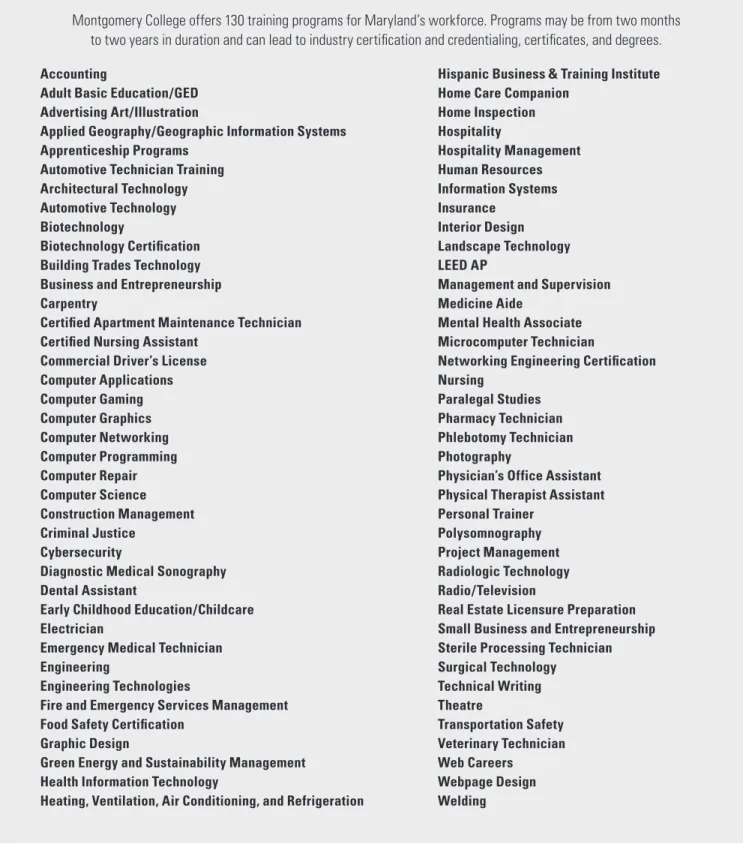
Accounting
Adult Basic Education/GED Advertising Art/Illustration
Applied Geography/Geographic Information Systems Apprenticeship Programs
Automotive Technician Training Architectural Technology Automotive Technology Biotechnology
Biotechnology Certifi cation Building Trades Technology Business and Entrepreneurship Carpentry
Certifi ed Apartment Maintenance Technician Certifi ed Nursing Assistant
Commercial Driver’s License Computer Applications Computer Gaming Computer Graphics Computer Networking Computer Programming Computer Repair Computer Science Construction Management Criminal Justice Cybersecurity
Diagnostic Medical Sonography Dental Assistant
Early Childhood Education/Childcare Electrician
Emergency Medical Technician Engineering
Engineering Technologies
Fire and Emergency Services Management Food Safety Certifi cation
Graphic Design
Green Energy and Sustainability Management Health Information Technology
Heating, Ventilation, Air Conditioning, and Refrigeration
Hispanic Business & Training Institute Home Care Companion
Home Inspection Hospitality Hospitality Management Human Resources Information Systems Insurance Interior Design Landscape Technology LEED AP
Management and Supervision Medicine Aide
Mental Health Associate Microcomputer Technician
Networking Engineering Certifi cation Nursing
Paralegal Studies Pharmacy Technician Phlebotomy Technician Photography
Physician’s Office Assistant Physical Therapist Assistant Personal Trainer
Polysomnography Project Management Radiologic Technology Radio/Television
Real Estate Licensure Preparation Small Business and Entrepreneurship Sterile Processing Technician Surgical Technology Technical Writing Theatre Transportation Safety Veterinary Technician Web Careers Webpage Design Welding
Montgomery College offers 130 training programs for Maryland’s workforce. Programs may be from two months to two years in duration and can lead to industry certifi cation and credentialing, certifi cates, and degrees.
Montgomery College trains maryland’s workforce
to ensure that our training methods are meeting the highest standards in the fi eld and complying with best practices. Since workforce devel-opment is also about preparing students in an evolving economy, this report also looks at which sectors are predicted to grow most quickly nationwide and within Montgomery County. As a critical link between
industry and training, Montgomery College is constantly attuned to how market changes impact workforce needs. Our collaborations across a host of sectors are shaping the education and training programs needed to prepare students optimally for career paths into the future.
Major Workforce Areas Supported by Montgomery College
Information Technology and Cybersecurity
Montgomery College is recognized by the National Security Agency
and the Department of Homeland Security as a National Center of
Academic Excellence in Information Security Two-Year Education.
How Montgomery College is
BRIDGing the CYBERSECURITY SKILLS GAP
cybersecurity certificate
20,000
unfilled
cybersecurity jobs
in Maryland
12 Months Training
AAS in cybersecurity
2 Years Training
BS in computer technology
(With Bowie State University)
4 Years Training
According to the US Bureau of Labor Statistics, cybersecurity consultant positions will grow by 37% from 2012 to 2022 with
the median 2012 salary for such a position at $86,170.
Maryland critical need areas fulfilled:
Computer Security and
Information Assurance
Maryland critical need area fulfilled:
Information SecurityMaryland critical need areas fulfilled:
Network Administrator, Network Manager, Assistant Director of Computer Services,
Network Analyst, Network Engineering Supervisor
T
he White House’s Comprehensive National Security Cyber Initiative identifi es cybersecurity as “one of the most serious economic and national security challenges we face as a nation.” Our nation’s most powerful tool in this effort is increased cybersecurity education. Montgomery College is taking the lead with a $15 million Trade Adjustment Assistance Community College and Career Training (TAACCCT) grant from the US Depart-ment of Labor’s EmployDepart-ment and Training Administration to a consortium of 14 community colleges in Maryland. The new Cyber-Technology Pathways Across Maryland (CPAM) Consortium is charging ahead with innovative job training in cybersecurity and information technology that is already connecting ambitious workers with growing businesses here. In total there are 40 employers partnering with Montgomery College on this initiative, including Lockheed Martin Corporation, VariQ, DMI Mobile Enterprise Solu-tions, and MedStar Health, along with several workforce boards and numerous community groups.Since Montgomery College is already recognized by the National Security Agency and the Department of Homeland Security as a National Center of Academic Excellence in Information Security Two-Year Education, our curriculum maps to federal security techni-cian standards. With this in mind, Montgomery College has created several bridges to the Maryland cybersecurity workforce. For those already working in computing, for example, just 12 months of training can earn them a certifi cate in cybersecurity. With the right prereq-uisites, this background prepares them to sit for the A+ certifi cation exam and compete for computer repair technician jobs.
For those who are new to cybersecurity, earning an associate of applied science (AAS) degree in cybersecurity makes them eligible for a growing number of information security positions in the homeland security industry. The coursework also moves students closer to a variety of industry certifi cations tied to jobs with higher wages. Montgomery College is working especially hard to connect traditionally underrepresented groups with jobs in this sector.
Our cyber and information technology programs prepare hundreds of students a year for a host of competitive exams including: A+, Network+, Security+, Linux+, Microsoft, CCENT, CCNA, and Foren-sics. One-hundred thirty Montgomery College students reported earning one of these credentials in 2013–2014. Such training prepares students for more complex jobs such as advanced help-desk employee, network administrator, and network engineer. Cisco certi-fi cations prepare students for employment as network infrastructure administrators, engineers, and security specialists.
For students who want more in-depth training, Montgomery College has an agreement with three colleges in Maryland that allow Montgomery College students to transfer and complete a bachelor’s of science in computer technology. The program prepares graduates for high-paying jobs such as an IT support specialist, systems analyst, systems network administrator, or security consultant, among others.
Information technology and cybersecurity are fi elds in which there is strong national growth. In Montgomery County, this growth is driven by employers such as Booz Allen Hamilton, Hughes Network Systems, IBM, and Lockheed Martin.
The demand for workers in cybersecurity is critical, with almost 20,000 jobs in Maryland going unfi lled for lack of qualifi ed workers. A student who earns an associate’s degree will qualify for a number of positions that are growing quickly nationwide. Cybersecurity consultant positions will grow by 37 percent from 2012 to 2022, according to the US Bureau of Labor Statistics (BLS),1 with the
median 2012 salary for such a position at $86,170. Information technology jobs are also plentiful and growing, according to the BLS. Students with an associate’s degree can qualify for jobs such as web designers (growing at 20 percent; $62,500 median 2012 salary) and computer support specialists (growing at 17 percent; $48,900 median salary). A host of IT jobs are open to candidates who can pass demanding exams certifying their skills. Montgomery College offers training courses that prepare students for certifi cation exams such as the Microsoft Certifi ed Solutions Associate, Cisco CCNA, and Oracle. Oracle database administrators generally require a bachelor’s degree, but earn an average of $77,080 in a fi eld predicted to grow 15 percent over the next decade. Montgomery College’s AAS degree and certifi cate in networking and wireless technology allow students to work in jobs such as LAN administrator, network administrator, network analyst, and network architect. Because they will train in state-of-the-art laboratories, such students will be optimally prepared to work for companies that partner with Montgomery College, such as Hughes Networking Systems.
Montgomery College’s TechLEAP computer retraining program is geared specifi cally for students who already have a college degree. With several tracks in which to specialize—programming, web technologies, network administration, among others—and paid internships as part of the package, TechLEAP allows profess-ionals to change careers or upgrade their current career in a short time frame.
Biotechnology, Life Sciences,
and Health Care
Eight of the top 20 fastest-growing occupations in the US
are in health care. Montgomery College provides education
and training that can move students into ten of them.
Montgomery College is a source for
Montgomery county’s life sciences and health care workForce
biotech
350
+
bioscience
companies
in maryland
300
MC Alumni
work in the
top 10 largest
biotech firms
2
nd
LARGest growing
occupation is nursing
270
affiliation
agreements give
MC students learning
experience at
clinical facilities
HEALTh CARE
Nurses and nursing assistants are in high demand. With a national median salary
of $65,470, nurses have a promising economic future.
E
ight of the top 20 occupations predicted to grow most rapidly in the United States by 2022 are in health care. Montgomery College provides education and training that can move students into 10 of them. At least three of them do not require a bachelor’s degree and earn more than the US median annual income of $51,371 according to the 2012 US Census’ American Communities Survey.With several large hospital employers in Montgomery County—Holy Cross Health, Adventist Health Care, and Walter Reed National Military Medical Center, among others—the need for medical technicians is rising. Montgomery College certifi cates in a range of related areas are boosting the employment prospects of students. Certifi ed nursing assis-tants, dialysis technicians, EKG technicians, pharmacy technicians, sterile processing technicians, and health care access and registration special-ists are just a few of the jobs for which Montgomery College graduates qualify after completing a certifi cate and taking the qualifying exam.
The links between Montgomery College training and in-demand health care industry standards are strong. For example, in the spring of 2014, 100 percent of Montgomery College students who took the national certifying exam in surgical technology passed the exam and were placed in full-time jobs in hospitals in Maryland or the District of Columbia. Surgical technology is predicted to grow by 30 percent by 2022 according to the BLS. In meeting this need, Montgomery College’s AAS in surgical technology prepares students to move directly into operating rooms. The College’s clinical coordinator reports that hospitals in Maryland and DC regularly inquire about our students preparing to take the exam, whom they might interview for open positions.
Medical sonography has an equally impressive success rate. For the past three years, 100 percent of Montgomery College graduates have passed their board exams to become medical sonographers. More than 85 percent of Montgomery College students get jobs
immedi-Biotechnology is thriving in Montgomery County with
more than 49,000 people employed in this sector.
ately in the fi eld with the remainder going on for further training or exploring other career paths.
The demand for physical therapist assistants (PTAs) also is booming, both nationally and in Maryland. Many students who come to Mont-gomery College for PTA training already have bachelor’s degrees (more than 40 percent of them) but want the credentials that will lead them to better opportunities. Montgomery College’s PTAs graduate with many opportunities to work in Maryland at assisted living and reha-bilitation facilities. Montgomery College’s program is enjoying great success, with the pass rates on the National Board Examination for PTA over the last three years exceeding 90 percent, and the College’s job placement rate for this program standing at 100 percent. With starting salaries at or near $50,000 per year in Montgomery County, there are strong incentives for these students to remain in Maryland. Health services certifi cates are a mainstay at Montgomery College. In 2013–2014, Montgomery College awarded 622 certifi cates to students in the allied health programs of the College’s Workforce Development & Continuing Education (WD&CE) division. Our 270 affi liation agreements allow our students to do clinical rotations at hospitals and clinics across Maryland and DC. Once they are familiar with the hospital, students move seamlessly into ready-made jobs. In our unique and innovative partnership with Holy Cross Health, Montgomery College is fortunate to have a hospital—Holy Cross Germantown Hospital—located in the Hercules Pinkney Life Sciences Park on our Germantown Campus, where students get hands-on learning, state-of-the-art instructional space, and exposure to the most advanced medical technology through an educational partner-ship with the hospital.
Nurses and nursing assistants are in high demand. The US Bureau of Labor Statistics ranks registered nurses as the second-largest growing occupation through 2022. Montgomery College is helping to fi ll the pipeline with an associate of science (AS) degree in nursing, which also prepares students to take the National Council Licensure Examination for Registered Nurses. Last year 93 percent of the AS nursing students who took the exam passed. With a national median salary of $65,470, nurses have a promising economic future.
Montgomery College’s nursing program had 200 applicants for just 120 openings in the spring of 2014. Increasing numbers of our nursing students—about 50 percent—are moving on to complete a bach-elor’s of science (BS) in nursing. A growing preference for nurses with a BS degree was reported by the Institute of Medicine’s 2010 report, The Future of Nursing: Leading Change, Advancing Health. Montgomery College’s nursing program has completed articulation agreements with eight four-year colleges and universities to help fi ll this gap. Agreements with hospitals such as Holy Cross Hospital,
Adventist Behavioral Health, Children’s National Medical Center, Doctors Community Hospital, MedStar Montgomery Medical Center, Providence Hospital, Shady Grove Adventist Medical Center, Sibley Memorial Hospital, Suburban Hospital, and Washington Adventist allow Montgomery College nursing students to participate in clinical rotations at the facilities. These collaborations enable students to complete a critical element of their education on the job and allow them to see in-demand skills at work in the fi eld. Another trend in health care is an increased demand for certifi ed nursing assistants— for which Montgomery College offers certifi cation preparation. With 45 students graduating per semester, students go on to work at long-term care facilities including Arcola Nursing Home, Asbury Methodist Village, and Hebrew Home.
Montgomery College also offers associate degrees in several fi elds that feed into four-year programs in science, technology, engineering, and mathematics (STEM) fi elds including bioengineering, chemistry, biochemistry, life sciences, and environmental science and policy. Montgomery College partners with several four-year colleges so that these students can transfer and work towards a bachelor’s degree in their areas of interest.
Biotechnology is another industry thriving in Montgomery County. More than 49,000 people are employed in this sector in the county, which includes more than 350 biosciences companies, the National Institutes of Health (NIH), the Food and Drug Administration (FDA), Walter Reed Army Institute of Research, as well as the National Institute for Science and Technology (NIST). Programs of study and relevant laboratory experience in classes in our new Bioscience Education Center are vital parts of the pipeline that supplies these agencies and fi rms. Montgomery College’s AAS and certifi cates in biotechnology prepare students for entry-level jobs in the local biotech industry. Since 2000, we have placed approximately 300 students in full-time positions, usually in the top 10 largest biotech companies. Half of Montgomery College’s biotech students already have a bachelor’s degree and are returning for further education and laboratory experience. Montgomery College’s biotech program has
Projected Job Growth
(2012–2022)Diagnostic Medical Sonographer
46%
JOB GROWTH
$65,860
Median 2012 salary Occupational Therapy Assistant43%
JOB GROWTH
$53,240
Median 2012 salary Physical Therapist Assistant41%
JOB GROWTH
$52,160
Median 2012 salarydeveloped an excellent relationship with the industry, and tailors its curriculum in response to feedback from the Biotech Industry Advisory Group. It also consults regularly with the leading biotech-nology sector partnership BIOTrain, a county biotechbiotech-nology training partnership. These relationships help hone our educational services and fi nd job placements for our graduates, who have found employ-ment at companies such as BioReliance, GeneDx, Human Genome Sciences (GlaxoSmithKline), Lonza, and MedImmune (AstraZen-eca). Montgomery College’s biotech faculty members are regularly contacted by industry representatives who are searching for new graduates to employ.
Montgomery College’s Hercules Pinkney Life Sciences Park is an extraordinary generator of economic activity, as well as another potential employer of students. Located on the Germantown Campus, the Park includes the Germantown Innovation Center, a 32,000-square-foot business incubator with wet labs, offi ces, and conference areas operated by the Montgomery County Department of Economic Development. The center currently has more than 20 tenants in biotech, cybersecurity, clean energy, and other technologies, all fueling the life sciences and biotech industries in the county. The College’s Bioscience Education Center is a critical academic anchor for the Park, where students will gain sophisticated training with opportunities to engage in business and research processes. Integrating these three components is the mission of the Park, geared to producing high-skilled graduates for the knowledge economy. The Park and incubator provide for an innovative environment that facilitates employment and internships, while providing access to nearby ready workers and driving job growth for the local economy.
Bioengineering—and within that fi eld, biomedical engineering—is a growing business in Maryland. Since professional engineers require a four-year degree, Montgomery College students who complete two years of engineering can transfer to a four-year program. Montgom-ery College is proud to have the largest engineering transfer program in the nation at a community college, with 1,400 students enrolled in the program. The new Science Center at our Rockville Campus now provides state-of-the-art classrooms and labs to support this and other STEM disciplines. Montgomery College engineering graduates have transferred to schools such as MIT, University of California– Berkeley, University of California–San Diego, Georgia Institute of Technology, Rensselaer Polytechnic Institute, and University of Maryland College Park, among others. With the fi eld of civil engi-neering growing rapidly—BLS predicts a 20 percent growth over a decade—and the median salary for a civil engineer at $79,340, engineering will continue to grow at Montgomery College. Several programs are helping this, including:
• a $600,000 grant from the National Science Foundation that provides students with fi nancial aid and a STEM adviser to guide them through the transfer process;
• the Graduate and Transfer STEM Talent Expansion Program (GT STEP), created through a $1.8 million grant over fi ve years from the National Science Foundation to provide students with extensive advising; GT STEP works to attract more students, including those who have been traditionally underrepresented, to STEM fi elds; and
• a $300,000 grant for Teaching to Increase Diversity and Equity (TIDES) in STEM. This three-year program through the Asso-ciation of American Colleges and Universities and the Leona M. and Harry B. Helmsley Charitable Trust supports the success of women and underrepresented minority students in its computer science degree program.
Some Montgomery College programs are tailored for workers who already have a bachelor’s degree but want to specialize further, such as our clinical trials project management certifi cate, offered through a partnership with Amarex Clinical Research. As a global research company located in Germantown, Amarex provides some of the instructors itself—even its CEO teaches in the program. Other classes are taught by subject-matter experts from NIH and FDA, in conjunction with Montgomery College project management faculty members. In the fall of 2014, the course in clinical trials project management was taught online and even enrolled students in India. Montgomery College aligns its health fi tness offerings with the American College of Sports Medicine’s (ACSM) certifi cations. Earning an associate of arts (AA) in health fi tness prepares students to take certifying exams for personal trainer and group fi tness certifi cates. These credentials open doors to personal trainer positions, which are predicted to grow by 13 percent over a decade. Many Montgomery College graduates go on to Salisbury University’s program offered at the Universities at Shady Grove for a bachelor’s degree in kinesiology with a minor in health. Montgomery College’s transfer agreement with Salisbury University has doubled its health fi tness enrollment in two years.
About half of the nation’s science and
engineering majors got their start at
community colleges. Montgomery College
has the nation’s largest engineering
transfer program at a community college.
T
he building trades have historically been a reliable source of stable jobs that provide career paths to workers with a high school diploma. With the proper licensing or certifi ca-tion, workers can move quickly into positions upon which the auto and construction industries rely. Montgomery College programs have aligned themselves rigorously with industry standards as well as licensing and certifi cation requirements. Montgomery College’s Gudelsky Institute for Technical Education, for example, provides training and education in automotive technology, building construc-tion, and apartment maintenance, among others. Many of these programs are industry-sponsored and formatted around certifi cation and licensing standards, including the Air Conditioning Contractors of America, North American Board of Certifi ed Energy Practitioners, and Certifi cate for Apartment Maintenance Technicians.Building, Professional,
and Human Services
Montgomery College programs have aligned themselves rigorously with
industry standards, as well as licensing and certifi cations requirements.
Long-term professional growth is particularly promising in several areas in which Montgomery College training is active: roles for carpenters, electricians, HVAC technicians, and solar PV installers are all predicted to grow at rates much faster than average in all fi elds, according to BLS, and to earn strong salaries for those with only a high school diploma.
Since Montgomery College provides instruction related to appren-ticeships in several job categories in the building trades, contact between instructors and experts in the fi eld is vital. Montgomery College regularly seeks guidance from construction industry pro-fessionals about the needs they see evolving on the job site. In consultation with industry advisory panels, Montgomery College has responded with training and education that fi ll gaps as they evolve. In fact, the Maryland Center for Construction Education and
Anticipated labor shortages through 2020:
montgomery college fills the gap
Montgomery College is actively training in four areas that, according to the US Bureau of Labor Statistics, are predicted to grow “much faster than average.”
Source: US Bureau of Labor Statistics and Maryland Center for Construction and Innovation
24%
JOB GROWTH
(2012–2022) Carpenter20%
JOB GROWTH
(2012–2022) Electrician21%
JOB GROWTH
(2012–2022) HVAC Technician24%
JOB GROWTH
(2012–2022) Solar PV Installer$39,940
Median 2012
salary
$49,840
Median 2012
salary
$43,640
Median 2012
salary
$37,900
Median 2012
salary
70%
anticipated labor shortage in skilled trades
Innovation (MCCEI) convened a panel of educators and construction industry professionals in 2013 at Montgomery College to produce an in-depth report on the topic: Digging Deeper: Aligning Education and Industry. With the job category of construction laborers and helpers predicted to grow by 25 percent, work in the construction industry is uniquely ripe for Montgomery College graduates. Students who go on for further training as construction managers can boost their earning potential greatly: construction managers with a bachelor’s degree earned a median salary of $82,790 in 2012. A recent articula-tion agreement allows Montgomery College construcarticula-tion manage-ment students to transfer to four-year programs at University of Maryland Eastern Shore/University of Maryland Shady Grove. Montgomery College also prepares students for several fi elds in which commercial licenses or certifi cations must be obtained to secure employment: home inspectors, home improvement contrac-tors, real estate agents, insurance sales agents, cab and truck drivers, food servers, apartment leasing managers, and environ-mental protection and safety positions. The certifi cations are designed to meet industry standards, such as those held by the National Restaurant Association (food handlers), the National Apartment Leasing Association (leasing agents), the Maryland Motor Vehicle Administration (truck and bus drivers, plus mobile crane and tractor operators), the Maryland Insurance Administra-tion (insurance policy sales), the Maryland Department of Labor, Licensing, and Regulation (real estate licenses for agents or brokers and home inspections), and the US Green Building Council (Leader-ship in Energy & Environmental Design accredited professionals). Several of these jobs can provide a promising career path for students who have completed postsecondary credential-preparation programs. For example, in 2012 the median salary for real estate agents was $41,990, with an 11 percent growth predicted over a decade; and $48,150 for insurance salespersons with a 10 percent growth rate predicted.
With guidance from an advisory board of automotive industry pro-fessionals, Montgomery College prepares students for employment in the automotive service and repair industry as repair technicians, vehicle inspectors, and service writers. With a curriculum that is driven and specifi ed by the Automotive Service Excellence-National Automotive Teachers Education Foundation (ASE-NATEF) standards, students are prepared for 11 ASE automobile technician certifi ca-tions, including master certifi ed technicians. With the master certifi ed curriculum, students can earn an associate of applied sciences (AAS) degree and a powertrain specialist certifi cate. Montgomery College also partners with industry to provide custom contract training and assistance with partner industry training, including the Washington Area New Automobile Dealer Association, Maryland Department of
the Environment, CarQuest, and AC Delco. In response to industry demand, the program also has a fl eet of hybrid electric vehicles and fully electric vehicles for its alternative fuels technology training. The College recently launched a new program certifi ed by ASE, the L-3 Hybrid Electric Vehicles Certifi cation. In 2013 and 2014, more than 490 students took these courses annually, with some students gaining employment even before graduation. The national median salary for automotive technicians in 2012 was $36,610.
Project management is another industry-certifi ed skill that is increasingly popular among employers. Montgomery College’s Workforce Development & Continuing Education division offers a project management certifi cation preparation course, after which students can sit for the Project Management Institute’s certifi cation exam. Nearly 100 percent of students have passed the Project Management Professionals (PMP) exam since spring 2013. Paralegal studies also can prepare students for a career path that is predicted to grow 17 percent over a decade. The median salary in 2012 for a paralegal with an associate’s degree was $46,990. Montgomery College offers both an associate of applied studies degree in paralegal studies, which prepares students to become paralegals, and an advanced paralegal studies certifi cate, designed for people already working in the profession.
Law enforcement is another popular career path at Montgomery College, with an AAS program in criminal justice and a two-year program for students who want to study further. Approximately 80 percent of the criminal justice students in the University of Maryland College Park program at the Universities at Shady Grove are from Montgomery College. Students with this credential can fi nd stable work in public safety as police offi cers (median salary of $56,980), probation/parole offi cers ($48,190), corrections offi cers ($38,970), uniformed Secret Service ($56,592), or transit and railroad police ($55,210).
Source: Maryland Center for Construction and Innovation, The Critical Path
anticipated labor shortages
through 2020
70%
13%
10%
7%
Skilled Trades and Crafts Engineering and Technology Project Management OtherW
ith a competitive economy in Montgomery County, businesses rely increasingly on skilled technicians to design websites, create digital animation, and produce computer applications for their products and services. At this inter-section of arts, communication, and culture, Montgomery College programs are preparing students to move into high-demand jobs such as graphic designers, art directors, production assistants, and web application designers.Montgomery College’s associate’s degree in web design, for example, prepares students to work as web developers. The fi eld is growing faster than average with a median national salary of $62,500 per year for a worker with an associate’s degree. Digital animators are a growing workforce group, for which Montgomery College offers an associate of applied studies degree and a certifi cate in digital animation, which prepare students to work in a variety of corporate and nonprofi t settings.
Computer gaming and simulation is another cutting-edge fi eld in which Montgomery College offers an associate’s degree. The
program prepares students to work as game artists, animators, designers, and programmers. A high-growth fi eld, there were 257 students enrolled in the program in 2013, and the enrollment over the past four years has grown more than 150 percent. Montgomery College’s gaming program has even produced educational video games for the National Oceanic and Atmospheric Administration (NOAA)—designed by our students—which appear on the NOAA website. Montgomery College graduates often go on to work at local game industry employers like Bethesda Software and Zenimax Online. Many students transfer to the University of Baltimore program provided at the Universities at Shady Grove, where the College has a transfer agreement for the upper two years of the video gaming bachelor’s degree. Faculty members in the gaming program report that employers frequently come to them looking to hire students with animation, web development, and game development skills. With a median 2012 salary of $62,500, web developers are predicted by BLS to grow by 20 percent over a decade.
Montgomery College also offers certifi cates in broadcast journal-ism, TV production, radio production, digital tools, and digital media
Communication, Education,
Arts and Culture
Montgomery College programs serve Montgomery County’s
needs in workforce sectors showing rapid growth.
Montgomery College actively trains in high-growth fields
web design and development
EDUCATION
ESL
training programs:
AAS in web design
AAS in digital animation
AAS in computer gaming and simulation
20%
JOB GROWTH
(In the next decade)
Montgomery College
partners with MCPS
for training program:
ACET
(Alternative Certifi cation for Effective Teachers)
89%
ACET graduates
who still teach
in MCPS
classes co-taught
with content and
English language:
certified apartment
maintenance technician
and
geriatric nursing
production. Students have gone on to work at production facilities including WUSA Channel 9, DC50, Telemundo, Univision, 106.7 Sports Radio “The Fan,” Monumental Sports Productions, Voice of America, and Clear Channel Radio. Students become profi cient with industry- standard hardware and software that include Adobe’s Creative Cloud Editing and Production Software, high-defi nition studio and fi eld production equipment, and tapeless, fi le-based production of video and audio programs, commercials, documentaries, and podcasts. Career-readiness also has become a priority in the last few years with internship opportunities and e-portfolios available to prospective employers through LinkedIn and personal web pages. The capstone course for the TV/radio program partners with MCTV, the College’s television station, and airs weekly live student-produced newscasts. Students also plan and perform on-air in the College’s e-radio studios or WMCR. Service learning video projects by students include web videos for the Literacy Council of Montgomery County, Friends of the Library, the Humane Society, and the Manna Food Center. Although 50 percent of Montgomery College students in communications go on to complete a four-year degree, those who move directly into the workplace from the College often succeed as video editors, freelance camera operators, or sound technicians. Sound technicians, for example, require an associate’s degree or training after a high school diploma and earn a median salary of $41,200 per year. To support Maryland’s public schools and communities, Montgomery College provides a wealth of teacher-training opportunities in areas of secondary education, advanced placement instruction, early childhood education, and English for Speakers of Other Languages. Montgomery College offers an associate of arts in teaching (AAT) degree program for students who want to master the fi rst two years of core educational requirements for teacher preparation before transfer-ring to complete their baccalaureate degree. The College also operates an Alternative Certifi cation for Effective Teachers program, which allows career-changers, who already have degrees, to become middle- and high-school teachers in high-need fi elds such as mathematics, science, and Spanish. This Workforce Development & Continuing Education program is a partnership with Montgomery County Public Schools (MCPS), with graduates going into classrooms in the county. Montgomery College’s collaborations on recruitment and training, plus internships and placement, help teachers move seamlessly into classrooms. Of the students who have completed the program since 2006, 89 percent are still teaching in the MCPS system.
Montgomery College’s Workforce Development & Continuing Educa-tion program also offers early childhood educaEduca-tion training courses. They allow students to gain certifi cates such as the Maryland 90-hour course certifi cate, preparing them for the national child development associate credential. Montgomery College training in this fi eld is
offered in both English and Spanish. On average, 275 students complete the 90-hour training each year. Montgomery College also partners with the county’s Department of Health and Human Services to make the program available to persons transitioning from welfare to work; 300 people have completed it over four years.
With a high number of Montgomery County residents speaking lan-guages other than English, interpreting and translation are critical for our workforce. The BLS predicts that skilled interpreters will grow by 46 percent from 2012 to 2022. Since the average nationwide salary for interpreters in 2012 was $45,430 per year, the fi eld offers promis-ing opportunities for those with language capabilities. Montgomery College offers a Community Spanish Facilitator Program through our Translation and Interpretation Institute. Created to serve the growing Latino population of Montgomery County, the program requires 36 hours of skills training in reading and speaking English and Spanish. Montgomery College also runs several programs that help new arrivals improve their English skills so that they can contribute maximally to the workforce. In FY14, over 6,000 individual students took one or more classes in one of the College’s English language programs. Core classes in English as a Second Language (ESL) for health care jobs and ESL for building trades jobs place English language instruction in the context of specifi c vocations. These grant-funded classes lead to an additional tier of instruction and services that is based on the Integrated Basic Education and Skills Training (I-BEST) model. The Maryland version of I-BEST programs, called MI-BEST, in certifi ed apartment maintenance technician (funded by the Community Foundation of the National Capital Region’s Greater Washington Workforce Development Collaborative) and geriatric nursing assistant (funded by the US Department of Labor) feature two instructors co-teaching each class, one for content and one for English language and basic skills. Completion and job placement in these areas have been excellent: of the students who were in the fi rst four cohorts of certifi ed apartment maintenance technician, 94 percent completed and earned a credential, and 72 percent went on to employment. Of the students who enrolled in the fi rst three geriatric nursing assistant cohorts, 90 percent have completed and earned a credential, and 81 percent are now employed.
Over four years, 300 people have
completed the 90-hour early childhood
education training program as they
transitioned from welfare to work.
W
ith the headquarters of Host Hotels, Marriott Inter-national, and Sodexo Services located in Maryland, thousands of people in the state work in hospitality, as well as the food and beverage industries. Montgomery College offers an associate in applied studies (AAS) degree in hospitality management with several concentrations and certifi cates avail-able. One specialization is food and beverage management, which is predicted to grow seven percent over a decade. This fi eld allows certifi cate students to transition directly into food service. Mont-gomery College collaborates with the county’s Department of Health and Human Services to provide food manager recertifi cation exams and the National Restaurant Association Education Foundation’s ServSafe food manager course.For those already working in hospitality and looking to advance, a certifi cate in hospitality supervision and leadership can move them into supervisory roles. In 2013, lodging managers made a median hourly wage of $51/hour and food service managers earned a median
wage of $32/hour according to Economic Modeling Specialists International data drawn from BLS. Meeting, conference, and event planning, another track in Montgomery College’s hospitality program, is predicted to grow by 20 percent over a decade, according to BLS data, with a median salary of $68,640. A Montgomery College certifi -cate in either fi eld can open doors to new professional roles for those students who already have a college degree.
On the business side of hospitality, critical computer skills can also be earned at Montgomery College with an AAS in computer appli-cations or certifi cates with a concentration in either information technology or database systems. Montgomery College also offers an AA in business designed for students who plan to transfer to a four-year program. Since launching a business also requires a critical competitive edge, specialized programs such as the Kauffmann Fastrac®, Hillman Entrepreneurs, and the Macklin Center for
Entrepreneurship help students start a new business or grow an existing one.
Business and Hospitality
Montgomery College collaborates with Montgomery County’s
Department of Health and Human Services to provide food manager
recertifi cation exams and the National Restaurant Association
Education Foundation’s ServSafe food manager course.
serving the needs of maryland’s hospitality workforce
Montgomery College training program:
Food and beverage management certificate
Meeting, Conference, and Event Planning certificate
Montgomery College training program:
Meeting,
Conference,
and Event
Planning
$33
/
hour
2013 Median wage
Food
Service
Management
$32
/
hour
2013 Median wage
Montgomery County’s hospitality industry employs more than 30,000 people.*
Government and Foundations
M
ontgomery College’s accomplishments in strengthening the STEM pipeline, facilitating students’ transition to the workplace, and increasing retention of students has garnered attention from federal and state funders. For example, National Institute of Standards and Technology (NIST) funding is giving real-world, laboratory research experience to Montgomery College students through internships. National Science Foundation (NSF) funding of the Graduate and Transfer STEM Talent Expan-sion Program is supporting culturally diverse students who want to complete an associate’s degree or transfer to a university in a STEM fi eld. NSF is also helping strengthen the STEM teacher pipeline at Montgomery College with its Teaching Pathways Opening Doors to STEM program. Montgomery College’s value to the humanities is also recognized by two grants from the National Endowment for the Humanities (NEH) —one $490,000 grant to launch a Global Humanities Institute, and another grant to support further education about Islam.The US Department of Health and Human Services has fi nanced several Montgomery College faculty projects that aid pharmacy students, fund equipment for biotech laboratories, and provide training services to accelerate entry to the workplace. At the state level, Montgomery College partnerships are helping improve literacy, provide job training, and fund biotechnology laboratories, all of which are supported by the Maryland Department of Labor, Licensing, and Regulation (DLLR). DLLR funds are also helping to align industry curricula with Montgomery College programs through Employment Advancement Right Now (EARN) grants. Montgomery College was awarded two EARN grants in 2014: one for BIOTrain, a county biotechnology training partnership, and the other for MOVE, the Maryland Mid-Western Transportation and Logistics Sector Partnership.
National foundations such as the Bill and Melinda Gates Foundation, the Kresge Foundation, and the Robert Wood Johnson Foundation are supporting Montgomery College’s transfer success through part-nerships with four-year institutions in Maryland.
Industry
On the industry side, employers in Montgomery County are active players in the Montgomery College educational process. Communica-tion and collaboraCommunica-tion between the Montgomery College faculty and industry representatives is dynamic and constant. Some of our faculty members are current industry practitioners who come into Mont-gomery College classrooms part-time, bringing the latest innovations directly from the workplace. Employers even pay community colleges to train incumbent workers for industry-specifi c roles. In fact, our faculty trained 2,800 employees last year. Montgomery College faculty members sit on numerous industry-led advisory boards, which work to align Montgomery College training with industry needs. Many departments report that companies approach them long before graduation to see how many new workers will be available. Montgomery College also participates on the Montgomery County Workforce Investment Board, contributing to the planning, policy, and performance oversight of county workforce services. In addition, a full time Montgomery College staff member is stationed at the Montgomery Works One-Stop Center in Wheaton, where residents can get information on job openings, training opportunities, and guidance on careers that are in high demand.
Community Engagement
Montgomery College works closely with Montgomery County Public Schools (MCPS) to facilitate the transition from secondary educa-tion to postsecondary educaeduca-tion. Many initiatives are embedded in high schools where some students are the fi rst in their families to go beyond high school. One of the newest is the Achieving Collegiate Excellence and Success (ACES) program, a collaboration with MCPS and the Universities at Shady Grove that provides Montgomery College academic coaches to targeted high school students in 10 MCPS high schools. Montgomery College also works with MCPS to offer early placement programs, some of which have a STEM focus. The programs allow high school students to begin earning college credit while still in high school. Another program includes collabora-tion with MCPS’ “academies,” which allow focus on a specifi c subject
Montgomery College Partnerships
Career-training programs are at the core of Montgomery College’s growing
collaboration with business, government, trade, and community organizations.
Its partnerships with employers, foundations, and government agencies
multiply the impact of its training and education programs.
subject area, such as business, health, or science to better prepare students for postsecondary education.
Montgomery College has numerous active partnerships with nonprofi ts that help community groups advance their services. Last year, Montgomery College offered a grant proposal writing series with the Nonprofi t Village helping 19 nonprofi ts to improve their research, writing, and storytelling for funding proposals. The College also offers a Nonprofi t Leadership Institute, which trains 25 mid-level administrators each year in skills that enhance the capacity and sustainability of their organizations. In response to the changing demographics of the region, Montgomery College’s WD&CE division helps organizations with language needs, among others services. Montgomery College provides Spanish language training to health care practitioners at Holy Cross Hospital, so they can better treat patients in their community.
Community engagement centers are another way that the College directly serves residents. Through a partnership with Montgomery County Government, Montgomery College has opened two Commu-nity Engagement Centers. Located at the Gaithersburg Library and the East County Regional Service Center, the centers help residents connect with community and educational resources, workforce development classes, and information to continue their education or training. Residents also have access to one-on-one consultations with trained staff who guide them through career exploration and possible enrollment at the College.
Staying Connected with Industry and Nonprofits
Montgomery College President DeRionne Pollard meets regularly with CEOs in Montgomery County to solicit guidance on workforce development trends and curricular changes tied to industry needs. The College benefi ts from the guidance provided by the President’s Roundtable, an advisory group that meets with the president three times a year. Dr. Pollard also serves on the boards of the Montgomery County Chamber of Commerce, the Montgomery Business
Develop-ment Corporation, Leadership Montgomery, Montgomery Moving Forward, and the Maryland Economic Development and Business Climate Commission. Dr. Sanjay Rai, our senior vice president for academic affairs, serves on the board of the Tech Council of Maryland. Provosts of the three Montgomery College campuses serve on the chambers of commerce for Gaithersburg/Germantown, Greater Silver Spring, and Rockville. Administrative leadership also participate in an array of other business organizations including the Montgomery County Workforce Investment Board (WIB). The WIB collaborates on projects such as Accelerating Connections to Employment (ACE), and the EARN grants—state grants to facilitate collaboration between employers and education to address industry-specifi c workforce needs. The following is a sample of industry organizations with which Mont-gomery College faculty members collaborate:
community and Industry advisors
Air Conditioning Contractors of America American Management Association American Nurses Association Biotech Industry Advisory Group Broadcast Educators Association CASA de Maryland
Computing Technology Industry Association Human Resources Bio Science Alliance Network
Law, Government, and Public Safety Cluster Advisory Board North American Board of Certifi ed Energy Practitioners Maryland Center for Construction Education and Innovation Maryland Board of Nursing
Maryland Department of Labor, Licensing, and Regulation Montgomery County Public Schools
National Apartment Leasing Association
National Automotive Teachers Education Foundation National Restaurant Association
Suburban Maryland Building Association
Washington Area New Automobile Dealer Association
Montgomery College Partnerships:
matching county needs to industry demands
ABC ■ Air Conditioning Contractors of America ■ Accenture ■ Adventist HealthCare
Amarex ■ BioMaryland ■ The Community Foundation ■ Department of Economic Development
Discovery Communications ■ Holy Cross Health ■ Lockheed Martin ■ Marriott
Mental Health Association ■ Moving Maryland Forward ■ MedImmune ■ NIST ■ Tech Council of Maryland
Top Ten Careers Viewed in “career coach”
(
July 2012 –January 2015
)
481
Diagnostic Medical Sonographer409
Medical Records and Health Information Technician408
Computer and Information Systems Manager391
Registered Nurse315
Medical and Health Services Manager285
General and Operations Manager283
Nursing Assistant274
Administrative Services Manager Computer Systems Analyst356
Accountant804
B
y creating a more integrated approach to career planning, Montgomery College students make more informed choices about education and training. Montgomery College’s Career Services include many aspects of traditional career counseling but one of its newest tools has proven inspiring and powerful. “Career Coach” is a portal that connects Montgomery College students directly to labor market data in Montgomery County and the surrounding localities. Using economic data from Economic Modeling Specialists International (EMSI), Career Coach lists jobs that are open withStudents and Jobs:
Montgomery College’s “Career Coach”
information on salaries, educational requirements, and workforce gaps. The tool is a real-time window into the labor market in Maryland. It gives clear links between Montgomery College’s offerings and the careers available in the region to Montgomery College students. Students have used the tool more than 23,000 times in the past two and a half years. While students—and former students—can use it themselves, career counselors and advisers at the College report that it helps their effective-ness immensely.
getting montgomery
college students on
the right career path
“Career Coach,” is a portal that connects MC students directly to labor market data in Montgomery County and the surrounding localities. Using economic data from Economic Modeling Specialists International, “Career Coach” lists jobs that are open, salaries, educational require-ments, and workforce gaps. The tool is a real-time window into the labor market in Maryland.
https://montgomerycollege.emsicareercoach.com
Diagnostic Medical Sonographer
All career data is set to your current geographical area
Bookmark Download PDF Wage $60 $50 $40 $30 $20 $36.18/hr $75k/yr Median Wage (50th percentile) $25.36/hr $53k/yr Entry-level Wage (10th percentile) $48.21/hr $100k/yr High Wage (90th percentile)
Home Careers Education/Programs Career Assessment Resume Builder
1,680Diagnostic Medical Sonographers are employed. This number
is expected to increase by 20.1% over the
next four years.
18%are over the age of 55 and will probably retire soon. Job Postings Medical Sonographer Sentara Alexandria, VA Sonographer ARDMS-Ultrasound Adventist HealthCare Rockville, MD Sonographer ARDMS-Ultrasound Adventist HealthCare Takoma Park, MD Career Coach
T
wo thirds of jobs in the future will require a postsecond-ary education and Montgomery College is ideally posi-tioned to serve a growing sector of diverse students who will fi ll such positions: those who are retraining, switching careers midstream, studying at night while working full-time, or raising a family. Our programs are nimble and relevant, preparing fi rst-time students to enter the market with job-ready skills and experienced professionals to step up their own training with advanced special-ization. Montgomery College is an institution dedicated to building the workforce of the future. Ambitious students and growing busi-nesses fi nd themselves perfectly matched at Montgomery College.Conclusion:
The Workforce
Montgomery College Board of Trustees
Reginald Felton
Chair, Board of Trustees
Marsha Suggs Smith
First Vice Chair, Board of Trustees
Michael J. Knapp
Second Vice Chair
Gloria Aparicio Blackwell Dr. Kenneth J. Hoffman Dr. Leslie S. Levine Carlos Mejia-Ramos Michael D. Priddy Benjamin H. Wu Dr. DeRionne P. Pollard
Secretary/Treasurer and President of Montgomery College
Contact Information
George Payne
Vice President and Provost of Workforce Development and Continuing Education Montgomery College
51 Mannakee Street Rockville, MD 20850
[email protected] 240-567-2582