(will be inserted by the editor)
Improved Complexities of Conditional
Gradient-Type Methods with Applications to Robust Matrix
Recovery Problems
Dan Garber, Atara Kaplan and Shoham Sabach
Received: date / Accepted: date
Abstract Motivated by robust matrix recovery problems such as Robust Principal Component Analysis, we consider a general optimization problem of minimizing a smooth and strongly convex loss function applied to the sum of two blocks of variables, where each block of variables is constrained or reg-ularized individually. We study a Conditional Gradient-Type method which is able to leverage the special structure of the problem to obtain faster con-vergence rates than those attainable via standard methods, under a variety of assumptions. In particular, our method is appealing for matrix problems in which one of the blocks corresponds to a low-rank matrix since it avoids prohibitive full-rank singular value decompositions required by most standard methods. While our initial motivation comes from problems which originated in statistics, our analysis does not impose any statistical assumptions on the data.
Keywords conditional gradient method· Frank-Wolfe algorithm ·convex optimization·robust PCA·low-rank matrix recovery·low-rank optimization·
semidefinite programming·nuclear norm minimization
Mathematics Subject Classification (2000) 90C22· 90C06· 68W27 ·
68W20
Dan Garber
Faculty of Industrial Engineering and Management, Technion, 32000 Haifa, Israel E-mail: [email protected]
Atara Kaplan
Faculty of Mathematics, Technion, 32000 Haifa, Israel E-mail: [email protected]
Shoham Sabach
Department of Industrial Engineering and Management, Technion, 32000 Haifa, Israel E-mail: [email protected]
1 Introduction
In this paper we consider the following general convex optimization problem min{f(X,Y) :=g(X+Y) +RX(X) +RY(Y) : X,Y∈E}, (1) whereEis a finite-dimensional normed vector space over the reals,g:E→R is assumed to be continuously differentiable and strongly convex, while RX :
E→(−∞,+∞] andRY :E →(−∞,+∞] are proper, lower semicontinuous and convex functions which can be thought of either as regularization func-tions, or indicator functions1 of certain closed and convex feasible setsX and
Y.
Problem (1) captures several important problems of interest, perhaps the most well-studied is that ofRobust Principal Component Analysis (PCA) [3, 14, 11], in which the goal is to (approximately) decompose an m×n input matrixM into the sum of a low-rank matrixXand a sparse matrix Y. The underlying optimization problem for Robust PCA can be written as (see, for instance, [11]) min 1 2kX+Y−Mk 2 F : kXknuc≤τ,kYk1≤s, X,Y∈R m×n , (2)
wherek·kF denotes the Frobenius norm,k·knuc denotes the nuclear norm, i.e., the sum of singular values, which is a highly popular convex surrogate for low-rank penalty, and k·k1 is the entry-wise `1-norm, which is a well-known convex surrogate for entry-wise sparsity.
Other variants of interest of Problem (2) are when the data matrixMis a corrupted covariance matrix, in which case it is reasonable to further constrain
Xto be positive semidefinite, i.e., use the constraints X0and Tr(X)≤τ. In the case thatMis assumed to have several fully corrupted rows or columns, a popular alternative to the `1-norm regularizer on the variable Y is to use either the normk·k1,2 (sum of`2-norm of rows) in case of corrupted rows, or the normk·k2,1 (sum of`2-norm of columns) in case of corrupted columns, as a regularizer/constraint [15]. Finally, moving beyond Robust PCA, a different choice of interest for the lossg(·) could beg(Z) := (1/2)kAZ−Mk2F, where
A is a linear sensing operator such that ATA is positive definite (so g(·) is
strongly convex).
In this paper we present an algorithm and analyses that build on the special structure of Problem (1), which improve upon state-of-the-art com-plexity bounds, under several different assumptions. A common key to all of our results is the ability to exploit the strong convexity of g(·) to obtain improved complexity bounds. Here it should be noted that while g(·) is as-sumed to be strongly convex, Problem (1) is in general not strongly convex in (X,Y). This can already be observed when choosing g(z) := 12kzk22, and
RX(·) =RY(·) = 0, wherex,y ∈Rd. In this case, denoting the overall ob-jective asf(x,y) := 12kx+yk22, it is easily observed that the Hessian matrix off(·,·) is given by∇2f(x,y) = (I I)>
(I I), and hence is not full-rank. The fastest known convergence rate for first-order methods applicable to Problem (1), is achievable by accelerated gradient methods such as Nesterov’s optimal method [12] and FISTA [2], which converge at a rate of O(1/t2), where t denoted the number of performed iterations. However, in the con-text of low-rank matrix optimization problems such as Robust PCA, these methods require to compute a full-rank singular value decomposition on each iteration to update the low-rank component, which is often prohibitive for large scale instances. A different type of first-order methods is the Conditional Gradient (CG) Method (a.k.a Frank-Wolfe algorithm) and variants of [6–10, 17]. In the context of low-rank matrix optimization, the CG method simply requires to compute an approximate leading singular vector pair of the nega-tive gradient at each iteration, i.e., a rank-one SVD. Hence, in this case, the CG method is much more scalable, than projection/proximal based methods. However, the rate of convergence is slower, e.g., if bothRX(·) andRY(·) are indicator functions of certain closed and convex setsXandY, then the conver-gence rate of the conditional gradient method is of the formO((D2
X+D2Y)/t), where DX and DY denote the Euclidean diameter of the corresponding fea-sible sets X and Y, where the diameter of a subset C of Rd is defined by
DC = maxx1,x2∈Ckx1−x2k2.
Recently, two variants of the conditional gradient method for low-rank matrix optimization were suggested, which enjoy faster convergence rates when the optimal solution has low rank (which is indeed a key implicit assumption in such problems), while requiring to compute only a single low-rank SVD on each iteration [5, 1]. However, both of these new methods require the objective function to be strongly convex, which as we discussed above, does not hold in our case. Nevertheless, both our algorithm and our analysis are inspired by these two works. In particular, we generalize the low-rank SVD approach of [1] to non-strongly-convex problems of the form of Problem (1), which include arbitrary regularizers or constraints.
In another recent related work [11], which also serves as a motivation for this current work, the authors considered a variant of the conditional gradient method tailored for low-rank and robust matrix recovery problems such as Problem (2), which combines standard conditional gradient updates of the low-rank variable (i.e., rank-one SVD) and proximal gradient updates for the sparse noisy component. However, both the worst-case convergence rate and running time do not improve over the standard conditional gradient method. Combining conditional gradient and proximal gradient updates for low-rank models was also considered in [4] for solving a convex optimization problem related to temporal recommendation systems.
Finally, it should be noted that while developing efficient non-convex op-timization-based algorithms for Robust PCA with provable guarantees is an
active subject (see, e.g., [13, 16]), such works fall short in two aspects: (a) they are not flexible as the general model (1), which allows for instance to impose a PSD constraint on the low-rank component or to consider various sparsity-promoting regularizers for the sparse componentY, and (b) all prov-able guarantees are heavily based on assumptions on the input matrixM(such as incoherence of the singular value decomposition of the low-rank component or assuming certain patterns of the sparse component), which can be quite limiting in practice. This work, on the other hand, is completely free of such assumptions.
To overcome the shortcomings of previous methods applicable to Problem (1), in this paper we present a first-order method, which combines two well-known ideas, for tackling Problem (1). In particular we show that under several assumptions of interest, despite the fact that the objective in Problem (1) is in general not strongly convex, it is possible to leverage the strong convexity of g(·) towards obtaining better complexity results, while applying update steps that are scalable to large scale problems. Informally speaking, our main improved complexity bounds are as follows:
1. In the case that bothRX(·) andRY(·) are indicators of compact and con-vex sets (as in Problem (2)), we obtain convergence rate ofO(min{D2
X, DY2}/t). In particular when Xis constrained, for example, via a low-rank promot-ing constraint, such as the nuclear-norm, our method requires on each iteration only a SVD computation of rank=rank(X∗), whereX∗ is part of certain optimal solution (X∗,Y∗). This result improves (in terms of run-ning time), in a wide regime of parameters, mainly when min{D2
X, D2Y}<< max{D2
X, D2Y}, over the conditional gradient method which converges with rate ofO(max{D2
X, DY2}/t), and over accelerated gradient methods which require, in the context of low-rank matrix optimization problems, a full-rank SVD computation on each iteration.
2. In the case that RY(·) is an indicator of a strongly convex set (e.g., an
`p-norm ball forp ∈(1,2]), our method achieves a fast convergence rate
of O(1/t2). As in the previous case, if X is constrained/regularized via the nuclear norm, then our method only requires a SVD computation of rank=rank(X∗). To the best of our knowledge, this is the first result that combines anO(1/t2) convergence rate and low-rank SVD computations in this setting. In particular, in the context of Robust PCA, such a result allows us to replace a traditional sparsity-promoting constraint of the form
kYk1 ≤τ with kYk1+δ ≤τ0, for some small constant δ. Using the `1+δ
-norm instead of the`1-norm gives rise to a strongly convex feasible set and, as we demonstrate empirically in Section 3.2, may provide a satisfactory approximation to the`1-norm constraint in terms of sparsity.
3. In the case that either RX(·) or RY(·) are strongly convex (though not necessarily differentiable), our method achieves a linear convergence rate. In fact, we show that even if only one of the variables is regularized by a strongly convex function, then the entire objective of Problem (1) becomes
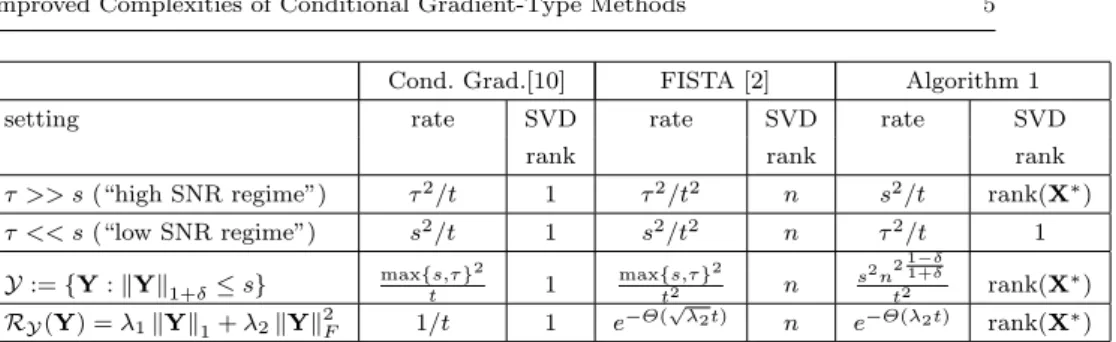
Cond. Grad.[10] FISTA [2] Algorithm 1
setting rate SVD rate SVD rate SVD
rank rank rank
τ >> s(“high SNR regime”) τ2/t 1 τ2/t2 n s2/t rank(X∗)
τ << s(“low SNR regime”) s2/t 1 s2/t2 n τ2/t 1 Y:={Y:kYk1+δ≤s} max{s,τ}t 2 1 max{s,τ}t2 2 n s 2n211+−δδ t2 rank(X∗) RY(Y) =λ1kYk1+λ2kYk2F 1/t 1 e−Θ( √ λ2t) n e−Θ(λ2t) rank(X∗)
Table 1: Comparison of convergence rates and iteration complexity bounds for Robust PCA problems (see Problem (2)) with an×ninput matrixM. For all methods the computational bottleneck is a single SVD computation to update the variable X, hence we focus on the rank of the required SVD. For clarity of presentation the results are given in simplified form. The dependence onn
in the rate for Algorithm 1 in the third row comes from the strong convexity parameter of the setY.
strongly convex in (X,Y). Here also, in the case of a nuclear norm con-straint/regularization on one of the variables, we are able to leverage the use of only low-rank SVD computations. In the context of Robust PCA such a natural strongly convex regularizer may arise by replacing the `1 -norm regularization onY with the elastic net regularizer, which combines both the`1-norm and the squared `2-norm, and serves as a popular alter-native to the`1-norm regularizer in LASSO.
A quick summary of the above results in the context of Robust PCA problems, such as Problem (2), is given in Table 1. See Section 3.2 in the sequel for a detailed discussion.
2 Preliminaries
Throughout the paper we letEdenote an arbitrary finite-dimensional normed vector space overRwherek·kandk·k∗denote the primal and dual norms over
E, respectively.
2.1 Smoothness and strong convexity of functions and sets
Definition 1 (smooth function)Letf :E→Rbe a continuously differen-tiable function over a convex setK ⊆E. We say thatfisβ-smooth overKwith respect tok·k, if for allx,y∈ Kit holds thatf(y)≤f(x) +hy−x,∇f(x)i+ (β/2)kx−yk2.
Definition 2 (strongly convex function)Letf :E→Rbe a continuously differentiable function over a convex setK ⊆E. We say thatf is α-strongly convex over K with respect to k·k, if it satisfies for allx,y ∈ Kthat f(y)≥ f(x) +hy−x,∇f(x)i+ (α/2)kx−yk2.
The above definition combined with the first-order optimality condition im-plies that for a continuously differentiable and α-strongly convex function f, if x∗ = arg minx∈Kf(x), then for any x ∈ K it holds that f(x)−f(x∗)≥
(α/2)kx−x∗k2.
This last inequality further implies that the magnitude of the gradient of
f at a point x, k∇f(x)k∗ is at least of the order of the square-root of the objective value approximation error atx, that is, f(x)−f(x∗). Indeed, this follows since r 2 α(f(x)−f(x ∗))· k∇f(x)k ∗≥ kx−x ∗k · k∇f(x)k ∗ ≥ hx−x∗,∇f(x)i ≥f(x)−f(x∗),
where the second inequality follows from Holder’s inequality and the third from the convexity off. Thus, at any pointx∈ K, it holds that
k∇f(x)k∗≥ r α 2 · p f(x)−f(x∗). (3)
Definition 3 (strongly convex set) We say that a convex set K ⊂ E is
α-strongly convex with respect to k·k if for any x,y ∈ K, any γ ∈ [0,1] and any vector z ∈ E such that kzk = 1, it holds that γx+ (1−γ)y+
γ(1−γ) (α/2)kx−yk2z∈ K. That is,Kcontains a ball of radiusγ(1−γ) (α/2)kx−yk2
induced by the normk·kcentered atγx+ (1−γ)y.
For more details on strongly convex sets, examples and connections to opti-mization, we refer the reader to [6].
3 Algorithm and Results
As discussed in the introduction, in this paper we study efficient algorithms for the minimization model (1), where, throughout the paper, our blanket assumption is as follows
Assumption 1 – g:E→R isβ-smooth andα-strongly convex.
– RX : E→(−∞,+∞] and RY : E→(−∞,+∞] are proper, lower semi-continuous and convex functions.
It should be noted that since RX(·) (similarly for RY(·)) is assumed to be extended-valued function, it allows the inclusion of a constraint through the indicator function of the corresponding constraint set. Indeed, in this case one will consider RX(X) := ιX(X), where X ⊂ E is a nonempty, closed and convex.
We now present the main algorithmic framework, which will be used to derive all of our results.
Algorithm 1Alternating Conditional Gradient Proximal Gradient Method
1: input:{ηt}t≥1⊂[0,1] - a sequence of step-sizes.
2: X1is an arbitrary point in domRX,Y1 is an arbitrary point in domRY.
3: fort= 1,2, . . .do 4: Wt= arg min W∈E {RY(W) +hW,∇g(Xt+Yt)i}, 5: Vt= arg min V∈E n φt(V) :=RX(V) +hV,∇g(Xt+Yt)i+ηtβ2 kV+Wt−(Xt+Yt)k2 o ,
{in fact it suffices thatφt(Vt)≤φt(X∗) for some optimal solution (X∗,Y∗)}
6: (Xt+1,Yt+1) = (1−ηt) (Xt,Yt) +ηt(Vt,Wt),
7: end for
Algorithm 1 is based on three well-known corner stones in continuous opti-mization: alternating minimization, conditional gradient, and proximal gradi-ent. Since Problem (1) involves two variablesXandY, we update each one of them separately and differently in an alternating fashion. Indeed, theY vari-able is first updated using a conditional gradient step (see step (4)) and then the alternating idea comes into a play and we use the updated information in order to update theXvariable using a proximal gradient step (see step (5))2.
3.1 Outline of the main results
Let us denote byf∗the optimal value of the optimization Problem (1). In the sequel we prove the following three theorems on the performance of Algorithm 1. For clarity, below we present a concise and simplified version of the results. In section 4, in which we provide complete proofs for these theorems, we also restate them with complete detail. In all three theorems we assume that As-sumption 1 holds true, and we bound the convergence rate of the sequence
{(Xt,Yt)}t≥1 produced by Algorithm 1 with a suitable choice of step-sizes
{ηt}t≥1.
Theorem 1 Assume thatRY :=ιY whereYis a nonempty, closed and convex subset ofE. There exists a choice of step-sizes such that Algorithm 1 converges with a rate ofO βD2
Y/t
.
Remark 1 Note that since X and Y are in principle interchangeable, The-orem 1 implies a rate of O(βmin{D2
X, D2Y}/t). This improves over the rate ofO(βmax{D2
X, DY2}/t) achieved by standard analyses of projected/proximal gradient methods and the conditional gradient method.
Theorem 2 Assume RX := ιX where X is a nonempty, closed and con-vex subset of E and RY := ιY, where Y is a strongly convex and closed
2 We note that a practical implementation of Algorithm 1 for a specific problem, such as
Problem (2), may require to account for approximation errors in the computation ofWtor
Vt, since exact computation is not always practically feasible. Such considerations which can
be easily incorporated both into Algorithm 1 and our corresponding analyses (see examples in [10, 5, 1]), are beyond the scope of this current paper, and for the simplicity and clarity of presentation, we assume all such computations are precise.
subset of E. There exists a choice of step-sizes such that Algorithm 1 con-verges with a rate of O(1/t2). Moreover, if there exists G > 0 such that minX∈X,Y∈Yk∇g(X+Y)k∗ ≥ G, then using a fixed step-size, Algorithm 1 converges with a rate ofO(exp(−Θ(t))).
Remark 2 While a rate ofO(1/t2) for the conditional gradient method over strongly convex sets was recently showed to hold in [6], it should be noted that it does not apply in the case of Theorem 2, since only the setY is assumed to be strongly convex. In particular, both the set of sumsX+Y ⊂Eand the product setX × Y ⊂E×Eneed not be strongly convex.
Theorem 3 Assume thatRY(·)is strongly convex. Then, there exists a fixed step-size such that Algorithm 1 converges with a rate of O(exp(−Θ(t))).
3.2 Putting our results in the context of Robust PCA problems
As discussed in the Introduction, this work is mostly motivated by low-rank matrix optimization problems such as Robust PCA (see Problem (2)). Thus, towards better understanding of our results for this setting, we now briefly detail the applications to Problem (2). As often standard in such problems, we assume that there exists an optimal solution (X∗,Y∗) such that the signal matrixX∗is of rank at most r∗, wherer∗<<min{m, n}3.
3.2.1 Using low-rank SVD computations
Note that the computation ofVtin Algorithm 1, which is used to update the
estimateXt+1, simply requires thatVtsatisfieskVtknuc≤τ and Vt− Xt+Yt−Wt− 1 ηt ∇t 2 F ≤ X∗− Xt+Yt−Wt− 1 ηt ∇t 2 F , (4) where we use the short notation∇t:=∇g(Xt+Yt). SinceX∗ is assumed to
have rank at mostr∗, it follows that
RHS of (4) ≥min X∈C X− Xt+Yt−Wt− 1 ηt ∇t 2 F , (5)
where C :={X: kXknuc ≤τ,rank(X)≤r∗}. The solution to the minimiza-tion problem on the RHS of (5) is given simply by computing the rank-r∗ sin-gular value decomposition of the matrix At = (Xt+Yt−Wt−(1/ηt)∇t),
and projecting the resulted vector of singular values onto the `1-norm ball of radiusτ (which can be done inO(r∗log(r∗)) time). Thus, indeed the time to compute the update forXt+1on each iteration of Algorithm 1 is dominated by
3 Our results could be easily extended to the case in which (X∗,Y∗) is nearly of rank
r∗, i.e., of distance much smaller than the required approximation accuracyεto a rankr∗
a single rank-r∗SVD computation. This observation holds for all the following discussions in this section as well. This low-rank SVD approach was already suggested in the recent work [1], that studied smooth and strongly convex minimization over the nuclear-norm ball (which differs from our setting).
3.2.2 Improved complexities for low/high SNR regimes
In case that (X∗,Y∗) is an (say, unique) optimal solution to Problem (2), which satisfieskY∗k2
F <<kX
∗k2
F, i.e., a high signal-to-noise ratio regime, we
expect thatDX >> DY, whereDXandDYare the Euclidean diameters of the nuclear norm ball and the`1-norm ball, respectively. In this case, the result of Theroem 1 is appealing since the convergence rate depends only onD2
Yand not onD2X+D2Yas standard algorithms/analyses. In the opposite case, i.e.,DX <<
DY, which naturally corresponds to a low signal-to-noise ratio regime, since
XandY are interchangeable in our setting, we can reverse their roles in the optimization and get via Theorem 1 dependency only onDX. Moreover, now the nuclear-norm constrained variable (assuming the role ofYin Algorithm 1) is only updated via a conditional gradient update, i.e., requires only a rank-one SVD computation on each iteration. In particular, statistical recovery results such as the seminal work [3], show that under suitable assumptions on the data, exact recovery is possible in both of these cases, even for instance, when
kY∗k2
F/kX
∗k2
F = poly(n).
3.2.3 Replacing the`1 constraint with an `1+δ constraint
The`1-norm is traditionally used in Robust PCA to constrain/regularize the sparse noisy component. The standard geometric intuition is that since the boundary of the `1-norm ball becomes sharp near the axes, this choice pro-motes sparse solutions. This property also holds for an `p-norm ball where
p is sufficiently close to 1. Thus, it might be reasonable to replace the `1 -norm constraint onY with an `1+δ-norm constraint for some small constant
δ, which results in a strongly convex feasible set for the variable Y (see [6]). Using Theorem 2, we will obtain an improved convergence rate ofO(1/t2) in-stead of O(1/t), practically without increasing the computational complexity per iteration (sinceYis updated via a conditional gradient update and linear optimization over a`p-norm ball can be carried-out in linear time [6]).
In order to demonstrate the plausibility of using the`1+δ-norm instead of
`1-norm, in Table 2 we present results on synthetic data (similar to those done in [3]), which show that already for a moderate value of δ = 0.2 we obtain quite satisfactory recovery results.
3.2.4 Replacing the`1-norm regularizer with an elastic net regularizer
In certain cases it may be beneficial to replace the `1-norm constraint (or regularizer) of the variable Y in Problem (2) with an elastic net regularizer,
δ= 0.05 δ= 0.1 δ= 0.2 δ= 0.3 δ= 0.4 kX−X∗k2 F/kX ∗k2 F 9.2×10 −5 6.0×10⁻⁴ 4.3×10⁻² 0.25 0.61 kY−Y∗k2 F/kY ∗k2 F 1.5×10 −6 6.4×10⁻⁶ 4.2×10⁻⁴ 2.5×10⁻³ 6.1×10⁻³
Table 2: Empirical results for solving Problem (2) with `1+δ-norm constraint
onYinstead of`1-norm. The input matrix isM=X∗+Y∗, whereX∗=UV> forU,V∈Rn×rwith entries sampled i.i.d. fromN(0,1/n) withn= 100 and
r= 10. Every entry inY∗is set i.i.d. to 0 w.p. 0.9 and to either +1 or−1 w.p. 0.05. For simplicity we set exact boundsτ=kX∗k
nuc ands=kY ∗k
1+δ. First
row gives the relative recovery error of the low-rank signal and the second row gives the relative recovery error of the sparse noise component, averaged over 10 i.i.d. experiments.
i.e., to take RY(Y) =λ1kYk1+λ2kYk 2
F, for some λ1, λ2 >0. The elastic net is a popular alternative to the standard`1-norm regularizer for problems such as LASSO (see, for instance [18]). As opposed to the`1-norm regularizer, the elastic net is strongly convex (though not differentiable). Thus, with such a choice for RY(·), by invoking Theorem 3, Algorithm 1 guarantees a linear convergence rate. We note that when using the elastic net regularizer, the computation of Wt on each iteration of Algorithm 1 requires to solve the
optimization problem: arg min W∈E n hW,∇ti+λ1kWk1+λ2kWk 2 F o = arg min W∈E ( λ1kWk1+λ2 W+ 1 2λ2 ∇t 2 F ) ,
where we again use the short notation∇t=∇g(Xt+Yt). In the optimization
problem above, the RHS admits a well-known closed-form solution given by theshrinkage/soft-thresholding operator, which can be computed in linear time (i.e.,O(mn) time), see for instance [2].
4 Rate of Convergence Analysis
In this section we provide the proofs for Theorems 1, 2, and 3. Throughout this section and for the simplicity of the yet to come developments we denote, for all t ≥ 1, Zt := Xt+Yt, Ut := Vt+Wt, and Qt := (Xt,Yt). Note
that, using these notations we obviously have thatZt+1= (1−ηt)Zt+ηtUt.
Similarly, for an optimal solution Q∗ := (X∗,Y∗) of Problem (1) we denote
Z∗:=X∗+Y∗.
We will need the following technical result which forms the basis for the proofs of all stated theorems.
Proposition 1 Let {(Xt,Yt)}t≥1 be a sequence generated by Algorithm 1. Then, for all t≥1, we have that
f(Qt+1)≤(1−ηt)f(Qt) +ηt(g(Zt) +RX(X∗) +RY(Wt)) +ηthX∗+Wt−Zt,∇g(Zt)i+ηt2β kZt−Z∗k 2 +kWt−Y∗k 2 . (6) Proof Fixt ≥1. Observe that by the update rule of Algorithm 1 (see step 6 of the algorithm), it holds that
Xt+1+Yt+1= (1−ηt) (Xt+Yt) +ηt(Vt+Wt).
Thus, sinceg(·) isβ-smooth, it follows that
g(Xt+1+Yt+1)≤g(Xt+Yt) +ηth(Vt+Wt)−(Xt+Yt),∇g(Xt+Yt)i +η 2 tβ 2 k(Xt+Yt)−(Vt+Wt)k 2 =g(Zt) +ηthVt+Wt−Zt,∇g(Zt)i+ η2 tβ 2 kZt−Vt−Wtk 2 .
Using the above inequality we can write,
f(Xt+1,Yt+1) =g(Xt+1+Yt+1) +RX(Xt+1) +RY(Yt+1) ≤g(Zt) +RX(Xt+1) +RY(Yt+1) +ηthVt+Wt−Zt,∇g(Zt)i +η 2 tβ 2 kZt−Vt−Wtk 2 ≤ (a) (1−ηt) (g(Zt) +RX(Xt) +RY(Yt)) +ηt(g(Zt) +RX(Vt) +RY(Wt)) +ηthVt+Wt−Zt,∇g(Zt)i+ ηt2β 2 kXt+Yt−Vt−Wtk 2 = (1−ηt)f(Xt,Yt) +ηt(g(Zt) +RX(Vt) +RY(Wt)) +ηthVt+Wt−Zt,∇g(Zt)i+ η2 tβ 2 kZt−Vt−Wtk 2 ≤ (b) (1−ηt)f(Xt,Yt) +ηt(g(Zt) +RX(X∗) +RY(Wt)) +ηthX∗+Wt−Zt,∇g(Zt)i+ η2tβ 2 kZt−X ∗−W tk 2 , (7)
where (a) follows from the convexity of RX(·) and RY(·), while (b) follows from the choice of Vt. Using the inequality (a+b)
2
≤2a2+ 2b2 which holds true for alla, b∈R, we obtain
kZt−X∗+Wtk 2 =kZt−X∗−Y∗+ (Y∗−Wt)k 2 ≤2kZt−Z∗k 2 + 2kWt−Y∗k 2 , (8)
where the last equality follows from the definition ofZ∗.
Finally, plugging the RHS of Eq. (8) into the RHS of Eq. (7) completes the proof of the proposition.
We now prove Theorem 1. For convenience, we first state the theorem in full details.
Theorem 4 Assume thatRY :=ιY whereYis a nonempty, closed and convex subset of E. Let {(Xt,Yt)}t≥1 be a sequence generated by Algorithm 1 with
the following step-sizes:
ηt= (α 2β, ift≤t0, 2 t−t0+4αβ , ift > t0, (9) wheret0:= max 0, 2β/(α) ln 2C/ αD2 Y , forCsatisfyingC≥f(X1,Y1)−
f∗. Then, for all t≥t0+ 1 it holds that
f(Xt,Yt)−f(X∗,Y∗)≤
4βD2 Y
t−t0−1 + 4αβ
.
Proof From the choice of Wt we have that
hWt,∇g(Zt)i+RY(Wt)≤ hY∗,∇g(Zt)i+RY(Y∗). (10) Now, using this in Proposition 1, we get for allt≥1, that
f(Qt+1)≤(1−ηt)f(Qt) +ηt(g(Zt) +RY(Y∗) +RX(X∗)) +ηthX∗+Y∗−Zt,∇g(Zt)i+η2tβ kZt−Z∗k 2 +kWt−Y∗k 2 ≤(1−ηt)f(Qt) +ηt(g(Zt) +RY(Y∗) +RX(X∗)) +ηthX∗+Y∗−Zt,∇g(Zt)i+η2tβ kZt−Z∗k2+D2Y , (11) where the last inequality follows from the fact thatWt,Y∗∈ Y. On the other
hand, from the strong convexity ofg(·) we obtain that
g(Zt) +hX∗+Y∗−Zt,∇g(Zt)i ≤g(Z∗)−
α
2kZt−Z ∗k2
.
Therefore, by combining these two inequalities we derive that
f(Qt+1)≤(1−ηt)f(Qt) +ηtf(Q∗)−ηt α 2 −ηtβ kZt−Z∗k 2 +ηt2βD2Y.
Subtracting f(Q∗) from both sides of the inequality and by denoting h
t :=
f(Qt)−f(Q∗), we obtain thatht+1≤(1−ηt)ht+η2tβDY2 holds true for all 0 < ηt ≤ α/(2β). The result now follows from simple induction arguments
and the choice of step-sizes detailed in the theorem (for details see Lemma 1 in the appendix below).
Before proving Theorem 2 we would like to comment about the constantC, which was used in the result above and appears in the step-size.
Remark 3 The constantC, even though appears in the step-size of the algo-rithm, can be easily bounded from above as we describe now. Suppose, we are setting the pointsW1 andV1 to be used in our algorithm as follows:
W1= arg min W∈E {RY(W) +hW,∇g(X1+Y1)i}, and V1= arg min V∈E {RX(V) +hV,∇g(X1+Y1)i}.
For these choices we obviously have (using optimality conditions) that
RY(W1) +RX(V1) +hW1+V1,∇g(X1+Y1)i ≤ RY(Y∗) +RX(X∗) +hY∗+X∗,∇g(X1+Y1)i. Hence, using the gradient inequality on the functiong, yields that
f(X1,Y1)−f∗=g(X1,Y1)−g(X∗,Y∗) +RY(Y1) +RX(X1)− RY(Y∗)− RX(X∗)
≤ h(X1+Y1)−(Y∗+X∗),∇g(X1+Y1)i+RY(Y1) +RX(X1)
− RY(W1)− RX(V1) +h(Y∗+X∗)−(W1+V1),∇g(X1+Y1)i =h(X1+Y1)−(W1+V1),∇g(X1+Y1)i+RY(Y1) +RX(X1)
− RY(W1)− RX(V1).
The obtained bound does not depend on the optimal solution and therefore can be computed explicitly.
It should be noted that in the case of Robust PCA (e.g., Problem (2)), we have thatRX(X) =ιk·knuc≤τ(X) andRY(Y) =ιk·k1≤s(Y). In this case,
computing the matricesW1andV1is computationally very efficient, since it requires to compute a single leading singular vectors pair, and solving a single linear minimization problem over an`1-ball, respectively.
Now, we turn to prove Theorem 2. Again, we first state the theorem in full details.
Theorem 5 Assume thatRX :=ιX whereX is a nonempty, closed and con-vex subset of E and RY := ιY, where Y is an γ-strongly convex and closed subset of E. Let {(Xt,Yt)}t≥1 be a sequence generated by Algorithm 1 using the step-size ηt= (t−1 + 6β/α)−
1
for all t ≥1. Then, for allt≥1 it holds that f(Xt,Yt)−f∗≤ 9 maxn128αγβ22, 4β2 α2 (f(X1,Y1)−f∗) o t−1 + 6βα 2 .
Moreover, if there exists G >0 such that minX∈X,Y∈Yk∇g(X+Y)k∗ ≥G, then using a fixed step-size ηt = min{α/(2β), γG/(8β)} for all t ≥1,
guar-antees that f(Xt,Yt)−f∗≤(f(X1,Y1)−f∗)·exp −min α 2β, γG 8β (t−1) .
Proof Fix some iteration t ≥1 and define the point ˜Wt := 21(Wt+Y∗)−
(γ/8)kWt−Y∗k
2
Pt where Pt ∈ arg minP∈E,kPk≤1hP,∇g(Zt)i. Note that
since Y is an γ-strongly convex set, it follows from Definition 3 that ˜Wt ∈
Y. Moreover, from the optimal choice of Wt we have that hWt,∇g(Zt)i ≤
D ˜
Wt,∇g(Zt)
E
. Thus, we have that
hX∗+Wt−Zt,∇g(Zt)i ≤ D X∗+ ˜Wt−Zt,∇g(Zt) E = X∗−Xt+ Wt+Y∗ 2 − γ 8kWt−Y ∗k2 Pt−Yt,∇g(Zt) ≤ (a) X∗−Xt+ Y∗+Y∗ 2 − γ 8 kWt−Y ∗k2 Pt−Yt,∇g(Zt) = (b) hZ∗−Z t,∇g(Zt)i − γ 8kWt−Y ∗k2 · k∇g(Zt)k∗, (12) where (a) follows from the fact thathWt−Y∗,∇g(Zt)i ≤0 , and (b) follows
from the definition ofPtand Holder’s inequality.
Plugging Eq. (12) into Eq. (6), and recalling thatWt∈ Y(hence,RY(Wt) =
RY(Y∗) =RX(X∗) = 0), we have that f(Xt+1,Yt+1)≤(1−ηt)f(Xt,Yt) +ηtg(Zt) +ηthX∗+Wt−Zt,∇g(Zt)i +ηt2βkZt−Z∗k2+kWt−Y∗k2 ≤(1−ηt)f(Xt,Yt) +ηtg(Zt) +ηthZ∗−Zt,∇g(Zt)i +ηt2βkZt−Z∗k 2 −ηtkWt−Y∗k 2γ 8k∇g(Zt)k∗−ηtβ ≤ (a) (1−ηt)f(Xt,Yt) +ηtg(Z∗)−ηtkZt−Z∗k 2α 2 −ηtβ −ηtkWt−Y∗k2 γ 8k∇g(Zt)k∗−ηtβ = (1−ηt)f(Xt,Yt) +ηtf(X∗,Y∗)−ηtkZt−Z∗k 2α 2 −ηtβ −ηtkWt−Y∗k 2γ 8k∇g(Zt)k∗−ηtβ , (13)
where (a) follows from the strong convexity ofg(·) since we have that
hZ∗−Zt,∇g(Zt)i ≤g(Z∗)−g(Zt)−
α
2 kZt−Z ∗k2
.
Using again the strong convexity ofg(·), we have from Eq. (3) that
k∇g(Zt)k∗≥ r α 2 · p g(Zt)−g(Z∗) = (a) r α 2 · p f(Xt,Yt)−f(X∗,Y∗) = r α 2 · p ht,
whereht:=f(Xt,Yt)−f(X∗,Y∗), and (a) follows sinceRX(Xt) =RY(Yt) =
RX(X∗) = RY(Y∗) = 0. Therefore, by subtracting f(X∗,Y∗) from both sides of (13), we get that
ht+1≤(1−ηt)ht−ηt α 2 −ηtβ kZt−Z∗k2 −ηtkWt−Y∗k 2γ 8 r α 2 · p ht−ηtβ .
Thus, we obtain the recursion:ht+1≤(1−ηt)htfor allηt≤min
γ√α√ht/ 8
√
2β
, α/(2β) . In particular, settingηtas stated in the theorem yields the stated
conver-gence rate via a simple induction argument, given in Lemma 2 (see appendix for a proof).
In order to prove the second part of the theorem, i.e., a linear rate of convergence in the case that the gradients are bounded from below, we observe that plugging the bound Gon the magnitude of the gradients into the RHS of Eq. (13), directly gives
f(Xt+1,Yt+1)≤(1−ηt)f(Xt,Yt) +ηtf(X∗,Y∗) −ηtkZt−Z∗k2 α 2 −ηtβ −ηtkWt−Y∗k2 γG 8 −ηtβ .
Thus, for anyηt≤min{α/(2β), γG/(8β)}, by subtracting f(X∗,Y∗) from
both sides, we obtainht+1≤(1−ηt)ht. In particular, settingηt= min{α/(2β), γG/(8β)}
for allt≥1 and using elementary manipulations, gives the linear rate stated in the theorem.
Before stating in details Theorem 3 and proving it, we would like to prove that the additional assumption made in this result, i.e., thatRX(·) orRY(·) isδ -strongly convex, actually guarantees that the whole objective functionf(·,·) is also strongly convex. The following result is valid when the function g is strongly convex with respect to the Euclidean norm.
Proposition 2 Assume that RX or RY is δ-strongly convex with respect to the Euclidean norm. Then, the objective functionf(·,·)of Problem (1), isτ -strongly convex with respect to the Euclidean norm, whereτ= δ+ 2α−√δ2+ 4α2
/2. Proof Throughout the proof we let k·k denote the Euclidean norm over E.
Without the loss of generality we assume that RX isδ-strongly convex. Let
Q1 = (X1,Y1) and Q2 = (X2,Y2) be two points in E×E and λ ∈ [0,1]. Then, by the definition of strong convexity, we have that
RX(λX1+ (1−λ)X2)≤λRX(X1)+(1−λ)RX(X2)− λ(1−λ)δ 2 kX1−X2k 2 , and g(P)≤λg(X1+Y1)+(1−λ)g(X2+Y2)− λ(1−λ)α 2 kX1+Y1−X2−Y2k 2 ,
whereP=λ(X1+Y1)+(1−λ) (X2+Y2). On the other hand, for anys >0, we have that kX1+Y1−X2−Y2k 2 ≥(1−s)kX1−X2k 2 +s−1 s kY1−Y2k 2 ,
where we have used the fact that (a+b)2 ≥ (1−s)a2+ (s−1)b2/s for all
a, b∈R, and that the norm is the Euclidean norm. Combining all these facts and using the fact thatRY(·) is convex yields that
f(λQ1+ (1−λ)Q2) =g(P) +RX(λX1+ (1−λ)X2) +RY(λY1+ (1−λ)Y2) ≤λf(Q1) + (1−λ)f(Q2)− λ(1−λ)δ 2 kX1−X2k 2 −λ(1−λ)α(1−s) 2 kX1−X2k 2 −λ(1−λ)α(s−1) 2s kY1−Y2k 2 =λf(Q1) + (1−λ)f(Q2)− λ(1−λ) 2 (δ+α(1−s))kX1−X2k 2 −λ(1−λ)α(s−1) 2s kY1−Y2k 2 ≤λf(Q1) + (1−λ)f(Q2)− λ(1−λ)τ(s) 2 kQ1−Q2k 2 ,
where τ(s) = min{δ+α(1−s), α(s−1)/s} and the last inequality follows from the definitions ofQ1andQ2. It is easy to check thatτ(s) gets its max-imum with respect to s when s = δ+√δ2+ 4α2
/(2α). Therefore we get thatf(·,·) is strongly convex with parameter δ+ 2α−√δ2+ 4α2
/2.
Thanks to Proposition 2, Problem (1) becomes an unconstrained minimization of a strongly convex function. Therefore, we can expect to achieve a linear rate of convergence of Algorithm 1 as we prove below. We now state first Theorem 3 in full details and then prove it.
Theorem 6 Assume thatRY(·)isδ-strongly convex. Let {(Xt,Yt)}t≥1 be a sequence generated by Algorithm 1 using the fixed step-sizeηt= min{α, δ}/(2β)
for allt≥1. Then, for all t≥1, we have that
f(Xt,Yt)−f∗≤(f(X1,Y1)−f∗)·exp −min{α, δ} 2β (t−1) .
Proof Fix some iteration t ≥ 1. Using the optimal choice of Wt, from the
strong convexity ofW → hW,∇g(Zt)i+RY(W), we have that
hWt,∇g(Zt)i+RY(Wt)≤ hY∗,∇g(Zt)i+RY(Y∗)−
δ
2kWt−Y ∗k2
Plugging the above inequality into Proposition 1, we have that f(Xt+1,Yt+1)≤(1−ηt)f(Xt,Yt) +ηt(g(Zt) +RX(X∗) +RY(Wt)) +ηthX∗+Wt−Zt,∇g(Zt)i+ηt2β kZt−Z∗k 2 +kWt−Y∗k 2 ≤(1−ηt)f(Xt,Yt) +ηt(g(Zt) +RX(X∗) +RY(Y∗)) +ηthZ∗−Zt,∇g(Zt)i+ηt2βkZt−Z∗k 2 −ηtkWt−Y∗k 2δ 2 −ηtβ ≤ (a) (1−ηt)f(Xt,Yt) +ηt(g(Z∗) +RX(X∗) +RY(Y∗)) −ηtkZt−Z∗k 2α 2 −ηtβ −ηtkWt−Y∗k 2δ 2−ηtβ = (1−ηt)f(Xt,Yt) +ηtf(X∗,Y∗) −ηtkZt−Z∗k 2α 2 −ηtβ −ηtkWt−Y∗k 2δ 2−ηtβ ,
where (a) follows from the strong convexity ofg(·), which implies that
hZ∗−Zt,∇g(Zt)i ≤g(Z∗)−g(Zt)−
α
2 kZt−Z ∗k2
.
Thus, subtracting f(X∗,Y∗) from both sides and using the notation ht :=
f(Xt,Yt)−f(X∗,Y∗), we conclude that
∀ 0< ηt≤
min{α, δ}
2β : ht+1≤(1−ηt)ht.
The theorem now follows from choosingηt= min{α, δ}/(2β) and using
stan-dard manipulations.
5 Numerical Results
In this section we present evidence for the empirical performance of Algorithm 1 on the Robust PCA problem in the constrained formulation given in Problem (2). Focusing on first-order methods that are scalable to high-dimensional problems involving optimization problems with a nuclear-norm constraint, we compare our method to other competing projection-free first-order methods that avoid using high-rank SVD computations.
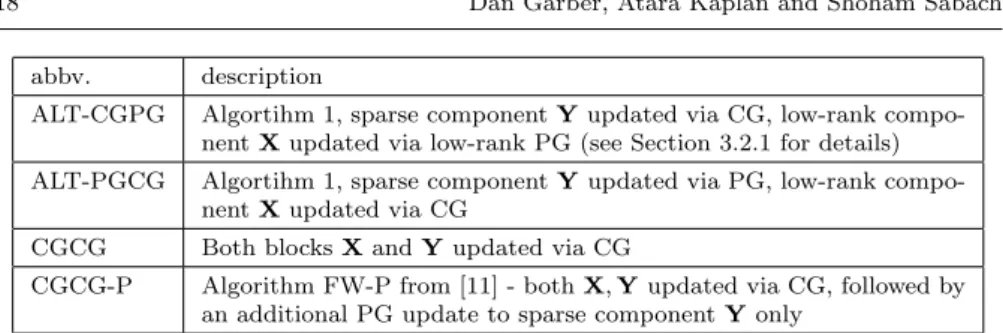
We tested Algorithm 1 and compare to two methods: the standard condi-tional gradient method and the condicondi-tional gradient variant proposed in [11], which adds an additional proximal step to update the sparse componentY, on top of the standard CG method. See Table 3 for description of the algorithms. For all algorithms, we apply a line-search procedure to compute the op-timal convex combination taken in the conditional gradient-like step on each iteration. This implementation is straightforward for the standard conditional gradient method (CGCG) and the proposed variant of [11] (CGCG-P). For
abbv. description
ALT-CGPG Algortihm 1, sparse componentYupdated via CG, low-rank compo-nentXupdated via low-rank PG (see Section 3.2.1 for details) ALT-PGCG Algortihm 1, sparse componentYupdated via PG, low-rank
compo-nentXupdated via CG
CGCG Both blocksXandYupdated via CG
CGCG-P Algorithm FW-P from [11] - bothX,Yupdated via CG, followed by an additional PG update to sparse componentYonly
Table 3: Description of the tested algorithms. CG is a short notation for a conditional gradient update, and PG is a short notation for a proximal gradient update.
our proposed methods (ALT-CGPG, ALT-PGCG), we set the step-size for the proximal gradient update on each iteration t to ηt= t+12 (this seems as a very good and practical approximation to the choice in Theorem 4 once we neglect the first short phase with a constant step-size, and start immediately with the second regime of step-sizes). Once we have computed the proximal gradient update with this step-size (Line 5 of Algorithm 1), we use a line-search to set the optimal convex combination parameter (used in Line 6 of Algorithm 1). It is straightforward to argue that performing such a line-search instead of using the pre-fixed value ofηtused for the proximal gradient update, does not
hurt any of the guarantees specified in Theorems 1, 2 and 3, but can be quite important from a practical point of view.
5.1 Experiments
We generate a synthetic data as follows. We set the dimensions in all exper-iments to m = n = 1000. We generate the low-rank component by taking
L= 10UV>, whereUis anm×rmatrix andVis ann×rmatrix, wherer
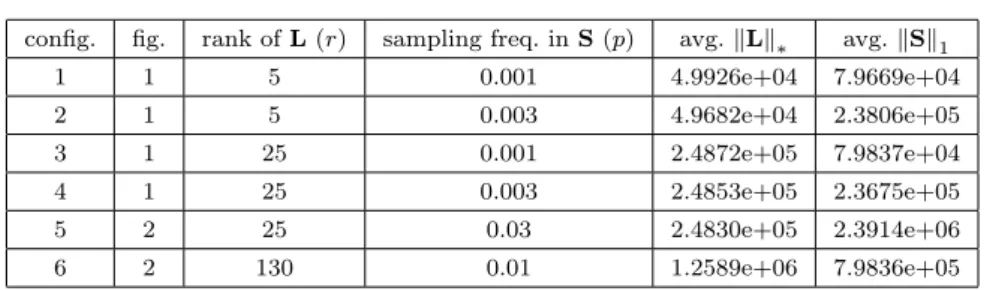
varies, and the entries ofU andV are i.i.d. standard Gaussian random vari-ables. The sparse componentSis generated by settingS= 10N, whereNis a matrix with i.i.d. standard Gaussian entries, and each entry inSis set to zero with probability 1−p(independently of all other entries), wherepvaries. We then set the observed matrix toM=L+S. For each value of (r, p) we have generated 15 i.i.d. experiments. See Table 4 for a quick summary.
All algorithms were used with the exact parameters τ = kLk∗ and s =
kSk1, and with the same initialization point (X1,Y1) = (0,0). The algorithms were implemented in Matlab with thesvdscommand used to compute the low-rank SVD updates. For our algorithm ALT-CGPG we have used a low-rank-rSVD to compute the low-rank proximal gradient update (wereris the rank of the low-rank data component L). For all experiments we measured the function value (as given in Problem (2)) both as a function of the number of iterations executed and the overall runtime.
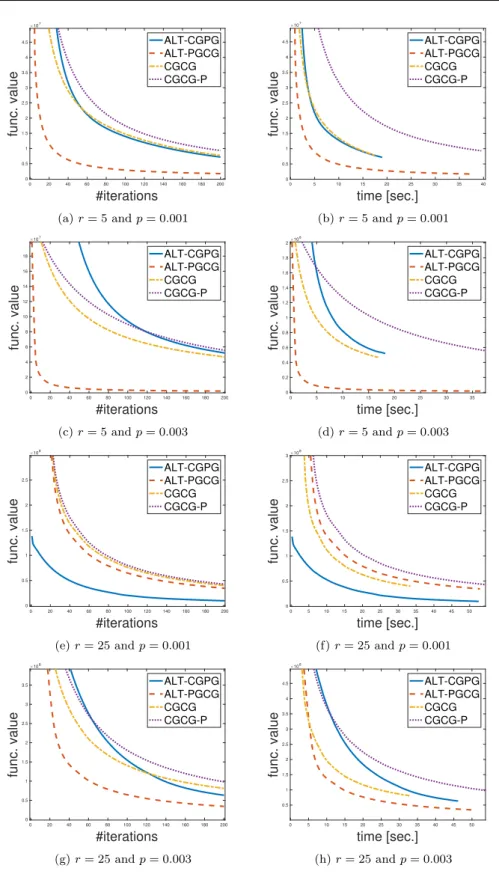
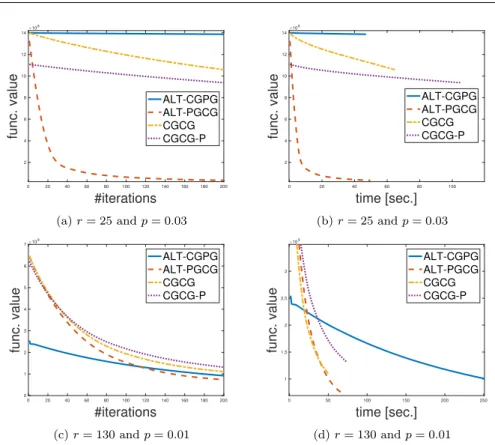
From the results in Figure 1 and Figure 2 it is clear that in each one of the six scenarios tested (different values of r and p), at least one of the
config. fig. rank ofL(r) sampling freq. inS(p) avg.kLk∗ avg.kSk1 1 1 5 0.001 4.9926e+04 7.9669e+04 2 1 5 0.003 4.9682e+04 2.3806e+05 3 1 25 0.001 2.4872e+05 7.9837e+04 4 1 25 0.003 2.4853e+05 2.3675e+05 5 2 25 0.03 2.4830e+05 2.3914e+06 6 2 130 0.01 1.2589e+06 7.9836e+05
Table 4: Description of data used. The forth and fifth columns give the values
kLk∗ andkSk1averaged over the 15 i.i.d. experiments.
variants of Algorithm 1 (either ALT-CGPG or ALT-PGCG) clearly outper-forms CGCG and CGCG-P. In particular, when examining the results and the corresponding norm boundsτ and s(as recorded in Table 4), we can see evidence for the improved complexity achieved in Theorem 1, which presents improved convergence bound in low/high Signal-to-Noise regimes (see also dis-cussion in Section 3.2.2). We can see that, as a rule of thumb, indeed when
kSk1>>kLk∗, updating the sparse componentYvia a proximal gradient up-date in Algorithm 1, results in significantly faster performances than when a conditional gradient update is used. Similarly, whenkSk1>>kLk∗, we can see that updating the low-rank componentXvia a (low-rank) proximal-update in Algorithm 1, results in significantly faster performances of our algorithm. Per-haps surprisingly, it also seems that the standard conditional gradient method (CGCG) outperforms the variant recently proposed in [11] (CGCG-P), with configuration 5 (r= 25,p= 0.03) being the exception.
Acknowledgments Dan Garber is supported by the ISRAEL SCIENCE FOUN-DATION (grant No. 1108/18).
6 Appendix
Lemma 1 Consider a sequence{ht}t≥1⊂R+ satisfying the recursion:
∀t≥1∀ηt∈ 0, α 2β : ht+1≤(1−ηt)ht+η2tβD 2 Y.
Then, setting the step-sizeηtaccording to:
ηt=
(α
2β ift≤t0,
2
t−t0+4αβ ift > t0,
where t0 := max0,2β/(α) ln 2C/ αDY2 , for C satisfying C ≥ h1, guarantees, for allt≥t0+ 1 that
ht≤
4βDY2 t−t0−1 + 4αβ
0 20 40 60 80 100 120 140 160 180 200 #iterations 0 0.5 1 1.5 2 2.5 3 3.5 4 4.5 func. value ×107 ALT-CGPG ALT-PGCG CGCG CGCG-P (a)r= 5 andp= 0.001 0 5 10 15 20 25 30 35 40 time [sec.] 0 0.5 1 1.5 2 2.5 3 3.5 4 4.5 func. value ×107 ALT-CGPG ALT-PGCG CGCG CGCG-P (b)r= 5 andp= 0.001 0 20 40 60 80 100 120 140 160 180 200 #iterations 0 2 4 6 8 10 12 14 16 18 func. value ×107 ALT-CGPG ALT-PGCG CGCG CGCG-P (c)r= 5 andp= 0.003 0 5 10 15 20 25 30 35 time [sec.] 0 0.2 0.4 0.6 0.8 1 1.2 1.4 1.6 1.8 2 func. value ×108 ALT-CGPG ALT-PGCG CGCG CGCG-P (d)r= 5 andp= 0.003 0 20 40 60 80 100 120 140 160 180 200 #iterations 0 0.5 1 1.5 2 2.5 func. value ×108 ALT-CGPG ALT-PGCG CGCG CGCG-P (e)r= 25 andp= 0.001 0 5 10 15 20 25 30 35 40 45 50 time [sec.] 0 0.5 1 1.5 2 2.5 3 func. value ×108 ALT-CGPG ALT-PGCG CGCG CGCG-P (f)r= 25 andp= 0.001 0 20 40 60 80 100 120 140 160 180 200 #iterations 0 0.5 1 1.5 2 2.5 3 3.5 func. value ×108 ALT-CGPG ALT-PGCG CGCG CGCG-P (g)r= 25 andp= 0.003 0 5 10 15 20 25 30 35 40 45 50 time [sec.] 0.5 1 1.5 2 2.5 3 3.5 4 4.5 func. value ×108 ALT-CGPG ALT-PGCG CGCG CGCG-P (h)r= 25 andp= 0.003
Fig. 1: Results for configurations 1-4. Each configuration presents the average over 15 i.i.d. runs.
0 20 40 60 80 100 120 140 160 180 200 #iterations 2 4 6 8 10 12 14 func. value ×108 ALT-CGPG ALT-PGCG CGCG CGCG-P (a)r= 25 andp= 0.03 0 20 40 60 80 100 time [sec.] 2 4 6 8 10 12 14 func. value ×108 ALT-CGPG ALT-PGCG CGCG CGCG-P (b)r= 25 andp= 0.03 0 20 40 60 80 100 120 140 160 180 200 #iterations 0 1 2 3 4 5 6 7 func. value ×109 ALT-CGPG ALT-PGCG CGCG CGCG-P (c)r= 130 andp= 0.01 0 50 100 150 200 250 time [sec.] 1 1.5 2 2.5 3 func. value ×109 ALT-CGPG ALT-PGCG CGCG CGCG-P (d)r= 130 andp= 0.01
Fig. 2: Results for configurations 5-6. Each configuration presents the average over 15 i.i.d. runs.
Proof Let us definevt:=ht/ 2βD2Yfor allt≥1. Dividing both sides of the
recursion in the lemma by 2βD2
Y, we obtain the recursion
∀0< ηt≤
α
2β : vt+1≤(1−ηt)vt+ η2t
2 . (14)
LetC, t0and{ηt}t≥1be as defined in the lemma, and recall thatηt=α/(2β),
for allt≤t0. Using Eq. (14), we have that
vt0+1≤(1−η0) t0v 1+ η2 0 2 t0 X t=1 (1−η0)t−1≤ C 2βD2 Y ·e−η0t0+η 2 0 2 · 1 η0 = C 2βDY2 ·e −αt0 2β + α 4β.
Thus, for t0 := max0,2β/(α) ln 2C/ αD2Y , we obtain that vt0+1 ≤
α/(2β).
We now show that for allt≥t0+ 1, it holds thatvt≤2/(t−t0+ 1 +c0) for c0 := 4β/α−2. For the base case t = t0 + 1, we indeed have already
showed that vt0+1 ≤α/(2β), as needed. Note that using the step-size choice
ηt := 2/(t−t0+ 2 +c0) for allt ≥t0+ 1, as defined in the lemma, we have that ηt ≤ηt0+1 = 2/(3 +c0)<2/c0 =α/(2β), and hence we can apply the recursion (14) for allt≥t0+ 1. Thus, assuming the induction holds for some
t≥t0+ 1, using the recursion (14), the induction hypothesis, and our step-size choice, we have that
vt+1≤vt(1−ηt) + η2 t 2 ≤ 2 t−t0+ 1 +c0 1− 2 t−t0+ 2 +c0 + 2 (t−t0+ 2 +c0)2 = 2 t−t0+ 2 +c0 1 + 1 t−t0+ 1 +c0 1− 2 t−t0+ 2 +c0 + 2 (t−t0+ 2 +c0)2 = 2 t−t0+ 2 +c0 1 +(t−t0+ 2 +c0)−2 (t−t0+ 1 +c0)−2 + (t−t0+ 1 +c0) (t−t0+ 1 +c0) (t−t0+ 2 +c0) = 2 t−t0+ 2 +c0 1− 1 (t−t0+ 1 +c0) (t−t0+ 2 +c0) < 2 t−t0+ 2 +c0 .
Hence, the induction implies thatvt≤2/(t−t0−1 + 4β/α) for allt≥t0+ 1. The proof is completed by recalling thatht= 2βD2Yvt.
Lemma 2 Consider a sequence{ht}t≥1⊂R+ satisfying the recursion:
∀t≥1 : ht+1≤ht−ηtht,
where 0 < ηt≤ min{c1
√
ht, c2},c1 >0 and 0 < c2 ≤1. Then, setting ηt=
3/ t−1 + 3c−21for allt≥1, yields thatht≤9 max{c−12, c −2
2 h1}/ t−1 + 3c−21 2
.
Proof We prove via induction that for suitably chosen positive constants a
andbthat ht≤a/(t+b)2 for allt≥1.
Fix some iterationt≥1 and suppose the claim holds forht. We consider
now two cases. First, ifht≤a/(t+b+ 1)
2
, then, since by the recursion in the lemma it holds thatht+1≤ht, the claim clearly holds in this case forht+1.
For the second case, we assumeht≥a/(t+b+ 1)
2
. Using this assumption, the recursion, and the induction hypothesis, we have that
ht+1≤ht−ηtht ≤ a (t+b)2 −ηt a (t+b+ 1)2 = a (t+b+ 1)2 t+b+ 1 t+b 2 −ηt ! ≤ a (t+b+ 1)2 1 + 3 t+b−ηt .
Thus, forηt= 3/(t+b), the induction clearly holds.
Since, for the recursion to hold, it is also required thatηt≤min{c1
√
ht, c2} ≤ min{c1
√
a/(t+b), c2}, this brings us to the following conditions on a and b which should be valid for allt≥1:
3 t+b ≤c2 and 3 t+b ≤ c1 √ a t+b.
Thus, we get the requirementsb≥3c−21−1 anda≥9c−12.
Finally, since for the base caset= 1 it needs to hold thath1≤a/(b+ 1) 2
, we can chooseb= 3c−21−1 anda= 9 max{c−12, c−22h1}, which guarantee that.
References
1. Zeyuan Allen-Zhu, Elad Hazan, Wei Hu, and Yuanzhi Li. Linear convergence of a frank-wolfe type algorithm over trace-norm balls. InAdvances in Neural Information
Processing Systems, pages 6192–6201, 2017.
2. Amir Beck and Marc Teboulle. A fast iterative shrinkage-thresholding algorithm for linear inverse problems.SIAM journal on imaging sciences, 2(1):183–202, 2009. 3. Emmanuel J Cand`es, Xiaodong Li, Yi Ma, and John Wright. Robust principal
compo-nent analysis?Journal of the ACM (JACM), 58(3):11, 2011.
4. Nan Du, Yichen Wang, Niao He, Jimeng Sun, and Le Song. Time-sensitive recom-mendation from recurrent user activities. In C. Cortes, N. D. Lawrence, D. D. Lee, M. Sugiyama, and R. Garnett, editors, Advances in Neural Information Processing
Systems 28, pages 3492–3500. Curran Associates, Inc., 2015.
5. Dan Garber. Faster projection-free convex optimization over the spectrahedron. In
Advances in Neural Information Processing Systems, pages 874–882, 2016.
6. Dan Garber and Elad Hazan. Faster rates for the frank-wolfe method over strongly-convex sets. InProceedings of the 32nd International Conference on Machine
Learn-ing,ICML, pages 541–549, 2015.
7. Dan Garber and Elad Hazan. A linearly convergent variant of the conditional gradient algorithm under strong convexity, with applications to online and stochastic optimiza-tion. SIAM Journal on Optimization, 26(3):1493–1528, 2016.
8. Gauthier Gidel, Fabian Pedregosa, and Simon Lacoste-Julien. Frank-wolfe splitting via augmented lagrangian method. InAISTATS, 2018.
9. Xiangru Huang, Ian En-Hsu Yen, Ruohan Zhang, Qixing Huang, Pradeep Ravikumar, and Inderjit Dhillon. Greedy Direction Method of Multiplier for MAP Inference of Large Output Domain. In Aarti Singh and Jerry Zhu, editors,Proceedings of the 20th
Inter-national Conference on Artificial Intelligence and Statistics, volume 54 ofProceedings
of Machine Learning Research, pages 1550–1559, Fort Lauderdale, FL, USA, 20–22 Apr
10. Martin Jaggi. Revisiting frank-wolfe: Projection-free sparse convex optimization. In
Proceedings of the 30th International Conference on Machine Learning, ICML, 2013.
11. Cun Mu, Yuqian Zhang, John Wright, and Donald Goldfarb. Scalable robust matrix recovery: Frank–wolfe meets proximal methods.SIAM Journal on Scientific Computing, 38(5):A3291–A3317, 2016.
12. Yurii Nesterov.Introductory lectures on convex optimization: A basic course, volume 87. Springer Science & Business Media, 2013.
13. Praneeth Netrapalli, UN Niranjan, Sujay Sanghavi, Animashree Anandkumar, and Pra-teek Jain. Non-convex robust pca. In Advances in Neural Information Processing
Systems, pages 1107–1115, 2014.
14. John Wright, Arvind Ganesh, Shankar Rao, Yigang Peng, and Yi Ma. Robust prin-cipal component analysis: Exact recovery of corrupted low-rank matrices via convex optimization. InAdvances in neural information processing systems, pages 2080–2088, 2009.
15. Huan Xu, Constantine Caramanis, and Sujay Sanghavi. Robust pca via outlier pursuit.
InAdvances in Neural Information Processing Systems, pages 2496–2504, 2010.
16. Xinyang Yi, Dohyung Park, Yudong Chen, and Constantine Caramanis. Fast algorithms for robust pca via gradient descent. In Advances in neural information processing
systems, pages 4152–4160, 2016.
17. Alp Yurtsever, Olivier Fercoq, Francesco Locatello, and Volkan Cevher. A conditional gradient framework for composite convex minimization with applications to semidefinite programming. In Jennifer Dy and Andreas Krause, editors,Proceedings of the 35th
International Conference on Machine Learning, volume 80 ofProceedings of Machine
Learning Research, pages 5727–5736, Stockholmsmssan, Stockholm Sweden, 10–15 Jul
2018. PMLR.
18. Hui Zou and Trevor Hastie. Regularization and variable selection via the elastic net.
Journal of the Royal Statistical Society: Series B (Statistical Methodology), 67(2):301–