Design of a multimedia content-delivery service
architecture for 3
rdgeneration networks
Andrea Calvagna
Dipartimento di Ingegneria Informatica e delle Telecomunicazioni Università di Catania
Viale A. Doria 6, 95125 Catania, Italy Email: {[email protected]}
Abstract. The Virtual Home Environment (VHE) has been introduced as
an abstract concept enabling users to access and personalize their subscribed services whatever the terminal they use and whatever the underlying network used. Much effort is currently being spent upon the challenging task to provide an architectural solution and an implementation of the VHE, providing ubiquitous service availability, personalised user interfaces and session mobility, while users are roaming or changing their equipment. In this paper we present a multimedia delivery service, one of the VHE services selected to demonstrate its features, showing its interconnection with the so far defined VESPER VHE architecture.
1 Introduction
The technological evolution of the last years, both in network speed and bandwidth than in multimedia capabilities of low-end devices, has made possible the convergence of telecommunication networks and data networks. This is leading to a new generation of integrated, IP based, transport infrastructure that will enable the deployment of even more valuable services for the users, like real-time video communication ones. Also, both existing and upcoming wireless technologies are enabling the support of data services and audio/video communication for “mobile” users, that is users whom network location may change even while a service session is currently in progress. As these services will be available over heterogeneous network, users would like to access them in a personalized way, transparently and independently of the underlying network technology and particular terminal used.
In 3GPP (3rd Generation Partnership Program) [1] this idea is embodied in the Virtual Home Environment (VHE)[2,3,4], defined as a concept for Personal Service Environment (PSE) portability across network boundaries and between terminals. The concept of the VHE is such that users are consistently presented with the same personalized features of subscribed services, in whatever network and whatever terminal (within the capabilities of the terminal and the network), wherever the user may be located. In example, the IST
VESPER (Virtual Home Environment for Service Personalization and Roaming Users) project [12] (funded by the European Community) aimed to provide an architectural solution and an implementation of the VHE, providing ubiquitous service availability, personalized user interfaces (i.e., service portability) and session mobility, while users are roaming or changing their equipment. VESPER VHE should hide away from the user the variety of access network types (fixed or wireless), the variety of supporting terminals, and the variety of the involved network and service providers involved during service provision [9,10]. Also, the project intends to influence the course of standardisation within 3GPP, Parlay [8] (with standard APIs supporting the VHE functionality) and OMG [5,6], toward a high-quality reference platform for open-services deployment.
In the context of the Vesper project, this paper describes our effort in the realization of a service-application [163] basing on the our experience in the design and implementation work on VHE platforms done in the project [11]. The service we will describe is a “multimedia delivery service”(MDS), designed to provide a mechanism to distribute multimedia streams (consisting of video and audio, but also pictures, etc) to end-users. In this paper we will show the main benefit gained by such a kind of service when used in the context of a Virtual Home Environment. The rest of the paper is organized in the following way. Section 2, after a brief overview of the Vesper VHE architecture, describes the multimedia delivery service and its interactions with the VHE architecture at the current phase of the project. In Section 3 we focus on the adaptation feature of VHE and finally, we conclude the paper in Section 4.
2
Vesper demonstration services
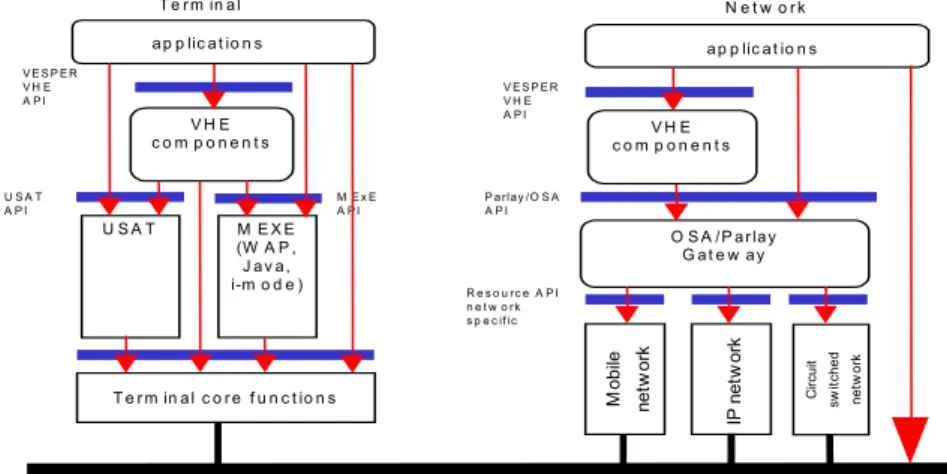
The VESPER architecture has been designed using a component based approach: all of these components rely on a CORBA based environment for their internal communication. A more detailed description of the overall VESPER architecture is out of scope of this paper and can be found in [10]. However, VESPER components are embedded into a heterogeneous network and terminal landscape. Figure 1 shows VHE architectural placement in relation to network and terminal environment. At server side VHE functionality is accessed via VHE API on top and deals via OSA/Parlay[8] gateways with different networks as transport layer. At terminal side VHE functionality is also accessed via VHE API and deals via USAT (Universal SIM Application Toolkit)[14] or MExE (Mobile Station Application Execution Environment)[12] with terminal core functions.
One of the objective of the VESPER project is to define, design, and implement services which both impose precise requirements on the VHE architecture defined and implemented by the project, and demonstrate that this VHE architecture fulfils the requirements. VESPER will provide an open API to VASPs’ applications, enabling the VHE concept within the service. VASPs (Value Added Service Provider) will be able to offer advanced services,
abstracting from the terminal used for accessing the service and from the underlying networks, leaving all of the basic VHE services to the VHE provider role. In this scenario, this section will describe the MDS service middleware.
a p p lic a t io n s V H E c o m p o n e n t s O S A /P a r la y G a t e w a y C irc ui t sw it ch e d net w o rk V E S P E R V H E A P I P a rlay /O S A A P I IP ne tw or k M ob ile ne tw or k R e s o u rc e A P I n e t w o rk s p e c if ic M E X E (W A P , J a v a, i-m o d e ) U S A T V H E c o m p o n e n t s a p p lic a t io n s T e r m in a l c o r e f u n c t io n s U S A T A P I M E x E A P I T e r m in a l N e t w o r k V E S P E R V H E A P I
Fig. 1.Embedding of VHE Architecture
2.1 The Multimedia Delivery Service design goals
People are nowadays used to get every kind of information through the Internet, using common Web browser applications. The next big challenge is to deliver multimedia informations to end users independently of the device used to access the network: notebook, PDA, and next generation UMTS phone will be able to display not only text and images but also audio and video.
Using VHE functionalities a multimedia delivery application will be greatly enhanced and widely spread among users. Users will not be restricted in the set of terminal they have to use to access the application and to receive data, neither in the network they are connected to. Users will be able to access the application using different terminals, ranging from the powerful multimedia PC to the personal PDA with limited screen size and computing capabilities. Even future smartphones will be able to reproduce small videoclips in their small screens.
The MDS will take benefit of adaptation, connectivity and service personalisation functionalities provided by VESPER VHE. The adaptation feature will make the service delivery transparent to the VASP, thus allowing a larger number of terminals to be able to access the MDS from a wider range of available networks. The service will only provide the stream content to the VHE component responsible of the adaptation, whose task will be to adapt it to the user preferences, user network, user terminal and deliver it. What is asked to the adaptation is not only a user interface adaptation, but also a content adaptation. So, for instance, if user terminal is not provided with the right codec to watch a movie, it is a task of the component responsible for adaptation either
to “adapt”(codify) the stream in a format compatible to that of one of the codecs owned by the user terminal, or to upload the suitable codec to the terminal.
3
Service adaptation in the Vesper VHE
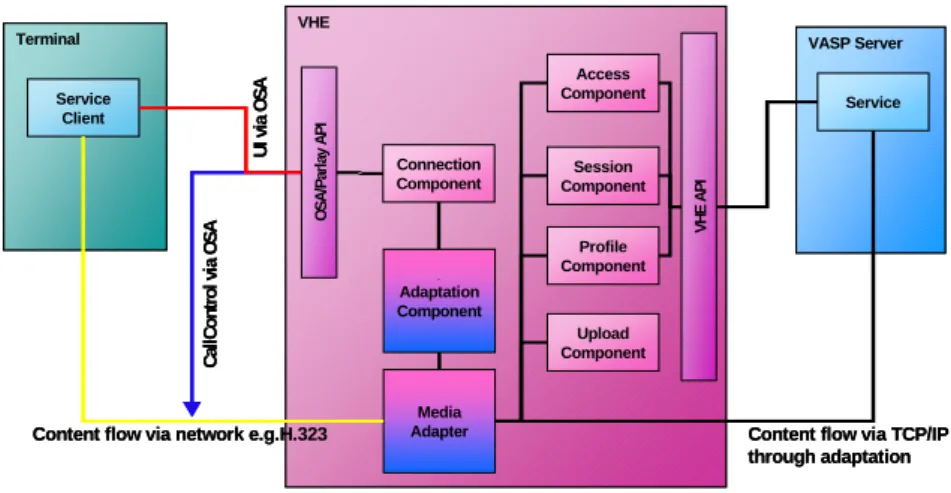
One of the key features of VHE, is the adaptation that it provides to terminal capabilities and user preferences. Each service using Vesper VHE APIs should not care of terminal device used by the end-user: it is the adaptation that takes charge of that. The adaptation is realized by the Adaptation Component, whose main tasks are:
− to adapt the contents a VESPER Service provides to the user according to the capabilities of the terminal accessing the VHE Server, the End-User interface and services preferences and the QoS classes supported by the underlying network(s),
− to manage the user interaction with the service.
Term inal VHE VASP Server
VH E AP I Session Com ponent Access Com ponent Profile Com ponent Connection Component M edia Adapter Upload Com ponent Service OSA /Par lay AP I Service Client
Content flow via network e.g.H.323
Cal lCo nt rol vi a O SA
Content flow via TCP/IP through adaptation UI via O SA Adaptation Com ponent
Term inal VHE VASP Server
VH E AP I Session Com ponent Access Com ponent Profile Com ponent Connection Component M edia Adapter Upload Com ponent Service OSA /Par lay AP I Service Client
Content flow via network e.g.H.323
Cal lCo nt rol vi a O SA
Content flow via TCP/IP through adaptation UI via O SA Adaptation Com ponent
Fig. 2.Media adaptation
The VHE service implementation is completely independent from the actually used environment (network type, terminal type, user preferences) during service usage. The adaptation component offers interfaces in the VHE API to enable this feature. An overview of an adaptation scenario is given in Figure 2. The adaptation to network and terminal capabilities is done at the VHE system. The content flow goes from the VASP Server to the media adapter via TCP/IP connection through the CORBA based VHE API. On the terminal side a connection is established by the Connection Component depending on the transport network via OSA/Parlay. The media adapter supports the used network protocol to provide the terminal with the media stream (e.g. announcements, multimedia/video). The Adaptation Component specification has provisioned for a flexible engineering scheme such that the media adapter
can be wrapped as a mobile agent whose itinerary is limited to the VASP Server and/or the End-User's terminal. The adaptation is done at VASP Server by the agent providing adaptation to the media stream supported by the terminal and to the used network protocol. At terminal side a corresponding agent decodes the stream and provides content output at the terminal. This solution presupposes that the terminal and the VASP Server provide an agent execution environment.
The second role of the adaptation is to manage the user interaction with the service: this means that the user interface should be adapted and presented to the user according the terminal capabilities (apart from user preferences). In order to be able to offer this kind of adaptation each service is required to provide a formal description (UIModel) of the user interface they want to offer to their users: this description is expressed in XML and includes several kind of logical tools for user interaction (buttons, text fields, text entries, checkbox, etc). The actual representation of this graphical model will depend of the actual device used by the user to access the service. It is the adaptation component that will decide the best way to render the User Interface model (UIModel) provided by the service.
MDS Server Web Server 8.HTML page 1. lookUpMediaAdapter 5.interpretUIModel () VHE-Provider Adaptation Manager Media Adapter UIModel Interpreter ... 7.Adapt(UIModel )
11.actionPerformed (movies selected, …) setUIModel (…)
User Terminal
2. getMediaAdapter
Chooses Media Adapter adapted to Terminal, Network and and user Profiles
3.GetUIModel
4.setUIModel(«input elements , output elements , action elements »)
interpretUIModel URL 6.interpretUIModel () UIModel 9. User action
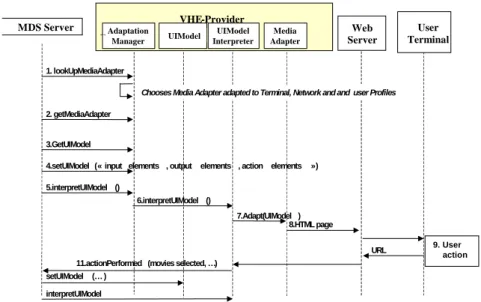
Fig. 3.MDS interaction with the VHE Adaptation component
For better understanding of this mechanism, Figure 3 shows a step by step scenario involving the MDS service interaction with the adaptation component, supposing the user has accessed the service through a Web browser:
1. The service looks up for a media adapter. The VHE Server provides the service with a list of available and appropriate media adapters for the terminal and network currently used.
2. The MDS chooses a media adapter whose presentation characteristics cope best with its logic.
3. The service asks for an UIModel object.
4. The MDS sends the description of the service’s user interface to this object as an XML description. This description synthesises the interface to be presented in the End-User’s terminal (output messages, input fields, selection list, buttons, etc).
5. The MDS asks the Adaptation component to interpret the UIModel.
6. (and 7) The Adaptation Component interprets the model and formats it into an HTML page, by mapping the output elements, input elements and action elements into HTML elements, respectively HTML texts, HTML text field/selection field and HTML buttons. The mapping of the previous UIModel description into HTML page takes in consideration the terminal capabilities and the End-User User Interface Preferences.
8. Once produced the adapted HTML page, the Adaptation Component submits the page to the Web server which then sends this page to user’s browser.
9. The user interacts with the received HTML page, fills the text field or selects values in the selection field and then clicks on a button.
10. The Web server forwards the request to the registered UIModel Interpreter. 11. The UIModel Interpreter object collects the information in the URL request,
builds a description of user’s interaction (user’s entered values, button pressed) in form of a XML description and invokes MDS callback action listener.
4 Conclusions
This paper has been focused on the architectural description of a multimedia delivery service component (MDS), designed and implemented (using the Rational (c) Rose for Java tools) to apply to the VHE architecture and demonstrating some the VHE platform capabilities. These kind of multimedia applications can be greatly enhanced by VHE features, since users will be able to access advanced services and features by means of heterogeneous device. Key functionalities of adaptation to terminal capabilities and personal user preferences have been described in deep detail. Also, in this paper an overview of the VESPER project and related framework architecture has been presented by the author, who actively contributed in its design process.
Acknowledgement
This work has been performed in the framework of the project VESPER, which is funded by the European Community. The Author(s) would like to acknowledge the contributions of his (their) colleagues from Intracom Hellenic Telecommunications and Electronics Industry S.A., National Technical University of Athens, Institut National de Recherche en Informatique et Automatique, IKV++ Technologies AGe, FOKUS Fraunhofer Institute for Open Communication Systems, Fondazione Ugo Bordoni,
Universita’ Di Catania, Portugal Telecom Inovação, University of Surrey, Technical Research Centre of Finland and SIEMENS AG Osterreich"
5 References
1. 3 rd Generation Partnership Project (3GPP), http://www.3gpp.org
2. “Virtual Home Environment / Open Service Architecture”, TS 23.127, 3GPP project. http://www.3gpp.org/ftp/specs/html%2Dinfo/23%2Dseries.htm
3. “The Virtual Home Environment”, TS 22.121, 3GPP project, release 2000.
http://www.3gpp.org/ftp/specs/html%2Dinfo/22%2Dseries.htm 4. 3GPP, 3G TS 22.121 v3.2.0, The Virtual Home Environment, stage 1.
http://www.3gpp.org/ftp/Specs/archive/22_series/22.121/22121-320.zip 5. 3GPP, 3G TS 29.198 v3.0.0, Open Service Access (OSA) API Part 1, stage 3.
http://www.3gpp.org/ftp/Specs/archive/29_series/29.198/29198-300.zip
6. 3GPP, 3G TS 23.127 v3.1.0 Virtual Home Environment/Open Service Architecture, st. 2. http://www.3gpp.org/ftp/Specs/archive/23_series/23.127/23127-310.zip 7. A. Calvagna, A. Puliafito, and L. Vita, ``A Low Cost/High Performance Video on
Demand Server'', in IEEE Int. Conf. on Computer and Communication Networks (ICCCN'99), Boston, MA USA, 11-13 Ottobre 1999
8. Parlay Group, Parlay Specifications, http://www.parlay.org/ 9. VESPER, IST-1999-10825, D11 – Project Presentation.
http://www.diit.unict.it/~acalva/D11.zip
10. VESPER, IST-1999-10825, D22 – VHE Architectural Design http://www.diit.unict.it/~acalva/D22.zip
11. VESPER, IST-1999-10825, D42 – Initial Demonstration Services Specification. http://www.diit.unict.it/~acalva/D42.zip
12. VESPER web page: http://www.ee.surrey.ac.uk/CCSR/IST/Vesper/ 13. 3GPP TS-22.057 v3 0 1 – MexE.
http://www.3gpp.org/ftp/Specs/archive/22_series/22.057/22057-301.zip 14. ETSI TS 101.267 v8.3.0, Specification of the SAT for the SIM-ME interface.
http://webapp.etsi.org/workprogram/Report_WorkItem.asp?WKI_ID=11245
Andrea Calvagna was born in Catania, Italy. He received his cum laude degree in
Computer engineering from the University of Catania in 1998, and the Ph.D. in Electronic, Computer and Telecommunication Engineering from the University of Palermo, Italy, in 2001. He also attended to many International Schools for Computer Science/Telecommunications Engineering Researchers during 2000-2002. Since 2001 he is a contract researcher at the University of Catania, where he serve also as a teaching assistant. His current research interests include IP mobility, integration of heterogeneous systems, wireless IP communications, distributed computing and P2P networks.