December 2014
CLOSING THE RACE GAP:
CLOSING THE RACE GAP
About Young Invincibles
Young Invincibles is a non-partisan, non-profit organization that works to expand economic opportunity for young adults -- ages 18 to 34 years-old -- through policy analysis and advocacy. With offices in six major cities across the country, its research and organizing experts seek to elevate the voices of young adults in top policy debates, and provide solutions to major economic challenges for the Millennial generation.Acknowledgements
The authors would like to thank the following people for their thoughtful comments, edits, and support: Jen Mishory, Rory O’Sullivan, Jennifer Wang, Tom Allison, Konrad Mugglestone, Reid Setzer, and Jasmine Hicks. We would also like to thank Colin Seeberger, Sarah Lovenheim, Maria Beltran, Julian Aldana, and Jessica Adair for their unbelievably hard work in design, communications, and outreach.TEXAS
Our national Closing the Race Gap report provides federal policy solutions to address racial dispari-ties in the workforce, but states and localidispari-ties are essential players in directing higher education poli-cies and resources, and so steps they can take are critical to explore. This report highlights a number of policy solutions that should be implemented or expanded in Texas to help close the employment gap between young adults of color and their white peers.
Houston Office
401 Branard St. Suite 115 Houston, Texas 77006
Please contact Colin Seeberger, Press Secretary for all Texas media requests. Email: [email protected]
CLOSING THE RACE GAP
Table of Contents
Introduction ...
5
Figure 1: Unemployment in Texas (18-34)
... 5
Table 1: Predicted Probability of Employment by Educational Attainment,
Race, and Gender
... 6
Figure 2: Education Attainment in Texas (25-34)
... 7
Early Awareness and College Readiness
...
... 8
Expand Early College High School Programs
... 8
Support Advise TX College Advising Corps
... 9
Monitor House Bill 5’s (HB5) Effect on Minority Access to Higher
Education ... 9
Access & Affordability: Protecting and Expanding the TEXAS Grant
Program ...
...
10
Conclusion
...
...
12
TEXAS
Introduction
Although the Great Recession ended over five years ago, more than 430,000 Millennials in Texas are unemployed.1 Moreover, the recession did not affect all young adults equally. Young African
Ameri-can and Latino Texans face higher unemployment rates than their white counterparts. Young AfriAmeri-can Americans, aged 18 to 34, have an unemployment rate of 18 percent in Texas – that’s more than double the unemployment rate of young white adults, which stands at seven percent. While young Latino unemployment rates are lower than young African American unemployment rates, young La-tinos still face an unemployment rate of nine percent.2
0% 2% 4% 6% 8% 10% 12% 14% 16% 18% 20%
White Hispanic Black
U n em pl oy m en t R at e
Figure 1: Unemployment In Texas Among
18 to 34 Year-Olds
Young adult unemployment doesn’t just impact individuals.3 Extreme youth joblessness results in
lost tax revenue and increased social safety net expenditures that cost state and federal govern-ments $25 billion per year.4 The economic costs of disproportionately high African American and
Hispanic young adult unemployment are too high to ignore.
This report is part of our Closing the Race Gap series -- a collection of policy briefs that examine racial disparities in the job market among young people and provide solutions to alleviate them. In June, we released our national analysis that found that young African Americans must attain two additional levels of education to have the same chance of landing a job as their white peers. As our national paper covers, the legacy of racial discrimination persists in the U.S. job market. But we also found that young African Americans experienced greater gains in employment opportunity with each level of education completed.5 While education cannot be the only response to this challenge,
em-CLOSING THE RACE GAP
ployment and wage disparities.
In Texas, young African Americans have the steepest hill to climb, but young Latinos also face higher unemployment rates than young white adults. There are nearly 1.5 million more Latino Millennials in the Texas labor force than whites, and we must tackle the challenges they face, too.6 In this report,
we build upon our national results predicting employment probabilities for young African American and Latino adults with state-specific information.7
Table 1: Predicted Probability of Employment by Education Attainment, Race, and Gender
Black White Hispanic Men Women Men Women Men Women
No HS Di-ploma (62.6 - 67.9)65.3% (68.0 - 73.1)70.6% (80.6 - 83.0)81.8% (81.2 - 83.8)82.6% (79.9 - 82.4)81.2% 81.4% (79.9 - 82.8) HS Diploma 74.5% (72.3 - 76.6) (77.0 - 81.0)79.1% (87.3 - 88.7)88.0% (87.8 - 89.3)88.5% (86.7 - 88.4)87.5% 87.7% (86.7 - 88.6) Some Col-lege (80.5 - 84.1)82.3% (84.3 - 87.4)85.9% (92.0 - 93.0)92.5% (92.4 - 93.4)92.9% (91.5 - 93.0)92.2% (91.6 - 93.0)92.3% Associate’s 88.4% (86.9 - 89.8) (89.8 - 92.2)91.1% (95.2 - 96.0)95.6% (95.5 - 96.2)95.9% (94.8 - 96.0)95.4% (94.9 - 96.0)95.5% Bachelor’s 92.8% (91.6 - 94.0) (93.7 - 95.5)94.7% (97.2-97.9)97.6% (97.4 - 98.0)97.7% (97.0 - 97.9)97.5% (97.0 - 97.9)97.5%
Note: 95% confidence intervals in parentheses
Note: Holding school enrollment status, veteran status, work disability status, southern region, rural/urban status, city center/suburban status, martial status, and number of children at their observed values.
Note: Professional Degrees narrowed to 25-34-year-old subsample.
As shown in Table 1, the good news is that our national model finds that -- holding other factors constant -- young non-white Hispanic adults at each educational level have similar probabilities of employment as their non-Hispanic white counterparts. The bad news is that in Texas, the jobs held by young Hispanics simply do not pay nearly as much as those held by both black and white young adults across the state. The median earnings for an employed Hispanic Millennial (aged 18 to 34) is $20,000 a year, compared to $29,000 for whites and $23,500 for African American Millennials.8
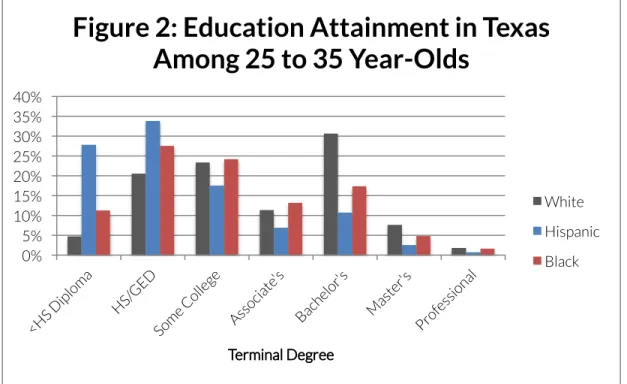
One reason for this racial wage disparity is an enormous educational attainment gap. Figure 2 shows that in Texas, young Hispanics are almost four times more likely to have dropped out of high school and almost one-third as likely to have a bachelor’s degree as their white peers.9 We also found that
in Texas, young African Americans are almost twice as likely to have dropped out of high school and half as likely to have a bachelor’s degree as their white peers.10 This is especially troubling because
research suggests that by 2020 65 percent of all jobs nationally will require some form of education above a high school diploma, and 62 percent of Texans between the ages of 25 and 34 will not meet
TEXAS
this requirement. Our analysis shows that we can close the gaps in employment and earnings – now and in the future – by increasing educational attainment for everyone. The growing demand for an educated workforce, means that educational equity is not only morally, but economically essential. It also means that our state cannot address these challenges without addressing the educational needs and experiences of students of color.
0% 5% 10% 15% 20% 25% 30% 35% 40% Terminal Degree
Figure 2: Education Attainment in Texas
Among 25 to 35 Year-Olds
White Hispanic Black
Despite the challenges, Texas has tremendous potential to improve its higher education outcomes. Through our Houston office’s engagement with state officials, community partners, and -- most importantly -- young adults themselves, it is clear that this potential is already being turned into action. Initiatives like the Texas Success Council to support community college students, the grow-ing Early College High School programs and the ongogrow-ing Closgrow-ing the Gap by 2015 strategy (both of which are discussed below) are great examples.
Even so, there is much work to be done to improve college completion rates, and in turn, the eco-nomic opportunity of young Texans – especially the most underserved young adults. Below we identify two areas of impact – early awareness and access and affordability -- and highlight suc-cessful programs and policies within each to continue closing the gap in educational attainment.
CLOSING THE RACE GAP
Ensuring students understand their college options and are prepared to succeed after graduation is a critical first step in closing attainment gaps. We discuss three policy recommendations below to increase early awareness and college readiness:
• Expand Early College High School programs • Support Advise TX College Advising Corps
• Monitor HB 5’s effect on minority access to higher education
Expand Early College High School Programs
College readiness starts many years before students even set foot on a college campus and should focus on academic, social, and financial preparation. The Early College High School (ECHS) is a pro-gram that ensures college readiness and reduces barriers to college access by offering dual credit courses. These college-level courses are available to high school students who receive both college and the high school academic credit for completing them.11 The courses are offered at no cost to
students while providing rigorous academic preparation and social support to help students suc-ceed.12 ECHS programs allow students to earn a high school diploma and an associate’s degree or
60 college-credit hours towards a Bachelor’s degree upon graduating from high school. The Early College High School program targets students who are at risk of dropping out of high school -- pre-dominately low-income and underrepresented students.
El Paso Community College is an example of a successful ECHS Initiative, housing six early college high schools with various school districts in the greater El Paso region. The program currently serves more than 1,500 students.13 Mission ECHS at the Socorro Independent School District opened in
2006 through a partnership with El Paso Community College. It has supported 485 students and helped them earn 401 associate’s degrees.14 The class of 2012 at Mission del Paso ECHS, for
exam-ple, saw 100 percent of their 114 students graduate on time15, and the majority of students
gradu-ated with both a high school diploma and an Associate of Arts/Associate of Science degree. One year after graduating from Mission del Paso ECHS, 80 percent of the class of 2011 were enrolled in a Texas institution of higher education and 95 percent completed one academic year without devel-opmental classes.16 Compared to Socorro’s district levels of higher education enrollment rates and
remediation rates, students who attend Mission del Paso ECHS are continuing their education at greater rates than their peers: 66 percent to 60 percent, respectively. 17 While more data is
neces-sary before scaling ECHS statewide, the initial success of programs like El Paso’s should give school and community college districts a strong blueprint to continue the support and expansion of the model.
Texas has sixty-five ECHSs, many of them concentrated in Houston and the Rio Grande Valley, how-ever, they make up less than one percent of all high schools across the state.18 We recommend that
community college and school district partners continue their financial and administrative support of the ECHS school model and seek to increase the number of eligible students. Furthermore,
Tex-TEXAS
as should incentivize the expansion and continued success of ECHS by 1) protecting state funding appropriations for public education and community colleges and 2) creating a dedicated funding source to support district partnerships with ECHS programs that are demonstrating success. This will ensure that more students have access to ECHS programs and that successful models can be replicated and expanded in other high need areas.
Support Advise TX College Advising Corps
Along with strong academic preparation, having access to information about higher educational op-tions is extremely important for students of color in Texas. Unfortunately, there is a college informa-tion and support gap that exists for underserved students in our state. The Advise TX College Advis-ing Corps is a statewide program that seeks to increase the number of low-income, first-generation students that attend college by providing information about college and the college application pro-cess.19 This includes assistance with testing and college application fee waivers, college applications,
FAFSA completion and submission, and – once students are accepted—helping students understand their varying financial aid offers.20 Launched in 2009 to bridge the college information and support
gap, it places recent college graduates as college advisers at high schools with large populations of low-income and first-generation students.
Advise Texas has served 228,979 high school students, including 49,308 seniors. Of the students served, 18 percent were African American, 72 percent Hispanic, and eight percent White.21 Advise
Texas’ FY 2013 budget of just over a $1 million has placed 120 advisors in Texas high schools from chapters at Texas A&M University, Texas Christian University, and Trinity University in addition to UT Austin.22 Initial research demonstrates that high school seniors who meet with advisers in the
na-tional program are 34 percent more likely to get accepted to four-year institutions, 18 percent more likely to take the SAT; 48 percent more likely to take the ACT, and 76 percent more likely to attend a financial aid workshop.23
We recommend that the Higher Education Coordinating Board continue its support of the Advise Texas program by increasing the amount of grant funding and partnerships available to universi-ties. Similarly, university and school district partners should seek to increase the number of adviser placements in high-needs regions of Texas to bridge the college information and support gap pres-ent in many schools. Lastly, THECB should also set and report goals for FAFSA completion, for the Texas Advise Corps as well as across the state.
Monitor House Bill 5’s (HB5) Effect on Minority Access to Higher Education
Finally, we cannot ignore both the challenges and opportunities posed by the implementation of House Bill 5 – especially on students of color. House Bill 5 created a 22-credit Foundation High
CLOSING THE RACE GAP
School Program, a graduation plan that offers students the choice of an Endorsement in Science, Technology, Engineering, Mathematics (STEM), Public Service, Arts and Humanities, Business and Industry, or Multidisciplinary to graduate with 26-credits.24 HB 5 has the potential to create new
opportunities for collaboration among K-12, higher education and industry, and could help align the skills and education that students receive with the labor demands of their communities.
While conceptually a good idea, the Foundation graduation path may leave students inadequately prepared for college. One obstacle imposed by HB 5 is the elimination of courses from the default high school curriculum such as Algebra, which is tested heavily on the SAT and ACT. Algebra is also required for Top 10% Plan eligibility. The program guarantees admission to Texas public universities to anyone who finish in the top 10% of their Texas high school class and has increased geographic, racial and economic diversity at state colleges. In fact, most four-year universities, many two-year community college programs, some work certification programs and even certain criteria for pri-oritizing TEXAS Grant recipients (discussed below) all require algebra. Removing this requirement from the HB 5 foundation risks setting students up to fail.
HB 5 also removed, from the default curriculum, courses in Chemistry and Physics, which remain a requirement for many four-year universities in Texas and out of state.25 We have concerns that
the bill may track particularly low-income, African American and Latino students out of more com-petitive institutions. These students may already have low academic expectations placed on them by their teachers and administrators, which place them into less rigorous, non-college ready paths.26
Policymakers should closely evaluate the implementation of the plan to ensure the continued col-lege readiness and access for low-income and students of color. Specifically, policymakers should ensure that courses adopted by the Texas State Board of Education and school districts, in partner-ship with community colleges and businesses are, in fact, of high quality. These courses should not only be appropriate for workforce demands, but should meet college eligibility requirements or lead to college-credit-bearing coursework. The legislature should also establish new metrics to track the success of low-income and nontraditional college students at the institutional and regional levels, including tracking target enrollment and completion for underrepresented students, including Pell-eligible students and students of color.
Access & Affordability: Protecting and Expanding the TEXAS Grant Program
Need-based grants are also an essential tool for expanding access and affordability to low-income students of color. The TEXAS (Toward EXcellence Access & Success) Grant Program was established in 1999 to provide funds to high-performing high school graduates with financial need to pursue higher education in Texas. In 2011, the Texas Legislature passed the TEXAS Grant College Readiness Reform Act, which created a priority award system by requiring institutions to award TEXAS Grants first to students with certain academic accomplishments.TEXAS
The TEXAS Grant has successfully provided low-income students financial aid. In 2010, $274 mil-lion was awarded to more than 68,000 students through the TEXAS Grant Program.27 During the
2010-2011 academic year, students could receive a maximum of $6,780 per year at public universi-ties and state colleges; $1,780 per year at community colleges; and $3,150 per year public technical colleges. 28
According to the Texas Higher Education Coordinating Board, roughly 80 percent of the 68,075 grant recipients in 2010 were students from the lowest income quintiles (less than $45,000 a year).29
When broken down by ethnicity, the majority of the TEXAS Grant funding goes to Hispanic and Af-rican AmeAf-rican students: 43.8 percent of TEXAS Grant recipients are Hispanic, (29,790 students), 20.1 percent are White (13,683 students), 14.1 percent are African American (9,621 students), and 5.9 percent are Asian/ Pacific Islander (3,994 students).30
TEXAS Grants are critical to the success of Texas students as studies show that need-based aid can increase student completion of a Bachelor’s degree.31 However, due to limited state funding and a
large low-income student population, Texas appears to be moving toward a more merit-based meth-od of allocating grants than prior years’ need-based methmeth-od. Evidence of this can be seen in the new priority considerations changes for the TEXAS grant made through SB 28.32 To gain priority status a
student must meet two of the following four requirements:
1.Advanced Academic preparation- completing 12 hours of college credit, the International Bac-calaureate Program, or the Distinguished Achievement Program;
2.Texas Success Initiative (TSI) Readiness: Meet college readiness indicators presented in the TSI assessment;
3. Class Standing: Graduate in the top third of class or with a B average; or 4. Advanced Math: complete at least one math course beyond Algebra II.33
These new eligibility requirements have the unfortunate potential to decrease college access, af-fordability, and success for incoming students of color. The original intent of the TEXAS grant pro-gram acknowledged that access to financial support is a “make-or-break” factor that determines whether or not these students will attend college. Unfortunately, many of the students who might already be impacted by the misalignment in graduation requirements, and subsequent merit-based eligibility, could lose out on critical financial support after the passage of HB 5. We recommend in-creasing funding to the TEXAS Grants program based on its emphasis on providing grants to low-income students.
CLOSING THE RACE GAP
Almost 15 years ago, Texas adopted the Closing the Gaps (CTG) by 2015 state higher education plan to focus its efforts to improve educational outcomes on four goals: to close education gaps in participation, success, excellence, and research. While there has been some progress made, there is still much work to do to keep up with the ever-changing needs of young Texans.
Texas will face a crisis if it fails to ensure an educated population and workforce. Our national report illustrates the importance of educational attainment in addressing racial disparities in economic op-portunity. The state’s Latino and African American students make up the majority of those enrolled, but continue to lag behind their white counterparts. It will be impossible to “Close the Gap” without addressing the needs and experiences of Latino and African American students. By expanding and investing in the programs and policies outlined above, we can increase educational attainment for these students, and in turn, ensure their economic prosperity and the prosperity of our state.
TEXAS
End Notes
1. Young Invincibles’ analysis of “Current Popu-lation Sur¬vey,” Bureau of Labor Statistics, US Census Bureau, accessed June 25, 2014. 2. Ibid.
3. Rory O’Sullivan, Konrad Mugglestone, and Tom Allison, In This Together: The Hidden Cost
of Young Adult Unemployment, (Washington,
DC: Young Invincibles, January 2014), 39-40, http://younginvincibles.org/wp-content/ uploads/2014/01/In-This-Together-The-Hid-den-Cost-of-Young-Adult-Unemployment. pdf.
4. Ibid., 38.
5. Rory O’Sullivan, Konrad Mugglestone, and Tom Allison, Closing the Race Gap: Al-leviating Young African American
Unem-ployment Through Education,
(Washing-ton, DC: Young Invincibles, June 2014), 5-6, https://d3n8a8pro7vhmx.cloudfront. net/yicare/pages/141/attachments/origi-nal/1403804069/Closing_the_Race_Gap_ Ntnl_6.25.14.pdf?1403804069.
6. Young Invincibles’ analysis of “Current Popu-lation Sur¬vey,” Bureau of Labor Statistics, US Census Bureau, accessed June 25, 2014. 7. For more information on the methodology
behind these statistics, please read our na-tional report.
8. Young Invincibles’ analysis of “Current Popu-lation Sur¬vey,” Bureau of Labor Statistics, US Census Bureau, accessed July 11, 2014. 9. Young Invincibles’ analysis of “Current
Popu-lation Sur¬vey,” Bureau of Labor Statistics, US Census Bureau, accessed June 25, 2014.
11. Texas Higher Education Coordinating Board, “Dual Credit- Frequently Asked Questions”, accessed July 21, 2014, http://www.thecb. state.tx.us/index.cfm?objectid=E9397432-F85E-83E1-471DFAB9F59301B8 .
12. Texas Education Agency, “Early College High School”, accessed June 17, 2014, http://www. tea.state.tx.us/index3.aspx?id=4464.
13. El Paso Community College, “Early College High School”, accessed June 17, 2014, http:// www.epcc.edu/earlycollegehighschool/Pag-es/default.aspx
14. Steven Smith, El Paso Community Colleges:
Early College High Schools,
www.epcc.edu/Vi- cePresidentofInstruction/Documents/Ear- ly_College_High_Schools_%20Educate_Tex-as_01-08-13.pdf .
15. Texas Education Agency, Four-Year Gradu-ation and Dropout Data, Class of 2012, http://www.tea.state.tx.us/acctres/comple-tion/2012/level.html
16. Texas Education Agency, 2012-2013 Federal Report Card for Texas Public Schools, Mis-sion Early College HS, Postsecondary Readi-ness Indicators, http://ritter.tea.state.tx.us/ perfreport/frc/2013/srch.html.
17. Ibid.
18. “Texas ECHS Map,” Texas Early College High School, accessed July 2, 2014, http://www.tx-echs.com/texas_school_map.php
19. Advise TX in an affiliate of the National Col-lege Advising Corps (NCAC). See Closing the
Race Gap national report for more
informa-tion on our nainforma-tional recommendainforma-tions.
20. Texas A&M University, “About Advise TX”, accessed June 27, 2014, http://admissions.
CLOSING THE RACE GAP
tamu.edu/AdviseTX 21. Ibid
22. Texas Higher Education Coordinating Board, FY 2013 Approved Budget, (Austin, TX: April 25, 2012), 4, http://www.thecb.state.tx.us/ reports/pdf/2594.pdf?CFID=12135682&C FTOKEN=12305673.
23. Evaluation and Assessment Solutions for Education, LLC, 2010-2011 National College Advising Corps 2010-2011 Evaluation Report,
(Chapel Hill, NC: 2012) 8, http://www.socia- limpactexchange.org/sites/www.socialim- pactexchange.org/files/Evaluation%20Re-port%2010-11%20(04%2025%2012)%20 FINAL.pdf.
24. Spring Branch Independent School District, “Graduation Requirements”, accessed July 21, 2014, http://cms.springbranchisd.com/ students/ForStudents/Graduation/Gradu-ationRequirements/tabid/27615/Default. aspx.
25. Texas Education Agency, “”End-of-Course Assessment Plan College-Readiness and Ad-vanced Course Readiness”, accessed June 19, 2014, 2, http://www.tea.state.tx.us/student. assessment/eoc/AssessmentPlan.pdf
26. Obaseki, V.O., Kessler, S.A., Freeman, K.A., “Post-Legislative Session Report: First in a Series* Primary and Secondary Education”, The Institute for Urban Research & Analysis: The University of Texas at Austin, Accesed October 19, 2014, http://www.utexas.edu/ cola/insts/iupra/_files/pdf/Education%20 Brief_10.10_Final.pdf.
27. Texas Higher Education Coordinating Board. “Report on Student Financial Aid in Texas Higher Education for Fiscal Year 2010”, ac-cessed July 2, 2014, 2 http://www.thecb.state. tx.us/reports/PDF/2337.PDF?CFID=2%20
4596374&CFTOKEN=93747001
28. Texas Higher Education Coordinating Board. “Overview: Texas Grant “, (Aus-tin: 2011), 2, accessed July 2, 2014, http://www.thecb.state.tx.us/download. cfm?downloadfile=85CCAF6B-A4AA-8D8A-0A5FA337BC7C9300&typename=d mFile&fieldname=filename (THIS IS A LINK TO DOWNLOAD THE PDF)
29. Texas Higher Education Coordinating Board. “Overview: Texas Grant “, (Aus-tin: 2012), 2-3, accessed July 2, 2014, http://www.thecb.state.tx.us/download. cfm?downloadfile=7C7CD8D4-FA3B-AB6A-CB5F959B041D5661&typename=d mFile&fieldname=filename (THIS IS A LINK TO DOWNLOAD THE PDF)
30. Ibid.
31. Benjamin Castleman and Bridget Terry Long, Looking Beyond Enrollment, (2012), ac-cessed November 30, 2014, 19, http://www. aefpweb.org/sites/default/files/webform/ Castleman%20and%20Long%20-%20Look- ing%20Be-yond%20Enrollment%20(3-9-12).pdf.
32. S.B. 28, Relating to eligibility for a TEXAS grant and to administration of the TEXAS grant program, Signed by Governor Rick Per-ry June 17, 2011 http://www.capitol.state. tx.us/tlodocs/82R/billtext/pdf/SB00028F. pdf#navpanes=0
33. Texas Higher Education Coordinating Board, “ Texas Grant”, accessed July 21, 2014, http:// www.hhloans.com/apps/financialaid/tofa2. cfm?ID=458 .