Security Configuration Benchmark For
Microsoft Exchange Server 2007
Version 1.1.0
July 2
nd
, 2010
Copyright 2001-2010, The Center for Internet Security
http://cisecurity.org
Background.
CIS provides benchmarks, scoring tools, software, data, information, suggestions, ideas, and other services and materials from the CIS website or elsewhere (“Products”) as a public service to Internet users worldwide. Recommendations contained in the Products (“Recommendations”) result from a consensus-building process that involves many security experts and are generally generic in nature. The Recommendations are intended to provide helpful information to organizations attempting to evaluate or improve the security of their networks, systems and devices. Proper use of the Recommendations requires careful analysis and adaptation to specific user requirements. The Recommendations are not in any way intended to be a “quick fix” for anyone’s information security needs.
No representations, warranties and covenants.
CIS makes no representations, warranties or covenants whatsoever as to (i) the positive or negative effect of the Products or the Recommendations on the operation or the security of any particular network, computer system, network device, software, hardware, or any component of any of the foregoing or (ii) the accuracy, reliability, timeliness or completeness of any Product or Recommendation. CIS is providing the Products and the Recommendations “as is” and “as available” without
representations, warranties or covenants of any kind.
User agreements.
By using the Products and/or the Recommendations, I and/or my organization (“we”) agree and acknowledge that: No network, system, device, hardware, software or component can be made fully secure;
We are using the Products and the Recommendations solely at our own risk;
We are not compensating CIS to assume any liabilities associated with our use of the Products or the Recommendations, even risks that result from CIS’s negligence or failure to perform;
We have the sole responsibility to evaluate the risks and benefits of the Products and Recommendations to us and to adapt the Products and the Recommendations to our particular circumstances and requirements;
Neither CIS, nor any CIS Party (defined below) has any responsibility to make any corrections, updates, upgrades or bug fixes or to notify us if it chooses at it sole option to do so; and
Neither CIS nor any CIS Party has or will have any liability to us whatsoever (whether based in contract, tort, strict liability or otherwise) for any direct, indirect, incidental, consequential, or special damages (including without limitation loss of profits, loss of sales, loss of or damage to reputation, loss of customers, loss of software, data, information or emails, loss of privacy, loss of use of any computer or other equipment, business interruption, wasted management or other staff resources or claims of any kind against us from third parties) arising out of or in any way connected with our use of or our inability to use any of the Products or Recommendations (even if CIS has been advised of the possibility of such damages), including without limitation any liability associated with infringement of intellectual property, defects, bugs, errors, omissions, viruses, worms, backdoors, Trojan horses or other harmful items.
Grant of limited rights.
CIS hereby grants each user the following rights, but only so long as the user complies with all of the terms of these Agreed Terms of Use:
Except to the extent that we may have received additional authorization pursuant to a written agreement with CIS, each user may download, install and use each of the Products on a single computer;
Each user may print one or more copies of any Product or any component of a Product that is in a .txt, .pdf, .doc, .mcw, or .rtf format, provided that all such copies are printed in full and are kept intact, including without limitation the text of this Agreed Terms of Use in its entirety.
Retention of intellectual property rights; limitations on distribution.
The Products are protected by copyright and other intellectual property laws and by international treaties. We acknowledge and agree that we are not acquiring title to any intellectual property rights in the Products and that full title and all ownership rights to the Products will remain the exclusive property of CIS or CIS Parties. CIS reserves all rights not expressly granted to users in the preceding section entitled “Grant of limited rights.” Subject to the paragraph entitled “Special Rules” (which includes a waiver, granted to some classes of CIS Members, of certain limitations in this paragraph), and except as we may have otherwise agreed in a written agreement with CIS, we agree that we will not (i) decompile, disassemble, reverse engineer, or otherwise attempt to derive the source code for any software Product that is not already in the form of source code; (ii) distribute, redistribute, encumber, sell, rent, lease, lend, sublicense, or otherwise transfer or exploit rights to any Product or any component of a Product; (iii) post any Product or any component of a Product on any website, bulletin board, ftp server, newsgroup, or other similar mechanism or device, without regard to whether such mechanism or device is internal or external, (iv) remove or alter trademark, logo, copyright or other proprietary notices, legends, symbols or labels in any Product or any component of a Product; (v) remove these Agreed Terms of Use from, or alter these Agreed Terms of Use as they appear in, any Product or any component of a Product; (vi) use any Product or any component of a Product with any derivative works based directly on a Product or any component of a Product; (vii) use any Product or any component of a Product with other products or applications that are directly and specifically dependent on such Product or any component for any part of their
functionality, or (viii) represent or claim a particular level of compliance with a CIS Benchmark, scoring tool or other Product. We will not facilitate or otherwise aid other individuals or entities in any of the activities listed in this paragraph.
We hereby agree to indemnify, defend and hold CIS and all of its officers, directors, members, contributors, employees, authors, developers, agents, affiliates, licensors, information and service providers, software suppliers, hardware suppliers, and all other persons who aided CIS in the creation, development or maintenance of the Products or Recommendations (“CIS Parties”) harmless from and against any and all liability, losses, costs and expenses (including attorneys' fees and court costs) incurred by CIS or any CIS Party in connection with any claim arising out of any violation by us of the preceding paragraph, including without limitation CIS’s right, at our expense, to assume the exclusive defense and control of any matter subject to this indemnification, and in such case, we agree to cooperate with CIS in its defense of such claim. We further agree that all CIS Parties are third-party beneficiaries of our undertakings in these Agreed Terms of Use.
Special rules.
CIS has created and will from time to time create special rules for its members and for other persons and organizations with which CIS has a written contractual relationship. Those special rules will override and supersede these Agreed Terms of Use with respect to the users who are covered by the special rules. CIS hereby grants each CIS Security Consulting or Software Vendor Member and each CIS Organizational User Member, but only so long as such Member remains in good standing with CIS and complies with all of the terms of these Agreed Terms of Use, the right to distribute the Products and Recommendations within such Member’s own organization, whether by manual or electronic means. Each such Member acknowledges and agrees that the foregoing grant is subject to the terms of such Member’s membership arrangement with CIS and may, therefore, be modified or terminated by CIS at any time.
Choice of law; jurisdiction; venue.
We acknowledge and agree that these Agreed Terms of Use will be governed by and construed in accordance with the laws of the State of Maryland, that any action at law or in equity arising out of or relating to these Agreed Terms of Use shall be filed only in the courts located in the State of Maryland, that we hereby consent and submit to the personal jurisdiction of such courts for the purposes of litigating any such action. If any of these Agreed Terms of Use shall be determined to be unlawful, void, or for any reason unenforceable, then such terms shall be deemed severable and shall not affect the validity and enforceability of any remaining
provisions. We acknowledge and agree that we have read these Agreed Terms of Use in their entirety, understand them and agree to be bound by them in all respects.
Table of Contents
Table of Contents ... 4
Introduction ... 7
Explanation of This Document ... 7
Intended Audience ... 7
Security Levels ... 8
Precursor Technical Information ... 8
1. General Exchange Guidance ... 10
1.1. General Guidance ... 10
1.2. Exchange Edge vs. Hub Transport ... 11
1.3. Edge Server Management ... 11
1.4. Roles ... 12
1.5. Features ... 13
2. Recommended Security Settings for Exchange Controls ... 15
3. Pre-Installation and Installation Recommendations ... 36
3.1. Installation Host is Not a Domain Controller ... 36
3.2. Patches and Updates ... 36
3.3. Security Configuration Wizard ... 36
3.4. Disable Unnecessary Exchange Services and Roles ... 37
4. All Roles ... 38
4.1. Audit Administrative Access to Exchange ... 38
4.2. Ensure Fatal Error Reporting is Disabled ... 38
5. Edge Transport Role ... 40
5.1. Restrict Accepted Domains ... 40
5.2. Mail Routing Options ... 40
5.3. Audit Send Connector Address Space... 41
5.4. Enable TLS for Smart Host Basic Authentication ... 42
5.5. Specify Block List Service Provider ... 42
5.6. Specify Allow List Service Provider ... 43
5.7. Filter Recipients Who Are Not in Directory... 44
5.8. Filter Recipients ... 45
5.9. Filter Senders ... 46
5.10. Filter Blank Senders ... 46
5.11. Filter Custom Words ... 47
5.12. Filter Attachment extensions ... 47
5.13. Configure Allowed IPs ... 48
5.14. Enable TLS for Basic Authentication ... 48
5.15. Restrict Mail Send Size ... 49
5.16. Restrict Mail Receive Size ... 50
5.17. Restrict Max Recipients ... 50
5.18. Restrict IP Range For Receive Connectors ... 51
5.19. Ensure Sender Reputation is Enabled ... 51
6. Mailbox Role ... 53
6.2. Restrict Mailbox Deletion Retention... 53
6.3. Restrict Deletion of Mail or Mailboxes Until Archival ... 54
6.4. Mounting of Mailbox Database at Startup ... 55
6.5. Ensure Proper Permissions on Mail Database ... 55
6.6. Ensure Mailbox Database Cannot Be Overwritten ... 56
6.7. Verify Default Mailbox Storage Limits ... 56
6.8. Ensure Public Folder Database Cannot Be Overwritten ... 57
6.9. Verify Default Public Folder Storage Limits ... 58
6.10. Audit Public Folder Client Access ... 59
6.11. Audit Public Folder Administrative Access ... 59
6.12. Verify Proper Permissions on Public Folder Database ... 60
6.13. Mounting of Public Folder Database at Startup ... 60
6.14. Restrict Deletion of Mail or Mailboxes Until Archival ... 61
6.15. Restrict Mail Send Size ... 62
6.16. Restrict Mail Receive Size ... 62
6.17. Restrict Max Recipients ... 63
6.18. Audit Mailbox Spam Bypass Settings ... 63
6.19. AntiSpam Updates ... 64
6.20. Zero out Deleted Database pages ... 64
7. Hub Transport Role ... 66
7.1. Restrict Accepted Domains ... 66
7.2. Mail Routing Options ... 66
7.3. Audit DNS Lookup Servers ... 67
7.4. Enable TLS for Basic Authentication ... 68
7.5. Restrict Out of Office Responses ... 68
7.6. Restrict Mail Send Size ... 69
7.7. Restrict Mail Receive Size... 69
7.8. Restrict Max Recipients ... 70
7.9. Restrict IP Range For Receive Connectors ... 70
8. Client Access Server Role ... 72
8.1. Require SSL for POP3 ... 72
8.2. Limit number of POP3 connections ... 72
8.3. Enforce Pop3 Connection Timeouts ... 73
8.4. Require SSL for IMAP ... 73
8.5. Enable IMAP connection timeout ... 73
8.6. Restrict number of IMAP connections ... 74
8.7. Remove Legacy Web Applications ... 74
8.8. Restrict Web Authentication Methods ... 75
8.9. Require SSL for Web Applications... 76
8.10. Disable Web Anonymous Access ... 77
8.11. Enable Logging for Default Website ... 77
8.12. Enable Policy for ActiveSync ... 78
8.13. Forbid ActiveSync NonProvisionable Devices ... 79
8.14. Forbid ActiveSync Simple Device Password... 80
8.15. Disable ActiveSync WSS/UNC Access... 81
8.17. Require ActiveSync Alphanumeric Password ... 82
8.18. Require ActiveSync Minimum Password Length ... 83
8.19. Require ActiveSync Password Expiration ... 84
8.20. Require ActiveSync Password History ... 85
8.21. Require ActiveSync Encryption ... 85
8.22. Restrict ActiveSync Attachment Size ... 86
8.23. Require ActiveSync Policy Refresh ... 87
8.24. Restrict ActiveSync Maximum Password Attempts ... 87
8.25. Require ActiveSync Certificate Based Authentication ... 88
8.26. Require ActiveSync Inactivity Lockout Time ... 89
8.27. Disable Outlook Anywhere ... 90
9. Unified Messaging Role ... 91
9.1. Disable Faxing ... 91
9.2. Require PIN length ... 91
9.3. Require PIN complexity ... 92
9.4. Restrict Allowed In-Country/Region Groups ... 93
9.5. Restrict Allowed International Groups... 93
9.6. VoIP IPSec... 94
10. Post Installation ... 95
10.1. Configure Monitoring ... 95
10.2. Install Anti-Virus Software ... 96
10.3. Security Configuration Wizard ... 96
Introduction
Explanation of This Document
This document is a general guide for securing Microsoft Exchange Server 2007 (Exchange) hosted on the Windows Server 2003 platform. The first section pre-installation and pre-installation prescribes general advice for installing Exchange. The
document breaks down the (five) 5 roles Exchange 2007 can perform, and makes security recommendations for each. These sets of rules constitute a benchmark. This benchmark represents an industry consensus of "best practices" listing steps to be taken as well as rationale for their recommendation.
Acknowledgements
This benchmark exemplifies the great things a community of users, vendors, and subject matter experts can accomplish through consensus collaboration. The CIS community thanks the entire consensus team with special recognition to the following individuals who contributed greatly to the creation of this guide:
Authors
Adam Cecchetti, Leviathan Security Group
Contributors and Reviewers Chris Ahlers Susan Bradley Gary Gapinski Michael Nelte Paul E. Robichaux Miles Stevenson Charles Schmidt
Nguyen Tuan Trung, Tripwire, Inc.
Intended Audience
This document is intended for system administrators, but can be read by anyone involved with or interested in installing and/or configuring Exchange. We assume that the reader is a knowledgeable “system administrator.” In the context of this document, a
knowledgeable system administrator is defined as someone who can create and manage accounts and groups, understands how operating systems perform access control, understands how to set account policies and user rights, is familiar with how to set up auditing and read audit logs, and can configure other similar system-related functionality. Additionally, it is assumed that the reader is a competent Exchange administrator.
Consequently, no tutorial-type information is provided regarding Exchange or electronic messaging in general. Many documents and books exist which provide this information, including Microsoft’s web presence at http://www.microsoft.com. That site leads to an extensive array of Exchange-related material.
Practical Application
The best usage of this document is to review the internal security policy for an
organization then to make adjustments as necessary. The benchmark can then properly help you gauge the how it should be used to assess the security state of an Exchange server.
Security Levels
Legacy- Settings in this level are designed for Exchange Servers that need to operate with older systems such as Exchange 2003, or in environments where older third party applications are required. The settings will not affect the function or performance of the operating system or of applications that are running on the system.
Enterprise- Settings in this level are designed for Exchange 2007 where legacy systems are not required. It assumes that all Exchange servers are 2007 or later, therefore able to use all possible security features available within those systems. In such environments, these Enterprise-level settings are not likely to affect the function or performance of the OS. However, one should carefully consider the possible impact to software applications when applying these recommended technical controls.
Specialized Security – Limited Functionality – Formerly “High Security,” settings in this level are designed for Exchange servers in which security and integrity are the highest priorities, even at the expense of functionality, performance, and interoperability. Therefore, each setting should be considered carefully and only applied by an
experienced administrator who has a thorough understanding of the potential impact of each setting or action in a particular environment.
Precursor Technical Information
Exchange 2007 ShellTo open the Exchange 2007 Shell
Goto Start->All Programs->Microsoft Exchange Server 2007-> Exchange Management Shell
This will be referred forth in this document as EMShell all commands required to be run in the shell will be prefixed with EMShell >
Exchange 2007 Management Console
To open the Exchange Management console
Start->All Programs->Microsoft Exchange Server 2007-> Exchange Management Console
This will be referred forth in this document as EMC all actions first requiring the console will be prefixed with EMC->
IIS 6.0 Management Console
To open the Internet Information Server Management Console
Start ->All Programs Administrative Tools -> Internet Information Server (IIS) Manager
This will be referred forth in this document as IIS all actions first requiring the console will be prefixed with IIS>
Command Shell
To open the command shell Start-> Run
Enter cmd
Click Ok
This will be referred forth in this document as IIS all actions first requiring the console will be prefixed with CMD>
1. General Exchange Guidance
1.1.
General Guidance
This chapter contains general security guidance for Exchange Server 2007. The following recommendations are provided to facilitate a more secure platform.
Review all recommendations to ensure they comply with local policy.
Do not install Exchange Server 2007 on a domain controller.
Load the operating system and secure it before loading Exchange onto the platform. It is important to realize that the system cannot be considered to be secured until the operating system has first been secured. If the
operating system is not secured, Exchange functionality might be secure but the platform as a whole will be vulnerable.
Ensure that all relevant operating system security patches have been applied.
Ensure that all relevant Exchange security patches have been applied.
Exchange Administrator should require a User’s network/domain username to be different than their email alias. If a malicious user has access to your email address, they would also have a valid
network/domain username to conduct malicious activity.
Subscribe to the Windows Security mailing list at:
http://www.microsoft.com/technet/security/bulletin/notify.mspx
Visit and implement appropriate recommendations at the vendor’s web site: http://technet.microsoft.com/en-us/library/aa996775.aspx
Because the recommendations in this document yield a Specialized Security - Limited Functionality posture, it is essential that the administrator:
Carefully review the recommendations to ensure that they are not disabling functionality that is required by their enterprise.
Test the settings in a non-production environment before deployment.
The recommended settings only increase security. It is essential to continually monitor the latest in best security practices.
1.2.
Exchange Edge vs. Hub Transport
Exchange 2007 supports Edge and Hub server architectures. The Edge server is a server running Exchange 2007 that does not host mailboxes or public folder stores.
The Edge server forwards client requests to the Hub server for processing. Mailboxes and/or public folder stores are hosted on the Hub server(s) that are running Exchange 2007. The advantages of using front-end/back-end server topology are as follows:
A single namespace for each user.
Offload processing.
Strengthened security: Edge servers can be positioned as the single point of access and located after a firewall(s).
Scalability: As an enterprise expands, adding additional role server can assist in the expansion as well as address load balancing issues.
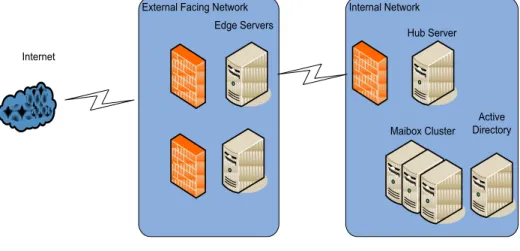
Figure 1 depicts the recommended Exchange Edge and Hub server
architecture. In a real world environment, it is critical to place a firewall in front of each Edge machine. This adds an additional layer of protection between the Internet and the Edge servers. The recommended deployment of Edge servers involves separating each server from the Domain and using ADAM (Active Directory Application
External Facing Network Internal Network
Edge Servers Hub Server Maibox Cluster Internet Active Directory
1.3.
Edge Server Management
Edge servers are by nature internet facing devices, and thus privy to targeted attacks and possible compromise. A properly installed Edge server will only accept inbound SMTP (25 and 587), combining a proper Exchange configuration
with a firewalling and filtering solution will reduce the attack surface of the Edge server considerably.
In smaller environments Edge transport servers should be deployed as workgroup members. The servers they are hosed on are meant to be deployed in a DMZ separate from the corporate network. As standalone systems they rely on ADAM (Active Directory Application Mode) for configuration and mail routing
information. When deployed correctly Edge servers are entirely separate from the Windows infrastructure and rely on no internal Windows services. Joining the Edge server to the internal domain would require trust relationships be established between hosts on the internal network and internal services to be forwarded to the DMZ. This would defeat the purpose of deploying the Edge Server in the DMZ and aid an attacker in taking over the internal network in the case of an Edge server compromise.
For medium and large enterprises Edge server installations manual management and ADAM syncing is simply not an option. In larger environments a separate domain or forest should be created for the Edge servers residing in the DMZ that is only used for the management of the Exchange Edge Cluster. The list of administrators and users that are able to access and administer this tree should be controlled and audited on a periodic basis.
1.4.
Roles
Exchange 2007 Servers can be configured to function with a specific role. Roles include Hub Transport, Client Access, Edge Transport, Mailbox, Unified
Messaging, or Management Tools Server. This paper provides security
recommendations based on each of these roles. Table 1 identifies each role and their associated functions.
Table 1
Client Access The Client Access role accepts connections from a various user clients. Mail clients such as Microsoft Outlook or Mozilla Thunderbird access mail via POP3 or IMAP4. Mobile devices use ActiveSync, POP3, or IMAP4 to communicate with the Exchange server. Hub Transport The Hub Transport role handles all mail flow
inside the organization and delivers messages to mailboxes. Email that is sent to external address is relayed by the Hub Transport server to the Edge Transport. Mail that is received from the Internet is processed by the Edge server before being relayed to the Hub Transport.
Edge Transport The Edge Transport role is deployed on the perimeter network as a stand-alone server. It is designed to minimize the attack surface and
handles all Internet-facing mail flow, which provides SMTP relay and smart host services for the Exchange organization.
Mailbox The Mailbox role hosts mailbox databases and
public folders.
Unified Messaging The Unified Messaging role combines voice messaging, fax, and e-mail into one Inbox, which can be accessed from the telephone and the computer.
1.5.
Features
Exchange Management Console: The Exchange Management Console is built on a set of snap-ins for the Microsoft Management Console. The EMC provides a graphic management Interface to Exchange Server 2007
Exchange Management Shell: The Exchange Management Shell provides administrators a command-line interface that they can use to
administer Exchange 2007. Command line access makes management of Exchange easy with commandlets to manage nearly every aspect of Exchange 2007.
ActiveSync: ActiveSync is a service provided by Exchange Server 2007 that allows users to synchronize e-mail, calendaring, and contact information between the Exchange server and Windows supporting mobile devices, such as PDAs.
Outlook Web Access (OWA): OWA is a remote email client and a basic Exchange Server 2007 messaging service. OWA allows users to access mailboxes and folders using an Internet browser that is compliant with HTML 3.2 and JavaScript standards. The HTML standard provides drag and drop functionality, expandable folder hierarchies, HTML composition, toolbar tips and Kerberos authentication
Public Folders: Exchange Server 2007 supports public folders even though they have been de-emphasized. The purpose of public folders is to provide common access to messages and files. Files can be dragged and dropped into public folders for instant sharing. In addition, sorting rules can be applied to public folders to ensure items are arranged by name or date. Each server has one default public folder store (named the Public Folder Store) that supports the Public Folder tree. There can be up to five stores per storage group, and any number of the five stores may be public folders. Lastly, users can be granted access or denied access to specific public folders.
Public Folder Tree: Public Folder Trees are a group of public folders in a hierarchical structure. One tree can have multiple public folder stores. Each Exchange organization has one default public tree. Additional public folder trees can be created that users can access using Outlook Web Access.
Mailbox Stores: Mailbox Stores is a database for storing mailboxes in Exchange 2007. Mailbox stores hold data that is private to an individual and contain mailbox folders generated each time a new mailbox is created for an individual. Stores are located in storage groups. There can be up to five stores per storage group, and any number of the five stores may be mailbox stores. Each mailbox store has a set of transaction logs associated with it. These transaction logs provide detailed information of messages received and sent from a store in a storage group.
2. Recommended Security Settings for
Exchange Controls
This chapter supplies control-specific Exchange guidance. (In this document, the term “control” refers to a specific parameter or setting through which the administrator configures the platform through the user-interface.)
Table 2 identifies the specific security recommendations. The information contained in the control table is the primary means by which the administrator can secure the Exchange platform. Several types of information are provided in the control table. The fundamental security-related information provided includes:
■ The control name
■ The recommended security setting for the control
■ How the administrator can navigate through the user-interface or power shell to access that control
The following is an explanation of the column and row headings in the table. Column Headings:
■ Reference— ID/ Number and Title associated with specific control for
referencing purposes.
■ Roles— The role associated with the setting
■ Security Level (SL) — The security level associated with the setting: Legacy, Enterprise, or Special Security
■ Scorable/Reportable/Manual (SR)—Identifies whether a control is
(“scorable”), or whether the control value could only reported by a tool and not included in the assessment (“reportable”). Lastly, items that are marked “manual”, means a tool could neither score nor report on the item.
■ GUI/SH—Navigation path through the Exchange MC to locate the
control setting and the name of the control as it appears in the MS Exchange Management Console. If no MC path is available an Exchange Shell Command is given.
■ Default — This list the out of the box default install setting in Exchange if any.
Reference Role SL SR GUI/SH Default Suggested Installation Host is Not a Domain
Controller
General E M dsquery *
“CN=hostname,DC=Domain Controller, DC=domain, DC=com”
N/A N/A
Patches and updates General E M wupdmgr N/A N/A
Security Configuration Wizard General E M Start->All Programs->Administrative Tools->Security Configuration Wizard
N/A N/A
Disable Unnecessary Exchange
Services and Roles General E R
Get-Service
Get-ExchangeServer | select identity, ServerRole
N/A N/A
Audit Administrative Access to Exchange
General E M Get-ExchangeAdministrator N/A N/A
Ensure Fatal Error Reporting is Disabled
General E S Microsoft Exchange->Server Configuration-><Role Name>-><Server Name>
Right click server name Select properties
General Tab
Automatically send fatal service error report to Microsoft
Unchecked $false
Unchecked $false
Restrict Accepted Domains Edge E M Microsoft Exchange->Edge Transport->Accepted Domains Right Click <name> Properties (Tab) General
Authoritative Domain: Selected
Authorita tive Domain
Authoritative Domain
Mail Routing Options Edge E S Microsoft Exchange->Edge Transport
(Tab) Send Connectors Select <name>
Right Click Properties (Tab) Network
Select how to send mail with this connector
DNS Smart Host if available.
Reference Role SL SR GUI/SH Default Suggested Audit Send Connector Address
Space Edge E M
Microsoft
Exchange->Organization Configuration->Hub Transport
(Tab) Send Connections
Right Click <name> properties (Tab) Network
Smart host authentication Click Change
N/A N/A
Enable TLS for Smart Host
Basic Authentication Edge E S
Microsoft
Exchange->Organization Configuration->Hub Transport
(Tab) Send Connections
Right Click <name> properties (Tab) Network
Smart host authentication Click Change
Unchecke
d Checked
Specify Block List Service Provider
Edge SS M Microsoft Exchange-> Edge Transport->IP Block List Providers
Right Click Properties Providers (Tab)
None Verified Black List Provider
Specify Allow List Service Provider
Edge SS M Microsoft Exchange-> Edge Transport->IP Block List Providers
Right Click Properties Providers (Tab)
None Verified White List Provider
Filter Recipients Who Are Not
in Directory Edge SS S
Edge Transport->Anti Spam -> Recipient Filtering ->
Properties -> (Tab) Blocked Recipients
Block messages sent to
recipients not listed in Global Address List Checked
Reference Role SL SR GUI/SH Default Suggested Filter Recipients Edge E M Edge Transport ->
Anti-Spam->Recipient Filter->Blocked Recipients -> Block the following Recipients
None Black Listed Recipients
Filter Senders Edge E M Edge Transport -> Anti-Spam->Sender Filter->Blocked Senders -> Block the following Senders
None Black Listed Senders
Filter Blank Senders Edge E S Microsoft Exchange->Edge Transport -> Anti-Spam -> Sender Filter->Block Senders-> Block Messages from blank senders (check)
Checked Checked
Filter Custom Words Edge SS M Microsoft Exchange->Edge Transport
(Tab) Anti-spam Content Filtering Right Click Properties (Tab) Custom Words
None Custom
Filter Attachment extensions Edge SS M Get-AttachmentFilterEntry | list
Add-AttachmentFilterEntry -Name <MIMEContentType> -Type
ContentType
See List Custom
Configure Allowed IPs Edge E M Microsoft Exchange->Edge Transport-><Select server> (Tab) Anti-Spam
Right-Click IP Allow List
None Custom
Enable TLS for Basic Authentication
Edge E S Microsoft Exchange->Edge
Transport>Receive Connectors -><name>
Right Click Properties (Tab) Authentication
Offer Basic Authentication only after starting TLS
Unchecke d
Restrict Mail Send Size Edge E S Get-TransportConfig | select identity, MaxSendSize Get-SendConnector | select identity, MaxMessageSize Set-TransportConfig – MaxSendSize 20Mb Set-SendConnector – MaxMessageSize 20Mb 30Mb 20Mb
Reference Role SL SR GUI/SH Default Suggested Restrict Mail Receive Size Edge E S Get-TransportConfig | select
identity, MaxReceiveSize Get-ReceiveConnector |select identity, MaxMessageSize Get-TransportServer | select identity, ExternalDsnMaxMessageAttachSize, InternalDsnMaxMessageAttachSize Set-TransportConfig –identity <name> –MaxReceiveSize 10MB Set-RecieveConnector –identity <name> –MaxMessageSize 10MB Set-TransportServer –identity <name> – ExternalDsnMaxMessageAttachSize 10mb Set-TransportServer –identity <name> – InternalDsnMaxMessageAttachSize 10mb 30Mb, 10Mb, 10Mb, 10Mb 10Mb 10Mb 10Mb 10Mb
Restrict Max Recipients Edge E S Get-ReceiveConnector | select identity, MaxRecipientsPerMessage Set-ReceiveConnector –identity <name> –MaxRecipientsPerMessage 100
200 100
Restrict IP Range For Receive
Connectors Edge E M
Microsoft Exchange->Server Configuration->Hub Transport (Tab) Receive Connectors Select Name
Right Click Properties (Tab) Network
None Custom
Ensure Sender Reputation is
Enabled Edge E S
Reference Role SL SR GUI/SH Default Suggested Restrict Email Deletion
Retention
Mailbox E S Server Configuration->Mailbox->Mailbox Database
Right Click Properties Tab Limits
Keep deleted items for (days)
7 7
Restrict Mailbox Deletion
Retention Mailbox E S
Microsoft Exchange-> Server Configuration->Mailbox->Mailbox Database
Right Click Properties Tab Limits
Keep deleted mailboxes for (days)
30 30
Restrict Deletion of Mail or Mailboxes Until Archival
Mailbox E S Microsoft Exchange-> Server Configuration->Mailbox->Mailbox Database
Right Click Properties Tab Limits
Do not permanently delete items until the database has been backed up
Unchecked Checked
Mounting of Mailbox Database at Startup
Mailbox E S Microsoft Exchange->Sever Configuration->Mailbox Database Management Right Click Properties (Tab) General
Do no mount this database at startup
Unchecked Unchecked
Ensure Proper Permissions on
Mail Database Mailbox E M
See Description N/A N/A
Ensure Mailbox Database Cannot Be Overwritten
Mailbox E S Microsoft Exchange->Server
Configuration->Mailbox->Database Managements
Mailbox Database
Right Click Properties (Tab) General
This Database can be over written by a Restore
Verify Default Mailbox Storage Limits
Mailbox E S Server Configuration->Mailbox->Mailbox Database
Right Click Properties (Tab) Limits
Issue warning at (KB) : value Prohibit send at (KB) : value Prohibit send and receive at (KB) : value
Reference Role SL SR GUI/SH Default Suggested Ensure Public Folder
Database Cannot Be Overwritten
Mailbox E S Microsoft Exchange->Server
Configuration->Mailbox->Database Management
Public Folder Database Right Click Properties (Tab) General
This Database can be over written by a Restore
Checked Unchecked
Verify Default Public Folder
Storage Limits Mailbox E S
Microsoft Exchange -> Server Configuration->Mailbox->Public Folder Database
Right Click Properties (Tab) Limits
Issue warning at (KB) : value Prohibit send at (KB) : value Prohibit send and receive at (KB) : value
Custom Custom
Audit Public Folder Client
Access Mailbox E S
GetPublicFolderClientPermission
-identity "\foldername" Custom Custom
Audit Public Folder
Administrative Access Mailbox E S
Get-PublicFolderAdmistrativePermission -identity "\foldername"
Custom Custom
Verify Proper Permissions on Public Folder Database
Mailbox E M Custom Custom Custom
Mounting of Public Folder Database at Startup
Mailbox E S Microsoft Exchange->Sever Configuration->Mailbox
Public Folder Database Management Right Click Properties
(Tab) General
Do no mount this database at startup
Unchecked Unchecked
Restrict Deletion of Mail or Mailboxes Until Archival
Mailbox E S Microsoft Exchange-> Server Configuration>Mailbox ->PublicFolder
Right Click Properties Tab Limits
Do not permanently delete items until the database has been backed up
Reference Role SL SR GUI/SH Default Suggested Restrict Mail Send Size Mailbox E S Get-Mailbox | select identity,
MaxSendSize
Get-MailContact | Select identity, MaxSendSize
Get-DistributionGroup | Select identity, MaxSendSize
SetMailbox –identity <name> -MaxSendSize 10Mb
SetMailContact –identity <name> -MaxSendSize 10Mb -DistributionGroup -identity <name> -MaxSendSize 10mb 10Mb 10Mb 10Mb
Restrict Mail Receive Size Mailbox E S Get-Mailbox | select identity,MaxReceiveSize Get-MailContact | select – identity, MaxReceiveSize
Get-DistributionGroup | Select identity, MaxReceiveSize
SetMailbox –identity <name> -MaxReceiveSize 10Mb
SetMailContact –identity <name> -MaxReceiveSize 10Mb Set-DistributionGroup -identity <name> -MaxReceiveSize 10Mb 10Mb 10Mb 10Mb
Restrict Max Recipients Mailbox E S Get-Mailbox | select identity, RecipientLimits
Set-Mailbox -RecipientLimits 2000
5000 2000
Audit Mailbox Spam Bypass Settings
Mailbox E M Get-Mailbox | select identity, AntispamBypassEnabled
SetMailbox –identity <name> -AntispamBypassEnabled $false
False False
AntiSpam Updates Mailbox E S Get-AntiSpameUpdates EnableAntispamUpdates
-SpamSignatureUpdatesEnabled $true -UpdateMode Automatic
Disabled See
Zero out Deleted Database pages
Mailbox E S Get-StorageGroup | select Identity, ZeroDatabasePages
Set-StorageGroup -Identity <name> -ZeroDatabasePages $true
Reference Role SL SR GUI/SH Default Suggested Restrict Accepted Domains Hub E S Microsoft Exchange->Edge
Transport->Accepted Domains Right Click <name> Properties (Tab) General
Authoritative Domain: Selected
Authoritative Domain
Authoritati ve Domain
Mail Routing Options Hub E S Microsoft Exchange->Edge Transport (Tab) Send Connectors
Select <name>
Right Click Properties (Tab) Network
Select how to send mail with this connector
DNS Smart Host
(if
available)
Audit DNS Lookup Servers Hub E M Microsoft Exchange->Server Configuration->Hub Transport-> (Tab) Receive Connectors Right Click Properties
External DNS Lookups or Internal DNS Lookups
None Custom
Enable TLS for Basic Authentication
Hub E S Microsoft Exchange->Edge
Transport>Receive Connectors -><name>
Right Click Properties (Tab) Authentication
Offer Basic Authentication only after starting TLS
Unchecked Checked
Restrict Out of Office Responses
Hub E S Microsoft Exchange->Organization Configuration->Hub Transport-> Remote Domains->General Tab
None
Restrict Mail Send Size Hub E S Get-TransportConfig | select identity, MaxSendSize Get-SendConnector | select identity, MaxMessageSize Set-TransportConfig –MaxSendSize 10Mb Set-SendConnector –MaxMessageSize 10Mb 30mb 30mb 10mb 10mb
Reference Role SL SR GUI/SH Default Suggested Restrict Mail Receive Size Hub E S Get-TransportConfig | select identity,
MaxReceiveSize
Get-ReceiveConnector |select identity, MaxMessageSize
Get-TransportServer | select identity, ExternalDsnMaxMessageAttachSize, InternalDsnMaxMessageAttachSize Set-TransportConfig –identity <name> – MaxReceiveSize 10MB
Set-RecieveConnector –identity <name> – MaxMessageSize
10MB
Set-TransportServer –identity <name> – ExternalDsnMaxMessageAttachSize 10mb Set-TransportServer –identity <name> – InternalDsnMaxMessageAttachSize 10mb 30Mb 30Mb 10Mb 10Mb 10Mb 10Mb 10Mb 10Mb
Restrict Max Recipients Hub E S Get-ReceiveConnector | select identity, MaxRecipientsPerMessage
Set-ReceiveConnector - – MaxRecipientsPerMessage 2000
5000 2000
Restrict IP Range For Receive Connectors
Hub SS M Microsoft Exchange->Server Configuration->Hub Transport (Tab) Receive Connectors Select Name
Right Click Properties (Tab) Network
None Custom
Require SSL for POP3 Client Access
E S Get-Popsettings | select identity,
LoginType SecureLogin SecureLogin
Limit number of POP3 connections
Client Access
E S Get-Popsettings | select identity, MaxConnections
SetPopsettings –identity <name> -MaxConnections 500
500 500
Enforce Pop3 Connection
Timeouts Client Access E S
Get-PopSettings | select identity,
PreAuthenticatedConnectionTimeout SetPopSettings –identity <name>
-AuthenticatedConnectionTimeout 00:20:00 –PreAuthenticatedConnectionTimeout 00:01:00
Reference Role SL SR GUI/SH Default Suggested Require SSL for IMAP Client
Access
E S Get-ImapSettings | select identity, LoginType
SetImapSettings –identity <name> -LoginType SecureLogin
SecureLogin SecureLog in
Enable IMAP connection
timeout Client Access E S
Get-ImapSettings | select identity, AuthenticatedConnectionTimeout, PreAuthenticatedConnectionTimeout SetImapSettings –identity <name> -AuthenticatedConnectionTimeout 00:20:00 –PreAuthenticatedConnectionTimeout 00:01:00
00:30:00
00:01:00 00:20:00 00:01:00
Restrict number of IMAP
connections Client Access E S
Get-ImapSettings | select identity, MaxConnections
SetImapSettings –identity <name> -MaxConnections 500
500 500
Remove Legacy Web Applications
Client Access
SS S <server name>-> Web Sites->Default Web Site-> {Exchange, Exchweb, Exadmin, Public}
Get-OwaVirtualDirectory
See Description for Remediation
Installed Removed
Restrict Web Authentication Methods
Client Access
E S <Server Name>->Web Sites-><Site Name> Right Click Properties
Tab Directory Security
Authentication and access control
See
Description See Descriptio n
Require SSL for Web
Applications Client Access E S
<Server Name>->Web Sites->Default Web Site
Right Click Properties Tab Directory Security Secure Communications Click Edit
Require Secure Channel SSL 128-bit encryption
Checked
Unchecked Checked Checked
Disable Web Anonymous
Access Client Access E S
<Server Name>->Web Sites-><Site Name> Right Click Properties
Tab Directory Security
Authentication and access control Click Edit
Unchecked Unchecke d
Enable anonymous access
Enable Logging for Default
Website Client Access E S
<Server Name>->Web Sites->Default Web Site
Right Click Properties Tab Website
Enable Logging
Reference Role SL SR GUI/SH Default Suggested Enable Policy for ActiveSync Client
Access
E S Microsoft Exchange-> Organization Configuration->Client Access->Exchange ActiveSync Mailbox Policies
None See
Discussion Forbid ActiveSync
NonProvisionable Devices Client Access E S
Microsoft Exchange-> Organization Configuration->Client Access->Exchange ActiveSync Mailbox Policies
Right Click on Policy, Select properties
Allow NonProvisionable Devices
Checked Unchecked
Forbid ActiveSync Simple Device Password
Client Access
E S Microsoft Exchange-> Organization Configuration->Client
Access->Exchange ActiveSync Mailbox Policies
Right Click on Policy, Select properties
Allow simple password
Checked UnChecked
Disable ActiveSync WSS/UNC Access
Client Access
E S Microsoft Exchange-> Organization Configuration->Client
Access->Exchange ActiveSync Mailbox Policies
Right Click on Policy, Select properties
General Tab WSS/UNC Access
Windows File Shares
Windows Sharepoint Services
Checked Checked
Unchecked Unchecked
Require ActiveSync Password Client Access
E S Microsoft Exchange-> Organization Configuration->Client
Access->Exchange ActiveSync Mailbox Policies
Right Click on Policy, Select properties
Password Tab Require Password
Reference Role SL SR GUI/SH Default Suggested Require ActiveSync
Alphanumeric Password
Client Access
E S Microsoft Exchange-> Organization Configuration->Client
Access->Exchange ActiveSync Mailbox Policies
Right Click on Policy, Select properties
Password Tab
Require alphanumeric password
Unchecked Checked
Require ActiveSync Minimum
Password Length Client Access E S
Microsoft Exchange-> Organization Configuration->Client
Access->Exchange ActiveSync Mailbox Policies
Right Click on Policy, Select properties
Password Tab
Minimum password length
Checked, 4 Checked, 8
Require ActiveSync Password Expiration
Client Access
E S Microsoft Exchange-> Organization Configuration->Client
Access->Exchange ActiveSync Mailbox Policies
Right Click on Policy, Select properties
Password Tab
Password Expiration
Unchecked 60
Require ActiveSync Password History
Client Access
E S Microsoft Exchange-> Organization Configuration->Client
Access->Exchange ActiveSync Mailbox Policies
Right Click on Policy, Select properties
Password Tab
Enforce password history
0 5
Require ActiveSync
Encryption Client Access E S
Microsoft Exchange-> Organization Configuration->Client
Access->Exchange ActiveSync Mailbox Policies
Right Click on Policy, Select properties
Password Tab
Reference Role SL SR GUI/SH Default Suggested Restrict ActiveSync
Attachment Size
Client Access
E S Microsoft Exchange-> Organization Configuration->Client
Access->Exchange ActiveSync Mailbox Policies
Right Click on Policy, Select properties
General Tab
Maximum Attachment Size
Unchecked Unchecked 3mb
Require ActiveSync Policy
Refresh Client Access E S
Get-ActiveSyncMailboxPolicy | Select
identity, DevicePolicyRefreshInterval None
24.00:00:00 Restrict ActiveSync Maximum Password Attempts Client Access E S
Microsoft Exchange-> Organization Configuration->Client
Access->Exchange ActiveSync Mailbox Policies
Right Click on Policy, Select properties
Password Tab
Number of attempts allowed
8 8 Require ActiveSync Certificate Based Authentication Client Access
SS S Server Configuration->Client Access Exchange Active Sync
Microsoft-Server-ActiveSync Right Click Select Properties Authentication (tab) Select Ignore Client Certs Require Client Certs Require ActiveSync Inactivity Lockout Time
Client Access
E S Microsoft Exchange-> Organization Configuration->Client
Access->Exchange ActiveSync Mailbox Policies
Right Click on Policy, Select properties
Password Tab
Time without user input before password must be re-entered
Checked, 15
Checked, 15
Disable Outlook Anywhere Client
Access SS S
Microsoft Exchange->Server
Configuration->Client Access-> <Name> Outlook Anywhere Enabled
Reference Role SL SR GUI/SH Default Suggested
Disable Faxing Uni
Msg
SS S Microsoft Exchange->Unified Messaging (Tab) UM Dial Plan
Right Click <name> Properties (Tab) General
Allow users to receive faxes
Checked Unchecked
Require PIN length Uni Msg
E S Microsoft Exchange->Unified Messaging (Tab) UM Mailbox Policies
Right Click <name> Properties (Tab) PIN Policies
Minimum PIN length
6 6
Require PIN complexity Uni Msg
E S Microsoft Exchange->Unified Messaging (Tab) UM Mailbox Policies
Right Click <name> Properties (Tab) PIN Policies
Allow common patterns in PIN
Unchecked Unchecked
Restrict Allowed In-Country/Region Groups
Uni Msg
E M Microsoft Exchange->Organization Configuration->Unified Messaging (Tab) UM Dial Plan
Right Click <name> Properties (Tab) Dialing Rule Groups In-Country/Region Rule Groups
None Custom
Restrict Allowed International Groups
Uni Msg
E M Microsoft Exchange->Organization Configuration->Unified Messaging (Tab) UM Dial Plan
Right Click <name> Properties (Tab) Dialing Rule Groups International Rule Groups
None Custom
VoIP IPSec Uni
Msg E M
See Description None Custom
Configure Monitoring Gen E M See Description None Custom
Install Anti-Virus Software Gen E M See Description None Custom
3.Pre-Installation and Installation
Recommendations
3.1.
Installation Host is Not a Domain Controller
Description: Installation of Exchange should never be performed on the same host as a domain controller.
Rationale: Installation of Exchange should be on a standalone server to reduce the attack surface and minimize possible damage done by a system compromise.
Recommendation Level: Enterprise
Audit: dsquery * “CN=hostname, DC=Domain Controller, DC=domain, DC=com” Remediation: Select a different host for the installation of Exchange.
Scoring Status: Manual
3.2.
Patches and Updates
Description: Install all relevant patches and updates before installing Exchange 2007.
Rationale: Ensuring the integrity of the host and its services is integral to performing a secure Exchange installation and deployment. Make sure the Windows 2003 Server is fully up to date before installing Exchange 2007.
Recommendation Level: Enterprise Audit:
Remediation: Start->Run
wupdmgr
Scoring Status: Manual
3.3.
Security Configuration Wizard
Description: Run the Microsoft Security Configuration Wizard to lock down the server Exchange is being installed on. The security configuration wizard should also be run post installation.
Rationale: The Security Configuration Wizard will create a security policy and reduce the attack surface of the Windows server.
Recommendation Level: Enterprise Remediation:
Start->Control Panel->Add Remove Programs Click Add/Remove Windows Components Select Security Configuration Wizard Click next
Click Finish
Start->All Programs->Administrative Tools->Security Configuration Wizard Scoring Status: Manual
Additional Resources: http://technet.microsoft.com/en-us/library/aa998208.aspx
3.4.
Disable Unnecessary Exchange Services and Roles
Description: Remove all services and roles that the individual Exchange server does not require.Rationale: Reducing the service list to only necessary services simplifies the administration complexity and reduces the attack surface of the Exchange server. Recommendation Level: Enterprise
Audit:
EMShell > Get-Service
EMShell > Get-ExchangeServer | select identity, ServerRole Remediation:
EMShell >Set-Service –name <name> -startupType Disabled CMD >Setup.com /mode:uninstall /role:<server roles to remove> Role Names: HubTransport, ClientAccess, EdgeTransport, Mailbox, UnifiedMessaging, ManagementTools
Scoring Status: Reportable
4. All Roles
4.1.
Audit Administrative Access to Exchange
Description: Restrict administrative access to Exchange to only necessary administrators.
Rationale: Allowing too many administrators or unrestricted administrative access to Exchange can result in a system instability or security compromise. Audit the
Exchange administrator list to ensure that the least privileges required are assigned to each admin. This audit will be manual and different for each organization.
Recommendation Level: Enterprise Audit:
EMShell >Get-ExchangeAdministrator Remediation:
EMShell > Remove-ExchangeAdministrator –identity <name> Scoring Status: Manual
Additional Resources: http://technet.microsoft.com/en-us/library/36cc2315-2d5c-4c55-9b7c-e6058c9ad83e.aspx
4.2.
Ensure Fatal Error Reporting is Disabled
Description: Restrict sending error reports to Microsoft in the case of a fatal error.
Rationale: This feature controls whether debugging messages are sent to Microsoft whenever a system error is detected. While no sensitive information is sent in the debugging report, the act of sending the report can provide system stability information to attackers. It is disabled by default and should be left as such. If a reoccurring problem occurs that requires Microsoft support enable this feature long enough to collect the report and disable it after.
Recommendation Level: Enterprise Audit:
EMC >Microsoft Exchange->Server Configuration-><Role Name>-><Server Name>
Right click server name Select properties General Tab
Remediation:
EMC > Microsoft Exchange->Server Configuration-><Role Name>-><Server Name>
Right click server name Select properties General Tab
Automatically send fatal service error report to Microsoft : unchecked
5.Edge Transport Role
5.1.
Restrict Accepted Domains
Description: Accepted domains for which this Exchange will route and or relay email for.
Rationale: Exchange should only route mail for which it is both the authoritative domain and the users/mailboxes are present in the organization. Allowing external mail routing on an Edge Transport role opens the Exchange server to both spam abuse and malicious activity. Authoritative Domain is selected by default and should be kept in this configuration. For more information on alternative configurations see the Additional Resources section.
Recommendation Level: Enterprise Audit:
EMC-> Microsoft Exchange->Edge Transport->Accepted Domains Right Click <name> Properties
(Tab) General
Authoritative Domain: Selected Remediation:
EMC-> Microsoft Exchange->Edge Transport->Accepted Domains Right Click <name> Properties
(Tab) General
Authoritative Domain: Selected
Scoring Status: Manual
Additional Resources: http://technet.microsoft.com/en-us/library/bb124423.aspx
5.2.
Mail Routing Options
Description: This controls whether the SMTP connector routes its messages through simple DNS lookups (forming outbound connections to whichever host its routing table prefers) or whether it should use a Smart host
Rationale: Selecting “Smart host” means that all outbound messages through this connector will pass through a single server. This allows hardening to be applied to this single point rather than at multiple locations throughout your network. As such, the Smart host provides many of the advantages of a proxy server (and, indeed, could be the same machine). The only exception to this recommendation is when one is
configuring the external SMTP server. Since such a host would have no more outward facing computer to forward its messages to, it cannot be configured to use a Smart host, it should simply use DNS. Smart hosts may be chained together, but care must be taken that the chain is not cyclic or outbound mail will never travel beyond the Smart hosts.
Recommendation Level: Enterprise Audit:
EMC-> Microsoft Exchange->Edge Transport (Tab) Send Connectors
Select <name>
Right Click Properties (Tab) Network
Select how to send mail with this connector Remediation:
EMC-> Microsoft Exchange->Edge Transport (Tab) Send Connectors
Select <name>
Right Click Properties (Tab) Network
Select hot to send mail with this connector
Select Route mail though the following smart hosts Click Add
Add Smart hosts as necessary.
Scoring Status: Scorable
5.3.
Audit Send Connector Address Space
Description: The send connector will only route email for a specific approved list of domains and sub-domains.
Rationale: A send connector will route mail for various sub domains allowing too general a list or other domains can result in server or relaying abuse. Manually check to ensure the send connector is only routing for approved address spaces.
Recommendation Level: Enterprise Audit:
EMC-> Microsoft Exchange->Organization Configuration->Hub Transport
(Tab) Send Connections
Right Click <name> properties (Tab) Network
Smart host authentication Click Change
Remediation:
EMC-> Microsoft Exchange->Edge Transport Scoring Status: Manual
5.4.
Enable TLS for Smart Host Basic Authentication
Description: If basic authentication must be used with smart host authentication require that TLS be enabled for the transport of the credentials. Whenever it is possible Smart host authentication should be done via Exchange Authentication or IPSec.Rationale: Basic authentication passes credentials encoded and not encrypted across the network an attacker can trivially intercept the credentials and decode them. Requiring TLS ensures the security of the credential is maintained in transit. Recommendation Level: Special Security
Audit:
EMC-> Microsoft Exchange->Organization Configuration->Hub Transport
(Tab) Send Connections
Right Click <name> properties (Tab) Network
Smart host authentication Click Change
Remediation:
EMC-> Microsoft Exchange->Organization Configuration->Hub Transport
(Tab) Send Connections
Right Click <name> properties (Tab) Network
Smart host authentication Click Change
Select Basic Authentication over TLS Scoring Status: Scorable
Additional Resources: http://technet.microsoft.com/en-us/library/bb124423.aspx
5.5.
Specify Block List Service Provider
Description: Configure a block list service provider to automatically update IP block lists.
Rationale: Block list providers update lists of known compromised or malicious email servers. Filtering known hostile email providers helps protect the Exchange infrastructure and users from viruses, spam, phishing, and other email based attacks Recommendation Level: Special Security
Audit:
EMC-> Microsoft Exchange-> Edge Transport->IP Block List Providers
Right Click Properties Providers (Tab)
EMShell >Get-IPBlockListProvidersConfig Remediation:
EMC-> Microsoft Exchange-> Edge Transport-> Providers (Tab)-> Add Fill in Provider Name, Lookup Domain, Custom Error message
Click Ok
EMShell > Add-IPBlockListProvider –Name <name> –LookupDomain Example.com -Enabled $true -RejectionResponse “Example response”
Scoring Status: Manual
5.6.
Specify Allow List Service Provider
Description: The allow list will white list which servers are able to communicate with the edge transport domain. This list will bypass the blacklist routing the email to its proper destination.
Rationale: Allowing specific servers as exceptions to the block rules can help
performance and mail flow. However, this can also be dangerous configuring a white list provider should only be used when the integrity of the list is verified or the list is run internally. Examples of server to be white listed are other internal email servers, a branch corporate offices and/or partner. This will be organizational dependent and filters may not exist or be needed in some cases.
Recommendation Level: Special Security Audit:
EMC-> Microsoft Exchange-> Edge Transport->IP Block List Providers
Right Click Properties Providers (Tab)