Design Research
Building the Knowledge Base
Charles L. OWEN
Institute of Design, Illinois Institute of Technology
350 North Lasalle Street, Chicago, Illinois 60610 USA
Tel: 312 595 4909
Fax: 312 595 4901
E-mail: [email protected]
Adapted from a speech to a research symposium at the Royal College of Art,
London, England. Published in Design Studies 19, No. 1 (January 1998): 9-20.
Published also as Understanding Design Research. Toward an Achievement of
Balance. Journal of the Japanese Society for the Science of Design
Special issue, 5 No. 2 (1997): 36-45.
INTRODUCTION
"Research" in design has a long but not very robust history. Individuals have published on the subject almost from the time design was recognized as something to be taught (engineer-ing and architectural design theories have been in the literature since Roman times). Yet, de-spite exceptional efforts by some individuals, the degree of interest in research among the design disciplines has been quite uneven, rang-ing from more than a little in engineerrang-ing de-sign, to some in architectural and product design, to not very much in the fields of design most closely associated with the arts and crafts. In sum, in comparison to what is normally en-countered in the sciences, humanities and other scholarly disciplines, there has been precious little interest in what might be thought of as "classic" research.
But change is afoot. Events are propelling in-dustries and countries into new economic rela-tionships, and design is being recognized as a critical factor for business success. The result is new interest in the quality of design available, and—more fundamentally—interest in how de-sign can be improved. As export strength com-mands more attention as an economic indicator, the improvement question becomes very impor-tant, its answer imperative.
For developed and developing countries alike, high-quality design is the most cost-effective re-source available to improve trade balances. A few good designers using advanced design pro-cesses can have dramatic impact on the success of products and services. The obvious inference
is that it behooves countries, industries and companies to develop high-quality designers and equip them with high-quality design tools: theory, methods and processes.
Thus, design research. And thus, among design educators, new interest in the nature of design research—especially as it may extend under-standing beyond definitions of classic research used by the sciences and scholarly disciplines. In fields where the thrust of work is synthetic rather than analytic, this questioning is not naive. There is value in serious reflection on the most basic questions concerning research. What follows should be interpreted as such an exploration—an attempt to abstract from what we know in the hope of finding new models that may shed light on what we can do in design.
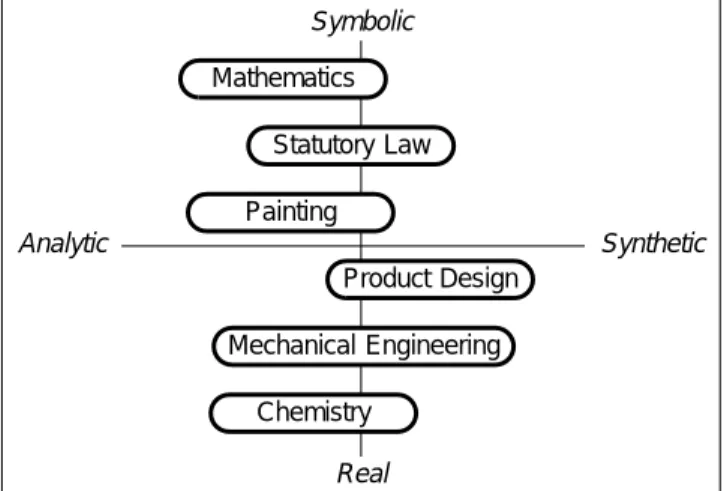
Painting Statutory Law Mathematics Product Design Mechanical Engineering Chemistry Symbolic Real Synthetic Analytic
THE PROBLEM
Design, as a discipline, is still young (or, per-haps, is a slow learner). At any rate, it has not developed the internal structures and under-standing that older disciplines have. Design is not science, and it is not art—or any other dis-cipline. It has its own purposes, values, meas-ures and procedmeas-ures. These become evident through comparisons, but they have not been extensively investigated, formalized, codified or even thought much about in literature created for the field. In short, there is little to point to as a theoretical knowledge base for design. As a result, those who seek to work more rigorously look to scientific and scholarly models for guid-ance, and we find references to "design science" and examples of "design research" that would seem to fit more appropriately in other fields. Yet, it is reasonable to think that there are areas of knowledge and ways of proceeding that are very special to design, and it seems sensible that there should be ways of building knowledge that are especially suited to the way design is studied and practiced. To approach these ques-tions, it is probably best to abandon the term "research" for a time and, instead, look at how knowledge is used and accumulated—since building knowledge, after all, is the goal of re-search.
As a context for thinking about specialized knowledge acquisition and use, a Map of
Disci-plines reveals interesting differences among
tra-ditional fields of study and practice. Two axes define the map in Figure 1. Separating the map into left and right halves is an Analytic/ Syn-thetic axis. Disciplines positioned to the left of center are more concerned with "finding" or dis-covering; disciplines to the right are oriented toward "making" and inventing. A Symbol-ic/Real axis divides the map again into halves—vertically this time, according to the nature of the subjects of interest. Disciplines in the upper half of the map are more concerned with the abstract world and the institutions and communications that allow people to live and work together. Disciplines in the lower half work with the real world and the artifacts and systems that enable us to operate in the physi-cal, not always friendly, environment.
A sample of disciplines illustrates how the map discriminates. In the upper half, mathematics, statutory law and painting work with abstract, symbolic subjects; below, product design,
me-chanical engineering and chemistry deal with real world phenomena. Mathematics, painting and chemistry are primarily analytic in proce-dure; product design is almost entirely synthet-ic; and statutory law and mechanical engi-neering achieve something of a balance.
The positionings are, of course, subjective and relative, but they provide a means for gross com-parisons on the basis of two very fundamental ideas about content and procedure.
The map is also a means for examining other relationships. Mechanical engineering seems nicely centered between the analytic and syn-thetic domains, but it is a discipline with sub-disciplines. Engineering science, as one of these, would be located on the analytic side; engineer-ing design would be more on the synthetic side. Hierarchical decompositions such as this afford opportunities for leveling or sharpening descrip-tions. Merging usually levels, moving the result of composition toward the center; decomposing sharpens, disseminating new elements into the quadrants.
Movements of disciplines over time can also be tracked. Through much of its history, painting was concerned with commissioned applications for clients. The trends of the last century moved it radically to the left, and it has become con-siderably more analytical and exploratory in in-tent and procedure.
No matter where they are on the map or how they move, merge or diverge, all disciplines build knowledge bases. How they do this is im-portant because it sheds light on the process and offers analogies for design. There is no single means, and the multiplicity strengthens the re-sults.
CHARACTERIZING THE PROCESS
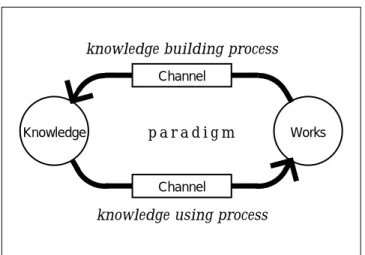
Knowledge is generated and accumulated through action. Doing something and judging the results is the general model. In Figure 2, the process is shown as a cycle in which knowl-edge is used to create works, and works are evaluated to build knowledge.
Knowledge using and knowledge building are not unstructured processes. They are controlled by channels that direct the procedures that are used to do and judge the work. These channels are the systems of conventions and rules under which the discipline operates. They embody the measures and values that have been empirically
developed as "ways of knowing" as the discipline has matured. They may borrow from or emulate aspects of other disciplines’ channels, but, in the end, they are special to the discipline and are products of its evolution.
Figure 2. A general model for generating and accumulating knowledge.
Channel
Channel
Works knowledge building process
knowledge using process p a r a d i g m Knowledge
The general model of Figure 2 can be extended to a model that fits the dual nature of actions suggested by the analytic/synthetic dimension of the map of disciplines. In Figure 3, this is done with an additional specialization of labels. On the left side of the diagram, the realm of theory, the model is a paradigm for inquiry. Existing knowledge, under the direction of
the-ory, is used to generate proposals. Proposals are
tested with measures that verify or refute con-clusions to build knowledge.
Figure 3. Using and accumulating knowledge in the two realms. Measures C r ite ri a Principles T he o r y Works Knowledge Proposals Analytic Synthetic knowledge building knowledge using inquiry paradigm knowledge building knowledge using application paradigm R e a l m o f T h e o r y R e a l m o f P r a c t i c e Discovery Invention Finding Making
On the right side, the realm of practice, the model forms a paradigm for application. Here,
knowledge is used through the application of principles to produce works. Works are judged
for their worth as additions to the knowledge base using the criteria of the discipline.
Proposals and works also benefit from and con-tribute to ideas in other disciplines. A more com-plex diagram would show interdisciplinary relationships. Figure 3 suggests these as dashed arrows entering and leaving proposals and works.
Some Examples
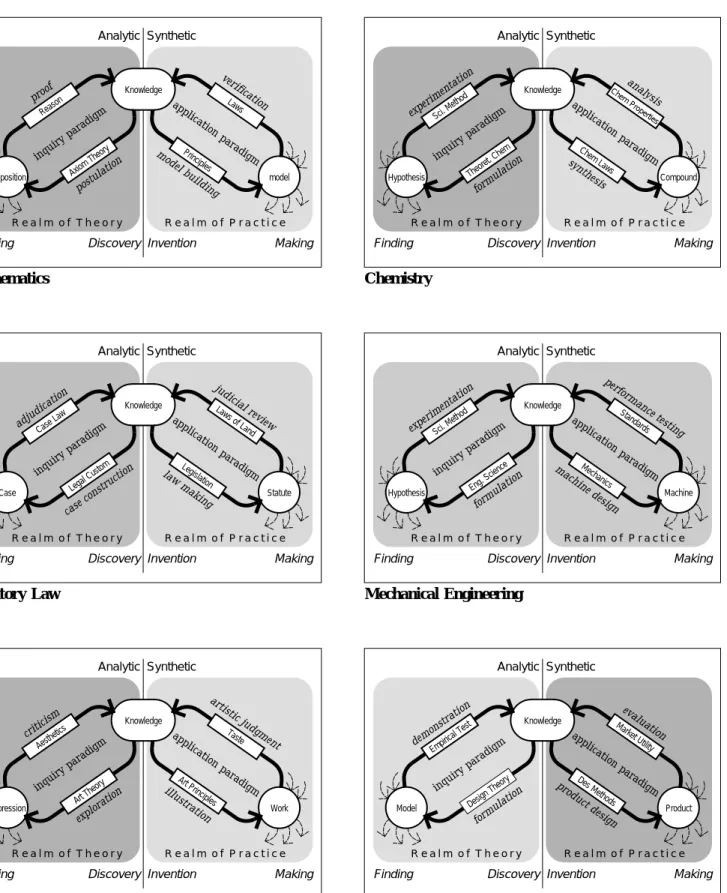
To test the model, Figure 4 shows the sample disciplines of Figure 1 fitted with titles more expressive of their special characters. The dark-ness of the background suggests the skew of their primary activity to either the realm of the-ory or realm of practice—darker meaning more commitment.
It is hard to find a set of words that optimally fits a discipline—clearly fits it better than any other set of words—and differentiates it dis-tinctly from other disciplines. Such nuance re-quires considerable variety and subtlety. Fortunately, both are available in English, and at least an attempt can be made. As an example, mathematics, for a paradigm of inquiry,
postu-lates propositions using axiomatic theory and proves them with reason to build knowledge. In
application, models are built with mathematical
principles and verified with the laws of
mathe-matics to add to applied knowledge. For better or worse, the other examples in Figure 4 simi-larly attempt to distinguish differences in pro-cedure, objects of effort and means of procedural control through choices of appropriate terms. Selectively substituted words bring the gener-alized model into harmony with a specific dis-cipline. Even though not perfect, they convey meanings well enough to convince. They also supply different viewpoints, a goal for extending our conception of knowledge-building processes in design.
USING AND BUILDING
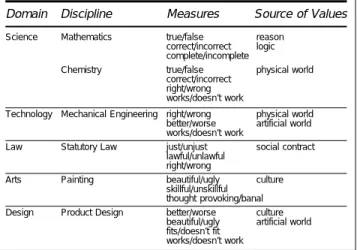
In the acts of both doing and judging, questions are asked, answers obtained and decisions made. How these are formed is the key to using knowledge successfully to build new knowledge. Questions, answers and decisions differ funda-mentally in nature from discipline to discipline. They are framed from the value systems embed-ded in the disciplines. Table 1 suggests some of the these differences using the sample disci-plines. Note that the differences are far deeper
Mathematics
Reason
Laws
Principles
Axiom Theory model
Knowledge Proposition Analytic Synthetic proof postulation inquiry paradigm verification model building application paradigm R e a l m o f T h e o r y R e a l m o f P r a c t i c e Discovery Invention Finding Making Chemistry Sci. Method Chem Properties Chem Laws
Theoret. Chem Compound
Knowledge Hypothesis Analytic Synthetic experimentation formulation inquiry paradigm analysis synthesis application paradigm R e a l m o f T h e o r y R e a l m o f P r a c t i c e Discovery Invention Finding Making Statutory Law Case Law Laws of Land Legislation
Legal Custom Statute
Knowledge Case Analytic Synthetic adjudication case construction inquiry paradigm judicial review law making application paradigm R e a l m o f T h e o r y R e a l m o f P r a c t i c e Discovery Invention Finding Making Mechanical Engineering Sci. Method Standards Mechanics
Eng. Science Machine
Knowledge Hypothesis Analytic Synthetic experimentation formulation inquiry paradigm performance testing machine design application paradigm R e a l m o f T h e o r y R e a l m o f P r a c t i c e Discovery Invention Finding Making Painting Aesthetics Taste Art Principles Art Theory Work Knowledge Expression Analytic Synthetic criticism exploration inquiry paradigm artistic judgment illustration application paradigm R e a l m o f T h e o r y R e a l m o f P r a c t i c e Discovery Invention Finding Making Product Design Empirical Test Market Utility Des Methods
Design Theory Product
Knowledge Model Analytic Synthetic demonstration formulation inquiry paradigm evaluation product design application paradigm R e a l m o f T h e o r y R e a l m o f P r a c t i c e Discovery Invention Finding Making
than issues of content. They grow directly from the basic values that create the knowledge structures of a discipline. As an interesting de-rivative of this comparison, it is possible to see through these differences the reason that design is not science or art, although it shares some of the characteristics of each.
The forms of questions, answers and decisions also differ within disciplines—between inquiry and application, and between doing and judg-ing. These reflect the difference in purpose be-tween inquiry and application and the dif-ference in process between doing and judging. For comparison purposes, the processes of using and building knowledge can be expressed as concatenations of question/answer and ques-tion/decision mediated through the channel ap-propriate to the process.
Table 1. Differences in Measures Discipline Measures
Domain Source of Values
Science Technology Law Arts Design Mathematics Chemistry Statutory Law Painting Product Design Mechanical Engineering true/false correct/incorrect complete/incomplete true/false correct/incorrect right/wrong right/wrong better/worse works/doesn’t work just/unjust lawful/unlawful right/wrong beautiful/ugly skillful/unskillful thought provoking/banal better/worse beautiful/ugly fits/doesn’t fit works/doesn’t work reason logic physical world physical world artificial world social contract culture culture artificial world works/doesn’t work
Consider first the case of inquiry, the classic and most thoroughly discussed process. Here, the form of a question in knowledge using, or doing, is theoretical or methodological, seeking to find understanding of a phenomenon or process im-portant to the discipline. An answer is formed as an evaluatable proposal. For the judging re-quired for knowledge building, the form of ques-tion and decision is derived from the discipline’s value system, setting a framework for judgment and measures to be used.
On the application side, doing involves ques-tions and answers specific to a work or project that has been undertaken. Questions search for understanding of entities, relationships and contextual elements within the project. Answers embody the understanding in ideas that draw on insights—solutions to problems. Judging, again, draws on the values of the discipline for
the kinds of questions to ask and the criteria to make decisions. Questions thoughtfully con-structed using these criteria exact decisions that determine a work’s contribution to the knowledge base. The contribution, in this case, is the work or aspects of it that, through new syntheses, add to what is known about how the discipline’s knowledge can be applied.
A DESIGN PROGRAM
Design (and design education), though young in comparison with many disciplines, has had suf-ficient time to move from fledgling practice to responsible discipline. And the issues discussed here are now being addressed in many colleges and universities around the world. At the Insti-tute of Design, this self-examination process has led to a reconceptualization of the school’s pro-grams, its purpose within the evolving disci-pline, and its role as an educational and research unit of its university, Illinois Institute of Technology.
Over the last nine years, the Institute of Design has moved organizationally from a department of the College of Architecture, Planning and De-sign to a college-level unit of the university, moved geographically to new quarters in the university’s research institute, and completely regenerated its graduate programs. Since the fall of 1991, the school has offered two graduate programs, one a professional, terminal-degree,
Master of Design (MDes) program, and one a
research program with Master of Science in
De-sign (MS) and PhD degrees.
Matching the Map
With the insights of the map of disciplines in mind, the new programs merge the previous programs and position the Institute of Design’s total offering in a better balance of inquiry and application. The new programs also integrate design specialties to create courses more appro-priate for today’s needs (Figure 5).
Product Design and Communication Design from the old program are now merged into a single design program with two tracks. This was done to recognize the changing nature of pro-ducts, communications, systems and services that increasingly act interdependently, mix hardware and software as well as products and information systems, and are designed by inter-disciplinary teams. Replacing the previous pro-gram organized vertically into Product Design and Communication Design, is a new horizontal
Communications Design
Figure 5. Merging and repositioning the Institute of Design’s programs. Symbolic Synthetic Real Analytic Design Product Design
"track" division: Design Planning, concerned with issues of concept, process, program and planning; and Human-Centered Design, con-cerned with details, human factors, artifact and development. Both tracks deal with communi-cations, products, services and systems.
In Figure 6, a new set of axes representing the degrees and tracks of the new program is matched to the map of disciplines. Matching the Analytic/Synthetic axis is an axis for the de-grees: research degrees for inquiry, a profession-al degree for application. Matching the Sym-bolic/Real axis is the axis for tracks: Design Planning concerned with the concept-building aspects of design, Human-Centered Design con-cerned with the specifics of form and function.
Figure 6. Matching a design program to the Map of Disciplines. Symbolic Synthetic Real Analytic Design Planning Professional Degree Human-Centered Design Research Degree Design
Extending the general model for knowledge using and knowledge building to the new axis system produces a four-lobed model (Figure 7). The four quadrants of the map articulate the purposes of design inquiry and application
clearly for the two-track program. Design
Plan-ning Research students investigate and develop
theory, methods and processes for planning and concept formation. Human-Centered Research students investigate and develop theory, meth-ods and process for the detailed design of sys-tems and services and their incorporated products and communications. Design Planning
Professional students apply the tools of design
planning to the creation of design plans for in-stitutions and industry. Human-Centered
De-sign Professional students apply the tools of
human-centered design to problems of systems and services with their associated products and communications.
Criteria
Figure 7. Graduate study at the Institute of Design.
Design Planning Human-Centered Design Professional Degree Research Degree Plan Knowledge I n q u i r y A p p l i c a t i o n Design Planning Design Theory A p p l i c a t i o n I n q u i r y Principles Criteria Measures Theory Measures Theory Principles Theory DESIGN RESEARCH
What light does all of this shed on the subject of design research? For a beginning, there are several general insights.
Some General Insights
First, research should not be thought of as being limited in form, in particular, to the classical forms of scholarly and scientific research. Those forms of research, as processes of knowledge using and building in the service of inquiry, are practiced by nearly all disciplines, but to greater or lesser extents. Knowledge using and building for the purposes of application is an equally pro-ductive process, adding to a discipline’s knowl-edge base through the contribution of worked examples. A corollary lesson from this reflection is that balance may be useful.
Second, the processes of knowledge using and building are fundamentally the same for inquiry and application. The differences are more in the purpose of the activity. In both cases what is
known is used to generate something new that will provide answers to questions inspired by a felt need. In the case of inquiry, the need is for deeper understanding of the subjects of a disci-pline; in the case of application, the need is for artifacts and institutions that employ the knowledge of the discipline more successfully. Third, determinations of value must be under-stood to derive from the value system underly-ing a discipline. The kinds of questions framed by one discipline are not necessarily those of another. It is counterproductive, misleading and a mistake, for example, to attempt to determine "rightness" or "truthfulness" within a discipline if these are not the relevant kinds of questions to ask.
Fourth, a position far to the left or right on the Map of Disciplines opens special opportunities for kinds of research appropriate to the other side. Disciplines skewed to the analytic side probably have unexplored opportunities for knowledge building through applications. Dis-ciplines on the synthetic side should look to areas of inquiry—frequently the tools of the dis-cipline (theory, methods, process) are worthy subjects for research.
Fifth, within the processes of framing questions and constructing answers or decisions lies the heart of good research and, ultimately, the basis for its quality. Questions sharply honed against the context of a discipline’s value system require answers similarly crafted and decisions equally well constructed. Creativity, whether discovery or invention, is inspired by good questions. Recommendations for Design
The design disciplines are on the synthetic side of the Map of Disciplines, far enough to the right that their claims to accomplishments in matters of inquiry are not extensive. This suggests a movement correction to the left for balance. Sev-eral other recommendations can be made; those following are primarily for design education, but a discipline includes practitioners, educators, researchers and other associates with special-ized responsibilities, so there are implications for many, including those responsible for collect-ing and disseminatcollect-ing design knowledge.
• Distinguish between research and profession-al advanced education. Graduate studies should be formalized to recognize the difference be-tween studies to achieve mastery of the latest and most sophisticated design theory, methods
and process (application), and studies to create new design theory, methods and process (in-quiry). Degree titles can recognize these distinc-tions.
• Institute more structured programs of ad-vanced study. Design has reached a level of ma-turity at which graduate courses can be taught with real information content. The master/ap-prentice model of an advanced degree course requiring only a longer, more thorough project is no longer adequate. Masters and doctoral pro-grams with taught-course components are fea-sible and necessary.
• Define areas of design inquiry and application for which research is desired and establish fund-ed centers and programs to accomplish the re-search. Design research has major potential value in a number of content areas— transportation, health care, information access, learning, work, urban systems, and design processes—to name just a few.
• Differentiate areas of design specialty and con-centrate resources. Schools with specialized re-search programs can assemble equipment, financial and human resources synergistically to do better work than can be done with the same resources spread among many.
• Seek out faculty with research experience from disciplines related to design. To prime the pump, faculty members from other fields who are sympathetic to the goals of design can bring general research attitudes, procedures and rigor to the discipline. A few such interdisciplinary members will not dilute a design program, and their fresh ideas may well lead to useful evolu-tions in design research.
• Initiate studies of the philosophy of design. Just as studies of the philosophy of science, his-tory, religion, etc. seek to understand the un-derpinning values, structures and processes within these systems of knowledge building and using, there need to be studies of the nature of design. The design disciplines need thoughtful study of how design proposals and works are produced and evaluated. Measures and criteria as well as procedures for use and judgment should have the same attention given to scien-tific method. What is the analogous design
method?
• Extend the means for communicating design knowledge. Most analytically oriented disci-plines have extensive infrastructures of
confer-ences, symposia, journals, text book publishing and other communication systems that attract, collect and distribute developing knowledge. These also act as recognition systems and create incentives for young faculty members to produce work of value.
• Inculcate knowledge-using more effectively in the question-asking phases of design applica-tions. Design projects that have better thought-out beginnings will have better thought-thought-out endings and, therefore, will be better candidates for building the experiential knowledge base. CONCLUSIONS
Stepping away from the term research allows it to be seen more clearly. Asking instead how knowledge is built, widens the focus. With a broader view, it is possible to see how activities, seemingly opposed, actually work together to support the growth of knowledge.
A knowledge-using/knowledge-building model resolves the "who does research?" debate. Knowledge building is done in different ways, all of which contribute. In recognition of this, the Institute of Design has tailored its graduate programs to research and professional degrees (inquiry and application dimensions) paired with tracks for design planning and human-centered design (symbolic and real dimensions). Knowledge using and building are fundamental to the tracks in both programs.
The interest now being shown in design re-search is timely. Whether its inspiration is de-fensive (justifying educational budgets), com-petitive (contributing to an educational or in-dustrial advantage), or simply idealistic (bring-ing the discipline to maturity), the impact will be the same. The health of our discipline will be well served by this needed attention to its foundations.