Intelligent Fleet Management
INTRODUCTION
Managing a fleet of vehicles is a challenging task, especially with rising fuel and maintenance costs, concerns about driver and passenger safety, and the need to deliver excellent customer service. Helping fleet operators address these areas, evolving technology, and the rise of connected vehicles provide new opportunities to improve fleet performance and customer satisfaction.
Nowadays, operating a fleet encompasses the management of vehicles, routes, and workers using a variety of technologies, including vehicle tracking, telematics, and smart surveillance. Making this easier, advanced fleet management systems allow fuel economy, driver behavior, and other things to be closely monitored by gather-ing useful data, such as mileage, speed, brakgather-ing style, and fuel consumption. This information, collected by the vehicle’s onboard computer and analyzed with data analytics, can produce valuable insights for fleet companies.
Fleet management systems also allow fleet operators to remotely track vehicles using realistic maps and views generated from Global Positioning System (GPS) data. This advanced technology increases fleet management effectiveness and efficiency by reducing workload and overall transportation and staff costs.
Table of Contents
Introduction ...1 Technologies ...2 Intel Solution...2 Data management ...3 Telematics ...3 Location-Based Advertisement ...4 Smart Surveillance ...4 Mobile Application ...4 Case Study ...6Future Plan and Conclusion ...7
Figures
Figure 1. Fleet Management System Architechure ...3Figure 2. Key Elements for Location-Based Advertisement ...4
Figure 3. Key Elements for Smart Surveillance ...5
Figure 4. Key Elements for Mobile App Support ...5
Figure 5. Aggressive Driving Test Result ...6
Figure 6. Fuel Inefficient Driving Test Results ...6
Technologies
Various evolving technologies are providing crucial information to fleet operators, for instance, on-board diagnostics version 2 (OBDII) support vehicle self-diagnostic and reporting capabilities, which collect real-time vehicle parameters used for monitoring and performance analysis (e.g., fuel consumption rate). ODBII systems utilize in-vehicle buses, such as the controller area network (CAN bus), to allow microcontrollers and devices to communicate with each other without a host computer. Accelerometers measuring vehicle acceleration allow fleet operators to monitor driving patterns, such as excessive speed and harsh cornering.
Fleet operators can avoid vehicle theft with remote vehicle disabling systems (RVDS) that can stop engines from starting, and stop or slow down moving vehicles. These systems use GPS technology to let operators know precisely where vehicles are located, significantly increas-ing the chances of recoverincreas-ing a stolen vehicle. Geofencincreas-ing technology can detect when a vehicle goes outside a desired area so that alerts can be sent to warn of possible suspicious activity. Likewise, some fleet management solutions send notifications based on a configurable set of rules (e.g., excessive speed, very low tire pressure). Given the powerful capabilities of RVDS, security technologies are needed to ensure fleet management systems cannot be accessed by unauthorized users.
Intel Solution
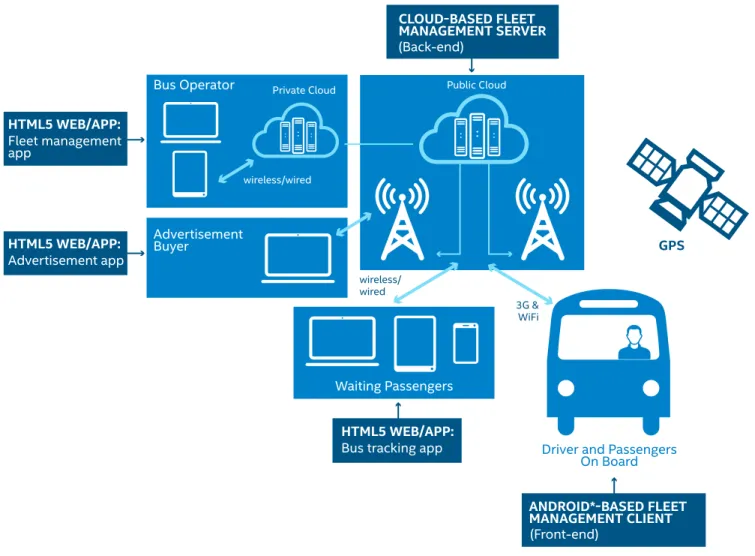
Helping systems integrators incorporate key technologies for public transportation, Intel developed a fleet management system proof of concept (PoC). It can be customized to easily fit into a wide variety of commercial vehicles, including taxis, school buses, and logistic freight vehicles. The architecture, shown in Figure 1, features an in-vehicle system based on the Intel® Atom™ processor E3827 and supports data man-agement, telematics, smart surveillance, location-based advertisement, and mobile applications, which are described in the following.
Data management
With the Intel PoC, fleet operators can move away from maintaining fleet data manually. The PoC manages the data associated with vehicles, terminals, stops, users, and driver schedules, allowing operations to run more efficiently. The solution also creates optimized routes and stops, and drivers can be assigned work shifts based on their available time.
Telematics
The Intel PoC collects real-time telematics data from sensors located inside the vehicle and sends it over an Internet connection to the cloud, where it can be distributed to stakeholders or further processed by the data analytics software.
• Fuel consumption estimation – Fleet operators can
calculate the fuel consumption rate for each vehicle using data collected by the Intel PoC. For each trip, the PoC sends the starting and ending fuel levels, and miles
• Pothole Detection – The Intel PoC can inform local
authorities about the location and severity of potholes, thus eliminating the need to send employees to constantly inspect roads. Accelerometers sense vehicle motion changes; and in general, potholes produce greater move-ment in the Z axis direction (up and down) than in the X or Y direction. When measurements exceed a certain threshold, the PoC can send the authorities an alert about the detected pothole and its GPS location and relative size. • Driver Behavior Monitoring – Fleet operators can
continuously monitor driver behavior, and for those driving recklessly, send them an alert via the Intel PoC. Accelerometer and GPS data sent over OBDII to the control center may be used to detect speeding, and harsh cornering and breaking. When necessary, the control center can send the driver a warning in the form of a pop-up text-to-voice notification.
Figure 1. Fleet Management System Architecture.
HTML5 WEB/APP: Fleet management app CLOUD-BASED FLEET MANAGEMENT SERVER (Back-end) Public Cloud Private Cloud wireless/wired wireless/ wired 3G & WiFi Waiting Passengers
Driver and Passengers On Board
GPS HTML5 WEB/APP:
Advertisement app
HTML5 WEB/APP:
Bus tracking app
ANDROID*-BASED FLEET MANAGEMENT CLIENT (Front-end) Advertisement Buyer Bus Operator
Location-Based Advertisement
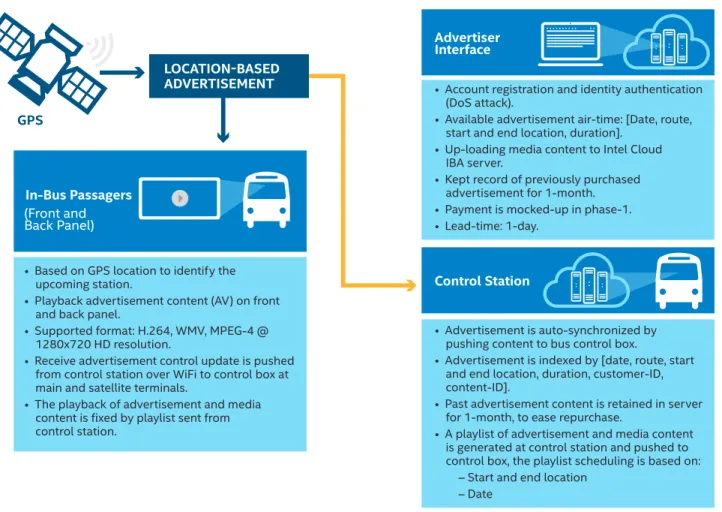
Operators of bus or taxi fleets can generate incremental revenue by using the Intel PoC to play location-based advertisements on passenger panels inside their vehicles. Shops and restaurants would be able to purchase air time for advertisements that are shown when the commercial vehicle is in the vicinity. Figure 2 shows elements of the solution, including location detection, advertisement playback, advertiser interface, and control station, for managing advertisement delivery.
Smart Surveillance
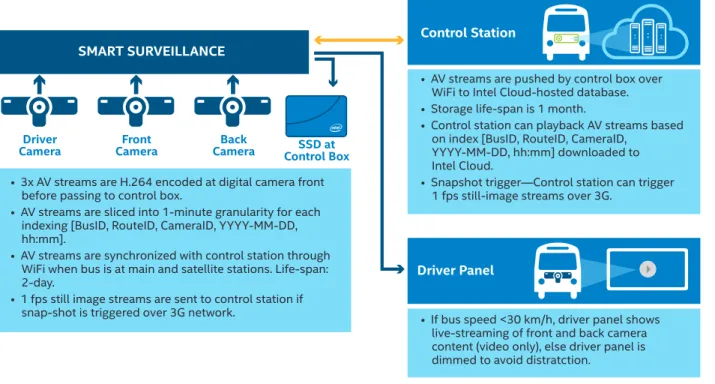
Drivers can view video streams of passengers inside their vehicle to make sure everyone is safe using a smart surveillance system based on the Intel PoC. The implementation example in Figure 3 shows a driver panel that displays video streams from front and rear cameras when the vehicle is going less than 30 km/h; otherwise, the display is dimmed to avoid distraction. These streams, as well as a third stream from a driver camera, are stored on a Solid-State Drive (SDD) and downloaded to a control station once the vehicle reaches its bay. The video can also be streamed to the control center in real time at one frame-per-second over a 3G network.
Mobile Application
Passengers can get regular updates on their journey by installing an app on their mobile devices that receives alerts from the Intel PoC. When passengers are waiting at a bus station, they can check-in to the app, which will let the bus driver know they are waiting to be picked up. Passengers get three alerts: 1) when the bus is at the prior stop, 2) when the bus reaches the pas-senger’s stop, and 3) when it reaches the paspas-senger’s destination. Figure 4 shows an implementation using the PoC to send the bus GPS coordinates to the control station, which generates alerts that are sent to passenger mobile devices via the PoC.
Figure 2. Key Elements for Location-Based Advertisement. GPS In-Bus Passagers (Front and Back Panel) LOCATION-BASED ADVERTISEMENT Advertiser Interface Control Station • Based on GPS location to identify the
upcoming station.
• Playback advertisement content (AV) on front and back panel.
• Supported format: H.264, WMV, MPEG-4 @ 1280x720 HD resolution.
• Receive advertisement control update is pushed from control station over WiFi to control box at main and satellite terminals.
• The playback of advertisement and media content is fixed by playlist sent from control station.
• Advertisement is auto-synchronized by pushing content to bus control box.
• Advertisement is indexed by [date, route, start and end location, duration, customer-ID, content-ID].
• Past advertisement content is retained in server for 1-month, to ease repurchase.
• A playlist of advertisement and media content is generated at control station and pushed to control box, the playlist scheduling is based on:
– Start and end location – Date
• Account registration and identity authentication (DoS attack).
• Available advertisement air-time: [Date, route, start and end location, duration].
• Up-loading media content to Intel Cloud IBA server.
• Kept record of previously purchased advertisement for 1-month. • Payment is mocked-up in phase-1. • Lead-time: 1-day.
Figure 3. Key Elements for Smart Surveillance.
Driver Panel Driver
Camera Control BoxSSD at
SMART SURVEILLANCE
Control Station
• 3x AV streams are H.264 encoded at digital camera front before passing to control box.
• AV streams are sliced into 1-minute granularity for each indexing [BusID, RouteID, CameraID, YYYY-MM-DD, hh:mm].
• AV streams are synchronized with control station through WiFi when bus is at main and satellite stations. Life-span: 2-day.
• 1 fps still image streams are sent to control station if
snap-shot is triggered over 3G network. • If bus speed <30 km/h, driver panel shows live-streaming of front and back camera content (video only), else driver panel is dimmed to avoid distratction.
• AV streams are pushed by control box over WiFi to Intel Cloud-hosted database. • Storage life-span is 1 month.
• Control station can playback AV streams based on index [BusID, RouteID, CameraID,
YYYY-MM-DD, hh:mm] downloaded to Intel Cloud.
• Snapshot trigger—Control station can trigger 1 fps still-image streams over 3G.
Front
Camera CameraBack
Control Station
ON-DUTY BUS TRACKING Driver Panel
• Bus route search (origin, destination, time)— sorted from most recent to later.
• Pre-check-in service to track BoI (Bus of Intrest) and get three notifications.
• First notification: when the bus is at a stop ahead. Second notification: when the bus reaches the stop. Last notification: when the bus reaches the destination.
• Post-ride feedback: satisfaction level and comment.
• On-duty bus fleet health indication on coverage map based on GPS @ 30s intervals:
– Green: moving, on-time per route – Orange: stop/idle (<1 minute) – Blinking Orange: stop/idle (>1 minute) • Controller can analyze individual bus info
(driver profile, in-bus surveillance)
– In-bus 1 fps snapshot from cameras over 3G network
• Bus fleet passenger satisfaction charts: driver ranking and KPI.
• Black-Box-Servce (BBS): driving behavior and road-condition profiling.
• Be notified of the next stop pre-check-in passengers amount and service rating.
GPS CAN
Passengers
(Smart Devices)
Case Study
Intel conducted case studies to measure the effectiveness of its fleet management system PoC. Company employees participated in a test to determine their driving behavior and how much it could be improved by the Intel PoC-based solution. In particular, aggressive driving and fuel-inefficient driving were taken into consideration in this test case. The participants were also asked their opinion about the study, and the responses were:
• They were not aware of their bad driving behavior before the test
• The solution helped to improve their driving
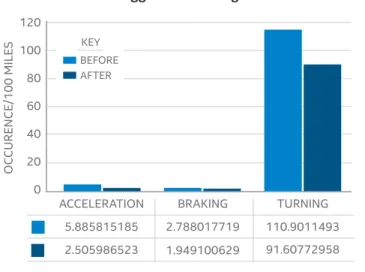
Figure 5 shows driving behavior before and after the fleet management system was deployed. The occurrences of aggressive acceleration, braking, and turning were reduced
by 57 percent, 30 percent, and 17 percent, respectively.1
Most of the drivers tended to turn harshly, not realizing their unsafe practice; however, the Intel solution helped them recognize this driving pattern and correct it.
During the test, the amount of time the participants drove at higher speeds (55 to 75 km/h) was monitored. Figure 6 shows the drivers drove for longer periods at faster speeds before the Intel solution was turned on. Afterwards, the drivers slowed down, which improved fuel economy. Therefore, fuel consumption rate decreased when the drivers were using the Intel solution. In conclusion, the Intel solution can improve driving behavior as well as reduce fuel consumption.
1.8000% 55 60 65 70 75 80 85 90 1.6874% 1.5992% 1.3056% 0.6212% 0.3162% 0.1574% 0.0111% 0.0151% 0.0000% 0.0000% 0.0000% 0.0000% 0.0000% 0.0000% 0.0000% 0.6736% DUR ATION IN PER CENT A GE SPEED RANGE 1.6000% 1.4000% 1.2000% 1.0000% 0.8000% 0.6000% 0.4000% 0.2000% 0.0000%
Fuel Inefficient Driving
BEFORE KEY AFTER
Figure 6. Fuel Inefficient Driving Test Results.1
Figure 5. Aggressive Driving Test Result.1
120 ACCELERATION 5.885815185 2.505986523 2.788017719 110.9011493 91.60772958 1.949100629 BRAKING TURNING OC CURENCE /100 MILES 100 80 60 40 20 0 Aggressive Driving BEFORE KEY AFTER
Future Plan and Conclusion
The Intel Intelligent Fleet Management proof of concept (PoC) was developed to help accelerate innovation in fleet management. The immediate future plan is to align the solution with the Intel® IoT Platform, an end-to-end refer-ence model designed to unify and simplify connectivity and security for the Internet of Things (IoT). As a result, fleet operators and systems integrators can take advantage of this repeatable foundation that enables devices to deliver trusted data to the cloud. The solution will unify the gateway, con-nectivity, and security components in IoT deployments for fleet vehicles. Intel is also adding cloud analytics support for the Intel® IoT Gateway so data collected from vehicles can be used to generate useful insights and value for fleet operators and consumers.
The next revision of the Intel Intelligent Fleet Management PoC will include Mashery* API management and service cre-ation framework, edge-to-cloud connectivity, and the ability to scale to different Intel® architecture processors. This Intel® Atom™ processor-based solution will be tested on the Wind River* Edge Management System, which is a pre-integrated, cloud-based middleware that enables customers to quickly build a solution and reduce time to market. The Enhanced Security for the Intel IoT Gateway will add advanced security management for the device.
With connectivity, security, scalability, and interoperability being addressed by the Intel PoC, it is expected that system integrators will be able to focus their efforts on customiza-tion and applicacustomiza-tion development for mass deployment.
For more information about Intel®
INFORMATION IN THIS DOCUMENT IS PROVIDED IN CONNECTION WITH INTEL PRODUCTS. NO LICENSE, EXPRESS OR IMPLIED, BY ESTOPPEL OR OTHER-WISE, TO ANY INTELLECTUAL PROPERTY RIGHTS IS GRANTED BY THIS DOCUMENT.
Intel may make changes to specifications and product descriptions at any time, without notice. Designers must not rely on the absence or characteristics of any features or instructions marked “reserved” or “undefined.” Do not finalize a design with this information.
The products described in this document may contain design defects or errors known as errata which may cause the product to deviate from published specifications. Current characterized errata are available on request.
Contact your local Intel sales office or your distributor to obtain the latest specifications and before placing your product order.