Publication Number: 11-06-010 7/15
Shoreline Master Programs Handbook
Chapter 15, Shoreline Stabilization
SMP HANDBOOK
Publication Number: 11-06-010 i 7/15
Contents
Introduction ... 1
Chapter overview ... 2
Description of shoreline stabilization ... 2
Design of shoreline stabilization ... 4
Legal framework ... 5
Shoreline Management Act ... 5
SMP Guidelines ... 5
Shoreline modifications ... 8
Shoreline stabilization section ... 8
Additional Guidelines requirements ... 9
Shoreline management permit and enforcement procedures ... 10
Other regulatory authority... 11
Department of Ecology - federal consistency certification ... 11
Washington Department of Fish and Wildlife ... 11
U.S. Army Corps of Engineers ... 12
Federal Emergency Management Agency (FEMA) ... 13
Impacts of shoreline stabilization ... 14
Physical processes ... 15
Ecological functions... 16
Impacts on use and enjoyment of the shoreline ... 16
Cumulative impacts ... 17
Sea level rise ... 19
Addressing shoreline stabilization in SMPs ... 20
Environment designations ... 20
Examples ... 21
Standards for shoreline stabilization ... 22
New development ... 24
New shoreline stabilization measures ... 25
Replacement and repair... 29
Replacement ... 29
Publication Number: 11-06-010 ii 7/15
Distinguishing between replacement and repair ... 31
Shoreline permits ... 32
Permits and exemptions ... 33
Considerations... 33
Demonstrating need for stabilization ... 35
Assessing threats to primary structures ... 35
Examples ... 36
What constitutes threat? ... 39
Normal erosion... 39
Substantial damage from erosion ... 39
Time frame ... 40
Erosion scenarios in different settings ... 41
Chronic erosion ... 42
Unstable banks and slopes ... 43
Floods and storm damage ... 44
Reasonable distance ... 45
Approaches to evaluating risk ... 45
Additional shoreline stabilization requirements ... 47
Erosion is not due to upland conditions ... 47
Nonstructural measures are not feasible or not sufficient ... 48
No net loss of shoreline ecological functions ... 48
Public access should not be restricted ... 50
Minimize impacts at feeder bluffs ... 51
Establish provisions for beach management districts ... 52
Soft shoreline stabilization ... 54
Soft techniques ... 54
Challenges ... 55
Replacement ... 55
Long term threat ... 55
Shorelines Hearings Board cases ... 56
Sources ... 59
Technical References ... 59
SMP HANDBOOK
Publication Number: 11-06-010 iii 7/15
Shoreline Master Programs ... 61
Websites referred to in Chapter 15 ... 62
Shoreline Master Programs Handbook ... 62
Shorelines Hearings Board cases ... 63
Appendix 1: Shoreline Settings ... 1
Lakes ... 1
Streams ... 3
Marine Shorelines ... 4
Sources for Appendix 1 ... 6
Technical references ... 6
Websites referred to in Appendix 1 ... 6
Appendix 2: General Principles for Shoreline Stabilization ... 1
Site planning ... 1
Managing an eroding shoreline ... 2
Design and construction of erosion control measures ... 3
Replacing existing stabilization ... 4
Publication Number: 11-06-010 iv 7/15
SMP HANDBOOK
Publication Number: 11-06-010 7/15
Chapter 15
Shoreline Stabilization
Shoreline Master Program Planning Process
Introduction
Shoreline stabilization includes a wide range of activities carried out at the water’s edge to control erosion or to prepare shorelines for development.Stabilization generally employs hardened structures, built parallel to the shoreline, that protect soils and unstable banks from the action of currents and waves. Stabilization is widespread, occurring on all manner of lake, stream, and marine shorelines. Common stabilization methods include revetments, bulkheads, and seawalls.
Shoreline stabilization policies and regulations are developed as part of Shoreline Master
Program (SMP) updates. (Phase 3 of the SMP planning process for local governments that began updating prior to July 2013, Task 6 for those that began updating after that date.) The SMP Guidelines (WAC 173-26-231) provide a framework for evaluating and permitting shoreline
Figure 15-1: Shoreline stabilization supports and protects houses on Lake Chelan. (Hugh Shipman photo.)
Publication Number: 11-06-010 2 7/15 stabilization activities. In general, they discourage stabilization and encourage consideration of alternative site development and less impacting stabilization methods.
The mandate of the Guidelines to achieve no net loss of shoreline ecological functions applies to all shoreline modifications, including shoreline stabilization. For shoreline modifications, this applies to individual projects and on a cumulative basis. No net loss is to be achieved by a preference for shoreline modifications with less impact on ecological functions and mitigation of impacts that would result from shoreline modifications [WAC 173-26-231(2)(d)]. New
development should be located to avoid the need for future shoreline stabilization to the extent possible [WAC 173-26-231(3)(a)(iii)(A)].
Chapter overview
This chapter provides guidance to develop and implement local SMPs regarding shoreline stabilization activities. It describes the types of shoreline stabilization methods, the impacts associated with its construction, the regulatory environment in which stabilization occurs, and how the SMA Guidelines address these issues. The chapter highlights key issues and provides examples. Although the examples draw heavily from Puget Sound, this guidance generally applies to shorelines throughout Washington. This chapter focuses on the more common forms of stabilization such as bulkheads and revetments and briefly discusses soft shoreline
stabilization methods. Soft Shoreline Stabilization: Shoreline Master Program Planning and Implementation Guidance(Gianou, 2014)takes an in-depth look at this topic.
Description of shoreline stabilization
Shorelines are naturally dynamic environments and inherently subject to erosion by waves and currents. Stream banks and coastal bluffs are often unstable and prone to slope failures.
Shorelines are subject to floods and storm damage; stabilization structures are often built to address threats associated with these processes as much as erosion itself. Artificial fill that has been placed along shorelines to create dry land or to facilitate development is particularly vulnerable to erosion if it is not armored.
Stabilization typically involves hardening the shoreline to prevent currents or wave action from eroding soils and damaging upland improvements. Stabilization structures often serve functions besides erosion control, influencing both their choice and their design. They may provide
protection from flood events and storm waves. They may facilitate access to boats or to the water on commercial, recreational and residential properties. They also may aid in creating usable space near the water’s edge.
Stabilization is typically a component of development that involves fill placed along shorelines and often occurs along with clearing and grading, site development and landscaping.
Stabilization is also a common element of other shoreline projects, such as bridge and pier abutments, utility crossings, stormwater outfalls, and water diversion structures.
SMP HANDBOOK
Publication Number: 11-06-010 3 7/15
Figure 15-2: Riprap revetment protects the petroleum processing facility at Point Wells, Snohomish County (left). A residential bulkhead sits at the toe of a bluff on Whidbey Island (right). (Hugh Shipman photos.)
For these reasons, and because stabilization was long viewed as a fairly benign activity, historic modification of shorelines has been extensive and proposals for new stabilization are common.
However, shoreline stabilization directly impacts sensitive habitats at the shoreline edge, involves work in or adjacent to public waters, and interferes with important geological and ecological processes. Shorelines occur within dynamic geologic systems, so stabilization may have unintended consequences on adjacent or downstream properties. (See “Impacts of Shoreline Stabilization” (page 14) for additional information.)
Shoreline stabilization has a rich terminology. Much stabilization is erosion control. The terms
hardening and armoring are often employed to describe the placement of rock or other resistant material to reduce erosion. Traditionally, expressions such as shore protection and coastal defense have been applied. Terms such as revetment, riprap, seawall, bulkhead, flood wall, and
groin describe specific types of structures.
Some of the most familiar applications of stabilization in Washington include:
• Bulkheads or seawalls built to protect residential property on lakes or on Puget Sound.
• Revetments built to stabilize river banks and levees.
Publication Number: 11-06-010 4 7/15
• Riprap revetments associated with industrial development and large bulkheads built to facilitate cargo handling at port facilities.
• Armor used to protect bridge abutments, drainage outfalls, and other structures.
Stabilization most commonly takes the form of shore-parallel structures such as rock revetments or bulkheads, but can also include structures built perpendicular to the shoreline such as groins that trap sediment on beaches or training structures that redirect currents on rivers. Breakwaters on lakes and marine shorelines reduce erosion by waves. Armor may be used to protect dikes and levees, built for flood control, from erosion and breaching. A wide variety of stabilization
methods are used to protect and buttress bluffs and unstable slopes. Design of shoreline stabilization
The design and construction of shoreline stabilization and erosion control structures reflects many different requirements and engineering considerations. In order to understand the nature of stabilization proposals, the choices impacting property owners and contractors, and the options for more environmentally friendly options, it is useful to describe the factors that influence the selection and design of erosion control structures.
In general, structures need to address geotechnical factors such as hydrostatic pressure and soil loadings, hydraulic forces from waves and currents, and design requirements associated with the use of the structure, such as boat moorage, flood control, or recreational access.
Stabilization structures should be designed to:
• Resist both geotechnical and hydraulics forces for the life of the structure, including reasonably foreseeable extreme events such as floods, storms, and impacts.
• Accommodate features such as stairs, moorage facilities, pier abutments, and outfalls.
• Allow drainage without the loss of soils behind the structure.
• Reduce or accommodate erosion induced by the structure itself (scour and undermining).
• Employ affordable, durable, and non-hazardous materials.
• Utilize reasonable construction methods regarding site access, staging, crew safety, and environmental practices.
• Tie in effectively with adjacent structures.
Conventional structures are usually standard designs that are based on proven effectiveness, constructability, and relatively low cost. Larger shoreline stabilization projects may involve extensive engineering design, while smaller projects, such as residential bulkheads and simple stream bank protection measures, may be built by contractors based on previous experience and without site-specific design engineering. One benefit of many standard designs is that they are cost effective and can be used in a wide variety of settings.
SMP HANDBOOK
Publication Number: 11-06-010 5 7/15
Legal framework
The legal framework for shoreline stabilization projects is found in both state and federal laws and regulations. This section provides an overview of those, with an emphasis on shoreline management under the Shoreline Management Act.
Shoreline Management Act
The Shoreline Management Act’s policy is to plan for and foster all reasonable and appropriate uses, while also “protecting against adverse effects to the public health, the land and its
vegetation and wildlife, and the waters of the state and their aquatic life…” [RCW 90.58.020]. The SMA requires SMPs to include standards regarding protection of single family residences and appurtenant structures against damage or loss due to shoreline erosion. Standards shall govern issuance of substantial development permits for structural methods such as bulkheads and nonstructural methods of protection. The standards also shall provide a preference for issuing permits to protect single family residences occupied prior to January 1, 1992, where the proposal is “designed to minimize harm to the shoreline natural environment” [RCW 90.58.100(6)]. Other sections of the SMA specifically address bulkheads.
• RCW 90.58.030(3) (a) lists “bulkheading” as development.
• RCW 90.58.030(3)(e) states that construction of the “normal protective bulkhead common to single family residences” is not considered substantial development (and therefore does not require a shoreline substantial development permit.) See “Shoreline management permit and enforcement procedures” below for the parallel WAC
provisions.
• RCW 90.58.140(11) establishes procedures for substantial development permit applications for bulkheads or limited utility extensions.
SMP Guidelines
The SMP Guidelines provide direction on developing and updating Shoreline Master Programs. The section concerning shoreline stabilization is extensive and prescriptive and is addressed in the Shoreline Modifications section, WAC 173-26-231. Shoreline modifications are defined as “actions that modify the physical configuration or qualities of the shoreline area, usually through the construction of a physical element such as a dike, breakwater, pier, weir, dredged basin, fill, bulkhead, or other shoreline structure. They can include other actions, such as clearing, grading, or application of chemicals” [WAC 173-26-020(34)].
Shoreline modifications generally are undertaken in order to support or prepare for a shoreline use. For example, dredging, a shoreline modification, is performed so a marina, a shoreline use, can be built. Other shoreline modifications listed in the Guidelines include revetments and soft stabilization techniques; docks; groins; jetties; weirs; dredging; significant vegetation removal; and beach and dunes management.
Publication Number: 11-06-010 6 7/15 This section provides a review of the Guidelines with the main focus on shoreline stabilization. The Guidelines are also discussed in other locations in this chapter, as relevant. Shoreline modifications and stabilization are discussed first, followed by additional requirements.
The chart below shows Guidelines provisions that provide direction for SMP updates regarding shoreline stabilization.
SMP HANDBOOK
Publication Number: 11-06-010 7 7/15
Figure 15-3: SMP Guidelines provisions related to shoreline stabilization
Shoreline Master Program Guidelines Shoreline Stabilization WAC 173-26-201(3)(c) Shoreline Inventory (i) Shoreline modifications WAC 173-26-211(5) Environment designations (a) Natural (b) Rural conservancy (c) Aquatic (e) Urban conservancy (f) Shoreline residential WAC 173-26-221 General SMP Provisions (2) Critical areas (c)(ii) Geologically hazardous areas (c)(iii) Critical saltwater habitats (c)(iv) Critical freshwater habitats (3) Flood hazard reduction (5) Shoreline vegetation conservation WAC 173-26-231 Shoreline Modifications (2) General principles (3)(a) Shoreline stabilization (ii) Principles (iii) Standards (A) New development (B)I) Existing primary structures
(B)(II) New non-water dependent development (B)(III) Water-dependent development (B)(IV) Restoration & remediation (C) Replacement (D) Geotechnical reports (E) When necessity
is demonstrated (3)(g) Habitat enhancement WAC 173-26-241 Shoreline Uses (3)(j) Residential development
Publication Number: 11-06-010 8 7/15
Shoreline modifications
Shoreline modifications, including stabilization measures, should be appropriate to the type of shoreline and environmental conditions. The following general principles for shoreline modifications apply to shoreline stabilization [WAC 173-26-231(2)].
• Allow only where demonstrated to be necessary to support or protect an allowed primary structure or legal existing shoreline use in danger of loss or substantial damage, or necessary for mitigation or enhancement purposes.
• Limit the number and extent of modifications and reduce their adverse effects.
• Do not result in a net loss of shoreline ecological functions.
• Base SMP provisions on scientific and technical information, including marine drift cells for marine waters and reach conditions for streams.
• Plan for enhancement of impaired ecological functions.
• Use the mitigation sequence to avoid significant ecological impacts.
Shoreline stabilization section
The following discussion provides highlights of the SMP Guidelines section on shoreline stabilization [WAC 173-26-231(3)].
Principles: Shorelines are unstable. The natural processes of erosion and accretion provide ecological functions. Hardening or armoring one property on the shoreline may have limited impacts at the site in the short term, but could have significant cumulative impacts, especially combined with the impacts of additional shoreline armoring in the vicinity. Impacts may include beach starvation, habitat degradation, sediment impoundment, exacerbation of erosion, hydraulic and groundwater impacts, loss of vegetation and large woody debris, and loss of channel
movement. Hard structures may create conditions that lead to failure of the structure itself. The Guidelines list a range of shoreline stabilization measures, from soft measures such as vegetation enhancement to hard measures such as seawalls. Generally, harder structures have greater impacts on shoreline processes than softer structures. See Shoreline Stabilization Measures: Spotlight on Puget Sound for more information about the range of stabilization measures. Although this chapter tends to reflect experience on Puget Sound shorelines, it is applicable to all SMA shorelines in the state.
Standards: The Guidelines include shoreline stabilization standards that shall be included in SMPs and implemented when development occurs. These standards cover new development, new shoreline stabilization measures, replacement shoreline stabilization measures and
geotechnical reports. Geotechnical reports that demonstrate need for stabilization are required for new stabilization measures to protect existing primary structures, new nonwater-dependent development, and water-dependent development. Geotechnical reports are also required for proposed development on steep slopes and bluffs, in order to demonstrate the development will be set back enough to not require shoreline stabilization. To replace existing stabilization
SMP HANDBOOK
Publication Number: 11-06-010 9 7/15
structures with similar structures, a demonstration of need is required, although the Guidelines do not specify that this constitute a geotechnical analysis.
Shoreline modifications and stabilization projects are allowed for projects with a primary
purpose to restore “the natural character and ecological functions of the shoreline.” Such projects may include removal of nonnative or invasive plants, dredging, filling and shoreline
stabilization. SMP provisions for these projects “should assure that the projects address legitimate restoration needs and priorities and facilitate implementation of the restoration plan developed pursuant to WAC 173-26-201 (2)(f)” [WAC 173-26-231(3)(g)].
Standards for shoreline stabilization are discussed in more detail in “Addressing Shoreline Stabilization in SMPs” starting on page 20.
Additional Guidelines requirements
Shoreline modifications and stabilization are also addressed in sections of the Guidelines other than WAC 173-26-231. The provisions specifically concerning shoreline modifications and stabilization are shown in Figure 15-3 and are briefly reviewed below. Please see the Guidelines for the complete language.
Shoreline inventory: The shoreline inventory, which is prepared early in the SMP update process, should include existing structures, including shoreline modifications
[WAC 173-26-201(3)(c)(i)]. (See SMP Handbook Chapter 7, “Shoreline Inventory and Characterization.”)
Cumulative impacts analysis: This analysis should consider the potential cumulative impacts of reasonably foreseeable future development. The Guidelines specifically address “effects such as the incremental impact of residential bulkheads” among the impacts on ecological functions that should be analyzed [WAC 173-26-201(3)(d)(iii)]. (See SMP Handbook Chapter 17, “Cumulative Impacts Analysis.”)
Residential development: SMP standards for residential development that address the subdivision of land should “Prevent the need for new shoreline stabilization or flood hazard reduction measures that would cause significant impacts to other properties or public improvements or a net loss of shoreline ecological functions” [WAC 173-26-241(3)(i)].
Geologically hazardous areas: Within geologically hazardous areas, new development that would require shoreline stabilization over the life of the development should not be allowed. Exceptions can be made to protect allowed uses if alternative locations are not available and no net loss of ecological functions will result. If alternatives are not feasible, stabilization to protect existing primary residential structures may be allowed [WAC 173-26-221(2)(c)(ii)].
Critical saltwater habitats: Specific conditions must be met in order for bulkheads and other structures to intrude into or over critical saltwater habitats. These conditions include public need for the structure, infeasibility or unreasonable or disproportionate cost for an alternative
Publication Number: 11-06-010 10 7/15 alignment, no net loss of shoreline ecological functions, and consistency with the state interest in resource protection and species recovery [WAC 173-26-221(2)(c)(iii)].
Critical freshwater habitats: Various SMP provisions, including those for shoreline
stabilization, should address protection of human health and safety and protection and restoration of lake and river corridor ecological functions and ecosystem processes [WAC
173-26-221(2)(c)(iv)].
Shoreline vegetation conservation: The Guidelines note the role of vegetation conservation in protecting and restoring ecological functions and ecosystem processes along shorelines.
Vegetation conservation should also be used to reduce the need for structural shoreline stabilization measures [WAC 173-26-221(5)(b)].
Flood hazard reduction: SMPs should include provisions to limit development and shoreline modifications that would interfere with channel migration or result in a net loss of ecological functions associated with streams [WAC 173-26-221(3)(b)]. New development or uses and the subdivision of land should not be allowed in shoreline jurisdiction if it is “reasonably
foreseeable” that they would require structural flood hazard reduction measures within the channel migration zone or floodway. However, measures to reduce shoreline erosion are allowed in channel migration zones if they can meet specific conditions. The applicant must demonstrate that the erosion rate exceeds “that which would normally occur in a natural condition.” In addition, the demonstration of need must show that the stabilization measure will not interfere with normal fluvial hydrological and geomorphological processes, and that impacts to ecological functions are mitigated appropriately [WAC 173-26-221(3)(c)].
Shoreline management permit and enforcement procedures
WAC 173-27 includes the shoreline permit and enforcement procedures. Construction of the “normal protective bulkhead common to single-family residences” is exempt from requirements for a substantial development permit under certain conditions [WAC 173-27-040(20(c)]. The exemption applies to bulkheads to be built at or near and parallel to the ordinary high water mark
to protect an existing single family home and appurtenant structures from loss or damage by erosion. A bulkhead is not exempt if it is built for the purpose of creating dry land. Any projects that are exempt from the SDP permit requirement must still meet requirements of the SMP.
The regulation also states:
• Not more than one cubic yard of fill per foot of wall may be used as backfill for a vertical or near vertical wall.
• A new vertical wall being built to repair an existing bulkhead must be built no further waterward of the existing bulkhead than necessary to built new footings.
• If a bulkhead has deteriorated to the extent that the ordinary high water mark (OHWM) has established landward of the bulkhead, a replacement bulkhead must be located at or near the current OHWM. (The OHWM may move over time.)
SMP HANDBOOK
Publication Number: 11-06-010 11 7/15
• Beach nourishment and bioengineered erosion control projects are considered normal protective bulkheads when structural elements are consistent with these requirements and when the project is approved by Washington Department of Fish and Wildlife.
Other regulatory authority
Shoreline stabilization projects may fall under other regulatory authority of state and federal agencies. This section provides a brief review.
Department of Ecology - federal consistency certification
The Department of Ecology reviews applications for “federal consistency certification” for projects that require federal approval, use federal funds or are undertaken by a federal agency. This would include bulkheads and rip-rap included in the Army Corps of Engineers permits discussed below.
This certification is required under Washington’s Coastal Zone Management Program, the state program that implements the federal Coastal Zone Management Act in the 15 coastal counties with marine shorelines. Federal agencies cannot approve permits for projects that require federal approval until Ecology concurs that a project is consistent with the Coastal Zone Management Program.
Ecology also administers Section 401 of the federal Clean Water Act through issuance of a Water Quality Certification. Project impacts should be avoided and minimized, and unavoidable impacts should be mitigated so that there is reasonable assurance that a proposal will comply with state water quality standards and other aquatic resource protection requirements under Ecology’s authority. The federal consistency certification is part of Ecology’s review for projects receiving federal approvals, including a Water Quality Certification. Under the Corps’
Nationwide Permit 13, Ecology must approve a Section 401 Water Quality Certification for new or expanded shoreline stabilization.
More information about federal consistency is available on Ecology’s website at http://www.ecy.wa.gov/programs/sea/czm/fed-consist.html
Washington Department of Fish and Wildlife
Any type of construction or performance of work that “will use, divert, obstruct, or change the natural flow or bed of any of the salt or fresh waters of the state” is a hydraulic project and requires a permit called a Hydraulic Project Approval (HPA) from the Washington Department of Fish and Wildlife [WAC 220-660-010]. Examples of shoreline stabilization construction activities that may require HPAs include bulkheads, stream bank protection, stabilization for piers and docks, and fills.
WAC 220-660 is the new administrative rule, effective July 1, 2015, that enacts RCW 77.55, “Construction projects in state waters.”
Publication Number: 11-06-010 12 7/15 WAC 220-660-130 addresses stream bank protection and lake shoreline stabilization. The rule requires the design of stream bank and lake shoreline protection to follow the mitigation sequence to protect fish life and habitat that supports fish life. The general design rule calls for protecting fish life and habitat by using the alternative with the least impact that is technically feasible. The area of stream bank protection and lake shoreline stabilization should be restricted to the least amount needed to protect the eroding banks.
WAC 220-660-370 addresses bank protection in saltwater areas and specifies bulkheads and other bank protection design. The alternative with the least impact that is technically feasible should be used. This section directs how HPAs for single family residence bank protection in saltwater areas are processed under RCW 77.55.
U.S. Army Corps of Engineers
Construction of shoreline stabilization may require a permit from the Army Corps of Engineers. Two categories of work require permits.
• Activities within navigable waters such as building bulkheads and docks, dredging and placing navigation aids. These require review under Section 10 of the Rivers and Harbors Act of 1899. This review is conducted to assure that these items will not obstruct
navigation.
• Activities that may involve discharging dredged or fill material into waters of the United States. These require review under Section 404 of the Clean Water Act of 1972.
Depositing dredged or fill material into open waters of the U.S. for construction of bulkheads, placement of riprap and other construction activities require Section 404 permits.
If a project has the potential to affect endangered or threatened species or their habitat, the Corps may consult with NOAA Fisheries and the U.S. Fish and Wildlife Service during permit
application review. For Lake Washington shorelines, applicants who comply with the Lake Washington Bank Stabilization biological evaluation may be able to avoid this consultation requirement for individual projects.
Note that the Corps issues permits for development, including shoreline stabilization, at or below Mean Higher High Water (MHHW) elevation. New stabilization structures should be built at or above the OHWM, which is typically a higher elevation than MHHW. Therefore, the Corps may not be involved in permitting for stabilization at OHWM. However, if the project involves any work below MHHW, such as beach enhancement, the Corps will review the entire project. More information is available from the Corps of Engineers at
SMP HANDBOOK
Publication Number: 11-06-010 13 7/15
Federal Emergency Management Agency (FEMA)
Shoreline stabilization within a mapped floodplain requires a floodplain development permit. Within the Puget Sound region, floodplain development requires compliance with a 2008 Puget Sound Biological Opinion for the National Flood Insurance Program.
FEMA has provided three distinct approaches to demonstrate compliance with the Biological Opinion. All three require FEMA approval. Most common is the preparation of a habitat assessment for each floodplain development permit. The habitat assessment must demonstrate “No Adverse Effect” to species listed under the Endangered Species Act. Another alternative is to adopt and implement the FEMA model floodplain ordinance for the Biological Opinion. The third alternative is adoption of a programmatic response that addresses the habitat concerns identified in the Biological Opinion.
Scrutiny of shoreline stabilization projects was heightened after completion of the 2008
Biological Opinion. The federal requirements apply even if the normal protective bulkhead for a single family residence is exempt from requirement for a shoreline substantial development permit under the SMA. Compliance with the Biological Opinion is necessary in order to maintain good standing in the National Flood Insurance Program.
FEMA’s website, “National Flood Insurance Program & the Endangered Species Act,” provides more information about compliance with the Endangered Species Act, including:
• Guidance on preparing habitat assessments in the Puget Sound region. http://www.fema.gov/media-library/assets/documents/85343.
• Model ordinance.
http://www.fema.gov/media-library/assets/documents/85339.
• Guidance for preparing a program to comply with the Biological Opinion. http://www.fema.gov/media-library/assets/documents/85336.
Publication Number: 11-06-010 14 7/15
Impacts of shoreline stabilization
Shorelines are physically dynamic and biologically sensitive environments. Stabilization measures occur at the water’s edge and can have significant impacts on shoreline conditions. Stabilization is a common and widespread activity; therefore, it may have significant cumulative effects.
The SMP Guidelines, in addressing potential impacts, stress the importance of avoiding impacts by requiring demonstration of need for stabilization and use of soft stabilization once such need is demonstrated, unless it can be shown to be ineffective for the immediate situation.
Erosion control structures affect shoreline ecosystems, disrupt important physical processes, and may affect people’s use and enjoyment of the shoreline. Stabilization measures can directly impact the shoreline, such as when a revetment buries a portion of a beach or leads to the loss of riverbank vegetation. They can also have indirect impacts, such as increasing erosion on adjacent property or causing degradation of downstream habitats.
The specific nature of the impacts depends on the type of structure (rock revetment, seawall) and its location in the landscape (on a river bend, on the edge of a wetland, below a coastal bluff, or on a sand spit).
The setting determines which geologic processes and ecological functions are acting at a site and therefore may be impacted by stabilization measures. The specific nature of the impacts depends on the type of structure (rock revetment, seawall) and its location in the landscape (on a river bend, on the edge of a wetland, below a coastal bluff, or on a sand spit). For example, armoring a riverbank has different consequences than stabilizing a coastal bluff. The former may affect channel migration and availability of freshwater habitat, whereas the latter may cut off a source of beach sediment and lead to diminishment of beaches elsewhere on the shoreline.
Regardless of the setting, shoreline stabilization can:
• Affect the natural erosion and shifting of shorelines, diminishing the processes that form habitat.
• Impact ecological functions such as aquatic habitat, the flow of nutrients and detritus, and the movement of organisms.
• Impact nearby locations and may lead to long-term disruptions to longer reaches of shoreline.
• Adversely affect public use of the shoreline, recreation activities, shoreline views and aesthetics.
• Encourage shoreline development in areas that remain vulnerable to other hazards, including stream avulsion and channel migration, flooding, and landslides, putting more people at greater risk in the future.
SMP HANDBOOK
Publication Number: 11-06-010 15 7/15
The following sections discuss impacts in more detail. In addition, see Appendix 1, Shoreline Settings, for more details about stabilization on stream banks, lake shorelines, and in the marine environment.
Physical processes
Stabilization measures are taken to prevent erosion, yet erosion is an important geological process that forms and maintains shoreline ecosystems. This process is recognized in the Guidelines: “Shorelines are by nature unstable, although in varying degrees. Erosion and accretion are natural processes that provide ecological functions and thereby contribute to sustaining the natural resource and ecology of the shoreline”[WAC 173-26-231(3)(a)(ii)]. River bank erosion and
channel migration are crucial to efficiently conveying water and sediment in meandering river systems and for forming and renewing flood plain and off-channel habitat. On Puget Sound, bluff erosion is an important source of sediment for maintaining beaches and shoreline habitat within a longer stretch of shoreline (See Puget Sound Feeder Bluffs web page). Although excessive erosion and
sedimentation resulting from poor land use practices is a serious environmental problem, it is important to distinguish this from the
natural erosional processes that shape shoreline landscapes.
Shorelines are continuous features connected by the movement of water and sediment; stabilization structures directly affect these processes. They may redirect currents and wave action, causing problems on nearby sites. By preventing erosion and altering the transport of sediment, they may impact a much longer stretch of river or beach (Figure 15-4). In addition to impacting the flow of water and sediment, they can also diminish both the supply and the accumulation of large wood, which are important ecosystem processes on northwest rivers and coasts.
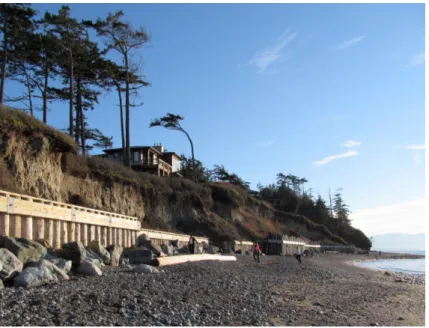
Figure 15-4: The timber pile bulkhead prevents material from a feeder bluff from reaching the littoral system. Erosion is an important geological process that forms and maintains shoreline ecosystems. (Hugh Shipman photo.)
Publication Number: 11-06-010 16 7/15 Ecological functions
Shorelines ecosystems play a key role in the health of Washington’s streams, lakes, beaches, and estuaries. The shoreline is a transition between terrestrial and aquatic environments. Shoreline stabilization impacts the nature of this
transition, typically replacing it with a harder, more abrupt edge (Figure 15-5). It results in the direct loss of habitat and may prevent the
accumulation of organic materials that contribute to shoreline ecosystems. It also impedes the movement of material and organisms, reduces the availability of food resources, and disrupts habitat-forming processes. Stabilization measures can affect riparian and wetland vegetation, the recruitment of large wood and organic detritus, the flow of surface water and groundwater, light and temperature, as well as the presence and quality of forage, refuge, and spawning habitat for fish.
Impacts on use and enjoyment of the shoreline
Shoreline structures, although sometimes built to improve access to the water, may also impede public use of the shorelines. Structures may restrict passage along a beach at high tides and may make getting to the water difficult or dangerous. They can also reduce the public’s enjoyment of natural stream banks or backshore areas on beaches.
In some cases, stabilization structures can incorporate elements such as stairways or ramps that improve access to the water. In many cases, though, stabilization
structures actually make access more difficult or more dangerous. The structures themselves may cover shallow water or beach areas and make walking along the water’s edge challenging. Recently, Figure 15-5: Rock seawall on Wollochet Bay impacts marsh habitat and riparian area. (Hugh Shipman photo.)
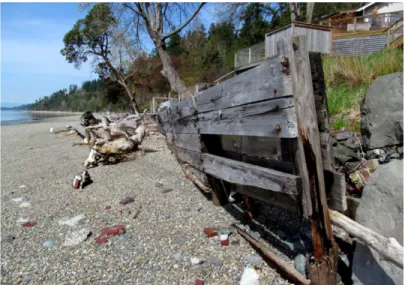
Figure 15-6: Bank stabilization along the Duwamish River uses debris and old tires. This type of bank stabilization has adverse environmental and aesthetic impacts. (Hugh Shipman photo.)
SMP HANDBOOK
Publication Number: 11-06-010 17 7/15
however, parks managers and property owners along Lake Washington and on Puget Sound have found that removing all or part of a bulkhead can make access to the water easier.
Stabilization structures can often impact views of the water and of the shoreline from the water. Many stabilization measures are visually unappealing (Figure 15-6).They often do not blend in with the natural environment because of their size, condition, or use of construction debris or other unattractive materials. The SMP Guidelines call attention to “failed bulkheads and walls” that “adversely impact beach aesthetics…” but do not provide specific standards regarding aesthetics [WAC 173-26-231(3)(a)(ii)].
This issue of aesthetics can be part of community discussion during the SMP update process. What is visually pleasing to one person or community may not be so to another person or community. What types of shoreline stabilization measures fit with the community’s preference and sense of aesthetics? This issue can be addressed during public participation activities, particularly the community visioning step. (See Chapter 10, “Community Visioning.”) Most stabilization constructed on the shoreline has minimal effect on navigation. The SMP Guidelines do note that failed bulkheads and walls “may be a safety or navigational hazard” [WAC 173-27-231(3)(a)(ii)]. Structures such as groins, jetties, or breakwaters that are built to manage erosion may affect navigation and the use of the water. (Jetties and breakwaters are addressed in the SMP Guidelines at WAC 173-26-231(3)(d)).
Cumulative impacts
The Guidelines direct that “master program policies and regulations should be developed to assure that the commonly occurring and foreseeable cumulative impacts do not cause a net loss of ecological functions of the shoreline” [WAC 173-26-201(3)(E)]. Stabilization often occurs at the scale of an individual property or short segment of shoreline, yet the rationale for stabilization typically would also apply to other parcels in the vicinity. As a result, although the regulations are applied at a site scale, the impacts ultimately relate to the aggregate effect of many similar structures along a reach of shoreline (Figure 15-7).
There is both a spatial and a temporal aspect to cumulative
Figure 15-7: Although stabilization structures are often built and permitted on a site by site basis, on many shorelines this results in long stretches of armored shoreline. This example is from Whidbey Island; similar patterns can occur on lakes and rivers. (Hugh Shipman photo.)
Publication Number: 11-06-010 18 7/15 impacts. The spatial aspect is related to the fact that the effect of a single structure may be
perceived as relatively minor, but that the cumulative impact of many similar actions over time may be much more significant and that these impacts can stretch to a longer reach of shoreline. The temporal aspect stems from the fact that the impacts of an action taken today may take years or decades to emerge because the processes that are affected occur slowly or episodically.
SMP HANDBOOK
Publication Number: 11-06-010 19 7/15
Sea level rise
The prospect of higher sea levels in future decades has ramifications for stabilization policy. Increased sea level will generally lead to higher rates of erosion and greater damage from coastal storms, which is anticipated to increase pressure to armor the coastline. At the same time, many of the existing impacts of armoring, such as loss of marsh and beach habitat, are expected to be exacerbated by higher sea levels.
The magnitude of future sea level rise remains extremely difficult to predict, largely due to uncertainty in projected carbon emissions, but there is little question that rates will be higher than in the past (Mote and others 2008, National Research Council 2012). The rate will accelerate over time, so while the initial effects will be difficult to recognize, the long term impacts will be large.
Just how much sea level will increase over the coming decades remains highly uncertain. Both global and regional studies suggest that sea level could be almost a foot higher in 50 years and perhaps 2 feet higher by the end of the 21st
century.
The impact of rising sea level will depend on local variations in rates due to geologic and oceanographic factors that influence local sea level patterns, the sensitivity of different shorelines to higher water levels (Shipman 2009, National Research Council 2012), and the character of shoreline development.
The potential for sea level rise has implications for shoreline stabilization policies:
• New development and redevelopment should be located and designed to reduce vulnerability and avoid the need for future stabilization measures.
• Pressure to stabilize shorelines will be high, particularly following damaging storms. Communities may identify in advance those areas where armoring is an appropriate option and those where it is not.
• Storm damage and failure of stabilization structures will be opportunities to relocate at-risk development and to adopt softer, more resilient stabilization. Communities will need to anticipate pressure to rebuild existing development in increasingly vulnerable areas and should adopt strategies that enhance resilience to future coastal hazards.
• Higher seawalls and stronger dikes require space and will impact existing waterfront development. Reserve space for future stabilization and drainage infrastructure along shorelines where engineering solutions are appropriate.
SMP Handbook Appendix 1 provides guidance on addressing sea level rise in SMPs.
A storm at high tide on Whidbey Island in December 2012, illustrates events that will become more frequent and more damaging with higher sea level. (Hugh Shipman photo.)
Publication Number: 11-06-010 7/15
Publication Number: 11-06-010 20 7/15
Addressing shoreline stabilization in SMPs
This section provides direction on addressing shoreline stabilization in SMPs. It discusses environment designations, new shoreline stabilization, replacement and repair, and shoreline permits and provides examples of language on these topics from comprehensive SMP updates approved by Ecology.
The significance of SMP language cannot be overstated. SMP language determines what can be approved. Clear language takes out any guesswork when reviewing and approving shoreline permits. The Shorelines Hearings Board and courts consider SMP language when making decisions.
Environment designations
SMPs establish permitted uses and modifications among shoreline environment designations and also dictate what types of shoreline permits are required. These may vary among shoreline environments. (See SMP Handbook Chapter 13, “Shoreline Environment Designations.” Environment designations also provide an opportunity to identify shoreline reaches that are particularly vulnerable to long-term erosion and slope instability, and to establish standards that foster safe development while also protecting ecological functions. This might be particularly relevant in areas of known or emerging erosion problems, particularly where public facilities and road or utility corridors occur along the shoreline.
The SMP Guidelines address shoreline modifications and stabilization mostly in general terms in all environment designations but the High Intensity environment [WAC 173-26-211(5)].
• For the Urban Conservancy and Shoreline Residential designations, the Guidelines direct SMPs to include standards for shoreline stabilization.
• In the Rural Conservancy environment, new shoreline stabilization and flood control works should be allowed only where there is a documented need to protect an existing structure or ecological functions, and mitigation is applied.
• For the Natural environment, the Guidelines state that subdivision of property that would require shoreline modification that adversely impacts ecological functions should not be allowed.
• In the Aquatic environment, shoreline modifications should be designed and managed to prevent water quality degradation and alteration of natural hydrographic conditions. In SMPs, the purpose and management policies for shoreline environments can help to determine whether stabilization should be a permitted use, conditional use or prohibited. This would apply whether the SMP includes the shoreline environments in the SMP Guidelines or custom
SMP HANDBOOK
Publication Number: 11-06-010 21 7/15
For example, some local governments have prohibited new shoreline stabilization within the Natural environment. The purpose of the Natural environment, is, in part, “to protect those shoreline areas that are relatively free of human influence or that include intact or minimally degraded shoreline functions intolerant of human use” [WAC 173-26-211(5)(a)(i)]. Only “very low intensity uses” should be allowed. One of the management policies states that a use that would “substantially degrade the ecological functions or natural character of the shoreline areas should not be allowed.” Another management policy states, “significant vegetation removal that would reduce the capability of vegetation to perform normal ecological functions should not be allowed.” The designation criteria for the Natural environment include ecologically intact shorelines that are generally free of structural shoreline modifications.
If a shoreline reach has considerable existing primary structures that may need protection through stabilization in the future, the Natural environment may not be not the most appropriate shoreline environment. However, if a shoreline reach generally meets the Natural environment criteria and has existing primary structures that may need protection through stabilization, the SMP should not prohibit future stabilization in this environment. As in all environment designations, any stabilization proposal to protect primary structures must demonstrate need. In contrast with the Natural environment, the purpose of the High-intensity environment is to “provide for high-intensity water-oriented commercial, transportation, and industrial uses while protecting existing ecological functions and restoring ecological functions in areas that have been previously degraded.”
Facilities for water-dependent uses may require shoreline stabilization measures such as
bulkheads. For shorelines with high-intensity uses, allowing for shoreline stabilization would be consistent with the uses in the High-intensity environment. Permit requirements and SMP standards would still apply. High-intensity environments are often already highly developed and stabilization is in place, so SMP provisions should account for the likely replacement that will occur.
Examples
Following are examples from updated SMPs that require different shoreline permits or prohibit shoreline stabilization in varying shoreline environments.
Kirkland
• Natural: Hard and soft structural shoreline stabilization is prohibited.
• Urban Conservancy: Requires a conditional use permit for hard structural stabilization and substantial development permit for soft structural stabilization.
• Residential – L and Residential – M/H and Urban Mixed environments: Requires substantial development permit for both hard and soft structural stabilization.
Whatcom County
• Natural: Shoreline stabilization is prohibited. However, bioengineering methods may be permitted as a conditional use.
Publication Number: 11-06-010 22 7/15
• Aquatic: Bulkheads and revetments are prohibited except for an approved water-dependent development, subject to policies and regulations of the SMP.
• Other eight shoreline environments: Bulkheads and revetments are permitted. However, bulkheads, revetments or similar hard structures on marine and lake accretion
shoreforms, marine feeder bluffs and estuarine shores, and on wetland and rock shores require a conditional use permit.
Anacortes
• Natural: Hard structural stabilization is prohibited. Soft stabilization is permitted.
• Conservancy and Shoreline Residential: Conditional use permit is required for hard stabilization; soft stabilization is permitted.
• Other three shoreline environments: Hard and soft stabilization is permitted.
Pateros
• Natural: Bulkheads and revetments are prohibited.
• Other five shoreline environments: Bulkheads and revetments require a conditional use permit.
Standards for shoreline stabilization
The SMP Guidelines establish standards for new development, new stabilization measures and replacement stabilization. The Guidelines emphasize that new development in shoreline areas should be located and designed to avoid any need for future stabilization. New stabilization must be based on documented need through a geotechnical analysis, employ nonstructural or soft measures unless they are demonstrated to be insufficient, and result in no net loss of shoreline ecological functions [WAC 173-26-231(30(a)(iii)(E)].
The following section discusses how the Guidelines address various situations where stabilization might be considered. In each of these circumstances, the Guidelines require consideration of the following issues, which are discussed in subsequent sections.
• Demonstrate the need for stabilization.
• Address other causes of erosion.
• Investigate nonstructural and softer measures of stabilization.
SMP HANDBOOK
Publication Number: 11-06-010 23 7/15
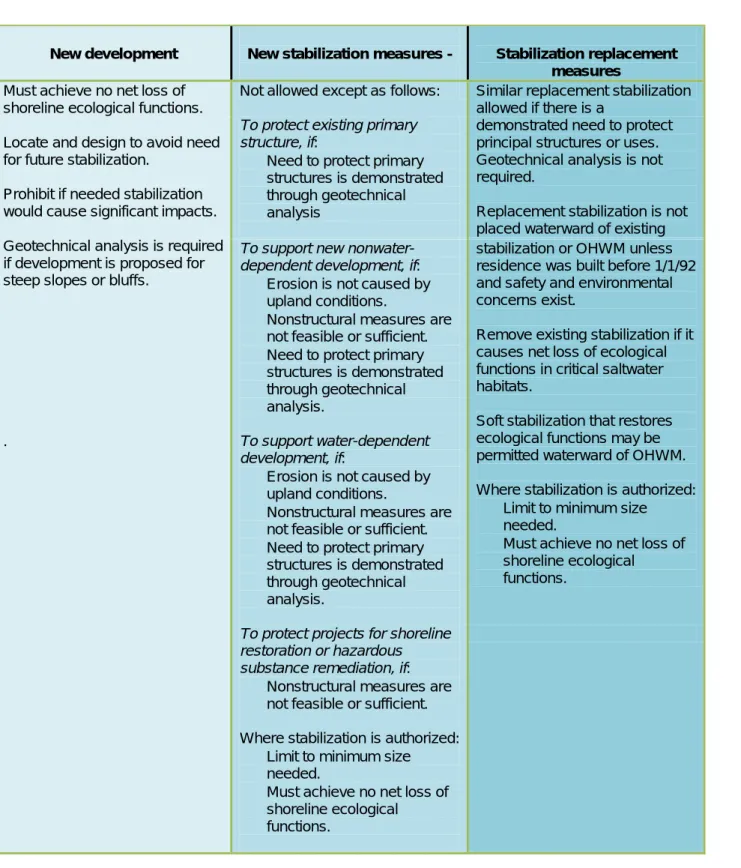
Table 15-1: SMP shoreline stabilization standards, WAC 173-26-231(3)(a)(iii).
New development New stabilization measures - Stabilization replacement measures
Must achieve no net loss of shoreline ecological functions.
Not allowed except as follows: Similar replacement stabilization allowed if there is a
Locate and design to avoid need for future stabilization.
Prohibit if needed stabilization would cause significant impacts. Geotechnical analysis is required if development is proposed for steep slopes or bluffs.
To protect existing primary structure, if:
• Need to protect primary structures is demonstrated through geotechnical analysis
demonstrated need to protect principal structures or uses. Geotechnical analysis is not required.
Replacement stabilization is not placed waterward of existing
To support new nonwater-dependent development, if:
• Erosion is not caused by upland conditions.
• Nonstructural measures are not feasible or sufficient.
• Need to protect primary structures is demonstrated through geotechnical analysis.
stabilization or OHWM unless residence was built before 1/1/92 and safety and environmental concerns exist.
Remove existing stabilization if it causes net loss of ecological functions in critical saltwater habitats.
Soft stabilization that restores ecological functions may be permitted waterward of OHWM. Where stabilization is authorized:
• Limit to minimum size needed.
• Must achieve no net loss of shoreline ecological functions.
. To support water-dependent
development, if:
• Erosion is not caused by upland conditions.
• Nonstructural measures are not feasible or sufficient.
• Need to protect primary structures is demonstrated through geotechnical analysis.
To protect projects for shoreline restoration or hazardous substance remediation, if:
• Nonstructural measures are not feasible or sufficient.
Where stabilization is authorized:
• Limit to minimum size needed.
• Must achieve no net loss of shoreline ecological functions.
Publication Number: 11-06-010 24 7/15
New development
The intent of the Guidelines is to avoid the individual and cumulative net loss of shoreline ecological functions associated with the construction of shoreline stabilization structures. This starts by designing and locating new development in a way that avoids the need for any future stabilization.
The Guidelines require the following standards to be included in SMPs:
• Lots created as part of the subdivision process should not require shoreline stabilization in order for reasonable development to occur. A geotechnical analysis should identify unstable portions of the site, assess long-term rates and patterns of erosion, and
assure that development does not increase potential erosion or instability.
• New development on steep slopes and bluffs should be located and set back so that stabilization is not likely to be needed during the life of the structure. This should be
demonstrated in a geotechnical analysis that considers erosion rates and expected life span of the development.
• New development should not result in stabilization measures that would impact adjacent properties or adversely affect downstream or downdrift shorelines, in either the short term or the long term.
Shoreline stabilization policies and regulations can be included in the relevant shoreline use sections of the SMP as well as the shoreline modifications or shoreline stabilization section. Following are a few examples of policies and regulations that address new development, from updated SMPs approved by Ecology.
New shore stabilization for new development is prohibited unless it can be demonstrated that the proposed use cannot be developed without shore protection, and a geotechnical analysis documents that alternative solutions are not feasible or do not provide sufficient protection. The need for shore stabilization shall be considered in the determination of whether to approve new water-dependent uses. Proposed designs for new or expanded shore stabilization shall be designed in accordance with applicable Department of Ecology and Department of Fish and Wildlife guidelines and certified by a qualified professional. (Whatcom County SMP, 23.100.13.B.1 Allowed Use)
3. New development requiring bulkheads and/or similar protection should not be allowed. Shoreline uses should be located in a manner so that bulkheads and
other structural stabilization are not likely to become necessary in the future. (City of Kent SMP, Chapter 4, C. 2.b. Policies)
3. New development on steep slopes or bluffs shall be set back sufficiently to
Avoiding the individual and cumulative net loss of shoreline ecological functions starts with designing and locating new development in a way that avoids the need for any future stabilization.
SMP HANDBOOK
Publication Number: 11-06-010 25 7/15
ensure that shoreline stabilization will not be needed during the life of the structure, as demonstrated by a geotechnical analysis by a geotechnical engineer or related professional licensed and in good standing in the State of Washington. (City of Kent SMP, Chapter 4, C. 2.c. Regulations)
New shoreline stabilization measures
The SMP Guidelines outline standards for new stabilization measures in several different situations, which are discussed below:
• Protect an existing primary structure.
• Support new nonwater-dependent development.
• Support water-dependent development.
• Protect ecological restoration and hazardous substance remediation projects.
The standards are similar for each of these categories. In all cases, the emphasis is on avoiding the need for structural stabilization in the first place, and where it is necessary, minimizing its impacts as much as possible.
This emphasis carries out the mitigation sequence in WAC 173-26-201(2)(e)(i) so that all development achieves no net loss of ecological
function.
Avoiding impacts is carried out by requiring a demonstration of need for shoreline stabilization. If shoreline stabilization is demonstrated to be
necessary and consistent with the standards outlined in the Guidelines (summarized in the table), minimizing and compensating for the impact occurs through the following:
• Requiring soft shoreline stabilization “unless demonstrated not to be sufficient to protect primary structures, dwellings and businesses.”
• Limiting the size of shoreline stabilization to the minimum necessary to protect the structure • Mitigating erosion control structures to offset
adverse impacts to beach sediment systems (e.g., through beach nourishment) [WAC 173-26-231(3)(a)(iii)(E)]
The Kitsap County SMP incorporates the mitigation sequence in General regulations:
WAC 173-26-201(2)(e)(i.) Master
programs shall indicate that, where required, mitigation measures shall be applied in the following sequence of steps listed in order of priority, with (e)(i)(A) of this subsection being top priority.
(A) Avoiding the impact altogether by not taking a certain action or parts of an action;
(B) Minimizing impacts by limiting the degree or magnitude of the action and its implementation by using appropriate technology or by taking affirmative steps to avoid or reduce impacts;
(C) Rectifying the impact by repairing, rehabilitating, or restoring the affected environment;
D) Reducing or eliminating the impact over time by preservation and maintenance operations;
(E) Compensating for the impact by replacing, enhancing, or providing substitute resources or environments; and
(F) Monitoring the impact and the compensation projects and taking appropriate corrective measures.
Publication Number: 11-06-010 26 7/15
“Soft shoreline stabilization measures shall be utilized unless demonstrated through a geotechnical analysis not to be sufficient to protect primary structures, dwellings and businesses. Alternatives for shoreline stabilization shall be based on the following order of preference:
a. No action, increase building setbacks, or relocate structures;
b. Soft shoreline stabilization constructed of natural materials including bioengineering, beach nourishment, protective berms, or vegetative stabilization;
c. Hybrid shoreline stabilization, usually constructed of a mix of rock, logs and vegetation;
d. Hard shoreline stabilization constructed of materials such as rock, riprap or concrete.”
e. When hard shoreline stabilization measures are demonstrated to be necessary, they must:
i. Limit the size of stabilization measures to the minimum necessary. ii. Assure no net loss of shoreline ecological functions.
iii. Ensure that publically financed or subsidized shoreline erosion control measures do not restrict appropriate public access to the shoreline except where such access is determined to be infeasible because of incompatible uses, safety, security, or harm to ecological functions.
iv. Where feasible, incorporate ecological restoration and public access improvements into the project.
i. Placement of shoreline stabilization methods shall follow the natural contour of the existing shoreline, be parallel to and at or above the OHWM.
j. Shoreline stabilization on marine feeder bluffs, when determined necessary pursuant to the standards of this section, may require additional mitigation measures, including those necessary to offset the loss of sediment supply.(K.C.C. 22.600.175.D.1 )
The Issaquah SMP regulation to limit the length of stabilization addresses the minimization step of the mitigation sequence:
11. When allowed pursuant to the provisions of this Program, structural shoreline stabilization must meet all of the following requirements:
a. The length of hard structural shoreline stabilization structures shall be minimized to the extent feasible. It shall be limited to the portion of a site where necessary to protect the primary structure/use and/or to connect to existing hard structural shoreline stabilization structures on adjacent properties. (Issaquah SMP, 6.1.4, Shoreline Stabilization Regulations.)
Protect existing primary structure: Existing structures may have been sited poorly or site conditions changed dramatically over time. Relocating existing primary structures is an option, but it may be difficult or infeasible due to specific aspects of the site or costs. Therefore, property owners may seek to protect the structure with shoreline stabilization.
SMP HANDBOOK
Publication Number: 11-06-010 27 7/15
In order for new or expanded stabilization structures to be authorized for existing primary structures:
• A geotechnical analysis must conclusively document that the structure is in danger from shoreline erosion caused by tidal action, currents or waves. Normal sloughing and erosion that do not threaten a structure do not constitute demonstration of need. (See “Demonstrating need for
stabilization” on page 35.)
• Shoreline stabilization measures must not result in a net loss of shoreline ecological functions.
Where erosion has been demonstrated to threaten a primary structure, the Guidelines require that softer methods of stabilization be employed unless demonstrated to be infeasible (Figure 15-8). See additional discussion in the Soft Shoreline Stabilization document.
Local governments have discretion in defining both primary and accessory uses and structures. SMPs can combine these in one definition. Examples include:
"Primary structure” means any permanent building, road, bridge or utility requiring a permit or approval which is necessary to support the primary use of a site. Primary use means the predominate use of any lot or development as determined by county zoning regulations. (Snohomish County SMP, 30.91P.292)
Primary Structure – A structure housing the main or principal use of the lot on which the structure is situated, including a detached garage associated with the primary structure. This term shall not include decks, patios or similar improvements, and accessory uses, structures or activities as defined in Chapter 5 KZC. (City of Kirkland SMP, 83.80.87)
Roads and bridges are typically primary structures in their own right. For example, arterial roads, highways and bridges do not support just the primary use of one site.
Another approach is to separately define accessory uses and structures as those that are
subordinate to and supportive of the primary use or structure. For example, accessory use can be defined as "a use that is demonstrably subordinate and incidental to the principal use and which functionally supports its activity." Accessory structures include drainlines, stairways, sheds, gazebos and patios, for example.
Figure 15-8: This soft shoreline stabilization stabilizes the bank of Moses Lake and helps to protect the house, a primary structure. Views from the house and the lawn above the retaining wall are not obstructed by the vegetation. The rocks in the foreground are at the property line. (Doug Pineo photo.)
Publication Number: 11-06-010 28 7/15 Whatcom County defines accessory structure as “a structure that is incidental and subordinate to a primary use and located on the same lot as the primary use, such as barns, garages, storage sheds, and similar structures” (Whatcom County SMP, Chapter 11 Definitions #2).
Support new nonwater-dependent development: As described above, the Guidelines require that “new development should be located and designed to avoid the need for future shoreline stabilization to the extent feasible” [WAC 173-26-231(3)(a)(iii)(A)]. Where the size or
configuration of a property precludes this, new structural stabilization measures may be allowed only if:
• Erosion is not caused by upland conditions, such as loss of vegetation and drainage.
• Planting vegetation, installing on-site drainage improvements or other nonstructural measures, such as placing development further from the shoreline, are not feasible or not sufficient.
• A geotechnical report demonstrates the need to protect primary structures from damage due to erosion caused by natural processes such as tidal action, currents and waves.
• The erosion control structure will not cause a net loss of shoreline ecological functions.
Support water-dependent development: Water-dependent developmentrelies on a location on or adjacent to the water due to the nature of its operations. The needfor physical proximity to the shoreline in order to moor boats, transfer marine cargo, and operate pump facilities, for example, may require shoreline stabilization. This does not apply to office space or materials handling facilities that may be part of the operation, but do not require direct access to the water. The SMP Guidelines require that even water-dependent developments should avoid the need for
stabilization, if feasible, and avoid its adverse impacts. Stabilization is allowed if:
• Erosion is not caused by upland conditions, such as loss of vegetation and drainage.
• Planting vegetation, installing on-site drainage improvements or other nonstructural measures are not feasible or not sufficient.
• A geotechnical report demonstrates the need to protect primary structures from damage due to erosion.
• The stabilization structure will not result in a net loss of shoreline ecological functions.
Protect projects for restoration of ecological functions or hazardous substance
remediation: Restoration projects may include stabilization due to site and project constraints such as adjacent development, flood potential or public access requirements. Restoration projects should allow for natural processes, such as erosion and stream processes, to occur.
Where hazardous substances are being removed, shoreline stabilization may no longer be needed. Stabilization structures that hold contaminated soils in place could be removed, for example. In cleaning up and redeveloping contaminated sites, there are often opportunities to remove, reduce, or avoid impacts to ecological functions that result from shoreline stabilization.