ERROR BOUNDS FOR SURFACE AREA ESTIMATORS BASED
ON CROFTON’S FORMULA
M
ARKUSK
IDERLEN1 ANDD
ANIELM
ESCHENMOSER21Department of Mathematical Sciences, University of Aarhus, 8000 Aarhus, Denmark;2Insitute of Stochastics,
Ulm University, 89069 Ulm, Germany
e-mail: [email protected], [email protected]
(Accepted September 1, 2009)
ABSTRACT
According to Crofton’s formula, the surface area S(A) of a sufficiently regular compact set A in Rd is proportional to the mean of all total projections pA(u) on a linear hyperplane with normal u, uniformly averaged over all unit vectors u. In applications, pA(u)is only measured in k directions and the mean is approximated by a finite weighted sumSb(A)of the total projections in these directions. The choice of the weights depends on the selected quadrature rule. We define an associated zonotope Z (depending only on the projection directions and thequadrature rule), and show that the relative errorSb(A)/S(A)is bounded from below by the inradius of Z and from above by the circumradius of Z. Applying a strengthened isoperimetric inequality due to Bonnesen, we show that the rectangular quadrature rule does not give the best possible error bounds for d=2. In addition, we derive asymptotic behavior of the error (with increasing k) in the planar case. The paper concludes with applications to surface area estimation in design-based digital stereology where we show that the weights due to Bonnesen’s inequality are better than the usual weights based on the rectangular rule and almost optimal in the sense that the relative error of the surface area estimator is very close to the minimal error.
Keywords: associated zonotope, Crofton formula, digitization, isoperimetric inequality, minimal annulus, perimeter, surface area.
INTRODUCTION
One common approach to approximate the surface area S(A) of an unknown set A ⊂ Rd from its
digitization is based on a discretization of Crofton’s formula. We discuss the worst case error introduced by the discretization of the rotational integral in dependence of the quadrature rule chosen. As the methods apply generally to surface area estimators based on Crofton’s formula, we describe them in a general framework and return to its application to digital images in the third section, entitled “Error Bounds for Digital Surface Area Estimators”.
Throughout the paper a direction is a vector on the unit sphere Sd−1 in Rd. If u is a direction, u⊥
denotesthe linear hyperplane with normal u, and er,u
isthe straight line with direction u through r∈u⊥. Let
A⊂Rd be afull-dimensionalcompact set in the class UPR; (definitions can be found in the next section). A special case of Crofton’s formula (Rother and Z¨ahle, 1990) expresses the surface area S(A)of A in terms of the Euler characteristicχof linear sections
S(A) = 2 γd
Z
Sd−1
Z
u⊥χ(A∩er,u)drµ(du). (1)
Hereγd= (2κd−1)/(dκd), whereκd is the volume of
the d-dimensional unit ball, and µ is the normalized
Haar measure on the unit sphere Sd−1; see, e.g., Schneider and Weil (1992, p. 18), but note the different normalization.For sets A that are not full-dimensional, Eq. 1 still holds if its left hand side S(A) is defined in such a way that lower dimensional parts of A are counted twice.The inner integral ofEq.1,
pu=
Z
u⊥χ
(A∩er,u)dr, (2)
is called total projection of A in direction u, as it is obtained by measuring the (d−1)-volume of the orthogonal projection of A on u⊥ with multiplicities.
In Eq. 2 the integration is understood with respect to the Lebesgue measure on u⊥. If total projections can be determined exactly for finitely many directions
u1, . . . ,uk∈Sd−1, say, a k-point quadrature rule can be
used to discretize the outer integral in Eq. 1 and one obtains the approximation
b
Sdk(A) = 2
γd k
∑
i=1cipui, (3)
which depends on the choice of weights c1, . . . ,ck≥0.
To assure that the quadrature rule is exact whenever
A is a ball, we assume throughout that the weights
spherical Voronoi cells generated by {u1, . . . ,uk} on S1. This geometric interpretation generalizes readily
to higher dimensions. If {P1, . . . ,Pk} is the spherical
Voronoi tessellation of Sd−1 generated by the set of
projection directions{u1, . . . ,uk}withui∈Pithen the
weights
cVi =µ(Pi), i=1, . . . ,k,
will be called Voronoi weights associated to
{u1, . . . ,uk}. These weights are commonly used in applications for d =2,3. In the special case where
d=2 and u1, . . . ,ukare equidistant, the weights for the
rectangular quadrature rule (Voronoi weights) coincide with those for the trapezoidal quadrature rule.
The discretization of the spherical integral introduces a bias, which typically depends on the set A. We are interested in the worst case behavior. Already Steinhaus (1930) treated the special case where d=2,
k is even, and{u1, . . . ,uk} forms an equidistant set of points in S1. ForSb2
k(A), given by Eq. 3 with Voronoi
weights cV1, . . . ,cVk, he derived sharp bounds for the relative error:
π k
cos(π/k)
sin(π/k) ≤ b
S2k(A) S(A) ≤
π k
1
sin(π/k) . (4)
The left hand side and the right hand side of Eq. 4 are the endpoints of the interval of all possible relative errors, as A varies. Such an interval can be established without the assumption of equidistant directions and in all dimensions. We refer to this interval as error
interval in the following.
Using a translative Crofton formula in Section
“Error Bounds for Sbdk(A)”, we will define an origin-symmetric convex body Z ⊂ Rd associated to the
discretization, only depending on the projection directions and the quadrature rule. We will show in Lemma 1 that the relative error Sbkd(A)/S(A) is in a sharp way bounded from below by (a multiple of) the inradius of Z and from above by (a multiple of) the outer radius of Z. Thus, the thickness of the minimal annulus of Z is proportional to the length of the error interval and describes the quality of the estimator. Given k projection directions, the quadrature rule (in other words, the values of the associated weights) that minimizes the minimal thickness of Z can typically only be determined numerically. In the planar case, we suggest to bound the thickness of the minimal annulus of Z from above by an isoperimetric deficit using a strengthened isoperimetric inequality due to Bonnesen. This isoperimetric deficit can be minimized with respect to all quadrature rules in closed form. The weights minimizing the isoperimetric deficit will be
called Bonnesen weights and are proportional to the lengths of the edges of a polygon circumscribing the unit disk and touching it exactly at the pointsu1, . . . ,uk. We will show that Voronoi weights are not minimizing the length of the error interval by giving an example where the Bonnesen weights yield better error bounds. We will determine the asymptotic behavior (as k→ ∞) of the relative error for the Bonnesen weights in Theorem 4. At the end of the second section we will consider the case where the directionsu1, . . . ,uk ∈S1 are obtained using systematic random sampling onS1. We will show that the coefficient of error of Sbk2(A)
can be bounded from above by a geometric quantity involving Z, namely a multiple of the L2-distance between Z and its Steiner ball.
Inthe subsequent section we discuss error bounds for digital surface area estimators. The digitization of
A on a randomly translated, rectangular grid will be
considered. Asymptotic bounds for the expected value of the estimator for S(A)in the grid will be established. ”Asymptotic” relates here to increasing resolution of the grid. The vectors u1, . . . ,uk are chosen as grid directions, i.e.,normalized vectors connecting two grid points. These two grid points are usually neighbours and we will consider the4-, 8- and 16-neighborhood in 2D and the 6- and 26-neighborhood in 3D. For all these settings the Voronoi and Bonnesen weights together with the corresponding in- and circumradii r and R, respectively, will be computed analytically, except for the 26 directions in 3D where numerical methods will be used. We will compare the relative errors with the minimal error achieved by numerically optimizing the weights and show that the Bonnesen weights lead, at least in 2D, to smaller errors than the widely used Voronoi weights. We then restrict to quadratic grids in the plane and consider boundary length estimators based on pairs of grid points that are contained in some (n−1)×(n−1) square of grid cells, n≥2. This generalizes the case n=2, which corresponds to the boundary length estimator based on 8-neighbours. Theorem 7 considers such estimators for general n≥2 and shows that the asymptotic mean relative error of b
Sdk(A)for Bonnesen weights decreases as n−2.
The application of Bonnesen’s improved isoperimetric inequality restricts many of the above arguments to the two-dimensional case. In the last section we discuss the possibility of extensions to higher dimensions.
ERROR BOUNDS FOR
S
b
dk(
A
)
A set A ⊂Rd is full-dimensional, if its tangent
to (d−1)-dimensional Hausdorff measure. If A is topologically regular (A is the closure of its interior) and convex, it is also full-dimensional. The set A has positive reach if there isanε>0 such that each point in theε-neighborhood of A has a unique closest point in A.
Throughout the following we assume that A is an element of the familyUPRof all sets inRd which can
be written as a finite union of compact sets A1, . . . ,Am
with positive reach such that any intersection Ti∈IAi
with I⊂ {1, . . . ,m}is either empty or a set of positive reach, as well. In particular, convex bodies (nonempty compact convex subsets of Rd) and polyconvex sets
(finite unions of convex bodies) are elements of UPR. For A ∈ UPR the surface area measure S(A,·) of order d−1 is defined, and Eq. 1 holds with S(A) = S(A,Sd−1). If A is in addition full-dimensional, S(A) coincides with the usual surface area of A.In view of the applications in digital stereology, it is convenient to extend the total projection mapping v7→pvtoRd\{o}
by positive homogeneity of degree 0. The translative Crofton formula
pv= 1
2kvk
Z
Sd−1|hu,vi|S(A,du) (5)
holds for almost all v∈Rd; see Rataj (2002, Theorem 2.1 and Theorem 2.3), wherehu,vi is the usual inner product of u and v. If A is polyconvex,Eq.5 holds for
all v∈Rd\ {o}.
If v1, . . . ,vk ∈Rd\ {o} are such that Eq. 5 holds
with v=vi for all i=1, . . . ,k, then the definition of
b
Sdk(A)in combination withEq.5 yields
b
Sdk(A) = 1
γd
Z
Sd−1h(u)S(A,du), (6)
with
h := k
∑
i=1ci
kvik|h
vi,·i|. (7)
The key observation is that the integrand h is the support function of a convex body. We refer the reader to Schneider (1993) for relevant notions and concepts in convex geometry and only recall the most important facts here. The support function hK of a convex body K is given by
hK(u) =max{hx,ui: x∈K}, u∈Sd−1.
Here and in the following, we consider the support function as a function on the unit sphere. For convex bodies K and M and scalarsα,β≥0, we have
αhK+βhM=hαK⊕βM, (8)
where the Minkowski addition ⊕ of sets and the multiplication of a set with a scalar are understood pointwise. We will repeatedly use the monotonicity property,
K⊂M ⇐⇒ hK≤hM, (9)
and the fact that the support function hBd of the
Euclidean unit ball Bd in Rd is the constant 1. Eq. 9
implies in particular that any convex body is uniquely determined by its support function. Consequently, the definition,
δ2
2(K,M):= Z
Sd−1(hK(u)−hM(u))
2 du,
for convex bodies K and M, gives rise to the so-called
L2-metric δ2(·,·) on the family of convex bodies. The support function of the line segment[−x,x]with endpoints −x and x∈ Rd is |hx,·i|. Due to Eq. 8,
the function h in Eq. 7 is the support function of a finite sum Z of line segments. Such sets are called
zonotopes and play a prominent role in functional
analysis, convex and stochastic geometry (see, e.g., Goodey and Weil, 1993 and the references therein). Explicitly, we have
Z=c1[−u1,u1]⊕. . .⊕ck[−uk,uk], (10)
with the unit vectors ui = vi/kvik for i =1, . . . ,k.
In view of Eq. 6 the approximation Sbdk(A) can be expressed in terms of the associated zonotope Z, as
b
Sdk(A) = 1
γd
Z
Sd−1hZ(u)S(A,du). (11)
To obtain lower and upper bounds ofSbkd(A), we have to find maxima and minima of hZ. Due to Eq. 9, r ≥0 is the minimum of hZ on Sd−1 if and only
if rBd is the largest ball contained in Z. Similarly,
R≥0 is the maximum of hZ, if and only if RBd is the
smallest ball containing Z. With these optimal values of 0≤r≤R, the set RBd\rBd is called the minimal
annulus of Z. The difference R−r is called the width of the minimal annulus and denoted by T(Z). For later reference we summarize this geometric interpretation for polyconvex sets (for whichEq.5 holds for arbitrary
v6=o). As formulations forUPR-sets are obtained in a straightforward manner, we will restrict to polyconvex sets from now on.
Lemma 1 Let A ⊂ Rd be a polyconvex set with positive surface area, and fix k≥2 and v1, . . . ,vk ∈ Rd\ {o}. Letγd = (2κd−1)/(dκd). IfSbd
k(A) is given byEq.3, then the sharp bounds
r γd ≤
b Skd(A)
S(A) ≤ R
γd , (12)
Proof As R is the maximum of hZ on Sd−1, it
follows from Eq. 11, that
b
Sdk(A)≤ R γdS(A) ,
which yields the upper bound. The lower bound follows analoguously from Eq. 11 and the fact that r is the minimum of hZ onSd−1.
That the bounds in the above Lemma are sharp follows from the next example.
Example 2 Fix k≥2, u1, . . . ,uk ∈Sd−1 and weights
c1, . . . ,ck ≥ 0 for a quadrature rule. Define Z according to Eq. 10. Due to symmetry, the ball rBd touches the boundary of Z in at least two antipodal points rw and −rw, w ∈ Sd−1. Let A be a ball of
(d−1)-volume 1/2 in the hyperplane w⊥. (As A is lower dimensional, the proper interpretation of S(A) is twice the (d−1)-dimensional Hausdorff measure, so S(A) = 1.) The surface area measure of A is
concentrated on the points w and−w, and hZcoincides in both of these directions with r, soEq.11 implies
b
Skd(A) = 1
γd
Z
Sd−1rS(A,du) =
r γd
S(A),
and equality holds on the left hand side ofEq.12.
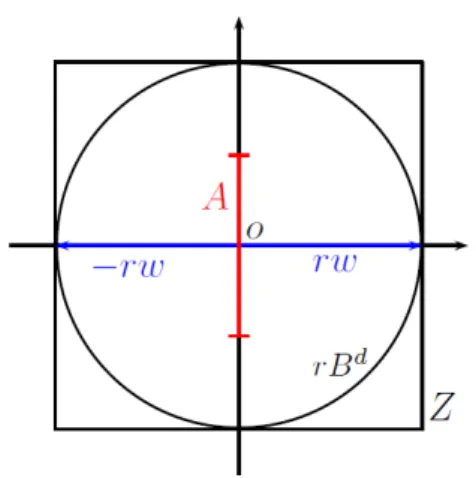
Fig. 1 illustrates this for d=2, k=2, u1= (1,0)⊤,
u2 = (0,1)⊤ and c1 =c2 =1/2. Obviously A is not
topologically regular, but it can be approximated by a sequence of topologically regular convex bodies (Am) in such a way that limm→∞Sbdk(Am)/S(Am) =
b
Skd(A)/S(A). This implies that the left hand side of Eq. 12 cannot be improved, even if we restrict considerations to topologically regular sets. To show that the second inequality inEq.12 is sharp, a similar argument can be used, if ±w are directions for which hZ becomes maximal, and thus coincides with R.
Fig. 1.A possible set A for the case where Z is the unit cube; see Example 2.
THE TWO-DIMENSIONAL CASE
In the following, we will restrict to the case d =
2, although some of the concepts can be transferred to higher dimensions. As the aim is to minimize the length of the error interval of Sb2k(A) in Eq. 6, the difference R−r should be as small as possible.
This can be achieved by an appropriate choice of the weights c1, . . . ,ck. To obtain an exact value for the
integral inEq.6 in the case where A is a disk, we must assume that the weights sum up to one.It follows from Schneider (1993), that c1+. . .+ck =1 is equivalent to the condition that the zonotope Z given byEq. 10 has perimeter 4. LetZ be the family of all zonotopes that can be written as sum of line-segments parallel to given unit vectors u1, . . . ,uk. LetZ4 be the family of those Z∈Z that have perimeter 4. We are therefore faced with the problem of finding a zonotope Z∗∈Z4 that satisfies
T(Z∗) =min{T(Z): Z∈Z4}. (13)
If
Z∗=c∗1[−u1,u1]⊕. . .⊕c∗k[−uk,uk],
then c∗1, . . . ,c∗k≥0 are the best weights inEq. 3, in the sense that among all weights summing up to one they yield the shortest interval of possible relative errors. A solution Z∗ of the optimization problem in Eq.13 always exists due to a compactness argument based on the Blaschke selection theorem.
For asymptotic results, it is enough to replace the objective function in Eq. 13 by a simpler one. Bonnesen (1929) improved the isoperimetric inequality for an arbitrary planar convex body K, stating that
S2(K)
4π −V(K)≥ π 4T
2(K), (14)
where S(K) and V(K) are perimeter and area of K, respectively. For K=Z∈Z4we have S(Z) =4 and the left hand side ofEq.14 is minimal for the zonotopeZe∈ Z4 that has the greatest area. According to a classical
result of Lindel¨of (1869), Z is characterized amonge
all zonotopes in Z4 by the fact that it circumscribes a circle. Due to origin-symmetry, this circle is the incircle ofZ, centered at the origin, and with radiuse erk.
This allows an explicit construction ofZ. Up to scalinge
with the factor 1/erk the zonotopeZ coincides with thee
polytope
e
P := k
\
i=1
obtained by intersecting all supporting half-planes of the unit disk with outer normal in{±u1, . . . ,±uk}. We now assume without loss of generality that the vectors
u1, . . . ,uk all are located on the positive half-sphere
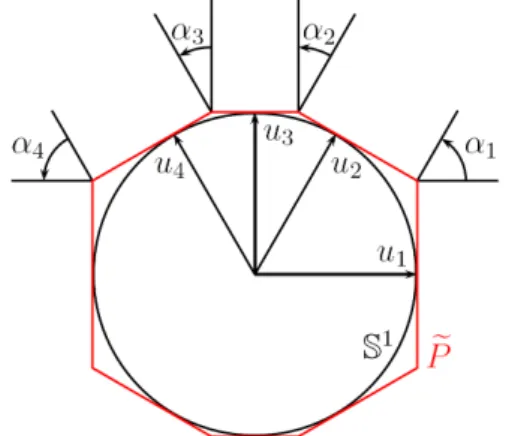
{(cosϕ,sinϕ): 0≤ϕ<π}and are ordered according toincreasing angles.We write<) (u,v)∈[0,π]for the (smaller) angle between the unit vectors u and v. Letαi
be the outer angle of the vertex between the ith and the
(i+1)st edge (i.e.,αi is the angle of the normal cone
at this vertex, in other wordsπ−αi is the usual inner
angle; see Fig. 2). Explicitly, we have
αi=
(
<) (ui,ui+1), i=1, . . . ,k−1, π−<) (u1,uk), i=k,
(16)
as the normal of the(k+1)st edge is−u1.
Fig. 2. Construction of the anglesαi and the polytope
e
P given byEq.15 with k=4.
As the length of the ith edge of P is tane (αi/2) +
tan(αi−1/2)and S(Ze) =4, we obtain
e
Z=ec1[−u1,u1]⊕. . .⊕eck[−uk,uk],
with
e
ci=erk
tan(αi/2) +tan(αi−1/2)
2 , (17)
and
e
rk= k
∑
i=1tan(αi/2)
!−1
, (18)
where we have put α0 =αk. This and V(Ze) = 2erk
was also derived by Knebelman (1941). The weightscei
are based on the application of Bonnesen’s inequality
Eq. 14 and will be called Bonnesen weights in the following. The ith weightceiis the relative length of the ith edge of the polygon with facet normals±uiwhich circumscribes a circle of radiuserk. The outer radiusRke
of Z is the largest distance of a vertex ofe Z from thee
origin, and this is
e
Rk=erk k
max
i=1 1 cos(αi/2)
. (19)
Summarizing, we have shown the following. If Sb2k(A) is an estimator of S(A)>0 given byEq. 6 with the Bonnesen weights ci =eci, i=1, . . . ,k, from Eq. 17,
then the relative errors obey
π
2erk≤ b S2k(A)
S(A) ≤ π
2Rek. (20)
These error bounds are sharp; see Example 2.
It should be noted that Eq. 14 is always a strict inequality unless K is a disk. As Eq. 14 is used for zonotopes here, this approach will not necessarily lead to the optimal choice of the weights. However, the choice may be better than choices for the weights motivated by usual quadrature rules.
Example 3 We consider the integrand in Eq. 6 with k=3 and the directions ui = cos(ϕi),sin(ϕi)
, i=
1,2,3, where
ϕ1=0, ϕ2= π
16, ϕ3= π 8 .
As mentioned before, the rectangular quadrature rule leads to the Voronoi weights cVi : The ith weight is the normalized length of the Voronoi arc corresponding to ui (arc inS1of all points closer to uithan to any other point in{±u1,±u2,±u3}). This gives
cVi = ϕi+1−ϕi−1
2π ,
where we assumed π-periodicity. For the present example, we obtain
cV =
15 32,
1 16,
15 32
,
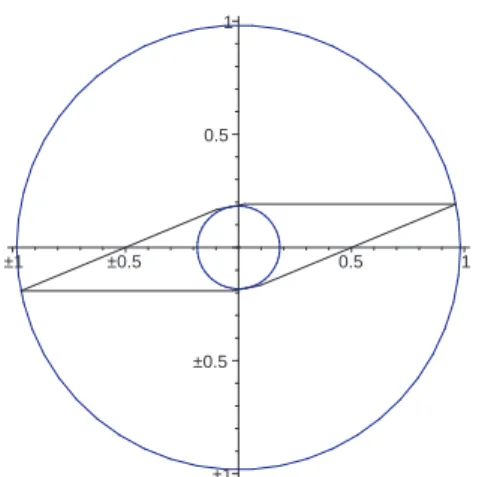
and the corresponding zonotope ZV has inradius rV ≈0.18290 and circumradius RV ≈ 0.98199; see Fig. 3. Thus, the width of the minimal annulus is approximately 0.79909.
Using instead the Bonnesen weights yields approximately
ec= (0.490 57,0.018 85,0.490 57),
leading to the inradiuser≈0.191 412 and circumradius
e
R≈0.981 147, respectively. The width of the minimal
annulus is now approximately 0.789 735, which is an
–1 –0.5
0.5 1
–1 –0.5 0.5 1
Fig. 3. The zonoid from Example 3 associated to Voronoi weights together with its minimal annulus.
To formulate an asymptotic result, we have to specify how close the set of the directions u1, . . . ,uk
is to a set of equidistant directions. Following Gardner
et al. (2006), we introduce the symmetrized spread∆∗k
of u1, . . . ,uk by
∆∗ k=max
u∈S11min≤i≤kmin{ku−uik,ku−(−ui)k}.
Geometrically, ∆∗k is the maximal distance of a unit vector from the set {±u1, . . . ,±uk}. In particular,
{±u1, . . . ,±uk} is a ∆∗k-net in S1. For αi defined by Eq.16, we have
2 sinαi 4 ≤∆
∗
k, i=1, . . . ,k. (21)
The following theorem shows that the choice ci=
e
ci leads to a relative error of Sb2k(A) that depends quadratically on∆∗k. Here we only consider sampling sets {u1, . . . ,uk} such that every closed sub-arc of S1 of length π/2 contains at least one point of
{±u1, . . . ,±uk}. Equivalently,∆∗k ≤
p
2−√2.
Theorem 4 Let A ⊂ R2 be a polyconvex set with
positive perimeter. Let k≥2 and{v1, . . . ,vk} ⊂R2\
{0} such that the symmetrized spread of the vectors ui=vi/kvik, i=1, . . . ,k, is∆∗k≤p2−√2. IfSb2k(A)in
Eq.3 is calculated using the Bonnesen weights ci=eci, i=1, . . . ,k, fromEq.17, then the relative error obeys
b
S2k(A)−S(A) S(A)
≤
π2 3 (∆
∗ k)
2.
(22)
Proof FromEq.20 we get
πerk−2≤2 b
S2k(A)−S(A) S(A)
!
≤πRek−2. (23)
We estimate the left hand side ofEq. 23. In view of
Eq.21, we haveαi/2≤2 arcsin ∆∗k/2
≤π/4 for all
i=1, . . . ,k. Taylor’s theorem implies
tan(αi/2)≤αi/2+c′(αi/2)3, for all i=1, . . . ,k,
where c′ = 8/3 is the third derivative of tan(x)/3! evaluated atπ/4. Relations 18, 21 and arcsin(x)≤π2x,
0≤x≤1, imply that
πerk≥
π ∑k
i=1
αi
2
1+c′ αi
2
2≥
2
1+c′4π2 ∆∗k2,
and this gives
πerk−2≥ −
2π2 3 (∆
∗ k)
2
.
The right hand side ofEq. 23 can be estimated in an even easier way using the fact that the perimeter of the incircle ofZ is bounded by Se (Ze) =4 and hence
erk≤2/π. Together withEq.19 this gives
πRek−2≤
2
1− ∆∗k2(∆
∗ k)
2
≤ √2
2−1(∆
∗ k)
2
,
as∆∗k≤p2−√2. Putting things together we arrive at
b
S2k(A)−S(A) S(A)
≤c(∆
∗ k)
2
with c=maxπ2/3,1/(√2−1) =π2/3.
Using the fact that Voronoi weights deviate only slightly from Bonnesen weights as k increases, it can be shown that the same order of convergence also holds for the relative error ofSb2k(A)if the estimator is based on Voronoi weights. The example of equidistant sampling shows that quadratic behavior is the best possible.
Example 5 Consider the special case where u1, . . . ,uk
are equidistant on the upper half circle, meaning that ui= (cos(iπ/k),sin(iπ/k)), i=1, . . . ,k. Hence
∆∗ k=2 sin
π 4k ∼
π
2k, k→∞.
By symmetry arguments, the weights leading to the minimal width of the corresponding minimal annulus must all be equal and thus c1 =. . .=ck =1/k and
ci =eci for i=1, . . . ,k. According to Eqs.18 and 19, the inner and outer radii of the associated zonotope are
e
rk=
k tan
π
2k
−1
and
e
Rk=erk
cos
π
2k
−1
=k sin
π
2k
−1
,
cf.Eq.4. Therefore, the width of the minimal annulus is
e
Rk−erk= π 4k
−2+O k−4, k
→∞.
This shows that Rke −erk, and thus the relative worst case error, are of order ∆∗k2.
Instead of using the above geometric arguments to obtain asymptotics for the worst case error, one might also use methods from optimum quantization (see Gruber, 2004). Among other important applications, this theory yields asymptotic minimum errors of numerical integration for classes of H¨older continuous functions. As the function gu: v7→ |hv,ui|, and hence
the function pv in Eq. 5 are Lipschitz continuous,
optimum quantization gives an upper bound for the worst case error depending linearly on ∆k. This
suboptimal rate is due to the fact that the class of H¨older continuous functions with H¨older exponent 1 is considerably larger than its subspace spanned by
gu: u∈S1 .
A SEMI-RANDOMIZED APPROACH
The associated zonotope for quadrature rules can also be used in the context of a semi-randomized approach, which generalizes systematic random sampling designs. The idea of this design based approach is to evaluate the total projections of the randomly rotated setϑA in k directions. In other
words, given k vectors v1, . . . ,vk ∈Sd−1 and weights c1, . . . ,ck, the estimator for S(A)is defined by
b
Sdk(ϑA) = 2
γd k
∑
i=1cipϑ−1v
i, (24)
where ϑ is a random rotation whose distribution is the normalized Haar measure on the compact group
SOd of proper rotations. Clearly, Eq. 24 defines a random variable and Crofton’s formula implies that
this variable is an unbiased estimator for S(A). In particular, if d = 2 and the set {±v1, . . . ,±vk} is equidistant in S1, the estimator Sbd
k(ϑA) in Eq. 24 is
the one obtained from systematic random sampling. Moran (1966) considered this special case and gave worst case bounds for the variance of Sbdk(ϑA). His approach allows a geometric interpretation which is not restricted to the planar setting: Let Z be, again, the
zonotope associated to a fixed quadrature rule. From
Eq.11 and the unbiasedness of the estimator, we get
VarSbdk(ϑA)=EϑSbd
k(ϑA)−S(A) 2
=γ−2 d Eϑ
Z
Sd−1(hZ(ϑu)−γd)S(A,du)
2 .
Hence
Var
b
Sdk(ϑA)=
γ−2 d
Z
Sd−1
Z
Sd−1J(u,v)S(A,du)S(A,dv), (25)
where
J(u,v) =Eϑ((hZ(ϑu)−γd) (hZ(ϑv)−γd)) .
H¨older’s inequality implies that
J(u,v)≤Eϑ(hZ(ϑu)−γd)21/2
×Eϑ(hZ(ϑv)−γd)21/2
=
Z
Sd−1(hZ(u)−γd)
2µ
(du).
Hence
Var
b
Sdk(ϑA)≤S(A)
2
γ2
dϖd δ2
2
Z,γdBd
, (26)
where δ2(·,·) denotes the L2-metric defined earlier. This inequality is sharp, as equality holds here for example whenever A is a set of dimension d − 1. The quadrature rule is exact when A = Bd and thus Sbdk Bd= dκd, which implies that 2γd is the
mean width b(Z) of Z and γdBd is the Steiner ball of Z; see Schneider (1993, p. 353). Hence,
the coefficient of variation
r
Var
b
Sdk(ϑA)/S(A)
is bounded from above by a multiple of the L2-distance of Z to its Steiner ball. Again, a geometric inequality (Groemer, 1990) would allow to give an upper bound of the right hand side of Ineq. 26. However, a more direct evaluation is possible and was carried out by Jan´aˇcek (2001). In particular he found optimal weights c1, . . . ,ck to minimize the variance
in the case of a “totally anisotropic object”, i.e., a set A contained in a hyperplane. The optimal weights are obtained by inverting the covariance matrix of
(pϑ−1u
ERROR BOUNDS FOR DIGITAL
SURFACE AREA ESTIMATORS
In this section we consider digitizations of a
topologically regular polyconvex set A ⊂ Rd on
rectangular grids and assume that the directionsuiare givenas normalizeddifference vectors of grid points, which usually are neigbours. For example, we consider the common 4- and 8-neighborhoods in the plane. We compute Voronoi- and Bonnesen-weights together with the associated in- and circumradii explicitly and give asymptotic error bounds forSb(A) for increasing resolution of the digitization.
To digitize A we consider the rectangular point grid G = ζ1Z ×ζ2Z ×. . . ×ζd−1Z ×Z, where
ζ1, . . . ,ζd−1>0are thegriddistances in the directions of the axes, and we used the grid distance in the last coordinate direction as unit. A grid cell is any
d-dimensional cuboid z+ [0,ζ1]×. . .×[0,ζd−1]× [0,1],z ∈ G. Motivated by design based stereology,
we consider digitizations of A by a randomly translated grid. With the random variableξ, uniformly distributed in an arbitrarily chosen grid cell, the random grid ξ+Gis a stationary random closed set
and is called a stationary grid in Kiderlen and Rataj (2006).
In order to increase resolution, we scale the grid by a factor t>0 and denote the digitization of A in the scaled grid t(ξ+G)by∆t(A). Let Q be a non-empty
compact set, called the sampling element. We assume that each grid point x∈t(ξ+G)is the center of a small
sampling window x+tQ, which can be thought of as
a pixel or voxel. The pixel digitization consists of all grid points x for which this sampling window x+tQ
hits the set A. Hence ∆t(A) = A⊕t ˇQ
∩t(ξ+G),
where ˇQ is the reflection of Q at the origin. For Q={o} the pixel digitization reduces to the Gauss
digitization (sometimes called hit-or-miss digitization)
containing all points of the scaled grid in A. All results on error bounds in this section will be stated for the pixel digitization and therefore also hold for the Gauss digitization. In image processing, the term digitization often denotes the union of pixels (grid cells) which are centered at grid points in ∆t(A). As such pixel unions are in one-to-one correspondence with the unions of their centers, one may equivalently consider digitizations as subsets of the grid, and we will do so througout the paper.
We fix a set A and estimate its surface area S(A)
from the information available in its digitization∆t(A)
using a discretized Crofton formula; cf. Ohser and M¨ucklich (2000). We will focus on the asymptotic error of this estimator when the grid spacing gets
finer, i.e., when the digitized set ∆t(A) becomes a
better approximation of the original set A. The function
pv given by Eq. 2 can easily be estimated from
the digitized set ∆t(A) by comparing the values of
neighboring points, if v is a gridpoint. For any vector
v∈G\{o}such an estimator is given by
b pv(t) =
td−1
kvk#{x∈t(ξ+G): x∈∆t(A),x+tv∈/∆t(A)} .
This estimator counts the number of points x in the digitized set ∆t(A) such that x+tv does not lie
in the digitization of A. From Kiderlen and Rataj (2006, Theorem 5) it follows that this estimator is asymptotically unbiased, i.e.,
lim
tց0
Epbv(t) =pv. (27)
Having chosen k vectors v1, . . . ,vk∈Gand scalars c1, . . . ,ck≥0, one can define
b
Sdk(A;t) = 2
γd k
∑
i=1cibpvi(t), (28)
and it follows from Eq. 27 that Sbdk(A;t) is an asymptotically unbiased estimator forSbdk(A), as t ց0. Note that the estimator given by Eq. 28 can be calculated from the knowledge of the digitization ∆t(A)of A alone.Sbdk(A;t)behaves approximately like
a discretized Crofton integral, when t is small. Thus, the methods and resultsof the previous sectioncan be applied to obtain asymptotic error bounds.
To illustrate this approach we discretize the Crofton integral using only directions parallel to the coordinate axes: in Rd we choose the 2d grid points
vi=−vd+i=ζiei, i=1, . . . ,d−1 and vd=−v2d=ed where eidenotes the ith unit vector. Due to symmetry,
the weights leading to a minimal error interval are all equal, ci =1/(2d),i=1, . . . ,2d, and coincide with
the Voronoi weights. The zonotope Z defined in Eq.
10 is given by Z = [−1/d,1/d]d and it has inradius
r=1/d and circumradius R=1/√d. Lemma 1 and
the asymptotic unbiasedness ofSbd2d(A;t)imply
1
dγd ≤
lim
tց0
ESbd
2d(A;t)
S(A) ≤
1
√
dγd .
In the planar case we haveγ2=2/πand
0.785≈π 4 ≤limtց0
ESb2
4(A;t)
S(A) ≤
π 4
√
which means the asymptotic relative error is 21.5 % in the worst case. In three dimensions, the asymptotic relative error is at most 33.3 % asγ3=1/2 and
0.667≈2
3 ≤limtց0
ESb3 6(A;t)
S(A) ≤
2 3
√
3≈1.155.
Due to Stirling’s formula we have√dγd →
p
2/π as
d→∞. As√dγd is decreasing in d, we have
0≤lim
tց0
ESbd
2d(A;t)
S(A) ≤ r
π
2 ≈1.253,
for all d, where pπ/2 is the best upper bound that holdsfor arbitrary dimension d. We do not obtain a non-trivial uniform lower bound, as there are d∈N
and sets A inRdwith S(A) =1, but such thatSbd
2d(A)is arbitrarily close to 0. Due to the large worst case error even in low dimensions, the above choice ofgrid points
is not recommended for practical applications. Instead, a larger number of gridpointsshould be used. On the other hand, the estimator of S(A)inEq.28 is based on asymptotic considerations and becomes less reliable when the lengths of the vectors viare large. One would
therefore restrict to vectors with bounded length, i.e., vectors contained in a small Euclidean disk around the origin. For computational reasons it is easier to replace the Euclidean disk by a disk with respect to the maximum norm.To be specific, we choose{v1, . . . ,vk}
in the set
Vn(d):= [−ζ1(n−1),ζ1(n−1)]×. . .
×[−ζd−1(n−1),ζd−1(n−1)]×[−(n−1),n−1]\{o}.
For n = 2, the most common choice in applications, we have
V(d)
2 ={−ζ1,0,ζ1} ×. . .
× {−ζd−1,0,ζd−1} × {−1,0,1} \ {o} , (29)
and k= #V(d)
2 =3d−1. We determine asymptotic worst case errors for n=2 and n=3 in the planar case and for n=2 in dimension d=3.
THE TWO-DIMENSIONAL CASE
In the planar case for n= 2, the k=32−1 =
8 grid points of the set in Eq. 29 are just the 8-neighbours of the origin, and the corresponding directions are parallel to the edges and diagonals of a grid cell. Both the Voronoi weights and the Bonnesen weights can be computed analytically. It turns out that the Voronoi weights and the Bonnesen weights do not coincide, and the corresponding
in-and circumradii are different. In the following letβ =
arccos(ζ1/√ζ12+1). For the Voronoi case, the inradius rVor(ζ1)and the circumradiusRVor(ζ1)are given by
rVor(ζ1) =
1
πβ+2√ζζ12 1+1
, ifζ1≤1,
1 2−
1
πβ+2√ζ12 1+1
, otherwise,
and
RVor(ζ1) =
1 π "
β2+
π
2−β+
π
2√ζ2 1+1
2#1/2
,
ifζ1≤1,
1
π
"
β+π2√ζ1
ζ2 1+1
2
+ π2−β2 #1/2
,
otherwise,
respectively. In the Bonnesen case the inradius rBon(ζ1)is given by
rBon(ζ1) =ζ1
2 q
ζ2
1+1(ζ1+1)−2 ζ 2 1+1
−1
and the circumradiusRBon(ζ1)is given by
RBon(ζ1) =
rBon(ζ1)
√
2
1+ζ12 1
+1
−1/2−1/2
,
ifζ1≤1
rBon(ζ1)
√
2
1+ ζ2 1+1
−1/2−1/2
,
otherwise.
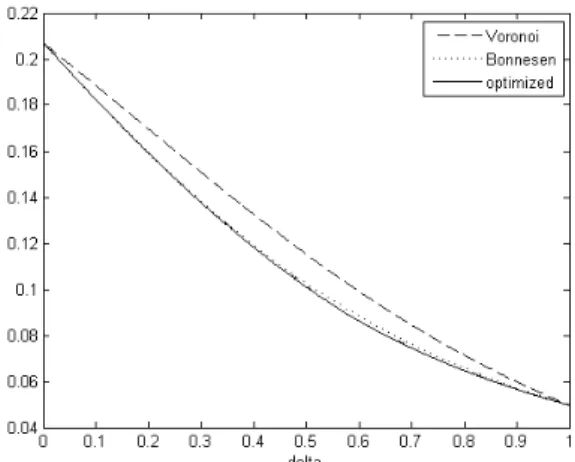
Fig. 4. Thickness of the minimal annulus for eight
directional vectors on a rectangular grid in 2D depending onζ1for Voronoi, Bonnesen, and optimized weights, respectively (see the text for details).
Fig. 5. Thickness of the minimal annulus for 16
directional vectors on a rectangular grid in 2D depending onζ1for Voronoi, Bonnesen, and optimized weights, respectively (see the text for details).
It is easy to see that in the case of a square grid (ζ1 =1) the width R−r of the minimal annulus is minimal if and only if all weights are equal, c1 = . . . = c8 = 1/8, a choice which coincides with the Voronoi and the Bonnesen weights. The corresponding zonotope Z is a regular octagon with side length 1/2 and facets parallel to the vectors v1, . . . ,v8. Z has circumradius R=p4+2√2/4 and inradius r=
1+√2/4. Withγ2=2/π we get
0.948≈π 8
1+√2
≤lim
tց0
ESb2 8(A;t)
S(A)
≤π8
q
4+2√2≈1.026.
This was also obtained in Kiderlen and Jensen (2003).
We consider also the case n=3 in the plane, i.e., we use all 16 directionsobtained by normalizing the grid points in the cuboid [−2ζ1,2ζ1]×[−2,2]\ {0}. Now even in the special case when ζ1 = 1 the 16 weights leading to a shortest asymptotic error interval are not equal. We refrain from explicitly stating the formulas for the in- and circumradii because of their complexity. The results are qualitatively similar to the case n=2. The use of the Bonnesen weights yields a smaller thickness of the minimal annulus than the use of the Voronoi weights. The minimal thickness achieved with optimized weights is only slightly better than for Bonnesen weights (Fig. 5).
THE THREE-DIMENSIONAL CASE
In three dimensions, we restrict considerations to the cubic grid (ζ1=ζ2=1) and n=2.The directions associated to the k=33−1= 26 grid points vi of
the set in Eq. 29 consist of the 6 directions along the edges (i =1, . . . ,6), 12 diagonals of the faces (i=7, . . . ,18) and 8 spatial diagonals (i=19, . . . ,26) of the unit cube [0,1]3. Hence, the surface area estimator in Eq. 28is based on comparison of pixels with neighbors in the so-called 26-neighborhood. The Voronoi weights can be calculated as the relative sizes of the Voronoi cells on the unit sphere generated by {v1/kv1k, . . . ,vk/kvkk} . They can be derived by computing the area of the Voronoi cells on the unit sphere analytically with the help of spherical trigonometry, and are given by
ci=
1 2−
2
πarccos
√
2+√3
√
2√3−√3sin
π
8
≈0.045 777 9, if i=1, . . . ,6,
1 2−
1
πarccos
√
6−2 2√3−√6sin
π
8
≈0.036 980 6, if i=7, . . . ,18,
1 2−
3 2πarccos
(2−√3)(2−√6)+2 4√3−√3√3−√6
≈0.035 195 6, if i=19, . . .,26. The zonotope Z is the convex hull of all points of the form∑26i=1εivi/kvik, where(ε1, . . . ,ε26)runs through all vectors in {−1,0,1}26. The quickhull-algorithm (Barber et al., 1996) was used to find this convex hull. Z has 96 vertices, inradius rVor ≈ 0.463 312, circumradius RVor ≈ 0.511 386, and thickness of minimal annulus TVor≈0.048 074 8. As γ3=1/2 we obtainthe bounds
0.927≤lim
tց0
ESb3 26(A;t)
S(A) ≤1.023.
be generalized to higher dimensions. We will do so for comparison with the established Voronoi weights. Recall the construction for the Bonnesen weights in the plane for givenvectors v1, . . . ,vk ∈R2\ {o}. We
defined ui = vi/kvik, i = 1, . . . ,k, and constructed
the polygon P ine Eq. 15 with outer unit vectors
±u1, . . . ,±uk circumscribing the unit ball. We then
choseceiproportional to the length of the edge ofP withe
outer unit normal ui. In higher dimensions, for given v1, . . . ,vk∈Rd\ {o}, we set ui=vi/kvik, i=1, . . . ,k,
and
e
P := k
\
i=1
n
x∈Rd:|hui,xi| ≤1o ,
in complete analogy toEq.15. HenceP is the polytopee
circumscribing the unit ball with facet normals in
{±u1, . . . ,±uk}. We then choose eci proportional to the (d−1)-dimensional volume of the facet of Pe
which has outer unit normal ui. In the present
three-dimensional example (with ζ1=ζ2 =1 and allgrid points inV(3)
2 ) the Bonnesen weights were computed with quickhull and are given by
e
ci≈
0.046 589 4, if i=1, . . . ,6,
0.036 743 9, if i=7, . . . ,18,
0.034 942 1, if i=19, . . .26.
The associated inradius is rBon ≈ 0.462 424, the circumradius is RBon ≈0.511 243, and thickness of minimal annulus is TBon ≈0.048 818 7. This shows that Bonnesen weights are not better than Voronoi weights for the 3d−1 directions in dimension d=3. But this is not surprising because they are based on Bonnesen’s inequalityEq. 14 which is valid only for two-dimensional convex bodies. In the last section
we discuss how the approachdeveloped in this paper
could be extended to higher dimensions.
Finally, we show how the asymptotic relative error bounds in the case of a quadratic (ζ1=1) planar grid depend on the choice of n. To do so, the symmetrized spread of the normalized vectors of Vn(2) must be determined.
Lemma 6 For n ≥ 2 the symmetrized spread of
n
x/kxk: x∈Vn(2)ois equal to
dn=
v u u u u
t2−
v u u u
t2
1+q n−1
1+ (n−1)2
≤ 1
2(n−1).
(30)
Proof Let∆ be the symmetrized spread of D := n
x/kxk: x∈Vn(2)o and set m :=n−1. Clearly, the
arc C ⊂ S1 in the first quadrant with endpoints (1,0)⊤, m2+1−1/2(m,1)⊤∈D does not contain any
other points in D and thus the spread∆is at least the distance of the midpoint of C to one of its endpoints. Hence
∆≥
r
2
1−cosϕ 2
=
v u u
t2 1−
r
1+cosϕ 2
! =dn,
where ϕ =arccos
m/√1+m2 is the length of C. This interpretation of dn also shows the inequality in Eq. 30, as dn cannot be larger then half the distance
of (1,0)⊤ from (1,1/m)⊤. To show that ∆ ≤ dn, let v,v′ ∈D two points such that the sub-arc of S1
connecting them does not contain any other points of D. Using reflections and translations leaving Z2
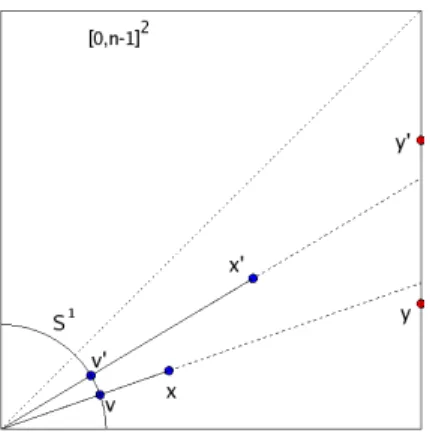
invariant, we may assume that v =x/kxk and v′ = x′/kx′k where x,x′ ∈Vn(2) and the angles they form with the x-axis are at mostπ/4. We refer to Fig. 6 for a sketch of the situation. The cone between the rays spanned by x and x′ cannot contain any other points of Vn(2) in its interior. Let y (y′) denote the point in Vn(2)∩ {(m,t): t≥0} with largest (smallest) second coordinate below (above) this cone. Then the length of the arc in S1with endpoints v and v′ is at most the
length of the arc C′ ⊂S1 with endpoints y/kyk and y′/ky′k. The segment[y,y′]does not contain any points of Vn(2), so y and y′ are distance one apart, and the length of C′ is bounded from above by the length of
C. Here we use the fact that among all unit intervals inn (m,t)⊤: t≥0
o
, the interval
h
(m,0)⊤,(m,1)⊤i has the largest gnomonic projection. This gives∆≤dn, as
v and v′where arbitrary in D.
In view of Theorem 4, Lemma 6 yields an estimate for the asymptotic relative error using the Bonnesen-weights ci=eciwhenever n≥2.
Theorem 7 Let A ⊂ R2 be a topologically regular
polyconvex set with positive perimeter, n ≥ 2, and ζ1 = 1. Let Sb2k(A;t) be defined by Eq. 28, where
{v1, . . . ,vk}=Vn(2) and ci =eci, i=1, . . . ,k, are the Bonnesen weights. Then the asymptotic relative mean error obeys
lim
tց0
ESb2
k(A;t)−S(A) S(A)
≤
π2
12(n−1)
Fig. 6. Construction to determine the symmetrized
spread in Lemma 6: the points x and x′ in Vn(2) are contained in the cube [0,n−1]2 and their normalizations v,v′inS1.
EXTENSION TO HIGHER
DIMENSIONS
Large parts of the present worst case analysis for quadrature rules, including the use of an associated zonotope Z, are not restricted to the two-dimensional setting. In order to find an easily accessible upper bound for the width of the minimal annulus, a joint extension of Bonnesen’s refined isoperimetric inequalities Eq. 14 and the geometric inequality of Groemer (1990) to higher dimensions (which is known) is not suitable, as it involves the surface area of Z. Instead, a strengthened version of Uhrysohn’s inequality is appropriate. It reads
b(Z) b(Bd)
d
− Vd(Z)
Vd(Bd) ≥cd(Z)δ
2 2
Z,γdBd
. (31)
Here cd is an explicitly known constant, depending
on d, the mean width b(Z) of Z, and the second intrinsic volume of Z. This inequality is a special case of a whole family of geometric inequalities derived by Groemer and Schneider (1991), who also showed that it implies the Bonnesen type inequality
b(Z) b(Bd)
d
− Vd(Z)
Vd(Bd)≥c′d(Z) (R−r)
(d+3)/2. (32)
The constant c′d, again, depends on d, b(Z) and the second intrinsic volume of Z. For d = 2 Ineq. 32 is of the same form as Ineq. 14, but with a weaker exponent. This apparently suboptimal exponent, and the problem to determine the zonotope with given mean width which minimizes the left hand side of Eq. 32 for d>2, limits the usefulness of these inequalities for applications.
ACKNOWLEDGMENTS
We want to thank Luis Cruz-Orive, Maria Hernandez Cifre, Ilya Molchanov, and the two anonymous refereesfor their helpful comments on an earlier version of this paper. The first author’s work was partially supported by the Carlsberg foundation and the Danish Council for Strategic Research. The second author’s work was partially supported by a Marie Curie Fellowship of the European Community Programme.
REFERENCES
Barber C, Dobkin D, Huhdanpaa H (1996). The Quickhull algorithm for convex hulls. ACM Trans Math Soft 22:469–83.
Bonnesen T (1929). Probl`emes des Isop´erim`etres et des Is´epiphanes. Paris: Gauthier-Villars.
Gardner R, Kiderlen M, Milanfar P (2006). Convergence of algorithms for reconstructing convex bodies and directional measures. Ann Stat 34:1331–74.
Goodey P, Weil W (1993). Zonoids and generalizations. In: Gruber P, Wills J, eds., Handbook of Convex Geometry, vol. B. Amsterdam: Elsevier, 1297–326.
Groemer H (1990). Stability properties of geometric inequalities. Am Math Mon 97:382–94.
Groemer H, Schneider R (1991). Stability estimates for some geometric inequalities. Bull Lond Math Soc 23:67–74.
Gruber P (2004). Optimum quantization and its applications. Adv Math 186:456–97.
Jan´aˇcek J (2001). Estimating length and surface area by systematic projections. Image Anal Stereol 20 (Suppl. 1):89–94.
Kiderlen M, Jensen E (2003). Estimation of the directional measure of planar random sets by digitization. Adv Appl Probab 35:583–602.
Kiderlen M, Rataj J (2006). On infinitesimal increase of volumes of morphological transforms. Mathematika 53:103–27.
Knebelman M (1941). Two isoperimetric problems. Am Math Mon 48:623–7.
Lindel¨of L (1869). Propri´et´es g´en´erales des poly`edres qui, sous une ´etendue superficielle donn´ee, renferment le plus grand volume. Bull Acad Sci St Petersburg 14:258– 69. Math Ann (1870) 2:150-159.
Ohser J, M¨ucklich F (2000). Statistical Analysis of Microstructures in Material Science. Chichester: John Wiley & Sons.
Rataj J (2002). Determination of spherical area measure by means of dilation volumes. Math Nachr 235:143–62. Rother W, Z¨ahle M (1990). A short proof of a principal
kinematic formula and extensions. Trans Amer Math Soc 321:547–58.
Schneider R (1993). Convex Bodies: The Brunn-Minkowski Theory, vol. 44 of Encyclopedia of Mathematics and its Applications. Cambridge: Cambridge University Press. Schneider R, Weil W (1992). Integralgeometrie. Stuttgart:
Teubner.