Journal of Global Pharma Technology
Available Online at:
www.jgpt.co.in
RESEARCH ARTICLE
Development of Logic Based Learning Evaluation Instruments
Kharisma Kusumaningtyas*
,Dwi Wahyu Wulan Sulistyowati
Poltekkes Kemenkes Surabaya.
*Corresponding Author:Kharisma Kusumaningtyas
Abstract
Objective: Logical models are methods for conveying ideas that describe and share the understanding of the interrelationships among elements to operate a program or change effort. The study aimed to compile the development of a logic-based clinical learning practice instrument. Method: This research used an action research design. Sixteen participants joined the Focus Group Discussion (FGD) consisting of Head of Study Program, Academic Coordinator, Practice Division staffs, and Lecturer Representatives from 4 Midwifery Study Program of a university in Indonesia. The FGD was conducted in 2 stages. The analysis used descriptive and inferential analysis. Result: The results obtained clinical practice learning evaluation instruments based on logic models. The results of the validity test with Pearson's product-moment correlation show r = 0.576 and the value of r for each question > r table, so it can be concluded that instruments valid and reliable. Discussion: Instrument of clinical practice learning program based on logic models in the Midwifery Department consists of context, input, activity, output, and outcomes. The instrument can assess the process of implementing clinical practice learning.
Keywords:Learning, Practice, Logic model, Clinical.
Introduction
An evaluation of learning is needed in increasing motivation and the need to excel in learning, having high learning affiliations, and having strength in learning management [1]. Effective and efficient learning through appropriate methods and media is very important [2, 3]. The logic model is used as a tool to model the structure of the program. Logical models are visual methods for conveying ideas that describe and share the understanding of the interrelationships among elements to operate a program or change effort [4].
McLaughlin and Jordan define a logic model as a tool to tell program performance to answer the questions, including what is trying to be achieved and why the program is considered important, how to measure its effectiveness, and how to do it correctly [5]. Meanwhile, according to W.K. Kellogg Foundation, a logic model is a picture of how a program works with the theories and underlying assumptions. Previous research in the development of logic models has been carried out in various fields, and the results can help the process of implementing a
program evaluation effectively [6]. Kang developed a logic model for technical analysis in research and development (R&D) programs [7]. West, Hayes, et al., and Crane have developed a logic model in the field of health care and nursing profession recognition programs (credentials) and family development training [8, 9, 10]. The development of models by Crane (2010) uses his knowledge resources and practical experience in undergoing the program at Cornell University [10].
its management in order to ensure the process runs according to standards [14]. Therefore, it is important to develop an instrument that can be used to evaluate the learning process in an educational institution so that the quality of education is maintained. The objective of this research was to arrange the development of a logic-based clinical learning instrument for midwifery.
Materials and Methods
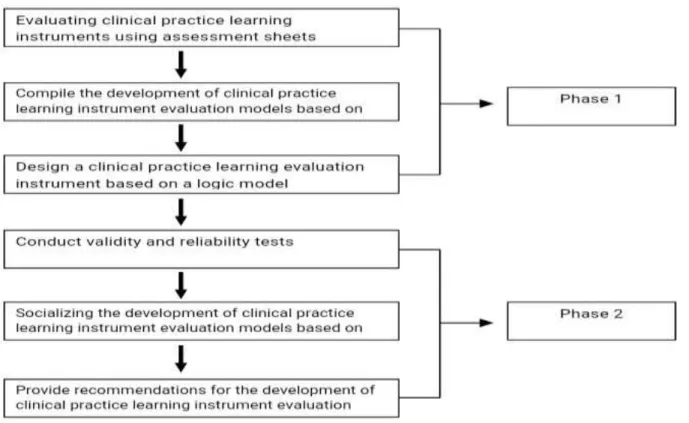
The design of this study used an action research design consisting of 2 stages [15]. Stage 1 was obtained to assess the need for developing an evaluation instrument by performing FGD to the staff of the study program and compile the draft of the instrument. Stage 2 was conducted to evaluate the instruments made from stage 1. The research stages are as follows:
Table 1: Operational Framework
Phase 1: FGD aimed to explore information about the need to create an evaluation instrument for clinical practice learning using a logic-based model. This FGD involved 16 people consisting of the head of the study program, the academic coordinator, the staff of the clinical practice division, and representatives of lecturers from the 4 study programs. The results of the FGD phase 1 were used to arrange items in the instrument. After the instrument was formed, a trial was conducted on 12 lecturers who were involved in the clinical practice division.
Phase 2: FGD aimed to evaluate whether the instrument formed has been able to assess the learning process and whether the instrument can be recommended to be applied in clinical practice learning activities.
Results
Results of the Phase 1 Research Analysis
Evaluation of Evaluation Instruments for Clinical practice Learning Programs in Stage 1 of Midwifery Major
The Practice Learning Evaluation Instrument used by the Midwifery Study Program contains Preparations, Student Competencies, and Evaluations. In the Preparation Stages of the Practice Learning Evaluation instrument, there is no uniformity between the number of semester
It is important for uniformity of instruments in the Department of midwifery. Instruments need to be made specifically so that they can measure the context and input needed during the learning process of midwifery clinical practice.
FDG Stage 1
Development of Evaluation Instrument for learning practice based on logic models in the Midwifery Departments.
Context
The differences by using of the curriculum at the D3 (diploma-three) of the midwifery study program in the Midwifery Department Environment. There is two utilizing curriculum that is already referring to the KPT Curriculum and the 2016 curriculum. Because of that, the Midwifery department has agreed using the Higher Education Curriculum, which has agreed by all D3 (diploma-three) of Midwifery Departments.
Input
In the Midwifery Departments, there has been uniformity about the selection of new students process, which is centered in the Directorate. There is already an RPS uniformity format for the practical clinic; there is no uniformity of practical modules in the midwifery department yet. Therefore, it is necessary to discuss D3 (diploma-three) Midwifery Study Programs about the form of the evaluation that aims to provide information to determine how to use the resources of the entrance examination and the available RPS in achieving the program objectives.
Activity
D3 (diploma-three) Midwifery Program in the Midwifery Environment has difficulty in determining the practice land for students because there is no difference between the amount the land and the amount of students so that the satisfaction of students in each study programs is not the same.
Output
In the D3 (diploma-three) Midwifery Study Program Department of Midwifery, the assessment system is by the assessment standards outlined in the academic guidelines of the department and study program. There has been an agreement in
the Midwifery Department regarding the achievement of practical competencies.
Outcomes
In the Midwifery Department, there are many D3 Midwifery Study Programs whose National Competency Test (First Taker) is less than 100%. This is due to the absence of standard evaluation instruments when learning clinical practice in the form of real cases. Practice counselors must be equipped with the knowledge and skills to use evaluation instruments after a rotation of real case-based clinical practice. Outcomes evaluation is used to determine the level of competence of student alumni regarding skills in the world of work.
The outcome of a program is the participant's response to services provided in a program, and the outcome is the impact, benefits, expectations of change from an activity or service of a program. Outcomes related to short-term goals "in the learning aspect, namely the creation of quality graduates who have the characteristics of:
1) Awareness, (2) knowledge, (3) attitude, (4) skill, (5) opinion, (6) aspiration, and (7) motivation. Outcomes relating to "medium-term goals" in the aspects of activities that include aspects of (1) behavior, practice, decision-makers, policies, and social actions in the education sector. Whereas the Outcomes relating to "long-term goals" emphasize changes in social, economic, population, and environmental conditions in the field of education. The program evaluation monitors the project implementation process to help the staff carry out activities and for users to be able to judge the program’s performance (Stufflebeam, 2003).
The “process” evaluation is important to provide feedback to allow the program to be implemented correctly, to improve the program and to verify accountability in the work plan (Chinta, Kebritchi, & Ellias, 2016; Kahn et al., 2014; O’Sullivan, 2013; Pfitzinger M, 2016 [16].
Instrument Validity and Reliability
on the clinical practice learning evaluation instrument have the results of the Pearson product-moment correlation test with r arithmetic r table. So it can be concluded that the question items are declared valid.
Results of the Phase 2 Research Analysis
Conducting Socialization and Training in Filling out the Logic Model Clinical
Practice Learning Evaluation
Instruments in the Midwifery
Department
The socialization and training for filling out the Logic Model clinical practice learning evaluation instruments in each Study Program namely in the D3 Midwifery Sutomo Study Program were held on July 25, 2019, Bangkalan on August 1, 2019, Bojonegoro on July 30, 2019, and Magetan on July 26, 2019. In this activity, researchers coordinate with each study program manager. In this case, each study program was attended by three managers.
The number of participants was 12 people. In the process, the researcher delivered the material following the Unit of Activities that have been made, the participants listened to the material well, and the question and answer discussion process went well. As a result, participants were very enthusiastic about the training activities and followed the activities from beginning to end. Participants were able to accept material delivered by researchers.
Evaluation of Evaluation Instruments for Clinical Practice Learning Programs in Stage 2 of the Midwifery Department
Explained that the activity of filling out the evaluation instruments of clinical practice learning evaluation based on the logic model, the average respondent had good ability about the context of the instrument (50%). The ability of respondents to fill instruments about inputs was largely sufficient (58%). The ability to fill instruments about activities is good (67%). The ability to fill instruments about output (100%) is good. The ability of respondents to fill instruments about outcomes (83%) is good.
Stage 2 FGD
This Phase 2 FGD activity was held on August 16, 2019, in the Meeting Room of the Midwifery Department of the Poltekkes
Kemenkes Surabaya and 16 participants were consisting of the Chairperson of the Department, Department Secretary, Chairperson of D3 Midwifery Study Program in Sutomo, Bojonegoro, Magetan, and Bangkalan, Academic Coordinator and Practical Section in the Midwifery Department environment. Phase 2 FGD activities were carried out to find out suggestions and criticisms from research respondents who had used a model of learning practices based on logic models, which could then be used as a material in providing recommendations on the form of clinical practice learning models based on logic models at the Midwifery Department. Recommendations from the FGD on the form of an instrument for evaluating the Logic-Based Clinical Practice Learning Program Model that will be applied in the Midwifery Department consisting of Context, Input, Activities, Output, Outcomes are agreed by the participants. Context, contains the number of SKS and Number of Clinical Practice Learning Hours,
Inputs, contains about the preparation of the RPS, which consists of the identity of the RPS, Learning Achievements, Final Capabilities, Study Materials, learning methods, learning media, learning time, learning experiences, assessments, references, practice module, Activities, contains the number of meetings, student attendance, satisfaction during learning, Output, contains the final grade of the course, the value of the assessment of competency achievement, competency test results, Outcomes, contains about competence. Some factors that influence the process in education are all inputs in education, including learning planning, human resources, infrastructure, and facilities [17].
Discussion
Evaluation of Evaluation Instruments for Clinical Practice Learning Programs in Stage 1 of Midwifery Major
still the same. There is no uniformity of student assessment in each study program. The assessment of practical activities still applies to each study program with a different model, but the contents still refer to the standards and learning objectives to be achieved. Each study program has a different form of instrument content; some are evaluating attitudes, psychomotor, and knowledge, some judge only skills.
There is no uniformity of instrument for the presence of students in each study program. The attendance sheet of each study program composition and attendance list form is not the same. The evaluation instruments for the Clinical Practice Learning Program in each Study Program are different so that they cannot be used as a reference in evaluating Clinical Practice Learning Programs. Require guidelines and standard skills for Diploma 3 students and Assessment of student skills. Student skills and assessment instruments need to be made so that uniform achievement of skills in clinical practice learning.
Evaluation Stages Evaluation instruments for the practice learning program in the Midwifery Department do not yet have a uniform assessment instrument in each study program. Each study program has a different form of instrument content; some are evaluating attitudes, psychomotor, and knowledge, some judge only skills.
There is no uniformity of instrument for the presence of students in each study program. The attendance sheet of each study program composition and attendance list form is not the same. The need for instrument assessment sheets and attendance sheets in the Department of Midwifery Instruments need to be made standard by considering the conditions of each study program.
So that the Midwifery Department has standardized instrument sheets. The evaluation was used as the bases for the recommendation of revising the course's curriculum and for increasing the facilities that included a library [16]. A quality improvement model in nursing education was directly determined with learning and operational process through human resources management along with information systems, strategy planning factors, and leadership. The research findings could be developed in the quality analysis application program [18].
Context
Context evaluation is carried out to determine the purpose and practical learning urgency in the Midwifery Education Programs, through elaboration in the curriculum that contains the number of credits, calculation of the number of face to face. Evaluation context explains a variable which can affect program implementation, such as environmental condition, institutional policies, and the economy [19].
Input
Input evaluation includes analysis related to how the use of available resources, alternative strategies must be considered to achieve a program. Identify and assess system capabilities, alternative system programs, design programs for implementation strategy, financing, and scheduling. The information and data collected can be used to determine sources and strategies within existing limitations.
Activity
The standard land and the standard land guidance practice need to be discussed at the department level so that the students can get the best standard land for doing practice. Evaluation activities are carried out to determine the effectiveness of the services or the process of implementing educational innovation as an action to produce outputs. Evaluation activities are carried out to determine the process of the implementation of practical learning with several aspects, namely the number of meetings, student attendance, and student satisfaction with the learning process and management of practical learning.
Output
Outcome
Outcomes related to short-term goals "in the learning aspect, namely the creation of quality graduates who have the characteristics of:
1) Awareness, (2) Knowledge, (3) Attitude, (4) Skill, (5) Opinion, (6) Aspiration and (7) Motivation. Outcomes relating to "medium-term goals" in the aspects of activities that include aspects of (1) behavior, practice, decision-makers, policies, and social actions in the education sector.
Whereas the Outcomes relating to "long-term goals" emphasize changes in social, economic, population, and environmental conditions in the field of education. The program evaluation monitors the project implementation process to help the staff carry out activities and for users to be able to
judge the program’s performance (Stufflebeam, 2003). The “process” evaluation is important to provide feedback to allow the program to be implemented correctly, to improve the program and to verify accountability in the work plan (Chinta, Kebritchi, & Ellias, 2016; Kahn et al., 2014; O’Sullivan, 2013; Pfitzinger M, 2016 [16].
Conclusions and Suggestions
Evaluation instrument for learning practices in the Department of Midwifery based on a logic model produced from this research was valid and reliable. The instruments consist of 5 elements, including context, input, activity, output, outcomes. The instrument provides convenience and time efficiency by managers in conducting learning activities while maintaining quality forms of learning. Furthermore, the instrument could be applied by another study program.
Reference
1. Nahariani P, Nursalam N, Triharini M, Probowati R (2013) Development of Self Regulated Learning Model in Studying Nursing (SRLSN) to Improve Student Learning Competence. J. Ners., 8(2):190-201.
2. Palupi H, Kusnanto, Yuwono SR (2019) Differences in Clinical Simulation with Audio-visual and Practicum-based Standard Operating Procedures in Nursing Student Competencies. J. Ners., 14(2):161-4.
3. Susilaningrum R, Utami S, Nursalam N (2018) Analysis of factors related to communication skills in midwifery students. Indian J. Public Heal. Res. Dev., 9(12):612-7.
4. Parsons B (2012) The Logic Model Guidebook: Better Strategies for Great Results (<I>Second Ed.</I>). Found Rev., 4(3):108-9.
5. McLaughlin JA, Jordan GB (1999) Logic models: A tool for telling your program’s performance story. Eval Program Plann., 22(1):65-72.
6. WK Kellogg Foundation Logic Model Development Guide.
7. Kang H (2013) Development of Logic Model for R&D Program Plan Analysis in Preliminary Feasibility Study. Int. J. Soc. Behav. Educ. Econ. Bus Ind. Eng., 7(9):2613-6.
8. West JF (2014) Public health program planning logic model for community engaged Type 2 diabetes management and prevention. Eval. Program Plann., 42:43-9. 9. Hayes H, Parchman ML, Howard R (2011) A logic model framework for evaluation and planning in a primary care Practice-based Research Network (PBRN). J. Am Board Fam. Med., 24(5):576-82.
10.Crane B (2010) Using qualitative data to refine a logic model for the Cornell family development credential program. Qual. Rep., 15(4):899-931.
11.Taylor-Powell E, Henert E (2008) Developing a logic model: Teaching and training guide. Madison: University of Wisconsin-Extension, (Februar):77.
12.Oz O, Seren DB (2012) Developing the Application of 360 Degree Performance Appraisal through Logic Model. Int. J. Bus Soc. Sci., 3(22):280-6.
13.Nahariani P, Kurdi F, Priyanti RP (2019) The Perception of Indonesian Nursing Students on the Learning Environment in Clinical Practice. J. Ners., 13: 2.
14.Noor S, Agianto, Nursalam, Setiawan H (2019) Clinical supervision training to increase nurses’ work performance in hospitals. Indian J. Public Heal. Res. Dev., 10(8):2751-5.
effective communication instrument in emergency handover at emergency department of hajj hospital in Surabaya. Indian J. Public Heal. Res. Dev., 10(10):688-91.
16.Siswadi Y, Houghty GS, Agustina T (2019) Implementation of the CIPP evaluation model in Indonesian nursing schools. J. Ners., 14: 3.
17.A Aziz Alimul Hidayat, Stefanus Supriyanto N (2015) Model sistem manajemen mutu berdasarkan kriteria malcolm baldrige pada pendidikan keperawatan di kota surabaya. J. Ners.,
10(1): 165-174.
18.Quality Improvement Model of Nursing Education (2015) In Muhammadiyah Universities Toward Competitive Advantage Abdul Aziz Alimul Hidayat, Musrifatul Uliyah, Sukadiono Sukadiono Department of Nursing , Faculty of Health Science , Muhammadiyah University of Sur., 59.