308
INFLUENCE OF TWO BIOSTIMULANTS APPLICATION ON GROWTH
AND DEVELOPMENT OF
TROPAEOLUM MAJUS
L.
ZELJKOVIĆ SVJETLANA, ŠUŠAK UROŠ, TODOROVIĆ VIDA Faculty of Agriculture, University of Banja Luka, Bulevar Vojvode Petra Bojovića 1A, Banja Luka, Republic of Srpska/Bosnia and Herzegovina
Keywords: biostimulant, Tropaeolum majus, nasturtium, growth parameters
ABSTRACT
The effect of two different biostimulants was inevstigated in this study on growth and development of nasturtium (Tropaeolum majus L.). Biostimulants Radifarm® and Megafol® were applied according manufactures advice. The experiment was conducted in 2013. It was arranged in a split - plot design with four replicates and three treatments (control, Radifarm®, Megafol®). Morphological parameters, plant height, leaf number and number of flowers were recorded regularly during growth and development of nasturtium. At the end of experiment, plants were sampled and root and above-ground fresh and dry weight and root length were recorded. Obtained results showed significantly higher values of all investigated parameters of nasturtium growth under tretament with biostimulants.The research shows that applying biostimulants in the production of Tropaeolum majus L. improves the growth and development of the root and the above-ground part.
INTRODUCTION
Nasturtium (Tropaeolum majus L.) is an annual herbaceous plant with stems growing to 1 meter long or more. The leaves are large, nearly round, 3 to 15 cm diameter. Flowers are found in many colors, mostly yellow, orange and red. It can be high, low, creeping and often is used as a ground cover and as the protector of the orchard from aphides. It is widely cultivated, both as an ornamental plant and as vegetable and medical plant. All its parts are edible. The flower has most often been consumed, making for an especially ornamental salad ingredient. The flowers contain about 130 mg vitamin C per 100 g, about the same amount as is contained in parsley. Moreover, they contain up to 45 mg of lutein per 100 g, which is the highest amount found in any edible plant. This plant is known because of its ornamental properties and also because its leaves and flowers are edible and used in salads, where they impart a peppery flavor due to the presence of glucosinolates (Jens and Birger, 1993).
309
radical and can help the plant to overcome the stress as shown in an investigation by Parađiković et al. (2016). Zeljković et al. (2013) reported positive effect of treatment with biostimulant Radifarm® on growth and development of marigold (Tagetes patula L.) resulting in enhancement of all morphological parameters as well as nutrient status compared to control plants.
The aim of this study was to investigate the effect of two different biostimulants, Radifarm® and Megafol® on growth and development of nasturtium (Tropaeolum majus L.).
MATERIAL AND METHOD
This study was conducted under greenhouse conditions at Faculty of Agriculture, University of Banja Luka, BiH and the family farm Topić in Prnjavor, BiH in the April - August 2013 period.Nasturtium seeds purchased in agricultural pharmacies were sown in April in polystyrene containers in the Klasmann-Deilmann substrate. The substrate is a poorly degraded mixture of black and white peat with pH level of 5.5-6.5. Plants were kept in the greenhouse where daily temperatures were 18-20°C, and nightly 15-18°C with a relative air humidity of 60-65%. The greenhouse was regularly ventilated so that disease development would not occur. The plant emergence was occured seven days after sowing. After two weeks seedlings were ready for transplantation. Nasturtium seedlings were transplanted in garden into garden soil. In the laboratory of Soil Science, Faculty of Agriculture, University of Banja Luka chemical analysis of garden soil was conducted and its composition is given in Table 1.
Table 1
Chemical analysis of garden soil
p H E C - e l e c t r o c o n d u c t i v i t y
H2O K C l
2 , 3 3 m S / c m 7 . 8 0 6 . 8 8
After transplanting biostimulant Radifarm® of the producer Valagro s.p.a. Italy was applied on the root zone by watering in the concentration of 0.25%. Biostimulant Radifarm® is highly recommended for root development, which contains polysaccharides, glycosides and proteins, and it is enriched with amino acids (arginine and asparagine), vitamins and micro-elements (Fe and Zn). It is used for mass increment and lateral root development during the first phase of plant growth, and then it stimulates formation and extension of new roots and root hairs. In this way it helps faster rooting of plantlets and recovery from stress of transplantation. On the following day, biostimulant Radifarm® was applied at the same concentration. Seven days after transplanting biostimalant Megafol® of the producer Valagro s.p.a. Italy was applied by spraying at a concentration of 0.20% to promote foliar growth and development. Megafol® is based on amino acids proline and tryptophan. There were several additional applications of Megafol® until the end of June.
Experiment was designed by split plot method in 4 repetitions with 10 plants per repetition: plants treated with biostimulant Radifarm® (treatment: factor A2), plants treated with biostimulant Megafol® (treatment: factor A3) and control plants watered just with water (control; factor A1). In the experiment were totally 120 plants of nasturtium - Tropaeolum majus L.
310
root and above-ground fresh mass of each plant was recorded. Dry mass was recorded after drying the plant material on 70°C and were expressed in grams (g).
The data obtained were statistically analyzed using analysis of variance (Vukadinović, 1994).
RESULTS AND DISCUSSIONS
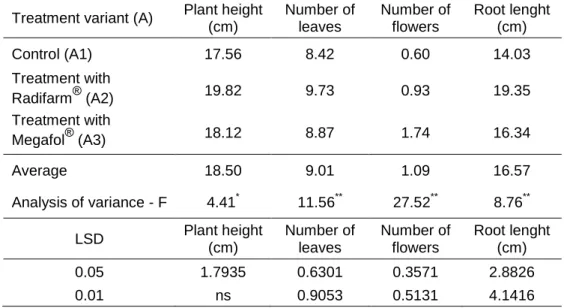
In order to determine the influence of two biostimulants on growth and development of nasturtium (Tropaeolum majus L.) through plants morphological indicators and the fresh and dry weight of roots and above-ground parts, the following results were obtained. During the experiment, measurements were made of morphological indicators of plant growth and development. Table 2. shows the average value of the indicator. Plants treatment showed better results in terms of morphological characteristics (plant height, leaf number, number of flowers, root lenght), as the average values of all investigated parameters were significantly higher than the average value of the control plants.
Table 2
Morphological indicators of growth and development nasturtium
Tropaeolum majus L. under the influence of biostimulants
Treatment variant (A) Plant height (cm)
Number of leaves
Number of flowers
Root lenght (cm)
Control (A1) 17.56 8.42 0.60 14.03
Treatment with
Radifarm® (A2) 19.82 9.73 0.93 19.35
Treatment with
Megafol® (A3) 18.12 8.87 1.74 16.34
Average 18.50 9.01 1.09 16.57
Analysis of variance - F 4.41* 11.56** 27.52** 8.76**
LSD Plant height
(cm)
Number of leaves
Number of flowers
Root lenght (cm)
0.05 1.7935 0.6301 0.3571 2.8826
0.01 ns 0.9053 0.5131 4.1416
ns = not significant
311
Table 3
Fresh weight (FW) and dry weight (DW) of root and
above-ground part of nasturtium Tropaeolum majus L. under the
influence of biostimulants
Treatment variant (A) Above ground part FW (g)
Above ground part DW (g)
Root FW (g)
Root DW (g)
Control (A1) 28.03 4.70 0.73 0.17
Treatment with
Radifarm® (A2) 57.60 6.89 1.19 0.19
Treatment with
Megafol® (A3) 40.97 6.66 0.92 0.18
Average 42.20 6.08 0.95 0.18
Analysis of variance - F 11.84** 5.31* 7.65* 0.57
LSD Above ground
part FW (g)
Above ground part DW (g)
Root FW (g)
Root DW (g)
0.05 13.7790 1.6521 0.2700 ns
0.01 19.7975 ns ns ns
ns = not significant
Fresh weight of above-ground part was under a very significant (p≤0.01) influence of the biostimulants. The highest recorded average value 57.60 g belong to the treatment with Radifarm® (A2). The lowest recorded value was 28.03 g and belong to the control variant (A1). Dry above-ground parts weight, was under significant (p≤0.05) influence of the biostimulants. The greatest value of the dry weight of above-ground parts belong to the variant A2 (treatment with Radifarm®) 6.89 g and the smallest value belong to variant A1 (control) 4.70 g. Fresh root weight, was also under significant (p≤0,05) influence of the biostimulants. Highest recorded value was in A2 variant (tretament with Radifarm®) 1.19 g and the lowest recorded value was in control group (A1 0.73 g). Statistical significance was missed in dry weight of roots (Table 3).
Biostimulants are plant extracts and contain a wide range of bioactive compounds that are mostly still unknown. These products are usually able to improve the nutrient use efficiency of the plant and enhance tolerance to biotic and abiotic stresses (Bulgari et al. 2015). Biostimulants improve and help the plant during the germination phase as described by Yilidirim et al. (2007). Also, Vernieri et al. (2002) showed that these types of biostimulants facilitate root growth and development and can be applied throughout the growing season. Similar results with several flower species have been obtained by Zeljković et al. (2011). In the phase of seed germination, biostimulants can increase seedlings fresh and dry mass of some flower species (Parađiković et al., 2008). Parađiković et al. (2009) determined, similar to this investigation, that biostimulants significantly affects on increasing of above-ground and root fresh and dry weight of
Tagetes patulus L. Todorović et al. (2015) confirmed positive biostimulants application in
312
CONCLUSIONS
This study shows the positive effect of biostimulants treatment on growth parameters. Treated plants had significantly higher fresh and dry weights of roots and above ground parts and significantly higher number of leaves in comparison with control plants. Biostimulants application also increased the most important parameter for decorative species, i.e. number of flowers. Based on the above, it can be concluded that the application of biostimulants in the plantlet phase is recommendable because of beneficial effect on growth and development both the above-ground part and the root of the nasturtium. At the same time the application of biostimulants treatment ensures the plant with adequate crop nutrition throughout the year without the application of mineral fertilizers, especially considering nitrogen. There is a need for further investigations on biostimulant effect, implying that the plants overcame the transplanting stress sooner as compared to control plants.
BIBLIOGRAPHY
1. Bulgari, R., Cocetta, G., Trivellini, A., Vernieri, P., Ferrante, A., 2015 - Biostimulants
and crop responses: a review. Biological Agriculture & Horticulture: An International Journal for Sustainable Production Systems, Vol.31, 1: 1–17.
http://dx.doi.org/10.1080/01448765.2014.964649
2. Hanić, E., 2000 - Značaj supstrata, kontejnera i hormona u rasadničarskoj proizvodnji.
Univerzitet "Džemal Bijedić" Mostar. Studij za mediteranske kulture, 1-260.
3. Jens, L., Birger, L. M., 1993 - Synthesis of Benzylglucosinolate in Tropaeolum majus.
Plant Physiology, Vol.102: 609–613.
4. Latimer, J.G., 1991 - Container size and shape influence growth and landscape
performance of marigold seedlings. Hort Science. Vol.26, 2: 124-126.
5. Nelson, P.V., 2003 - Greenhouse operation and management. Slow-release fertilizers,
growth-regulating compounds. Library of congress cataloging. Prentice Hall: 335-434.
6. Parađiković, N., Vinković, T., Radman, D., 2008 - Utjecaj biostimulatora na klijavost
sjemena cvjetnih vrsta. Sjemenarstvo. Vol. 25, 1: 25-33.
7. Parađiković, N., Zeljković, S., Đurić. G., Vinković, T., Mustapić-Karlić, J., Kanižai,
G., Iljkić, D., 2009 - Rast i razvoj kadife (Tagetes erecta L.) pod utjecajem volumena
supstrata i tretmana biostimulatorom. Zbornik radova 44. Hrvatski i 4. Međunarodni simozij
agronoma: 786-790.
8. Parađiković, N., Zeljković, S., Tkalec, M., Vinković, T., Maksimović, I., Haramija, J.,
2016 - Influence of biostimulant application on growth, nutrient status and proline concentration of begonia transplants. Biological Agriculture & Horticulture. Taylor & Francis: 1-8. DOI:10.1080/01448765.2016.1205513
9. Todorović, V., Zeljković, S., Koleška, I., Bosančić, B., Klokić, I.,2015 - Efficiency of
biostimulants application in the regulation of tomato productivity. Book of Proceedings. 2nd International Symposium for Agriculture and Food, Ohrid Republic of Macedonia: 427-432.
10. Vernieri, P., Malorgio, F., Tognoni, F., 2002 - Use of biostimulants in production of
vegetable seedlings. Colture-Protette. Vol. 31, 1: 75-79.
11. Vujošević, A., Lakić, N., Beatović, D., Jelačić, S., Lazarević, S., 2007 - Effect of appling different rates of slow-disintegrating fertilizer on the quality of marigold (Tagetes
patula L.) and scarlet sage (Salvia splendens L.)Journal of Agricultural Sciences, Vol. 52,
2: 105-115.
12. Yildirim, E., Dursun, A., Guvenc, I., Kumlay, A.M., 2007 - The effects of different
313
13. Zeljković, S., Parađiković, N., Tkalec, M., Vinković, T., Ðurić, G., Oljača, R., 2010 -
Nutrient content and growth of begonia transplants (Begonia semperflorens L.) under the influence of biostimulant application. Sjemenarstvo, Vol. 27:77–84.
14. Zeljković, S., Parađiković, N., Vinković, T., Tkalec, M., 2011 - Primjena
biostimulatora u proizvodnji rasada sezonskog cvijeća. Agroznanje, Vol.12, 2: 175-181.
15. Zeljković, S., Parađiković, N., Vinković, T., Tkalec, M., Maksimović, I., Haramija,