128
Why Knowledge Management?
Zoran Lovreković, Higher Education Technical School of Professional Studies at Novi Sad, Serbia, [email protected]
Abstract
This paper discusses some of the reasons for the implementation of knowledge management (KM). Increasingly, rapid technology changes impact the way people work and live and result in new ways they utilize knowledge in organizations, working practices, and overall activities. This paper provides an explanation of general business operations as it used to be during the industrial revolution. Moreover the advantages and disadvantages at the point when the world entered the industrial revolution are discussed, as well as how these same advantages and disadvantages are viewed today. In this paper, it is argued that the industrial way of conducting business operations is not feasible nowadays, and discuss what changes have occurred during the transition to the knowledge economy. Furthermore, this paper discusses what knowledge management is and the reasons why KM must be realized in organizations. The concept of a company's intangible assets is also discussed, as well as its relation with the KM issues discussed. The paper concludes with the observation that KM is the only concept that promotes progress in society while providing organizations with the key to survival and development in today’s highly competitive marketplace.
Keywords: Knowledge, knowledge management, intangible assets, industrial business processes, knowledge
management business processes, innovativeness.
Introduction
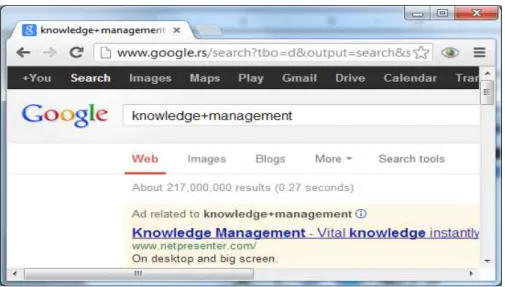
What is Knowledge management? What’s new about it? Do we really need knowledge management? Is it something that should be learned? If you type into your Web browser (e.g. Google) the keywords “knowledge management”, it will return more than 200,000,000 websites relating to the words knowledge and management, as can be seen in the Figure 1.
129
Clearly knowledge management arouses great interest. We live in a time when we are constantly bombarded with information. The question is how to find the right pieces of information and make use of them in a proper way. How should we choose what to read among these 217,000,000 sites? If we were to read all of them, it would require several hundred years to accomplish while Google was able to produced the search results in only 0.27 seconds! Did we manage any knowledge here?
Previously introduced technologies, such as the telephone, experienced much longer lifecycles than technologies introduced today. When your grandfather had a telephone, it was normal to consider that this item, which he had bought “God knows how many years ago”, would be used for the next 50 years. On the other hand, a mobile phone made only five years ago nobody wants and everybody thinks is awful even though it is fully functional. Such short technology product lifecycles is something that is considered normal today. As Peter Drucker once uttered that in a time of rapid change, the past is less and less connected with the future (Drucker, 1999). It is becoming increasingly difficult to guess or predict what life will look like tomorrow, which of the many new technologies will become indispensable, and which new products will emerge and remain competitive.
Additionally there is more and more new and diverse knowledge that can be immediately put into practice. As a result, it is becoming increasingly difficult to determine which knowledge is “right”. How does one get by with the vastness of the new knowledge available? When the pace of life was slow, it was easy to manage a relatively small amount of knowledge. Today, we can all witness that the pace of life has become hectic and everything is changing rapidly:
• Products are not single-purpose any more, but multi-purpose or even universal; • More and more knowledge is invested in such products;
• More and more knowledge is required in order to be able to use these products.
Knowledge management is becoming an imperative for survival in today’s information intense world.
The Industrial age has gone away
At the beginning of the 18th century, the world was predominantly an agricultural society. The majority of people worked and earned their living in agriculture. Hundreds and even thousands of peasants, or serfs, were needed to work on large farmlands. Then the inventions that were to change the world emerged: the steam engine and Watt’s revolution regulator (1770), which led to 10 or even 100 times increase of a man’s physical strength. At the time, all necessary goods (cookers, stoves, furniture, etc.) were made in craft workshops. Very quickly, the steam engine led to the making of the first automobile. Daimler and Benz introduced their first automobiles in 1889. The world was hungry for goods, and the few craft workshops in existence could not manufacture all the goods needed to match demand.
130
postulates, work was organized in a different way from the work organization in the workshops. The whole manufacturing process was broken down into parts or operations. The operations were conducted using machines which were set in such an order that they followed the technological procedure. That was the key to the product-making – to render more in a smaller time period and without engaging skilled craftsmen. Thousands of people who were “made redundant” in agriculture as the machines replaced them, came into towns in search of work. This was a perfect situation that made the industrial production possible. These people started working in factories, where they learned in a very short period of time a couple of routine operations at the machines and were able to perform one or two operations on the material in the product-making process. The material was then passed on to the colleague working on another machine where another operation was performed and so on. Each one of them knew only a little and could perform only a couple of operations on the object that was processed. Owing to the division of work & the knowledge “built into” the machines, productivity was some dozen times larger than in the case of manufacturing the product in the previous craft manner.
Of course, when a product is ordered in a craft workshop, it is tailor-made to suit you and your needs. A craftsman works for established customers and is focused on meeting their individual and possibly unique needs. For example, if you ordered a car from an eminent craft workshop, it would not be a problem if you said: ‘I’d like a bigger steering wheel, wider pedals than the ones you made for my neighbour, and a better quality of seat upholstery compared to his.’ A craftsman is someone who has an excellent knowledge of the materials he/she works with as well as the tools and technological processes while also being familiar with costs (Lovrekovic, 2012). A craftsman will immediately calculate the price of the changes you require and will make a deal with you respecting all your wishes. Furthermore a craftsman is capable of providing excellent quality. Therefore, quality and flexibility are synonyms for craft production. When a product is produced in a factory, the level of productivity is higher than when it is produced in a craft manner.
Besides productivity, there are some other differences between craft workshops and factories. The factory production process is rigid – tweaks and changes are not welcome and it is hard to make them. It is unlikely one could go into a car showroom and ask for a Fiat Punto with a bigger steering wheel and wider pedals.. How would a salesman react to such a request? What about the quality? What level of quality will one get if there are half-skilled workers at the machines, who are not either trained for or capable of flexible production? Such workers can perform a limited range of everyday routine operations but they are not familiar enough with materials and their characteristics and do not know the production technology or costs in order to accommodate custom requests. If there is any kind of production change, new machines or at least new tools on the existing ones would likely be provided and this again requires new operations and new production methods, all of which takes time to achieve and can be costly. A suit made by a good tailor has a higher value than a ready-to-wear item produced by a group of workers at a factory. The industrial product is mass-produced for stocks of ready-made goods, not tailored specifically for a particular customer.
131
of time along with the profit generated by the factory in order to make the investment cost-effective. Because of that, this heavy investment has to be calculated into the final product price. The more units of a product made, the lower the price per unit because the part of the price relating to the return on investment decreases with the increase in the number of units produced (i.e. the product is cheaper and thus is more affordable to a larger mass of customers). The production with the established system strives to keep such a system as every kind of change is expensive and difficult to achieve (Davidow & Malone, 1992). Back in the 1920s, Henry Ford was able to produce several millions of the famous T-model cars by having them all identical, and, of course, all in a single colour: black.
It has been more than 200 years since the steam engine made its appearance and almost 100 years since the Henry Ford era. Of course the market situation has changed since then as markets have become saturated. Today, most people in western societies have a car, mobile phone, and refrigerator and when they decide to buy a new item, there is a wide variety to choose from. No matter what a given company produces, in general, there appears to be several other companies producing the same kind of products and competing with it on the market. The question for survival is: how to make customers opt for your product on a supermarket shelf instead of the one made by the competitor sitting next to yours on the shelf. The key question is how to beat the competition? This question became important to companies operating in developing countries during the 1970s. At that time it appeared that the solution to the problem brought about by saturated markets with increasingly fierce and diverse competition was to execute a massive marketing campaign. Even today when I ask students how they would make sure that a customer would select their product instead of competitors the most common answer is a marketing campaign including advertising. However, advertising has a limited range of opportunities because if your product is not really good, customers will soon recognize this and turn to others at once.
The basic idea was to provide better quality in order to attract customers. After the 1970s, when Japanese products became known for their superior quality, user-friendliness, design and price the US customers started to demand the same characteristics from the products made in the USA. The domestic car manufacturers responded by including additional process steps for better product control within the standard classical industrial production approach used at that time. These additional steps were focused on the quality control of finished products, the quality control of raw materials, controls introduced between the production stages, etc. Every control required special equipment and instruments/tools (for example, particular welds had to be checked by using x-ray devices), people to perform the new control, and space where the control was to take place,all of which added cost to the process. This led to the fact that almost 50% of the production price accounted for the quality control measures and the additional processing of products that did not meet the quality standards. The resulting product price was raised to such an amount that it could not compete with the Japanese price point (Port, 1991). Everything that could be done regarding the quality was done, as well as regarding marketing. However, the problems pertaining to oversaturated markets and tough competition still remained.
132
As a result, this business concept that had been developing for years while we were entirely unaware and uninterested in it was taking place. The reengineering of the old business processes “smashed” the established procedures and ways of how something used to be done or produced and introduced completely new and totally unknown processes and ways of working. This raised the level of modern company performance measures to significantly higher ones. The aim of reengineering is not to make us improve our work by 20% but by 200% or even 700% or 800%. "Reengineering is the fundamental rethinking and radical redesign of business processes to achieve dramatic improvements in critical contemporary modern measures of performance, such as cost, quality, service, and speed (Hammer &Champy, 1992). According to Benis and Mische (1997) reengineering is: “reinventing the enterprise by challenging its existing doctrines, practices, and activities and then innovatively redeploying its capital and human resources into cross-functional processes“. This reinvention is intended to optimize the organization’s competitive position, its value to shareholders, and its contribution to society (Benis & Mische,1997).
Soon after the appearance of reengineering, the latest wave of activities attempting to contribute to competitiveness has emerged – knowledge management. The theory of knowledge management is becoming more and more popular. And it is no longer just a theory as there are numerous case study initiatives for knowledge management introduced in companies worldwide seeking the benefits brought about by such initiatives.
Let us briefly go back to the analysis of the classical industrial way of doing business – mass production. Owing to the concepts created by Adam Smith and Frederick Winslow Taylor who are the pioneers of scientific management, and the manufacturing premises established by Henry Ford, the characteristics of industrial production are determined:
• Workers are capable of performing everyday routine work within a limited range of work activities.
• Production managers generally lack trust in their employees and are aware of the fact that the only way to maintain productivity and cost-effectiveness is by producing the largest possible number of products with the smallest possible number of changes.
• A low level of responsibility is given to workers, who also lack motivation.
• Management, coordination and control are separated from product-making processes, hence the managerial bodies are formed which do not provide any added value directly for the customer but manage the working processes that actually create the added value for the customer. Namely, the post of a foreman is transferred into the hierarchy of managers whose duty it is to ensure that the product performance is provided.
• In this way a “hierarchy of power” is created within the production plant which results in the fact that decisions and behaviour of foremen and unit heads are not driven by company interests but instead by their personal interests to keep and secure their privileged position within the working class hierarchy.
• When errors or mistakes are detected during control processes, a part of such products is returned for additional processing if it is possible, or if not, they are thrown away. This results in increased production costs and the resulting product price.
• Because of that, managers hold the opinion that product quality and flexibility of production are the main obstacles to achieving a lower product price.
133
suppliers who also provide poor quality, do not meet delivery times or do not offer reliability.. This can also result in companies keeping large amounts of inventory in case there is a problem with suppliers.
• It goes without saying that large investments in inventory increases production costs while making the business more complicated and additionally decreasing the flexibility of the company.
• Outdated machines and equipment, which were cheap to buy, are used by workers who are not properly trained and who are not motivated to work. These machines frequently break down. The company is well-aware of these facts but it is a common practice to keep a large number of redundant machines or equipment available.
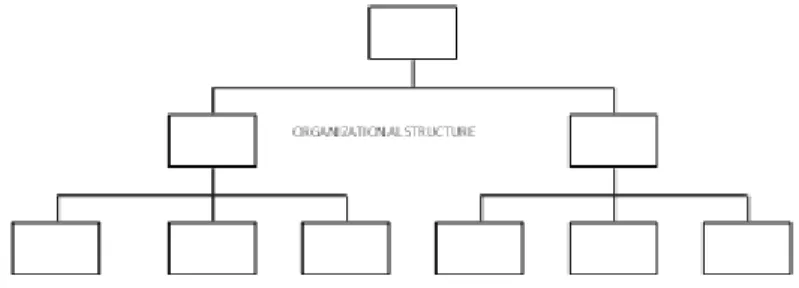
• The organizational structure is almost always hierarchical, as can be seen in Figure 3. It has been adopted from the army establishment and is based on the belief that it is possible to have direct and effective management of at most ten people at lower levels, while with the higher levels of responsibility, this number decreases. For example, there is a corporal who is in charge of a unit; a sergeant who is directly in charge of four corporals and their units; then a commander in charge of three or four sergeants, etc. Such a structure has been transferred to the production environment where the shop floor workers are managed by foremen and department heads, then these report to the heads of plants, the heads of plants report to the sector managers, and these to the general manager.
Figure 2: Hierarchical organizational structure
134
labouring to earn his pay. At the same time, his peer, who is not much of a worker, but who regularly brings special treats to the foreman, usually in a form of home-made brandy, gets assignment with the lowest possible hourly rate of work to be done, so that he can easily exceed the set rate, and logically, earn better money. So much for the flexibility and innovation in such organizations!
How is it possible to overcome the problems that mass production entails? First of all, what has to be done is to change the workforce structure. Workers have to be knowledgeable about their entire field of work; they have to be highly qualified for the work they do, as craftsmen used to be, and not just taught how to perform a limited number of operations on only one machine. They also have to have sound knowledge of information technologies in order to apply solutions provided by automatics, computers, software and new data organization within their scope of work activities. Such workers have to be given a higher degree of responsibility and independence work and decision-making authority in order to have flexibility increased as well as more efficient responses to challenging production demands requiring a higher motivational level necessary for high quality and an effective work environment. The workforce has to be skilled and motivated to take part in teamwork, to cooperate with other employees and to be encouraged to suggest ideas and proposals for enhancing production by introducing technological and organizational innovations and improvements.
What knowledge do we have to manage and why?
A large number of the definitions of knowledge are cited in the literature dealing with knowledge management:
• Nonaka and Takeuchi (1995) define knowledge as a true, justified conviction or belief. • Niva (2003) defines knowledge as a set of facts, convictions and experience.
• Davenport, Prusak and Prusak (1997) define knowledge as “a fluid mix of experience, contextual information and expert insight that provides a framework for evaluating and incorporating new experiences and information. It originates and is applied in the minds of knowers. In organizations, it often becomes embedded not only in documents or repositories but also in organizational routines, processes, practices, and norms.”
Let us briefly analyze the last definition, which is also the most comprehensive one. A fluid mix is something that constantly moves, boils, and is comprised of multiple components. Experience, contextual information and expert insight are cited as the ingredients of the fluid mix supporting knowledge. When I ask my students to define knowledge, or what their first association of knowledge is, I usually get answers such as books, what is written in the books, and what is learned in school. All of this is contextual information. Hardly anyone classifies experience as knowledge, but experience or expert insight is a very important component of knowledge. Furthermore, knowledge in books is static therefore not fluid by any means. How can it become an ingredient of the fluid mix? Well, only by application in the solving of real problems; thus one gains experience and becomes an expert as well.
135
purpose of increasing the business performance of a company. Knowledge management is seen as an answer to the problems that occur during operations under particular circumstances such as:
• Few products are capturing the market faster;
• Business globalization rate is increasing more and more; • The competition level is increasing;
• Technology is constantly changing; • Workforce is more and more diverse; • Suggested innovations are realized faster;
• The complexity of managerial surrounding is increasing faster;
• The future bears increasingly less resemblance to the past (Drucker, 1999).
With an increase of this topic's popularity and the “explosion” of new books, papers and authors in this field, the initially understood clear and logical reasons for knowledge management applications is becoming blurred. The most important answers that knowledge management should provide focus on how to operate well and how to be globally competent. A knowledge management strategy has to be fully correlated with the business strategy of an organization in order to lead to the success of a corporation. Therefore a knowledge management strategy has to be built on answers to the following questions:
• Who are our customers?
• What generates new values in our job?
• What are the relationships and partnerships that we have?
• What do we need in order to do what we have to do successfully?
It is important to note that the critical question is not "What do we need in order to do what we do successfully?" but "What do we need in order to do what we have to do successfully?". Karl-Erik Sveiby (2001) highlights that it is essential to understand knowledge as an object or a process. If you perceive knowledge as an object, for example if knowledge for you is some sort of advanced information, then for you knowledge management will likely mean investing in IT infrastructure (information and communication technologies). This interpretation is an easy way to make a mistake, and of course, an easy way to lose a lot of money. Ernst and Young, who are among the world's top five companies investing in knowledge management, admit that their initial investment of $100 million dollars in IT systems was a waste of money (Sveiby, 2001). However, if you believe that knowledge is a process, then you realize that it lies within people and therefore you can define knowledge as "the ability to act". This is very important for managers to understand since it leads to two very significant questions: Why do you need the people with vast knowledge but who are not able to do anything with it? And why do you need a pile of computers loaded with information, but without the appropriate people to use them? Computers and communication technologies are just enablers or tools dependent upon people.
136
it is of vital importance to understand the dynamic development and resulting perspectives of knowledge management, which can pose many dilemmas and quandaries. Knowledge management helps in better understanding a professionals (knowledge workers) influence in a company and in the management of their learning process and developmental needs. It deals with the possibilities brought about by the synergy between people's innovativeness and creativity and the advanced possibilities of information technologies.
Nonetheless, the number of successful initiatives for knowledge management in companies is still negligible in comparison to the number of published books and works on this topic. Why is it like that? Above all, the knowledge management field is still immature and therefore not defined clearly enough. As a result, a great number of authors approach this issue in very different ways. Even the very concept of knowledge management is defined in different ways depending on the opinions, attitudes, experiences and previous orientation of a given author.
Contemporary literature in this field embraces different concepts of knowledge management – from artificial intelligence, system theories and the application of information technologies, to the organizational, psychological and philosophical aspects of knowledge management. Knowledge management, therefore, is a highly fragmented set of concepts. The ideas for knowledge management are based on the wide set of already firmly established and defined scientific disciplines, from technical and technological to completely philosophical and psychological. The integration of these different approaches into one perspective is still the main challenge and precondition for the successful application of knowledge management.
Another large obstacle to the successful application of knowledge management is when humans keep knowledge “locked” for personal use for gaining one's own competitive advantage. Knowledge sharing is historically taboo in the human society. The way in which people are raised and educated in the social surrounding and in educational, organizational and business systems does not contribute to the forming of a knowledge sharing culture, motivate teamwork or create new knowledge. Mastering the sharing of knowledge includes a culture that celebrates teamwork, cooperation and work motivation. What gives the strength to the knowledge management movement today is the fact that economically most developed countries are facing a paradigm shift moving from the era of gaining competitive advantage resulting from information possession to the era of gaining competitive advantage through the creation of new knowledge.
The ability to create new knowledge results in: • new technologies;
• new products; • new processes; • high customization; • improved quality.
Additional customer satisfaction is what provides an organization with competitive advantage. A permanent “insight” into a customer is the basic precondition for successful knowledge management. Organizational knowledge management implies knowledge:
137
• organization;
• adaptation to specific problems; • sharing; and
• Knowledge application intended to improve business performance. Knowledge management can be realized in a company through:
• externally structured initiatives o Gaining knowledge from a user
o Offering additional knowledge to a user • internally structured initiatives
obuilding a knowledge sharing culture
ocreating a new source of existing knowledge
ocollecting individual knowledge, storing and distributing it in a company, and using it on multiple occasions
omeasuring of processes omeasuring of intangible assets • increase in competence
o creating careers based on knowledge management
o creating micro surroundings for transfer and sharing of knowledge
o learning through simulations and pilot installations
Intangible assets of a company
After performing a simple Google search on NASDAQ companies (2012) the results, detailed in the Figure 3, show the market value of Microsoft, Google, and Apple as follows:
• Microsoft – $229.94 billion dollars
• Google corporation – $228.99 billion dollars • Apple – even $509.28 billion dollars
Company name Valuation
Price
Change Chg % d | m | y Mkt Cap
MSFT Microsoft Corpora... 27.32 0.38 1.41% 229.94B
IBM Intl. Business Ma... 194.2 1.58 0.82% 219.43B
ORCL Oracle Corporation 32.34 0.27 0.84% 155.85B
HPQ Hewlett-Packard C... 14.26 0.1 0.71% 28.04B
ADBE Adobe Systems Inc... 35.54 -0.21 -0.59% 17.59B
RHT Red Hat, Inc. 50.76 1.24 2.50% 9.81B
SAP SAP AG (ADR) 79.82 0.39 0.49% 95.17B
138
In addition, Microsoft employed 90,000 people at the end of 2011, while Apple had about 34,000 employees. If we know that the book value (total assets) of each of these companies is by several hundred billion dollars lower than the market value, the question is: what makes such an enormous difference between the market and book values? The data on the book value and cash short-term investments of these companies in 2010 was found on the royal.pingdon.com web-site (Figure 4).
Figure 4: The book value of the high-technology companies
More than a year ago, the data were different, according to Mashable where the following is cited:
MacDailyNews (2011) crunched the numbers on a Friday after the market closed and found that Microsoft had a market value of $201.59 billion while Intel’s value was $115.21 billion. Combined, the two were worth $316.8 billion, which is still less than Apple’s $317.6 billion valuation. On 6 June 2011, Microsoft’s market value was $201.59 billion dollars which equated to a growth in market value of $30 billion dollars in the period of one year). In the same time period Intel’s market value was $115.21 billion dollars while Apple had a market value of $317.6 billion dollars which equated to a growth of almost $200 billion dollars over one year. That means that in 2011 Apple alone had the same value as Microsoft and Intel combined. At present, this difference is even larger. Why? Could it be because Apple is currently more innovative than Microsoft or Intel? Further market data from (Geekwire, 2012) revealed the following:
• Apple’s market value: $563 billion • Microsoft’s market value: $268 billion • Google’s market value: $199 billion • Intel’s market value: $141 billion • eBay’s market value: $52 billion
139
There are some other interesting facts on the same website. For instance, Amazon saw an increase in the number of employees by 9,400. It now employs 65,000 people, which is the largest growth in its employment achieved to date.
Intangible assets are considered to be enormously valuable company assets which should not be neglected by any means. The “Fortune” magazine editor-in-chief, Thomas Stewart, who is the author of the column Leading Edge, described it as “something new that can’t be touched, but which slowly makes you wealthy” (Stewart, 1997). Comparing the differences between a market and book value of a company, it can be concluded that this difference is on the increase in cases when a company’s core business activity is based on knowledge. Comparing the companies whose core activities are based on knowledge, we can see that the differences (as well as the market values themselves) go up along with the increase in the company’s innovativeness and faster provisioning of new knowledge, which can result in conceptually new products and improved customer satisfaction. The Scandinavian countries (Finland, Sweden, Denmark, and Norway) were among the first who became aware of these facts and who started looking for the mechanisms that would enable the recognition, measurement, tracking, monitoring, and of course, further development and enhancement of intangible assets for their companies.
There is another dimension to the measuring of intellectual capital that is of great importance – it enables better business management. If the company’s crucial values are known to us, we will know how to manage them in order to maximize growth. Profit is said to be a measure of a company’s success, but it is a measure relating only to an observed performance period. Apart from that, profit is an indicator of past performance whereas for the long-term company orientation, it is necessary to take the company’s capability to generate profits in the future as a more appropriate measure and that means measuring intellectual capital.
There are a wide variety of intellectual capital measurement methods suggested by various resources, as can be seen in the Figure 5. Sveiby’s and Skandia Navigator intangible assets measurement methods are similar in terms of defining intellectual capital. The only difference between them is the Skandia model has introduced one additional level by including innovation and process capital.
Intangible Assets Monitor
(Sveiby)
Skandia
Navigator
(Edvinsson)
IC-index
(Roos)
Balanced scorecard
Employees Individuals’
competence
Human capital Human capital Learning and growth
Organization Internal
structure
Organizational
capital
Infrastructure capital
Internal business processes
Customers External
structure
Customer capital Relationship
capital
Customers
140
Becoming aware of the existence of intellectual capital and its management are important management tools for every company working in today’s marketplace. Intellectual capital holds a central role in creating company and serves as an incentive for the company’s top management, its partners and customers to focus on measuring and reporting on knowledge and competences.
Conclusion
At the dawn of the industrial revolution and the establishment of industrial production, markets were unsaturated and hungry for goods. The producers were not faced with omnipresent and tough competition. The world was slower to change and therefore easier to predict. Industrial production, especially mass production, contributed to fantastic growth in productivity owing to the introduction of machines and the division of labour, both of which were of great importance at the point when they emerged. However they also entailed rigidity, poor quality and some not so aesthetic features of products. But that was not considered a problem back in those days. The customers were happy to get a product and nobody was asking for what product features they expected to see in the next generation of the product. In present times however, markets are oversaturated and competition is difficult to fight off. Product life-cycles and technology are shorter than ever before and working conditions are constantly changing. For these reasons, the best way to survive in today’s market lies in the capacity to frequently produce new work knowledge. More specifically, to perform business in such a way that innovations are produced on an everyday basis and not as a mere coincidence. The customer’s influence on creating the product and its features is greater than ever, while the capability to meet customer needs is a decisive factor of success. The market value of companies who are fast and efficient in providing innovations, which constantly offer new and attractive products and produce them in a proper way, who are sensitive to customer wishes and wants and provides flexibility is often valued higher than their book value by several hundred billion dollars. The ability to create, keep, constantly develop and enhance new organizational knowledge often determines which companies will be successful and distinguish themselves from those that are likely doomed to failure. This skill represents efficient knowledge management in such organizations.
141
production techniques were applied in these companies. The “age of knowledge” has arrived and was preceded by “the industrial age”. When will Servia finally be competitive with competitors like Toyota or BMW? Never if we do not accept the fact that the industrial age belongs to the past and that humanity has reached a new age – the age of knowledge.
References
Batchelor, R. (1994). Henry Ford: Mass production, modernism and design, Manchester U. Press.
Benis, W. & Mische, M. (1997.). The 21st Century Organization – Reinventing Through Reengineering, Jossey-Bass Publishers, San Francisco.
Davenport, T. H. & Prusak, L. (1997), Working Knowledge: How Organizations Manage What They Know, Harvard Business School Press, December, Journal Number, page numbers?.
Davidow, W. H & Malone, M. S. (1992), The Virtual Corporation – Structuring and Revitalizing
the Corporation for the 21st Century, Harper Business, New York, 10–11.
Drucker, F. P. (1999). Management Challenges for the 21st Century, Harper Business, New York.
Geekwire (2012). Amazon’s stock soars, tops $100 billion in market value. Retieved from http://www.geekwire.com/2012/amazon-stock-soars-tops-100-billion-market/
Google Finance (2013). Microsoft Corporation Stock. Retrieved from https://www.google.com/finance?q=NASDAQ%3Amsft
Hammer, M. & Champy, J. (1992), Reengineering the Corporation: a Manifesto for Business Revolution, New York: Harper Business.
Lovrekoviæ, Z. (2005). Influence of knowledge management concepts to increase students' ability to create new working knowledge at their future jobs, 3. Conference "On the road to the knowledge Age", Novi Sad.
Lovrekovic, Z. (2012). Knowledge Management, Higher Education Technical School of Professional Studies at Novi Sad.
Mashable (2011). Apple now worth more than Microsoft and Intel combines. Retrieved from http://mashable.com/2011/06/06/apple-worth-more-than-wintel/
Niva, K. (2003). Themes and Challenges of Knowledge Management: A Technology Management Perspective, PICMET03 Proceedings, Portland, USA.
142
New York, USA.
Pingdom (2010). How much big tech companies have in the bank. Retrieved from
http://royal.pingdom.com/2010/03/17/how-much-big-tech-companies-have-in-the-bank/
Port, O. (1991). Questing for the Best, Business Week/Quality, 10.
Smith, A., (1776). The Wealth of Nations ,An Electronic Classics Series Publication (2005.) http://www2.hn.psu.edu/faculty/jmanis/adam-smith/wealth-nations.pdf
Stewart, T. A. (1997). Intellectual capital: The new wealth of organizations, A Currency Book, Doubleday Dell Publishing Group Inc., New York, USA.
Sveiby, K. E. (2001) – Lessons from the Pioneers. Retrieved from
http://www.providersedge.com/docs/km_articles/km-lessons_from_the_pioneers.pdf
Taylor, F. W. (1911). The principles of scientific management, Harper & Brothers, New York,USA.
Acknowledgement
A sincere gratitude goes to Dr. Linda Brock for her assistance with the editorial task for this paper.
Biography
Zoran Lovrekovic is a professor at the Higher Technical School of Professional Education,