355
HEAVY DISC HARROW TESTING WITH INTEGRATED TRANSPORT
TRAIN FOR TRACTORS OF 80 - 100 HP
Bolintineanu Gh.*1), Voicea I.1), Cujbescu D.1), Persu C.1), Găgeanu I.1), Ungureanu N.2)
1)INMA Bucharest / Romania; 2)UPB Bucharest / Romania
E-mail: [email protected]
Keywords: harrow, disc, tractors, indeces.
ABSTRACT
Heavy-disc harrow with integrated GDG-2.7M transport train is intended for carrying out the work of harrowing stubble on medium and heavy light soils located on lands with a maximum slope of 22 °, as well as for discussing bulky and dry plows, in the framework for the preparation of the germinating bed for sowing. Depending on
the specificity of the work performed and the working conditions (plowing quality, humidity and soil type), the GDG-2.7M heavy disc harrow can also be used in aggregate with other ground grinding machines (soiled or adjustable harrows, staples or rollers). The paper presents the test methodology of the GDG-2.7M disc harrow.
INTRODUCTION
Germination bed preparation is very important to perform a good quality
seeding work (Cârdei et. al, 2007).
The design of the working organs of the harrows is essential from the point of view of proper tractor-implement matching and harrow design (Upadhyay and Raheman, 2019).
Minimal soil tillage is mainly done with main disc-type working organs, which are often combined with other
types of working organs (Vasilenko et al.,
2017).
Harrowing for processing
seedbed is necessary for aeration for its
aeration to maintain their aerobic
condition. Normally, the agricultural
machinery used to prepare the germinal bed are rotary hoes, subsoilers and offset disc harrows. The harrow spins the soil through evenly spaced discs, and the disk plow removes semicircular sections that help incorporate oxygen into the material. (Galama et al., 2015, Mota et al., 2017).
However, depending on the
irregularities of the soil profile, additional dynamic loads appear that can cause
damage that can affect the discs (Constantin et al., 2009).
For a wide range of models of disc harrows it has been found, through experimental researches that with the increase of the number of discs the possibility of deterioration will increase. The deterioration of the machines is an important problem often encountered in most of the machines used for agricultural work. Therefore, the structural stress analysis solutions have come to support
the elimination of this problem. (Isrel et
al., 2015). Experimental researches were carried out in order to study von Misses stress, as well as displacements in clutch couplings using the CATIA productive
structural analysis interface (Zaharia et
al., 2011).
Incorporating soil residues into
the soil, handling crop residues,
especially those left after harvesting crops requires a lot of work and is time consuming. Generally, the time for the preparation of the land ahead
the sowing of the next crop is
available for a limited period (Nalavade et
356
MATERIAL AND METHOD
The operation of the heavy disc harrow with integrated transport train GDG-2.7 is ensured by executing the following settings:
➢ adjusting the working depth, which is done both by the variation of the angle of attack of the discs and by the variation of the specific pressing on the disc;
➢ adjustment of the graft clearance to the longitudinal axis of symmetry of the tractor in order to balance the harrow in the horizontal - transverse plane;
➢ adjusting the traction device fixing position on the harrow frame. The heavy disc harrow with integrated GDG-2.7M transport train consists of:
➢ the harrow frame with the traction device;
➢ two batteries with discs arranged on a "V" frame;
➢ the compensation mechanism;
➢ integrated transport train;
➢ the hydraulic system.
Laboratory and field-laboratory tests. During the tests in laboratory and field-laboratory conditions with the heavy-disc harrow with integrated GDG-2.7M transport train were determined:
➢ functional indices;
➢ qualitative indices of work;
➢ energy indices.
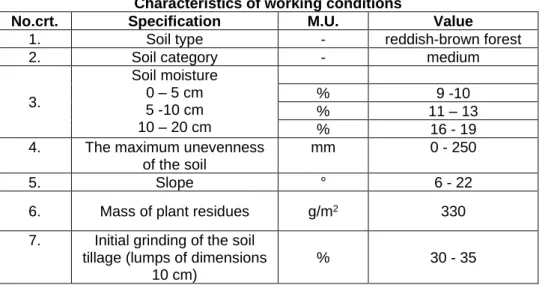
Table 1 presents the
characteristics of the working conditions.
Table 1 Characteristics of working conditions
No.crt. Specification M.U. Value
1. Soil type - reddish-brown forest
2. Soil category - medium
3.
Soil moisture 0 – 5 cm 5 -10 cm 10 – 20 cm
% 9 -10
% 11 – 13
% 16 - 19
4. The maximum unevenness
of the soil
mm 0 - 250
5. Slope ° 6 - 22
6. Mass of plant residues g/m2 330
7. Initial grinding of the soil
tillage (lumps of dimensions 10 cm)
% 30 - 35
The following functional indices were determined in the field-laboratory tests:
➢ the radius of return of the aggregate in work and in transport;
➢ the times of return of the aggregate in work and in transport;
➢ the transition time of the harrow from working position to transport position and vice versa;
➢ the lifting or lowering time of the transport wheels;
➢ the adjustment time of the attack angle of the disk.
In the field-laboratory tests the following qualitative indices of work were determined:
➢ average working depth;
➢ average working width;
➢ the degree of shredding of the soil;
➢ the degree of soil relaxation;
357
➢ the degree of incorporation in the soil of the vegetal remains.
Average depth is calculated by the formula:
1
100
n
i
i
m
a
a
n
=
=
where
am represents the average working
depth (cm);
ai represents the measured
working depth (cm);
Average working width is calculated by the formula:
:
1
100
n
i i m
B
B
n
=
=
where
Bm represents the average working
width (cm);
Bi represents the measured
working width (cm);
The degree of grinding of the soil is calculated by the formula:
better used when processing the soil at a]
1
100
n
ei
i ti
ms
M
M
G
n
=
=
1
100
nfi ii
i ii
ms
S
S
S
G
n
=
−
=
- where
Gms represents the degree of soil
shredding on the working depth of the machine (%);
Mei represents measured weight of
soil pellets with the maximum
conventional size less than 10 cm from the soil sample (kgf);
Mti represents the measured
weight of the entire soil sample (kgf). The loosening of the ground is calculated using the formula:
1
100
n
si
i
ti
av
G
G
G
n
=
358
RESULTS AND DISCUSSIONS
In the field-laboratory tests the following energy indices were determined:
➢ working speed of the aggregate;
➢ skidding;
➢ hourly fuel consumption;
➢ tensile strength;
➢ the power consumed for towing the harrow.
These indices were determined on lands with a slope of 20° -22°, under the conditions presented in table 1.
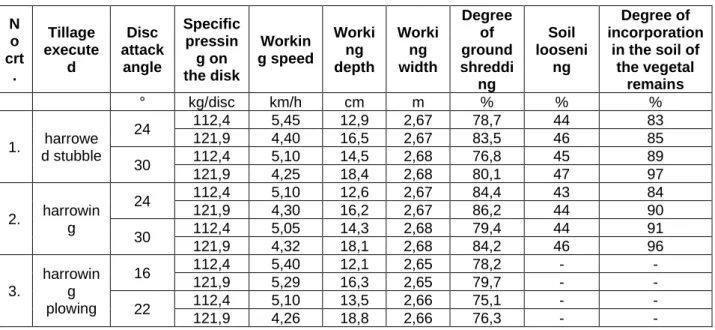
Table 2 presents the results of the functional index determinations. Table 3 presents the results of the measurements obtained from the experimental research of the qualitative indices of work. The results of the measurements of the average values of the energy indices are presented in table 4.
Table 2 Functional work indices
No.crt. Characteristics M.U. Value
1. The radius of return of the aggregate in transport m 6,2
2. The radius of return of the aggregate to work m 6,5
3. The return time in the transport of the unit sec. 25
4. The return time of the aggregate sec. 30
5. Time of shift of the harrow from working position to transport
position and vice versa sec. 285
6. Time to adjust the angle of attack sec. 300
Table 3 Qualitative work indices
N o crt .
Tillage execute
d
Disc attack
angle
Specific pressin
g on the disk
Workin g speed
Worki ng depth
Worki ng width
Degree of ground shreddi
ng
Soil looseni
ng
Degree of incorporation
in the soil of the vegetal
remains
° kg/disc km/h cm m % % %
1. harrowe
d stubble
24 112,4 5,45 12,9 2,67 78,7 44 83
121,9 4,40 16,5 2,67 83,5 46 85
30 112,4 5,10 14,5 2,68 76,8 45 89
121,9 4,25 18,4 2,68 80,1 47 97
2. harrowin
g
24 112,4 5,10 12,6 2,67 84,4 43 84
121,9 4,30 16,2 2,67 86,2 44 90
30 112,4 5,05 14,3 2,68 79,4 44 91
121,9 4,32 18,1 2,68 84,2 46 96
3.
harrowin g plowing
16 112,4 5,40 12,1 2,65 78,2 - -
121,9 5,29 16,3 2,65 79,7 - -
22 112,4 5,10 13,5 2,66 75,1 - -
359
Table 4 Energy indices
N o crt .
Tillage execute
d
Disc attack
angle
Specific pressin
g on the disk
Workin g speed
Workin g depth
Workin g width
Hourly fuel consum
ption
Skidding
Power consum ed for towing
the harrow
° kg/disc km/h cm m % % HP
1. harrowe
d stubble
24 112,4 5,45 12,9 2,67 10,7 5,4 44,6
121,9 4,40 16,5 2,67 12,8 7,1 50,0
30 112,4 5,10 14,5 2,68 12,3 6,2 52,7
121,9 4,25 18,4 2,68 14,6 9,9 54,3
2. harrowin
g
24 112,4 5,10 12,6 2,67 10,9 6,1 45,5
121,9 4,30 16,2 2,67 12,8 8,3 50,2
30 112,4 5,05 14,3 2,68 12,1 5,9 52,0
121,9 4,32 18,1 2,68 14,5 9,6 54,4
3.
harrowin g plowing
16 112,4 5,40 12,1 2,65 10,8 13,8 40,0
121,9 5,29 16,3 2,65 13,0 15,1 56,2
22 112,4 5,10 13,5 2,66 11,7 14,3 49,9
121,9 4,26 18,8 2,66 14,2 16,7 52,9
Analyzing the results of the experimental determinations it is observed the following:
➢ the working depth achieved by the harrow increases as the angle of attack increases or the specific pressing on the disc;
➢ at a specific pressure of 112,4 kg/disk (unstamped staple) and the attack angle of 24° - 30° the working depth is 12,9-14,5 cm for the work to be discussed in the stubble and 12,6- 14,3 cm for the work to be discussed the degree of thinning of the soil also varies with the angle of attack of the disks, increasing with its increase the average values being between 80,5% and 92,8% the values
corresponding to the
requirements for disc harrows;
➢ at the same specific press on the disk and angles of attack of 16° -22° the working depth realized by the harrow at the work to be discussed in boulder is 12,1-13,5 cm;
➢ at the same angle of attack, there is an increase of the degree of ground shearing as the working
depth increases, respectively as the specific pressing of the disk increases;
➢ there is an increase in the degree of loosening with increasing working depth;
➢ the degree of cutting of the corn and the corn roosts varies depending on the increasing variation of the angle of attack;
➢ at the angle of attack of 24° the cutting degree of the vegetal debris is 95,3-96,1% for the staple work and 96,1-96,7% for the staple work;
➢ the degree of incorporation in the soil of the vegetal remains was 83-85% at an angle of attack of 24° and of 89-97% at an angle of attack of 30°;
➢ the strength of resistance varies incrementally as the working depth increases, it having values of 2210-2790 kgf for unpowered harrow and 3079-3450 kgf for 200 kg weighted harrow;
360
ACKNOWLEDGEMENT:
This work was supported by the Romanian Research and Innovation Ministry, through the project entitled “Researches on achieving integrated systems for the bioeconomy field according to the concept of intelligent agriculture” – PN 19 10 01 01 – Ctr.
5N/07.02.2019, and through Programme 1 – Development of the national
research-development system,
subprogramme 1.2 – Institutional performance – Projects for financing excellence in RDI, contract no. 16PFE.
BIBLIOGRAPHY
[1] Cârdei P., Kolozsvari C.,
Candea I. (2007). Researches
regarding the problem existence of an optimal space of the disk harrows work process, INMATEH, Vol. 21. Nr. 3/2007, pp: 85-92. [2] Constantin N., Cojocaru I., Pirna
I, Nitescu V., Leu I. (2009).
Independent disk harrows for
stubble-turn and ready
germination, all types of soil, designed 120-220 hp tractors, INMATEH, Vol.27, No.1/2009, pp: 139-143.
[3] Galama P.J., de Boer H.C., van Dooren H. J. C., Ouweltjes W., Driehuis K. (2015). Aspects of ten bedded pack dairy barns in The Netherlands, Wageningen.
[4] Irsela G., Altinbalikb T., Can Y. (2015). Failure Investigation of the Disc Harrow Profiles and Redesigning by CATIA Analysis, Applied Mechanics and Materials Vol. 729, pp: 181-186.
[5] Mota V.C., Damasceno F.A.,
Leite D.F. (2018). Fuzzy clustering and fuzzy validity measures for knowledge discovery and decision
making in agricultural engineering, Computers and Electronics in Agriculture 150, pp:118-124.
[6] Nalavade P. P., Peeyush S.,
Salokhe V., M., Niyamapaa T.
(2013). Development of a powered
disc harrow for on-farm crop residue management, International Agricultural Engineering Journal, Vol. 22, No. 1, pp: 49-60.
[7] Reicosky D. C., Wilts A. R.
(2005). Crop residue management.
Encyclopedia of Soils in the Environment, Elsevier Ltd. Volume 1: pp 334-338.
[8] Upadhyay G., Raheman H.
(2019). Specific draft estimation
model for offset disc harrows, Soil & tillage research, ISSN: 0167-1987 pp. 75-84.