223
THE FAVORABILITY OF THE VITICOL YEAR 2018 FOR
THE CULTURE OF WINE IN THE ECOLOGICAL SYSTEM IN
THE MURFATLAR VITICULTURAL AREA
STROE C.T., BOTU M., BĂDUCĂ CÎMPEANU C.
Keywords: viticulture, viticol year, ecological system.
ABSTRACT
The culture of the vine in an ecological system requires particularly favorable climatic conditions that allow the growth, development and maturation of the grapes under optimal conditions. To do this, the climatic conditions must limit as much as possible the development of diseases and pests. Therefore, the temperature regime and the water regime are prime factors for the favorability of a wine-growing area. Research has shown that the year 2018 was particularly warm but also with a surplus of rainfall, especially during the growing season, which also led to a decrease in the duration of the sun's brightness. Therefore, the year 2018 was more favorable to the ecological system for the white varieties and less favorable for the red varieties.
INTRODUCTION
It is well known that the world’s great wines are produced in regions with an appropriate climate for growing specific grape varieties. Based on the environmental interactions, the viticultural profession has provided a world «zoning», mapping the ecopedological and geographical characteristics of the grape-growing territory in relation to the adaptive response of wine grapes (Morlat, R., 1992). In recent years, several integrated and interdisciplinary studies have been carried out to determine the aptitude of vines for cultivation in different viticultural zones. These studies show the impact of different environmental characteristics such as hydrology, geology, climate and the surrounding ecology, factors defining the singularity of an area in terms of grape production (Falcão L.D. e.a., 2010). Grape quality varies according to the daily temperature range during the ripening period, because this parameter affects the sugar and anthocyanin composition, as well as the aroma; photosynthesis occurs during the day and at night the photosynthesis products move from the source leaves to the fruit. During grape ripening, cool night
temperatures favor the sugar accumulation and restrictnthe vegetative growth (Mori K. e.a., 2007). Meteorological parameters have a crucial influence on grapevine (Vitis vinifera L.) production quantity and quality. Most of the commonly used bioclimatic indices are not appropriate to represent intravineyard micrometeorological variability, in particular the subdaily dynamics that are important in grape maturation processes (Matese A. e.a., 2012). Vine phenology and grape ripening are highly dependent on water uptake conditions. Moderate water deficits reduce shoot growth, berry size and yield and enhance fruit ripening and phenolic compound synthesis in the berries. These factors generally enhance grape quality for the production of red table wines (Van Leeuween C. e.a., 2009).
224 grape quality (Chou M.-Y., Vanden Heuvel Justine, 2019).
Pedoclimatic conditions affect grape and wine quality. In particular, the relationship between soil and grape quality is at the core of the terroir definition (De Santis Diana e.a., 2017). Grapevine yield and fruit composition largely depend on vine water status, which can be manipulated, especially in semiarid climates, by irrigation strategies and training systems (Mirás-Avalos J. e.a., 2017). Weather conditions have a
significant impact on crops, and temperature is one of the main factors that controls plant development. Thermal time models based on temperature have been applied to predict the development of many species. To implement these models, determination of an appropriate base temperature (Tb) is required to characterize the differences among developmental stages and cultivars (Zapata Diana e.a., 2017).
MATERIAL AND METHOD
The favorability of the viticol years for the culture of the vine in ecological system was studied by analyzing the climatic data (temperature, precipitation, insulation) characteristics of the mentioned viticol year. In this respect, for each climatic factor, the data for the viticol year were compared with the multiannual average values. Regarding the temperature, the 3 types of thermal balance (global, active and useful), the average temperature of each month, the minimum and maximum temperatures of each month were analyzed. Regarding its precipitation, the values of each month were analyzed as well the number of days of precipitation of each month on 3 levels: over 0.1, 5 and 10 mm. The insolation was analyzed as the number of hours the sun shines during the vegetation period (April 1 - September 30).
RESULTS AND DISCUSSIONS
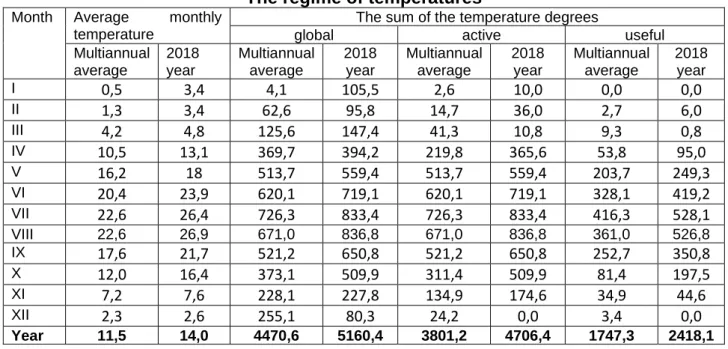
The data regarding the thermal regime characteristic of the year 2018 are presented in table 1 and shows that this was a particularly hot year, with an average temperature (140C) well above the multiannual average value (11.50C). Also, all the 12 months of the year were warmer compared to the multiannual average values of the respective months. The lowest difference was in December, when the average temperature was only
0.30C higher than the multiannual average temperature this month, and the biggest differences were in October (4.40C), August (4.30C) and July (4.20C).
225 The analysis of the data on the precipitation regime show that the year 2018 was much wetter than the multiannual precipitation average. Thus, compared to an average of 436 mm of annual precipitation, in 2018, 654.8 mm of precipitation fell. The most important aspect, however, is that during the growing season there were 364.3 mm of rainfall, well above the multiannual average (245.7 mm). The months of June and July were particularly rainy. These were the only months of the year that far exceeded 100 mm of rainfall, especially in June (130 mm). In the two months, rainfall was 3 times higher than the multiannual averages. This makes the cultivation of vines in the ecological system very difficult because it greatly increases the risk of disease attack.
To better characterize the precipitation regime of 2018, we also analyzed the number of days with rainfall and the data show that this year there were 111 days with rainfall, of which 39 days had rainfall over 5 mm and only 20 days had rainfall over 10 mm. Curiously, in the two months with excess rainfall, there were only 4 days with rainfall greater than 10 mm. This shows that during these 4 days the rains were particularly abundant.
One of the consequences of the excess rainfall was the decrease of the insolation during the growing season from 1587 hours (multiannual average) to 1247 hours (the value of the year 2018). This greatly reduces the favorability of the viticultural year for the ecological system cultivation of varieties for red wines, which need high insolation values for anthocyanin synthesis. A duration of sunlight during the vegetation period of less than 1250 hours is incompatible with obtaining quality organic red wines.
CONCLUSIONS
The year 2018 was contradictory in terms of the favorability for the cultivation of vine in an ecological system in the Murfatlar viticultural area. On the one
hand, it has been an excessively hot year, characterized by temperatures well above the multiannual averages throughout the months of the year, which can be beneficial for organic viticulture under certain conditions. This increase of heat was manifested especially in the summer and autumn months, from July to October, a period that coincides with the process of ripening the grapes, from véraison to harvest.
On the other hand, it was a year of excessive rainfall, but they were not distributed evenly throughout the year. Thus, in January, February and March, rainfall was much higher than the multiannual averages. For example, in March 2018 rainfall fell 71 mm, more than 3 times more than the multiannual average (21.7 mm). The situation was repeated in June and July. In May and August, rainfall was also higher than multiannual values but the differences were much smaller. In contrast, there were also months of precipitation well below the multiannual averages, as were April, September and October.
Thus, in April and October, rainfall was slightly over 5 mm, 6 times less than multiannual averages but in September rainfall was slightly over 4 mm, 10 times less than the multiannual average.
226
BIBLIOGRAPHY
1. Chou, M.-Y., Vanden Heuvel, Justine, 2019 - Annual Under-Vine Cover Crops Mitigate Vine Vigor in a Mature and Vigorous Cabernet franc Vineyard. American Journal of Enology and Viticulture, vol. 70, nr. 1, pag. 98-108. 2. De Santis, Diana, Frangipane, Maria Teresa, Brunori, Elena, Cirigliano, P., Biasi, Rita, 2017 - Biochemical Markers for Enological Potentiality in a Grapevine Aromatic Variety under Different Soil Types. American Journal of Enology and Viticulture, vol. 68, nr. 1, pag. 100-111. 3. Falcão, L.D., Burin, V., Chaves, E.S., Vieira, H.J., Brighenti, E., Rosier, J.P., Bordignon-Luiz, M.T., 2010 - Vineyard altitude and mesoclimate influences on the phenology and maturation of Cabernet-Sauvignon grapes from Santa Catarina State. Journal international des sciences de la vigne et du vin, vol. 44, nr. 3, pag. 135-150.
4. Matese, A., Crisci A., Di Gennaro, F.S., Fiorillo, E., Primicerio, J., Toscano, P., Vaccari, F., Di Blasi, S., Genesio, L., 2012 - Influence of Canopy Management Practices on Vineyard Microclimate: Definition of New Microclimatic Indices. American Journal of Enology and Viticulture, 2012, vol. 63, nr. 3, pag. 424-430.
227 (Vitis vinifera). The Journal of Horticultural Science and Biotechnology, vol. 82, nr. 2, pag. 199-206.
7. Morlat, R., 1992 - Le terroir viticole: contribution à l’étude de sa caractérisation et de son influence sur les vins. Application aux vignobles rouges de moyenne vallée de la Loire. Revue Française d'OEnologie, nr. 32, pag. 6–13. 8. Triolo Roberta, Roby J.Ph., Plaia Antonella, Hilbert G., Buscemi Simona, Di Lorenzo R., van Leeuwen C., 2018 - Hierarchy of Factors Impacting Grape Berry Mass: Separation of Direct and Indirect Effects on Major Berry Metabolites. American Journal of Enology and Viticulture, vol. 69, nr. 2, pag. 103-112.
9. Van Leeuween, C., Trégoat, O., Choné, O., Bois, B., Pernet, D., Gaudillère, J.P., 2009 - Vine water status is a hey factor in grape ripeninh and
vintage qualizy for red Bordeaux wine. How can it be assessed for vineyard management purposes? Journal International of Sciences Vigne Vin, vol. 43, nr. 3, pag. 121-134.
10. Zapata, Diana, Salazar-Gutierrez,
M., Chaves, B., Keller, M.,
Hoogenboom, G., 2017 - Predicting Key Phenological Stages for 17 Grapevine Cultivars (Vitis vinifera L.). American Journal of Enology and Viticulture, vol. 68, nr. 1, pag. 60-72.
Table 1
The regime of temperatures
Month Average monthly
temperature
The sum of the temperature degrees
global active useful
Multiannual average
2018 year
Multiannual average
2018 year
Multiannual average
2018 year
Multiannual average
2018 year
I 0,5 3,4 4,1 105,5 2,6 10,0 0,0 0,0
II 1,3 3,4 62,6 95,8 14,7 36,0 2,7 6,0
III 4,2 4,8 125,6 147,4 41,3 10,8 9,3 0,8
IV 10,5 13,1 369,7 394,2 219,8 365,6 53,8 95,0
V 16,2 18 513,7 559,4 513,7 559,4 203,7 249,3
VI 20,4 23,9 620,1 719,1 620,1 719,1 328,1 419,2
VII 22,6 26,4 726,3 833,4 726,3 833,4 416,3 528,1
VIII 22,6 26,9 671,0 836,8 671,0 836,8 361,0 526,8
IX 17,6 21,7 521,2 650,8 521,2 650,8 252,7 350,8
X 12,0 16,4 373,1 509,9 311,4 509,9 81,4 197,5
XI 7,2 7,6 228,1 227,8 134,9 174,6 34,9 44,6
XII 2,3 2,6 255,1 80,3 24,2 0,0 3,4 0,0
Year 11,5 14,0 4470,6 5160,4 3801,2 4706,4 1747,3 2418,1
Table 2
The regime of precipitations and insolation
Month Precipitations Insolation (hours)
Multiannual average
2018 year Number of days with rain Multiannual
average
2018 year > 0.1 mm > 5 mm > 10 mm
228
II 33,0 92,5 14 7 3
III 21,7 71,0 13 6 3
IV 33,5 5,2 2 0 0 160,7 196,8
V 50,2 67,2 7 3 2 261,8 212,6
VI 53,2 130,5 8 6 4 314,5 175,35
VII 35,6 110,8 15 4 4 323,7 196
VIII 31,6 46,4 3 1 1 305,5 280,9
IX 41,6 4,2 9 0 0 221,0 212,7
X 30,2 5,8 5 0 0
XI 40,4 41 13 4 1
XII 34,0 26,2 14 3 0