131
REACTION OF WALNUT NATIVE GENOTYPES TO KEY ATTACK OF
XANTHOMONAS CAMPESTRIS PV. JUGLANDIS (PIERCE)
DYE.,UNDERTHECLIMATIC CONDITIONS
VÂLCEA AREA
Simona Giura1, Glodeanu Mihnea Valeriu2, Rodi Mitrea1,
1University of Craiova, Faculty of Horticulture, Department of Horticulture and Food Science, Str. Al. I. Cuza nr. 13, Craiova 200585, Romania 2 University of Craiova, Faculty of Agronomy, Str. Libertatii, No 19, Craiova, Romania
Keywords: walnut, variety, hybrid, correlation, regression.
ABSTRACT
Research on the behavior of domestic walnut genotypes (varieties and hybrids) between 2015 - 2016 at S.C.D.P. - Valcea, have conducted to attack the pathogen Xanthomonas campestris pv. juglandis (Pierce) Dye.
The research aimed to establish the influence of rainfall between March and June of years of research on the incidence of Xanthomonas campestris pv. juglandis (Pierce) Dye., attack on 14 walnut genotypes under natural infection.
INTRODUCTION
Blight or walnut bacterium is the main bacterial disease affecting the walnut crop cultivators in most countries.
In terms of Romania, especially in the nearby Carpathian walnut with higher humidity it is very strongly affected.
Causing bacteria (Xanthomonas campestris pv. juglandis) infects young shoots, leaves, female and male flowers and especially the fruits (Teviotdale and Schroth 1998, Bandi 2014).
Tissue penetration by the pathogen occurs through stomata, through flower stigmas and through artificial openings (cuts, injuries, strokes mechanical) spread during vegetation accomplished with the help of drops of water, wind and insects.
Teviotdale and Schroth(1998), studying the pathogen in vitro biological parameters determine the threshold temperature is 1° C, the optimal threshold is between 22-32° C and the maximum is 37° C.
Adaskaveg J. E. et al., in (2004), observed for the first time in artificial conditions (rain programmed in plastic tunnels after producing budbreak), the incidence of pathogen attack produced is directly proportional to the number of scheduled rains. Thus, comparative plants (without rain) attack amounted to 6.60%, while artificial rains after the attack amounted to 31.90%.
Through this paper, it was proposed to establish under the effect of natural rainfall in the years 2015 - 2016, on the frequency (F%) and intensity of the attack the pathogen
Xanthomonas campestris pv. juglandis, some walnut genotypes grown in experimental fields at Research Fruit Growing the Station of Valcea (Carpathian area of Oltenia).
It was noted that varieties of walnut has a differentiated resistance to blight, depending on environmental zones and where they were or cultured as mentioned a number of authors: Woeste K., et. al., 1992; Mulrean and Schroth 1982; Vagelas I. K. et. al., in 2012; Botu in 2010 and Flondor2011.
MATERIAL AND METHODS
132
rootstock of juglans regia. During the growing season (March to June) plants were treated for five times with bouille bordelaise at 0.5% concentration.
Field observations have aimed to establish frequency (F%) and intensity (I%) at
Xanthomonas campestris pv. juglandis bacterium attack on leaves and fruit at different times (June to September), to illustrate the evolution of the attack and the behavior of walnut genotypes depending on the time of the determination.
Correlations pathogen attack was done with rainfall (number of days with rain, the amount of water recorded monthly) in the two years of study in the March to June.
RESULTS AND DISCUSSION
In 2015 and 2016 years, under theResearch Fruit Growing the Station of Valcea, at all genotypes of walnut was found to contain the attack of the pathogen Xanthomonas campestris pv. juglandis (Tables 1, 2, 3 and 4).
Analysis of data from table 1, show that in june 2015 the average frequency of attacks leaves ratio was 5.69% compared to 9.95% as was recorded in 2016.
The biggest differences in the frequency of attacks leaves values in 2016 compared to 2015 were recorded in varieties Velnita (8.09%), Sibişel 44 (5.25%) and Sarmis (8.67%).
Intensity of the attack on the leaves in june was comparable values in 2015 and 2016 in most genotypes except VL 102H (11.85%) and Sarmis (5.95%).
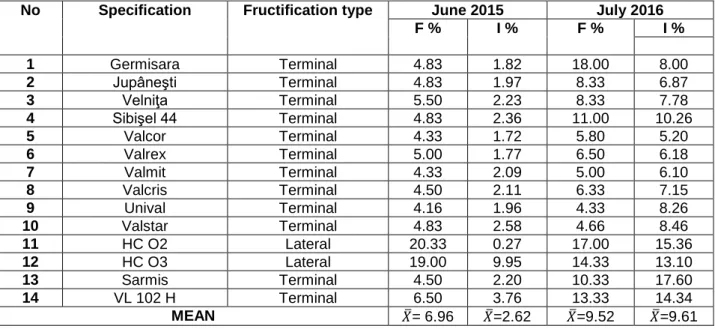
The attack on fruit in June (Table 2) joined with averages of greater frequency and intensity in 2016 (9.52% and 9.61% respectively) compared to 2015 (6.96% and 2.62%).
In 2015, the 14 genotypes of walnut, attack frequency values fluctuated within narrow limits, except selections HC O3 and HC O2 growing side, while the intensity was higher in HC O3 (9.95%) and VL 102H ( 3.76%).
The frequency of attacks fruit in 2016, June had values generally higher than in 2015, except genotypes Valstar (4.83% - 4.66%), HC O2 (20.33% - 17.00%) and HC O3 (19,00% -% 14.33), while intensity was elevated regardless of genotype.
The conclusion is that 2016 the attack at Xanthomonas campestris pv. juglandis
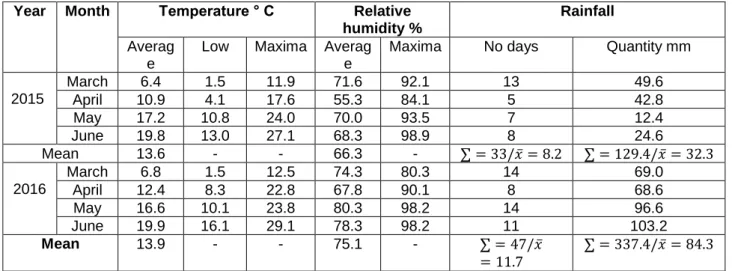
bacterium on leaves and fruit in June had a frequency and intensity higher than in 2015, a phenomenon blamed on the number of rainy days (33 days/2015 and 47 days/2016), but also on account of rainfall (129.4 mm/337.4 mm 2015/2016) Table 5.
The observations in september on blight attack on the leaves and fruit (Tables 3 and 4), revealed that the attack frequency value increased from 6.93% in leaves (2015) to 11.00% (2016), and the intensity of attacks increased from 6.14% (2015) to 9.61% (2016).
In the two years of observations mean frequency of attacks increased from June to September (5.69% to 6.93%) in 2015 and 9.95% to 11.00% in 2016.
Blight attack on the fruit increased both in frequency and intensity in 2016 compared to 2015. The average frequency of attacks in September was 8.55% (2015) and 12.05% (2016) and the intensity of 3.28% (2015) to 9.35% (2016). Blight attack in two years of observations it was heavily influenced by genotype and environmental conditions (rainfall from March to June).
The varieties with high resistance proved to be: Valcor, Valstar, Valrex and Valcris varietyes and are most susceptible genotypes HC O2, HC O3, Germisara Velnita and Sibişel 44.
Regression and correlation analysis of the correlation coefficient for attack (F%) on the leaves and fruits have resulted in:
• Leaf regression equation - y = 0.29 x - 3.21 and the coefficient of correlation r = 0.960;
133
Biostatistical analyzes resulting from that under more intense rainfall during the period from March to June, bacteriosis attack both the leaves and fruit is more evident. The attack occurred in that period maintain product superiority and attack frequency and intensity in September.The results obtained at theResearch Fruit Growing the Station of Valcea, under natural conditions, confirms the results obtained in vitro Adskaveg et. al. 2004 in California.
Table 1
The attack produced by Xanthomonas campestris pv. juglandis (Pierce) Dye.,on the leaves of native genotypes of walnut, in 2015-2016 conditions years
Table 2
The attack produced by Xanthomonas campestris pv. juglandis (Pierce) Dye.,on the fruits of native genotypes of walnut, in 2015-2016 conditions years
No Specification Fructification type June 2015 July 2016
F % I % F % I %
1 Germisara Terminal 6.83 5.52 9.50 2.00 2 Jupâneşti Terminal 2.91 2.75 9.50 4.64 3 Velniţa Terminal 5.41 4.39 13.50 6.17 4 Sibişel 44 Terminal 6.08 4.04 11.33 7.05 5 Valcor Terminal 3.75 2.14 5.83 2.07 6 Valrex Terminal 3.33 2.56 6.33 4.40 7 Valmit Terminal 4.08 3.67 8.33 1.82 8 Valcris Terminal 3.41 2.91 6.50 3.10 9 Unival Terminal 2.91 3.86 3.66 5.40 10 Valstar Terminal 2.50 4.01 5.00 5.26 11 HC O2 Lateral 14.16 14.64 18.50 12.52 12 HC O3 Lateral 15.50 10.04 16.33 7.42 13 Sarmis Terminal 3.66 5.08 12.33 11.05 14 VL 102 H Terminal 5.33 4.15 12.83 16.00
Mean 𝑋̅= 5.69 𝑋̅=4.98 𝑋̅=9.95 𝑋̅=6.35
No Specification Fructification type June 2015 July 2016
F % I % F % I %
1 Germisara Terminal 4.83 1.82 18.00 8.00
2 Jupâneşti Terminal 4.83 1.97 8.33 6.87
3 Velniţa Terminal 5.50 2.23 8.33 7.78
4 Sibişel 44 Terminal 4.83 2.36 11.00 10.26
5 Valcor Terminal 4.33 1.72 5.80 5.20
6 Valrex Terminal 5.00 1.77 6.50 6.18
7 Valmit Terminal 4.33 2.09 5.00 6.10
8 Valcris Terminal 4.50 2.11 6.33 7.15
9 Unival Terminal 4.16 1.96 4.33 8.26
10 Valstar Terminal 4.83 2.58 4.66 8.46
11 HC O2 Lateral 20.33 0.27 17.00 15.36
12 HC O3 Lateral 19.00 9.95 14.33 13.10
13 Sarmis Terminal 4.50 2.20 10.33 17.60
14 VL 102 H Terminal 6.50 3.76 13.33 14.34
134
Table 3
The attack produced by Xanthomonas campestris pv. juglandis (Pierce) Dye.,on the leaves of native genotypes of walnut, in 2015-2016 conditions years.
Table 4
The attack produced by Xanthomonas campestris pv. juglandis (Pierce) Dye.,on the fruits of native genotypes of walnut, in 2015-2016 conditions years.
No Specification Fructification type
September 2015 September 2016
F % I % F % I %
1 Germisara Terminal 6.58 5.75 12.30 9.47
2 Jupâneşti Terminal 3.25 3.30 10.83 9.00
3 Velniţa Terminal 6.25 4.10 16.30 11.50
4 Sibişel 44 Terminal 6.91 5.20 12.30 10.40
5 Valcor Terminal 4.41 2.94 6.16 4.28
6 Valrex Terminal 4.05 2.14 7.50 2.75
7 Valmit Terminal 4.66 3.75 8.30 1.82
8 Valcris Terminal 4.08 2.78 7.30 1.76
9 Unival Terminal 3.75 2.32 4.60 4.93
10 Valstar Terminal 3.16 4.42 5.16 4.54
11 HC O2 Lateral 15.50 13.04 16.10 19.05
12 HC O3 Lateral 16.50 11.92 18.00 22.84
13 Sarmis Terminal 4.16 5.56 13.50 15.36
14 VL 102 H Terminal 13.80 18.81 15.50 16.82
MEAN 𝑋̅= 6.93 𝑋̅=6.14 𝑋̅=11.00 𝑋̅=9.61
No Specification Fructification type
September 2015 September 2016
F % I % F % I %
1 Germisara Terminal 6.65 1.66 9.00 11.69
2 Jupâneşti Terminal 6.00 2.42 11.60 11.78
3 Velniţa Terminal 6.80 1.75 12.60 13.48
4 Sibişel 44 Terminal 7.65 1.99 14.00 13.76
5 Valcor Terminal 5.30 2.25 0.00 0.00
6 Valrex Terminal 6.00 1.65 0.00 0.00
7 Valmit Terminal 5.30 2.34 6.33 5.88
8 Valcris Terminal 6.30 2.03 8.00 5.44
9 Unival Terminal 5.15 2.77 7.33 6.82
10 Valstar Terminal 6.00 2.07 6.00 7.72
11 HC O2 Lateral 23.60 8.81 22.33 18.09
12 HC O3 Lateral 21.00 9.67 22.00 13.72
13 Sarmis Terminal 6.50 2.88 18.60 9.48
14 VL 102 H Terminal 7.50 3.69 17.33 8.10
135
Table 5
Climatic conditions representative of the Valcea area (2015-2016)
Year Month Temperature ° C Relative
humidity %
Rainfall
Averag e
Low Maxima Averag e
Maxima No days Quantity mm
2015
March 6.4 1.5 11.9 71.6 92.1 13 49.6 April 10.9 4.1 17.6 55.3 84.1 5 42.8 May 17.2 10.8 24.0 70.0 93.5 7 12.4 June 19.8 13.0 27.1 68.3 98.9 8 24.6 Mean 13.6 - - 66.3 - ∑ = 33/𝑥̅ = 8.2 ∑ = 129.4/𝑥̅ = 32.3
2016
March 6.8 1.5 12.5 74.3 80.3 14 69.0 April 12.4 8.3 22.8 67.8 90.1 8 68.6 May 16.6 10.1 23.8 80.3 98.2 14 96.6 June 19.9 16.1 29.1 78.3 98.2 11 103.2
Mean 13.9 - - 75.1 - ∑ = 47/𝑥̅
= 11.7
∑ = 337.4/𝑥̅ = 84.3
Correlation and regression attack Xanthomonas campestris pv. juglandis according to number of days with rain (March-June 2015 - 2016)
Figure. 1 Attack leaves
Figure. 2 Attack fruits Series1; 33; 5,69
Series1; 47; 9,95
Series1; 33; 6,93
Series1; 47; 11 y = 0,2975x - 3,5075
R² = 0,9293
The
a
tt
a
c
k
freque
nc
y
%
The number of days with rain (march-june)
Series1; 33; 6,96
Series1; 47; 8,55 Series1; 33; 9,52
Series1; 47; 12,5
y = 0,1632x + 2,8539 R² = 0,3203
T
he
a
tt
a
c
k
freque
nc
y
%
136
CONCLUSIONS
Romanian walnut genotypes (varieties and hybrids) are affected each year by
Xanthomonas campestris pv. juglandis (Pierce) Dye., at leaves and fruit under the Research Fruit Growing the Station of Valcea.
Varieties and hybrids behave differently to pathogen attack, and the most resistant are following varieties: Valcor, Valstar, Valcris, and Valrex.
Along with genotype major influence on the frequency (F%) and intensity (I%) had the attack and climatic conditions of the year and especially during rainfall from March to June.
The number of days with precipitation (March – June) was 33 in 2015 and 47 in 2016 and 2015 rainfall was 129.4 mm and 337.4 mm in 2016.
Bacteriosis attack in 2016 was higher than in 2015 and fruit, because the number of rainy days (47 days and 33 days), in June (75.1%) and September (70, 9%).
Program to combat the bacteriosis it must be correlated with the number of days with precipitation in the period from march to june, during which infection occurs on leaves, shoots, female and male flowers and fruit to reduce production losses.
Acknowledgment: This research has been parttiolly suported thongh ADER 322 proiects.
BIBBLIOGRAPHY
1. Adaskaveg J. E., et. al. 2004., - Epidemiology and management of walnut blight.
Walnut Research Reports, California, USA.
2. Botu M. 2010.,- Evaluation of some walnut cultivars with Different Bearing Habits in
the Ecological Conditions of Oltenia, România. Intern. Walnut Symp., Acta Horticult., no. – 861.
3. Bandi A. 2014., - Comparison of Xanthomonas arboricola pv. juglandis isolates from
walnut trus grown in Romania and Hungary Intern. Journ. of Hortic. Science, vol. 10, nr. 1 – 2.
4. Flondor I. S. 2011., - Cercetării asupra productivității calității fructelor și rezistenței la
boli și dăunători, la populațiile și selecțiile de J. regia din zona de Nord a Olteniei în relație cu factori de mediu. Teză de Doctorat, Universitatea din Craiova.
5. Mulrean E. N. and Schroth M. N. 1982., -Ecology of Xanthomonas campestris pv.
juglandis on Persan Walnut. Phytopathology, nr. 72:434 – 438, USA.
6. Teviotdale B. and Schroth M. 1998., -Bark, Fruit, and Foliage Disease, in Walnut
Production Manual, Univ. of California. Diviz. of Agric. and Nat. Resources.
7. Vagelas I. K., et. al.2012., -Variationin Disease Development among Persian Walnut
Cultivars, Selections and Crosses when inoculated with Xanthomonas arboricola pv. juglandis in Greece. Journal of Plant Pathology, nr. 94, Supplement, S1.57-S1.61 and Edizioni ETS Pisa – Italia.
8. Woeste K., et. al. 1992., - Variation among Persian Walnuts in Response to