THE CARBON FOOTPRINT GENERATED BY TOURIST INFORMATION
POINTS LOCATED IN TISMANA AND CHEILE SOHODOLULUI AREA
CILIBIU C.1, NICULESCU L.2, ABRUDAN A. C.1,RUS T.1 1Technical University of Cluj-Napoca, Faculty of Building Services 2University of Craiova, Faculty of Agronomy
Keywords: environmental impact, energy consumption, building envelope, heat demand
ABSTRACT
The paper summarizes the main issues on the carbon footprint generated by two tourist information points throughout the duration of their use. In order to maintain comfort conditions inside the building throughout the year, it requires heating, water and lighting so greenhouse emissions will be generated, mostly CO2.
The study proposes two types of tourist information points in two different but not far sites, which for was evaluated the equivalent carbon dioxide emissions generated by the building itself and the amount of energy that satisfy the building needs in order to maintain it's proper function.
INTRODUCTION
The paper presents a case study for evaluating environmental impact regarding CO2 emissions generated by two tourist information points located in Gorj region, one of them being proposed to be located in Tismana area and the other one in CheileSohodolului area.
The building has an octagonal shape with sides of 4 meters and the inner surface is 75 square meters. Clear height of the rooms is 2.75 meters, so the total heated volume is 206.25 m3.
Figure1 Tourist information point building section and top view [15]
The study analyzes three scenarios for the building envelope construction materials and for the primary energy supply fuel.
The construction of the building envelope was considered by wood and expanded polystyrene in the first case, bricks and expanded polystyrene in the second case and precast concrete and expanded polystyrene for the last case.
MATERIALS AND METHODS
An energy performance assessment was performed in order to establish the amount of CO2emissions generated by the building use [6] in a year span.
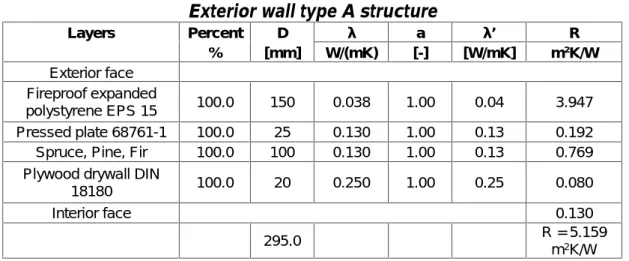
In the first scenario, the exterior wall type A within the building envelope is considered by wood and expanded polystyrene as it is shown in table 1 and there are three options for the primary energy source.
Table 1 Exterior wall type A structure
Layers Percent D λ a λ’ R
% [mm] W/(mK) [-] [W/mK] m²K/W
Exterior face Fireproof expanded
polystyrene EPS 15 100.0 150 0.038 1.00 0.04 3.947 Pressed plate 68761-1 100.0 25 0.130 1.00 0.13 0.192 Spruce, Pine, Fir 100.0 100 0.130 1.00 0.13 0.769 Plywood drywall DIN
18180 100.0 20 0.250 1.00 0.25 0.080
Interior face 0.130
295.0 R = 5.159
m2K/W
Seasonal heat consumption for the building is 11 013[kW/season].
Annual specific energy consumption index for the building is 142.56 [kWh/m2year] Primary energy consumptionis 15 270 [kWh/year]
CO2 equivalent emission amount generated by the building with wood as fuel for heating is 498.17 [kg/year]
CO2 equivalent emission index generated by the building with wood as fuel for heating is 6.45[kgCO2/m²year]
CO2 equivalent emission amount generated by the building with gas as fuel for heating is 2428.74 [kg/year]
CO2 equivalent emission index generated by the building with gas as fuel for heating is 31.44[kgCO2/m²year]
CO2equivalent emission amount generated by the building with electrical energy as fuel for heating is 2645.79 [kg/year]
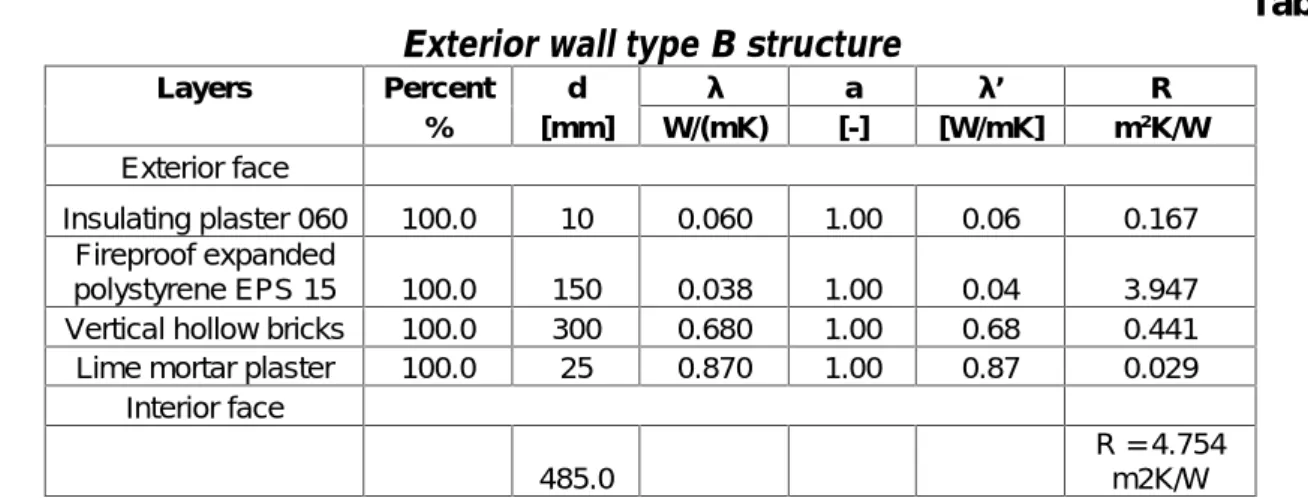
Table 2 Exterior wall type B structure
Layers Percent d λ a λ’ R
% [mm] W/(mK) [-] [W/mK] m²K/W
Exterior face
Insulating plaster 060 100.0 10 0.060 1.00 0.06 0.167 Fireproof expanded
polystyrene EPS 15 100.0 150 0.038 1.00 0.04 3.947 Vertical hollow bricks 100.0 300 0.680 1.00 0.68 0.441 Lime mortar plaster 100.0 25 0.870 1.00 0.87 0.029
Interior face
485.0
R = 4.754 m2K/W
Seasonal heat consumption for the building is 11 034 [kW/season].
Annual specific energy consumption index for the building is 142.84 [kWh/m2year] Primary energy consumption is 15 270 [kWh/year]
CO2 equivalent emission amount generated by the building with wood as fuel for heating is 498.93 [kg/year]
CO2 equivalent emission index generated by the building with wood as fuel for heating is 6.46 [kgCO2/m²year]
CO2 equivalent emission amount generated by the building with gas as fuel for heating is 2433.05 [kg/year]
CO2 equivalent emission index generated by the building with gas as fuel for heating is 31.50[kgCO2/m²year]
CO2equivalent emission amount generated by the building with electrical energy as fuel for heating is 2650.50 [kg/year]
CO2 equivalent emission index generated by the building with electrical energy as fuel for heating is 34.31[kgCO2/m²year]
Figure 3 Annual amount of CO2emission for case B
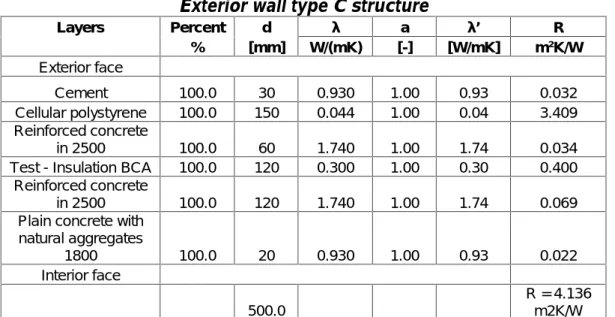
In the third scenario, the exterior wall type C within the building envelope is considered by precast reinforced concrete and expanded polystyrene as it is shown in table 3 and there are three options for the primary energy source.
Table 3 Exterior wall type C structure
Layers Percent d λ a λ’ R
% [mm] W/(mK) [-] [W/mK] m²K/W
Exterior face
Cement 100.0 30 0.930 1.00 0.93 0.032
Cellular polystyrene 100.0 150 0.044 1.00 0.04 3.409 Reinforced concrete
in 2500 100.0 60 1.740 1.00 1.74 0.034 Test - Insulation BCA 100.0 120 0.300 1.00 0.30 0.400
Reinforced concrete
in 2500 100.0 120 1.740 1.00 1.74 0.069 Plain concrete with
natural aggregates
1800 100.0 20 0.930 1.00 0.93 0.022
Interior face
500.0
R = 4.136 m2K/W
Seasonal heat consumption for the building is 11 074 [kW/season].
Annual specific energy consumption index for the building is 143.36 [kWh/m2year] Primary energy consumption is 15 337 [kWh/year]
CO2 equivalent emission amount generated by the building with wood as fuel for heating is 500.37 [kg/year]
CO2 equivalent emission index generated by the building with wood as fuel for heating is 6.48[kgCO2/m²year]
CO2 equivalent emission amount generated by the building with gas as fuel for heating is 2441.26 [kg/year]
CO2 equivalent emission index generated by the building with gas as fuel for heating is 31.60 [kgCO2/m²year]
CO2equivalent emission amount generated by the building with electrical energy as fuel for heating is 2659.47 [kg/year]
A. Forest habitats represented byfollowing types: habitat9110 – Luzulo-Fagetumbeech forests; CLAS. PAL.41.11; RO habitat type code: R4102, R4105-4107,
R4110; habitat 9130-Asperulo-Fagetum beech forests;
CLAS. PAL.: 41.13; RO habitat type code: R4118, R4119, R4120;habitat 91V0 - Dacian beech forests (Symphyto-Fagion); CLAS. PAL.: 41.1D2; RO habitat type code R4101, R4103, R4104, R4108, R4109, R4116; habitat9410 - Acidophilus spruce forests (Picea) of the montane to the alpine levels (Vaccinio-Piceetea);CLAS. PAL.: 42.21 to 42.23, 42.25-Eastern Carpathian arolla forests; EUNIS cod - G3.1B62 -42.25-Eastern Carpathian subalpine spruce forest; RO habitat type code: R4203, R4205, R4206, R4207, R4208, R4209; habitat 91M0 -Pannonian-Balkanic turkey oak sessile oak forests; CLAS. PAL.: 41.76; RO habitat type code: R4132, R4133, R4134, R4136, R4137, R4140, R4142, R4149, R4150,R4151, R4152, R4153, R4154, R4155; habitat 91Y0 - Dacian oak-hornbeam forests; CLAS. PAL.: 41.2C; RO habitat type code: R4124, R4125, R4126, R4143, R4147;Habitat 9150 - Medio-European limestone beech forests of the Cephalanthero-Fagion CLAS. PAL.: 41.16; RO habitat type code: R4111; habitat 9170 - Galio-Carpinetumoakhornbeam forests; CLAS. PAL.: 41.261, 41.262; RO habitat type code: R4123, R4128; habitat 9180*-Tilio-Acerion forests of slopes, screes and ravines CLAS.
PAL.: 41.4; RO habitat type code: R4117; habitat91E0*-Alluvial forests with
Alnusglutinosaand Fraxinusexcelsior (Alno-Padion, Alnionincanae, Salicionalbae; CLAS. PAL.: 44.3, 44.2 and 44.13 RO habitat type code: R4401, R4402, R4405, R4407, R4408; habitat 91L0 -Illyrian oakhornbeam forests (Erythronio-Carpinion; CLAS. PAL.: 41.2A; RO habitat type code: R412;habitat 9260 - Castanea sativa woods; CLAS. PAL.: 41.9; RO habitat type code:R4141; (Gafta and Mountford., coord., 2008)
B. Rock and screes habitats. The most important debris habitat in this area is the habitat 8120 – Calcareous and calcashist screes of the montane to alpine levels (Thlaspietearotundifolii);CLAS. PAL.61.2;RO habitat type code: R6106, R6107, R6108, R6109, R6110, R6111, R6112, R6113. This habitat is found on the calcareous screes and it is poorly spread in general and this habitat is highly significant for the investigated territory as it presents an essential role in early fallowing and application of mobile calcareous screes. In general, the characteristic and dominant species in this habitat are specific and adapted to fixed, semi-fixed or mobile screes, with soilification process or not. Also the habitat 8210is found in this territory - Calcareous rocky slopes with chasmophytic vegetation; CLAS. PAL.: 62.1;RO habitat type code:R6202, R6204, R6206, R6207, 6208, R6209, R6211 p.p., R6212,R6213, R6214, R6216, R6217, R6218, R6222, R6223; (Gafta and Mountford., coord., 2008). This habitat is characteristic to rocky, steep and shady walls, calcareous rocks, growing on superficial rendzinic soils.
Out of the vegetal communities characteristic to the habitat in this area the most frequently found are the following: Asplenio- Cystopteridetum fragilisOberd. (1936) 1949;
Thymo pulcherrimi-Poëtum rehmaniiColdea (1986) 1990; Asplenietum trichomano-rutae-murariaeKuhn 1937, Tx. 1937 (Syn: Tortulo-AsplenietumTx. 1937); Asplenioquadrivalenti Poëtum nemoralisSooex Gergelyet al. 1966.
C. Grassland habitats. The most important grassland habitat is 6170 - Alpine and subalpine calcareous grasslands; CLAS. PAL.: 36.12, 36.41 până la 36.43, 36.37, 36.38;RO habitat type code:R3601, R3605-3607, R3611, R3612, R3613, R3616, R3618, R3619 (Gafta and Mountford.,coord., 2008). The most important vegetal community in this habitat is: Seslerio haynaldianae-Caricetum sempervirentisPuşcaruet al.1956 (syn.:
habita6520 - Mountain hay meadows; CLAS. PAL.: 38.31; RO habitat type code:R3801, R3803, R3804 R3801, R3803, R3804.
D. Tall-herb habitats.From this types we found the habitat6430 -Hydrophilous tall-herb fringe communities of plains and of the montane to alpine levels; CLAS. PAL.: 37.7 şi 37.8; RO habitat type code:R3701, 3702, 3703, 3706, 3707, 3708, R3714 (Gafta and Mountford.,coord., 2008).Hydrophilous weeds in this habitat grow in shady places with high humidity of the montane level on colluvium alluvial soils.
E. Heath habitatsThis category includes,the following two types of habitats: habitat 4060 - Alpine and Boreal heathsCLAS. PAL.31.4;RO habitat type code:R3101, R3104, R3107-3109, R3111, R3115, R3617. It includes dwarf, sometimes crawling heaths, characteristic to the higher montane levels, mainly dominated by Ericaceae species; habitat 4070* Bushes with Pinusmugoand Rhododendron hirsutum( Mugo-Rhododendretumhirsuti); CLAS. PAL.31.5; RO habitat type code:R3105. This habitat includes mountain pine formations(Pinusmugo) (Gafta and Mountford.,coord., 2008).
F.Waters flowing. In this area from this type habitats we found : habitat 3220 – Alpine rivers and the herbaceous vegetation along their banks; CLAS. PAL.: 24.221 şi 24.222; RO habitat type code: R5416, R5418, R5420, R5423;habitat 3230 -Alpine rivers and their ligneous vegetation with Myricariagermanica; CLAS. PAL.: 24.223 x 44.111; RO habitat type code: R4415; 3240 -Alpine rivers and their ligneous vegetation with Salix elaeagnos; CLAS. PAL.: 24.224 x 44.112;RO habitat type code:R4417
Human impact, current pressure and future threats
In the investigated area this habitats is characterized by the following data on the conservation status and human impact.
Conservation status: from favorable up to unfavorably-inappropriate; Development trend of habitat: from stable up to decreasing;
Human impact and current pressures: G05.07-missing or wrongly directed conservation measures; D.06- Other forms of transportation and communication;H05.01- garbage and solid waste; F04.02.02- hand collection;E03.01- disposal of household/recreational facility waste; A.06.01.02- non- intensive annual crops for food production; D.06- Other forms of transportation and communication; H05.01- garbage and solid waste; A04.01- intensive grazing; H01.09 diffuse pollution to surface waters due to other sources not listed; B01 -forest planting on open ground; E01.01- continuous urbanization;D01.02-roads, motorways;E01-Urbanized areas, human habitation;E02-Industrial or commercial areas; H04 - Air pollution, air-borne pollutants; H05 - Soil pollution and solid waste (excluding discharges).
Future threats: E03.01- disposal of household / recreational facility waste;E01.01-continuous urbanization;D.06- Other forms of transportation and communication; F.03.02.09 - other forms of taking animals; H05.01- garbage and solid waste; H01.09-diffuse pollution to surface waters due to other sources not listed; B01-forest planting on open ground; D01.02-roads, motorways;E01-Urbanized areas, human habitation;E02-Industrial or commercial areas.
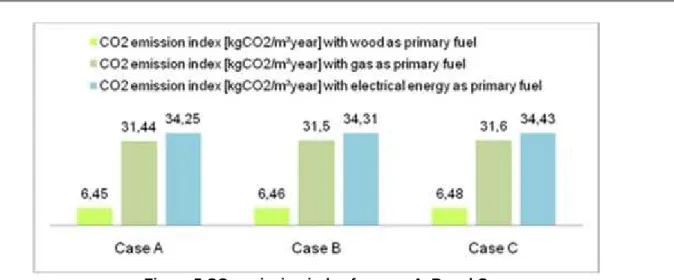
Figure 5 CO2emission index for case A, B and C
The study results reveal that the CO2emissions generated by the building use are mainly influenced by the primary fuel used for the heat demand. Regarding the building envelope structure, there are no significant differences between the three cases in relation with CO2emission index.
CONCLUSIONS
The carbon footprint generated by use of the building may be reduced if energy strategy is approached as a whole. The fuel required for maintaining comfort conditions inside having thus a significant environmental impact.
In terms of construction materials the tourist information points could be built with any variants presented above, differences between the three outer envelope construction systems being relatively close in terms of carbon footprint released by the building.
Regarding carbon emissions, the building recorded best results for case A with exterior wall type A and wood as primary energy source for heating the interior spaceand for hot water preparation, CO2emission index being 6.45 [kgCO2/m²year] totalizing 498.17 [kg/year].
BIBLIOGRAPHY
1.GAFTA, D., MOUNTFORD, O. Coord., 2008 - Romanian Manual for interpretation of Eu habitats, ED. Risoprint, Cluj-Napoca, pp. 101
2. MOUNTFORD O., GAFTA D., ANASTASIU Paulina, BĂRBOS M., NICOLIN Alma, NICULESCU Mariana & OPREA Ad., 2008- Natura 2000 in Romania. Habitat Fact Sheets. Available on:http://www.anpm.ro
3.NICULESCU, M.GRECU, F., NUŢĂ, I. S., IOVU, I., 2012 -Researches on the meadows from Cynosurion cristati Br.-Bl. ettx. 1943 in the Bistriţa-Văratec Valley (Gorj County, Romania), Analele Universităţii din Craiova, seria Agricultură – Montanologie – Cadastru Vol. XLII/2/2012, http://agronomie.administrativ.ucv.ro/aamc/index.php/aamc, p.188-193 4. NICULESCU, M., FĂGĂRAȘ, M. M., 2015 - The grassland Natura 2000 habitats found in Lespezi Quarry and the surroundings, Dambovita County -15th International Multidisciplinary Scientific GeoConference SGEM 2015,www.sgem.org, SGEM2015 Conference Proceedings, ISBN 978-619-7105-39-1 / ISSN 1314-2704, June 18-24, 2015,
Book5 Vol. 1, 877-882 pp, DOI:
10.5593/SGEM2015/B51/S20.116,http://www.sgem.org/sgemlib/spip.php?article6369&lan g=en
https://docs.google.com/a/jepe
journal.info/viewer?a=v&pid=sites&srcid=amVwZS1qb3VybmFsLmluZm98amVwZS1qb3V ybmFsfGd4OjgwMzIwZGUwMDQ2N2E2NQ
6. TRIF, C. R., FĂGĂRAȘ, M. M., HÎRJEU, N. C., NICULESCU, M.-2015. Ghidsintetic de monitorizarepentruhabitate de interescomunitar (sărături, dune continentale, pajiști, apadulce)din Romania, Ed. Bolda, Constanța
7. ROŞCULETE, C. A., ROŞCULETE, E.,2009 - Pedologie si staţiuni forestiere – Lucrări practice, 2009. Roşculete Catalin Aurelian, Editura Sitech, ISBN 978-606-530-620-2 8.ROSCULETE, E., SOARE, R. BONEA, D., ROSCULETE, C. A., TELEANU, E.,2015
-Detection and quantification of genetically modified soybean in food and feed traded in the Romanian market, Journal of Biotechnology, Volume 208, Supplement, 20 August
2015, Page S73
9. *** Metodologie de calcul al performanţei energetice a clădirilor partea a II-a – Performanţa energetică a instalaţiilor din clădiri,indicativ Mc 001 / 2 – 2006
10. *** Metodologie de calcul al performanţei energetice a clădirilor partea a III–a – Auditul şi certificatul de performanţă a clădirii”,indicativMc 001/3 – 2006
11. *** Metodologie de calcul al performanţei energetice a clădirilor partea a IV-a – Breviar de calcul al performanței energetice a clădirilor si apartamentelor, indicativ Mc 001 / 4 – 2009;
12. *** SR EN 12831:2004 - Sisteme de încălzire a clădirilor. Metodă de determinare a necesarului de căldură de calcul
13. *** SR 1907-1:2014 - Instalaţii de încălzire. Necesarul de căldură de calcul. Metodă de calcul
14. *** SR 1907-2:2014 - Instalaţii de încălzire. Necesarul de căldură de calcul. Temperaturi interioare convenţionale de calcul
15. *** SR 4839-2014 -Instalaţii de încălzire. Numărul anual de grade-zile
16.*** Council Directive 92/43/EECof 21 May 1992 on the conservation of natural habitats and of wild fauna and flora, Annex I (Habitats Directive)
17.***List Threats, Pressures and Activities(final version)
http://bd.eionet.europa.eu/activities/Reporting/Article_17/reference_portal