Daichi Yanagisawa
Research Center for Advanced Science and Technology, The University of Tokyo, Meguro-ku, Tokyo, Japan,
E-mail:[email protected]
Received: 13 June 2016 / Accepted: 24 November 2016 DOI:10.17815/CD.2016.8
Abstract We have introduced evolutionary game dynamics to a one-dimensional cellular-automaton to investigate evolution and maintenance of cooperative avoiding behavior of self-driven particles in bidirectional flow. In our model, there are two kinds of particles, which are right-going particles and left-going particles. They often face opponent par-ticles, so that they swerve to the right or left stochastically in order to avoid conflicts. The particles reinforce their preferences of the swerving direction after their successful avoidance. The preference is also weakened by memory-loss effect.
Result of our simulation indicates that cooperative avoiding behavior is achieved, i.e., swerving directions of the particles are unified, when the density of particles is close to 1/2 and the memory-loss rate is small. Furthermore, when the right-going particles occupy the majority of the system, we observe that their flow increases when the number of left-going particles, which prevent the smooth movement of right-going particles, becomes large. It is also investigated that the critical memory-loss rate of the cooperative avoiding behavior strongly depends on the size of the system. Small system can prolong the cooperative avoiding behavior in wider range of memory-loss rate than large system.
Keywords Evolutionary game dynamics · cellular automata · bidirectional flow ·
self-driven particles
1. Introduction
Coordination game is a class of games in game theory where Nash equilibria are achieved when the players choose the same strategy. It is applied to study the choice of technolog-ical standards [1], tax compliance [2], and trading behavior [3].
We see coordination-game-like phenomena in pedestrian dynamics, which has been vigorously studied in these two decades [4–8]. Collision avoidance by swerving in bidi-rectional flow, which has been investigated both theoretically [9–12] and experimentally
ZŝŐŚƚƐǁĞƌǀŝŶŐ
>ĞĨƚƐǁĞƌǀŝŶŐ
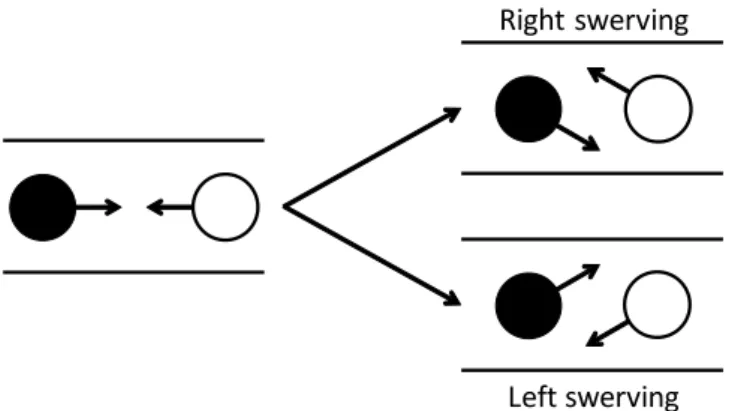
Figure 1 Schematic view of collision avoidance by swerving in bidirectional flow.
[13–15] is a representative example. When a right-going pedestrian face to a left-going pedestrian as in Fig.1, he/she has to avoid the opponent by swerving to the right or left. If the swerving directions of the two pedestrians do not agree, they need to adjust their strategy (right or left) by trial and error. Thus, the unification of the swerving directions of pedestrians smooths bidirectional flow and has a positive effect as the choice of tech-nological standards.
This correspondence between coordination game and collision avoidance reminds us that we need to consider frequency of interaction among pedestrians when we study the cooperative avoiding behavior in pedestrian dynamics. Walking side of pedestrians is not strictly determined as that of vehicles, and it is presumable to consider that pedestrians learn appropriate swerving direction in their living culture and society. Thus, frequency of interaction (chance for learning swerving direction) is an important factor for the uni-fication of the swerving directions.
Besides, original game theory does not include spatial effect. Recently, evolutionary coordination game has been studied on networks [3,16]; however, players in such models stay at the nodes and do not move in the space, in other words the nodes represent the players. In the real world, players, such as pedestrians, move by their selves and interact with each other.
With the two motivations above, we develop a new model by combining a one-dimensional cellular automaton and evolutionary game dynamics in order to investigate evolutionary game dynamics with moving particles on a lattice. Particles in the model have memo-ries of their preferred swerving directions, which are updated by interaction with other particles and memory-loss effect. Jam in the lattice deprives the particles of interactions with others; therefore, the spatial effect on the frequency of interaction is also studied. Although we obtain the motivation of this research from bidirectional flow in pedestrian dynamics, elucidation of evolutionary coordination-game dynamics on a lattice is the main goal in this paper.
͍ ͍ ͍ ͍ ͍ dŝŵĞƐƚĞƉ
dŝŵĞƐƚĞƉ 1
;Ϳ ;Ϳ ;Ϳ ;Ϳ ;Ϳ
&ŝŐ͘ϱ &ŝŐ͘ϰ
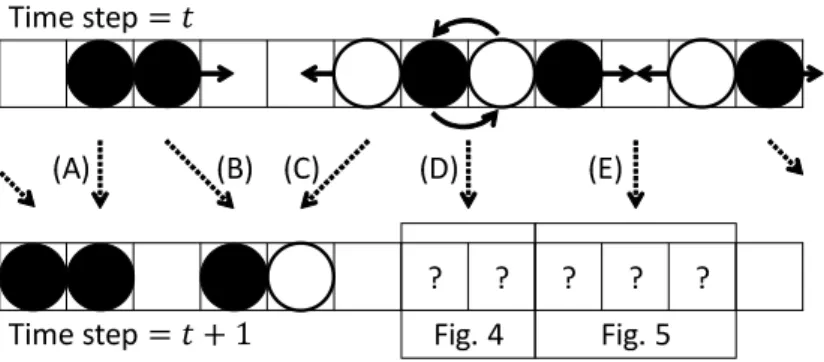
Figure 2 Schematic view of the model. (A) The black particle cannot move since its target cell is occupied by the other particle moving in the same direction. (B) The black particle moves to the vacant right cell. (C) The white particle moves to the vacant left cell. (D) and (E) Interaction between the black and white particles occurs.
the cooperative avoiding behavior when the number of right-going and left-going parti-cles are same. Subsequently, we consider the case where the number of right-going and left-going particles are different in Sec.4. It is shown that increase of opponent particles, which seems to disrupt the smooth movement, improves the flow. In Sec.5, we investi-gate how the size of the system affect the condition of the cooperative avoiding behavior by simulation and approximate analysis. The final section is devoted to summary and conclusion.
2. Model
A schematic view of our model is depicted in Fig. 2. We consider one-dimensional dis-crete space with periodic boundary condition. The size of the system, i.e., the number of cell in the system, isL. Time is also discrete in the model.
There are two kinds of particles, which are right-going (black) and left-going (white) particles. The number of the right-going and left-going particles are NR andNL, respec-tively. Similarly, the density of the right-going and left-going particles are ρR=NR/L
andρL=NL/L, respectively. The total number of the particles isN=NR+NL.
Every discrete time step, first, all the right-going particles are updated in parallel, and then, all the left going particles are updated in parallel. Each right-going (left-going) particle moves to the right (left) for one cell if their target cell is vacant (Fig.2case (B) and (C)). It cannot move if their target cell is occupied by the particles moving in the same direction (Fig.2case (A)).
ŽŶĨůŝĐƚ ǀŽŝĚĂŶĐĞ ;Ϳ
;Ϳ ;Ϳ ;Ϳ
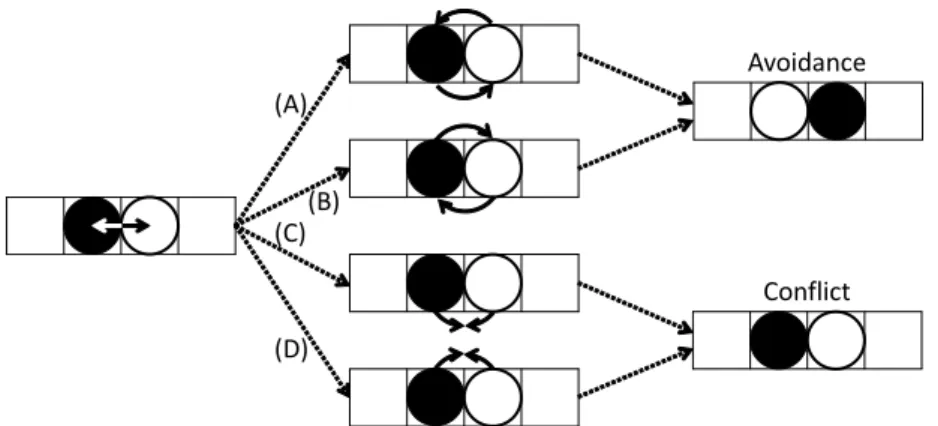
Figure 3 Schematic view of avoidance and conflict when the two particles try to exchange their cell. (A) Avoidance achieved by right swerving. (B) Avoidance achieved by left swerving. (C) and (D) Conflict.
ǀŽŝĚĂŶĐĞ
ŽŶĨůŝĐƚ ;Ϳ
;Ϳ ;Ϳ ;Ϳ
Figure 4 Schematic view of avoidance and conflict when the two particles move to the same cell. (A) Avoidance achieved by right swerving. (B) Avoidance achieved by left swerving. (C) and (D) Conflict.
pi(1−pj) +pj(1−pi), a conflict occurs and they remain at their cell (Fig. 3 case (C), (D)).
In the case where the right-going and left-going particles are trying move to the same cell as in Fig.2case (E), first, the right-going particle moves one cell due to the updating order. Then, the left-going particle tries to penetrate into the cell occupied by the right-going particle. The similar rule used in case (D) is exploited to judge avoidance and conflict. The details are summarized in Fig. 4. Note that the advantage of the updating order for the right-going particles does contribute to the differences between the results of right-going and left-going particles when the simulated time steps is short; however, if we perform a simulation long enough and consider average values, the differences are neglected.
left swerving, respectively, in the following. The right-swerving probability, which is introduced in the previous paragraph is represented by the Logit model [17] with theses preferences:
pi(t) = exp P
R
i (t)
exp PiR(t)+exp PiL(t). (1)
The preferences are updated every time steps by the following equation1:
PiX(t+1) = (1−φ)PiX(t) +SXi (t), (2)
where X ∈ {R,L}, φ ∈(0,1] is the memory-loss rate, and SXi (t) is the payoff for the particle i at the time step t. The payoff SR=1 when the particles succeed in avoiding conflict by swerving to the right (Case (A) in Fig. 3and4). Similarly,SL =1 when the particles succeed in avoiding conflict by swerving to the left (Case (B) in Fig. 3 and4). In the other cases,SR=SL=0.
Therefore, if the particles often interact with the opponent particles and succeed in avoiding, their preferences increase. By contrast, if they fail to avoid the opponent parti-cles, their preferences do not increase. Furthermore, when there are few interaction, the preferences decrease due to the memory-loss rateφ.
3. Symmetric case
Here, we consider the case where the same number of right-going and left-going particles are moving in the system, i.e., ρR=ρL(≡ρ). We control the density of the particlesρ
and the memory-loss rateφ, and investigate the two quantities.
The first one is the unified ratio defined as follows:
U =
∑Ni=12(pi−1/2) N
∈[0,1]. (3)
U ≈ 1 implies that the unified phase is achieved, i.e., most of the particles swerve to the same direction when they face their opponent particles. On the other hand, U ≈0 indicates that the disordered phase is attained, i.e., most of the particles do not have their preferred swerving direction, in other words, they swerve to the right and left with the equal probability 1/2.
The other is the flow of the particles. The flow of right-going (left-going) particles is the average number of right-going (left-going) particles that move in one time step divided byL. We describe the flows of right-going particles, left-going particles, and their sum as
JR,JL∈[0,0.5]andJ∈[0,1], respectively.
We set the length of the system as L=50 and the initial preferences PiR(0) =100,
PiL(0) =0. Simulation has been conducted for 110000 time steps, and the results from
t=10001 to 110000 are used to calculate the average unified ratio and flow. Note that the stationary state is achieved att=10001.
1Upper bound on the preferencesPR
ĞŶƐŝƚLJ
ĞŶƐŝƚLJ
D
Ğ
ŵ
Ž
ƌLJ
Ͳů
Ž
ƐƐ
ƌ
Ă
ƚĞ
D
Ğ
ŵ
Ž
ƌLJ
Ͳů
Ž
ƐƐ
ƌ
Ă
ƚĞ
hŶŝĨŝĞĚƌĂƚŝŽ
&ůŽǁ
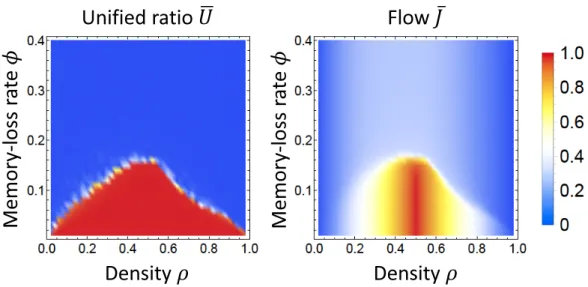
Figure 5 (Left) Average unified ratio ¯Uas a function of the densityρ(=ρR=ρL)and memory-loss rate φ. We see two clear phases, which are the disordered phase (upper blue region) and the unified phase (lower red region). (Right) Average total flow ¯Jas a function of the densityρ(=ρR=ρL)
and memory-loss rateφ. We see that high flow is achieved in the unified phase in the left figure.
The parameters are set as L=50,PR
i (0) =100, PiL(0) =0, and the data fromt=10001 to
110000 are used to depict the figures.
Fig. 5 (left) shows the average unified ratio ¯U as a function of the density ρ and
memory-loss rateφ. We see two phases, which are the disordered (upper blue region)
and unified (lower red region) phases, and phase transition between them. When φ is
large, quick memory-loss prevents the particles from keeping their preferences large, so that the disordered phase is achieved. Even if the memory-loss rate is small, the disor-dered phase is observed in the low and high density region. This is because there are few interactions between particles, which are opportunities to increase the preferences, in the low and high density cases. In the low density case, there are few particles to interact. In the high density case, it is difficult to move and interact since the cells are occupied by the other particles moving in the same direction. If the memory-loss rate is small and the density is medium, the unified phase is achieved. Many interactions between the particles reinforce their preference.
Fig.5(right) shows the average total flow ¯Jas a function of the densityρ and
memory-loss rate φ. We see that ¯J achieves high values in the unified phase, while it becomes
small in the disordered phase.
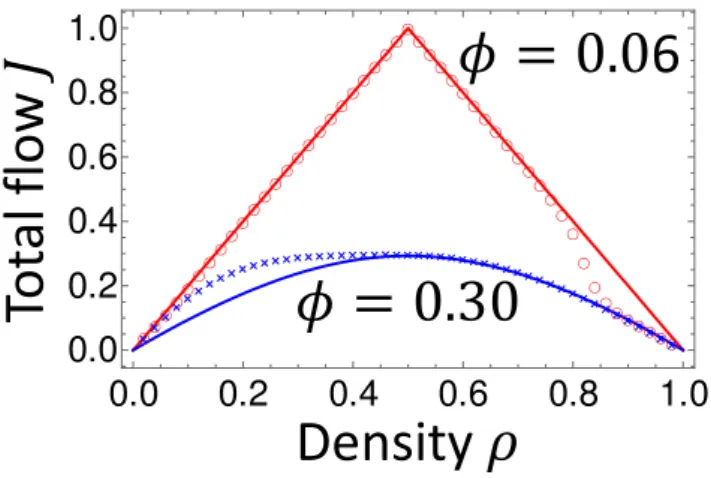
Cross-section diagrams of Fig. 5 (right) at φ =0.06 and 0.30 are depicted in Fig. 6.
From Fig.5(left), we find that the unified phase is achieved in the most density region for
φ =0.06, whereas the disordered phase is attained in all the density region forφ =0.30.
0.0 0.2 0.4 0.6 0.8 1.0 0.0
0.2 0.4 0.6 0.8 1.0
ĞŶƐŝƚLJ
dŽ
ƚĂ
ů
Ĩů
Ž
ǁ
ϲ
Figure 6 Cross-section diagrams of Fig.5 (right) at φ =0.06 and 0.30. We see that the flow of the
simulation (φ=0.06) agrees well with that of the TASEP (q=1.0) in the most part of the curve
(ρ≤0.8). By contrast, the flow of the simulation (φ=0.30) agrees well with that of the TASEP
(q=0.5) in the high density region (ρ≥0.5). The parameters are set asL=50,PiR(0) =100,
PiL(0) =0, and the data fromt=10001 to 110000 are used to depict the figures.
update rule [18], are shown in the figure. The explicit formulation is described as
J=2×1− p
1−4qρ(1−ρ)
2 , (4)
whereqis the hopping probability of the particles and the number 2 is multiplied because
J is the sum ofJRandJL. The higher and lower curves are the flow of the TASEP in the
caseq=1.0 and 0.5, respectively.
The flows in the unified phase (φ = 0.06, ρ ≤0.80) are close to the higher curve
and those in the disordered phase (φ =0.06, ρ ≥0.86 and φ =0.30) are close to the
lower curve. Thus, the probability of successful avoidance in the unified phase and disor-dered phase (ρ≥0.5) in our model approximately corresponds to the hopping probability q=1.0 and 0.5 in the TASEP, respectively. In the disordered phase (ρ ≤0.5) both the
movement with the probability 1 (to the vacant cell) and 1/2 (interaction with the opponent particles) are included, so that the flow is not simply represented by the TASEP.
4. Asymmetric case
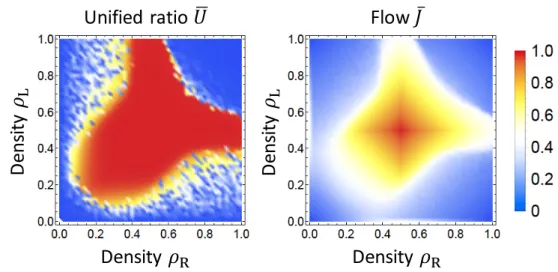
Next, we consider asymmetric cases, where the number of right-going and left-going particles are different. Fig. 7 (left) shows the average unified ratio ¯U as a function of the density of right-going particles ρR and left-going particlesρL. The unified phase is
formed at the center of the figure. When ρR ≈ρL ≈1/2, both particles can move and
have enough chances to interact with opponent particles. By contrast, when ρR andρL
ĞŶƐŝƚLJ
ୖĞŶƐŝƚLJ
ୖĞ
Ŷ
Ɛŝ
ƚLJ
ߩ
Ğ
Ŷ
Ɛŝ
ƚLJ
ߩ
hŶŝĨŝĞĚ ƌĂƚŝŽ
&ůŽǁ
̅
Figure 7 (Left) Average unified ratio ¯U as a function of the density of right going particlesρR and
left-going particlesρL. We observe the unified phase (red region) at the center and the disordered
phase (blue region) in the marginal part. (Right) Average total flow ¯Jas a function of the density of right going particlesρRand left-going particlesρL. Similar to the symmetric case, ¯Jachieve
high values in the unified phase. The parameters are set asL=50,φ=0.08, andPiR(0) =100,
PiL(0) =0, and the data fromt=10001 to 110000 are used to depict the figures.
have few chances. Thus, the preferences of major particles decrease due to the memory-loss effect, and the unified phase is collapsed.
Fig.7(right) shows the average total flow ¯J as a function of the density of right going particlesρR and left-going particles ρL. Similar to the symmetric case, ¯J achieves high
and low values in the unified and disordered phases, respectively.
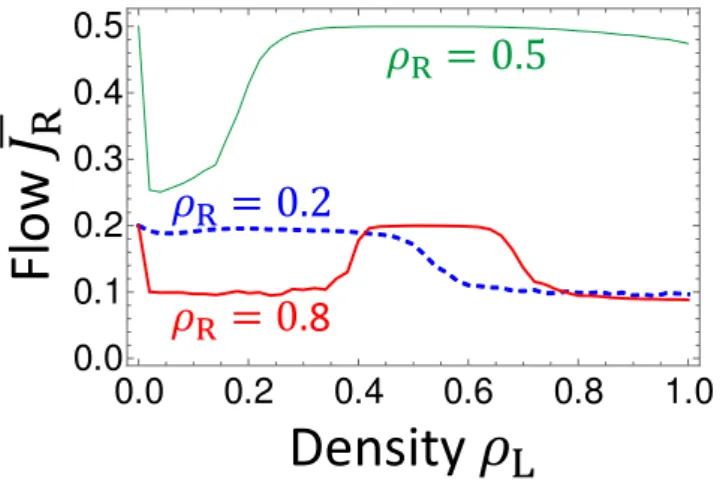
Fig.8shows average flow of right-going particles ¯JRas a function ofρLfor variousρR.
The flow ¯JR changes non-monotonically against the increase of ρL. Firstly, in the case
ofρR=0.2, ¯JR ≈0.2 for ρL<0.5, then ¯JR drops due to the large number of opponent
particles forρL>0.5. Secondly, in the case ofρR =0.5, ¯JR =0.5 at ρL=0.0 because
there is no obstruction by left-going (opponent) particles at all. Then it suddenly drops by one left-going particle atρL=0.02. For right-going particles there are few chances to
interact with left-going particles, so that the disorder phase is achieved. However, more increase of left-going particles recovers ¯JR. Left-going particles do not only obstruct
the movement of going particles but also increase chances of interaction for right-going particles. Therefore, the unified phase is achieved for ρL >0.3 and ¯JR becomes
larger. Finally, we would like to investigate the case of ρR =0.8. Similar to the case
of ρR =0.5, ¯JR achieves the maximum at ρL =0.0, drops at ρR =0.02, and recovers
aroundρL ≈0.4. The different phenomenon is observed aroundρL ≈0.7. In the case
ofρR=0.8, right-going particles cannot move smoothly, so that left-going particles have
0.0 0.2 0.4 0.6 0.8 1.0 0.0
0.1 0.2 0.3 0.4 0.5
ĞŶƐŝƚLJ
&
ůŽ
ǁ
ϴ
Figure 8 Average flow of right-going particles ¯JR as a function of ρL for ρR=0.2, 0.5 and 0.8. The
parameters are set asL=50,φ=0.08, andPiR(0) =100,PiL(0) =0, and the data fromt=10001
to 110000 are used to depict the figures.
5. Effect of system size
In this section, we investigate the effect of the system size Lon the unified ratioU and preferences PR and PL. Before showing the result of the simulation, we derive an ap-proximate theoretical result for comparison. By assuming that the properties of all the particles are always identical (PiR=PˆR,PiL=PˆL, andpi=pˆfor alli) and all the particles interact at every time step, we deform Eq.1and2as follows:
ˆ
p(t) = exp ˆP
R(t)
exp ˆPR(t)
+exp ˆPL(t), (5)
ˆ
PR(t+1) = (1−φ)PˆR(t) + (pˆ(t))2, (6)
ˆ
PL(t+1) = (1−φ)PˆL(t) + (1−pˆ(t))2, . (7)
In the stationary state (t→∞), these equations are numerically solved.
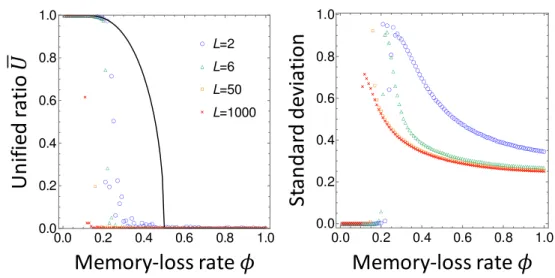
Fig. 9(left) shows the average unified ratio ¯U as a function of the memory-loss rateφ
for various system sizesL=2, 6, 50 and 1000 obtained from our simulation. Initial pref-erences are set asPiR(0) =100 andPiL(0) =0, thus, the unified phase with right swerving is tend to be achieved. The black curves represent the approximate results computed with Eq. 5- 7. We observe the drop of ¯U from ¯U =1 (unified phase) to ¯U =0 (disordered phase) at the critical memory-loss rate for eachL. The critical memory-loss rate becomes smaller as Lincreases. Since the dynamics of the model is stochastic, deviation from the right swerving more likely to occur when the number of particles is large. Left swerving of one particle hinders the movement of all the particles in the system and decreases the chances of interaction. As a result, the system becomes the disordered phase. Therefore, it is difficult to maintain the unified phase in the large system.
L 2 L 6 L 50 L 1000
0.0 0.2 0.4 0.6 0.8 1.0 0.0 0.2 0.4 0.6 0.8 1.0
0.0 0.2 0.4 0.6 0.8 1.0 0.0 0.2 0.4 0.6 0.8 1.0
DĞŵŽƌLJͲůŽƐƐƌĂƚĞ
߶
DĞŵŽƌLJͲůŽƐƐƌĂƚĞ
߶
h
Ŷ
ŝĨ
ŝĞ
Ě
ƌ
Ă
ƚŝ
Ž
ܷഥ
^
ƚĂ
Ŷ
Ě
Ă
ƌĚ
Ě
Ğ
ǀ
ŝĂ
ƚŝ
Ž
Ŷ
Figure 9 (Left) Average unified ratio ¯Uas functions of the memory-loss rateφ for various system sizes. (Right) Standard deviation of the right swerving probabilitypias functions of the memory-loss
rateφ for various system sizes. The parameters are set asρR=ρL=0.5,PiR(0) =100, and
PiL(0) =0. Data from t=10001 to 110000 are used for L=2, 6, and 50, and those from
t=2001 to 22000 are used forL=1000.
to the drop of ¯U. Since the approximate theoretical result assume homogeneous proper-ties of the particles, large standard deviation of pi deteriorate this assumption. Thus, we see great discrepancy aroundρ=0.2 to 0.5 in the left figure.
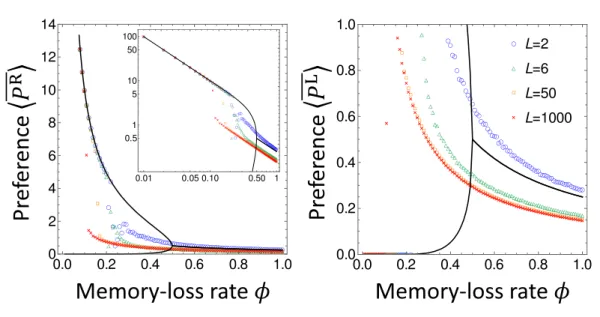
In order to elucidate the large standard deviation of pi, we also investigate the aver-age preferenceshPRiandhPLias functions of the memory-loss rateφ for various system
sizes. In Fig. 10, hPRi and hPLi for L=2, 6, 50, and 1000 obtained from our
simula-tion are depicted together with the black curves, which represent the approximate results computed with Eq.5-7. There is only one black curve forφ >0.5, while there are two
black curves forφ <0.5, which represent the larger and smaller preferences, respectively.
Since we set PiR(0) =100, and PiL(0) =0, the larger and smaller curves correspond to
hPRiandhPLi, respectively.
In Fig. 10 (left, main), we see that all the results of simulation agree well with the approximate curve when the memory-loss rateφ is small or large. These agreements
in-dicate that all the particles interact every time step and maintain largePR to achieve the unified phase for smallφ. For largeφ, all the particles cannot keepPR, so that the
disor-dered phase is attained. In such regionhPRidecrease with power law with the exponent -1 as the interpolated double logarithmic plot shows. In the middle region, we observe great discrepancy between the results of the simulation and the approximate analysis similar to the unified ratio. This phenomenon is explained with Fig.10(right). We see the rise of
hPLiat the same point as the drop ofhPRi. As the memory-loss rateφ increases,
cooper-ative avoidance with left serving is sometimes succeeded in spite of the initial condition
0.0 0.2 0.4 0.6 0.8 1.0 0 2 4 6 8 10 12 14
DĞŵŽƌLJͲůŽƐƐƌĂƚĞ
DĞŵŽƌLJͲůŽƐƐƌĂƚĞ
W
ƌĞ
ĨĞ
ƌĞ
Ŷ
Đ
Ğ
W
ƌĞ
ĨĞ
ƌĞ
Ŷ
Đ
Ğ
0.01 0.05 0.10 0.50 1 0.5 1 5 10 50 100 L 2 L 6 L 50 L 1000
0.0 0.2 0.4 0.6 0.8 1.0
0.0 0.2 0.4 0.6 0.8 1.0
Figure 10 (Left) Average preference for right swervinghPRias functions of the memory-loss rateφ for
various system sizes. (Right) Average preference for left swerving hPLias functions of the
memory-loss rateφfor various system sizes. The parameters are set asρR=ρL=0.5,PiR(0) =
100, andPiL(0) =0. Data fromt=10001 to 110000 are used forL=2, 6, and 50, and those fromt=2001 to 22000 are used forL=1000.
stochastic effect is introduced, so that bothhPRiandhPLigradually changes according to φ. However, in the model, a little stochastic disturbance is enough to collapse the unified
phase and form the disordered phase. Therefore, ¯U and hPRi in the simulation drop at
much smallerφ than those of the approximate analysis.
6. Summary and Conclusion
In this paper, we have developed a one-dimensional cellular automaton model with two kinds of particles, which are right and left-going ones. They try to avoid each other by swerving to the right or left stochastically. Evolutionary game dynamics is introduced in the model, so that the particles update their preferences of swerving direction by interact-ing other particles. The effect of memory-loss is also considered.
the opponent particles work as both obstruction and lubricant. When the density of the opponent particles is not adequate to the density of the main particles, they just obstruct the main flow. However, if the density of the opponent particles is adequate, they enhance unification of the swerving direction and achieve high main flow. The effect of the size of the system has been also studied. We have clarified that it is difficult to maintain the unified phase in the large system.
Although the model is too simple to directly apply to the real pedestrian flow, we hope that indication from our investigation helps us to understand the mechanism of cooperat-ing avoidcooperat-ing behavior in bidirectional flow.
A. Learning from failure
In our model introduced in Sec. 2, the particles increase their preferences when they succeed in avoiding conflicts. Here, we would like to consider the particles whose prefer-ences increase also in the case of failure in avoiding conflicts. In other words, the particles in this appendix learn from failure.
We generalize the payoffSXi (t)as in Tab. 1by introducing the probability of learning form failure plff. When the particleiswerve to the right and the particle j swerve to the left, they fail to avoid a conflict. Then the particleilearns from this failure and increases its preference of left-swervingPiL by 1 with the probability plff. Similarly, the particle j
increases its preference of right-swervingPRj by 1 with the probability plff. Note that the model becomes the original one introduced in Sec.2when we set plff=0.
Fig. 11 shows the average unified ratio ¯U and the flow ¯J as functions of the density
ρ(=ρR =ρL) and memory-loss rate φ. Actually, we see no clear difference between
Fig. 5 (plff =0) and 11 (plff =1), so that the effect of learning from failure does not greatly influence on the stationary state of the system. However, the effect of learning from failure on relaxation process is remained as a future work.
Acknowledgements This work was financially supported by JSPS KAKENHI Grant Numbers 15K17583. The author would like to thank Kenta Yoshikawa for useful discussion.
Swerving direction ofi Swerving direction of j SRi SiL
R R 1 0
R L 0 1 with plff
0 with 1−plff
L R 1 with plff 0
0 with 1−plff
L L 0 1
Table 1 Value of the payoff for the particlei SXias a function of the swerving directions of the particle
ĞŶƐŝƚLJ
ĞŶƐŝƚLJ
D
Ğ
ŵ
Ž
ƌLJ
Ͳů
Ž
ƐƐ
ƌ
Ă
ƚĞ
D
Ğ
ŵ
Ž
ƌLJ
Ͳů
Ž
ƐƐ
ƌ
Ă
ƚĞ
hŶŝĨŝĞĚƌĂƚŝŽ
&ůŽǁ
Figure 11 (Left) Average unified ratio ¯Uas a function of the densityρ(=ρR=ρL)and memory-loss rate φ. (Right) Average total flow ¯Jas a function of the densityρ(=ρR=ρL)and memory-loss
rateφ. The parameters are set asL=50,PiR(0) =100,PiL(0) =0, plff=1, and the data from
t=10001 to 110000 are used to depict the figures.
References
[1] Mattli, W., B¨uthe, T.: Setting International Standards: Technological Ra-tionality or Primacy of Power? World Polit. 56(1), 1–42 (2003). doi:10.1353/wp.2004.0006
[2] Bloomquist, K.M.: Tax Compliance as an Evolutionary Coordination Game: An Agent-Based Approach. Public Financ. Rev. 39(1), 25–49 (2011). doi:10.1177/1091142110381640
[3] Bian, Y.T., Xu, L., Li, J.S.: Evolving dynamics of trading behavior based on coor-dination game in complex networks. Phys. A Stat. Mech. its Appl. 449, 281–290
(2016). doi:10.1016/j.physa.2015.12.113
[4] Helbing, D.: Traffic and related self-driven many-particle systems. Rev. Mod. Phys.
73(4), 1067–1141 (2001). doi:10.1103/RevModPhys.73.1067
[5] Seyfried, A., Steffen, B., Klingsch, W., Boltes, M.: The fundamental diagram of pedestrian movement revisited. J. Stat. Mech. Theory Exp. 2005(10), P10002– P10002 (2005). doi:10.1088/1742-5468/2005/10/P10002
[7] Yanagisawa, D., Kimura, A., Tomoeda, A., Nishi, R., Suma, Y., Oht-suka, K., Nishinari, K.: Introduction of frictional and turning function for pedestrian outflow with an obstacle. Phys. Rev. E 80(3), 036110 (2009). doi:10.1103/PhysRevE.80.036110
[8] Schadschneider, A., Chowdhury, D., Nishinari, K., Santen, L.: Stochastic Transport in Complex Systems. Elsevier, Amsterdam/Oxford (2010)
[9] Helbing, D., Moln´ar, P.: Social force model for pedestrian dynamics. Phys. Rev. E
51(5), 4282–4286 (1995). doi:10.1103/PhysRevE.51.4282
[10] Blue, V.J., Adler, J.L.: Cellular automata microsimulation for modeling bi-directional pedestrian walkways. Transp. Res. Part B Methodol. 35(3), 293–312
(2001). doi:10.1016/S0191-2615(99)00052-1
[11] Fl¨otter¨od, G., L¨ammel, G.: Bidirectional pedestrian fundamental di-agram. Transp. Res. Part B Methodol. 71(2015), 194–212 (2015). doi:10.1016/j.trb.2014.11.001
[12] Morton, N.A., Hendy, S.C.: Symmetry Breaking in Pedestrian Dynamics (2016).
URLhttp://arxiv.org/abs/1605.05437
[13] Hoogendoorn, S., Daamen, W.: Self-Organization in Pedestrian Flow. In: Traf-fic Granul. Flow ’03, pp. 373–382. Springer-Verlag Berlin Heidelberg (2005). doi:10.1007/3-540-28091-X 36
[14] Zhang, J., Seyfried, A.: Empirical Characteristics of Different Types of Pedestrian Streams. Procedia Eng. 62, 655–662 (2013). doi:10.1016/j.proeng.2013.08.111
[15] Feliciani, C., Nishinari, K.: Phenomenological description of dead-lock formation in pedestrian bidirectional flow based on empirical ob-servation. J. Stat. Mech. Theory Exp. 2015(10), P10003 (2015). doi:10.1088/1742-5468/2015/10/P10003
[16] Konno, T.: Coordination Always Occurs in a Two-Strategy Pure-Coordination Logit Game on Scale-Free Networks. Theor. Econ. Lett. 05(04), 561–570 (2015). doi:10.4236/tel.2015.54066
[17] Hausman, J., McFadden, D.: Specification Tests for the Multinomial Logit Model. Econometrica52(5), 1219 (1984). doi:10.2307/1910997