113
BULK DENSITY OF SOME ROMANIAN SOILS
ILIE L., MIHALACHE M., GINA SCĂEȚEANU University of Agronomic Sciences and Veterinary Medicine of Bucharest
Keywords: bulk density, soil properties, Romaniansoils
ABSTRACT
In order to investigated the influence of some soil properties on the bulk density were selected 102 samples distributed in three categories: poldzols (podzols and dystric cambisols), luvisols (haplic, rhodic and albic) and tilled soils (chernozems, phaeozems, arenosols and vertisols).
Bulk density presents smaller values in upper horizons of soil profiles due to the dead vegetal decay.
The bulk density increase from podzols to chernozems in the same time with specific gravity, pH and clay content and decrease with organic matter concentration.
The presented paper determines on the statistical way the connection between bulk density and the other soil properties.
INTRODUCTION
The soil settling sate is dependent on many soil properties and is known its importance in different agricultural fields. It is estimated especially by bulk density, soil porosity (Crăciun et al., 1998, 2003, 2004). The clasical agricultural technologies developed after a long time in the tilled and the subjacent horizons determine some degradation processes which necesite to be investigated (Guş P. and Rusu T., 2004; Rusu et al., 2004).
Bulk density increase with smectite content in soil, decrease with the ordering of atoms in the broken surface of crystalites but do not correlate with the mean particle size of smectite. It increase with the illite content in soil, with ordering of atoms in the broken surface of illite but decrease with its particle size and interne ordering of atoms in the octahedral and tetrahedral plans and the stacking ordering of elementar layers.
A multiple linear equation of investigated soil group show that the influence of some soil properties decrease in the succession specific gravity, pH, organic matter concentration and clay content.
MATERIAL AND METHOD
A group of 102 samples was selected from the main soil types (chernozems, luvisols, vertisols, arenosols, dystric cambisols, podzols), from many regions and all horizons.
The particle size distribution was made by pipette method (Eugenia Moţoc, 1964), the bulk density by cylinder method (Rozalia Thaler, Canarache A., 1964), pH with glass electrod and organic matter content by Walkley-Black method modified by Gogoaşă (1959).
114
On the diagrams were calculated three crystallinity indices:
IA index- the inverse of the width of (001) line peak measured at half height. It include prevalent the mean size and interne ordering of atoms in the crystalline lattice (Scherrer quoted by Bartram, 1967).
IB index- the ratio of the heights measured from (001) peak to adjacent minimum towards the small angles and from the peak to the background. It is prevalent attributed to the ordering of atoms in the broken surface of particles (Gâţă, 2001).
IC index- the ratios of the heights (002) and (001) diffraction lines of the clay mineral. It represents the atom ordering in the octahedral and tetrahedral plans and the stacking ordering of elementar layer (Bradley and Grim, 1961; Eberl and Velde, 1989).
By comparison with the crystallinity indices already used in the clay mineralogy IA index is inverse of Kubler index (Kubler, 1968), IB is the Biscaye index (Biscaye, 1965) and IC is the inverse of the index used by White J.L. (1962) for illite. These changes were used to have always an increase of the index value when increase the crystallinity, to avoid the infinite values when do not appears on the diagrams the (002) the peack of smectite minerals at about 8.5 kX and to facilitate their comparison.
RESULTS AND DISCUSSIONS
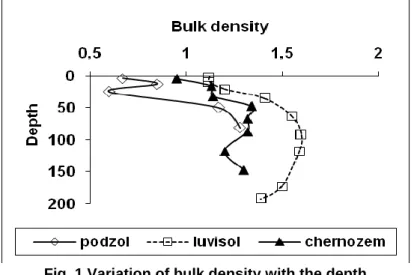
Settling state of the soils is estimated usually by the values of bulk density which are smaller in surface horizons of soils. A graphic (Fig.1) confirm this variation at the profiles of calcic chernozem at Mărculeşti (Ilfov), chromic luvisol at Brăneşti forest (Ilfov) and haplic podzol on Jepii Mari Mountain (Prahova) (Excursion Guide, Bucharest, 1997).
Fig. 1 Variation of bulk density with the depth
Different technologies applied to the soils (Rusu et al., 1994; Guș P. and RusuT., 2004) produce variation of bulk density at a chernozem (1.10-1.32 g/cm3), a luvisol (1.12-1.2 g/cm3) and a fluvisol (1.18-1.28 g/cm3). Therefore in order to investigate the influence of soil properties on the bulk density were selected samples from many soil types, all horizons and several regions.
115
variation coefficients. Gennerally the mean values are greater than medians except the specific gravity, bulk density, illite content and IB illite index (Table 1).
Table 1 Statistical data of selected soil group (n=102)
Properties Mean Variation coefficient
Minim Maxim Median
Bulk density 1.21 22.75 0.54 1.73 1.28
Specific gravity 2.56 5.95 1.96 2.72 2.62
Porosity 53.03 17.72 36.2 78.6 50.5
Clay 32.39 54.94 4 79.1 30.35
Organic matter 4.93 131.63 0.4 32.6 2.47
pH 6.17 23.05 3.55 8.9 5.8
Smectite in soil 16.2 75.47 18.1 60.4 11.8
Illite in soil 14.2 47.09 20.6 30.1 15.4
Smectite/illite 1.17 54.32 0.23 3.71 0.96
IA smectite 0.51 46.94 0.16 1.67 0.45
IB smectite 0.2 84.98 0.01 0.72 0.16
IA illite 1.11 38 0.46 2.38 1.05
IB illite 0.47 37.68 0.08 0.88 0.48
IC illite 0.47 53.02 0.15 1.61 0.4
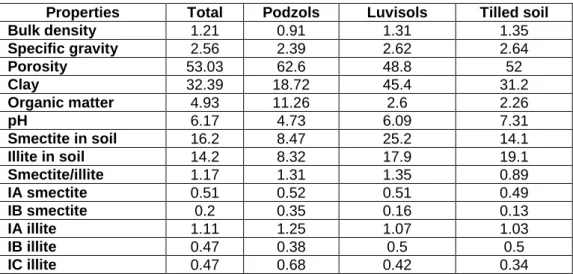
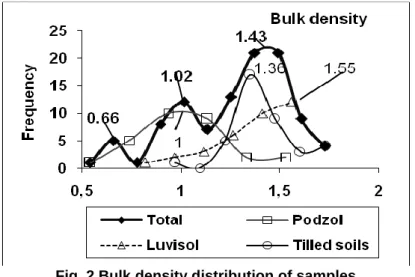
These differences between the histograms are due to their different proporties of the three invesigated soil categories. The statistical data of these categories are presented in the Table 2.
Table 2 The mean statistical date of the three soil categories
Properties Total Podzols Luvisols Tilled soil
Bulk density 1.21 0.91 1.31 1.35
Specific gravity 2.56 2.39 2.62 2.64
Porosity 53.03 62.6 48.8 52
Clay 32.39 18.72 45.4 31.2
Organic matter 4.93 11.26 2.6 2.26
pH 6.17 4.73 6.09 7.31
Smectite in soil 16.2 8.47 25.2 14.1
Illite in soil 14.2 8.32 17.9 19.1
Smectite/illite 1.17 1.31 1.35 0.89
IA smectite 0.51 0.52 0.51 0.49
IB smectite 0.2 0.35 0.16 0.13
IA illite 1.11 1.25 1.07 1.03
IB illite 0.47 0.38 0.5 0.5
IC illite 0.47 0.68 0.42 0.34
Some properties increase in the order podzol-luvisol-tilled soils (bulk density, specificgravity, organic matter, pH, illite content in soil), while another decrease according this succession (organic matter, A and IB smectite indicis, IA and IC illite indices). The clay, smectite in soil and smectite/illite ratio have their maxim value for luvisols. These successions account for the histogram differences of the proprieties.
The averages of the table 2 emphasized that podzols would have the lowest pH, specific gravity, bulk density, clay, smectite and illite contents and the hightest organic matter content and crystalline indices of soil clay minerals.
116
The tilled soils have the highest specific gravity, bulk density pH, and illite content in soil but the lowest organic matter content, the smectite/illite ratio and clay mineral crystalinity indices.
Fig. 2 Bulk density distribution of samples
The luvisols present intermediate values of pH, specific gravity, bulkdensity, organic matter, illite content and the lowest crystallinity indices of clay and smectite content. The statistical data point out the increase of organic matter mineralization and of clay mineral alteration.
Bulk density high correlates with specific gavity accordind to a power curve (n=102 Rpow=0.761***, Rlin=0.721, F=108) although the investigated group contains soil types from chernozem to podzol (Fig. 3).
Fig. 3 Bulk density versus specific gravity
117
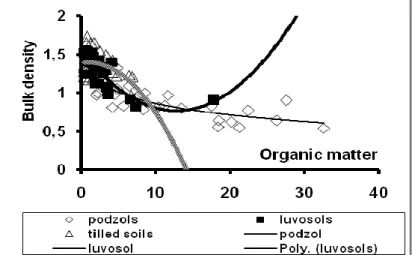
Fig. 4 Bulk density dependind on organic matter
The correlation coefficients of the last categories (Fig. 5) are lower probably due to the effect of the agricol technologies applied during to a different periods. The greatest part of representative points appear to be at the low contents of organic matter and at the high concentration there are only points of podzols along of representative curves. In addition more organic matter content increases more the bulk density decreases approximatively with 0.25-0.35 g/cm3 for 1% matterial organic content. Only podzols have points till 32.6% organic matter when the other two categories are limited at 7% organic matter.
Fig. 5 Bulk density as a function of organic matter content
But the mean value of pH (Table 2) increase from podzols to the tilled soils in the same times with bulk density and suggest a relation between these two variables. Indeed, the bulk density correlates the best with pH (Fig. 6) according to a parabola (n=102, Rpoly=0.663***, Rlin=0.521***, F=37.2) with a relative small curvature radius and increases till a maximum (7.2; 1.4) then decreases slowly. However the podzols (n=29, R=poly0.51***, Rlin=0.115, F=0.66) have generally bulk density smaller than luvisols (n=34, Rpoly=0.505**, Rlin=0.342*, F=4.23) and tilled soils (n=39, Rpoly=0.203, Rlin=0.154, F=0.9).
118
Rlin=0.236, F=2.19). On the graph the representative points appear in the different areals which intersect one to another. The podzol curve is under the other two and shows smaller values for bulk density of these soils.
Fig. 6 Bulk density as a function of pH
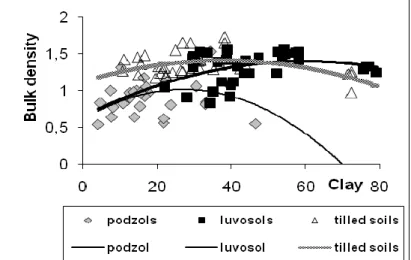
The comparison of correlation coefficients of bulk density with the three tested soil properties shows that the relation with the clay content have the lower coefficients probably due to the variation of its composition and of the clay mineral crystallisation. Thus the smectite from the clay do not correlates with bulk density (n=102, Rpoly=0.051, Rlin=0.032) but increases with smectite from the clay (n=102, Rpow=0.384***, Rlin=0.374***, F=7.1) and show an effect of smectite-illite transformation reaction due to potassium fixation in the illite lattice, a greater alteration of smectite due to its high surface area and the traslocation to the depth of the argillo-humico-sesquioxydes plasma with differend proportions of smectite and illite. The lack of correlation between bulk density and smectite/illite ratio confirm this supposition.
Fig. 7 Bulk density as a function of clay content
119
Fig. 8 Bulk density versus illite in soil
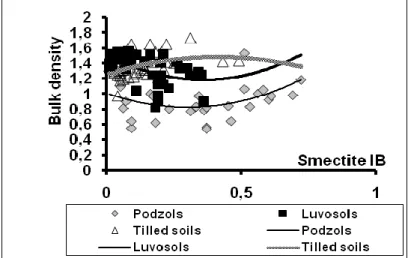
The crystallinity indicis of smectite have value smaller than these of illite for all soil categories. The smectite IA index namely the mean size of its particles do not correlates with bulk density (n=102, Rpoly=0.089, Rlin=0.079, F=0.62) due to the variable composition of smectite complexes but the smectite IB index (the ordering of atoms in the broken surface of crystalls) correlates with bulk density (Fig. 9) both at the whole group (n=102, Rpoly=0.371***, Rlin=0.359***, F=14.8) and the podzols (n=29, Rpoly=0.370*, Rlin=0.172, F=0.82), luvisols (n=34, Rpoly=0.487**, F=9.04) and tilled soils (n=39, Rpoly=0.410**, Rlin=0.382*, F=6.31). The representative points of the three categories appear to be distributed in bands almost parallel with abscisa in the succession podzols luvisols and tilled soils but the last two have their points almost in the same areal.
Fig. 9 Bulk density as a function of smectitte IB
120
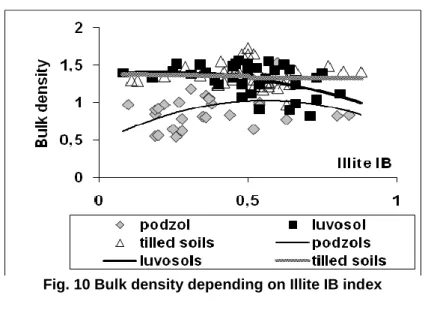
Fig. 10 Bulk density depending on Illite IB index
CONCLUSIONS
Bulk density presents smaller values in the surface horizons due to the decay of vegetal remains. The selected soil group appear to be statistical representative of Romanian soils by its ranges with the dates similar with these presented in Romanian soil papers.
The bulk density increase from podzols to chernozems in the same time with specific gravity, pH and clay content and decrease with organic matter concentration.
Bulk density increase with smectite content in soil, decrease with the ordering of atoms in the broken surface of crystals but do not correlate with the mean particle size of smectite. It increase with the illite content in soil, with ordering of atoms in the broken surface of illite but decrease with its particle size and interne ordering of atoms in the octahedral and tetrahedral plans and the stacking ordering of elementar layer.
BIBLIOGRAPHY
1. Canarache, A., 1990 -Fizica solurilor agricole, Ed. Ceres, pp. 52-54.
2. Crăciun, C., 1998 -The clay minerals in vertisols of Romania. Implication in soil physical and chemical properties, Ştiinţa solului, nr. 1-2.
3. Crăciun, C., Mihaela, Lungu, Dana, M., 2003 -Influenţa cantităţii şi calităţii
argilei asupra stării de aşezare a unor cernisoluri din Câmpia Română, Ştiinţa Solului nr.1-2, pp. 77-98.
4. Crăciun, C., Victoria, Mocanu, Sorina, Dumitru, 2004 -Mineralogia şi calitatea
solului, Ştiinţa Solului nr. 1-2, vol. XXXVIII, pp. 123-145.
5. Eberl, D.D., Velde, B., 1989 -Beyond the Kubler index. Clay minerals,vol. 24, pp. 571-577.
6. Gâţă, Gh., 2001 -Illite crystalinity of Romanian soils, Ştiinţa Solului, vol. XXXV, nr. 1-2.
7. Guş, P., Rusu, T., 2004 -Cercetări privind pretabilitatea principalelor soluri din
Transilvania la sistemele neconvenţionale de lucrare a solului, Publ. S.N.R.S.S., nr. 34. 8.Rusu, I., Goian, M., Ianoş, Gh., Borza, I., Ştefan, V., 1994 -Influenţa antropică