14
THE STUDY OF PARTITION COEFFICIENT OCTANOL/WATER FOR
3-(2-ALCHYLSULFANYL-6-BENZOTHIAZOLYLAMINOMETHYL)-2-
BENZOXAZOLTIONE AS PHOTOSYNTHESIS INHIBITORS
EMILIA AMZOIU*, IONELA BELU, LARISA ELISABETH AVERIS, DENISA AMZOIU, LUDOVIC BEJENARU
Faculty of Pharmacy, University of Medicine and Pharmacy, Craiova
*
corresponding author: [email protected]
Keywords: partition coefficient, photosynthesis inhibitors, lipophilic, regression correlation, benzoxazoltione
ABSTRACT
It is well known that benzoxazole derivatives have a wide range of biological activities. Recently, it was shown that the derivatives of benzoxazoltione, substituted at an amino group inhibit photosynthesis in chloroplasts and algae such as Chlorela vulgaris. It was observed that the inhibitory effect decreases with increasing lipophilicity of substances in the series.
The lipophilicity or hydrophilicity are expressed by the partition coefficient, which is a very important factor that characterize the pharmacokinetic profile of a chemical compound. We studied the structural descriptors that contribute to the biological activity of substances. For a series of nine substances, results show that descriptors CSAA, CSEV and TFES appear to be responsible for the inhibitory activity of these substances.
INTRODUCTION
Lately intensified research regardig those chemicals capable of destroying vegetable pests of crops by inhibiting photosynthesis of the second system of these pests (PS I) /1-3/.
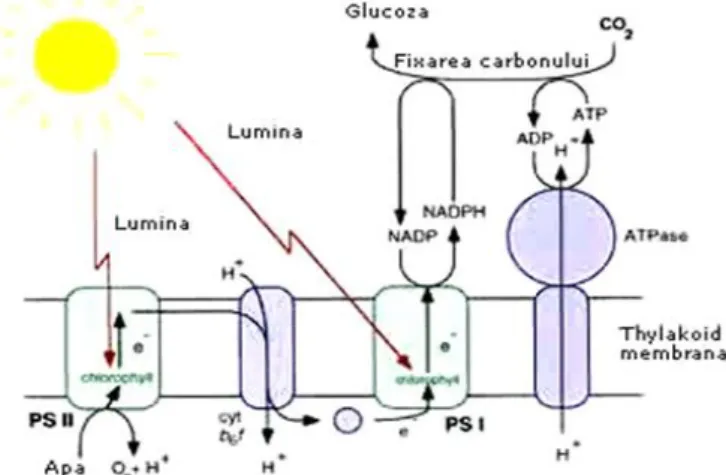
It is known that in the photosynthesis drives of chloroplasts which are, particularly there tilakoide membranes, photosynthesis reactions take place with the illuminating radiation. The light energy is collected by the chloroplast pigments antenna and transferred to reaction centers. For photosynthesis to be effective, light is distributed evenly between the two systems of photosynthesis so that they derive with the same speed. Plants do this using the redox state of the quinone tank which regulates the distribution of light energy between the two systems of photosynthesis (Figure 1).
Figure 1. The process of photosynthesis /2/
If the quinone tank is too low, the first system of photosynthesis (PS I), ie the direct one, operates too slowly, requiring more light energy.
15
This is done by activating an enzyme, called kinases, which stimulates the phosphorylation reaction LHCP (Light Harvesting Complex Protein) which direct the light energy to the first system of photosynthesis. If the quinone tank is oxidized, the kinase is inactivated, and LHCP is dephosphorylated by an enzyme called phosphatase. In the latter case, much of the light energy is directed to the photosynthetic system PS II, which is called the dark reaction system. Thus light energy is converted by the two photochemical reactions systems into chemical energy by redox reactions.
Some chemicals affect the electron transport system, acting as a oxidant terminal for the first system of photosynthesis, stimulating beyond measure electronic transport.
Other substances compete and blocks access of plastoquinone to the binding site QB
of the protein D1 in the second system of photosynthesis. In this way it inhibited the
reduction of plastochinonei through photosynthesis. As a result, the electronic properties and mediation of a proton, in the D1 proteincase, are strongly influenced by the presence of
fluids inside the chloroplast of such substances and their concentration in the fluid.
MATERIALS AND METHODS
In this context, it is well known that benzoxazoltionă derivatives have a wide range of biological activities /4-6/ namely, it was found that 3-(2-Aminomethyl-benzothiazol-6 alkylsulfanyl)-2-benzoxazoltiones inhibits photosynthesis in chloroplasts /4/. The biological activity of these derivatives depends, as expected, of the partition coefficient and, therefore, the lipophilicity or hydrophilicity of these substances.
This coefficient is a physicochemical factor directly influencing the pharmacokinetics profile of a chemical and, indirectly, its pharmacodynamic profile.
The partition coefficient:
) (
) tan 1 (
2 1
2 1
water C
nol oc C C C
P
sau
log P = log
2 1
C C
= log C1 – log C2
The substance is, therefore, hydrophobic if the log P > 0 or hydrophilic if log P < 0. The purpose of this paper is to study the lipophilicity of these substances and see which molecular descriptors is responsible for the lipophilic properties. To this end, modelling was performed for the chemical structures in Figure 2.
Figure 2. Benzoxazoltione derivatives
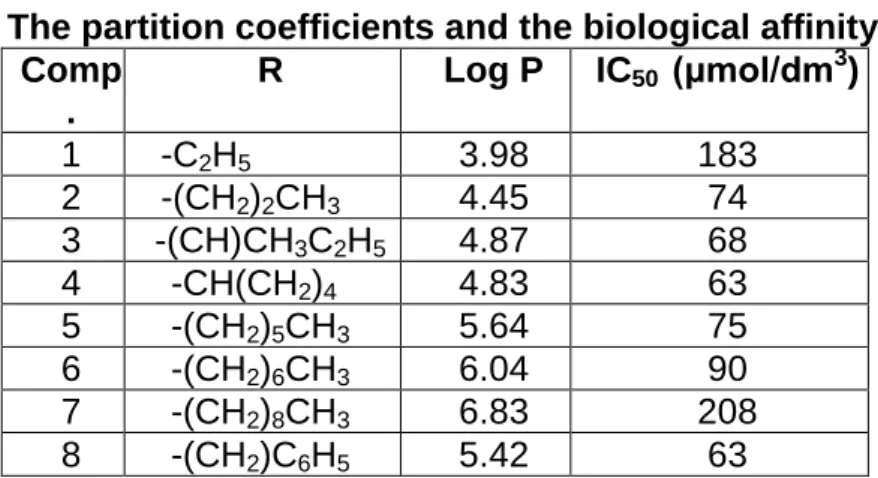
For these compounds the following data are reported on the partition coefficient and the biological affinity (Table 1).
16
Table 1
The partition coefficients and the biological affinity Comp
.
R Log P IC50 (μmol/dm3)
1 -C2H5 3.98 183
2 -(CH2)2CH3 4.45 74
3 -(CH)CH3C2H5 4.87 68
4 -CH(CH2)4 4.83 63
5 -(CH2)5CH3 5.64 75
6 -(CH2)6CH3 6.04 90
7 -(CH2)8CH3 6.83 208
8 -(CH2)C6H5 5.42 63
Modelling and optimization of the molecular geometry was carried out by molecular mechanics (MM+) /7/ and using the software package MOPAC /8/. Cartesian coordinates are used as input data for obtaining the solute-solvent interaction energies for the solvents water and 1-octanol.
These interactions have been calculated using ab initio cuantomolecular program GAMESS /9,10/ based STO-6G of atomic orbitals per atom. The solvents were simulated using the model PCM (Polarisable Continuum Model) incorporated into the GAMESS program in which the solvent is described as a continuous medium, and the solvent molecule immersed into the solute forms a molecular cavity. Solute-solvent interactions are described as a field reaction due to the presence of a dielectric medium.
Figure 3. Solvation in PCM
Solute-solvent interaction energies and the Connolly descriptors regarding molecular cavity, that is solvent accessible surface area and excluded volume of solvent were
calculated for the solvents water and octanol.
Figure 4. Connolly solvent accessible surface and molecular volume of solute solvent excluded
REZULTS AND DISCUTIONS
17
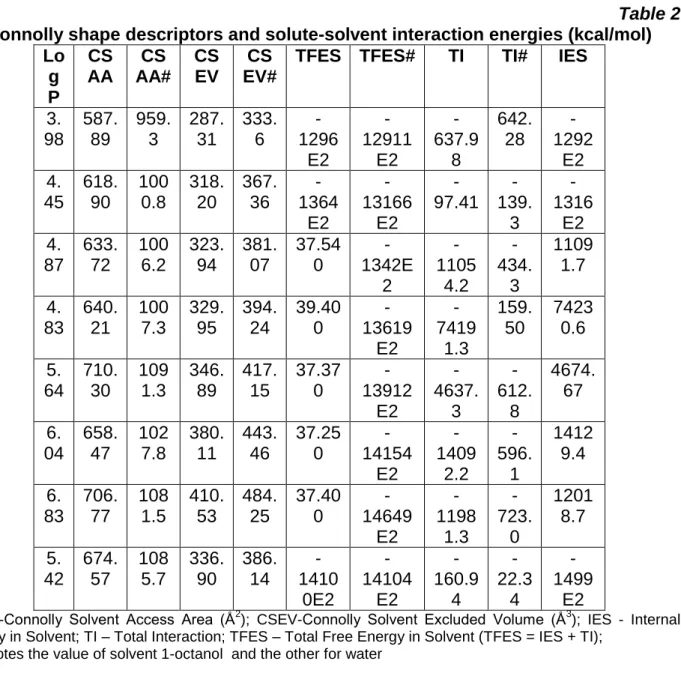
Table 2
Connolly shape descriptors and solute-solvent interaction energies (kcal/mol) Lo g P CS AA CS AA# CS EV CS EV#
TFES TFES# TI TI# IES
3. 98 587. 89 959. 3 287. 31 333. 6 -1296 E2 -12911 E2 -637.9 8 642. 28 -1292 E2 4. 45 618. 90 100 0.8 318. 20 367. 36 -1364 E2 -13166 E2 -97.41 -139. 3 -1316 E2 4. 87 633. 72 100 6.2 323. 94 381. 07 37.54 0 -1342E 2 -1105 4.2 -434. 3 1109 1.7 4. 83 640. 21 100 7.3 329. 95 394. 24 39.40 0 -13619 E2 -7419 1.3 159. 50 7423 0.6 5. 64 710. 30 109 1.3 346. 89 417. 15 37.37 0 -13912 E2 -4637. 3 -612. 8 4674. 67 6. 04 658. 47 102 7.8 380. 11 443. 46 37.25 0 -14154 E2 -1409 2.2 -596. 1 1412 9.4 6. 83 706. 77 108 1.5 410. 53 484. 25 37.40 0 -14649 E2 -1198 1.3 -723. 0 1201 8.7 5. 42 674. 57 108 5.7 336. 90 386. 14 -1410 0E2 -14104 E2 -160.9 4 -22.3 4 -1499 E2
CSAA-Connolly Solvent Access Area (Å2); CSEV-Connolly Solvent Excluded Volume (Å3
); IES - Internal Energy in Solvent; TI – Total Interaction; TFES – Total Free Energy in Solvent (TFES = IES + TI);
# denotes the value of solvent 1-octanol and the other for water
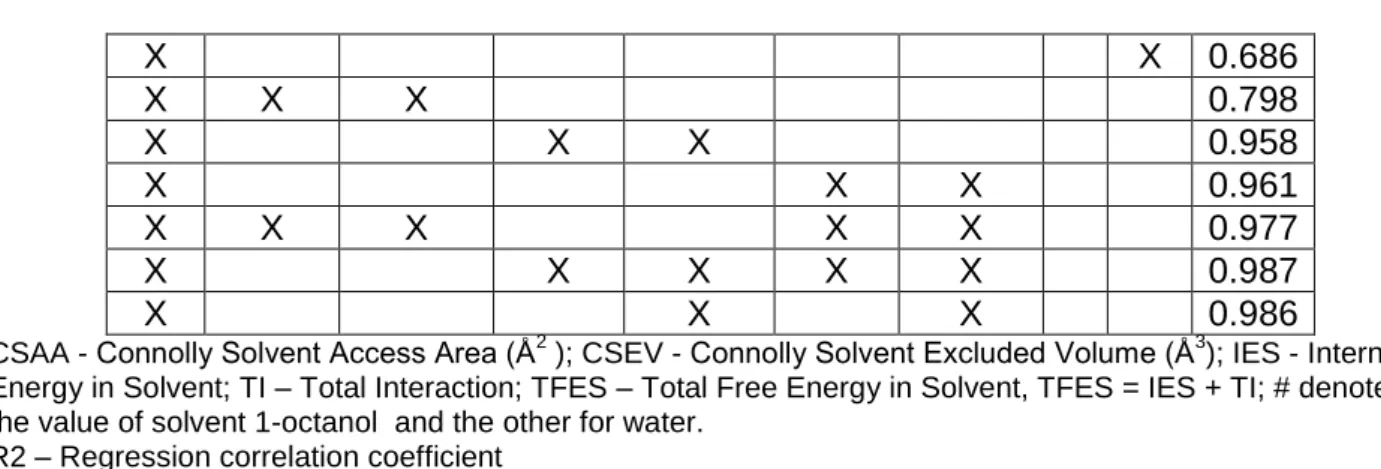
Correlation of these parameters with partition coefficient values is shown in Table 3, using linear regression.
Table 3
Multiple linear regression log A = a0 + a1X1 + …
Xi
Log P
CSAA CSAA# CSEV CSEV# TFES TFES# TI TI# R2
X X 0.764
X X 0.621
X X 0.957
X X 0.945
X X 0.311
X X 0.947
18
X X 0.686
X X X 0.798
X X X 0.958
X X X 0.961
X X X X X 0.977
X X X X X 0.987
X X X 0.986
CSAA - Connolly Solvent Access Area (Å2 ); CSEV - Connolly Solvent Excluded Volume (Å3
); IES - Internal Energy in Solvent; TI – Total Interaction; TFES – Total Free Energy in Solvent, TFES = IES + TI; # denotes the value of solvent 1-octanol and the other for water.
R2 – Regression correlation coefficient
As it can be seen in Table 3, Solvent Excluded Volume (CSEV) seems to play a more important role than solvent accessible surface area (CSAA). The total energy of solute-solvent interaction TI for water solvent plays no role compared to the same interaction energy in 1-octanol in simulating biological membranes. The same can be said about the total free energy of interaction in the solvent for water is R2 = 0.311, but for 1-octanol is R2 = 0.947 and the standard deviation of the estimate is much lower.
Obviously all linear combinations of molecular shape descriptors as CSAA, CSEVwith the total free energy in solvent TFES condition the partition coefficient values.
The most suitable combination appears to be for the excluded volume of the solvent CSEV and the total free energy in the solvent TFES for 1-octanol, for which R2 = 0.986 and the standard deviation is small, 0.130.
Last result explains the model suggested in the literature, bilinear model introduced by Kubinyi whereby aqueous and lipid phases are arranged alternately /11/. This model applied to photosynthesis inhibitors is shown schematically in Figure 5.
A1 L1 A2 R
Figure 5.The Kubinyi model A1 – the external aqueous phase
L1 – lipid phase (tilakoid membrane)
A2 – the internal aqueous phase of the chloroplast R – receptor (D1 protein)
The fact that the partition coefficient values for photosynthesis inhibitors studied dependent more on molecular descriptors in 1-octanol is very interesting. This capacity may be a characteristic of the respective inhibitors, given that 1-octanol simulates very well biological membranes.
According to a partition model that is developed within our circle of modeling and drug design, the ligand-receptor interaction itself can be explained through a partition
19
LIGAND + RECEPTOR [LIGAND-RECEPTOR] => Biologic Response
aqueous phase lipid phase lipid phase
Figure 6. The ligand - receptor interaction in key-lock model approximation /12/
The ligand located in the aqueous phase will pass into the lipid phase in which it is contained or even is biological receptor. The formation of the active complex ligand - receptor occurs by passing the ligand or inhibitor from the lipid phase into the aqueous phase (Figure 6).
CONCLUSIONS
1. Molecular shape descriptors, such as Connolly excluded volume of the solvent (CSEV), have a major contribution to the value of the partition coefficient.
2. Correlation of partition coefficient with molecular shape descriptors (CSAA, CSEV) and interaction energy (TFES) leads to good results.
3. Partition coefficient values for photosynthesis inhibitors that we studied dependent more on molecular descriptors in 1-octanol, which may be a characteristic of these substances, 1-octanol simulating best cell membranes.
4. The results explains the bilinear model of Kubinyi, the inhibitory activity of analytes substances being more pronounced as the partition coefficient has higher values.
REFERENCES
1. Petcu G., Sin G., Gay M., Radu M., Utilizarea teledetecţiei pentru aplicarea
agriculturii de precizie. Probleme de agrofitotehnie teoretică şi aplicată, XXVI (1-2): 1-122, 2004.
2. Berca M., Planificarea de mediu şi gestionarea resurselor naturale, Ed. Ceres
Bucureştiâ, 2004.
3. Loriga M., Paglietti G., Mattana A., Fiori P. L., Mollicotti P., Sechi L., Eur. J. Med. Chem., 39:195-313, 2006.
4. Forchiassin G., Pitacco G., Risaliti A., Russo C. and Valentin E., Benzoxazol-2 (3H)-one and 1,3,4-oxadiazol-Benzoxazol-2(3H)-one derivatives from substituted enaminones and ketoenamines, J. Heterocyclic chemistry, 20: 305-309, 2009.
5. Phatangare K., Vikas P., Synthesis, photophysical property study of novel
fluorescent 4-(1,3-benzoxazol-2-yl)-2-phenylnaphtho[1,2-d][1,3]oxazole derivatives and their inhibitory activity, 1, 2013.
6. Chaeuk I., Yim C., Yoon S, Archives of Pharmacal Research, 20, 647-651, 1997.
7. http://www.4shared.com/file/E6zKU0pg/portable_hyperchem_807.html 8. MOPAC 7.0 for UNIX, Quantum Chemistry Program Exchange, Project 688.
9. Schmidt M.W.; Baldridge K.; Boatz A.; Elbert S.T.; General atomic and molecular electronic structure system, Journal of Computational Chemistry, 14 (11): 1347–1363, 1993.
10. Gordon Research Group,GAMESS Manual (Input), 2013.
11. Kubinyi H., Quantitative structure-activity relations. 7. The bilinear model, a new model for nonlinear dependence of biological activity on hydrophobic character, J. Med. Chem., 20(5), 625–629, 1977.