RESEARCH ARTICLE
County-level hurricane
exposure and birth rates: application
of difference-in-differences analysis
for confounding control
Shannon C. Grabich
1*, Whitney R. Robinson
1, Stephanie M. Engel
1, Charles E. Konrad
2, David B. Richardson
1and Jennifer A. Horney
3Abstract
Background: Epidemiological analyses of aggregated data are often used to evaluate theoretical health effects of natural disasters. Such analyses are susceptible to confounding by unmeasured differences between the exposed and unexposed populations. To demonstrate the difference-in-difference method our population included all recorded Florida live births that reached 20 weeks gestation and conceived after the first hurricane of 2004 or in 2003 (when no hurricanes made landfall). Hurricane exposure was categorized using ≥74 mile per hour hurricane wind speed as well as a 60 km spatial buffer based on weather data from the National Oceanic and Atmospheric Administration. The effect of exposure was quantified as live birth rate differences and 95 % confidence intervals [RD (95 % CI)]. To illustrate sensitivity of the results, the difference-in-differences estimates were compared to general linear models adjusted for census-level covariates. This analysis demonstrates difference-in-differences as a method to control for time-invariant confounders investigating hurricane exposure on live birth rates.
Results: Difference-in-differences analysis yielded consistently null associations across exposure metrics and hur-ricanes for the post hurricane rate difference between exposed and unexposed areas (e.g., Hurricane Ivan for 60 km spatial buffer [−0.02 births/1000 individuals (−0.51, 0.47)]. In contrast, general linear models suggested a positive association between hurricane exposure and birth rate [Hurricane Ivan for 60 km spatial buffer (2.80 births/1000 indi-viduals (1.94, 3.67)] but not all models.
Conclusions: Ecological studies of associations between environmental exposures and health are susceptible to confounding due to unmeasured population attributes. Here we demonstrate an accessible method of control for time-invariant confounders for future research.
Keywords: Difference-in-difference, Fixed-effect regression, General linear models, Hurricane, Disaster, Birth rates
© 2015 Grabich et al. This article is distributed under the terms of the Creative Commons Attribution 4.0 International License (http://creativecommons.org/licenses/by/4.0/), which permits unrestricted use, distribution, and reproduction in any medium, provided you give appropriate credit to the original author(s) and the source, provide a link to the Creative Commons license, and indicate if changes were made. The Creative Commons Public Domain Dedication waiver (http://creativecommons.org/ publicdomain/zero/1.0/) applies to the data made available in this article, unless otherwise stated.
Background
Ecological analyses with exposure and outcome meas-ures at aggregate level are often used in environmental and natural disaster epidemiology. The purpose of aggre-gate level analyses can be the estimation of ecological
associations or inference to individual risks. While aggre-gate level research may be more practical when individ-ual exposures and outcomes are difficult to define, there are many methodological challenges surrounding its use in inference on individual risks. Some concerns may include ecological bias, exposure misclassification and proper control of measured or unmeasured confounders. Challenges inherent to the timely collection of post-dis-aster data or reliance on surveillance data often leads to lack of control for unmeasured confounding.
Open Access
*Correspondence: [email protected]
1 Department of Epidemiology, Gillings School of Global Public Health,
University of North Carolina at Chapel Hill, 135 Dauer Drive 2101 McGavran-Greenberg Hall, CB #7435, Chapel Hill, NC 27599, USA Full list of author information is available at the end of the article
To assess the health impacts of hurricanes and inform the policies needed to mitigate adverse effects, epide-miologists often conduct analyses of aggregated data [1,
2]. The findings of the current literature on hurricane exposure and reproductive health outcomes are gener-ally mixed [3–7]. These inconsistencies may be in part the result of the limitations associated with the use of aggregate data such as determination of timing in expo-sure and outcome relationships. Methods like difference-in-differences fixed-effects modeling can be applied to control for unmeasured confounding in pre-post or county-level level analysis [8–10].
Difference-in-differences methods have a long history in disciplines outside of epidemiology [11–13]; however, their use is relatively less common in epidemiology, with the exception of a few studies [14–16] as well as case-crossover and case-time-control designs. Difference-in-differences methods can be applied to any model where outcomes are observed in a minimum of two groups (e.g., treatments or exposure categories) at two different time points assuming confounders are time invariant [17–19]. The exposed group must have an exposure status which changes across the two time points, while the referent group remains unexposed in both time periods. The esti-mate in the unexposed group is then subtracted from that of the exposed group. This removes biases resulting from static population characteristics between the two time points. A commentary by Kaufman discusses the application of similar fixed-effects methods in epidemiol-ogy to reduce bias and derive more valid estimates [20]. This method is a relatively simple yet powerful technique to address confounding inherent in comparing popula-tions that may not have the same baseline characteristics. To demonstrate an application of this method in county-level analysis, we assessed the association between hurricane exposure and live birth rates. Live birth rates are often anecdotally assumed to be influenced by natural disaster occurrences, with some reports sug-gesting a “baby boom” following severe weather events [5, 21]. In other words, live birth rates may increase after disaster occurrence through increased conception rates. We compared an adjusted general linear model approach, to directly compare birth rates in counties affected and unaffected by hurricanes, to results obtained by a dif-ference-in-differences analysis to illustrate the method’s application for future epidemiology research.
Methods Study population
We used a retrospective cohort of 2003 and 2004 Flor-ida conceptions resulting in live birth to demonstrate the difference-in-differences method on the relationship between county-level hurricane exposure and live birth
rates. Four hurricanes made landfall in Florida during the 2004 hurricane season, exposing the majority of the 67 counties to hurricane weather. No hurricanes made land-fall during the 2003 season. Therefore conceptions during 2003 were all considered unexposed while conceptions during 2004 could be considered exposed or unexposed depending on maternal county of residence. Our source population, from vital records data, included all docu-mented Florida pregnancies conceived in 2003 and 2004 that completed a minimum of 20 weeks gestation.
The 2004 cohort used in both the difference-in-dif-ferences models and general linear models included women who conceived between August 14, 2004 and October 31, 2004. Conception was estimated based on clinical estimate from the birth certificate. The defined window of exposure falls from just after the first hurri-cane occurrence through 3 months after the last hur-ricane occurrence. This exposure window aligned with the conception-based “baby-boom” hypothesis. For the difference-in-differences analysis, we also used pregnan-cies conceived in the previous year, from August 14, 2003 and October 31, 2003, to calculate 2003 unexposed live birth rates.
Exclusions
We excluded births to non-Florida residents, as they did not have a residential address to link to Florida hurricane exposure. Additionally, births with gestational age less than 20 weeks and to mothers less than 15 years at deliv-ery or greater than 45 years of age were also excluded. Of the 94,593 total eligible births, 92,398 remained in the analytic population after exclusion criteria were applied. Hurricane exposure
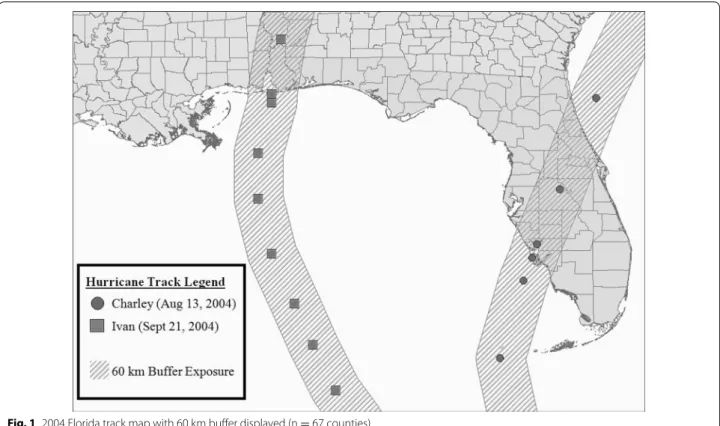
We focused on two of the four 2004 hurricanes which made landfall in Florida: Charley (August 13, 2004) and Ivan (September 21, 2004) (Fig. 1). Charley was the first and strongest hurricane of the season, hitting many Florida counties with diverse population groups. In con-trast, Ivan hit the Florida panhandle, where the popula-tion that is socioeconomically and socially distinct from the rest of the state. Therefore, analyses comparing coun-ties exposed to Hurricane Ivan to the rest of the state are uniquely susceptible to bias from unmeasured confound-ing. Therefore, analysis of Hurricane Ivan presents a opportunity to explore whether the differences-in-differ-ences model accounts for unmeasured confounding that may bias analyses using general linear models.
Counties were classified with respect to hurricane exposure using two previously published methods. The first method applied exposure based on a cutoff of hur-ricane maximum wind severity according to the Saf-fir-Simpson Wind Scale [22]. Based on the cutoff for
category 1 hurricane, counties affected by winds ≥74 mph were considered exposed and compared to coun-ties with wind speeds less than 74 mph (unexposed). The second method was defined by a 60 km symmetrical spa-tial buffer around the storm track. Any county within the 60 km buffer, including partial counties, was considered exposed and compared to the counties completely out-side of the buffer (unexposed) [23, 24]. We compared the two methods of classifying exposure to demonstrate the consistency of the results.
Statistical methods
We calculated county-level live birth rates for 2003 and 2004 conceptions as the number of live births in a county divided by the total county population at midyear times 1000. All analyses were conducted in SAS 9.2 (Cary, North Carolina) and an example SAS program of dif-ference-in-differences methods is provided in the Addi-tional file 1: supplemental digital content 1. This research was approved by the Institutional Review Boards at the Florida Department of Health (#H13049) and the Univer-sity of North Carolina at Chapel Hill (#13-0784).
Difference‑in‑differences
Difference-in-differences is a statistical technique which attempts to mimic experimental research study design for analyses of observational data. The effect of exposure
(treatment) on an outcome is calculated as the difference of the average change in the exposed group minus the change in the unexposed group. In this hurricane expo-sure example, we are estimating the difference in live birth rate differences in exposed counties from the 2003 to 2004 time periods as shown in the hypothetical dia-gram Fig. 2. The change in birth rate labeled “Difference from hurricane effect” (graphically illustrates the rate estimated using the difference-in-differences analysis.
Difference-in-differences models have the same assumptions as the underlying model form (in this
Fig. 1 2004 Florida track map with 60 km buffer displayed (n = 67 counties)
case general linear model) with additional assump-tions regarding parallel trends in county attributes. This implies that within-county characteristics, e.g., median income, are invariant between time periods or change at the same rate across exposed and unexposed counties. If this assumption holds, then difference-in-differences removes confounding by these covariates, even those which are unmeasured. When this assumption is vio-lated, there will be residual confounding by factors that change differentially between study years.
We conducted analyses of the difference-in-differences method using PROC GLM with the ABSORB statement in SAS 9.2 to estimate the rate difference between the 2003 and 2004 within-county live birth rates. This is anal-ogous to the rate difference generated in a general linear model with the previous unexposed year rate difference removed, estimating the marginal within-county rate difference (Fig. 3). The 2003 conception period in these models stands in for the baseline differences in covariate distributions between counties before hurricane expo-sure or non-expoexpo-sure in 2004.
General linear models
We illustrate sensitivity of results by fitting general linear models to estimate the association between hurricane exposure and county-specific live birth rates of 2004 con-ceptions. We conducted unadjusted and adjusted general linear models using PROC REG with identity link and Gaussian random distribution in SAS 9.2 software to estimate rate differences.
To demonstrate a regression approach to control con-founding in aggregate analyses, the models were adjusted for county-level 2000 US Census covariates, includ-ing percent renter-occupied units, median household income, percent of persons who speak English less than well and percent of adults with more than high school education. These variables have been used previously in developing social indices and controls in county-level studies [25–27]. The chosen covariates were determined
a priori based on a literature review of natural disasters and public health.
Results
The first hurricane of 2004, Charley, moved northeast through central Florida impacting a large geographic area. In contrast, Hurricane Ivan made landfall in Ala-bama and Florida, affecting only a small area of the Florida panhandle. The Florida counties exposed to Hur-ricane Ivan had lower median incomes, less education and a higher proportion of renter occupied units than the unexposed counties (Table 2). The number of exposed and unexposed counties varied with the specific hur-ricane (Table 1). For example, using the 60 km buffer, twenty-three counties were classified as exposed to Hur-ricane Charley while only two were exposed to HurHur-ricane Ivan.
Associations in Table 1 are reported as rate differ-ences (RD) with 95 % confidence interval (95 % CI). For Hurricane Charley, neither the difference-in-differences nor the general linear models identified an association between hurricane and live birth rates. The 95 % confi-dence intervals produced by the difference-in-differences method exhibited greater statistical precision as shown by the tighter confidence intervals.
The associations found for Hurricane Ivan differed from Hurricane Charley. The difference-in-differences model did not suggest an association between hurri-cane exposure and live birth rates. In contrast, in the general linear models, live birth rates were consist-ently positively associated with both the 60 km buffer [RD = 2.80 births/1000 individuals (1.94, 3.67)] and the wind speed ≥74 mph [RD = 2.23 births/1000 individuals (1.47, 2.99)]. Higher birth rates in the exposed Panhandle counties, even after covariate-adjustment, are compatible with our hypothesis that GLM analysis of Hurricane Ivan would be subject to residual confounding from unmeas-ured social and socioeconomic factors that are more common in the Panhandle and associated with higher birth rates.
Discussion
To assess the health impacts of environmental exposures including natural disasters, epidemiologists often con-duct analyses of aggregated data. Such approaches may have methodological limitations, including incomplete confounder control, exposure misclassification and lack of group level covariate information. We sought to dem-onstrate an application of the difference-in-differences method in estimating the effect of county-level hur-ricane exposure on live birth rates. While still poten-tially suffering from bias due to residual confounding and migration, this method overcomes some of the
Fig. 3 Methods description for general linear and
limitations of conventional approaches by addressing confounding by unmeasured time-invariant attributes. It has become increasingly common in epidemiologic and public health research to perform aggregate level analysis (e.g., at the level of the county, ZIP code or cen-sus track) and to use aggregate indices or cencen-sus varia-bles to control for confounding (Platt et al. [26]). Results from the difference-in-differences analyses demonstrate a method to improve control of confounding due to
unmeasured variables in aggregate analyses. We dem-onstrated the use of difference-in-difference into a spa-tial single year comparison; however, studies of other outcomes with hurricane exposure often use pre-post analysis or clinic-based populations. Methods like dif-ference-in-difference modeling can be applied to con-trol confounding in ecological pre-post or county-level analysis [28]. Overall across exposure metrics and hur-ricanes, the consistency of the difference-in-differences Table 1 Census-adjusted general linear model (GLM) and difference-in-differences models of Hurricane exposure and live birth
Rates per 1000 Individuals, Florida 2004 (n = 67 counties)
Adjusted models include percent renter-occupied units, median household income, percent of persons who do not speak English and percent of persons with more than high school education
CI confidence interval, GLM general linear model
a N exposed column indicates the number of exposed counties given indicated exposure method and hurricane out of 67 total counties
Exposure method Hurricane Charley exposure Hurricane Ivan exposure
N exposeda Estimate (95 % CI) N exposeda Estimate (95 % CI)
60 km buffer
Within county difference-in-differences model 23 0.02 (−0.16 to 0.20) 2 −0.02 (−0.51 to 0.47) Across County GLM adjusted model −0.30 (−0.72 to 0.13) 2.80 (1.94 to 3.67) Wind speed ≥ 74 mph
Within county difference-in-differences model 5 0.18 (−0.13 to 0.49) 3 0.05 (−0.34 to 0.44) Across county GLM adjusted model 0.06 (−0.67 to 0.78) 2.23 (1.47 to 2.99)
Table 2 Description of census county variables from adjusted analysis, Florida 2004 (n = 67 counties)
a Exposure for Table 2 was categorized by 60 km buffer
Census variable Overall number
counties Charley exposed countiesa (n = 23) Ivan exposed countiesa (n = 2)
N (%) N (%) N (%)
Renter occupied units
<15 % 5 (7.5 %) 1 (4.3 %) 0 (0.0 %) 15 to <25 % 43 (64.2 %) 13 (56.5 %) 1 (50.0 %) 25 to <35 % 12 (17.9 %) 7 (30.4 %) 1 (50.0 %) 35+ % 7 (10.4 %) 2 (8.7 %) 0 (0.0 %) Median household <Median (38,819 K) 47 (70.1 %) 14 (60.8 %) 1 (50.0 %) >Median (38,819 K) 20 (29.9 %) 9 (39.2 %) 1 (50.0 %)
Percent persons do not speak English
<5 % 12 (17.9 %) 0 (0.0 %) 0 (0.0 %)
5 to <15 % 41 (61.1 %) 15 (65.2 %) 2 (100.0 %)
15 to <20 % 7 (10.4 %) 4 (17.4 %) 0 (0.0 %)
25+ % 7 (10.4 %) 4 (17.4 %) 0 (0.0 %)
Percent persons with ≥HS education
<65 % 4 (6.0 %) 2 (8.7 %) 0 (0.0 %)
65 to <75 % 26 (38.8 %) 4 (17.4 %) 0 (0.0 %)
75 to <85 % 26 (38.8 %) 12 (52.2 %) 1 (50.0 %)
method suggests the integrity of this method over the general linear models.
There is no current consensus on the impact of hurri-cane exposure on reproductive health, with associations widely varying across studies [3, 29]. These mixed find-ings are potentially the result of varied mechanisms of exposure (e.g., stress, economical, injury etc.), variations in exposure definitions, dissimilar study populations, incomplete confounding control or potential heterogene-ity in hurricane effects. Our analysis applied several expo-sure metrics over multiple hurricanes to examine some of these potential sources of inconsistencies. All differ-ence-in-differences models yielded null associations for both hurricanes and for all exposure metrics. In contrast the general linear model yielded some potential associa-tions with Hurricane Ivan. In supplemental analyses of the other hurricanes in the 2004 season, while some variabil-ity exists between the GLM and DID method, none are as stark a contrast as that seen in Hurricane Ivan. In analyses of Hurricane Frances and Jeanne, general linear models varied in magnitude and direction while we found consist-ently null associations using the difference-in-differences approach (Additional file 1: supplemental digital content 2). Additionally, the results from the Hurricane Ivan mod-els are compatible with the hypothesis that uncontrolled confounding by unmeasured or imprecisely measured factors like low socioeconomic status, more widespread lack of medical access, and social norms around higher parity may bias GLM models of these data.
Suggested associations between hurricane exposure and live birth rates are largely anecdotal, including clini-cal observations and media reports. Two studies have focused on birth rates after hurricane occurrence. Cohan and Cole investigated live birth rates in twenty-four South Carolina counties in a time-series analysis before and after Hurricane Hugo and found that before the hur-ricane live birth rates decreased, while after the hurhur-ricane live birth rates increased [21]. Hamilton investigated county live birth rates in the Gulf Coast states (Louisi-ana, Mississippi and Alabama) following Hurricane Kat-rina and had mixed results depending on state [5]. While both studies controlled for measured population charac-teristics, the difference-in-differences approach (which additionally accounts for some unmeasured factors) may more fully adjust for differing population characteristics.
Difference-in-differences models assumptions regard-ing parallel trends can in theory be evaluated to the extent that all confounders’ distributions are available in both time periods. A review of the current literature suggests that the parallel trend assumption was likely met as hur-ricanes are thought of as an exogenous occurrence likely uncorrelated with changes in determinants of birth rates [30]. However, like many environmental studies, our
exposure was defined by county of residence and there-fore secular trends influencing birth rate may differ by county. Researchers should consider these assumptions in the application of the difference-in-differences method.
While the difference-in-differences model may have improved control of unmeasured confounder bias, other biases may persist. For instance, several articles have crit-icized the use of difference-in-differences methods using large datasets, where inappropriately small standard errors can incorrectly indicate significant relationships [28, 31]. This is a particular problem if outcomes are non-independent between subjects, which is not expected to be the case in our birth rate outcome. Our difference-in-differences models showed tighter 95 % confidence inter-vals than the general linear models, indicating smaller standard errors, however, we assume individual changes in conception are independent.
There were also limitations with our study methods. A major limitation of our study is that the four hurricanes hit Florida in 2004 in rapid succession, limiting our abil-ity to understand independent hurricane effects. In par-ticular, the Ivan-unexposed counties were affected by exposure to other hurricanes, which could bias our esti-mates towards the null. However, supplemental analy-sis did not indicate that additional hurricanes conferred additional risk on affected counties. Another limitation is that the number of counties exposed changed by the method of exposure categorization, thus rendering com-parisons across method or hurricane difficult, especially using general linear models (Table 1). The county-fixed effects which are used in the difference-in-differences approach better allows for comparisons across models. Moreover, our reliance on Vital Statistics data prevents us from understanding the impact of early pregnancy loss as well as being unable to adjust for information on migration into or out of our study population.
Changes in live birth rates can be influenced by increases in the number of conceptions, migration into or out of the study area, and changes in fetal loss rates. While we are assuming migration into and out of our Florida cohort is equal, we have no way to document births that occurred out-side of the state of Florida due to relocation or evacuation. Studies of the 2004 hurricane season estimate that between one-quarter and one-third of Florida’s population evacu-ated their homes prior to at least one hurricane; and many were evacuated several times [32].We assume the relocation of potentially exposed individuals could bias associations toward the null since people returning to exposed counties would have actually received no direct exposure by evacuat-ing heavily influenced areas. Maternal exposure was defined based on residence at the time of delivery as listed on the birth certificate; however, we acknowledge that residence in a county throughout pregnancy has not been verified.
Conclusion
In summary, we illustrate a method of inference for aggregate analyses to partially account for unmeas-ured confounding. Our analysis differs from much of the current epidemiological application of differences-in-differences method by demonstrating its appli-cation with county-level data. The inconsistency of the literature on hurricanes and reproductive health may be in part due to biases inherent in pre-post or regression-based county-level comparisons. Because of limited information on covariates in administrative data sources like those analyzed here, the DID method may be particular useful as the exploitation of aggre-gate-level “big data” increases. This example can aid future researchers in applying these methods to future studies.
Abbreviations
95 % CI: 95 % confidence intervals; DID: difference-in-diffrences; GLM: general linear model; km: kilometers; Mph: miles per hour; RD: rate differences.
Authors’ contributions
SCG: designed to project, acquired outcome data from the Florida Depart-ment of Health, ran analyses and wrote the majority of the manuscript. WRR: aided in project design and methods, corresponded with co-authors, and wrote the manuscript. SME: served as reproductive health outcome expert and design and worked on editing manuscript. CEK: acquired and designed exposure data, served as climatology exposure expert. DBR: statistical method expert in design and assisted in writing manuscript. JAH: assisted in data acquisition, design and hurricane expert as well as wrote manuscript. All authors read and approved the final manuscript.
Author details
1 Department of Epidemiology, Gillings School of Global Public Health,
Univer-sity of North Carolina at Chapel Hill, 135 Dauer Drive 2101 McGavran-Green-berg Hall, CB #7435, Chapel Hill, NC 27599, USA. 2 Department of Geography,
University of North Carolina at Chapel Hill, Chapel Hill, NC, USA. 3 Department
of Epidemiology and Biostatistics, School of Rural Public Health, Texas A&M Health Science Center, College Station, TX, USA.
Competing interests
The submitted research is unfunded and the authors declare that they have no competing interests. I, as corresponding author on behalf of all the authors, am retaining the rights for all authors and their representatives (such as their respective university employers).
Acknowledgements
The open access publishing fees for this article have been covered by the Texas A&M University Online Access to Knowledge (OAK) Fund, supported by the University Libraries and the Office of the Vice President for Research. Received: 21 July 2015 Accepted: 4 December 2015
Additional file
Additional file 1. Supplemental Digital Content 1. Model form and code for difference-in-differences method application. Supplemental
Digital Content 2. Table of Florida 2004 unadjusted, census adjusted and
difference-in-difference analysis of Hurricane exposure and live birth rates (n = 67 counties).
References
1. Harville E, Xiong X, Buekens P. Disasters and perinatal health: a systematic review. Obstet Gynecol Surv. 2010;65(11):713–28.
2. Tschoegl L, Below R, Guha-Sapir D. An analytical review of selected data sets on natural disasters and impacts. Centre for Research on the Epide-miology of Disasters, 2006.
3. Harville EW, et al. Population changes, racial/ethnic disparities, and birth outcomes in Louisiana after Hurricane Katrina. Disaster Med Public Health Prep. 2010;4(Suppl 1):S39–45.
4. Harville EW, et al. Resilience after hurricane Katrina among pregnant and postpartum women. Womens Health Issues. 2010;20(1):20–7.
5. Hamilton BE, et al. The effect of Hurricane Katrina: births in the US Gulf Coast region, before and after the storm. Natl Vital Stat Rep. 2009;58(2):1– 28 (32).
6. Savage J, et al. Post-Katrina perinatal mood and the use of alternative therapies. J Holist Nurs. 2010;28(2):123–32 (quiz 133–5).
7. Xiong X, et al. Hurricane Katrina experience and the risk of post-traumatic stress disorder and depression among pregnant women. Am J Disaster Med. 2010;5(3):181–7.
8. Hansen CA, et al. Ambient air pollution and birth defects in Brisbane, Australia. PLoS One. 2009;4(4):e5408.
9. Lee SJ, et al. A time-series analysis of any short-term effects of meteoro-logical and air pollution factors on preterm births in London, UK. Environ Res. 2008;106(2):185–94.
10. Pennell CE, et al. Genetic epidemiologic studies of preterm birth: guide-lines for research. Am J Obstet Gynecol. 2007;196(2):107–18.
11. Abadie A. Semiparametric difference-in-differences estimators. Rev Econ Stud. 2005;72(1):1–19.
12. Athey S, Imbens GW. Identification and inference in nonlinear difference-in-differences models. Econometrica. 2006;74(2):431–97.
13. Hausman J, Kuersteiner G. Difference in difference meets generalized least squares: higher order properties of hypotheses tests. J Econom. 2008;144(2):371–91.
14. Milojevic A, et al. Health effects of flooding in rural Bangladesh. Epidemi-ology. 2012;23(1):107–15.
15. Dennis J, et al. Helmet legislation and admissions to hospital for cycling related head injuries in Canadian provinces and territories: interrupted time series analysis. BMJ. 2013; 346.
16. Fitz-Simon N, et al. Reductions in serum lipids with a 4-year decline in serum perfluorooctanoic acid and perfluorooctanesulfonic acid. Epidemi-ology. 2013;24(4):569–76.
17. Allison PD. Fixed effects regression models. Sage Los Angeles. 2009. 18. Schneeweiss S, Stürmer T, Maclure M. Case–crossover and case–time–
control designs as alternatives in pharmacoepidemiologic research. Pharmacoepidemiol Drug Saf. 1997;6(S3):S51–9.
19. Suissa S. The case-time-control design. Epidemiology. 1995;6(3):248–53. 20. Kaufman JS. Commentary: why are we biased against bias? Int J
Epide-miol. 2008;37(3):624–6.
21. Cohan CL, Cole SW. Life course transitions and natural disaster: mar-riage, birth, and divorce following Hurricane Hugo. J Fam Psychol. 2002;16(1):14–25.
22. Grabich SC, et al. Measuring the storm: methods of quantifying hurricane exposure in public health. Nat Hazard Rev, Under Review.
23. Currie J, Rossin-Slater M. Weathering the storm: hurricanes and birth outcomes. J Health Econ. 2013;32(3):487–503.
24. Zandbergen PA. Exposure of US counties to Atlantic tropical storms and hurricanes, 1851–2003. Nat Hazards. 2009;48(1):83–99.
25. Greenland S, Pearl J, Robins JM. Causal diagrams for epidemiologic research. Epidemiology. 1999. pp. 37–48.
26. Platt RW, et al. A proportional hazards model with time-dependent covariates and time-varying effects for analysis of fetal and infant death. Am J Epidemiol. 2004;160(3):199–206.
27. Polańska K, Jurewicz J, Hanke W. Review of current evidence on the impact of pesticides, polychlorinated biphenyls and selected metals on attention deficit/hyperactivity disorder in children. Int J Occup Med Environ Health. 2013;26(1):16–38.
28. Lechner M. The estimation of causal effects by difference-in-difference methods. 2011: Now.
29. Zotti ME, et al. Post-disaster reproductive health outcomes. Matern Child Health J. 2012.
30. Cutter SL, Smith MM. Fleeing from the hurricane’s wrath: evacuation and the two Americas. Environ Sci Policy Sustain Develop. 2009;51(2):26–36. 31. Bertrand M, Duflo E, Mullainathan S. How much should we trust
differ-ences-in-differences estimates? National Bureau of Economic Research. 2002.
32. Smith SK, McCarty C. Fleeing the storm (s): an examination of evacu-ation behavior during Florida’s 2004 hurricane season. Demography. 2009;46(1):127–45.
• We accept pre-submission inquiries
• Our selector tool helps you to find the most relevant journal
• We provide round the clock customer support
• Convenient online submission
• Thorough peer review
• Inclusion in PubMed and all major indexing services
• Maximum visibility for your research Submit your manuscript at
www.biomedcentral.com/submit