Abstract— Today's society is getting ever modernized by the
every second. This sweep of modernization across complicated society come at a cost, health problems contributing to a major part of that. Cardiovascular diseases come under lifetime diseases. Around the world, heart diseases contribute more deaths than any other diseases. Controlling and detecting cardiovascular diseases have become one of the most challenging task in medical research. The main objective of the project is identify cardiac disorders using different signal processing techniques and to help the doctors to diagnose actual cardiac problem.
ECG observations are often corrupted by various types of noise. In this study, we mainly focused on reduction of broad-band myopotentials (EMG) noise in ECG signal using DWT. Hence De-noising gained lot of importance. The proposed method choose the best suitable wavelet function based on DWT, using mean square error (MSE) and output SNR. The main advantage of this improved thresholding technique is retentive of each the geometrical characteristics of the first cardiogram signal and the variations with the amplitude of the varied cardiogram waveform effectively. The experimental results proves that the proposed method is improved than traditional wavelet thresholding de-noising methods in the aspects of remaining geometrical characteristics of ECG signal and in improvement of signal-to-noise ratio (SNR).Using Standard patterns and DSP in MATLAB, advantages and disadvantages of all these techniques have been studied and the best compromised solution has been determined.
Keywords:Electrocardiogram(ECG), wavelet de-noising, discrete wavelet transform, improved thresholding
I. INTRODUCTION
The heart signals are measured by using electrocardiography. These signals are collected by placing electrodes in arms, leg, and chest of our body. The ECG signal consist of six peaks and valleys, which are named as P, Q, R, S, T and U as shown in figure 1. In practical environment ECG signals are contaminated with various types of noises such as baseline wander, power line interference and Broadband myopotentials. Reduction of Broadband myopotentials (EMG) mainly concentrates in spectrum of the QRS complex [2]. With the increase of muscle activity EMG noise is occurred.
M. DURGA RANI, Dept of ECE,DVR Dr. HS MIC College of engineering
and Technology kanchikacherla, Andhra Pradesh, India.
M. Madhavi, Associate Professor, Dept of ECE, DVR Dr. HS MIC College of engineering and Technology kanchikacherla, Andhra Pradesh, India.
ECG signal has a feature called non stationarity made tough task to denoise it. There are many methods to denoise this ECG signal but each method has it limitations which include poor SNR, MSE and complexity.
The use of discrete time wavelet transform (DWT) can increase effectiveness of suppression of wide-band EMG noise in comparison with linear filtering. DWT decomposes the signal containing EMG noise and some additive components of QRS complexes which are present in highest bands , and the lower bands contain more components of QRS complexes. The signal can be filtered by suitable adjustments in the transform coefficients depending on the expected level of interference. The important feature of DWT-based filtering is that it keeps additive components of QRS complexes even in the highest bands of decomposition. By using nonlinear filter the reversible DWT allows to estimate the level of noise in individual decomposition bands and proportionally adapt correction of DWT coefficients. By this method, we can achieve efficient noise suppression at the same time distortion of the ECG signal is minimized. The choice of the level of decomposition and the strategy of DWT coefficient adjustment are important factors.
II.WAVELETTRANSFORM
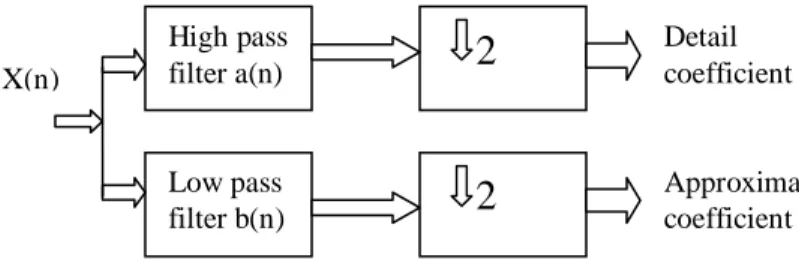
A wavelet is a small wave whose energy is concentrated in time, which is useful for the analysis of transient, nonstationary or time-varying phenomena. Such a wave can be expressed and analyzed as a linear decomposition of the sums and products of the coefficient and function. Consider a Example, any signal x(n) decomposition can be done by simultaneously passing it through a series of high and low pass filters with impulse responses as a(n) and b(n) respectively. The output of high pass filter is named as detailed coefficient and low pass approximate coefficients respectively.
Fig 1.wavelet decomposition
ARTIFACTS REMOVAL OF
ELECTROCARDIOGRAM USING WAVELETS
M. Durga Rani and M. Madhavi
Detail coefficient Approximate coefficient X(n) High pass filter a(n) Low pass filter b(n)
2
2
The down-sampling by 2 divides the input frequency by2, in the decomposition process. By this method of doubling the frequency resolution in further process makes the time resolution half. Increasing the levels of decomposition, which is on based user defined and application specific, will increase the frequency resolution. Unusually 3 to 5 levels are cascaded.
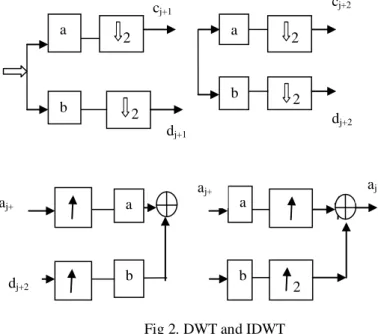
In the wavelet transform, the original signal (1-D) is transformed using predefined wavelets. The wavelets are orthonormal. In discrete case, the wavelet transform is modified to a filter bank tree using the Decomposition/ reconstruction given in Fig.2.
Fig 2. DWT and IDWT
The wavelet transform de-noising is based on the statement that most energy of a signal is concentrated in few coefficients whereas noise is spread over a large number of coefficients. The shrinkage step involves implementing a nonlinear threshold over these coefficients to retain the larger magnitude (signal) coefficients and nullifying the smaller magnitudes (noise).
III.THRESHOLD ESTIMATION
Since approximation coefficients contain low frequency components which are less affected by noise threshold is applied in detailed coefficients. The coefficients magnitude is compared to a threshold level, which is denoted by λ’ and an optimized value of λ is estimated. To estimate the threshold λ, we need to calculate the noise level σ. For estimating value of σ, a popular proposed by Donoho and Jhonstone is based on the detail coefficients of the last level calculated with the help of median absolute deviation (MAD) as per the following formulae:
𝜎 = (|𝑥 − 𝑥′|)/ 0.6745 (1)
Where, 0.6745 is the scaling factor for a normally distributed data. Further, to estimate the threshold level „λ’, a universal threshold was used which is a function of noise level „σ’ and length of signal ' k', given as:
𝜆 = 𝜎 √2 log(𝑘) (2)
This shrinkage step is also referred as wavelet thresholding. Hard Thresholding:
𝑆 𝜆(𝑑) = 𝑑. (𝑎𝑏𝑠(𝑑) > 𝜆)
IV.METHODOLOGY
Fig Block diagram of WWF method
The above block diagram represents the WWF method. We can obtain the noise free coefficient am(n) from the coefficient
ym (n) using WWF method [7] , [25] . The procedure for above
block diagram is illustrated below.
The first 3 blocks such as DWT1, H and IDWT1 represents the classic wavelet filtering method. The upper part consists of 4 blocks such as wavelet transform DWT1, threshold H, inverse wavelet transform IDWT1 and DWT1. The lower part consist of the wavelet transform DWT2, the wiener wavelet Domain HW, and inverse wavelet transform IDWT2.
Using the inverse transform IDWT1, we estimate S(n), which approximate the noise free signal S(n). This estimate is used to design the Weiner Filter HW, which is applied to the noisy signal X(n) in the DWT2 domain in the lower path using wiener correction factor [2], [26] .
ℎ 𝑚 𝑛 =
𝑎 𝑚 2 (𝑛) 𝑎 𝑚2 𝑛 + 𝜎𝑣𝑚 2 (𝑛)
where 𝑎 (𝑛)𝑚2 are the squared wavelet coefficients obtained from the estimate s(n), and σ2 ym(n) is the variance of the
noise coefficients vm(n) in the mth band, estimated using
(2).We process the noisy coefficients ym(n) in the HW block,
using the previously described Wiener correction factor, to obtain the modified coefficients
ℷ𝑦m(n) =ym(n) · ℎ m(n).
Adaptive Wavelet Wiener Filtering method (AWWF): cj+1 dj+1 2 a b 2 2 a b 2 aj dj+ 2 aj+ 222 222 b 2 2 a aj+ 1 dj+ 2 dj+2 2 a b 2 cj+2 dj+2 2 DWT1 IDWT1 DWT2 H DWT2 HW IDWT2 X(n) Y(n) Estimate of am(n) Ym(n) = am(n) + vm(n) ℷ𝑦m(n)=ym(n) .ℎ m(n) S(n)
Fig 3.Block diagram of AWWF Method
In WWF many parameter has to be set manually. Multiplier place an important role to decompose WT. Setting of proper input parameters had a great influence with filtering Threshold Results. Due to this reasons it became very difficult to set suitable input parameters.
TABLE-1
To solve this problem we improved WWF by adding a block known as NOISE ESTIMATOR (NE).To estimate the noise it need two inputs one from noisy signal X(n) and another from noise free signal Y(n) obtained by WWF. The difference between signals gives an estimate input noise from this we can calculate the SNR. The parameters in the blocks are DWT3, H3, IDWT4, DWT4 and IDWT4 are set up using the estimated SNRest value. Here for different level of interference
we need to find out parameters individually. Because the problem here is we don’t know correct setting of individual blocks.
V. RESULTS
The ECG signal which is used here for testing are taken from standard CSE database. This signal consists of 2 sets of 125 practical 12 lead and 3 lead ECG signals. With a sampling frequency of 500HZ and quantization step of 5µv ECG signal will be recorded for 10s.
If filter whole data base using AWWF, SNR value increases greatly. The average improvement of SNR and SNRi changes
with the noise level. From the below graphs e can see it gives a clear idea of SNR improvement by using AWWF method.
RAW ECG SIGNAL
RR INTERVAL
RR interval after WWF
RR interval after AWWF
BASIC GROUPS OF INVESTIGATION PARAMETERS
Dec.level Thres TM WT3 WT4
2 HARD 1 Haar Haar
3 Hyperbolic 1.5 dB4 db4
4 Garrote 2 Sym2 Sym2
5 Semi-soft - - -
6 Soft 20 dmey Dmey
5 5 15 53 53
Dec.level-decomposition level, Thres-Thresholding method, TM-Thresholding Multiplier
TABLE-2
Example of iteration with ending condition
Iteration Dec.level Thres TM WT3 WT4
0 6 Hard 21 db4 dmey
1 4 Hard 4.5 sym2 bior
4.4 2 4 Hyperb. 4.5 rbio1. 3 sym4 3 4 Garrote 4 db4 coif2 4 4 Garrote 4 db4 sym4 5 4 Garrote 4 db4 sym4 6 4 Garrote 4 db4 sym4 7 4 Hyperb 4.5 db4 sym4
8 4 Hyperb 4.5 Sym5 sym4
9 4 Garrote 4.5 db4 sym4 10 4 Semi soft 4.5 db4 sym4 11 4 Garrote 4.5 db4 sym4 12 4 Garrote 4.5 db4 sym4 13 4 Garrote 4.5 db4 sym4
Dec.level-decomposition level, Thres-Thresholding method, TM-Thresholding Multiplier
IDWT3 SWT4 IDWT4 Y(n) output DWT3 WWF NE H3 DWT4 HW Input x(n)
TABLE-3
Comparison of results with tested methods
Method LF WF WWF AWWF Mean Imp.[db] -4.4 6.3 6.6 10.5 STD.Imp.[db] 8.1 3.5 3.7 2.3 Computational cost [sec] 0.002 9.54 0.04 0.3 VI.CONCLUSION
The proposed technique Adaptive Wavelet Wiener filtering results is very effective when compared with simple wavelet filtering. In AWWF method setting of suitable parameter value and their estimate of noise level had a great impact on performance of filtering algorithm. By considering above factors effective noise suppression was done with less significant changes in the noise power. Due to this adaptive nature AWWF filter deal with dynamically changing noise. By applying this method on various ECG signals which are corrupted by EMG noise had a great Improvement in its SNR ratio.
ACKNOWLDGEMENT
The authors express deep sense of thanks and gratitude to the Head of the Department, the supervisor, management and staff of DVR & DHS MIC College of Technology for their inspiration and necessary technical suggestions during the research pursuit.
VII. REFERENCES
1. L.Smital Martin, Vitek, Jiri Kozump and Ivo Provazn, “Adaptive Wavelet Wiener Filterin of ECG signal”, IEEE TRANSCATIONS ON BIOMEDICAL ENGINEERING, VOL, 60, NO. 2, FEBRUARY 2013.
2. L. Sornmo and P. Laguna, Bioelectrical Signal Processing in Cardiac and Neurological Applications. New York: Academic, 2005.
3. H. A. Kestler, M. Haschka, W. Kratz, F. Schwenker, G. Palm, V. Hombach, and M. Hoher, “De-noising of high-resolution ECG signals by combining the discrete wavelet transform ith the Wiener filter,” Comput, Cardiol., vol. 25, pp. 233-236, Sep. 1998.
4. V. X. Afonso, W. J. Tompkins, T. Q. Nguyen, K. Michler, and S. Luo, “Comparing stress ECG enhancement algorithms,” IEEE Eng. Med. Biol. Mag. , vol. 15, no. 3, pp. 37-44, May 1996.
5. S. Poornachandra, “wavelet-based denoising using subband dependent threshold for ECG signals,” Digital Signal Process., vol. 18, no. 1, pp. 49-55, Jan. 2008.
6. S. Li and J. Lin, “The optimal de-noising algorithm for ECG using stationary wavelet transform,” in Proc. WRI World Congr. Comput. Sci. Inf. Eng., Mar. 2009. No. 6, pp. 469-473. 7. E.-S. A. El-Dahshan, “Genetic algorithm wavelet hybrid scheme for ECG signal denoising,” Telecommun. Syst., vol.
8. S. P. Ghael, A. M. Sayeed, and R. G. Baraniuk, “Improved wavelet denoising via empirical Wiener filtering,” Proc. SPIE-Int. Soc. Opt. Eng. Vol. 3169, pp. 389-399, Jul. 1997.
9. N. Nikolaev, Z. Nikolov, A. Gotchev, and K. Egiazarian, “Wavelet domain Wiener filtering for ECG de-noising using improved signal estimate,” in Proc. IEEE Int. Conf. Acoust. Speech Signal Process, Jun. 2000, vol. 6, pp. 3578-3581. 10. L. Chmelka and J. Kozumplik, “Wavelet based Wiener filter for electrocardiogram signal de-noising,” Comput. Cardiol., vol. 3, pp. 771-774, Sep. 2005.
11. P. M. Agante and J. P. Marques de sa, “ECG noise filtering using wavelets with soft thresholding methods,” Comput. Cardiol., vol. 26, pp. 535-538, Sep. 1999. DOI: 10.1109/CIC.1999.826026.
12. M.Jansen, Noise Reduction by wavelet thresholding. New York: Springer-Verlag, 2001.
13. C. M. Stein, “Estimation of the mean of a multivariate normal distribution,” Ann. Statits., vol. 9, no. 6, pp. 1135-1151, 1981.
14. D. L. Donoho and J. M. Johnstone, “Ideal spatial adaptation by wavelet shrinkage,” Biometrika, vol. 81, n0. 3, pp. 425-455, Sep. 1994.
15. D. L. Donoho and J. M. Johnstone, “Adapting to unknown smoothness via wavelet shrinkage,” J. Amer. Static. Assoc., vol. 90, no. 432, pp. 1200-1224, Dec. 1995.
16. S. Mallat, A wavelet tour of sinal processing, 2nd ed. New York: Academic, 1999.
17. L. Chmelka and J. Kozumplik, “Adaptive wavelet filtering methods for ECG de-noising,” in Proc. 3rd Eur. Med. Biol. Eng. Conf. Proc., Nov. 2005, pp. 1-4.
18. L. N. Sharma, S. Dandapat, and A. Mahanta, “Multiscale wavelet energies and relative energy based de-noising of ECG signal,” in Proc. IEEE Int. Conf. Commun. Control comput. Technol., Oct 2010, no.11, pp. 491-495.
19. A. Phinyomark, C. Limsakul, and P. Phukpattaranont, “EMG de-noising estimation based on adaptive wavelet thresholding for multifunction myoelctric, control,” in Proc. Innovative technol. Intell. Syst . Ind. Appl., Jul. 2009, pp. 171-176.
20. N. Devillard. (Jul. 1998). Fast median search: An ANSIC implementation (online). Available: http://ndevilla.free.fr. 21. A. Phinyomark, C. Limasakul, and P. Phukpaptaranont, “An optimal wavelet based on wavelet denoising for multifunction myoelectric control,” in Proc. 6th Int. Conf. Electr. Eng./Electron. Comput. Telecommun. Inf. Technol., May 2009, pp. 1098-1101.
22. L. Breiman, “Better subset regression using the nonnegative garrote,” technometrics, vol. 3, no. 4, pp. 373-384, Nov. 1995.
23. H.-Ye Gao and A. G. Bruce, “Waveshrink with firm shrinkage,” Stat. Sinica, vol. 7, no. 4, pp. 855-874, Oct. 1997. 24. P. Rajmic, “Exact risk analysis of wavelet spectrum thresholding rules,” in Proc. 10th
IEEE Int. Conf. Electron. Circuits Syst., Dec. 2003, vol. 1-3, pp. 455-458.
25. H. Choi and R. Baraniuk, “Analysis of wavelet domain iener filter,” in Proc. IEEE-SP Int. Symp. Time-Frequency Time-Scale Anal., Oct. 1998, pp. 613-616.
14 26. P. Lander and E. J. Berbari, “Time-frequency plane wiener
filtering of the high resolution ECG: Background and time-frequency representation,” IEEE Trans. Biomed. Eng., vol. 44, no. 4, pp. 247-255, Apr. 1997.
27. J. Willems, P. Arnuad, J. H. van Bemmel, P. J. Bourdillon, R. Degani, B. Denis, F. M. A. Harms, P. W. Macfarlane, G. Mazzocca, J. Meyer, H. J. R. van Eck, E. O. R. de Medina, and C. Zywietz, “Establishment of a reference library for evaluating computer measurement programs,” Comput. Biomed. Res., vol. 18, no. 5, pp. 439-457, Oct 1985.
28. B. Singh and A. Tiwari, “Optimal selection of wavelet basis function applied to ECG signal de-noising,” Digital Signal Process., vol. 16, no. 3, pp. 275-287, May. 2006. 29. E. Shwedyk, R. Balaubrahmanian, and R. N. Scott, “A stationary model for the electromyogram,” IEEE Trans. Biomed. Eng., vol. 24, no. 5, pp. 417-424, Sep. 1997.
30. D. Farna and R. Merletti, “A novel approach for presize simulation of the EMG signal detected by surface electodes,” IEEE Trans. Biomed. Eng., vol. 48, no. 6, pp. 637-646, Jun. 2001.
31. G. Garag, V. Singh, J. R. P. Gupta, and A. P. Mittal, “Optimal algorithm for ECG de-noising using discrete wavelet transform,” in Proc. IEEE Int. Conf. Comput. Intel. Comput. Res., Dec. 2010, pp. 577-580.
Mrs. M. Madhavi was born in Andhra Pradesh, India. She received B.Tech and M.Tech degrees in ECE from JNTUH in 2005, 2008. She presently working as Associate Professor in Dept of ECE at DVR & DHS MIC College Of Tech. She has 8 years experience in teaching. Her research includes Bio medical signal processing and Control applications.
M. DURGA RANI was born in Andhra Pradesh, India in 1991. She received the B.Tech degree ECE in ANU. M.tech degree in Digital electronics and communication Engineering (DECE) from DVR & DHS MIC college of Tech. her research interest include in DIGITAL
SIGNAL PROCESSING and