Abstract— This paper deals with study of sleeper coach bus rollover as per AIS-119 regulation. Rollover analysis of sleeper coach is carried out using simulation method. It is assumed that rollover mechanism of sleeper coach is same as that of buses with seats (AIS-031). A validated FE modeling methodology of bus (as per AIS-031) is used as guideline and relevant changes in modeling of residual space are incorporated. Different types of sleeper berths and or seating arrangements are studied; amongst this double berth arrangement is selected for simulation. Residual space template as defined in AIS-119 is used to carry out rollover analysis of sleeper coach buses. Results of rollover analysis are evaluated to check intrusion/clearance of residual space in superstructure of bus.
Index Terms—Bus Rollover, Residual Space, Hypermesh, LS-DYNA
I. INTRODUCTION
In India as per recent scenario motorised vehicle accounted for 92.4 percent of the total road accidents in the year 2011, amongst vehicle category wise the percent share bus accidents is 9.4percent; whereas percent share of person killed and injured in bus accidents is as 9.2 percent and 11.0 percent respectively. Out of them most are due to bus rollover type accidents which are a major concern for passenger safety in buses.
Because of this rollover analysis and its prevention has end up the studies subject matter inside the recent years. Rollover accidents are depending on the bus balance for the duration of turns. The stableness is encouraged by using the height of middle of gravity and the song width. A high middle of gravity and narrow tune could make an automobile risky even as taking turns at excessive speeds resulting in rollover accident. A vehicle might also rollover because of reasons which include excessive cornering velocity, tripping, collision with another automobile or item, sharp changes in direction at excessive pace and so forth.
The harm to shape in the rollover twist of fate may be very excessive and as a result occupants are uncovered to high danger of existence. The bus shape may additionally crumble because of severe effect load.
II. INTRODUCTION TO AIS-031AND AIS-119 In India AIS-031states the methods to compute the strength of the structure of the passenger bus and thereby guiding the safe manufacturing of coach, whether AIS-119 laid for special class
under Type IV of the Bus Body Structure vehicles build for the bearing of more than 13 passengers or above excluding driver. The structure of the coach will be so purpose and constructed as to neglect, to the greatest possibility strain, the risk of injury to the occupants in the incident of an accident. These are standards mention the need of constancy of the coach superstructure for the safety of occupants of the bus.
General Specifications and Requirements
There are four types of tests avail to evaluate rollover performance. Those are as follows-
1. A roll-over test on a complete vehicle 2. A roll-over test on a body section or sections
representative of a complete vehicle
3. A pendulum test on a body section or sections 4. A verification of strength of superstructure by
calculation
The superstructure of the vehicle must be of capable energy to ensure that during and after it has been subject to one of the methods of discrimination or computation prescribed above -
1. No displaced part of the vehicle intrudes into the residual space, and
2. No part of the residual space projects outside the deformed structure.
The rollover test on a complete vehicle is the most preferred way of testing because of better accuracy of results and good repeatability. There are minimum assumptions in this method. But it is the most expensive method as precise instrumentation is required during testing and manufacturer has to sacrifice the complete bus. Furthermore the method will not provide any solution if the structure does not meet the requirements of the regulation. Nowadays CAE methodology is very well developed and is widely used for evaluation of impact scenarios in automotive industry. But to simulate the real-life event one has to understand and study the actual behaviour of the object under consideration. Following paragraph describes the actual rollover test procedure.
A. Physical Rollover Test
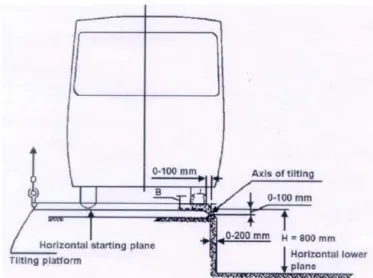
The bus is positioned on a platform that allows to be rolled over on weak side of the structure. It‟s far ensured that the axis of rotation of the bus is parallel to the longitudinal axis of the bus. The typical rollover test setup is shown in figure 1. Tilting platform is slowly lifted as a way to tilt the bus without rocking and without any dynamic outcomes. The angular speed is confined up to 5 degrees in keeping with 2d (0.087 rad/sec). Because the tilting is accelerated the bus falls over within the ditch on its personal due to gravitational acceleration. Excessive-velocity photography, deformable templates or other appropriate method are used to determine the structural deformations.
Rollover Analysis of Sleeper Coach Bus by
Virtual Simulation in LS-DYNA
Ajinkya Patil ,M-Tech, BVDUCOE, Pune.
Fig.1 Rollover Platform B. Residual Space
The residual area is the extent within the passenger compartment which the bus shape needs to retain during and after rollover to shield the occupants. As stated in advance no displaced a part of the structure shall intervene into the residual area. The essential dimensions of the survival area are drawn from the subsequent figures. All of the dimensions in following figure are in mm.
Fig.2 Residual Space
Figure 2 shows the sectional front view of the bus. The half trapezium portion in the figure indicates the passenger survival space. Figure 2 shows the single berth as well as double berth residual space.
III. FINITE ELEMENT MODEL BUILDING The primary target of finite detail version of the bus is to resize the deformation and interaction of bus subsystems in the course of rollover effect. The accuracy of effects relies upon the
accuracy of CAD geometry and nice of meshing. Because the rollover impact takes region on the edges of the bus, the principle load bearing participants are the superstructure contributors of the bus. As the rollover impact takes place on the sides of the bus, the main load bearing members are the superstructure members of the bus. The parts of the bus model lying below the position of centre of gravity contribute very little in absorbing kinetic energy [5]. The fundamental a part of kinetic energy is absorbed with the aid of the superstructure participants inside the shape of deformations. Therefore dense mesh is used for the superstructure as compared to the other components. The whole bus structure in conjunction with chassis was modeled the usage of shell elements. To ensure computational convergence and to preserve computational time fairly low, minimal element period used is 10 mm. The mesh criteria observed for shell meshing is given in Table I.
S. NO. ELEMENT TYPE QUALITY CRIT. VALUE 1 Warpage >15.00 2 Aspect ratio >05.00 3 Skew >60.00 4 Jacobian <0.50
5 Trias Min. angle <20.00
6 Quads Max. angle >120.00
7 Min. angle <45.00
8 Max. angle >135.00
Table I
Altair Hypermesh software program is used for meshing motive. The CAD model of the bus turned into imported into Hypermesh. The mid-surfaces were extracted from the CAD version. The features like fillet, small holes having dimensions less than eight mm had been deleted because of much less structural significance.
Finite element version, proven in figure 3, may be prominent among the bus superstructure and the chassis. The superstructure is the primary load bearing member and has the dense meshing in comparison to the chassis and its additives. Chassis includes axles, tires, suspension machine,
Mounted on it. It‟s required to capture the mass of numerous components on chassis appropriately to hold the centre of gravity of total bus close to the actual value. The chassis being the heaviest part, it controls the dynamics of total bus during rollover [6].
The exact distribution of mass is likewise vital. Mass of diverse subsystems like engine, radiator, transmission, fuel tank and seats are implemented as concentrated mass at respective places. Axles are represented through „shell‟ elements and their mass is adjusted to account for the mass of complete axle assembly, differential and wheels. The exterior panels and leads had been left out for his or her small ability of impact energy absorption. The finite element solver used for the simulation is LS_DYNA, a non-linear solver advanced by using Altair Engineering. The FE version of bus has been made of combination of shell, beam and rigid factors. All of the structural individuals are modelled the use of shell elements. Bolt joints are simulated the usage of 1-D beam elements, and 1-D inflexible elements are used for weld simulation. The ground turned into represented by using RIGIDWALL option
A. Modeling of Residual Space
Residual space is described as in step with the hints provided in AIS-119. It was delivered 305 mm above the floor under the passengers‟ toes, and 147 mm far away from the inner surface of the aspect of the bus, all through the complete bus. The version of the survival area consists of „beam‟ element frames rigidly mounted inside the tough location of berth structure. the connection of the residual area to the berth horizontal pillars is supplied through rigidlink element of LS_DYNA. The finite detail model of the full bus comprised 5,83,048 first order express shell elements, 552 beam elements, 8,595 1-D rigid elements and 22 mass elements. Shell element period become assigned as 10 mm in both vital regions and as much as 40 mm changed into used for the ones underneath the floor (decrease shape-chassis). The variety of elements according to profile width was at the least 3 for the top a part of the shape and the range of factors according to profile width turned into four for sidewall pillars (foremost pillars) which are great for rollover effect deformation [7].
B. Material Data
Non-linear material residences are assigned to the superstructure. The tensile test was finished on pattern components to gain the engineering strain-strain curve. The real stress and authentic strain were used as the center to the material card in software. The material card utilized in LS_DYNA is “Mat L_24” Elastic Plastic Piecewise Linear material. This law fashions the isotropic elastic plastic material using person defined features for the plastic stress-stress curve. This is an elastic version made of plastic which applies the young‟s Modulus if the stress is decrease than the yield stress, and measured stress-strain-curves if the stress is more than the yield stress [8].
C. Material Coupon Testing
LS_DYNA, a nonlinear finite detail solver, is used for the
rollover crash simulation. To represent the car dynamic behavior greater realistically, genuine material properties were first determined from laboratory assessments. Two material types which constitute most of the bus frame had been decided on for laboratory shape-belongings quantification. Structural material used for the passenger compartment consists of container tubing sections of 60mm x 40mm x 2.5mm thick and 40mm x 40mm x 2.5mm thick. The same old check specimens have been cut from the hole sections by using the usage of milling device.
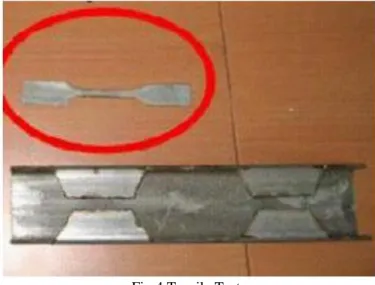
Fig.4 Tensile Test
Figure 4 indicates the hole segment tube used in the construction of bus structure as well as the sample specimen. The encircled piece is the specimen prepared as consistent with trendy ASTM tensile take a look at. The engineering stress- strain curves and mechanical houses like closing tensile strength, breaking energy, elongation at UTS breaking elongation and so on. Have been received from the tensile check.
IV. SIMULATION OF BUS ROLLOVER
The bus version is first rotated alongside the longitudinal axis about rotation axis of tilt table until the middle of gravity point reaches the highest role alongside vertical axis as shown in figure 5. The attitude of rotation and the height of middle of gravity point are recorded. The model is in addition rotated till it touches the floor. At this function also the angle of rotation and the height of centre of gravity point are recorded. The rollover simulation starts off evolved in the intervening time of impact.
At the start of the simulation an initial angular velocity has been carried out to all nodes, equal to the angular velocity that the bus could have if the rollover started out with zero velocity, and with the centre of gravity of the bus placed over an imaginary vertical line passing through the axis of rotation. The initial angular velocity of the bus at this instance is calculated by applying law of conservation of power. To simulate the free-fall of the bus, gravity load is implemented to all the nodes. There are not any external constraints to the version.
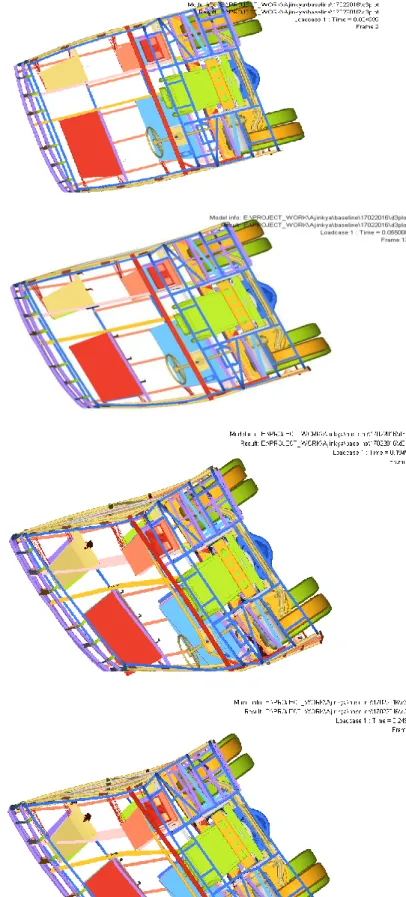
In figure 6, a popular review of the simulation consequences for the chosen time steps is illustrated. The bus first comes into contact with the ground while the roof nook hits the ground. It begins absorbing kinetic power by using elastic-plastic deformation. As the deformation progresses the primary pillars start bending and thereby soaking up the essential a part of kinetic energy. The deformation stops whilst the waist-rail touches the floor. The bus begins sliding now as the heavier part of undercarriage falls from the tilt platform. The deformation stops while the kinetic strength within the version is absolutely absorbed in deformation and receives converted into inner energy. The residual space is represented through pink trapezoidal segment. It may be really seen at time step of 0.24999 seconds that the model can‟t face up to the rollover effect load and the structure intrudes into the residual space.
Figure.6 suggests the passenger survival area via red coloration and all other components in special colour to distinguish survival space definitely. The shape of the bus deforms critically and the intrusion of 102.0 mm is observed on upper berth and the intrusion of the 51.83 mm is discovered on the lower berth of the survival space. Results of intrusion expressed in Table.II
As in step with AIS-031 the superstructure of the automobile will be of enough strength to make certain that during and after it has been subjected to rollover test-
1. No displaced part of the vehicle intrudes into the residual space, and
2. No part of the residual space projects outside the deformed structure.
It‟s far concluded that the bus version beneath consideration does no longer meet the structural necessities of AIS-031and AIS-119. It could fail inside the rollover take a look at.
Templates Intrusion with Body section along Z_ direction in mm
Max. Intr., Min. Intr.
Table II
Fig. 6 Numerical Result at time 𝑡1 = 0.0049, 𝑡2=0.055, 𝑡3=0.194, 𝑡4=0.2499 sec. Berth No 1 2 3 4 5 6 U_Berth 102.2 91.27 85.39 83.33 83.07 100.1 L_Berth 86.36 76.08 73.76 67.20 76.20 51.83
V. RESULT AND DISCUSSION
After the rollover analysis is performed the energy curves are plotted as shown in figure 7. The energy balance is a method to evaluate the correctness of the numerical analysis. The kinetic energy drops continuously right from the start of the run (time 0 seconds to 0.025 seconds). At the time instance of 0.025 seconds the window rail touches the ground. The undercarriage of the bus now starts sliding down the tilting platform. The bus starts sliding in the lateral direction. The curve slopes down sharply which shows that the energy is absorbed due to sliding friction (time 0.025 seconds to 0.175 seconds).
The curve becomes nearly flat after time interval of 0.25 seconds. Ideally the kinetic energy must reach to zero, but for this the total simulation time has to be increased. From the figure 14 it is clear that the model still has the kinetic energy in it which is the residual energy in the model due to sliding. One of the indications for correct analysis is that the total energy remains constant. It can be observed that the kinetic energy drops and transforms into internal energy (strain energy + sliding energy) over the time. The hourglass energy is negligible.
Fig.7 Energy Graph A. Verification of Calculation
AIS-031 defines the tilting platform test in which the bus is tilted without rocking and without any dynamic effects until it rolls over. It is in unstable equilibrium position when the centre of gravity is at the highest position. Rollover simulations have been carried out by positioning the bus models at a moment just before impact. At the start of the simulation an initial angular velocity has been applied to the bus model, equal to the angular velocity that the vehicle would have gained, if the rollover started with zero velocity from unstable equilibrium position. As per AIS-031 initial zero velocity is considered at the start of the rollover test. Angular velocity can be calculated by applying law of conservation of energy.
Potential Energy at unstable equilibrium position = Kinetic energy at the impact
𝑴 𝒈 Δ𝒉= 1/2 (𝑰 𝝎𝟐)
Where,
M = Kerb Mass of the bus, kg g = Gravitational constant, mm/sec2
Δh = Drop of centre of gravity from highest position till impact position,
I = Mass moment of inertia of bus, kg-mm4 ω = Angular velocity, rad/sec
Total Energy at the moment of impact can be observed from the energy balance curve to verify the correct angular velocity has been applied to the model. Referring to figure 14 Kinetic Energy at the moment of impact is 1.39x 10⁸ N-mm.
Potential energy = 13100x 9810x 1111.4 = 1.4x 𝟏𝟎𝟖 N-mm As the value of energies by mathematical calculation and from analysis results are in close agreement, the mathematical model is verified.
VI. CONCLUSION
In this work a methodology to analyze the bus structure during rollover using finite element method is presented. The used computational model provided comparable results to experimental measurements and can be used for other type of bus to avoid expensive full-scale crash tests. Following points can be concluded from this work-
1. The numerical simulation of the bus model showed that it does not fulfill the requirements of minimum structural resistance described in AIS-031. There are intrusions of structure into residual space throughout the length of the bus.
2. The method used on this work may be applied for the verification of bus structures in a rollover cases in future.
3. This methodology can also be used to evaluate the effect of any structural modifications on the rollover performance before finalizing the design.
4. The finite element simulations may be used to keep away from or lessen the physical checking out of mechanical systems and additives. standard effect of this is value saving and equal is accomplished with rollover evaluation
ACKNOWLEDGMENT
The authors are grateful to the Principal, BVUCOE, Pune and to the Head of Mechanical Engineering Department for providing the required facilities. We also are thankful to the top of Civil Engineering department and Structural Dynamics lab group of workers for imparting steerage and assist at some point of experimental validation
REFERENCES
[1] J. Padmanaban, Road safety around the world, Keynote paper, Symposium on International Automotive Technology, ARAI, India, 2007, pp. 17 -25 [2] Matthew Huang, Vehicle crash mechanics, 1st edition, CRC Press, USA,
2002
[3] AIS-031, Automotive Industry Standard, India, Automotive Vehicles –The Strength of Superstructure of large Passenger Vehicles, 2004 [4] AIS-119, Automotive Industry Standard, India, Automotive Vehicles
[5] Chopade S. E. et. al., Certification of buses as per AIS-031/ ECE-R66 using CAE methods, SAE paper no. 2009- 26-001
[6] Tiwari Sanjay, Performance evaluation of bus structure in rollover as per ECE-R66 using validated numerical simulation, SAE paper no. 2009-26-002
[7] K. Elitok et. al., An investigation on the rollover crashworthiness of an intercity coach, influence of seat structure and passenger weight, 9th International LS-DYNA user conference
[8] ECE Regulation No-66, United Nations, Uniform technical prescriptions concerning the approval of large passenger vehicles with regard to the strength of their superstructure, Revision-1, 2006
First Author: Name: Ajinkya Pratap Patil
Branch: M-Tech (CAD/CAM) (Mechanical)
College: Bharati Vidyapeeth University COE, Pune-43, Maharashtra, (India).
Second Author: Name: Prof. S.R.Pawar
Qualification: M-tech (Phd Pursuing) Profession: Assistant Professor
Institute: Bharati Vidyapeeth COE, Pune, Maharahtra, (India) Department: Mechanical Engineering