ELECTRONIC COMMERCE AND NETWORKED LIBRARIES
A Lakshmana Moorthy & CR Karisiddappa*
Defence Scientific Information & Documentation Centre, Metcalfe House, Delhi-110 054 *Dept of Library & Information Science, Karnatak University, Dharwad-580 003
1. WHAT IS ELECTRONIC COMMERCE ?
In the beginning it was mail (electronic mail). This was followed by publishing, journals, e-zines and now e-commerce and e-business (e-biz); the extension of the IT lexicon is still growing. Internet catalised the proliferation of the electronic and online journals as well as the development of the digital, and most recently, virtual libraries. Electronic commerce (e-commerce) is another area where the impact of Internet is increasingly felt in the library and information field. It is nothing but the business and financial transactions made using Internet. Computer hardware and software, books, music and travel are the most popular purchases over the Net. Variously known as e-commerce, Internet (or Net) commerce, e-biz, online market place, cyber commerce etc, electronic commerce is one of the most exciting areas beneficial to the institutions, industries, individuals with specialised skills, expert professionals and commercial organisations alike. Many of these are doing thriving business by offering expertise, consultancy services, buying and selling, job hunting and placement, advertising and marketing. Apart from supplementing the vast electronic information resources Internet, is also helping in achieving increased visibility to and enhanced marketability of their products, services and expertise.
1.1 Internet and E-Commerce
Internet has made an indelible impact on libraries and information centres (LICs). Internet has changed the way the information is processed, stored, transmitted, retrieved and disseminated in LICs. The number of scholarly and peer-evaluated electronic journals available over Internet are rapidly increasing. The usefulness of Internet in LICs, accessing the Web-based information, electronic journals and e-commerce have been discussed by the authors elsewhere (Lakshmana Moorthy and Karisiddappa, 1998(b)). Internet plays an important role in e-commerce which is an area where individuals can also play a major role. The individuals could be the professionals offering consultancy in their areas of expertise or they could be the public at large who wish to utilise the various resources available on the Internet.
Internet facilitates advertising and marketing, services and sales thereby promoting e-commerce. Marketing through advertisements is one of the well established channels in business. Advertising over Internet involves low premiums (as against print media), assures easy access and has global appealing as against the conventional print media. Unlike the print media which generally have a restricted domain, Internet caters to all kinds of vendors and customers in almost all subject areas. Unlike print media, there is no restriction of space; one can put up additional information. This avoids the follow up material sent in the case of print media when a user wants to know more about a particular item in an advertisement. Also, the popularity of the product or otherwise is immediately known to the vendor due to instant feedback from the customers unlike in print media where it takes longer time. Quite often, the interaction between the user and the advertising Web site results in online ordering and receiving the products as well.
Internet is an inexpensive medium which allows widespread access to individuals, librarians, institutions and business industry without any discrimination absolutely free. However, there are a number of issues and concerns in accessing electronic information resources over Internet (for a detailed discussion on these issues, see Lakshmana Moorthy and Karisiddappa, 1997). Internet allows selling of non-material goods directly while material goods can be delivered by conventional means. The former includes software, downloading articles from e-journals and/or digital libraries, newspapers, magazines, etc. Ordering of books and other goods by searching online book stores (like Amazon.com) and shopping malls is an example where the items ordered are sent by post to the specified addresses. It also facilitates e-commerce in three ways (Opplinger, 1998):
(a) It provides a very large customer base and reaches maximum number of countries,
(b) The presence (creation) and maintenance of a site on Internet is cheap, and results in reduced prices, makes more competitive, facilitates instant updation, access and sales (i.e., it results in `zero time lag' between advertising and sales), and
In NACLIN 98 ; Library and Information Networking : Papers of the First National Annual Convention on Library
(c) It caters to the customer's wide and varied interests, thus saving the time taken for travelling between different places (although physically seeing may help choose quality items).
1.2 Net Commerce
There is a lot of variation in the estimated value of revenue generated by the cyber commerce in the next five years. As per the NASSCOM (1997) report, the value of Internet commerce in 1997 was US$ 9.61 billion; the projected values for the years 1998, 1999 and 2000 are US$ 13.06, 17.76 and 24.15 billion respectively. Other reports published in the Economic Times (1998) estimate that e-commerce would generate US$ 45.8 billion in 1998 and US$ 200 billion by the turn of the century. With more than 19.5 million computers attached to the Net spread over 135 countries, 1.5 million domain names, about 2.75 lakh Internet protocol networks, 6.5 lakh Web sites growing at the rate of 9-12 per cent every month, with a number of online shopping malls and over 100 million users (in 1997), the Net can make a lot of difference in the business world. By the year 2000, the access to the Web is expected to reach 36 million house holds in the US alone, 20 million in the European Union and 12 million in India. Whereas in the conventional commerce the advertiser goes to the consumer, in the Net commerce the latter goes to the former.
2. NETWORKED LIBRARIES AND E-COMMERCE
Publishing industry is already exploiting the Internet by way of offering online journals, table of contents of journals, and catalogues of books and products over Internet. Networked libraries can benefit from electronic resources over Internet and also e-commerce in many ways. A number of electronic reference sources and guides, and many e-magazines (e-zines), business publications and scholarly periodicals are available for subscription over the Net. These are increasing rapidly day by day and represent, perhaps, the largest single resource available to anyone at any given time.
Many printed journals are available in electronic form over Internet; some are available freely and some on subscription. When both printed and electronic versions are subscribed, the subscription charges are nominal (for example, Elsevier charges 7.5 per cent) over and above the subscription charges of printed journals. However, if only electronic version is subscribed then the charges are substantial(97 per cent in the case of Elsevier). Many publishers having significant market share in the book trade established home pages on the Web to draw the attention of 'cyber grazers'. Some of the well known publishers on Internet include Elsevier, Blackwell, Pergamon, McGraw-Hill, Random House, Sage, Reference Press, O'Reilly Associates etc.
A large number of specialised online book stores are being established on the Web. Well-known book stores around the world are offering their holdings over Internet. It is possible to order a book from, say, Blackwell (http://www.blackwell.co.uk/bookshops/), which maintains a database of over 150,000 active titles. Bookwire (http://www.bookwire.com) has links to 150 booksellers and over 200 publishers to select and order publications. Of particular importance to librarians is the Acqweb (http://www.library. vanderbilt.edu/law/acqs/acqs.html), a Web site intended for library acquisitions (Barber, 1995). Libraries with Internet access can benefit from online book stores; they can acquire books and journals, reports and other information services from Internet. A recent search of Yahoo! for online book shops gave a list of 62 Web sites covering various subject fields. These sites could be used for online ordering of documents by users. The search also revealed 90 bookshops, 98 online book publishers, 2083 book publishers (having a home page on the Net) and 598 book publication categories. Many of these offer searching and ordering facilities. A search on 'online ordering' gave 438,550 hits, which may include those who simply seek information (like the current search) as well as those actually order documents online. Ordering an online book is beneficial as it is up-to-date till the moment of publication (O'Reilly, 1996); this may be useful in fast developing and emerging fields of technology. An online service (for example, America Online) provides many forms of online content for attracting subscribers. These include a glimpse of title page, book reviews, contents and excerpts from book.
the first quarter of 1998, an increase from 1,510,000 customers during the fourth quarter in 1997. It reported US$ 16 millions and 66 millions in the first and fourth quarters of 1997, respectively thus achieving over 400 per cent growth during the year. The sales touched US$ 87.4 millions during the first quarter of 1998 (Balasubramanian, 1998). Barnes & Noble, the largest book retailers of USA, have also launched their own online book store over Internet in 1997 (Vittal, 1998) to take part in the Internet commerce in this area.
3. ELECTRONIC PAYMENTS SYSTEMS
The procedure of different electronic payments has been extensively dealt in the literature (see for example, Computers Today,1998; Freeman, 1996; Hamilton, 1997; Kambil, 1997; Opplinger, 1998; etc). In brief, it is a transaction process involving he customer, shopping mall (an intermediary representing various vendors/merchants), vendor, credit card bank and the customer's bank. In a simple process, it involves the customer, online vendor, vendor's bank and credit card bank. In the second case, the customer will have the bank and the credit card accounts with the same bank. The mode of payments vary in different systems. For example, one can choose to pay through a payment system sponsor (for example, DigiCash) wherein the participants are to register with the system in some way. A second approach is payment through digital currency wherein a customer having an account with a bank offering digital currency can withdraw money, and transact using digital wallets. Digital signatures and cryptographic techniques are used for safe and secure transaction.
Some of the important players involved in e-commerce include CommerceNet Inc., CyberCash Inc., DigiCash bv, First Virtual Holdings Inc., IBM Co., MasterCard International, Microsoft Corp, Mondex International, NetCash/NetCheque, Netscape Communications Corp., VeriSign Inc., and Visa. There are a number of other firms involved as well.
3.1 Digital Payment Systems
Electronic funds transfer (EFT) through electronic checking has been in usage since 1960s. This involves, the customer, the vendor/merchant and the intermediary/financial institution. This resulted in improving speed of transaction, saving time, and reducing costs of paper handling. This lead to the development of digital cash, ensuring anonymity of the customer. This also made possible the usage of prepaid cards (like telephone cards) and later electronic cash (e-cash) (Panurach, 1996).
In digital payment systems, to transact business, both the customers and vendors have to take some important steps with respect to the payment system they intend to use. They have to make some commitment to the payment system; some times they may have to open an account with the digital payment system, install software on their computers to operate and may have to enter into agreements. The software providers get one-time benefit when the server software is purchased; but the payment system profits every time a transaction is made.
(a) First Virtual Internet Payment System
First Virtual (FV) Holdings is a pioneering and successful Internet service providing company established in 1994 to facilitate Net commerce. The first product of the company is the Internet Payment System, built on top of Internet protocols.The system does not use cryptography.
In this system, first the customer registers with FV by giving identification and credit card details. A virtual personal identification number (VPIN) is assigned to the customer by FV. The customer and the vendor can use any Internet procedure or protocol to transact business. When they come to an agreement, the transaction is submitted to FV. The customer provides the VPIN to the vendor and informs the FV. The vendor in turn checks the authenticity of VPIN with FV cleaning house which in turn confirms the payment orders while the payment to the customer. The money is transferred off-line after receipt of confirmation. FV uses e-mail to place and confirm payment orders while the money is handled off-line. FV works on the basic assumptions; the most important aspect is that the customer can download and check it before actually purchasing, as in normal purchases (Loshin and Murphy, 1997; Opplinger, 1998). First Virtual supports both Visa and Master cards, and charges US$ 10 as annual fee with a registration fee for providing VPIN. A detailed description of FV's experiences, perils, pitfalls and security and administrative issues were discussed in detail by Borenstein, et al (1996) (see
(b) Electronic Cash (E-cash)
E-cash, developed by DigiCash Co. of Netherlands, is being implemented by Mark Twain Bank (USA) and Merita Bank (Finland). This system involves three players; the customer, the vendor and the e-cash issuing bank. The customer obtains e-e-cash from the issuing bank (by sending payment from his own banker) and stores the same on hard disc of his/her PC or on smartcard. The customer can transfer corresponding amoun to a vendor for purchasing goods or services. The vendor then redeems the e-cash received from the customer by approaching the e-e-cash issuing bank (which can be credited to the vendor's bank).
The most striking feature of the e-cash system is the anonymity it provides to both the vendor and the customer. It is transferable from person to person and can be spent only once. It should be available in various denominations to store on a PC or smartcard. One problem perceived is that anonymity may lead to black money and illegal money laundering. To ensure the e-cash is used only once, hardware devices called digital wallets or digital envelopes are being used.
(c) CyberCash
CyberCash Inc., USA developed the Secure Internet Payment System which offers a secure, inexpensive, instantaneous and efficient delivery of payments across Internet. The system provides a
digital wallet to the customers. It acts as a conduit for transactions among Internet, vendors, customers and banking networks It involves the customer, vendor and their respective banks, and a clearing centre to process transactions among different banks. Customers can authorise payments out of their digital wallets; the payments are signed, encrypted and then sent through the vendor back to CyberCash which in turn are passed on to the vendor's bank for processing. The required software is provided free of cost for client as well as server applications. The participating banks and credit card processors pay fee to CyberCash. For transactions below US$ 10, CyberCoin feature has been developed to facilitate micropayments.
PayNow, an electronic check payment system, has also been recently developed based on the CyberCash system. This reduces operational costs as it lowers mailing fee, paper transactions and increases accuracy of billing (Loshin and Murphy, 1997). A similar system is the NetCheque and NetCash, developed by the Information Sciences Institute of the University of Southern California (http:// gost.isi.edu/info/NetCheque).
(d) Other Systems
Electronic Credit Card Payment Systems provide higher level of security to protect the credit card and payment transmission over the Internet. Several schemes have been designed which include iKP Protocols of IBM; Secure Electronic Payment Protocol (SEPP) of Master Card; Secure Electronic Transaction (SET) protocol jointly developed by MasterCard, Visa, Microsoft, Netscape, Terisa and VeriSign; etc. These are discussed in some detail by Loshin and Murphy (1997) and Opplinger (1998). Apart from these, to facilitate payments of very small amounts (of the order of a few cents) and to minimise overhead costs of using the other electronic payment systems, several micropayment systems came into existence. These include, CyberCoin from CyberCash, MilliCent from DEC, PayWord and MicroMint from Ron Rivest and Adi Shamir, and NetBill from Carnegie Mellon University (Opplinger, 1998).
(e) Smart Cards
Smart card concept was developed over a decade ago. Smart cards are wallet-sized plastic cards with a programmable micro-processor that interfaces to network terminal devices. It contains different types of memory, RAM, ROM, EEPROM etc (Myhill, 1998). A few companies introduced smart cards. These include the pioneer Mondex (of Master Card) which is nothing but electronic cash on card (http://www.mondex.com) and VisaCash of Visa (http://www.visa.com). The memory and processing capabilities of the chip on smart cards enhance the bank card and allows the banks offer increased utility, convenience and products tailored to the individual needs. The new smart cards can enhance mobile e-commerce (Hofland, 1998).
The major concerns in the usage of electronic payment systems are:
(a) The anonymity of customer and merchant may result in fraud, impersonation and delivery of goods at wrong addresses;
(b) Credit card information may be used by unscrupulous persons with ulterior motives who may order unwanted material and have them delivered to non-customer addresses or authorise self payments;
(c) Bugs may appear due to incompatible protocol implementations of Internet sites dealing with software;
(d) Usage of cancelled credit cards, overshooting available credit limit and payment to an unknown party may result; and
(e) Problems posed by security considerations including authentication of e-transactions and data.
In spite of these and many such problems, e-commerce would still continue to grow and may one day surpass the traditional commerce in revenues. And the turnover of many companies supports
this feeling.
3.3 Online Commerce Environments
This is different from electronic payment systems in that it uses a secure server to provide a secure channel for reliable e-transactions between a vendor/merchant and customer. This is capable of allowing transaction with customers having different types of credit cards or following electronic payment systems. Big players like Microsoft and Netscape are involved in developing and supporting new software products to help companies and individuals to become hosts on the Net. Netscape commerce environment is created through Netscape Client Products including Netscape Navigator; Netscape Commerce Platform, a set of servers, for developing Web sites; and Netscape Commercial Applications including Netscape Publishing and Netscape Merchant systems. Microsoft offers Internet Explore and Internet servers. The Microsoft Internet Commerce Strategy (http://www.microsoft.com/commerce) describes the various products, protocols, and applications including Commerce Server for user management and personalisation, usage and site analysis and content deployment.
3.4 Security Considerations
Security of e-transactions is a must to ensure the growth of e-commerce as "any unscrupulous individual could order unwanted materials and have them sent to non-library address, or authorise payments of library funds to him or himself" (Barber, 1995) thus causing loss to vendor and/or the customer. Further, the data is to travel across many Internet backbone networks to reach the destination. The information is vulnerable at many points including the originating computer.
The customer orders online for purchase of a product or a book and also provides his/her credit card number and authorisation by way of password or by digital signature. However, as the message travels through many systems and networks, the system administrators, supervisors or even a hacker can intercept the mail and misuse the credit card number. More than 20,000 credit card numbers stored in a computer at an Internet Service Provider (ISP) were compromised by an intruder as early as 1995 (Loshin and Murphy, 1997). However the Secure Electronic Transaction (SET) initiative takes care of security electronic payments. SET is backed by Visa and Master cards with giants like Microsoft, IBM, Netscape Communications, Terisa Systems, VeriSign etc are assisting the project. Further public key and private key encryptions are used for sending payment details securely over networks. Some of the technologies including cryptography, digital watermarks and digital signatures for security of information over networks and multimedia works are discussed by the authors elsewhere (Lakshmana Moorthy and Karisiddappa, 1998(a) & 1998(c)).
4. INDIA AND INTERNET
21.8 million worldwide) in 1996 which rose to 7175 (out of 29.67 million worldwide) in 1997 (Internet Domain Survey, 1998). Currently India has 1.2 lakh subscribers which is growing by 10,000 every month (Deccan Chronicle, 1998) and is expected to reach 12 million by the year 2000. The growth rate of Internet in India is 12-15 per cent per month as against the world average of about 10 per cent. VSNL has about 95 per cent of the total area of Internet connectivity which has a monopoly over the Internet access as all ISPs have to go through its gateway. India has four major ISPs, viz. ERNET of Dept of Electronics (DOE), NICNET of National Informatics Centre (NIC), Gateway Internet Access Service (GIAS) of VSNL and Softnet of the Software Technology Parks (STPs) of DOE (Subba Rao, 1997). Compare this with 16,322 hosts with ten lakh users and 30 Internet Service Providers (ISPs) for China; 57,605 hosts with over one lakh users and 3 ISPs for Singapore; 67,000 hosts with 2.5 lakh users and 90 ISPs for Hong Kong; 1.2 lakh hosts with 7.5 lakh users and 15 ISPs for South Korea; 1.8 lakh hosts for Taiwan; 12 lakh hosts with 15 lakh users and 1300 ISPs for Japan. These figures speak India's status in providing access to the Internet services and making them popular.
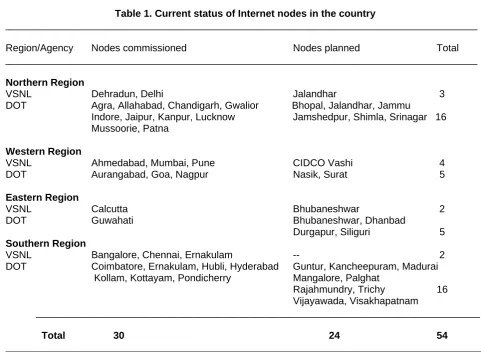
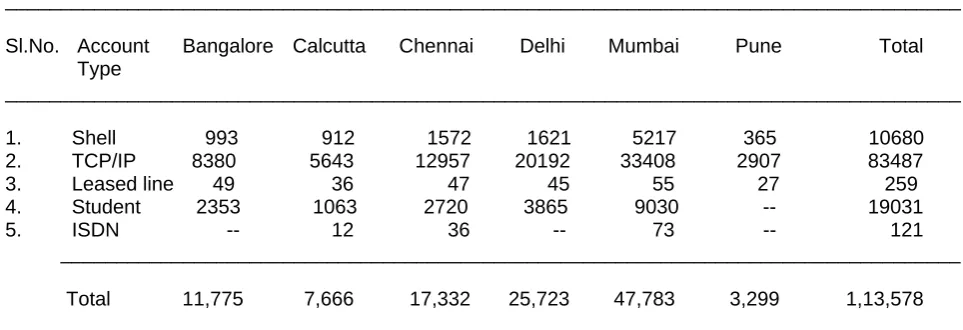
The Dept of Telecommunications (DOT) and VSNL are the two important players in providing the Internet access to the public. As on August 1998, VSNL is operating Internet nodes in nine cities while it planned three more; whereas DOT is operating twenty-one nodes and planned an equal number. The existing and planned Internet nodes of VSNL and DOT, and VSNL's customer base are shown in Tables 1 and 2 respectively (Srivastava, 1998). It appears that Internet access nodes are concentrated in northernand southern regions of the country which account for 19 (34.5 percent) each.
Table 1. Current status of Internet nodes in the country
_____________________________________________________________________________________
Region/Agency Nodes commissioned Nodes planned Total
_____________________________________________________________________________________
Northern Region
VSNL Dehradun, Delhi Jalandhar 3 DOT Agra, Allahabad, Chandigarh, Gwalior Bhopal, Jalandhar, Jammu
Indore, Jaipur, Kanpur, Lucknow Jamshedpur, Shimla, Srinagar 16 Mussoorie, Patna
Western Region
VSNL Ahmedabad, Mumbai, Pune CIDCO Vashi 4 DOT Aurangabad, Goa, Nagpur Nasik, Surat 5
Eastern Region
VSNL Calcutta Bhubaneshwar 2 DOT Guwahati Bhubaneshwar, Dhanbad
Durgapur, Siliguri 5
Southern Region
VSNL Bangalore, Chennai, Ernakulam -- 2 DOT Coimbatore, Ernakulam, Hubli, Hyderabad Guntur, Kancheepuram, Madurai Kollam, Kottayam, Pondicherry Mangalore, Palghat
Rajahmundry, Trichy 16
Vijayawada, Visakhapatnam
________________________________________________________________________________
Total 30 24 54
Table 2. Internet customer base as on 30 June 98*
______________________________________________________________________________________
Sl.No. Account Bangalore Calcutta Chennai Delhi Mumbai Pune Total Type
______________________________________________________________________________________
1. Shell 993 912 1572 1621 5217 365 10680
2. TCP/IP 8380 5643 12957 20192 33408 2907 83487
3. Leased line 49 36 47 45 55 27 259
4. Student 2353 1063 2720 3865 9030 -- 19031
5. ISDN -- 12 36 -- 73 -- 121
_________________________________________________________________________________ Total 11,775 7,666 17,332 25,723 47,783 3,299 1,13,578 ______________________________________________________________________________________ * Excluding Internet customers from Ahmedabad, Dehradun and Ernakulam At present in Delhi there are over 2500 applications pending for Internet connectivity. The VSNL has 1800 telephone lines connecting about 32,000 users (as on 11 September 1998) in Delhi and adjoining areas Noida, Gurgaon and Ghaziabad, making it totally difficult to log on to the Net. Owing to the lack of additional telephone lines to support its services, VSNL informally suspended issuing new Internet connections. (Whereas VSNL claims it approached MTNL for providing 900 additional lines which did not materialise, MTNL claims that VSNL did not pay the required fee; whichever is true, Internet users are suffering in the cross fire). Also, since one month, no application for Internet connection is accepted in Mumbai (Pioneer, 1998). The international standard is 10 Internet connections per line. Whereas in Delhi, it is 18 per line. This makes getting logged to Internet rather difficult. Many a time, users encounter the Server (of the target Web site) Temporarily Not Available or Down message, which is mainly because of lack of adequate lines and logging in of too many users at a single time. Now as many public and private firms are joining the race to provide Internet connectivity, it is expected that Internet access in India is going to increase manifold. The expected demand for Internet connections during 1998-2002 is shown in Table 3 (NASSCOM, 1997, p. 110). Among the Internet services, e-mail, Web browsing are the most widely used utilities of Internet (with 86 and 68 per cent of total users). These are followed by ftp (53 per cent), mailing lists (46 per cent) and electronic data interchange (EDI--4 per cent). Table 3. Projected demand for Internet connections in India _______________________ Year Demand (in '000) _______________________ 1998 45
1999 80
2000 150
2001 350
2002 800 _______________________
5. INDIA AND E-COMMERCE
When the out side world is talking of second generation e-commerce, India is entering the scene slowly but steadily in to the first generation--a generation gap indeed! Although e-commerce has grown phenomenally world over in a very short time, it is in its infamy in India. Many software companies in India are taking lead in selling products through Internet. The trend is on the increase. In Bangalore, movie tickets are being traded over the net, Baba Bazar (of IB Saxena) offers fresh vegetables over the Net (Sharma, 1998).
A number of the Indian computer and business magazines such as Data Quest, PC Quest, Computers Today, Business India, Business Today, Voice and Data, Nayi Duniya etc are available over Internet. Further, many of the leading Indian newspapers including The Hindu, Business Line, The Times of India, The Pioneer, The Economic Times, The Deccan Chronicle, The Deccan Herald, The Indian Express, etc are having Internet editions. A number of institutions such as NCSI, IISc, IITs, and many public sector institutions like SAIL, ECIL, ONGC, NIC, Software Technology Parks, All India Radio, Customs, etc are maintaining home pages on Internet.
Manipal Control Data Electronic Commerce Ltd (MCDEC) of Bangalore in collaboration with Control Data Systems, USA is offering e-commerce using MCDNET with three centres operating at Bangalore, Delhi and Mumbai with access nodes at Delhi and Chennai. EDI, the computer-to-computer business transaction standard between companies, is gaining acceptance both in domestic and overseas business transactions. Oracle corporation plans to generate Rs 300 crore of business from India from business-to-business e-commerce solutions by the year 2000 (Business Standard, 1998). Kochi Port Trust was the first to implement EDI in the country. Mainly public and private sector players, such as Satyam Infoway, Tata-IBM, several Port Trusts, BHEL, ERDC Calcutta, CMC Ltd, Wipro Infosys, Customs and Director General Foreign Trade, etc are involved in EDI. This may further pick up because the EDI Council of the Ministry of Commerce is taking steps to adopt EDI technology by all departments involved in foreign trade. EDI based e-biz is expected to cross Rs 500 crore by the year 2000.
The Information Technology Action Plan of Govt of India (1998) envisages to address critical national needs in the areas of e-commerce, Internet access, information infrastructure and R&D in IT among others. It also envisages training citizens in the use of e-commerce, tele-banking, tele-documents transfer, tele-library leading to IT-led economic development. The Plan also targets to achieve an annual export target of US$50 billions of IT software and services in the coming 10 years (by 2008). To achieve this target, the Plan also targets improving the PC density from the present level of one PC to 500 people to one PC to 50 people with a universal access to Internet and Intranets. Important points include :
(a) Opening of Internet access points by DOT and other authorised ISPs at all district HQrs by 26 January 2000,
(b) Withdrawing the monopoly of VSNL on the International Gateway for Internet access and allowing public/govt agencies (including private agencies with Defence clearance) to become ISPs,
(c) Providing Internet access through authorised cable TV by ISPs with out licensing fee,
(d) Meeting data communication requirements for e-commerce and EDI by DOT,
(e) Non-charging of gift tax (for giver) or income tax by receiver up to Rs 30,000 of original purchase PC price,
(f) Allowing (by RBI) purchase of and permitting advance payment for IT software and services over Internet through International Credit Cards (ICC),
(g) Giving maximum flexibility in organising marketing of software packages through Internet,
(h) Creating `Mega Web sites' on Internet servers located in India,
(i) Making Internet available in every school, college, polytechnic, university and public hospital,
(j) Networking of all universities, engineering and medical colleges, other institutions of higher learning, and R&D organisations by the year 2000, and
(k) Allocating 1-3 per cent of budget of every Ministry/Department for IT and applications.
6. PROBLEMS IN THE INDIAN CONTEXT
All these measures/concessions may seem exciting. But the
availability of computers should be considerable. On both teledensity (number of telephones per 100 people) and PC density, we are far behind developing countries like China, Brazil, Thailand, Malaysia, Greece, Argentina, Philippines etc.
India had a teledensity of 0.4 in 1988, 0.55 in 1990, 0.9 in 1994, 1.1 in 1995 which rose to 1.3 in 1996. This is far less, less than the average teledensity of 1.48 for low income countries in 1994! The PC density in India in 1995 was only 0.1 (i.e), 1 PC per every 1000 people) again behind all the developed countries whereas the average PC density for developed countries is 10 (per 100 people) with USA and Switzerland leading with PC Densities of 29.7 and 28.8 respectively (ITU, 1995). India ranks 39 in both the cases.
Even in the case of telecommunication services, the prices are extremely high when compared to world standards (see Shah, 1997 for a critical comparison of local, long distance, leased line international trunk calls and personal Internet charges with world standard charges).
The Internet connectivity charges, although claimed by VSNL as the lowest in the world, are quite considerable. In many countries the users are charged at fixed rates and some charge flat rate (for example in US, a charge of US$20 is levied per month) for full toll-free access. But in India Internet access is charged differently. While students are offered the service for a nominal fee of Rs 500 (for 500 hours of access) with a one-time registration fee of Rs 50, general public have to pay 10 times this rate for the same access time and also for registration under dial-up service. For TCP/IP service the rates are much higher; the charges for 500 hours are Rs 10,000 with an incremental tariff in slabs of 20 hours @ Rs 30/- per hour. Surely, these rates are not subscriber-friendly; monthly flat rates for general access with some incremental charges for special access would be highly appreciated by the user community.
Another point of concern is at present VSNL has a limited number of nodes (in 9 cities only). Further it has only 259 leased line connections (Table 3) and the charges for obtaining a 64 or 128 kbps leased line connection invites an annual fee of Rs 10 and 14 lakhs respectively with an additional one-time registration fee of Rs 20,000/-. DOT can only provide Internet connectivity in other places not connected by the VSNL nodes. But DOT lacks proper backbone as the existing network cannot take the load of lakhs of Internet browsing for hours on end. For providing meaningful, country-wide uniform Internet access DOT has to wait till such time its 2 Mbps backbone is fully operational. To utilise fully the benefits and resources of Internet including e-commerce in the country this scenario has to change.
Also, in the case of cities where Internet nodes are not available, if a customer accesses Internet through I-Net, there is possibility of payment of higher tariff (of several fold) as per a case filed in Coimbatore, which has 153 subscribers (highest in the country) for I-Net (Akila, 1998). Although this is attributed by VSNL to the volume-based fee structure of I-Net, there is no alternative to VSNL as private ISPs are no where in the vicinity.
In India, FERA regulations do not allow to transact business in foreign currencies through credit card and so we cannot make payments online. Also, electronic funds transfers like e-cash are not legal tender and are not negotiable instruments under the Negotiable Instrument Act. In Indian courts of law, only written signatures and thumb impressions are accepted as evidence and not their digital versions. Further encryption of messages to protect confidentiality of the document violates Indian Telegraph Act (of 1885) (Komandur, 1998). Electronic transactions when not supported by printed documents, are not accepted as evidence in a court of law.
ACKNOWLEDGEMENTS
The authors are thankful to Dr SS Murthy, Director, DESIDOC for his for providing the facilities and for the kind permission to present this paper. The authors thank Smt K Shailaja Reddy for her secretarial assistance.
REFERENCES
Akila, S. Access discrimination. DataQuest, 30 June 1998, XVI(12), 48-49.
Barber, David. Electronic commerce in library acquisitions with a survey of booksellers and subscriptions agency services. Library Technology Reports, 1995, 31(5), 493-610.
Bates, Mary Ellen. Electronic clipping services: A new life for SDIs. Online, May 1994, 18(3), 43-51.
Borenstein, Nathaniel S. et al. Perils and pitfalls of practical cybercommerce. Communications of the ACM,
June 1996, 39(6), 36-44.
Business Standard, 17 September 1998, 3.
Computers Today, June 1998, 14(160), 52.
Deccan Chronicle, 5 July 1998, 23.
Economic Times, 24 July 1998, 11.
Freeman, Eva. How to move e-cash around the Internet. Datamation, October 1996, 58-60. (http://www.datamation.com)
Govt. of India, National Task Force on Information Technology & Software development. information Technololgy Action Plan. New Delhi, PMO, 1998. (http:/www.nic.in)
Hamilton Scot. E-Commerce for the 21st century. IEEE Computer, May 1997, 30(5), 44-47.
Hofland, Peter. News: New smartcards enhance mobile e-commerce. Byte, June 1998, 96D-96E.
Internet Domain Survey, January 1997 and January 1998. (http://www.nw.com)
ITU. World telecommunication report 1995. ITU, Geneva, ITU, 1995.
Jacobson, Thomas L. The electronic publishing revolution is not 'global'. Journal of the American Society for Information Science, 1994, 45(10), 745-752.
Kambil, Ajit. Doing business in the wired world. IEEE Computer, May 1997, 30(5), 56-61.
Komandur, Sowri Rajan. Electronic Commerce via Internet. Telematics India, June 1998, XI(9), 47
Lakshmana Moorthy, A. and Karisiddappa, C.R. Copyright and electronic information. In Access to Electronic Information: Papers presented at Sixteenth Annual Convention and Conference on Access to Electronic Information, 25-29 January 1997, Bhubaneswar, edited by M. Mahaptra, D.B. Ramesh, K.N. Kittur, P. Padhi and J.R. Sahu. New Delhi, SIS, 1997. pp. 403-416.
Lakshmana Moorthy, A and Karisiddappa, CR. Intellectual property rights and virtual libraries. Paper presented at the 49th FID Conference and Congress, 1998 held at New Delhi, 15-17 October 1998(a).
Lakshmana Moorthy, A. & Karisiddappa, C.R. Internet and its impact on library and information centres : A review. In Information technology : Issues and trends, edited by L.S. Ramaiah, V. Pulla Reddy, B. Ramesh Babu and T. Ashok Babu. New Delhi, Cosmos Publishers, 1998(b).
Lakshmana Moorthy, A. and Karisiddappa, C.R. Transformation to virtual libraries: Real or virtual? In
Working papers presented at the SIS 98: Seventeenth Annual Convention and Conference on Virtual Libraries: Internet-based Library and Information Services held during 12-14 March 1996 at University of Hyderabad. Hyderabad, SIS, 1998(c). pp. 109-122.
Loshin, Pete and Murphy, Paul. Electronic commerce: Online ordering and digital money. Ed. 2. Mumbai, Jaico, 1997. 326 p.
NASSCOM. The software industry in India : A strategic review 1997-98. National Association of Software and Services Companies, 1997. 131 p.
Opplinger, Rolf. Electronic commerce. In Internet and Intranet Security, Chapter 13. Boston, Artech House, 1998. pp. 287-305.
O'Reilly, Tim. Publishing models for Internet commerce. Communications of the ACM, June 1996, 39(6), 79-86.
Panurach, Patiwat. Money in electronic commerce : DigitalCash, Electronic Funds Transfer and Ecash.
Communications of the ACM, June 1996, 39(6), 45-50.
Pioneer, 11 September 1998, p.4.
Shah, Ajay. Telecommunication : Monopoly vs competition. In India development report 1997, edited by Kirit F Parikh. New Delhi, Indira Gandhi Institute of Development Research & Oxford University Press, 1997. Chapter 13, pp. 239-249.
Sharma, Manish. Let's go e-shopping. Economic Times, 24 July 1998, 11.
Srivastava, Binod. Personal communication, 28 July 1998.
Subba Rao, S. The Internet in India : An update. Electronic Library, December 1997, 15(6), 485-493.