VOLUME 36, ARTICLE 11, PAGES 339
−
370
PUBLISHED 19 JANUARY 2017
http://www.demographic-research.org/Volumes/Vol36/11/ DOI: 10.4054/DemRes.2017.36.11
Research Article
The gender division of labor and second births:
Labor market institutions and fertility in Japan
Nobuko Nagase
Mary C. Brinton
This publication is part of the Special Collection on “Domestic Division of Labour and Fertility Choice in East Asia,” organized by Guest Editors Ekaterina Hertog and Man-Yee Kan.
©2017 Nobuko Nagase & Mary C. Brinton.
This open-access work is published under the terms of the Creative Commons Attribution NonCommercial License 2.0 Germany, which permits use, reproduction & distribution in any medium for non-commercial purposes, provided the original author(s) and source are given credit.
1 Introduction 340
2 The household division of labor and fertility 341
2.1 Empirical studies 341
2.2 Japanese government policies promoting fathers’ involvement in housework
343
3 Explanations of gender-role specialization in Japanese marriage 345
4 The effect of labor market structure, workplace norms, and the legal environment on the household division of labor
346
4.1 Firm-internal labor markets and work norms 346
4.2 Legal support of workplace norms 348
5 Hypotheses 350
6 Data and methods 351
6.1 Dependent variables 352
6.2 Independent variables 352
6.3 Modeling husband’s household work share 354
6.4 Modeling the transition to second birth 354
7 Results 356
7.1 Husband’s household work share 356
7.2 Transition to second birth 358
8 Discussion and conclusion 360
9 Acknowledgments 362
References 363
The gender division of labor and second births:
Labor market institutions and fertility in Japan
Nobuko Nagase1
Mary C. Brinton2
Abstract
BACKGROUND
Research has examined how the gendered household division of labor may deter the transition to second birth. However, little research has investigated how workplace norms influence men’s household work.
OBJECTIVE
This paper takes into account labor market structure, workplace norms, and the legal environment governing working conditions to contextualize men’s contribution to household labor and its effect on transition to second birth.
METHODS
Using data from the Japanese Longitudinal Survey of Adults in the 21st Century (2002 Cohort), we employ fixed-effects models to estimate the effect of workplace norms on men’s contribution to household work and the effect of men’s household work hours on transition to second birth.
RESULTS
Japanese male university graduates in large firms do a smaller share of household labor than other men. These men are subject to workplace norms prevalent in firm-internal labor markets, which have been supported by Japanese Supreme Court rulings. These norms influence men’s allocation of time between the workplace and the home. Moreover, analysis of the transition to second birth indicates that husband’s share of household work is an important predictor of second birth, especially for dual-earner couples.
CONCLUSIONS
Our empirical results suggest that unless changes are made in Japanese employment law and workplace norms, dual-earner couples in particular will continue to face difficulties proceeding to a second birth.
1
CONTRIBUTION
This paper demonstrates how the economic and cultural context can create disincentives for men to contribute to household labor, which in turn lowers the probability of transition to second birth.
1. Introduction
Very low fertility rates in Southern Europe, Eastern Europe, and East Asia have been a source of great interest for demographers in recent years (Kohler, Billari, and Ortega 2002; Lesthaeghe 2010). Among the theories proposed to explain the emergence of what is termed ‘lowest-low’ fertility (total fertility rates of 1.3 or lower), theories emphasizing the unevenness of gender-role change have increasingly occupied center stage. Central among these is McDonald’s gender equity framework, with its focus on the slow pace of change in men’s and women’s household roles compared to their increasingly equal participation in the public sphere, especially the labor market (McDonald 2000). Recent work has suggested that increases in gender equality are likely to help societies currently experiencing low fertility to move towards an equilibrium characterized by near-replacement fertility rates (Esping-Andersen and Billari 2015; Goldscheider, Bernhardt, and Lappegård 2015).
2. The household division of labor and fertility
2.1 Empirical studies
Following McDonald’s gender equity perspective and the expectation that a highly gendered household division of labor in postindustrial societies is likely to depress fertility, in recent years a number of empirical studies have endeavored to test this relationship. At the macro level, Feyrer, Sacerdote, and Stern (2008) find a positive relationship in OECD countries between the average household work share of husbands and the average number of births.3 A number of studies using micro-level data find that increased involvement of fathers in childcare and housework increases the likelihood of a second birth. For instance, Oláh (2003) compares Sweden, which has had a long-standing dual-earner/dual-carer family model, with Hungary, a country that has emphasized paid work for men and women but a more traditional division of labor at home. She finds that fathers’ involvement in household work increases the probability of second birth in both countries.4 Using US data, Torr and Short (2004) find a U-shaped relationship between couples’ distribution of household labor and the transition to second birth, with a higher probability of second birth for couples where the wife does most of the housework (the ‘traditional’ model) as well as for couples where housework is shared relatively equally between spouses.
Studies using micro-level data from countries with a more traditional male-breadwinner model have produced somewhat mixed results. In her comparative study of Italy and Spain, Cooke (2009) finds that fathers’ share of childcare has no effect on the probability of a second birth in Spain. In Italy, fathers’ childcare time has a positive effect but the strength of the effect varies by mothers’ employment status. In couples where the wife is not employed, the probability of a second birth peaks when the husband’s share of childcare time increases from 0% to around 25%. Among couples where the wife works part-time, the peak probability is reached only when the husband contributes around 30% of total childcare time. The contribution of childcare time by fathers needs to be much higher (around 60%) to affect the probability of a second birth in couples where the wife works full-time. Such cases are extremely rare in Italy. In other research, Cooke (2004) finds that in Germany, husbands’ increased share of childcare time is positively related to the probability of a second birth, but this does not completely outweigh the negative effect of long work hours among women. She also
3 Throughout the paper we use “household work” to indicate the combination of housework and childcare; housework refers only to domestic tasks (such as cooking, grocery shopping, cleaning, etc.).
4
finds that the probability of experiencing a second birth two to three years after the first birth is about twice as high among male-breadwinner couples as dual-earner couples.
In sum, studies report varied relationships between a couple’s transition to second birth and men’s contribution to household work, although there has been little analysis of how the country-level cultural context with regard to gender roles affects this relationship. Moreover, studies have not necessarily paid theoretical attention to how the relationship between men’s participation in the household and the transition to second birth is conditioned by the employment status of husbands and wives and the opportunity costs faced by mothers.
Empirical studies in Japan generally find a positive relationship between husbands’ housework share and fertility intentions, but, like studies in other countries, this relationship does not appear to be completely straightforward. Using panel data, Yamaguchi (2005) finds that a woman’s intention to give birth is lower when she does not expect her husband to cooperate in housework, even though the husband’s actual housework share does not have a statistically significant relationship to wife’s fertility intentions. Mizuochi (2010) uses data from five countries and finds that in Japan, men’s intention to have an additional child is lower when their own housework share is low. On the other hand, husband’s housework share as reported by female respondents is not significantly related to wife’s birth intentions. Mizouchi interprets this as indicating that women may not evaluate husband’s increased domestic work share as highly as men themselves do. This could also be interpreted as suggesting that males who desire an additional child are more willing to share the burden of housework.5
The possible relevance of husbands’ increased participation in household work for couples’ transition to a second birth is highly important in a low-fertility society such as Japan. The Japanese total fertility rate has declined monotonically over the past 30 years, except for occasional minor upticks, and in 2014 the total fertility rate was 1.4. Low fertility in recent years has been closely related to rising age at marriage as well as increased rates of non-marriage (National Institute of Population and Social Security Research 2012). Given that the rate of non-marital births remains very low in Japan (Hertog 2009), conditions within marriage that make it possible for couples to have two or more children are central in order for Japan to raise its fertility rate.
Outsourcing of housework is uncommon in Japan, and employed wives experience a heavy “second shift” of household tasks (Brinton 2017). Nevertheless, the Japanese government has been encouraging women to remain employed after childbirth because the country is facing rapid population aging and will soon encounter a shortage of
prime-age workers. In an effort to make work and family more compatible for women, the government introduced childcare leave in 1992: It has subsequently revised the system several times to make it even more generous. Nevertheless, the Japanese National Fertility Survey documents that from the 1980s until recently, around 70% of mothers with first children under the age of one were not in the labor force. This stability in non-employment among young mothers represents a dramatic contrast to the majority of postindustrial societies.
Further reforms include a reduced work-hour option for Japanese workers with a child under age three (approved in 2009), and an increase in salary replacement in 2014 from 50% to 67% for the 180 days during childcare leave. There is some evidence that these policies are having an effect in terms of increasing the probability of childbirth as well as new mothers’ attachment to the labor force (Nagase 2014). The 2015 Japanese National Fertility Survey shows that the percentage of mothers employed when their first child is age one increased from 27.4 % (for births in 2000‒2004) to 29.1% (for births in 2005‒2009) to 38.3% (for births in 2010‒2014).
Given this context, it is very important to understand how Japanese women’s contribution to housework and childcare might be complemented by a greater time contribution on the part of husbands. Numerous studies have documented the extremely low amount of time that Japanese men devote to housework and childcare (Feyrer, Sacerdote, and Stern 2008; Tsuya, Bumpass, and Choe 2000; Tsuya et al. 2013). According to the Japanese Cabinet Office’s 2014 White Paper on Children, Japanese fathers of preschool children spent an average of 1.07 hours per week on housework and childcare, compared to over two hours for fathers in France and the United Kingdom and over three hours in the United States, Germany, Sweden, and Norway.
2.2 Japanese government policies promoting fathers’ involvement in housework
announced that it would recognizenintei kigyō (approved firms) starting from 2007 by allowing them to use kurumin, a family-friendly seal, on their goods and advertisements. To receive a kurumin seal, a firm must have action plans extending across more than two and less than five years, realize the stated action plan goals, implement measures for workers with children between age three and school age, have at least one male employee who takes parental leave, and have at least a 70% take-up rate of childcare leave among female employees. The gender difference in the targets for leave-takers, exceeding 70% for females but just one male employee in the entire company, is an excellent demonstration of the assumption of very unbalanced involvement of men and women in childcare. Indeed, Japanese firms have generally constructed action plans that are more targeted to accommodating the needs of female than male workers.
Due to extensive government publicity efforts, the termikumen (‘men caring for children’) became a buzzword in 2010. Among the new action plans formulated that year, the government set a target of 150 minutes (2.5 hours) per week for men to be involved in housework and childcare by 2020. According to a time-use study conducted by the Japanese Statistical Office (Survey on Time Use and Leisure Activities), the average weekly time devoted by men with children under age six to housework, childcare, and elder care was 38 minutes in 1997 and 67 minutes in 2011. The figure thus nearly doubled over a 15-year period, yet still remained far short of the 2.5 hours set as the target.
3. Explanations of gender-role specialization in Japanese marriage
Empirical studies consistently document that Japanese marriages tend to have a high degree of gender-role specialization (Brinton 2017; Lee and Ono 2008; Tsuya et al. 2013). Japanese scholars have tested a variety of theoretical frameworks in their research on the household division of labor. Dominant perspectives from the Western literature include the relative resources hypothesis, the time availability hypothesis, and gender-role ideology (Aassve, Fuochi, and Mencarini 2014; Bianchi et al. 2000; Bittman et al. 2003). The first two frameworks are extensions of Becker’s theory of comparative advantage and the optimal allocation of time (Becker 1993), although the relative resources hypothesis adds negotiation and the effects of a power imbalance between spouses, neither of which was explicitly included in Becker’s formulation. Among the various perspectives, gender-role ideology is often posited as the most probable cause of the exceptionally strong gender-based division of work among Japanese couples compared to their Western counterparts. But few empirical studies have found a significant effect of Japanese men’s gender-role attitudes on their household labor.
Using the National Family Research Surveys of 1998 and 2003, Matsuda (2006) finds that Japanese husbands’ available time affects their household work share but that their gender-role attitudes have no significant effect when other factors are controlled for. Matsuda also finds that the share of household income provided by the wife is a significant predictor of husband’s share of household work, and this effect became stronger between 1998 and 2003. On the other hand, Nishioka (1998) finds a significant negative effect of wives’ traditional gender-role beliefs on husbands’ housework in the 30‒49 year age group, using another national survey (Katei Dōkō Chōsa). This effect was not present for husbands age 29 and under or age 50 and older. Nakagawa (2010) also finds that mothers’ traditional gender-role attitudes are related to a significant increase in women’s household work, which in turn decreases husband’s involvement: she refers to this mechanism as maternal gate-keeping. On the other hand, a study by Ishii-Kuntz et al. (2004) finds a significant effect of men’s gender-role attitudes on their own housework.
of hours spent by Japanese husbands on housework is not very responsive to wives’ employment hours. Similarly, Mizouchi (2006) finds that mothers’ estimated participation in the labor force does not significantly affect husbands’ involvement in childcare. Matsuda (2000) reports that a husband’s involvement in housework increases when his wife works full-time but not when she works part-time.
In sum, prior studies have not been able to fully explain the high degree of gender-role specialization in Japanese marriages by using theoretical frameworks centered on intra-family dynamics. At the same time a great deal is known about labor market structure in Japan and the constraints and norms governing men’s working lives, particularly in large firms. We turn now to this context in order to examine how men’s heavy time commitment to the workplace is incentivized by the structure of the labor market, associated work norms, and the Japanese legal environment. All of these forces, we argue, mitigate against married Japanese men’s ability to contribute equally or even substantially to household work.
4. The effect of labor market structure, workplace norms, and the
legal environment on the household division of labor
4.1 Firm-internal labor markets and work norms
few decades have seen a large increase in non-standard employment and in the outsourcing of work in Japan, together with some loosening in the link between tenure and salary for middle-aged core employees. Even so, the fundamental labor practices that emphasize firm-internal training and promotion of core workers remain intact. Hiring a cohort of workers straight out of university and training, managing, and promoting them with reference to theirdōki (the other members of their cohort) remains common practice at large enterprises.
Even with the increase in non-standard (part-time, temporary, and short-term contract) work since the early 1990s, a large proportion of Japanese married males continue to be in long-term jobs. The average job tenure of married males actually increased in the 1990s and 2000s (Genda and Rebick 2000; Shimizutani and Yokoyama 2009). On the other hand, female full-time workers and part-time workers and workers in small enterprises have had more unstable jobs and have functioned as a buffer during economic fluctuations (Abraham and Houseman 1989; Brinton 1993; Houseman and Osawa 2003; Osawa, Kim, and Kingston 2013). Japanese women are rarely found in career-track jobs (Brinton and Mun 2016; Mun and Brinton 2014) and when they are they tend to be uneasy about their future because balancing work and family is difficult due to the long work-hour norms (Nagase and Yamaya 2011). While the Equal Employment Opportunity Law of 1985 and its subsequent amendment in 1997, 1999, and 2007 opened the career track to a small number of women, analysis of 1990s data shows little effect of the law on female employment (Abe 2010, 2011). In a probit analysis of labor force participation, employment among new mothers indeed decreased among younger cohorts in the 1990s and early 2000s, despite the favorable changes in childcare leave. The share of female workers who entered the labor market in non-standard employment increased, but these workers lack job security and are not entitled to childcare leave (Nagase and Moriizumi 2011, 2013). Meanwhile, the wage rate has remained very low for female workers who return to the labor market on a part-time basis (Nagase 2003; Yu 2009).
order is very difficult to follow if one has young children and a spouse who works full-time. This system works if most male workers have a spouse who is able to adjust. But workers who have difficulty moving to a different location because their spouses are employed may be evaluated by the firm as less capable or committed. Such labor practices make family life very challenging for dual-earner couples and make it difficult for childrearing responsibilities to be shared between the mother and the father.
4.2 Legal support of workplace norms
Japanese norms of high workplace commitment have been strengthened by decisions reached by the Japanese Supreme Court. In the 1960s the Supreme Court ruled that company dismissal of a permanent employee is invalid unless the company has taken certain specified steps to avoid dismissals. At the same time, Supreme Court decisions have strengthened employers’ authority to control permanent employees’ overtime work, job content, and transfers.6 Employers’ authority over human resource and personnel affairs in exchange for employees’ job security is the most prevalent in large domestic firms. Wages do not rise as steeply with job tenure in smaller Japanese firms or in foreign-owned firms (Ono 2007). Therefore, an employee in a smaller firm may choose to look for a new job rather than to accept company personnel decisions that do not accommodate his family needs. Moreover, since suing a company takes many years, a worker’s expectation of losing his job is higher at small firms, given their relatively high bankruptcy rate and the possibility that the firm may go out of business before the case is settled.
The influence of labor law and labor practices on the work hours and job transfers of regular full-time employees is evidenced in the government’s Recommendation Report from the May 2013 Regulatory Reform Council Working Group on Employment. The addendum to the report specifies the labor principles that apply to permanent full-time employees (seishain): Seishain (regular full-time employees) are generally defined by such factors as 1) indefinite employment without termination of contract, 2) working full-time, and 3)direct employment (i.e. working directly for the
employer). In addition, for such employees the conditions in the employment contract are unlimited with respect to the 1) content and 2) location of work and 3) work hours. In other words, there is an implicit contract that the employee will accept the decisions of the employer regarding future changes in work content, relocation of the worker, and amount of overtime work ….Given the social context in which the wife supports a man’s unlimited style of work by specializing in domestic work, permanent full-time jobs are more male-centered. Since men need to support the family, the wage system is based more on tenure and on a living wage (Report of Regulatory Reform Council Working Group on Employment, May 30th, 2013, pp.10-11; translation by Nobuko Nagase).
The report points out that the virtues of this type of employment system include the flexibility it grants to employers and the encouragement they receive to make firm-specific investments in employees, better coordination between the different departments in a firm, increased motivation among employees as a result of having a wider range of work responsibilities, and employees’ job security. On the other hand, the disadvantage is that employees are obliged to accept long work hours and possible transfers to other locations, thereby compromising their work-life balance. Also, since employees rotate between different positions in the same company, their accumulated human capital tends to be company-specific, rendering the benefits of voluntarily moving to a different firm much smaller. Moreover, strong employment protection discourages firms from employing a large number of permanent full-time employees, instead hiring many fixed-term contract workers so as to retain flexibility to adjust the company’s wage bill to economic fluctuations.
5. Hypotheses
Given Japanese labor market structure, workplace norms, and a legal environment supportive of employers’ large discretionary power over employees’ working hours and working conditions, we propose an explanatory framework that incorporates workplace norms (Akerlof and Kranton 2000) as an important influence on specialization within the household. Though we assume that both husbands and wives can devote time to both household work and market work, we follow de Laat and Sevilla-Sanz (2011) in assuming that men’s disutility to engage in household work depends on the cultural norms of their reference group. These norms generate externalities, so that when men belong to a group where men’s level of participation in household work is low, then all other things being equal their higher disutility will lead them to engage in less household labor. While de Laat and Sanz address culture at the country level, we extend the theoretical framework to the organizational culture of the firm. We expect that when men are surrounded by other male employees who devote little time to housework and childcare, this will exert downward pressure on their own household work contribution. In this way, norms of gender-role specialization (husbands as breadwinners, wives as caregivers) will be reinforced.
As an illustration, when workplace managers expect that wives take care of children, important work meetings may be planned for the evening and overtime work and business trips may be demanded at short notice. In such a setting, if fathers go home to care for children it interferes with work. Their promotions and wage increases may therefore be threatened if they cannot meet managerial demands due to caring for children. In this case, there is an increase in the disutility for husbands to engage in household work and childcare.
We hypothesize:
1) Organizational work norms that make combining parenthood and labor force participation more difficult will encourage gender-role specialization in the household, and husbands will therefore engage in a smaller share of household work.
couples who marry will proceed to a first birth. Thus, it is particularly important to understand the mechanisms behind the transition to second birth. Second, as discussed earlier in this article, a large body of demographic research has explored the relationship between household gender-role specialization and transition to second birth in various OECD countries. This empirical emphasis likely reflects not only the importance of higher parities (beyond one child) for total fertility rates but also the fact that the time constraints experienced by couples who already have one child are likely to render the household division of labor a highly relevant predictor of the decision to proceed to a second birth. Therefore, our second hypothesis is:
2) The less household work a husband does, the lower the probability of transition to second birth.
6. Data and methods
We use data from the Japanese Longitudinal Survey of Adults in the 21st Century (2002 Cohort), a nationally representative panel survey conducted by the Ministry of Health, Labor, and Welfare using multi-stage probability sampling of men and women aged 20‒34 in late October of 2002 (cohorts born between 1967 and 1982). This survey is conducted annually at the household level on the first Wednesday of November and collects yearly information on labor market participation, household work hours, marriages and births, and individuals’ background characteristics. If both members of a couple were born between 1967‒1982, each is given the long form of the survey and is considered to be a main respondent. In the case where one’s spouse was born outside of the 1967‒1982 range, or if marriage took place after the initial survey year, a short form asking about employment and background characteristics is filled out by the spouse. We use panel data up to the eleventh wave (conducted in 2012). This allows us to follow the family formation of individuals who were 20‒34 years old in 2002 and became 30‒44 in the final year. The effective response rate was 82.8% in the first year and an equivalent or higher rate in subsequent years.7 We limit our analysis to currently married main respondents and also use spousal information.
7
The advantages of the Japanese Longitudinal Survey of Adults in the 21st Century (2002 Cohort) include the large sample size and the high response rate. Other panel data in Japan such as the Panel Survey on Consumers, the Keio Household Panel Survey (KHPS), or the Japan Household Panel Survey (JHPS) are smaller and have a lower response rate in the initial year than the Japanese Longitudinal Survey of Adults. Owing to restrictions on the use of micro-level data imposed by a government statistics law, data from this survey have not been utilized until very recently. The panel structure of the data allows us to control for individual differences in unobserved preferences and abilities. This is an advantage because birth timing and fathers’ family involvement may differ by unobservable characteristics such as fecundity and the desire for children.
6.1 Dependent variables
There are two dependent variables in our analyses. In our first analysis, the dependent variable is husband’s contribution to household work, measured as the ratio of husband’s number of hours spent on housework and childcare divided by the total number of hours spent on housework and childcare by both husband and wife. Household work hours are calculated based on the question: “How many hours and minutes per day do you spend on housework and childcare?” Respondents and their spouses were asked to respond separately for a typical work day and a typical non-work day. Average daily household work hours were calculated by multiplying the minutes for a typical workday by five and for a typical non-work day by two, adding the two figures together, dividing by seven, and then converting to hours. In our second analysis the dependent variable is the probability of transition to second birth among those individuals who have one child.
6.2 Independent variables
To see if differences in organizational work norms affect Japanese men’s household work share (the first analysis), we calculate the average household work share contributed by men of different educational levels in different-sized firms. We conceptualize this as the standard against which men in that educational category and firm size are likely to compare themselves. Stated differently, we construct the norm for the group that we can assume men consider as their own reference group. We use educational level and firm size to construct the reference-group norm because these
characteristics define the group with whom Japanese male employees are in the most direct competition for promotion and salary increases. Japanese men experience fewer job changes than men in many other OECD countries. Nevertheless, on average more than 15% of men change firm size in adjacent years in our data, making it possible for us to use firm-size change as a time-varying covariate in a fixed-effects model. In our model we estimate if a man’s workplace change exerts a significant effect on his household work share after controlling for his income, gender-role attitudes, and work hours. Size of firm is measured as 5,000 or more employees, 1,000‒4,999, 500‒999, 300‒499, 100‒299, 30‒99, 5‒29, and 1‒4. Public servants are considered as a separate category. Married men who report their work information for at least two consecutive years as well as their own and their spouse’s household work hours are included in the analysis. Educational level is measured as graduate school, university, junior college or technical school, or high school and below.
Gender-role attitudes are measured by the two-pronged question: “What kind of family do you prefer with regard to: 1) housework, and 2) income?”8 If a male responds that housework should mainly be the wife’s responsibility he is given a score of 1. If he is undecided he is given a score of 2. If he responds that both husbands and wives should be equally responsible he is given a score of 3. The response that housework should mainly be the husband’s responsibility is given a 4 (although only about 2% of individuals give this response). Likewise, if a male responds that generating income is mainly the husband’s responsibility this receives a score of 1; uncertainty generates a score of 2, equal responsibility generates a score of 3, and wife’s responsibility generates a score of 4. The total score for gender-role attitudes thus ranges from 2 to 8, with 2 representing the most ‘traditional’ set of attitudes and 8 representing the most untraditional. Cronbach’s α is 0.654. The two-pronged question was asked in 2002, 2006, and 2010. In the fixed-effects model that we employ, we use data from the previous year in years when the question was not asked. With regard to other independent variables, work hours are measured as weekly work hours: these set a constraint on how much time is available for domestic activities. For husbands we use logged weekly work hours. We add dummy variables for the different ranges of wife’s weekly work hours: 0 hours, 1‒20 hours, 21‒35 hours, and 36‒42 hours, with 43 hours or more as the reference category. Annual income is measured in 10,000 yen, and this and other independent variables are lagged by one year in the model, with coefficients representing the effect of change in the past year.9
8 The survey also asks for opinions about childcare. However, since Cronbach’s α declines when we include this, we exclude this question in calculating men’s gender-role attitude score.
9
6.3 Modeling husband’s household work share
In our first analysis we estimate a fixed-effects linear probability model where husbands’ domestic work share is predicted to be lower if men in the reference group have a low average household work share. The analysis is limited to male respondents, as data on husbands’ firm size is reported by them but not by wives. The sample includes couples with varying numbers and ages of children, including childless couples. For this reason we consider the most appropriate dependent variable to be husbands’ household work share rather than absolute hours. Independent variables include husband’s logged annual income, logged weekly work hours, and gender-role attitudes, all in t‒1. We control for husband’s age. Number of children in the household and age of the youngest child are also controlled for, in order to account for the greater amount of household work necessary in households with at least one young child and/or multiple children. Since only a few surveyed individuals acquired additional education during the survey years we exclude educational level in the fixed-effects model estimation. By using a fixed-effects model we control for individual differences in preference for household work and differences in other unobserved characteristics. If other things are equal, moving to a firm where the average male worker of the same educational level contributes less to household work should significantly reduce an individual male’s household work share, controlling for his earnings, work hours, number of children, age of youngest child, gender-role attitudes, and wife’s work hours. We include a year dummy to take into account the time trend.
6.4 Modeling the transition to second birth
household work time put in by husbands and wives together has an independent effect on transition to second birth, this will not be reflected in the coefficient for a ratio variable. We therefore choose to use husband’s actual household work hours as an independent variable. We also run a second model that adds in wife’s actual household work hours.
Mothers’ participation in the labor market is obviously an important variable in considering the transition to second birth. Compared with more flexible labor markets such as in the United States, once a woman in Japan quits her job and exits the labor force around the time of a birth it is less likely that she will reenter after a short work interruption (Nagase 2013; Yu 2009). Since wage increases are related to tenure and since most full-time regular workers are entitled to one year of childcare leave, it is worthwhile for a woman to continue her employment by using childcare leave if she hopes to be working after her second childbirth. Therefore, if a woman is in the labor force following the birth of her first child, we assume that her decision to have a second birth may be different to that of women who are not in the labor force. Accordingly, we measure whether a woman was in the labor force at t‒1 as an explanatory variable for her progression to a second birth at time t. To see if explanatory variables such as husband’s household work hours exert different effects on the second birth for working and non-working mothers, we also run separate regressions for women with one child who were in the labor force at t‒1 and those who were not in the labor force at t‒1.
7. Results
7.1 Husband’s household work share
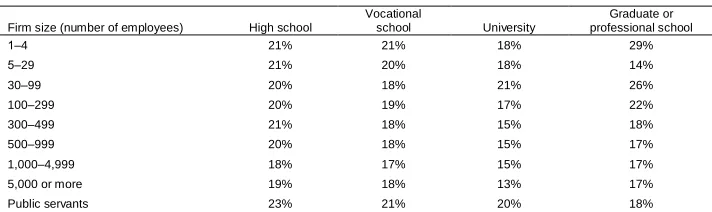
We measured the mean household work share of husbands in each of 36 categories that we consider to represent the organizational norms for men of different education levels in firms of different sizes. Table 1 shows men’s average contribution to household labor by firm size and education, based on the pooled data. While men working in the largest firms contribute a very low share of household labor (13%‒19%) relative to men working in firms of other sizes, male university graduates in these firms contribute by far the lowest share (13%) across all educational levels and firm size categories. Male high school graduates in the largest firms contribute 19% of the household work in their household. The differences by firm size and by educational level make intuitive sense to us, as university-educated men in large Japanese firms are well-known to be subject to the most intense work pressures and have the most to lose (and conversely the most to gain) based on their demonstrated commitment to the firm, which is generally evaluated by time spent working with colleagues (Yashiro 2011), sometimes extending into after-hours socializing.
Table 1: Men's average contribution to household work, by firm size and education
Firm size (number of employees) High school
Vocational
school University
Graduate or professional school
1‒4 21% 21% 18% 29%
5‒29 21% 20% 18% 14%
30‒99 20% 18% 21% 26%
100‒299 20% 19% 17% 22%
300‒499 21% 18% 15% 18%
500‒999 20% 18% 15% 17%
1,000‒4,999 18% 17% 15% 17%
5,000 or more 19% 18% 13% 17%
Public servants 23% 21% 20% 18%
logged weekly work hours are added to the model. These are negatively related to his household work share, showing that longer work hours are a major constraint on his household work. Nevertheless, the strong positive effect of mean household work hours by men of similar education and firm size remains. This is consistent with our hypothesis that the gender-role specialization behavior of a man’s work peers influences his behavior. The third model (column 3) shows that a change in wife’s work hours from longer to shorter is associated with a significant decrease in husband’s household work share. Husband’s household work share decreases by 7 percentage points in the case of non-employed wives compared with wives who work more than 42 hours per week. A reduction in the work hours of employed wives also reduces husbands’ household work share by 1 to 4 percentage points.
Table 2: Determinants of husband’s share of household work
Model 1 Model 2 Model 3
Coefficient SE Coefficient SE Coefficient SE
Men’s mean household work hours by firm size and education
0.231** 0.098 0.329** 0.163 0.239** 0.097
Husband’s logged annual income at t‒1 ‒0.006** 0.003 ‒0.006 0.004 ‒0.004 0.003
Husband’s logged weekly work hours at t‒1 ‒0.008** 0.004 ‒0.010*** 0.002
Husband’s gender-role attitudes at t‒1 0.001 0.001 0.001 0.001 0.001 0.001
Number of children ‒0.001 0.004 ‒0.000 0.006 0.001 0.004
Age of youngest child (in years)
0‒1 ‒0.018** 0.008 ‒0.012 0.012 ‒0.009 0.008
2‒3 0.005 0.007 0.015 0.010 0.011 0.007
4‒6 0.014*** 0.006 0.014* 0.007 0.017*** 0.005
7‒9 0.017*** 0.004 0.018*** 0.005 0.018*** 0.004
Over 9 ---- ---- ---- ---- ----
----Wife’s weekly work hours at t‒1
Not employed ‒0.067*** 0.006
1‒20 ‒0.040*** 0.006
21‒35 ‒0.028*** 0.006
36‒42 ‒0.011** 0.005
Over 42 ----
----Constant 0.225*** 0.028 0.258*** 0.046 0.288*** 0.030
R2 within 0.021 0.022 0.041
Number of person-years 20,486 20,486 20,486
Notes: *p<.10; **p<.05; ***p<.01. Standard errors are corrected for clustering. Survey year and husband’s age are included as controls in all three models.
7.2 Transition to second birth
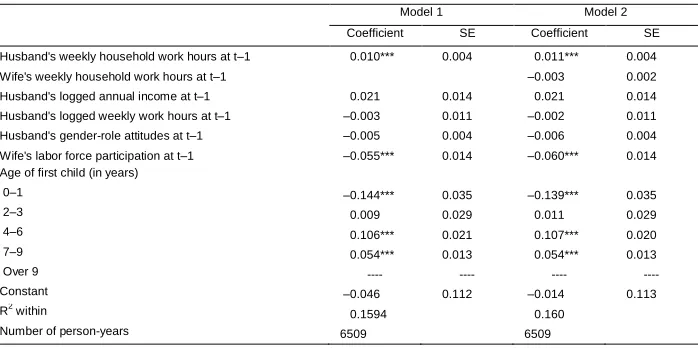
Table 3 shows the results of the fixed-effects linear probability model predicting transition to second birth. A second birth is less likely when a wife moves from non-employment to non-employment at t‒1: the probability of a second birth the next year decreases by just over 5 percentage points. On average, close to 50% of wives with only one child are employed at t‒1, around 18% of whom are in regular full-time jobs, 25% in part-time or other non-standard employment, and 7% are self-employed.10 Of particular interest is whether husband’s higher household work hours significantly increase the probability of a second birth. This is indeed the case. A one-hour per week increase is associated with slightly more than a 1 percentage point rise in the probability of a second birth. On the other hand, wife’s household work hours (in column 2) tend to decrease the probability of a second birth, although this effect is not statistically significant.
Table 3: Determinants of transition to second birth
Model 1 Model 2
Coefficient SE Coefficient SE
Husband's weekly household work hours at t‒1 0.010*** 0.004 0.011*** 0.004
Wife's weekly household work hours at t‒1 ‒0.003 0.002
Husband's logged annual income at t‒1 0.021 0.014 0.021 0.014
Husband's logged weekly work hours at t‒1 ‒0.003 0.011 ‒0.002 0.011
Husband's gender-role attitudes at t‒1 ‒0.005 0.004 ‒0.006 0.004
Wife's labor force participation at t‒1 ‒0.055*** 0.014 ‒0.060*** 0.014
Age of first child (in years)
0‒1 ‒0.144*** 0.035 ‒0.139*** 0.035
2‒3 0.009 0.029 0.011 0.029
4‒6 0.106*** 0.021 0.107*** 0.020
7‒9 0.054*** 0.013 0.054*** 0.013
Over 9 ---- ---- ----
----Constant ‒0.046 0.112 ‒0.014 0.113
R2 within
0.1594 0.160
Number of person-years 6509 6509
Notes: *p<.10; **p<.05; ***p<.01. Standard errors are corrected for clustering. Survey year and wife’s age are included as controls in all three models.
10
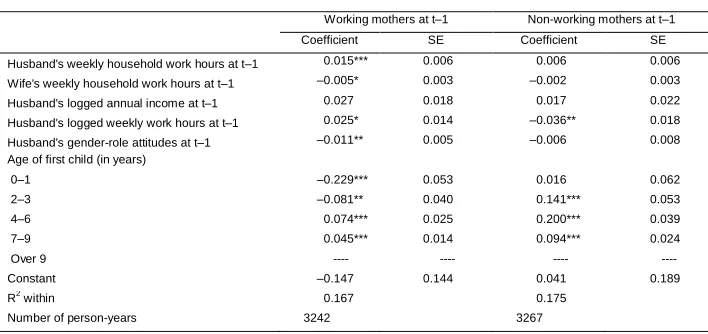
Since husband’s household work hours may be of greater importance for dual-earner couples than for male-breadwinner couples (i.e., couples where husbands specialize in market work and wives in domestic work), we divide the female sample into those who were working at t‒1 and those who were out of the labor force at t‒1 (Table 4). As shown in the second column of Table 4, for wives who were out of the labor force at t‒1 an increase in husbands’ household work hours at t‒1 does not significantly affect the second birth at t. However, an increase in husband’s work hours (i.e., employment hours) significantly decreases the probability of a second birth at time t. Also, within two to six years after having the first child, the likelihood of having a second child accelerates for these male-breadwinner couples.
Table 4: Determinants of transition to second birth among working and non-working mothers
Working mothers at t‒1 Non-working mothers at t‒1
Coefficient SE Coefficient SE
Husband's weekly household work hours at t‒1 0.015*** 0.006 0.006 0.006
Wife's weekly household work hours at t‒1 ‒0.005* 0.003 ‒0.002 0.003
Husband's logged annual income at t‒1 0.027 0.018 0.017 0.022
Husband's logged weekly work hours at t‒1 0.025* 0.014 ‒0.036** 0.018
Husband's gender-role attitudes at t‒1 ‒0.011** 0.005 ‒0.006 0.008
Age of first child (in years)
0‒1 ‒0.229*** 0.053 0.016 0.062
2‒3 ‒0.081** 0.040 0.141*** 0.053
4‒6 0.074*** 0.025 0.200*** 0.039
7‒9 0.045*** 0.014 0.094*** 0.024
Over 9 ---- ---- ----
----Constant ‒0.147 0.144 0.041 0.189
R2 within 0.167 0.175
Number of person-years 3242 3267
Notes: *p<.10; **p<.05; ***p<.01. Standard errors are corrected for clustering. Survey year and wife’s age are included as controls in all three models.
When the wife is employed after the first birth, the probability of transition to second birth increases only after intervals of 4‒6 and 7‒9 years, which is a much longer time interval as compared with non-working mothers. Also, among dual-earner couples the more the husband’s gender-role attitudes become non-traditional, the less likely it is that the couple will progress to a second birth. Husbands in dual-earner couples are less traditional in their gender-role attitudes on average, accepting a more equal role for husbands and wives in sharing the responsibilities of earning income and doing household work. Consistent with these values, an increase in husband’s household work hours and a decrease in the wife’s indeed increase the probability of transition to second birth in dual-earner couples. However, rather than husbands increasing their household work time by a substantial amount, such couples appear to scale back their number of children (or at least increase the spacing). Lastly, husbands’ longer working hours at t‒1 compared to t are associated with an increase in the probability of a second birth among working couples, which is contrary to the case of breadwinner couples.
8. Discussion and conclusion
Japanese men’s contribution to household work is strikingly low compared to other postindustrial societies. Prior research has shown that Japanese men’s household labor is not very responsive to either reductions in their weekly work hours or to their wives’ labor force participation. The dominant theoretical perspectives in the research literature on household work ‒ relative resources, time availability, and gender-role attitudes ‒ have been insufficient to explain this relative unresponsiveness.
This paper has focused on the Japanese employment system, a system of labor practices and work norms that continues to apply especially to male university graduates working in large firms. The system is based on an implicit contract between employer and employee in which the employer promises job security and future wage increases in exchange for employees’ high work commitment and willingness to work overtime and relocate when ordered to by the company. This package of employment practices is supported by Japanese Supreme Court rulings. The speed of promotion and the amount of future wage increases depend on the evaluations of managers, beginning in the early years of a man’s career and extending throughout his working life. A highly gendered division of labor at home is a rational response to this system, as it facilitates men’s ability to fully engage in the intra-company competition for promotion that characterizes the early career stage.
graduates in the largest firms do the lowest average share of household work compared to other men. In supplementary analyses we found that these men are more likely than others to be married to non-working wives. After controlling for husbands’ logged annual earnings, logged weekly work hours, number of children, age of the youngest child, gender-role attitudes, and wives’ work hours in the previous year, as well as unobserved characteristics, using a fixed-effects linear probability model, we found that husbands’ household work share is lower when the norm for men in the same education category and firm size is to do less household work.
We then tested for the effect of fathers’ household labor hours on the transition to second birth. We assume that couples decide whether the wife will continue to work after the first childbirth, and that the decision to have a second birth occurs after this decision. We also conducted separate analyses for wives who were working at t‒1 and those who were out of the labor force at t‒1. Results indicate that husband’s higher participation in household work is an important condition for dual-earner couples to proceed to a second birth. A wife’s employment at t‒1 has a negative impact on the probability of having a second birth. In order to wipe out this negative effect, husband’s household work hours need to increase substantially. Other significant effects on transition to second birth for dual-earner couples include a negative effect of husbands’ more egalitarian gender-role attitudes and a slight positive effect of husbands’ work hours. While at first glance the result for husbands’ gender-role attitudes may seem counterintuitive (especially with regard to McDonald’s gender equity theory), recent qualitative work finds that young, highly-educated, egalitarian-minded dual-earner Japanese couples have lower fertility intentions than single-earner couples or dual-earner couples where the wife intends to leave the labor force or to cut back to part-time work (Brinton and Oh 2017). In-depth interviews reveal that the underlying logic of such couples is that if both partners intend to continue working full-time it will be very difficult to accommodate the time demands of a second child. In such couples, husbands’ household work time is generally somewhat higher than in single-earner couples, but not substantially higher, so that it is not enough to offset the increased time demands that would occur with the birth of a second child. We also note that the household income of dual-earner Japanese couples in our sample in this paper is lower than that for single-earner households. This may motivate husbands in dual-earner couples to increase their work hours after the birth of a first child in order to try to raise their earning potential.
of the Japanese employment system. In other words, we can predict that as long as the Japanese employment system sustains rigid employment practices that encourage long-term employment and rely on cumulative appraisals for wage increases and promotions, the core work force will work longer hours than workers in other countries and the specialization of household labor between husbands and wives will likely continue.
Does long-term employment remain an effective employment practice in the context of population aging and a shrinking population size? While some Japanese economists (e.g., Yashiro 2011) answer in the negative, many Japanese human resource professionals and company managers continue to evaluate the system highly. Our results, however, suggest that unless such long-term employment practices are reformed, wives are likely to continue to be the main caretakers in households and many husbands will continue to focus nearly single-mindedly on their workplace responsibilities. Our analyses suggest that as more married women remain in the labor force after the first birth, work norms that encourage strong gender-role specialization at home will inhibit many couples’ transition to a second birth.
Even though our results indicate that the low amount of household work contributed by husbands does not significantly decrease the probability of second birth in households where the wife is not employed, when one considers rapid population aging together with the stagnation of male income a strong argument can be made for altering the Japanese employment system so that workplace norms presuppose dual-earner couples. This would involve modifying the rules for company-initiated relocations, overtime work, and the hiring of workers into different tracks, based on whether the workers accept these management-directed decisions. The management and reward structure based on workers’ year of entry into the firm should also be modified so that the labor market becomes more mobile and the chance to move across firms ‒ perhaps in search of better work-family balance ‒ increases for both men and women.
9. Acknowledgments
References
Aassve, A., Fuochi, G., and Mencarini, L. (2014). Desperate housework: Relative resources, time availability, economic dependency, and gender ideology across Europe. Journal of Family Issues 35(8): 1000‒1022. doi:10.1177/0192513X1 4522248.
Abe, Y. (2010). Equal employment opportunity law and the gender wage gap in Japan: A cohort analysis. Journal of Asian Economics 21(2): 142‒155. doi:10.1016/ j.asieco.2009.12.003.
Abe, Y. (2011). The equal employment opportunity law and labor force behavior of women in Japan. Journal of the Japanese and International Economies 25(1): 39‒55.doi:10.1016/j.jjie.2010.06.003.
Abraham, K.G. and Houseman, S.N. (1989). Job security and work force adjustment: How different are U.S. and Japanese practices? Journal of the Japanese and International Economies 3(4): 500‒521.doi:10.1016/0889-1583(89)90015-4.
Akerlof, G.A and Kranton, R.E. (2000). Economics and identity.Quarterly Journal of Economics 115(3): 715‒753.doi:10.1162/003355300554881.
Becker, G.S. (1993).A treatise on the family. Cambridge: Harvard University Press.
Bianchi, S.M., Milkie, M.A., Sayer, L.C., and Robinson, J.P. (2000). Is anyone doing the housework? Trends in the gender division of household labor. Social Forces
79(1): 191‒228.doi:10.1093/sf/79.1.191.
Bittman, M., England, P., Sayer, L., Folbre, N., and Matheson, G. (2003). When does gender trump money? Bargaining and time in household work. American Journal of Sociology 109(1): 186‒214.doi:10.1086/378341.
Brinton, M.C. (1993).Women and the economic miracle: Gender and work in postwar Japan. Berkeley: University of California Press.
Brinton, M.C. (2017). Happiness at work? Marital happiness among Japanese housewives and employed wives. In Holthus, B. and Manzenreiter, W. (eds.).
Life course, happiness and well-being in Japan.London: Routledge.
Brinton, M.C. and Oh, E. (2017). Babies, work, or both? The interdependence of women’s employment and fertility in East Asia. Working paper, Department of Sociology, Harvard University.
Brunello, G. and Ariga, K. (1997). Earnings and seniority in Japan: A re-appraisal of the existing evidence and a comparison with the UK. Labour Economics 4(1): 47‒69.doi:10.1016/S0927-5371(96)00021-8.
Cooke, L.P. (2004). The gendered division of labor and family outcomes in Germany.
Journal of Marriage and Family 66(5): 1243‒1256. doi:10.1111/j.0022-2445. 2004.00090.x.
Cooke, L.P. (2009). Gender equity and fertility in Italy and Spain. Journal of Social Policy 38(1): 123‒140.doi:10.1017/S0047279408002584.
de Laat, J. and Sevilla-Sanz, A. (2011). The fertility and women’s labor force participation puzzle in OECD countries: The role of men’s home production.
Feminist Economics 17(2): 87‒119.doi:10.1080/13545701.2011.573484.
Esping-Andersen, G. and Billari, F.C. (2015). Re-theorizing family demographics.
Population and Development Review 41(1): 1‒31. doi:10.1111/j.1728-4457.20 15.00024.x.
Feyrer, J., Sacerdote, B., and Stern, A.D. (2008). Will the stork return to Europe and Japan? Understanding fertility within developed nations. Journal of Economic Perspectives 22(3): 3‒22.doi:10.1257/jep.22.3.3.
Genda, Y. and Rebick, M. (2000). Japanese labour in the 1990s: Stability and stagnation. Oxford Review of Economic Policy 16(2): 85‒102. doi:10.1093/ oxrep/16.2.85.
Goldscheider, F., Bernhardt, E., and Lappegård, T. (2015). The gender revolution: A framework for understanding changing family and demographic behavior.
Population and Development Review 41(2): 207‒239.doi:10.1111/j.1728-4457. 2015.00045.x.
Hanada, M. (1987). Competition within the human resource management system: Human resource management strategies of Japanese firms from the viewpoint of the promotion system.Soshiki Kagaku 21: 44‒53.
Hashimoto, M. and Raisian, J. (1985). Employment tenure and earnings profiles in the US and Japan.American Economic Review75(4): 721‒735.
Houseman, S. and Osawa, M. (2003). The growth of nonstandard employment in Japan and the United States: A comparison of causes and consequences. In Houseman, S. and Osawa, M.( eds).Nonstandard work in developed economies: Causes and consequences. Kalamazoo: W.E. Upjohn Institute for Employment Research.
Imada, S. and Hirata, S. (1995). Promotion structure of white-collar male employees.
Nihon Rōdō Kenkyū Kikō (in Japanese).
Ishida, H. (1986). Transferability of Japanese human resource management abroad.
Human Resource Management 25(1): 103‒120.doi:10.1002/hrm.3930250108.
Ishii-Kuntz, M., Makino, K., Kato, K., and Tsuchiya, M. (2004). Japanese fathers of preschoolers and their involvement in child care. Journal of Marriage and Family 66(3): 779‒791.doi:10.1111/j.0022-2445.2004.00052.x.
Kamo, Y. (1994). Division of household work in the United States and Japan.Journal of Family Issues 15(3): 348‒378.doi:10.1177/019251394015003002.
Kamoda, T. (2015). Should we leave unlimited regular employees as they are? (in Japanese)Quarterly Labor Law248: 41‒51.
Kisei Kaikaku Kaigi Koyō Working Group Hōkokusho (2013). Report of the Regulatory Reform Council Working Group on Employment. Paper presented at the 11th Meeting of the Regulatory Reform Council of the Cabinet Office, May 30, 2013.http://www8.cao.go.jp/kisei-kaikaku/kaigi/publication/p_index.html.
Kohler, H.-P., Billari, F.C., and Ortega, J.A. (2002). The emergence of lowest-low-fertility in Europe during the 1990s.Population and Development Review 28(4): 641‒681.doi:10.1111/j.1728-4457.2002.00641.x.
Kuroda, S. and Yamamoto, S. (2014). Economic analysis of working hours. Tokyo:
Nihon Keizai Shinbunsha (in Japanese).
Lee, K.S. and Ono, H. (2008). Specialization and happiness in marriage: A U.S.–Japan comparison. Social Science Research 37(4): 1216–1234. doi:10.1016/j.ssrese arch.2008.02.005.
Lesthaeghe, R. (2010). The unfolding story of the second demographic transition.
Population and Development Review36(2): 211‒251.doi:10.1111/j.1728-4457. 2010.00328.x.
Matsuda, S. (2006). Factors affecting men’s housework and childcare. Kakeikeizai Kenkyū 71: 45‒54 (in Japanese).
McDonald, P. (2000). Gender equity, social institutions and the future of fertility.
Journal of Population Research 17(1): 1‒16.doi:10.1007/BF03029445.
Mitsubishi-UFJ Research and Consulting (2014). Survey on Child Rearing Support (Kosodate Shien ni Kansuru Chōsa; in Japanese).
Mizuochi, M. (2006). Father’s childcare involvement and the allocation of household time.Kakeikeizai Kenkyū 71: 55‒63 (in Japanese).
Mizuochi, M. (2010). Husband’s childcare time and additional births: A Comparative analysis of five developed countries. Journal of Population Studies(Jinkōgaku Kenkyū) 46:1‒13 (in Japanese).
Mun, E. and Brinton, M.C. (2014). Workplace matters: The use of parental leave policy in Japan. Work and Occupations 42(3): 335‒369. doi:10.1177/073088841 5574781.
Nagase, N. (2003). Standard and non-standard work arrangements, pay differences, and choice of work by Japanese mothers. In Houseman, S. and Osawa, M. (eds.).
Nonstandard work in developed economies. Kalamazoo: Upjohn Institute of Employment Research: 267‒305
Nagase, N. (2013). Comparing women’s work and family in Japan and the U.S.: Implications for the social security system. Aging and Pension Investment
(Nenkin to Keizai) 31: 3‒24 (in Japanese).
Nagase, N. (2014). The effect of the short working hours option mandate on first childbirth, birth intentions, and work continuation after childbirth: Evidence from Japan. Journal of Population Studies (Jinkōgaku Kenkyū) 50: 29‒53 (in Japanese).
Nagase, N. and Moriizumi, R. (2011). Work and family choices of highly-educated Japanese women: The effects of changing labor practices in Japanese firms in the 1990s and 2000s. Journal of Social Sciences and Family Studies (Seikatsu Shakai Kagaku Kenkyū) 17: 1‒21 (in Japanese).
Nagase, N. and Moriizumi, R. (2013). Female labor force participation following the first birth: Why a small increase despite the protective law change in Japan.
Nagase, N. and Yamaya, M. (2011). Career prospects of female university graduates in large Japanese firms: The difficulties and possibilities of track-based hiring practices. Journal of Career Research (Kyaria Dezain Kenkyū) 7: 95‒105 (in Japanese).
Nakagawa, M. (2010). Wives’ maternal gate-keeping and husbands’ involvement in childcare and housework when children are under 12 years old. Family Sociology (Kazoku Shakaigaku Kenkyū) 22(2): 201‒212 (in Japanese).
National Institute of Population and Social Security Research (2012). Marriage processes and fertility of Japanese married couples: Overview of results from the fourteenth (2010) Japanese National Fertility Survey (in Japanese). Tokyo: National Institute of Population and Social Security Research, Department of Population Dynamics Research.
Nishioka, H. (1998). Men’s domestic role and the gender system: Determinants of husband’s household labor in Japan.Jinkō Mondai Kenkyū 54: 56‒71.
Ogawa, N. (2003). Japan’s changing fertility mechanisms and its policy responses.
Journal of Population Research 20(1): 89‒106.doi:10.1007/BF03031797.
Oláh, L.Sz. (2003). Gendering fertility: Second births in Sweden and Hungary.
Population Research and Policy Review 22(2): 171‒200. doi:10.1023/A:10250 89031871.
Ono, H. (2007). Careers in foreign-owned firms in Japan. American Sociological Review 72(2): 267‒290.doi:10.1177/000312240707200207.
Osawa, M., Kim, M.J., and Kingston, J. (2013). Precarious work in Japan. American Behavioral Scientist 57(3): 309‒334.doi:10.1177/0002764212466240.
Shimizutani, S. and Yokoyama, I. (2009). Has Japan’s long-term employment practice survived? Developments since the 1990s.Industrial and Labor Relations Review
62(3): 313‒326.doi:10.1177/001979390906200303.
Takeuchi, H. (1995). Japanese meritocracy. Tokyo: University of Tokyo Press (in Japanese).
Torr, B.M. and Short, S.E. (2004). Second births and the second shift: A research note on gender equity and fertility.Population and Development Review 30(1): 109‒ 130.doi:10.1111/j.1728-4457.2004.00005.x.
Tsuya, N.O., Bumpass, L.L., Choe, M.K., and Rindfuss, R.R. (2013). Employment and household tasks of Japanese couples, 1994‒2009. Demographic Research
27(24): 705–718.doi:10.4054/DemRes.2012.27.24.
Ueda, A. (2005). Intrafamily time allocation of housework: Evidence from Japan.
Journal of the Japanese and International Economies19(1): 1‒23.doi:10.1016/ j.jjie.2003.12.002.
Yamaguchi, K. (2005). Causes and measurement of fertility decline: The Role of husbands, the workplace, government, and society.Kakei Keizai Kenkyū 66: 57‒ 67 (in Japanese).
Yashiro, N. (2011). Myths about Japanese employment practices: An increasing insider-outsider conflict of interests. Contemporary Japan 23(1): 133‒155. doi:10.1515/cj.2011.008.
Appendix
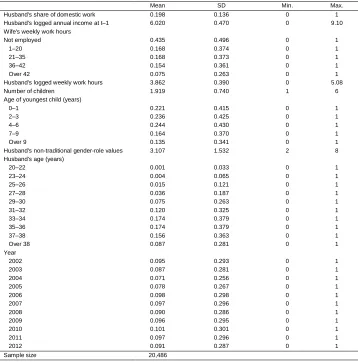
Table A-1: Means for Table 2
Mean SD Min. Max.
Husband's share of domestic work 0.198 0.136 0 1
Husband's logged annual income at t‒1 6.020 0.470 0 9.10
Wife's weekly work hours
Not employed 0.435 0.496 0 1
1‒20 0.168 0.374 0 1
21‒35 0.168 0.373 0 1
36‒42 0.154 0.361 0 1
Over 42 0.075 0.263 0 1
Husband's logged weekly work hours 3.862 0.390 0 5.08
Number of children 1.919 0.740 1 6
Age of youngest child (years)
0‒1 0.221 0.415 0 1
2‒3 0.236 0.425 0 1
4‒6 0.244 0.430 0 1
7‒9 0.164 0.370 0 1
Over 9 0.135 0.341 0 1
Husband's non-traditional gender-role values 3.107 1.532 2 8
Husband's age (years)
20‒22 0.001 0.033 0 1
23‒24 0.004 0.065 0 1
25‒26 0.015 0.121 0 1
27‒28 0.036 0.187 0 1
29‒30 0.075 0.263 0 1
31‒32 0.120 0.325 0 1
33‒34 0.174 0.379 0 1
35‒36 0.174 0.379 0 1
37‒38 0.156 0.363 0 1
Over 38 0.087 0.281 0 1
Year
2002 0.095 0.293 0 1
2003 0.087 0.281 0 1
2004 0.071 0.256 0 1
2005 0.078 0.267 0 1
2006 0.098 0.298 0 1
2007 0.097 0.296 0 1
2008 0.090 0.286 0 1
2009 0.096 0.295 0 1
2010 0.101 0.301 0 1
2011 0.097 0.296 0 1
2012 0.091 0.287 0 1
Table A-2: Means for Table 3
Mean SD Min. Max.
Birth of second child at t 0.133 0.340 0 1
Husband's weekly household work hours at t‒1 2.238 1.761 0 9
Wife's weekly household work hours at t‒1 9.261 4.105 0 18.43
Husband's logged annual income at t‒1 6.047 0.470 0 8.476
Husband's logged weekly work hours at t‒1 3.830 0.433 1.386 4.942
Husband's gender-role attitudes at t‒1 3.159 1.547 2 8
Wife's labor force participation at t‒1 0.498 0.500 0 1
Age of first child (in years)
0‒1 0.112 0.315 0 1
2‒3 0.310 0.463 0 1
4‒6 0.253 0.435 0 1
7‒9 0.141 0.348 0 1
Number of person-years 6,509
Table A-3: Means for Table 4
Working mothers at t-1 Non-working mothers at t-1
Mean SD Min. Max. Mean SD Min. Max.
Birth of second child at t 0.120 0.325 0 1 0.146 0.353 0 1
Husband's weekly household work hours at t‒1 2.258 1.824 0 9 2.218 1.697 0 9
Wife's weekly household work hours at t‒1 7.274 3.367 0 18.29 11.232 3.810 0 18.43
Husband's logged annual income at t‒1 5.976 0.483 0.693 8.010 6.118 0.446 0 8.476
Husband's logged weekly work hours at t‒1 3.832 0.438 1.386 4.940 3.828 0.428 1.946 4.787
Husband's gender-role attitudes at t‒1 3.504 1.660 2 8 2.816 1.341 2 7
Wife's labor force participation at t‒1 1.000 0.000 1 1 0.000 0.000 0 0
Age of first child (in years)
0‒1 0.070 0.255 0 1 0.154 0.361 0 1
2‒3 0.247 0.431 0 1 0.373 0.484 0 1
4‒6 0.256 0.436 0 1 0.250 0.433 0 1
7‒9 0.169 0.375 0 1 0.114 0.317 0 1