* Corresponding author. Tel:+989123887038 E-mail: [email protected] (E. Ghobadian) © 2012 Growing Science Ltd. All rights reserved. doi: 10.5267/j.ijiec.2012.08.001
Contents lists available at GrowingScience
International Journal of Industrial Engineering Computations
homepage: www.GrowingScience.com/ijiec
Scheduling trucks in cross docking systems with temporary storage and dock repeat truck holding pattern using GRASP method
Ehsan Ghobadiana*, Reza Tavakkoli-Moghaddamb, Hassan Javanshira and Mahdi Naderi-Benia
a
Department of Industrial Engineering, South Tehran Branch, Islamic Azad University, Tehran, Iran
bDepartment of Industrial Engineering, College of Engineering, University of Tehran, Tehran, Iran
A R T I C L E I N F O A B S T R A C T
Article history: Received 18 May 2012 Received in revised format 7 July 2012
Accepted July 31 2012 Available online 5 August 2012
Cross docking play an important role in management of supply chains where items delivered to a warehouse by inbound trucks are directly sorted out, reorganized based on customer demands, routed and loaded into outbound trucks for delivery to customers without virtually keeping them at the warehouse. If any item is held in storage, it is usually for a short time, which is normally less than 24 hours. The proposed model of this paper considers a special case of cross docking where there is temporary storage and uses GRASP technique to solve the resulted problem for some realistic test problems. In our method, we first use some heuristics as initial solutions and then improve the final solution using GRASP method. The preliminary test results indicate that the GRASP method performs better than alternative solution strategies.
© 2012 Growing Science Ltd. All rights reserved
Keywords:
GRASP Scheduling Temporary storage Metaheuristics
Cross docking
1. Introduction
777
Cross docking problem is normally formulated as a mixed integer problems and they are mathematically considered as NP-Hard problem (Feo & Resende, 1989; Mosheiov, 1998). Therefore, there is a need to use some metaheuristics to solve such problem. Rohrer (1995) discussed cross docking problem and the implementation of simulation to solve such problem.
Vahdani and Zandieh (2010) presented the implementation of five meta-heuristic algorithms including genetic algorithm (GA), tabu search (TS), simulated annealing (SA), electromagnetism-like algorithm (EMA) and variable neighborhood search (VNS) to schedule the trucks in cross-dock systems to minimize total operation time when a temporary storage buffer to hold temporarily items is located at the shipping dock. They used response surface methodology (RSM) methodology to tune their problem parameters. They also considered two kinds of objective functions to develop multiple objective decision making model. Vahdani et al. (2009) considered another cross docking problem where it was a scheduling the truck holdover recurrent dock cross-dock problem using robust meta-heuristics.
Soltani and Sadjadi (2010) proposed two hybrid meta-heuristics, hybrid simulated annealing and hybrid variable neighborhood search, to solve cross docking problem by achieving the best possible sequence of truck pairs. They used different sample problems to demonstrate the effectiveness of the proposed methods, especially for large-sized problems. Nascimento et al. (2010) discussed the independent multi-plant, multi-period, and multi-item capacitated lot-sizing problem where transfers among different plants were allowed. They developed a Greedy Randomized Adaptive Search Procedure (GRASP) heuristic as well as a path-relinking intensification procedure to detect cost-effective solutions for this problem. They also proposed some heuristics to solve some instances of the capacitated lot sizing problem with parallel machines. The results of the computational tests showed that the proposed heuristics outperform other heuristics previously described in the literature.
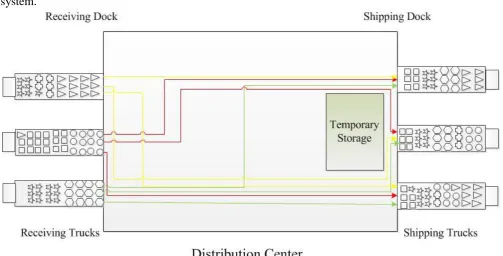
Boloori Arabani et al. (2011) developed another some meta-heuristics implementation for scheduling of trucks in a cross-docking system with temporary storage. Fig. 1 shows a sample of cross docking system.
Fig .1. Cross docking distribution center
The other trucks, which are responsible for shipping cargos to final destinations could also use this temporary storage to meet final customers' needs.
2. The proposed method
Continuous Variables:
Makespan,
Time at which the variable transferring receiving truck to shipping truck starts to unload
from receiving truck onto the receiving dock,
Time at which the variable transferring from receiving truck to shipping truck finished
loading from the shipping dock into shipping truck ,
Integer Variables:
Number of units of product type which transfer from receiving truck to shipping truck ,
Total number of units of products which transfer from receiving truck to shipping truck ,
where ( ∑ ),
Binary Variables:
1 if any products transfer from receiving truck to shipping truck
0 otherwise
ij
i j
v
1 if any variable immediately or directly precedes the variable in the receiving sequence
0 otherwise
ij i j
iji j
t t
p
i'j' 00
1 if the variable t is placed at the first position in the receiving sequence
0 otherwise
i j
p
i'j' 00
1 if the variable t is placed at the last position in the receiving sequence
0 otherwise
ij
p
1 if any products transfer from receiving truck to shipping truck
0 otherwise
ij
i j
v
1 if any variable immediately or directly precedes the variable in the receiving sequence
0 otherwise
ij i j
iji j
t t
p
1 if any variable immediately or directly precedes the variable in the shipping sequence
0 otherwise
ij i j
iji j
t t
q
ij 00
1 if the variable t is placed at the first position in the shipping sequence
0 otherwise
ij
p
ij 00
1 if the variable t is placed at the last position in the shipping sequence
0 otherwise
ij
p
Data:
777
S = Number of shipping trucks in the set,
N =Number of product types in the set,
Number of units of product type k, which is initially loaded in receiving truck i,
Number of units of product type k, which is initially loaded for shipping truck j,
D = Delay time for truck change,
V = Moving or travel time of products from the receiving dock to the shipping dock,
M = Big number.
Mathematical Model
min T
subject to
(1)
∑
(2)
∑
(3)
∑
(4)
(5)
∑ ∑
(6)
∑ ∑
(7)
∑ ∑
(8)
∑ ∑
(9)
∑ ∑
∑ ∑
(11)
∑ ∑
(12)
∑ ∑
(13)
(14)
(15)
( ) (16)
( ) (17)
(18)
( ) (19)
( ) (20)
All variables ≥ 0.
According to Eq. (1), makespan is greater equal to the time that the last product is loaded into the last
scheduled shipping truck. Eq. (2) assures that total number of units of kth product from receiving truck i
are shipped to all shipping trucks are the same as the number of products scheduled for receiving truck
i. Similarly, Eq. (3) assures that, for shipping truck j, total number of outgoing products type k from all
receiving trucks is the same as total number of incoming product type k. Variable tijused in Eqs.
(16-20) computes the time of loading or unloading. Eq. (5) guarantees an appropriate relationship between
ij
t and vij. According to Eq. (6) only one of tij when vij 1 can immediately stay in the sequence
compared with ti j . Eq. (7) guarantees that when vij 1 only one of ti j is scheduled immediately after
ij
t . Similarly, Eq.(6-8) assures that only one of tij are directly in priority compared with other ti j when
1
ij
v . According to Eq. (9), only one of ti j happens right after tij when vi j' 1.
Eq. (10) assures that only one of receiving trucks' ti j is scheduled in the beginning of the sequence and
Eq. (11) assures that only one of receiving trucks' tijshould stay in the last schedule. Similarly, Eq. (12)
and Eq. (13) assures that only one of the shipping trucks' ti j comes at the beginning of the sequence
and only one of tij comes last. Eq. (14) and Eq. (15) guarantee that there is no consecutive sequence,
which transfers products from the same receiving truck to the same shipping truck.
Eq. (16) and Eq. (17) provide an appropriate sequence for unloading times for tijvariables. If there is no
change on receiving truck (ii) we use Eq. (16) and when there is receiving truck (ii) we need to
777
Eq. (18) setup a good relationship between Lijand Uijand finally, Eq. (19) and Eq. (20) setup a valid
loading time for tijbased on the orders received. If there is no changes between two consecutive
shipments ( j j) Eq. (19) becomes active, otherwise Eq. (20) is used to calculate delay time.
As we can observe, there are literally considerable number of binary variables, which make it impossible to solve the resulted problem for real-world applications. For instance, there are 3 receiving truck and 3 shipping truck with 8 products, there will be 307 decision variables including 207 binary variables and 19 continuous variables. There are also 304 constraints, 189 inequality and 115 equality constraints. Yu (2002) proposed the following heuristic approach to solve the proposed model.
PHASE 1
1 initiate set of receiving truck, shipping truck, receiving and shipping truck in relation with them
and quantity of products are associated between two shipping and receiving truck;
2 for shipping truck i=0,…,n compare with receiving trucks i=0,…,n do
3 for compare receiving truck with shipping trucks select one of strategies 1, 2 or 3;
4 for Select the receiving truck which has the largest relationship with the certain
shipping truck.
5 update shipping truck and receiving truck list;
6 end for;
7 select the shipping truck which has the smallest relation with receiving trucks
and remove it from shipping list. Update receiving trucks that have relationship with the certain shipping truck;
8 end for;
9 endfor;
PHASE 2;
1 condition 1;
2 start from the first, for each two sequence shipping truck do;
3 if have one in share;
4 change sequence
5 elseif there is more than one in share and ;
6 change sequence;
7 end if;
8 condition 2;
9 start from the last shipping sequence;
10 if in the former sequence set is smaller than truck change time do
11 revise sequence;
3. GRASP algorithm
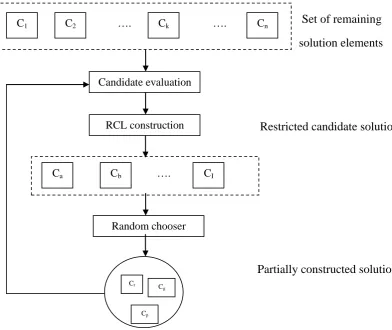
Greedy randomized adaptive search procedure(GRASP) (Feo, 1989, 1994, 1995; Resende & Ribeiro, 2002; Pitsoulis & Resende, 2002) starts with an empty solution and as the search algorithm continues, new solutions are added to solution set until there is no further solution found. There are many applications of GRASP to solve engineering problems (Zapfel et al., 2010; Javanshir & Haghighi, 2011). There are some similarities between GRASP and Greedy construction method but there are some important changes between these two methods. GRASP uses restricted candidate list (RCL) and allows the algorithm diversified solution sets. The primary objective is to simplify the process of adding new solutions. Fig. 7 shows details of GRASP algorithm.
Fig. 2. GRASP-solution Processing
The solution procedure starts with an empty set and evaluates all elements based on performance function and their effects on quality of solution. These elements are sorted based on their performances in candidate list. Fig. 3 shows three levels of the operations.
Set of remaining
solution elements
Restricted candidate solution
Partially constructed solution
Fig. 3. Solution construction of the GRASP metaheuristic
Let g be objective function, to build construction list, we need to have and with
{ } and { } . We use these two limits for the
implementation of our GRASP method. For the proposed model of this paper, there are two RCL
Heuristic information
Solution
construction S
Solution
improvement S
C1 C2 ….
.
Ck ….
.
Cn
Candidate evaluation
RCL construction
Ca Cb ….
.
CI
Random chooser
Cr
r
777
namely cardinality-based and value Based. The cardinality-based method includes k best alternative
solutions. For instance, if k = 5, there are five best elements in RCL and from this list, one sample is
selected randomly. The value based method uses a parameter α to build RCL. Suppose we deal
with an optimization problem and all elements must maintain a value less than their limits to become
eligible for RCL list, we use gmin(gmaxgmin) with g c( )j [gmin, ] . When 1the method
is completely random and when 0 the algorithm is greedy. The following shows the summary of
the proposed GRASP algorithm,
Step 1: Execute three heuristic algorithms 1, 2 and 3
Step 2: Compute cj
Step 3: Compute gminand gmax
Step 4: Add generated solution to RCL if cj gmin(gmaxgmin)
Step 5: Select one of shipping truck and update the information
Step 6: If the number of solutions obtained is equal to S (number of shipping trucks) stop, otherwise
goto step 1
The proposed GRASP algorithm first generates three heuristic solutions proposed by Yu (2002) and in
each stage, we choose and dispatch one truck. Based on the calculated cjwe calculate gminand gmax
and based on the values of cjwe add any solution with cj gmin(gmaxgmin). One advantage of
GRASP method is that the proposed GRASP method has only two parameters including the value of
and termination criteria and the implementation of this algorithm chooses 0.2.
4. The results
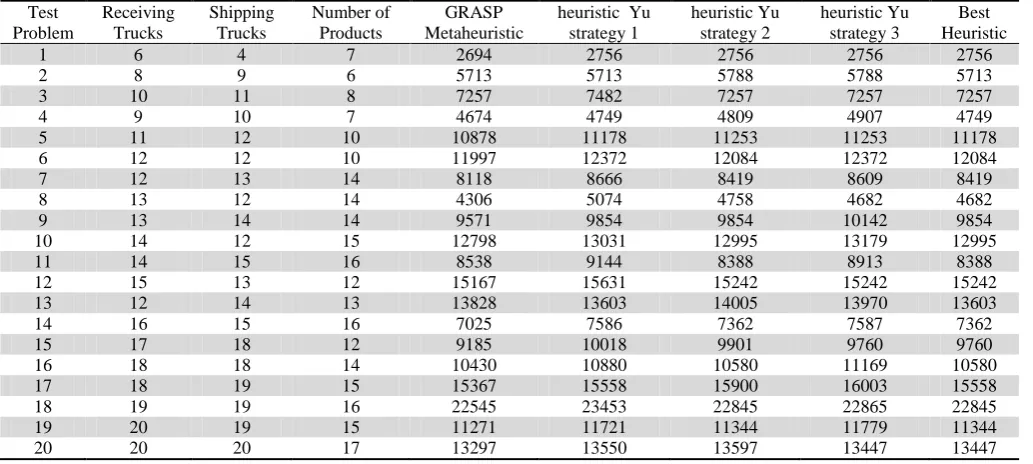
The proposed GRASP method has been implemented using three strategies. All programs were coded using personal computer with 4GB RAM and Intel ® Core™ DUE CPU processor. Table 1 shows details of our implementations on some test problems. As we can observe from the results, in most cases, the proposed model of this paper provides better objective values.
Table 1
Makespan obtained by the GRASP and Heuristics for the test problem
Test Problem
Receiving Trucks
Shipping Trucks
Number of Products
GRASP Metaheuristic
heuristic Yu strategy 1
heuristic Yu strategy 2
heuristic Yu strategy 3
Best Heuristic
1 6 4 7 2694 2756 2756 2756 2756
2 8 9 6 5713 5713 5788 5788 5713
3 10 11 8 7257 7482 7257 7257 7257
4 9 10 7 4674 4749 4809 4907 4749
5 11 12 10 10878 11178 11253 11253 11178
6 12 12 10 11997 12372 12084 12372 12084
7 12 13 14 8118 8666 8419 8609 8419
8 13 12 14 4306 5074 4758 4682 4682
9 13 14 14 9571 9854 9854 10142 9854
10 14 12 15 12798 13031 12995 13179 12995
11 14 15 16 8538 9144 8388 8913 8388
12 15 13 12 15167 15631 15242 15242 15242
13 12 14 13 13828 13603 14005 13970 13603
14 16 15 16 7025 7586 7362 7587 7362
15 17 18 12 9185 10018 9901 9760 9760
16 18 18 14 10430 10880 10580 11169 10580
17 18 19 15 15367 15558 15900 16003 15558
18 19 19 16 22545 23453 22845 22865 22845
19 20 19 15 11271 11721 11344 11779 11344
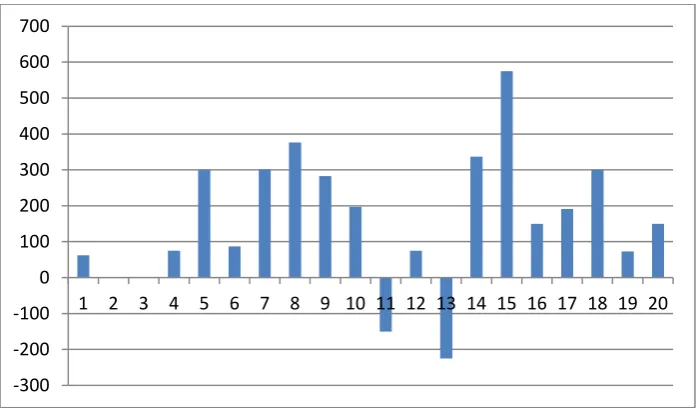
Fig. 4. Objective function difference between GRASP and Yu's heuristic
Fig. 4 shows the difference between the objective functions of the proposed GRASP and Yu's heuristics results. As we can observe, except two cases, there are 16 cases where GRASP performs better than best solution strategies provided by Yu's heuristic method, in two case there is no difference and only in two cases, Yu's method beats GRASP method.
Fig. 5. GRASP performance for the test problem
Fig. 5 shows the performance of the proposed GRASP CPU time in seconds for 20 test problem. Note that the CPU time does not increase significantly as inputs of changes. In other words, the proposed GRASP can be easily implemented for some real-world case studies in reasonable amount of time.
5. Conclusion
In this paper, we have presented an extended cross docking problem by considering temporary storage and repeat holding pattern in the system. The proposed model of this paper was formulated as mixed integer programming and GRASP method was developed to solve the resulted problem. The performance of the proposed model has been compared with Yu's method using some randomly generated test problems. The preliminary results indicate that the proposed GRASP provides better objective values compared with alternative method. Besides, the proposed GRASP seems to be
-300 -200 -100 0 100 200 300 400 500 600 700
1 2 3 4 5 6 7 8 9 10 11 12 13 14 15 16 17 18 19 20
0 5000 10000 15000 20000 25000
0 5 10 15 20 25
777
applicable for real-world application in reasonable amount of time. The proposed model of this paper can be used for cross docking problems with more than one single objective function. Such a problem can be solved using multi objective GRASP methodologies to generate efficient Pareto solutions and we leave it for interested researchers as future research.
Acknowledgment
The authors would like to thank the anonymous referees for constructive comments on earlier version of this paper. We would like to also thank Mr Vahdani for providing assistance in part of this research work.
References
Apte, U.M., & Viswanathan, S. (2000). Effective cross docking for improve distribution efficiencies.
International Journal of logistics: Research and applications, 3(3), 291-302.
Baker, K. R. (1974). Introduction to Sequencing and Scheduling. John Wiley & Sons, New York. Barbarosoglu, G., & Ozgur, D. (1999). A tabu search algorithm for the vehicle routing problem.
Computer &Operations Research. 26, 255-270.
Boloori Arbani, A.R., Fatemi Ghomi, S.M.T., & Zandieh, M. (2011).Meta-heuristics implementation
for scheduling of trucks in a cross-docking system with temporary storage. Expert systems with
Applications, 38(3), 1964-1979.
Javanshir, H., & Haghighi, M. (2011) A GRASP model in network design for two-stage supply chain.
Management Science Letters, 1, 203-212.
Mosheiov, G. (1998). Vehicle routing with pick-up and delivery: tour-partitioning heuristics.
Computers & Industrial Engineering, 34, 669-684.
Nascimento, M.C.V., Resende, M.G.C., & Toledo. F.M.B. (2010). GRASP heuristics with
path-relinking for the multi-plant capacitated lot sizing problem. European Journal of Operation
Research, 200, 747-754.
Pitsoulis, L.S., Resende, M.G. (2002). Greedy randomized adaptive search procedure. Handbook of
applied Optimization, Oxford University Press, 168-183.
Resende, M.G., & Ribeiro, C.C. (2002). Greedy randomized adaptive search procedure. Handbook in
Metaheuristic, Kluwer Academic Publishers, 219-249.
Rohrer, M. (1995). Simulation and cross docking. In: Proceeding of the 1995 Winter Simulation
Conference, 846-849.
Soltani, R., & Sajadi, S.J. (2010). Scheduling trucks in cross-docking systems: A robust meta-heuristics
approach. Transportation Research - Part E, 46, 650-666.
Feo, T.A., & Resende, M.G.C. (1989). A probabilistic heuristic for a computationally difficult set
covering problem. Operation Research Letters, 8, 67-71.
Feo, T.A., & Resende, M.G.C. (1995). Greedy randomized adaptive search procedure. Journal of
Global Optimization, 6, 109-133.
Feo, T.A., Resende, M.G.C., Smith, SH. (1994). A Greedy randomized adaptive search procedure for
maximum independent set. Operation Research, 42, 860- 878.
Vahdani, B., Soltani, R., & Zandieh, M. (2009).Scheduling the truck holdover recurrent dock
cross-dock problem using robust meta-heuristics. International Journal of Advanced Manufacturing
Technology , 46, 769-783.
Vahdani, B., & Zandieh, M. (2010).Scheduling trucks in cross-docking system: Robust meta-heuristics.
Computers & Industrial Engineering, 58, 12-24.
Yu, W., & Egbelu, P. J. (2008). Scheduling of inbound and outbound trucks in cross docking system
with temporary storage. European journal of Operational Research, 184, 377-396.
Yu, W. (2002). Operational strategies for cross docking systems. Dissertation, Iowa state University.
Ames, IA, USA.
Zapfel, G., Braune, R., & Bogl, M. (2010). Metaheuristic Search Concepts: A tutorial with