R E S E A R C H A R T I C L E
Open Access
How evidence-based is an
‘
evidence-based
parenting program
’
? A PRISMA systematic review
and meta-analysis of Triple P
Philip Wilson
1*, Robert Rush
2, Susan Hussey
3, Christine Puckering
4, Fiona Sim
4, Clare S Allely
4, Paul Doku
4,
Alex McConnachie
5and Christopher Gillberg
4Abstract
Background:Interventions to promote positive parenting are often reported to offer good outcomes for children but they can consume substantial resources and they require rigorous appraisal.
Methods:Evaluations of the Triple P parenting program were subjected to systematic review and meta-analysis with analysis of biases. PsychInfo, Embase and Ovid Medline were used as data sources. We selected published articles reporting any child-based outcome in which any variant of Triple P was evaluated in relation to a comparison condition. Unpublished data, papers in languages other than English and some book chapters were not examined. Studies reporting Eyberg Child Behavior Inventory or Child Behavior Checklist scores as outcomes were used in the meta-analysis.
Results:A total of 33 eligible studies was identified, most involving media-recruited families. Thirty-one of these 33 studies compared Triple P interventions with waiting list or no-treatment comparison groups. Most papers only reported maternal assessments of child behavior. Twenty-three papers were incorporated in the meta-analysis. No studies involved children younger than two-years old and comparisons of intervention and control groups beyond the duration of the intervention were only possible in five studies. For maternally-reported outcomes the summary effect size was 0.61 (95%CI 0.42, 0.79). Paternally-reported outcomes following Triple P intervention were smaller and did not differ significantly from the control condition (effect size 0.42 (95%CI -0.02, 0.87)). The two studies involving an active control group showed no between-group differences. There was limited evidence of
publication bias, but there was substantial selective reporting bias, and preferential reporting of positive results in article abstracts. Thirty-two of the 33 eligible studies were authored by Triple-P affiliated personnel. No trials were registered and only two papers contained conflict of interest statements.
Conclusions:In volunteer populations over the short term, mothers generally report that Triple P group
interventions are better than no intervention, but there is concern about these results given the high risk of bias, poor reporting and potential conflicts of interest. We found no convincing evidence that Triple P interventions work across the whole population or that any benefits are long-term. Given the substantial cost implications, commissioners should apply to parenting programs the standards used in assessing pharmaceutical interventions. See related commentary: http://www.biomedcentral.com/1741-7015/10/145
Keywords:parenting, public health, child psychology, behavioral family intervention, systematic review, meta-analysis
* Correspondence: [email protected]
1
Centre for Rural Health, University of Aberdeen, Centre for Health Sciences, Old Perth Rd, Inverness IV2 3JH, Scotland
Full list of author information is available at the end of the article
Introduction
Rationale
Problems in effective parenting are increasingly seen as a significant public health issue [1] and public policy has come to reflect this. The Positive Parenting Programme (Triple P) [2] is a multi-level behavioral family interven-tion which has been proposed [3,4] and used [5,6] in recent years on a whole-population basis as a public health intervention in addition to its use on a more tar-geted basis. Many administrative entities (cities or coun-ties) throughout the world have adopted or are in the process of adopting the program on a large scale, with substantial cost implications [7]. UK National Institute for Clinical Excellence guidelines suggest Triple P is an effective educational intervention for parents of children with conduct disorder, a recommendation which carries considerable weight in policy and purchasing decisions in England [8].
The evidence base for Triple P appears to be exten-sive, with more than 200 publications and a large num-ber of published randomized trials. There are four existing meta-analyses of the program [9-12], uniformly reporting positive effects on child behavior, but these reviews did not make systematic attempts to analyze risk of bias beyond the differing effect sizes attributable to different informants [9,11]. Moderators of effective-ness, such as severity of presenting problems, intensity of intervention and age/gender of the child, were assessed in three reviews [9,11,12]. There is some doubt about the effectiveness of Triple P in deprived commu-nities [11], with lone parents [13] and among younger children, and the overall impact at population level has not been examined in detail. Much of the published work is authored by affiliates of the Triple P organiza-tion putting the independence of the evidence in a less favorable position.
We have used Preferred Reporting Items for Systematic Reviews and Meta-Analyses (PRISMA) guidelines [14] to examine reporting and other biases in a systematic way and to delineate any gaps in the evidence base supporting Triple P. We have focused on child-based outcomes in this review since the ultimate aim of parenting programs is to improve children’s wellbeing.
Objectives
We examined the published data to:
•Identify characteristics of the populations in which Triple P interventions have been subject to investigation
•Clarify which comparison conditions were used in Triple P evaluations
• Identify child-based outcome measures and which informants provided outcome data
•Examine critically the design of studies in which comparisons with alternative interventions have been reported
•Clarify any contribution of publication bias to the existing meta-analyses through examination of trial registry entries, funnel plots, and meta-regression approaches
•Clarify any contribution of outcome reporting bias and selective reporting of results in article abstracts
Methods
Protocol and registration
We did not register the protocol for this review.
Eligibility criteria
Published articles in which any level of Triple P (or a precursor behavioral family intervention from the same group of authors) was used, in which any (non-Triple-P) comparison condition was employed, and in which a quantitative child-based outcome was reported, were eli-gible for inclusion in the systematic review. Criteria for the meta-analysis were more restrictive: eligible studies were randomized controlled trials (RCTs) reporting Child Behavior Checklist or Eyberg Child Behavior Inventory scores for intervention and comparison groups.
Journal articles published in English before September 2011 were eligible for inclusion. We also examined book chapters, whole books and electronic documents avail-able locally and through the United Kingdom’s inter-library loan system.
Information sources
We searched databases PsycINFO 1970- August 2011, Embase 1980- August week 3 2011 and Ovid Medline 1950-August week 3 2011. We also included all journal articles, books and book chapters listed on the Parenting and Family Support Centre Triple-P database at the Uni-versity of Queensland [15] (accessed 16 September 2009 and 29 August 2011) and relevant secondary references from the four available systematic reviews [9,11,12,16].
Search
A search was carried out on 29 August 2011 using the following strategy:
Keywords =“bfi”or“Behav$ Family Intervention”or ["parenting” and “Triple"] or ["positive” and “parenting"].
Study selection
Screening:
In the first stage, papers which were clearly not:
•intervention studies or
• studies about the Triple-P parenting program or one of its precursors were excluded on the basis of title alone.
For the next stage papers were rejected which:
•were not published in the English language •were not intervention studies
•were not conducted using a comparison group •did not report a quantifiable child outcome.
In addition, review papers and book chapters which were clearly reviews were excluded.
Full documents were obtained for the remaining records.
Papers were rejected at this stage if they:
•were not intervention studies
•were not conducted using a non-Triple P compari-son group
•did not report a quantifiable child outcome •did not use Triple P or one of its precursors as an intervention
•did not report original data.
Eligible papers were tabulated and used in the qualita-tive synthesis.
For the meta-analysis, papers from randomized trials reporting the two most commonly used outcome mea-sures, the Intensity scale of the Eyberg Child Behavior Inventory [17] (ECBI-I) and the Externalizing Behavior subscale of the Child Behavior Checklist (CBCL) [18] were used. These are the outcome measures reported in other meta-analyses of Triple-P child-based outcomes and are applicable to children 2- to 16-years old. Other child-based outcomes (apart from the Problem subscale of the ECBI and the Internalizing subscale of the CBCL) were reported in too few studies to allow meaningful meta-analysis. Reductions in ECBI-I and CBCL scores represent improvement. Scores on the ECBI and CBCL subscales not reported here generally mirrored those that we have reported but effect sizes were usually of lesser magnitude.
Data collection process
Data were collected, with permission, onto a form based on that used by the Scottish Intercollegiate Guideline Network [19] (accessed 11 October 2012). For each paper, two of the authors completed the data collection form. If authors disagreed, a third author adjudicated.
As our analysis concerned only published data, we did not seek to obtain further data from investigators.
Data items
The following variables were assessed:
•Numbers of patients or families included in the study
•Main characteristics of the patient population •Nature of the intervention being investigated •Which outcomes were compared across groups •Nature of the control or comparison group •Length of follow-up
•Nature of child-based outcome measure(s) used in the study
•Which outcomes were reported in article Results and Abstract sections
•Whether a principal outcome measure was pre-specified
•Whether a power calculation was included
•Whether the assignment of subjects to treatment groups was randomized
•Whether an adequate concealment method was used (RCTs only)
•Whether reporters of the child-based outcomes were blind to treatment allocation
•Whether treatment and control groups were simi-lar at baseline
•Dropout rates for participants recruited into each arm of the study
•Whether group differences were analyzed by inten-tion to treat
•Whether subgroup analyses were performed •Mean and standard deviation of post-intervention child-based outcome measures (for meta-analysis) • Whether a statement of study funding was included
•Affiliations of authors
• Whether a conflict of interest statement was included
•Whether trials were registered with a public trials registry.
Risk of bias in individual studies
Outcome reporting bias within eligible studies was reported qualitatively. Numerical summaries were made of the likelihood of statistically significant and non-sig-nificant results being equally reported in the Results and Abstract sections of published papers.
Summary measures
difference (SMD), with post-intervention mean and pooled standard deviation. Hedges g, under a random effects modelling approach, was used to obtain unbiased estimates of ESs. From studies with more than one treatment group, or subgroups reported separately, an averaged effect was derived based on sample size, stan-dard deviation and mean.
Synthesis of results
Both fixed and random effects models were generated, but the resulting models were very similar and only the random effects model is reported here. Random effects models assume that treatment effects may differ between studies, and this assumption has face validity given that treatment intensities and types of participants varied between studies.
Variation in SMDs attributable to heterogeneity was assessed with the I-squared statistic (that is, the percen-tage of between study heterogeneity attributable to variability in the true treatment effect, rather than sam-pling variation).
Risk of bias across studies
Publication bias was assessed with funnel plots which illustrate the possibility of selective publication of small studies with positive results. Egger’s regression based adjustment method was used on the data presented on funnel plots.
Additional analyses
We planned sensitivity analyses in relation to authorship (Triple-P affiliated versus non-Triple-P affiliated). We also planned a subgroup analysis of data obtained on child behavior from sources other than the mother or principal carer (for example, fathers, teachers, indepen-dent observers).
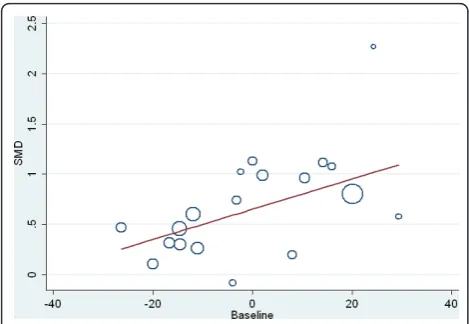
In order to assess whether baseline symptom severity moderated treatment effects, we undertook a random effects meta-regression to investigate the association of baseline (pre-intervention) values with ES, examining only those studies which employed the most commonly used outcome measure - the ECBI Intensity scale score.
Results
Study selection
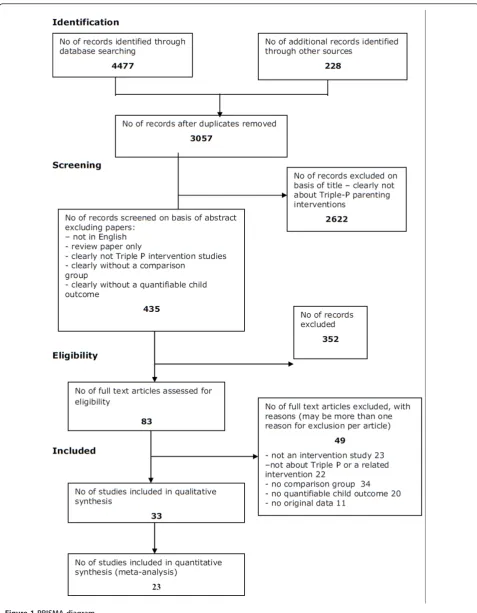
The selection process is illustrated in Figure 1.
Study characteristics
The main characteristics of the studies are presented in additional file 1. Most of the studies (26/33) used a waiting list control condition where treatment was offered immediately after the post-intervention assess-ment. This design precluded control group follow-up beyond the end of the intervention. Comparisons of
intervention and control groups beyond the duration of the intervention were only possible in five studies.
Risk of bias within studies
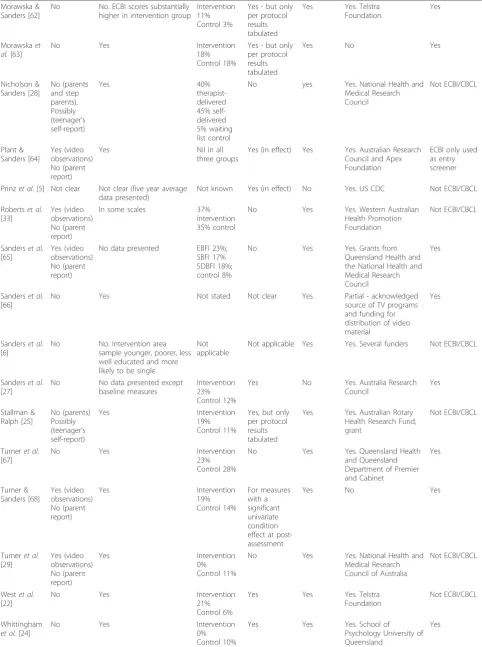
Data on the risk of bias of each study are presented in Table 1.
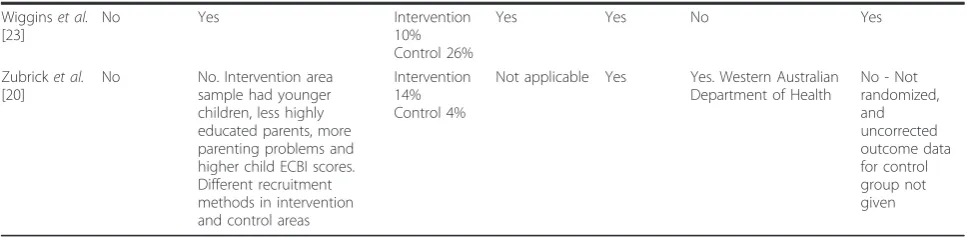
No studies were registered with national or interna-tional trials registries. All the studies apart from two [6,20] used individual or cluster [5,13,21,22] random assignment to the study group, but the mechanism of randomization was only reported in the minority of stu-dies. No papers reported a pre-specified principal out-come measure, and no power calculations based on specific outcome measures were reported. Four papers reported a power calculation based on a general ES [23-26]. All eligible papers appeared to be co-authored by a Triple-P affiliated author, apart from one [26], although it was difficult to establish affiliation in some cases. We were, therefore, not able to conduct sensitivity analyses in relation to authorship. Conflict of interest statements were found in two papers: one [13], where ‘no conflict’ was reported and another [27] where roy-alty payments to authors were mentioned.
There is substantial risk of outcome reporting bias. Between papers, there is inconsistent reporting of sub-scale results within the Strengths and Difficulties Ques-tionnaire, the ECBI, the Family Observation Schedule and the Developmental Behavior Checklist. In some papers all subscales are reported, in others selected sub-scales and in two, [25,28] no subsub-scales are reported. Such selective reporting might increase the likelihood of presentation of findings supporting a favored hypothesis and the omission of less favorable analyses. Before- and after- data from the intervention group were usually presented more prominently than between-group com-parisons, and this often obscured interpretation of group effects. In the 33 papers tabulated above, all except one [29] report at least one statistically signifi-cant positive child-based outcome for Triple P com-pared to the control condition in the Results sections, while 25/33 papers report at least one statistically non-significant result. Only 4/33 abstracts report any nega-tive findings, whereas 32/33 report posinega-tive findings so that abstracts tend to give a more favorable picture of the effects of Triple P interventions than are supported by the more detailed findings.
Risk of bias within studies - whole-population (’public health’) interventions
Table 1 Risk of bias in individual studies.
Paper Blinding of assessors?
Treatment and control groups similar at baseline?
Percentage drop out at post intervention measure? Analyzed by intention to treat Subgroup analyses reported?
Statement of study funding
Included in meta-analysis?
Bodenmann et al.[32]
No Yes Triple P 5%
CCET 8% Control 23% (at long term follow up)
No Yes Yes. Gebert Ruef
Foundation (Switzerland)
Yes
Connellet al. [50]
No More females in control group
Intervention 0% Control 8%
No Yes No Yes
Gallart & Matthey [26]
No Yes (not tabulated) Not stated (9% overall)
No Yes No Yes
Hahlweget al.[51]
No Yes Intervention
mothers 14% Control mothers 3% All fathers 19% (unable to distinguish intervention & control attrition)
No No Yes. Deutsche
Forschungsgemeinschaft Yes
Hahlweget al.[13] (data also reported in [52]) No (parents and teachers) Yes (observers)
More parents in control group were single in comparison to the intervention group: 34% and 15.6%, respectively. Baseline differences between groups for two-parent households
Intervention 0.5% Control 1%
Yes Yes Yes. Deutsche
Forschungsgemeinschaft Yes Hoath & Sanders [53] No (parents) Not known (teachers)
Control group had lower family income
Intervention 10% Control 0%
No No No Yes
Joachimet al. [54]
No Higher proportion of male children in control group
Intervention 15% Control 10%
Yes Yes No Yes
Leunget al. [55]
No Yes Intervention
28% Control 20%
Yes - but only per protocol results tabulated
No No Yes
Markie-Dadds & Sanders [56]
No Yes Intervention
3% Control 0%
No Yes No Yes
Markie-Dadds & Sanders [57]
No Yes Intervention
28% Control 23%
Yes - but only per protocol results tabulated
Yes Queensland Health and the National Health and Medical Research Council
Yes
Martin & Sanders [58]
No Treatment group had lower ECBI scores
Intervention 30% Control 50%
No Yes No Yes
Matsumoto et al.[59]
No Yes Intervention
0% Control 0%
Yes (in effect) No No Yes
Matsumoto et al.[60]
No No. ECBI scores substantially higher in intervention group
Not stated No No No Yes
McTaggart & Sanders [21]
No Yes Not known No Yes No Not ECBI/CBCL
Morawska & Sanders [61] No (parents) Yes (observers) Yes Intervention 12% Control 10%
Yes - but only per protocol results tabulated
Table 1 Risk of bias in individual studies.(Continued)
Morawska & Sanders [62]
No No. ECBI scores substantially higher in intervention group
Intervention 11% Control 3%
Yes - but only per protocol results tabulated
Yes Yes. Telstra Foundation.
Yes
Morawskaet al.[63]
No Yes Intervention
18% Control 18%
Yes - but only per protocol results tabulated
Yes No Yes
Nicholson & Sanders [28] No (parents and step parents), Possibly (teenager’s self-report) Yes 40% therapist-delivered 45% self-delivered 5% waiting list control
No yes Yes. National Health and Medical Research Council Not ECBI/CBCL Plant & Sanders [64] Yes (video observations) No (parent report)
Yes Nil in all
three groups
Yes (in effect) Yes Yes. Australian Research Council and Apex Foundation
ECBI only used as entry screener
Prinzet al.[5] Not clear Not clear (five year average data presented)
Not known Yes (in effect) No Yes. US CDC Not ECBI/CBCL
Robertset al. [33]
Yes (video observations) No (parent report)
In some scales 37% intervention 35% control
No Yes Yes. Western Australian Health Promotion Foundation
Not ECBI/CBCL
Sanderset al. [65]
Yes (video observations) No (parent report)
No data presented EBFI 23%; SBFI 17% SDBFI 18%; control 8%
No Yes Yes. Grants from
Queensland Health and the National Health and Medical Research Council
Yes
Sanderset al. [66]
No Yes Not stated Not clear Yes Partial - acknowledged
source of TV programs and funding for distribution of video material
Yes
Sanderset al. [6]
No No. Intervention area sample younger, poorer, less well educated and more likely to be single
Not applicable
Not applicable Yes Yes. Several funders Not ECBI/CBCL
Sanderset al. [27]
No No data presented except baseline measures
Intervention 23% Control 12%
Yes No Yes. Australia Research Council Yes Stallman & Ralph [25] No (parents) Possibly (teenager’s self-report)
Yes Intervention
19% Control 11%
Yes, but only per protocol results tabulated
Yes Yes. Australian Rotary Health Research Fund, grant
Not ECBI/CBCL
Turneret al. [67]
No Yes Intervention
23% Control 28%
No Yes Yes. Queensland Health and Queensland Department of Premier and Cabinet Yes Turner & Sanders [68] Yes (video observations) No (parent report) Yes Intervention 19% Control 14% For measures with a significant univariate condition effect at post-assessment
Yes No Yes
Turneret al. [29] Yes (video observations) No (parent report) Yes Intervention 0% Control 11%
No Yes Yes. National Health and Medical Research Council of Australia
Not ECBI/CBCL
Westet al. [22]
No Yes Intervention
21% Control 6%
Yes Yes Yes. Telstra
Foundation
Not ECBI/CBCL
Whittingham et al.[24]
No Yes Intervention
0% Control 10%
Yes Yes Yes. School of
Psychology University of Queensland
cluster randomized trials [31], making an accurate assess-ment of the implications of the paper difficult. Although it claimed to have achieved a reduction in the incidence of episodes of child maltreatment [5], it actually demon-strated an unexplained rise in reports in control areas rather than a drop in Triple P intervention sites. The description of the random allocation was poor, and the analysis was simplistic, being a two-sample t-test of county-wide measures. In particular, although some form of stratification or matching was used (it was not clear exactly how this had been done), there was no evidence that this had been accounted for in the analysis. For exam-ple, if counties were randomized within pairs, then the within-pair differences in the changes from baseline would have been of interest, but these were not reported. There-fore, although there are positive conclusions from this study, some doubt remains as to their validity.
There are two other whole-population Triple P eva-luations involving a comparison group. Sanderset al.[6] reported a quasi-experimental study in parts of Brisbane, Sydney and Melbourne. There were substantial baseline differences between intervention and control popula-tions. Approximately 3,000 parents were interviewed before and after the intervention, but different samples were used in each data collection and so it is not possi-ble to characterize changes in individuals over time. Results are reported only as proportion of children with ‘clinically elevated’scores rather than mean or median results. The positive child-based outcomes reported with this approach, from seven possible outcomes, were in the emotional and total problems domains of the Strengths and Difficulties Questionnaire, although neither finding would have attained conventional levels of statistical significance had allowance for multiple comparisons been made. We consider that this study offers relatively little support for any effect of triple P on children at the whole-population level.
Zubricket al.[20] reported a further quasi-experimen-tal study in two areas of Western Australia. There were
again substantial differences in the characteristics of intervention and control populations. Recruitment methods differed significantly between the two areas: in the intervention area parents volunteered for active par-ticipation whereas in the control area parents volun-teered to take part in a health services survey of child behavior. Analysis using hierarchical linear modelling suggests a short term improvement in ECBI externaliz-ing behavior scores but given the potential for con-founding by factors such as parental motivation it is difficult to confirm that this difference is attributable to the intervention.
Results of individual studies
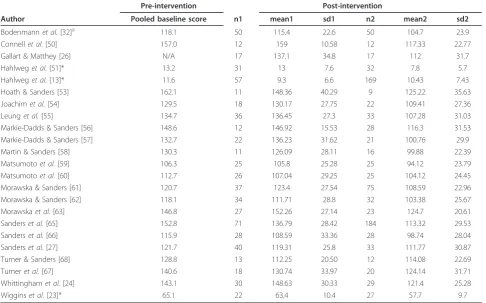
The 23 papers listed in Table 2 and associated data were used in the meta-analysis. These papers report the ran-domized trials in which the principal carer (usually the mother) of the index child returned ECBI or CBCL data before and after the intervention. Insufficient informa-tion is presented in most publicainforma-tions to allow use of intention-to-treat data, so non-imputed data for study completers only are used here.
Only two studies [29,32] compared a Triple-P inter-vention with an active comparison condition - a marital distress prevention program (Couples Coping Enhance-ment Training, n = 50 per group) [32] and standard dietary education (group n = 12 and 9) [29]. No signifi-cant differences between the active intervention groups in terms of maternal or paternal reports of child beha-vior were reported in either study.
The whole population studies were excluded from the meta-analysis on the grounds of non-randomized design or the nature of the reported outcome measures.
Synthesis of results
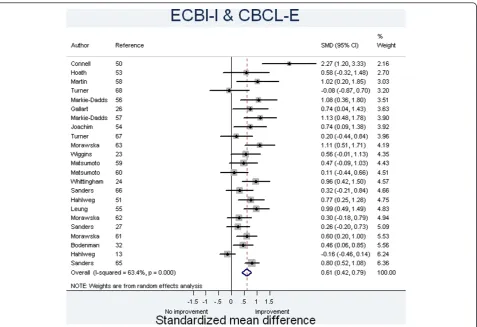
The forest plot (Hedges) depicting the included studies (maternal report ECBI-I or CBCL-E) is shown in Figure 2.
For the (generally) maternally-reported ECBI-I and CBCL-E, the summary ES was 0.61 (95%CI 0.42, 0.79)
Table 1 Risk of bias in individual studies.(Continued)
Wigginset al. [23]
No Yes Intervention
10% Control 26%
Yes Yes No Yes
Zubricket al. [20]
No No. Intervention area sample had younger children, less highly educated parents, more parenting problems and higher child ECBI scores. Different recruitment methods in intervention and control areas
Intervention 14% Control 4%
Not applicable Yes Yes. Western Australian Department of Health
No - Not randomized, and uncorrected outcome data for control group not given
under the definition of a random-effects model with Hedges correction. Thirteen of the studies showed a sig-nificant positive effect while ten did not, with most ESs falling in the range 0.3 to 1.0.
There is evidence of heterogeneity (chi-squared = 60.16 (d.f. = 22) P= 0.000), with the variation in SMD attributable to heterogeneity (I-squared) = 63.4%. This level of heterogeneity indicates that there are significant differences between the studies which cannot be explained by random variation.
Risk of bias across studies
Publication bias was assessed by the use of a funnel plot, which illustrates the relationship between sample size and ES. Publication bias is present when there is selective reporting of small studies with positive results. Larger studies are more likely to be published successfully regardless of ES. The results are shown in Figure 3.
Egger’s test (regression of the standard normal deviate of intervention effect estimate against its standard error) yielded limited evidence of small-study effects (P = 0.067), with an estimated bias coefficient of 1.98.
Additional analysis
Sensitivity analysis in relation to author affiliation was not possible because of the small number of articles published without Triple-P affiliated authorship.
The meta-regression comparing baseline severity scores with ES for those studies which employed the ECBI-I outcome is shown in Figure 4. Ninety four percent of the between-study variance is explained by the covariate mean baseline value, and a ten-point increase in baseline ECBI-I score is associated with a 0.15 increase in ES (95% CI: 0.005, 0.025). The mean baseline ECBI-I score was 132.7, and the ES for the studies included in this meta-regression was 0.65.
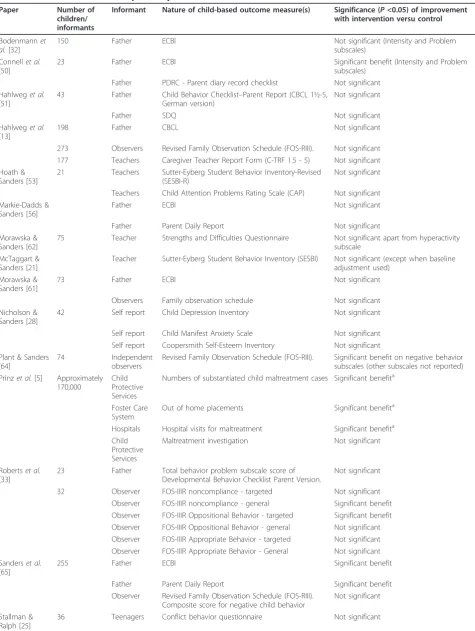
Summaries of child-based outcomes reported by infor-mants other than the principal (usually maternal) carer are reported in Table 3.
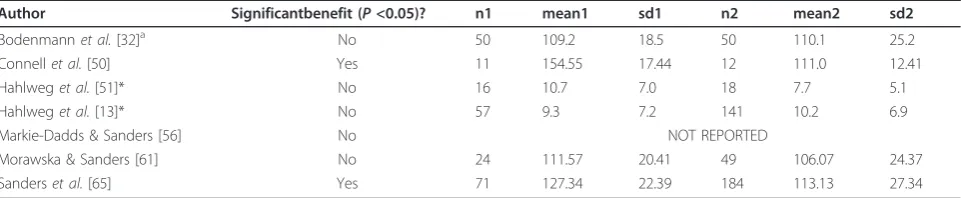
Independent observers reported benefit attributable to Triple P on at least one subscale of an observational measure in two of seven papers in which these data are reported. Teachers reported benefit in one subscale score in one of four papers with relevant data. Seven papers yielded data on paternally reported ECBI-I or CBCL-E. Summary data are reported in Table 4.
Table 2 Papers included in the meta-analysis.
Pre-intervention Post-intervention
Author Pooled baseline score n1 mean1 sd1 n2 mean2 sd2
Bodenmannet al.[32]a 118.1 50 115.4 22.6 50 104.7 23.9
Connellet al.[50] 157.0 12 159 10.58 12 117.33 22.77
Gallart & Matthey [26] N/A 17 137.1 34.8 17 112 31.7
Hahlweget al.[51]* 13.2 31 13 7.6 32 7.8 5.7
Hahlweget al.[13]* 11.6 57 9.3 6.6 169 10.43 7.43
Hoath & Sanders [53] 162.1 11 148.36 40.29 9 125.22 35.63
Joachimet al.[54] 129.5 18 130.17 27.75 22 109.41 27.36
Leunget al.[55] 134.7 36 136.45 27.3 33 107.28 31.03
Markie-Dadds & Sanders [56] 148.6 12 146.92 15.53 28 116.3 31.53
Markie-Dadds & Sanders [57] 132.7 22 136.23 31.62 21 100.76 29.9
Martin & Sanders [58] 130.3 11 126.09 28.11 16 99.88 22.39
Matsumotoet al.[59] 106.3 25 105.8 25.28 25 94.12 23.79
Matsumotoet al.[60] 112.7 26 107.04 29.25 25 104.12 24.45
Morawska & Sanders [61] 120.7 37 123.4 27.54 75 108.59 22.96
Morawska & Sanders [62] 118.1 34 111.71 28.8 32 103.38 25.67
Morawskaet al.[63] 146.8 27 152.26 27.14 23 124.7 20.61
Sanderset al.[65] 152.8 71 136.79 28.42 184 113.32 29.53
Sanderset al.[66] 115.9 28 108.59 33.36 28 98.74 28.04
Sanderset al.[27] 121.7 40 119.31 25.8 33 111.77 30.87
Turner & Sanders [68] 128.8 13 112.25 20.50 12 114.08 22.69
Turneret al.[67] 140.6 18 130.74 33.97 20 124.14 31.71
Whittinghamet al.[24] 143.1 30 148.63 30.33 29 121.4 25.28
Wigginset al.[23]* 65.1 22 63.4 10.4 27 57.7 9.7
There was strong evidence of heterogeneity (chi-squared = 29.72 (d.f. = 5)P< 0.001), with a variation in SMD attri-butable to heterogeneity (I-squared) of 83%. The summary
ES for the six studies for which data were presented was 0.42 (95%CI -0.02, 0.87) under the definition of a random-effects model. The remaining study reporting non-signifi-cant results could have influenced this estimate in either direction.
Discussion
There are a large number of published evaluations of Triple-P parenting interventions and we were able to identify 33 English-language studies which measured a child-based outcome and which compared Triple P inter-ventions with a comparison condition. Most of the studies involved families who responded to media advertisements. These families clearly have children whose parents are finding difficulties with their behavior but may well not be typical of such families in the population. They are more likely to be motivated and literate and are sufficiently con-fident to present for treatment as volunteers. These char-acteristics would be likely to lead to high levels of compliance with treatment and better than average treat-ment response. Only five studies [5,6,21,33,34] did not rely upon self-referral by potential participants. All the studies Figure 2Forest Plot (Hedges) of Standardized Mean Differences. Studies reporting data based on ECBI or CBCL questionnaires completed by mothers are presented in increasing order of weight to final estimate, based on sample size. CBCL, Child Behavior Checklist; ECBI, Eyberg Child Behavior Inventory.
involved only children over two years old. There are many forms of the Triple-P program [2], and new versions emerge regularly, but for simplicity we have not distin-guished between the levels of intervention. Nevertheless, most of the studies reported on the effectiveness of small group-based Triple-P interventions, usually level 4 or 5, and synthesis of results from other Triple P levels would be limited by low numbers.
Most of the studies were relatively small and the great majority used a waiting-list control design in which the participants on the waiting list were offered active treat-ment immediately after the post-intervention data collec-tion. It is, therefore, not possible to draw conclusions about the longer term effectiveness of Triple P relative to a comparison condition. Before- and after- data from the intervention group were usually presented more promi-nently (and frequently) than between-group comparisons, and this method of reporting often obscured interpreta-tion of group effects and tended to increase the impres-sion of a positive effect from the intervention. Only two trials used an active comparison group, and neither of these showed any advantage for Triple P in terms of child-based outcomes. Trials with waiting list controls or usual care provide intervention estimates which reflect the combined specific and non-specific effects that will accrue in practice, and are more likely to show between-group differences than trials with active controls [35].
A range of child-based outcome measures was used but the most commonly reported was the ECBI, completed by parents. In the majority of cases (31/33) the main infor-mant was the mother, and these data were synthesized in our main meta-analysis. Despite some differences in meth-odological approach, the ES obtained in our meta-analysis of maternally-reported ECBI scores (0.61) is impressive
and is broadly in line with that reported by other authors [9,11,12].
There is some evidence of publication bias from our analyses of the published work and there is additional evidence that results of a number of evaluations of Triple-P have not been published [30,36]. Further evalua-tion of publicaevalua-tion bias is not possible given the uniform lack of Triple-P trial registration. Thus, despite the apparent consistency of more recently published work, there is still the possibility that these studies represent a particularly favorable picture of Triple-P. The Interna-tional Committee of Medical Journal Editors (ICMJE) agreed in 2005 that only registered trials would be con-sidered for publication. Allowing for publication time lags, about one third of the studies in our meta-analysis pre-dated the guidance and two thirds could potentially have benefitted from adopting these recommendations.
There are considerable limitations in relying on mater-nal report data alone: 17 papers gave outcomes reported by informants other than mothers. Five of these studies showed a relative benefit for Triple P on one or more out-come measures compared with no treatment. Meta-analy-tic synthesis of paternally-reported data identified a pooled ES of 0.42 but there was significant heterogeneity and the overall effect size was not significantly greater than zero. Multiple outcomes were used in five of the six papers reporting significantly positive results: primary outcomes were not pre-specified (in common with all the reported trials), and corrections were not made for multiple com-parisons. Paternal reports are often difficult to assess because of missing data which may not be missing at ran-dom. The incorporation of independent direct observa-tions of parent and child behavior into trial design provides important confirmatory information [37,38], and seven of the Triple P trials (see Table 4) included data from independent observers. Two of these seven studies reported benefit in one or more observational subscale.
It is possible that the discrepancy between maternal and paternal (or independent) reports of child behavior may be accounted for by the fact that maternal mental state improved significantly with most Triple-P interventions [10] and this may have led to a more positive maternal evaluation of the child’s behavior, reflecting more optimis-tic states of mind. Fathers are less likely to attend sessions and independent observers are unconnected with the intervention. Related attribution effects have been reported in relation to Triple-P [39]. It is also possible that mothers are more accurate than fathers in reporting their children’s behavior difficulties. One paper [13] reported a planned subgroup analysis for lone parent families - and reported no benefit from the triple P intervention.
All of the papers considered here, with one exception [26] were authored or influenced by Triple-P affiliated personnel. This is commonly observed in the early stages Figure 4Bubble plot of standardized between-group mean
Table 3 Child based outcomes reported by informants other than the child’s mother.
Paper Number of children/ informants
Informant Nature of child-based outcome measure(s) Significance (P<0.05) of improvement with intervention versu control
Bodenmannet al.[32]
150 Father ECBI Not significant (Intensity and Problem
subscales) Connellet al.
[50]
23 Father ECBI Significant benefit (Intensity and Problem
subscales) Father PDRC - Parent diary record checklist Not significant Hahlweget al.
[51]
43 Father Child Behavior Checklist–Parent Report (CBCL 1½-5, German version)
Not significant
Father SDQ Not significant
Hahlweget al. [13]
198 Father CBCL Not significant
273 Observers Revised Family Observation Schedule (FOS-RIII). Not significant 177 Teachers Caregiver Teacher Report Form (C-TRF 1.5 - 5) Not significant Hoath &
Sanders [53]
21 Teachers Sutter-Eyberg Student Behavior Inventory-Revised (SESBI-R)
Not significant
Teachers Child Attention Problems Rating Scale (CAP) Not significant Markie-Dadds &
Sanders [56]
Father ECBI Not significant
Father Parent Daily Report Not significant
Morawska & Sanders [62]
75 Teacher Strengths and Difficulties Questionnaire Not significant apart from hyperactivity subscale
McTaggart & Sanders [21]
Teacher Sutter-Eyberg Student Behavior Inventory (SESBI) Not significant (except when baseline adjustment used)
Morawska & Sanders [61]
73 Father ECBI Not significant
Observers Family observation schedule Not significant Nicholson &
Sanders [28]
42 Self report Child Depression Inventory Not significant
Self report Child Manifest Anxiety Scale Not significant Self report Coopersmith Self-Esteem Inventory Not significant Plant & Sanders
[64]
74 Independent
observers
Revised Family Observation Schedule (FOS-RIII). Significant benefit on negative behavior subscales (other subscales not reported) Prinzet al.[5] Approximately
170,000
Child Protective Services
Numbers of substantiated child maltreatment cases Significant benefita
Foster Care System
Out of home placements Significant benefita
Hospitals Hospital visits for maltreatment Significant benefita
Child Protective Services
Maltreatment investigation Not significant
Robertset al. [33]
23 Father Total behavior problem subscale score of Developmental Behavior Checklist Parent Version.
Not significant
32 Observer FOS-IIIR noncompliance - targeted Not significant Observer FOS-IIIR noncompliance - general Significant benefit Observer FOS-IIIR Oppositional Behavior - targeted Significant benefit Observer FOS-IIIR Oppositional Behavior - general Not significant Observer FOS-IIIR Appropriate Behavior - targeted Not significant Observer FOS-IIIR Appropriate Behavior - General Not significant Sanderset al.
[65]
255 Father ECBI Significant benefit
Father Parent Daily Report Significant benefit Observer Revised Family Observation Schedule (FOS-RIII).
Composite score for negative child behavior
Not significant
Stallman & Ralph [25]
of development of non-pharmaceutical interventions but readers should interpret findings accordingly, particularly when authors may gain financially from the intervention under study. Although authors of Triple P interventions receive royalty payments from sales of training and mate-rials [27], only one of the articles we obtained declared any conflict of interest. Conflict of interest may be of par-ticular importance in interpreting studies (such as many of those reported here) in which subgroup analyses are reported [40]. Outcome reporting bias [41] may also be an important consideration in this respect, with possible significance for the interpretation of meta-analyses [42].
Claims that whole-population parenting programs have significant impact on public health are particularly important, because these may have led to substantial commitment of public funds. We were unable to find any convincing evidence of benefit from the Triple P program in the three whole-population studies eligible for inclusion in the present review.
Summary of evidence
Although a standard meta-analysis confirmed previous findings that mothers report improved child behavior after Triple-P interventions in comparison to a waiting list control condition, fathers and independent observers generally do not report improvements that are signifi-cantly different from those attributable to the control condition (Table 4). There is an absence of evidence of
sustained benefit from Triple P interventions compared to control conditions, and no evidence that Triple P is superior to any other active intervention.
Limitations
Given the highly specific nature of the literature search, and the multiple sources of data, we believe that we have retrieved almost all of the relevant literature. We did not synthesize papers in languages other than English. We were not able to retrieve some book chapters with titles indicating possible eligible studies, but we did not find any new data reported in the many chapters we were able to retrieve. We did not obtain potentially relevant data from studies which were conducted but not subsequently published [30,36].
Conclusions
The studies to date give proof-of-concept that group-based Triple-P may be effective in the short term accord-ing to maternal report of child behavior but, given the high risk of bias (or unknown risk of bias when reporting is poor), they do not support the view that Triple P pro-vides other benefits to children.
The lack of convincing evidence of benefit from whole-population interventions is in line with previous work in which no significant improvement in child-based out-comes resulted from a public health parenting program [43] and with a more recent large-scale independent
Table 3 Child based outcomes reported by informants other than the child?’?s mother.(Continued)
Turner & Sanders [68]
25 Independent
observers
Family Observation Schedule (disruptive behaviors) Not significant
Turneret al. [29]
21 Father Child behavior checklist Not significant
Observer Mealtime observation Not significant Observer Anthropometric measures Not significant
a
Method of analysis not clearly specified. Reported as two-sample t-tests comparing intervention and control counties, presumably of the differences between pre- and post-randomization outcome variables. However, a stratified randomization was used, so the within-pair differences in the change from baseline should be analyzed, though these are not reported. CBCL, Child Behavior Checklist; ECBI, Eyberg Child Behavior Inventory; SDQ, Strengths and Difficulties Questionnaire.
Table 4 Papers giving paternally-reported ECBI Intensity scores.
Author Significantbenefit (P<0.05)? n1 mean1 sd1 n2 mean2 sd2
Bodenmannet al.[32]a No 50 109.2 18.5 50 110.1 25.2
Connellet al.[50] Yes 11 154.55 17.44 12 111.0 12.41
Hahlweget al.[51]* No 16 10.7 7.0 18 7.7 5.1
Hahlweget al.[13]* No 57 9.3 7.2 141 10.2 6.9
Markie-Dadds & Sanders [56] No NOT REPORTED
Morawska & Sanders [61] No 24 111.57 20.41 49 106.07 24.37
Sanderset al.[65] Yes 71 127.34 22.39 184 113.13 27.34
a
evaluation of Triple P in Zurich which demonstrated no impact on child behavior [44]. Along with findings from a previous systematic review [12], the results of our meta-regression support the view that some benefit might be achieved if interventions were focussed on the families of children with more severe problems. A recent Cochrane review of parent training interventions for chil-dren with established conduct problems and those at high risk of conduct disorder [45] provides robust evi-dence of the effectiveness of such targeted programs. It is, therefore, likely that an effective case-finding approach combined with offers of interventions to families with identified problems may be more effective than the‘ pub-lic-health’approach.
Only one of the studies [26] included in our review had no apparent conflict of interest. We are aware of two further independent evaluations of Triple P which were ineligible for inclusion in our review - one published in German [46] and one recent large scale trial [44]. Both produced negative results. These findings mirror the fre-quently observed failure of independent replication of positive results from a range of developer-led studies. Theoretical models developed by Eisner [47], describing the mechanisms by which conflict of interest can lead to research bias, may help to explain this phenomenon.
Given the substantial cost implications, health care pro-viders and policymakers would be well advised to apply the same standard of evidence when purchasing behavioral interventions as they do to the purchase of pharmaceutical agents or medical devices. Compulsory clinical trial regis-tration and full and open declaration of conflicts of inter-est would address many of the deficits noted in our review. Pending the implementation of such mechanisms, unproven interventions should only be carried out in the context of a robust independent evaluation.
Developers and evaluators of psychological interven-tions should be encouraged to adhere to the guidelines dealing with good publication practice for communicat-ing company sponsored medical research (GPP2 [48]). Journal editors and reviewers should be encouraged to adhere to CONSORT guidelines for both text and abstracts [49]: we believe that authors who choose jour-nals that do not adhere to these guidelines, and editors who choose not to adopt them, do the field, as well as their own work, a disservice. There should be a clear expectation that instrument subscales should be reported in full and covered even-handedly in article abstracts. Care providers and policy makers should assess the gen-eralizability of findings from socially advantaged and volunteer samples to their own situation. There is a need for registered, large, multicenter trials, with prospectively defined, long-term outcomes and active comparison groups rather than further evaluations using waiting list control groups. Rigorous systematic reviews of parenting
interventions (for example [45]) attest to the importance of including data from independent observers in trials and in reviews, both in order to reduce risk of bias and to provide more convincing data on the effects of parenting interventions. Whole-population data on child behavior, reported by multiple informants, and linked to provision of parenting interventions, may be an alternative approach to the evaluation of public health parenting programs.
Funding
The study was unfunded, apart from a contribution made by the Gillberg Neuropsychiatry Centre to pay for statis-tical analysis. The funder played no part in the study design, analysis or interpretation of the data except inso-far as one of the authors (CG) is employed within the Gillberg Neuropsychiatry Centre at the Sahlgrenska Academy, University of Gothenburg.
Additional material
Additional file 1: Main characteristics of the included studies. Tabulation, for all eligible studies [5,6,13,20-29,32,33,50,51,53-69], of numbers and characteristics of patients or families included, whether problems were likely to be in the clinical range, inter-group comparisons made, nature of the control group, length of follow-up and nature of informants.
Abbreviations
CBCL: Child Behavior Checklist; CONSORT: Consolidated Standards of Reporting Trials; ECBI-I: Eyberg Child Behavior Inventory - Intensity scale; ES: effect size; PRISMA: Preferred Reporting Items for Systematic Reviews and Meta-Analysis; RCT: randomized controlled trial; SMD: standardized mean difference; Triple P: Positive Parenting Program.
Acknowledgements
We wish to thank Irene O’Neill for administrative support. Professor Manuel Eisner kindly provided information on conflicts of interest.
Author details
1Centre for Rural Health, University of Aberdeen, Centre for Health Sciences,
Old Perth Rd, Inverness IV2 3JH, Scotland.2Department of Health Sciences, Queen Margaret University, Queen Margaret University Drive, Musselburgh EH21 6UU, Scotland.3Cromarty Medical Practice, Allan Square, Cromarty, Ross-shire IV11 8YF, Scotland.4Institute of Health and Wellbeing, University
of Glasgow, Caledonia House, Royal Hospital for Sick Children, Dalnair St, Yorkhill, Glasgow G3 8SJ, Scotland.5Robertson Centre for Biostatistics,
University of Glasgow, Boyd Orr Building, University Avenue, Glasgow G12 8QQ, Scotland.
Authors’contributions
PW, CP, PD, FS, SH and CG reviewed the published papers, RR performed the statistical analyses and AMcC provided statistical support to the authors. PW is guarantor of this paper. All authors contributed to the drafting of the article and approved the final submission.
Competing interests
author of the Mellow Parenting program, which is owned by a charity, and she is employed as a trainer for this program. Other authors report no conflicts of interest.
Received: 14 June 2012 Accepted: 2 November 2012 Published: 2 November 2012
References
1. Barlow J, Parsons J, Stewart-Brown S:Systematic review of the effectiveness of parenting programmes in the primary and secondary prevention of mental health problemsHealth Services Research Unit, University of Oxford; 2002. 2. Sanders MR, Markie-Dadds C, Turner K:Theoretical, Scientific and Clinical
Foundations of the Triple-P - Positive Parenting Program: A Population Approach to the Promotion of Parenting CompetenceBrisbane: Australian Academic Press; 2003, 1-21, Parenting Research and Practice Monographs. 3. Sanders MR, Murphy-Brennan M:Creating conditions for success beyond
the professional training environment.Clin Psychol: Sci Pract2010, 17:31-35.
4. Sanders MR, Kirby JN:Parental programs for preventing behavioral and emotional problems in children.InOxford Guide to Low Intensity CBT Interventions.Edited by: Bennet-Levy J, Richards D, Farrand P, Christensen H, Griffiths K, Kavanagh D, Klein B, Lau M, Proudfoot J, Ritterband L, White J, Williams C. New York, NY. Oxford University Press; 2010:399-406.
5. Prinz RJ, Sanders MR, Shapiro CJ, Whitaker DJ, Lutzker JR:Population-based prevention of child maltreatment: the U.S. Triple p system population trial.Prev Sci2009,10:1-12.
6. Sanders MR, Ralph A, Sofronoff K, Gardiner P, Thompson R, Dwyer S, Bidwell K:Every family: a population approach to reducing behavioral and emotional problems in children making the transition to school.
J Prim Prev2008,29:197-222.
7. Dean C, Myors K, Evans E:Community-wide implementation of a parenting program: The South East Sydney Positive Parenting Project.
AeJAMH (Australian e-Journal for the Advancement of Mental Health)2003, 2:2003.
8. NICE. Conduct disorder in children - parent-training/education programmes. National Institute for Clinical Excellence; 2006 [http://www. nice.org.uk/TA102].
9. Nowak C, Heinrichs N:A comprehensive meta-analysis of Triple P-Positive Parenting Program using hierarchical linear modeling: effectiveness and moderating variables.Clin Child Fam Psychol Rev2008,11:114-144. 10. de Graaf I, Speetjens P, Smit F, de Wolff M, Tavecchio L:Effectiveness of
the Triple P Positive Parenting Program on parenting: a meta-analysis.
Fam Relat2008,57:553-566.
11. Thomas R, Zimmer-Gembeck MJ:Behavioral outcomes of parent-child interaction therapy and Triple P-Positive Parenting Program: a review and meta-analysis.J Abnorm Child Psychol2007,35:475-495.
12. de Graaf I, Speetjens P, Smit F, de Wolff M, Tavecchio L:Effectiveness of the Triple P Positive Parenting Program on behavioral problems in children: a meta-analysis.Behav Modif2008,32:714-735.
13. Hahlweg K, Heinrichs N, Kuschel A, Bertram H, Naumann S:Long-term outcome of a randomized controlled universal prevention trial through a positive parenting program: is it worth the effort?Child Adolesc Psychiatry Ment Health2010,4:14.
14. Liberati A, Altman DG, Tetzlaff J, Mulrow C, Götzsche PC, Ioannidis JPA, Clarke M, Devereaux P J, Kleijnen J, Moher D:The PRISMA statement for reporting systematic reviews and meta-analyses of studies that evaluate healthcare interventions: explanation and elaboration.BMJ2009,339: b2700, doi: 10.1136/bmj.b2700.
15. Parenting and Family Support Centre Triple-P database. University of Queensland;[http://www.pfsc.uq.edu.au/publications/].
16. de Graaf I, Speetjens P, Smit F, de Wolff M, Tavecchio L:Effectiveness of the Triple P Positive Parenting Program on parenting: A meta-analysis.
Fam Relat2008,57:553-566.
17. Eyberg S, Ross AW:Assessment of child behaviour problems: the validation of a new inventory.J Clin Child Psychol1978,7:113-116. 18. Achenbach T, Edelbrock C:Manual for the Child Behavior Checklist and
Revised Child Behavior ProfileBurlington: University of Vermont; 1983. 19. Scottish Intercollegiate Guideline Network checklists.[http://www.sign.ac.
uk/methodology/checklists.html].
20. Zubrick SR, Ward KA, Silburn SR, Lawrence D, Williams AA, Blair E, Robertson D, Sanders MR:Prevention of child behavior problems through
universal implementation of a group behavioral family intervention.Prev Sci2005,6:287-304.
21. McTaggart P, Sanders MR:The Transition to School Project: Results from the classroom.Australian e-Journal for the Advancement of Mental Health 2003,2:1-12.
22. West F, Sanders MR, Cleghorn GJ, Davies PSW:Randomised clinical trial of a family-based lifestyle intervention for childhood obesity involving parents as the exclusive agents of change.Behav Res Ther2010, 48:1170-1179.
23. Wiggins TL, Sofronoff K, Sanders MR:Pathways triple P-positive parenting program: effects on parent-child relationships and child behavior problems.Fam Process2009,48:17-530.
24. Whittingham K, Sofronoff K, Sheffield J, Sanders MR:Stepping Stones Triple P: an RCT of a parenting program with parents of a child diagnosed with an Autism Spectrum Disorder.J Abnorm Child Psychol2009, 37:469-480.
25. Stallman HM, Ralph A:Reducing risk factors for adolescent behavioural and emotional problems: a pilot randomised controlled trial of a self-administered parenting intervention.Australian e-Journal for the Advancement of Mental Health2007,6:1-13.
26. Gallart SC, Matthey S:The effectiveness of Group Triple P and the impact of the four telephone contacts.Behav Change2005,22:71-80.
27. Sanders MR, Stallman HM, McHale M:Workplace Triple P: a controlled evaluation of a parenting intervention for working parents.J Fam Psychol 2011,25:581-590.
28. Nicholson JM, Sanders MR:Randomized controlled trial of behavioral family intervention for the treatment of child behavior problems in stepfamilies.J Divorce Remarriage1999,30:1-23.
29. Turner KMT, Sanders MR, Wall CR:Behavioural parent training versus dietary education in the treatment of children with persistent feeding difficulties.Behav Change1994,11:242-258.
30. Prinz RJ, Sanders MR:Adopting a population-level approach to parenting and family support interventions.Clin Psychol Rev2007,27:739-749. 31. Campbell MK, Elbourne DR, Altman DG:CONSORT statement: extension to
cluster randomised trials.BMJ2004,328:702-708.
32. Bodenmann G, Cina A, Ledermann T, Sanders MR:The efficacy of the Triple P-Positive Parenting Program in improving parenting and child behavior: a comparison with two other treatment conditions.Behav Res Ther2008,46:411-427.
33. Roberts C, Mazzucchelli T, Studman L, Sanders MR:Behavioral family intervention for children with developmental disabilities and behavioral problems.J Clin Child Adolesc Psychol2006,35:180-193.
34. Turner KMT, Sanders MR, Wall CR:Behavioural parent training versus dietary education in the treatment of children with persistent feeding difficulties.Behav Change1994,11:242-258.
35. Foster N, Little P:Methodological issues in pragmatic trials of complex interventions in primary care.Br J Gen Pract2012,62:10-11.
36. Ross MK, de Caestecker L:The Starting Well Health Demonstration Project: the best possible start in life?Int J Ment Health Promot2009,5:5-12. 37. Hutchings J, Gardner F, Bywater T, Daley D, Whitaker C, Jones K, Eames C,
Edwards RT:Parenting intervention in Sure Start services for children at risk of developing conduct disorder: pragmatic randomised controlled trial.BMJ2007,334:678-685.
38. Gardner F, Burton J, Klimes I:Randomised controlled trial of a parenting intervention in the voluntary sector for reducing child conduct problems: outcomes and mechanisms of change.J Child Psychol Psychiatry2006,47:1123-1132.
39. Whittingham K, Sofronoff K, Sheffield J, Sanders MR:Do parental attributions affect treatment outcome in a parenting program? An exploration of the effects of parental attributions in an RCT of Stepping Stones Triple P for the ASD population.Res Autism Spectr Disord2009,3:129-144.
40. Sun X, Briel M, Busse JW, You JJ, Akl EA, Mejza F, Bala MM, Bassler D, Mertz D, Diaz-Granados N, Vandvik PO, Malaga G, Srinathan SK, Dahm P, Johnston BC, Alonso-Coello P, Hassouneh B, Truong J, Dattani ND, Walter SD, Heels-Ansdell D, Bhatnagar N, Altman D G, Guyatt GH:The influence of study characteristics on reporting of subgroup analyses in randomised controlled trials: systematic review.BMJ2011,342:d1569, doi: 10.1136/bmj.d1569.
42. Roseman M, Milette K, Bero LA, Coyne JC, Lexchin J, Turner EH, Thombs BD: Reporting of conflicts of interest in meta-analyses of trials of
pharmacological treatments.JAMA2011,305:1008-1017.
43. Hiscock H, Bayer JK, Price A, Ukoumunne OC, Rogers S, Wake M:Universal parenting programme to prevent early childhood behavioural problems: cluster randomised trial.BMJ2008,336:318-321.
44. Malti T, Ribeaud D, Eisner M:The effectiveness of two universal preventive interventions in reducing children’s externalizing behavior: a cluster randomized controlled trial.J Clin Child Adolesc Psychol2011, 40:677-692.
45. Furlong M, McGilloway S, Bywater T, Hutchings J, Smith S, Donnelly M: Behavioural and cognitive-behavioural group-based parenting programmes for early-onset conduct problems in children aged 3 to 12 years. Issue 2. Art. No.: CD008225. DOI: 10.1002/14651858.CD008225. pub2.Cochrane Database Syst Rev2012,2:CD008225.
46. Eisner M, Ribeaud D, Jünger R, Meidert U:Frühprävention von Gewalt und Aggression; Ergebnisse des Zürcher Interventions- und Präventionsprojektes an Schulen.Zürich: Rüegger; 2007.
47. Eisner M:No effects in independent prevention trials: can we reject the cynical view?J Exp Criminol2009,1:163-183.
48. Graf C, Battisti WP, Bridges D, Bruce-Winkler V, Conaty JM, Ellison JM, Field EA, Gurr JA, Marx ME, Patel M, Sanes-Miller C, Yarker YE:Good publication practice for communicating company sponsored medical research: the GPP2 guidelines.BMJ2009,339:b4330, doi: 10.1136/bmj. b4330.
49. Hopewell S, Ravaud P, Baron G, Boutron I:Effect of editors’
implementation of CONSORT guidelines on the reporting of abstracts in high impact medical journals: interrupted time series analysis.BMJ2012, 344:e4178, doi: 10.1136/bmj.e4178.
50. Connell S, Sanders MR, Markie-Dadds C:Self-directed behavioral family intervention for parents of oppositional children in rural and remote areas.Behav Modif1997,21:379-408.
51. Hahlweg K, Heinrichs N, Kuschel A, Feldmann M:Therapist-assisted, self-administered bibliotherapy to enhance parental competence: short- and long-term effects.Behav Modif2008,32:659-681.
52. Kuschel A, Heinrichs N, Hahlweg K:Is a preventive parenting program effective in reducing a child’s externalizing behavior?Eur J Dev Sci2009, 3:299-303.
53. Hoath FE, Sanders M:A feasibility study of enhanced group Triple P -Positive Parenting Program for parents of children with attention-deficit/ hyperactivity disorder.Behav Change2002,19:191-206.
54. Joachim S, Sanders MR, Turner KMT:Reducing preschoolers’disruptive behaviour in public with a brief parent discussion group.Child Psychiatry Hum Dev2010,41:47-60.
55. Leung C, Sanders MR, Leung S, Mak R, Lau J:An outcome evaluation of the implementation of the Triple P-Positive Parenting Program in Hong Kong.Fam Proc2003,42:531-544.
56. Markie-Dadds C, Sanders M:A controlled evaluation of an enhanced self-directed behavioural family intervention for parents of children with conduct problems in rural and remote areas.Behav Change2006, 23:55-72.
57. Markie-Dadds C, Sanders M:Self-directed Triple P (Positive Parenting Program) for mothers with children at-risk of developing conduct problems.Behav Cogn Psychother2006,34:259-275.
58. Martin AJ, Sanders MR:Balancing work and family: a controlled evaluation of the Triple P-Positive Parenting Program as a work-site intervention.Child Adolesc Ment Health2003,8:161-169.
59. Matsumoto Y, Sofronoff K, Sanders M:The efficacy and acceptability of the Triple P-Positive Parenting Program with Japanese parents.Behav Change2007,24:205-218.
60. Matsumoto Y, Sofronoff K, Sanders MR:Investigation of the effectiveness and social validity of the Triple P Positive Parenting Program in Japanese society.J Fam Psychol2010,24:87-91.
61. Morawska A, Sanders MR:Self-administered behavioral family
intervention for parents of toddlers: Part I. Efficacy.J Consult Clin Psychol 2006,74:10-19.
62. Morawska A, Sanders M:An evaluation of a behavioural parenting intervention for parents of gifted children.Behav Res Ther2009, 47:463-470.
63. Morawska A, Haslam D, Milne D, Sanders MR:Evaluation of a brief parenting discussion group for parents of young children.J Dev Behav Pediatr2011,2:136-145.
64. Plant KM, Sanders MR:Reducing problem behavior during care-giving in families of preschool-aged children with developmental disabilities.Res Dev Disabil2007,28:362-385.
65. Sanders MR, Markie-Dadds C, Tully LA, Bor W:The triple P-positive parenting program: a comparison of enhanced, standard, and self-directed behavioral family intervention for parents of children with early onset conduct problems.J Consult Clin Psychol2000,68:624-640. 66. Sanders MR, Montgomery DT, Brechman-Toussaint ML:The mass media
and the prevention of child behavior problems: the evaluation of a television series to promote positive outcomes for parents and their children.J Child Psychol Psychiatry2000,41:939-948.
67. Turner KM, Richards M, Sanders MR:Randomised clinical trial of a group parent education programme for Australian indigenous families.
J Paediatr Child Health2007,43:429-437.
68. Turner KM, Sanders MR:Help when it’s needed first: a controlled evaluation of brief, preventive behavioral family intervention in a primary care setting.Behav Ther2006,37:131-142.
69. Bor W, Sanders MR, Markie-Dadds C:The effects of the Triple P-Positive Parenting Program on preschool children with co-occurring disruptive behavior and attentional/hyperactive difficulties.J Abnorm Child Psychol 2002,30:571-587.
Pre-publication history
The pre-publication history for this paper can be accessed here: http://www.biomedcentral.com/1741-7015/10/130/prepub
doi:10.1186/1741-7015-10-130
Cite this article as:Wilsonet al.:How evidence-based is an‘ evidence-based parenting program’? A PRISMA systematic review and meta-analysis of Triple P.BMC Medicine201210:130.
Submit your next manuscript to BioMed Central and take full advantage of:
• Convenient online submission
• Thorough peer review
• No space constraints or color figure charges
• Immediate publication on acceptance
• Inclusion in PubMed, CAS, Scopus and Google Scholar
• Research which is freely available for redistribution Submit your manuscript at