www.ijper.org
Present Status of Pharmacy Education and Practice in
Angola: Trends and Challenges
Alina de las Mercedes Martínez Sánchez
Escuela Universitaria de Enfermería y Fisioterapia de Toledo Universidad de Castilla La Mancha,Toledo, ESPAÑA.
ABSTRACT
Pharmacy education in Angola, the second largest sub-Saharan country after the Demo-cratic Republic of Congo, has undergone some changes since the first pharmacy school was established in 2001. Currently, to practice as a pharmacist, one needs a pharmacy degree. This university degree is awarded after 5 years of pharmacy studies offered only at 7 Pharmacy Schools located mainly in the capital city. This article describes the Angolan pharmacy education framework, including criteria for admission, the type and training length and an overview of the cur ricula; and outlines the system of pharmacy schools. The pharmacy practice, continuing education and development barriers, and latest directions in phar macy education are also discussed.
Key words: Angola, Curriculum, Pharmacy Education, Pharmacy practice, University.
DOI: 10.5530/ijper.50.4.6 Correspondence: Alina M. Sánchez
Campus Tecnológico Antigua Fábrica de Armas, Avda. Carlos III, s/n., 45071 Toledo, ESPAÑA
Telf: 925 26 88 00 Fax: 925 26 88 11
E-mail: alimarti2014@gmail. com
INTRODUCTION
In Angola, to practice as a pharmacist, one needs a pharmacy degree. This university degree is awarded after 5 years of pharmacy studies offered only at 7 Pharmacy Schools located mainly in the capital city. There are three types of higher education institutions in Angola: Academies, Universities and Polytechnics. The last ones usually comprise the Pharmacy Schools.
In recent years, higher education has grown
significantly in Angola: in 1979, there were 1,000 students, in 2002, after the war, there were 40,000 students, and in 2014, there were 40,095 registered students. Furthermore, there
used to be only one public university. Now
there are 26 public and 45 private universities.1,2 Pharmacy education in Angola, the second largest sub-Saharan country after the Demo-cratic Republic of Congo with a population
of 24,383 301 inhabitants,3 has undergone
some changes since the first pharmacy school was established in 2001.
Since the Angolan economy has experienced a tremendous growth in the last few years
Submission Date : 04-01-2016
Revision Date : 29-02-2016
Accepted Date : 27-03-2016
with exports of crude oil, diamonds, and petroleum products to mainly China, the United States of America and India, due to the fast economic progression of the pharma-ceutical sector, there has been an increasing
need for qualified pharmacy personnel. Newly
established pharmacy schools and degree programs have provided increasing oppor-tunities for students attempting to pursue a career in pharmacy. This article describes the Angolan pharmacy education framework, including criteria for admission, the type and training length and an overview of the cur-ricula; and outlines the system of pharmacy schools. The pharmacy practice, continuing education and development barriers, and latest directions in pharmacy education are also discussed.
Pharmacy education framework
From the historical point of view, the need
for skilled pharmacists in Angola comes soon after proclamation of national
existed in this specialty and the lack of Pharmacy Schools. Many young people with scholarships were sent abroad (Cuba, Congo, USSR, Brazil and Portugal) for a complete approved training.
Consistent with the International Pharmaceutical Feder
-ation (FIP) Educ-ation Initiative’s 2013 global educ-ation
report,3Africa has the fewest pharmacists per capita in
the world. According to the 2012 National Directorate of Medicines and Equipment (Direção Nacional de Medicamentos e Equipamentos) pharmacists (919) are
fewer in number compared with doctors and nurses in
2004 (2 18 435 nurses and 1 168 physicians),4 but this
number is higher than Guinea Bissau5 and Mozambique,6
(13 and 200, respectively). In the last ten years, 6 universi
ties have opened a BPharm program, bringing the total
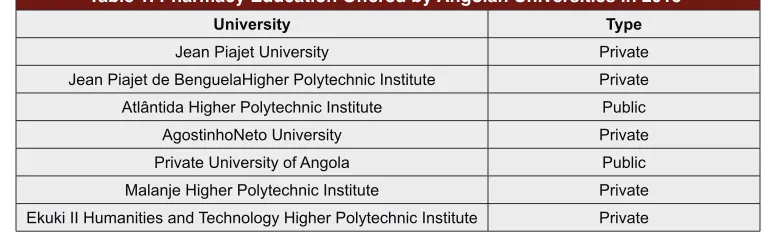
number of BPharm programs to 7 in 2015.2 Table 1 lists all Angolan universities currently offering the the BPharm program. Pharmacy schools are regulated by
the Ministry of Higher Education. Most pharmacy
schools are public-funded however, the number that is
privately funded has significantly increased.
The professional pharmacist profile in Angola, could
be seen through the Angolan Private Higher School of Pharmacy, which according to pharmacists is consid-ered a generalist professional with a humanist, critical
and reflective training to act in all health care levels, with scientific and intellectual rigor.7
According to 2013 data, the expected annual number of graduates was about 24 with a BPharm degree which is
higher than Cape Verde,8 (4 graduates in the same year).
In Angola, 381 students were registered in Pharmacy Courses in 2014.2 As developing this work, no university offers a postgraduate pharmacy program. Regarding the continuation of pharmacy education, student migration to Portugal remains a reality today. Currently, there is the increasing tendency of studying in Brazil, under exchange programs and agreements between the two countries.9
Conditions for admission in Pharmacy Schools
The increasing of higher education access in Angola
started by the end of the civil war (in 2002) along with the
increasing in budgetary allocation for higher education. The expansion of higher education to the different provinces of the country, has contributed to the access to this level of education of a growing number of young
people. In the years from 1977 to 2002, the number of higher education students increased from 1,109 to 12,566, at an average annual rate of 10.2%.10
In Angola, to be eligible to enter any University program,
applicants must pass a series of examinations. For
example, an individual who successfully completed high
school cannot enroll as an undergraduate in the Faculty
of Pharmacy without passing admission exams. The competitive examination is based on questions about different topics: social, biological sciences, and health sciences. Applicants must submit original high or
preuniversity school certifications with itemized bills,
Identity Card and Service statement; the last one only
for applicant workers. Besides, the certificate of military
situation regularized for candidates within the military age and three passport size photographs must be submitted.
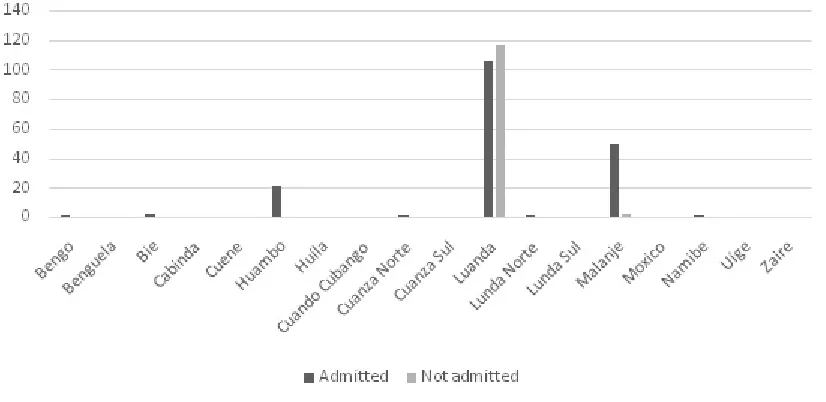
A fee must be paid as well. Figure 1 describes the admis
-sion of students to the pharmacy courses in 2014. Of the total amount of 339 admitted students, 223 were
from the capital city, which has the largest number of
pharmacy schools.2
Summarizing, access and quality have been identified
as the two main problems of the education system in
Angola.11 As said by Baptista12 each higher education
institution has its own format of university admission tests, it is necessary to take into account the quality of the student who access the university. The admission exam formats should be an agreement between both, education and higher education ministries and those who enter higher education are those who graduate high school or technical high school.
Table 1. Pharmacy Education Offered by Angolan Universities in 2015a
University Type
Jean Piajet University Private
Jean Piajet de BenguelaHigher Polytechnic Institute Private
Atlântida Higher Polytechnic Institute Public
AgostinhoNeto University Private
Private University of Angola Public
Malanje Higher Polytechnic Institute Private
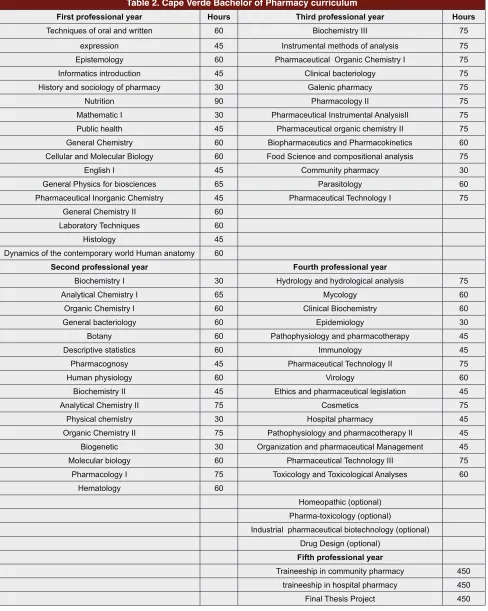
Table 2. Cape Verde Bachelor of Pharmacy curriculum
First professional year Hours Third professional year Hours
Techniques of oral and written 60 Biochemistry III 75
expression 45 Instrumental methods of analysis 75
Epistemology 60 Pharmaceutical Organic Chemistry I 75
Informatics introduction 45 Clinical bacteriology 75
History and sociology of pharmacy 30 Galenic pharmacy 75
Nutrition 90 Pharmacology II 75
Mathematic I 30 Pharmaceutical Instrumental AnalysisII 75
Public health 45 Pharmaceutical organic chemistry II 75
General Chemistry 60 Biopharmaceutics and Pharmacokinetics 60
Cellular and Molecular Biology 60 Food Science and compositional analysis 75
English I 45 Community pharmacy 30
General Physics for biosciences 65 Parasitology 60
Pharmaceutical Inorganic Chemistry 45 Pharmaceutical Technology I 75
General Chemistry II 60
Laboratory Techniques 60
Histology 45
Dynamics of the contemporary world Human anatomy 60
Second professional year Fourth professional year
Biochemistry I 30 Hydrology and hydrological analysis 75
Analytical Chemistry I 65 Mycology 60
Organic Chemistry I 60 Clinical Biochemistry 60
General bacteriology 60 Epidemiology 30
Botany 60 Pathophysiology and pharmacotherapy 45
Descriptive statistics 60 Immunology 45
Pharmacognosy 45 Pharmaceutical Technology II 75
Human physiology 60 Virology 60
Biochemistry II 45 Ethics and pharmaceutical legislation 45
Analytical Chemistry II 75 Cosmetics 75
Physical chemistry 30 Hospital pharmacy 45
Organic Chemistry II 75 Pathophysiology and pharmacotherapy II 45
Biogenetic 30 Organization and pharmaceutical Management 45
Molecular biology 60 Pharmaceutical Technology III 75
Pharmacology I 75 Toxicology and Toxicological Analyses 60
Hematology 60
Homeopathic (optional) Pharma-toxicology (optional)
Industrial pharmaceutical biotechnology (optional) Drug Design (optional)
Fifth professional year
Traineeship in community pharmacy 450
traineeship in hospital pharmacy 450
Figure 1: Admission of Students to 2014 pharmacy courses on the different provinces of Angola.
Figure 2: An overview of the BPharm Curriculum in Angola.
Curriculum in Angolan Pharmacy Programs
The emergence of various Pharmacy Schools has condi-tioned the rise of several teaching programs, so the
establishment of Guidelines for Pharmacy Education
is imperative for Angola. An approach to the pharmacy curriculum could be submitted through the Project
designed by Londa et al.6 for the creation of the School
of Pharmacy at Agostinho Neto University. The five
year pharmacy course incorporates both theory and practice modules. Students are required to complete a
unique placement in a professional setting for successful
completion of the course. Each scholar year is divided
into two semesters, each semester consisting of seventeen weeks. Besides, all students are required to do a research project, write a dissertation, and present their work to
a scientific committee in order to graduate (Figure 2).
the basic sciences, such as chemistry, biology, physics, and mathematics, is required for education at the college of pharmacy and for research.
Unlike Angola, other Portuguese-speaking countries
such as Cape Verde13 show a pharmacy curriculum
designed to strengthen pharmacy training in skills and knowledge and orient it toward clinical practice. In addi-tion, its information concerning pharmacy education and teaching programs have greater visibility on the network. Chemical, physic, natural and environmental
sciences, scientific law, pharmacy practice, mathematics,
health sciences are included in the Cape Verdean phar-macy curriculum. It also ensures a knowledge of the philosophy, communication sciences, and sociology that underlie pharmacy and an understanding of the relevance
of that knowledge to patient care. Table 2 lists courses
taught in the Cape Verde Bachelor of Pharmacy curriculum.
Education Quality Assurance
In accordance with the research conducted by Isaac14
the development of self-evaluation in the Angolan higher education institutions is in its initial structuring
phase. Certain autonomy to define their evaluation stage according to their organizational specificities, as long as
that competence should be exercised without excluding the reference patterns of the national, regional and international system of evaluation. Likewise,
Nasci-mento,15 also acknowledged that the higher education
development in Angola was not followed by appropri-ated measures to ensure the quality of the courses and programs offered by these institutions. As expected, this reality characterizes the Angolan pharmacy education. Now-a-days, an absence of Angolan universities among
the best in Africa is reported.16
In Angola, there are no Accreditation Standards and
Guidelines for Pharmacy Education. Pharmacy education
in Angola currently prepares pharmacy students for roles in pharmacovigilance, clinical pharmacy, hospital pharmacy, pharmacoepidemiology, clinical research and public
health, herbal medicine and pharmaceutical industry.17
In 2013 is officially established the National Association of Pharmacists (Ordem dos Farmacêuticos de Angola),
which has among its obligations organize internships, research, postgraduate courses, improvement and recy-cling as well as to promote or participate in conferences, seminars, and other activities, contributing to updating the knowledge of professionals on topics relate to
phar-macy practice and other areas of health.18 Creating
qual-ity standards in pharmacy education it was considered among the obligations of this organization according
to FIP, the educational development should progress
through an action plan that first seeks to “identify local
needs, the pharmacy services needed to meet these needs, the competences needed to provide these pharmacy services and the education required to achieve/ensure
these competences”.19 FIP’s Pharmacy Education Action
Plan is oriented toward identifying locally determined pharmacy service needs and then facilitating compre-hensive educational development and competency achievements to meet those local needs.
Future directions of pharmacy education
The continuing growth of Africa’s pharmaceutical
industry, shortages in the number of trained pharma-cists, growth access of patients to medicines previously unavailable on the continent, the rise of major cities, the expansion in healthcare capacity, and the maturing of the business environment, turns Africa into a continent
of opportunity for pharmacists and patients.20,21
Some efforts to improve the system of pharmacy schools include: extending existing pharmacy schools, implementing the establishment of new pharmacy schools and increasing investment in the area; improving teaching facilities for example: classrooms, laboratories, materials, and computerized systems. Besides, when improving the quality of pharmacy education, some policies take into account the National Statement of Pharmacy
Education Standards consistent with the concept of the
seven-star pharmacist, introduced by the World Health
Organization (WHO) and included by FIP in 2000 in its policy on Good Pharmacy Education Practice.22
Cooperation between pharmacy schools and industry helps to provide some continuing education opportuni-ties to upgrade the knowledge and skills of the existing pharmacy workforce. Two hundred pharmacists from Luanda and other provinces were trained on generic,
skin diseases, and oral hygiene topics by Tecno-Saúde
Inc; likewise, during the first half of 2013, 17 pharmacy
students from Jean Piajet University were trained in Portugal, within the framework of the cooperation agreements between state universities and companies
like Bayer and Blue pharma respectively.23Angola is a
mem-ber of the Association of Pharmacists of Portuguese
Language CountriesAssociação de Farmacêuticos dos Países de Língua Portuguesa (AFPLP), which according
to the continuous updating of knowledge and develop-ment of professional attitudes are fundadevelop-mental to the
advancement of the pharmacy professionals.24
As stated by Valmir Santi,25AFPLP is committed to
create an integrated pharmacy curriculum among all members, increase training opportunities and pharmacists
organization and get more benefits out of the staff
education. The experience of more advanced countries in both, the practice of patient-centered pharmacy and the stabilized pharmacy system, like Portugal, must be taken advantage of.
Pharmacy practice
In Angola, the pharmacy activity is regulated by
Presi-dential Decree 191/10 (September 1st).26 According to the decree, the Ministry of Health is responsible for the organization, legislation and oversight of the pharmacy
activity. For its operation, all pharmacies are required to
have the presence of a pharmacist or pharmacy technician, who is responsible for good pharmacy practices, thus being technical director. If the pharmacy has no phar-macist it can be managed by a pharmacy technician, however the pharmacy technician must be supervised by a pharmacist who is located geographically nearby. Should possess the technical direction of the pharmacy, this activity is incompatible with any other to prevent
staying in the pharmacy. Currently, there are 1261 phar
-macies in Angola27 covering the entire country, with one
pharmacy for every 10 000 inhabitants.
Related to pharmacy services, pharmacy practice in
Angola is also regulated by the AFPLP Resolution,
which brings together professionals from Angola, Brazil, Cape Verde, Guinea-Bissau, Mozambique, Portugal and Sao Tome and Principe, approved in General Assembly
held in Luanda, Angola in 2013.28
CONCLUSION
With the rapid expansion in the number of pharmacy schools, ensuring high-quality pharmacy education is a major challenge for Angola.
Data collection on the characteristics of the pharmacy workforce and pharmacy practices, identifying the
specific needs of the country, and using these to develop comprehensive education is considered as a first step
towards improving the quality of pharmacy education. Set up a national framework of pharmacy programs as guidelines for pharmacy schools to develop their own
specific curricula, elaborate standard pharmacy textbooks
with up-dated and advanced content, elaborate post-graduate pharmacy programs to offer continuing education and professional development chances in cooperation with overseas organizations, are some challenges to face by pharmacy education and practice in Angola in the near future.
ACKNOWLEDGEMENTS
Boaventura Moura and Eduardo Ekundi Valentim from Ordem dos Farmacêuticos de Angola and Instituto
Superior Politécnico de Malanje, respectively for their willingness to prepare this article, although it was impos-sible to realize their collaboration. Mr. Manuel Antonio Reyes Sampedro for his assistance during the prepara-tion of this article.
CONFLICTS OF INTEREST
The author has no conflict of interests to declare.
REFERENCES
1. Do Nascimento A. Higher Education in Angola: The Importance of International Partnerships. January 31, 2013. http://www.chathamhouse.org/ events/view/188811. Accessed November 15, 2015.
2. Ministério do Ensino Superior. Anuário Estatístico 2014. Luanda 2014. http:// unia.ao/docs/MES_AnuarioEstatistico2014.pdf. Accessed November 16, 2015.
3. International Pharmaceutical Federation – FIP 2012 FIP Global Pharmacy Workforce Report. The Hague, The Netherlands: International Pharmaceutical Federation. 2012.
4. Angola. Health Workforce. Pharmacists. http://knoema.es/atlas/Angola/ topics/Salud/Recursos-Humanos-en-Salud/Farmac%C3%A9uticos?action= export&gadget=indicator-preview-host#_=_. Accessed November 16, 2015. 5. Guiné-Bissauem números. © 2005 Instituto Nacionalde Estatísticae
Censos. http://www.stat-guinebissau.com/publicacao/GB_Numerofinal_ Publica%C3%A7%C3%A3o1.pdf. Accessed March 17, 2016.
6. Ordem dos Farmacêuticos (OF). http://www.ordemfarmaceuticos. p t / s c i d / o f W e b I n s t _ 0 9 / d e f a u l t A r t i c l e V i e w O n e . asp?categoryID=1492&articleID=6146. Accessed March 17, 2016. 7. Londa-Vueba M. Formação pré-graduada, pós-graduada E contínua em
Angola. IX Congresso Mundial de Farmacêuticos da Comunidade de países de Língua Portuguesa (CPLP). Praia, Cabo Verde, 24 de Abril de 2008. 8. Anuário Estatístico do Ministério de Ensino Superior, Ciência e Inovação.
Cabo Verde. http://www.mesci.gov.cv/images/Anuario%202013-14%20 actual.pdf. Accessed March 17, 2016.
9. Liberato E. A Formação de Quadros Angolanos no Exterior: Estudantes angolanos em Portugal e no Brasil.Cadernos de Estudos Africanos. 2012;23:109-30.
10. Paulo deCarvalho. Evolução e crescimento do ensino superior em Angola. Revista Angolana de Sociologia. 2012;1(9):51-8.
11. Governo da República de Angola. Estratégia Integrada para a Melhoria do Sistema de Educação 2001-2015. http://planipolis.iiep.unesco.org/upload/ Angola/Angola_Estrategia_Integrada_Melhoria.pdf. Accessed November 18, 2015.
12. Agência Angola Press (ANGOP). Ministério do Ensino Superior quer regular sistema de acesso ao ensino superior. 05 Setembro de 2013 | 18h09 - Atualizado em 05 Setembro de 2013 | 19h50. http://www.portalangop. co.ao/angola/pt_pt/noticias/educacao/2013/8/36/Ministerio-Ensino-Superior- quer-regular-sistema-acesso-ensino-superior,2fa78b3d-2add-48c1-8c09-bb772408dce1.html. Accessed November 18, 2015.
13. Universidade Jean Piajet de Cabo Verde. Ciências Farmacêuticas. Descrição geral www.unipiaget.cv/doc/cfa.pdf. Accessed March 17, 2016.
14. Isaac O, López A, Mohar F.Higher education, Angola. Rev Cie Téc Agr. 2014;23(2):76-80.
15. ANGOP. Ministro do Ensino Superior analisa atual estado do sector. 10 Novembro de 2014 | 06h46 - Atualizado em 10 Novembro de 2014 | 08h51. http://www.portalangop.co.ao/angola/pt_pt/noticias/educacao/2014/10/46/ Ministro-Ensino-Superior-analisa-actual-estado-sector,a351c097-bb17-408a-83cd-01127c565f10.html.Accessed November 16, 2015.
17. Kamgno J. A história do ensino farmacêutico em Angola. Revista da Ordem dos Farmacêuticos de Angola. 2014;2:25.
18. Estatuto da Ordem dos Farmacêuticos de Angola. ARTIGO 3º (Atribuições). http://www.ordemfarmaceuticosangola.org/PDF/2-EstatutosOFA01042011A provadoEmenda.pdf. Accessed November 17, 2015
19. Anderson C, Bates I, Beck D, et al. The WHO UNESCO FIP Pharmacy Education Taskforce. Hum Resour Health. 2009;7(1):45. http://dx.doi. org/10.1186/1478-4491-7-45 ; PMid:19500351 PMCid:PMC2697153 20. IMS Health. Libro blanco para las farmacéuticas en África. http://guinguinbali.
com/index.php?lang=es&mod=news&task=view_news&cat=2&id=3484. Accessed November 21, 2015
21. Holt T, Lahrichi M, Mina J, et al. Insights into Pharmaceuticals and Medical Products Africa: A Continent of Opportunity for Pharma and Patients. April 2015. http://www.mckinsey.com/~/media/mckinsey/dotcom/insights/ health%20care/africa%20-%20a%20continent%20of%20opportunity%20 for%20pharma%20and%20patients/pmp_africa_a_continent_of_ opportunity_for_pharma_and_patients.ashx. Accessed November 21, 2015. 22. World Health Organization (WHO). The role of the pharmacist in the health
care system. Preparing the future pharmacist curricular development. 1997. Available at: http://www.who.int/medicinedocs/en/d/Js2214e/. Accessed November 21, 2015.
23. Ordem dos Farmacêuticos de Angola (OFA). A formação ao serviço dos profissionais. Revista da Ordem dos Farmacêuticos de Angola. 2014;2:6. 24. Código Deontológico Farmacêutico. Associação de Farmacêuticos dos
Países de Língua Portuguesa-AFPLP. Aprovado em Assambleia Geral, Cabo Verde, 14 de Março de 1999. http://www.ordemfarmaceuticosangola. org/profissaofarmaceutica.html. Accessed November 22, 2015.
25. Cumbana J. Farmacêuticos apostam numa formação integrada. Jornal Domingo Online. http://www.jornaldomingo.co.mz/index.php/nacional/5160-farmaceuticos-apostam-numa-formacao-integrada. Accessed November 21, 2015.
26. Decreto Presidencial n. o 191/10 de 1 de setembro. Regulamento no exercìsio da atividade farmacêutica. http://www.ordemfarmaceuticosangola. org/PDF/Regulamento%20do%20Exercicio%20Farmaceutico.pdf. Accessed November 16, 2015.
27. Lista das Farmácias atualizada. Ordem dos Farmacêuticos de Angola. http:// www.ordemfarmaceuticosangola.org/PDF/Lista%20das%20Farmacia%20 Actualizadas12.pdf. Accessed November 20, 2015.
28. Prestação de serviços pelas farmácias. Resolução AFPLP.http://www. ordemfarmaceuticosangola.org/PDF/Prestacao%20de%20Servicos%20 pelas%20Farmacias_Resolucao%20AFPLP.pdf. Accessed November 21, 2015.
SUMMARY
• In Angola to practice as a pharmacist, one needs a pharmacy degree. • Universities and polytechnics comprise the Pharmacy Schools.
• Access and quality have been identified as the two main problems of the education system in Angola • In Angola, there are no Accreditation Standards and Guidelines for Pharmacy Education.
• Ensuring high-quality pharmacy education is a major challenge.
Alina M. Sánchez, PhD: Working as Pharmacology Professor at the Physiotherapy and Nursing School in Toledo, Universidad de Castilla La Mancha, Spain. Alina M. Sánchez has 40 paper publications, also has 4 books published. She received a FIP Award in 1999 to attend the World Pharmacy Education Congress. Currently, she is the Main Coordinator of the Project for the continuing professional development for pharmacists from Africa speaking-Portuguese countries.