This article is published under the terms of the Creative Commons Attribution License 4.0 Author(s) retain the copyright of this article. Publication rights with Alkhaer Publications. Published at:
http://www.ijsciences.com/pub/issue/2016-02/
DOI: 10.18483/ijSci.908
; Online ISSN: 2305-3925; Print ISSN: 2410-4477
Ejikeugwu Chika(Correspondence)
[email protected]
+234(0)8097684562
Phenotypic Characterization and Comparative
Study on ESBL-producing
E. coli
of Clinical
Origin
Ugbo Emmanuel
1
, Anyamene Chris
2
, Orji Jerry
1
, Eluu Stanley
1
,
Ukpai Grace
1
, Ogene Lilian
1
, Okata-Nwali Divinegift
3
1Department of Applied Microbiology, Faculty of Science, Ebonyi State University, P.M.B. 053, Abakaliki, Ebonyi State, Nigeria.
2Department of Applied Microbiology and Brewery Science, Faculty of Bioscience, Nnamdi Azikiwe University, Awka, P.M.B. 5025, Anambra State, Nigeria.
3Department of Biological Sciences, Faculty of Science and Technology, Federal University Ndufu-Alike, Ikwo, Ebonyi State, Nigeria.
Abstract: Extended-spectrum β-lactamases (ESBLs) continue to be a major challenge in clinical setups worldwide, conferring resistance to the expanded-spectrum cephalosporins. The present study focused on the prevalence of ESBL-producing E. coli clinical isolates among patients diagnosed of Wound and Urinary Tract Infections attending Federal Teaching Hospital Abakaliki. A total of one hundred and ninety two clinical isolates of E. coli was studied for their susceptibility patterns to cephalosporin antibiotics and detection of ESBL producers was carried out by double disc synergy test (DDST) and Brilliance ESBL Agar. Of the 192 isolates tested for their antibiogram, 19(9.9%), 41(21.4%), 132(68.7%); 48(25.0%) and 144(75.0%) isolates were from wound, high virginal swab, urine, male and female respectively. The isolates showed higher susceptibility to cefepime (a 4th-generation cephalosporin) with percentage susceptibility of 78.9, 85.4 and 73.5 to the isolates from wound, HVS and urine respectively. Higher resistance was recorded among the 3rd-generation cephalosporins which include Cefotaxime (63.4%), Ceftriaxone (57.9%), and Cefpodoxime (73.7%). Among the resistant isolates of E. coli, 20 isolates were phenotypically confirmed ESBL producers by the DDST and Brilliance ESBL Agar methods. Ten (10) ESBL producing E. coli was confirmed using DDST method whereas 15 ESBL producing E. coli was confirmed using the Brilliance ESBL Agar. Brilliance ESBL Agar was found to be better than DDST in the detection of ESBLs. Continuous monitoring of drug resistance and regulating the use of cephalosporin drugs in our hospitals is vital for proper infectious disease management and treatment.
Keywords: ESBLs, E. coli, Patients, DDST and Brilliance ESBL Agar.
Introduction
Extended-spectrum β-lactamase (ESBL)–producing Gram-negative bacteria are emerging pathogens. Clinicians, microbiologists, infection control practitioners, and hospital epidemiologists are concerned about ESBL-producing bacteria because of the increasing incidence of such infections, the limitations of effective antimicrobial drug therapy, and adverse patient outcomes (Lautenbach et al.,
2001; Paterson, 2006). The rapidity of the development and spread of resistance is a complex process that is influenced by selective pressure,
http://www.ijSciences.com Volume 5 – February 2016 (02)
28
ESBLs therefore, are acquired plasmid-mediated beta-lactamases that hydrolysis broader spectrum beta-lactam antibiotics including the oxyimino-3rd -generation cephalosporins and the penicillins (Paterson and Bonomo, 2005). Some data supported that foreign travel as well as household and community exposure may be important risk factors leading to colonization of the human intestinal tract by ESBL-producing E. coli (Laupland et al., 2008; Valverde et al., 2008). Person-to-person transmission and acquisition from a common source, probably related to food and poor hygiene clearly contribute to ESBL dissemination within families or community (Rodriguez-Bano et al., 2008). Similarly, other studies have reported a high prevalence of ESBL-producing bacteria in certain communities. The high prevalence of these bacteria in healthy carriers may be an important source of community-acquired infections, including urinary tract infections (UTIs). However, whether these ESBL-producing bacteria can be causative infectious agents in the carrier has not yet been confirmed (Niki et al., 2011). Clinical strains of Escherichia coli producing ESBLs have high prevalence of ESBL-producing Enterobacteriaceae in hospitals in African countries including Morocco, South Africa and Nigeria (Iabadene et al., 2008; Sekhsokh et al., 2008; Pitout et al., 1998; Aibinu et al., 2003). Arpin et al., (2009) detected a variety of β-lactamases among the isolates of E. coli and K. pneumoniae, namely SHV-, CTX-M-, OXA- and TEM-type enzymes. The CTX-M type was the most common ESBL in our setting. In Nigeria, these enzymes have been reported in Enterobacter species from human patients in Lagos (Aibinu et al., 2003). Chau and Obegbunam (2007) reported the presence of high resistant extended spectrum beta-lactamase producing Escherichia coli in Enugu State. ESBLs have been implicated in a variety of stubborn bacterial-related infections such as bacteraemia, pneumonia, UTIs and wound infections (Iroha et al., 2010; Ejikeugwu et al., 2013). Hence, the present study is designed to evaluate the prevalence of ESBL-producing strains of Escherichia coli in the hospital and compare the efficiency of Brilliance ESBL Agar and Double Disc Synergy Test in the detection of ESBLs.
Materials and Methods
Study area: This prospective study was conducted in the Department of Applied Microbiology at Ebonyi State University, Abakaliki, Nigeria. A total of 192 isolates were obtained from clinical samples from October 2014 to October 2015. Among 192 isolates, 48 were from male patients and 144 isolates were from female patients diagnosed of wound and UTIs; and who attended the Federal Teaching Hospital Abakaliki, (FETHA) Ebonyi State for medical attention.
Bacteriology: All the clinical samples of wound swabs and urine samples were inoculated on MacConkey agar (MAC), Chocolate agar (CA) and Cystein Lactose Electrolyte Deficient (CLED) medium (Oxoid, UK), and incubated at 37°C for 18-24 hrs. Suspected bacterial colonies were sub-cultured onto freshly prepared MAC, CLED and CA for the isolation of pure cultures of the bacteria. E. coli isolates were identified based on colony morphology and biochemical reactions using standard microbiological conventional identification techniques (Cheesbrough, 2010; Stephan and William, 2006).
Antimicrobial Susceptibility Testing:
Antimicrobial susceptibility testing was performed by the modified Kirby-Bauer disc diffusion method (Bauer et al., 1990). Various antimicrobial discs were used which include antimicrobials for screening of ESBL- producing bacteria. Single antibiotic disks of Ceftazidime (30 µg), Cefotaxime (30 µg), Ceftriaxone (30 µg), Cefpodoxime (10 µg), Aztreonam (30 µg), Cefepime (30 µg) and Amoxicillin plus Clavulanic acid 30) (Oxoid, UK) were used for determining the susceptibility profile of the test bacterium. The results were interpreted as per the Clinical Laboratory Standard Institute (CLSI) recommendations (CLSI, 2006).
Screening for ESBL production: Bacterial isolates that showed decreased susceptibility (intermediate by CLSI criteria) to any of the third generation cephalosporins including ceftazidime and cefotaxime were suspected to produce ESBL and further tested for ESBL production phenotypically. According to CLSI guidelines, strains showing zone of inhibition of ≤ 22 mm for ceftazidime, ≤ 27 mm for cefotaxime, and ≤ 25 mm for ceftriaxone were selected for ESBL confirmatory test.
http://www.ijSciences.com Volume 5 – February 2016 (02)
29
ESBL Testing using Brilliance ESBL Agar. Code: PO5302: Brilliance ESBL Agar (pale, off white, semi-opaque gel medium) is a chromogenic screening agar plate for detection of ESBL- producing organisms. The medium provides presumptive identification of ESBL- Producing E. coli direct from clinical samples or isolates in 24 hours. Brilliance ESBL Agar was inoculated directly with isolated colony of E. coli prepared as a liquid suspension approximately equivalent to 0.5 McFarland turbidity standards. The medium was allowed to warm to room temperature before inoculation. The inoculated plates were incubated for 18-24 hours at 37oC. Negative plates were re-incubated for additional 24 hours. Blue or Pink colonies were recorded as presumptive positive ESBL-producing E. coli (CLSI, 2006; Thermo Scientific Oxoid Microbiology, 2013).
Results
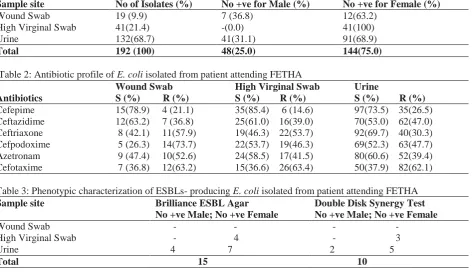
The distribution of E. coli isolated from patient attending FETHA are shown in the Table 1. Out of 192 clinical isolates of E. coli used for this study, 48 (25.0 %) were isolated from male, while 144 (75.0
%) were from female. Moreover, the site of isolation of the isolates are wound 19 (9.9 %), high virginal swab 41 (21.4 %) and urine 132 (68.7 %). The results of antimicrobial susceptibility test of the E. coli
isolates to some commonly used cephalosporin antibiotics are shown in Table 2. The results showed that cefepime are most effective drugs against the E. coli isolates. Higher levels of resistance by the E. coli
isolates were recorded for ceftazidime, cefotaxime, ceftriaxone, cefpodoxime and aztreonam. Phenotypic characterization of ESBLs- producing E. coli isolated from patient attending FETHA was shown in Table 3. Among the resistant isolates of E. coli, 15 were ESBL producers detected by DDST and Brilliance ESBL Agar. Ten ESBL producing E. coli was confirmed using DDST whereas 15 ESBL producing E. coli was confirmed using Brilliance ESBL Agar. Figure 1 shows a keyhole effect produced by E. coli
isolate expressing ESBL using DDST method. This appearance is the characteristic for ESBL-producing bacteria due to the synergistic effect produced between amoxicillin-clavulanic acid (a beta-lactamase inhibitor) and the third generation cephalosporins such as ceftazidime and cefotaxime.
Table 1: Distribution of E. coli isolated from patient attending FETHA
Sample site No of Isolates (%) No +ve for Male (%) No +ve for Female (%)
Wound Swab 19 (9.9) 7 (36.8) 12(63.2)
High Virginal Swab 41(21.4) -(0.0) 41(100)
Urine 132(68.7) 41(31.1) 91(68.9)
Total 192 (100) 48(25.0) 144(75.0)
Table 2: Antibiotic profile of E. coli isolated from patient attending FETHA
Wound Swab High Virginal Swab Urine
Antibiotics S (%) R (%) S (%) R (%) S (%) R (%)
Cefepime 15(78.9) 4 (21.1) 35(85.4) 6 (14.6) 97(73.5) 35(26.5) Ceftazidime 12(63.2) 7 (36.8) 25(61.0) 16(39.0) 70(53.0) 62(47.0) Ceftriaxone 8 (42.1) 11(57.9) 19(46.3) 22(53.7) 92(69.7) 40(30.3) Cefpodoxime 5 (26.3) 14(73.7) 22(53.7) 19(46.3) 69(52.3) 63(47.7) Azetronam 9 (47.4) 10(52.6) 24(58.5) 17(41.5) 80(60.6) 52(39.4) Cefotaxime 7 (36.8) 12(63.2) 15(36.6) 26(63.4) 50(37.9) 82(62.1)
Table 3: Phenotypic characterization of ESBLs- producing E. coli isolated from patient attending FETHA
Sample site Brilliance ESBL Agar No +ve Male; No +ve Female
Double Disk Synergy Test No +ve Male; No +ve Female
Wound Swab - - - - High Virginal Swab - 4 - 3 Urine 4 7 2 5
http://www.ijSciences.com Volume 5 – February 2016 (02)
30
Figure 1. Illustration of ESBL positive plate.
Discussions
Extended-spectrum β-lactamases (ESBLs) are a rapidly evolving group of β-lactamases which share the ability to hydrolyze third-generation cephalosporins and aztreonam yet are inhibited by clavulanic acid. Typically, they derive from genes for TEM and SHV-type beta-lactamases by mutations that alter the amino acid configuration around the active site of these earlier β-lactamases. This extends the spectrum of β-lactam antibiotics susceptible to hydrolysis by these enzymes. ESBLs are often located on plasmids that are transferable from strain to strain and between bacterial species. However, it can still be chromosomal mediated. There is no doubt that ESBL-producing organisms are of enormous clinical and microbiological significance. Such bacteria are associated with severe infections such as bacteraemia, intra-abdominal infection, wound infection, urinary tract infections (particularly in the community setting), and respiratory tract infections (Pituot et al., 2004). A total of one hundred and ninety two (192) isolates of E. coli was studied for their susceptibility patterns to cephalosporin antibiotics and detection of ESBL producers by double disc synergy test (DDST) and Brilliance ESBL Agar. Of the 192 isolates tested for their antibiogram, 19 (9.9%), 41 (21.4%), and 132 (68.7%) isolates were from wound, high vaginal swab, and urine samples respectively while 48 (25.0%) and 144 (75.0%) isolates were from male and female patients respectively. The E. coli isolates showed higher susceptibility to 4th-generation cephalosporins (cefepime). This is akin with previous works in which cefepime was reported as the drug of choice for the treatment of bacterial infections caused by
ESBL-producing organisms (Lye et al., 2008; Walsh
http://www.ijSciences.com Volume 5 – February 2016 (02)
31
cephalosporin drugs in our hospitals is important in the containment of the emergence and spread of ESBL-producing bacteria in the hospital environment.
Acknowledgment
Authors are grateful to the staff and management of the medical microbiology laboratory department of Federal Teaching Hospital, Abakaliki (FETHA), Ebonyi State and Applied Microbiology Laboratory Unit, Ebonyi State University, Abakaliki, Nigeria for their technical support during the collection and analysis of the clinical samples used for this study.
References
1. Aibinu, I. E., Ohaegbulam, V. C., Adenipekun, E. A.,
Ogunsola, F. T., Odugbemi, T. O and Mee, B. J. (2003). Extended-spectrum beta-lactamase enzymes in clinical
isolates of Enterobacter species from Lagos, Nigeria. J. Clin.
Microbiol., 41: 2197-2206.
2. Arpin, C., Quentin, C., Grobost, F., Cambau, E., Robert, J., Dubois, V., Coulange, L., André, C. & on behalf of the
Scientific Committee of ONERB (2009).Nationwide survey
of extended-spectrum β-lactamase-producing
Enterobacteriaceae in the French community setting. J
Antimicrob Chemother 63, 1205–1214.
3. Bauer, A. W., Truck, H. and Sherries, J. C. (1990).
“Antibiotic Susceptibility testing by standardized single disc
method,” American Journal of Clinical Pathology, 45: 493–
496.
4. Bradford, P. A. (2001). Extended Spectrum Beta-lactamases
in the 21st century: Characterization, Epidemiology and
Detection of this Important Resistance Threat. Clinical
Microbiology Reviews, 14 (4):933-951.
5. Chau, K. F and Oboegbunam, S. I. (2007). Extended –
spectrum beta lactamase production among ampicillin resistant Escherichia coli strains from chicken in Enugu State, Nigeria. Brazilian J. Microbiol., 38:1-4
6. Cheesbrough, M. (2010).District Laboratory Practice in
Tropical Countries, Part two, 2nd edn. Cambridge
University Press, UK. Pp 143-180.
7. Clinical Laboratory Standards Institute (CLSI) (2006).
Performance standards for antimicrobial susceptibility testing.Proceedings of the 16th International Supplement (M100-S16). Wayne, Pa, USA.
8. Ejikeugwu C, Iroha I, Adikwu M and Esimone C (2013).
Susceptibility and Detection of Extended Spectrum
β-Lactamase Enzymes from Otitis Media Pathogens. American
Journal of Infectious Diseases. 9(1):24-29.
9. Health Protection Agency, HPA (2008). Laboratory detection
and reporting of bacteria with extended spectrum Beta-lactamases. National Standard Method QSOP 51 Issue 2.2.
10. Iroha I.R., Amadi E.S., Oji A.E., Nwuzo A.C and Ejikeugwu
P.C (2010). Detection of plasmid borne extended – spectrum beta – lactamase enzymes from blood and urine isolates of
Gram – negative bacteria from a university teaching hospital
in Nigeria. Current Research in Bacteriology, 3(2):77-83.
11. Jacoby, G. A. and Munoz-Price, L. S. (2005). Mechanisms of
Disease: The New Beta-lactamases. N Engl J Med, 352:
380-91.
12. Lautenbach, E., Patel, J. B., Bilker, W. B., Edelstein, P. H. and Fishman, N. O. (2001). Extended-spectrum
beta-lactamase-producing Escherichia coli and Klebsiella
pneumoniae: risk factors for infection and impact of
resistance on outcomes. Clin Infect Dis. 32:1162–71.
13. Laupland, K.B., Church, D.L and Vidakovich, J. (2008).
Community-onset extendedspectrum b-lactamase (ESBL)
producing Escherichia coli: importance of international
travel. J. Infect. 57:441-448.
14. Lye, D. C., Wijaya, L., Chan, J., Teng, C. P. and Leo, Y. S.
(2008). Ertapenem for treatment of Extended Spectrum beta-lactamase producing and Multidrug resistant Gram negative
Bacteriaemia. Ann. Acad. Med. Singapore, 37 (10): 831-4.
15. Mark, E. Rupp and Paul, D. Fey (2003). Extended Spectrum
Beta-lactamase (ESBL)- producing Enterobacteriaceae,
consideration for diagnosis, prevention and drug treatment.
Drug, 63 (4): 353-365.
16. Niki, M., Hirai, I., Yoshinaga, A., Ulzii-Orshikh, L., Nakata,
A., Yamamoto, A., Yamamoto, M and Yamamoto, Y. (2011).
Extended-spectrum b-lactamase-producing Escherichia coli
strains in the feces of carriers contribute substantially to urinary tract infections in these patients. J. Infection, 39:467– 471.
17. Paterson, D. L. (2006). Resistance in gram-negative bacteria:
Enterobacteriaceae. Am J Med. 119:20–8.
18. Paterson, D. L. and Bonomo, R. A. (2005). Extended
Spectrum Beta-lactamases: A clinical update. Clinical
Microbiology Review, 18:657-686.
19. Pitout, J. D. D., Thomson, K. S., Hanson, N. D and Ehrhardt,
A. F. (2004). Beta-lactamase responsible for resistance to
extended-spectrum cephalosporin in Klabsiella pnumoniae,
Escherichia coli and Proteus mirabils isolates recovered
from South Africa. Antimicrob. Agents Chemother., 42:
1350-1354.
20. Rodriguez-Bano, J., Lopez-Cerero, L. and Navarro, M. D.
(2008). Faecal carriage of extended-spectrum
b-lactamaseproducing Escherichia coli: prevalence, risk factors
and molecular epidemiology. J. Antimicrob. Chemother.
62:1142-1149.
21. Stephan, J. A and William, J. (2006). Eds., Koneman’s Color
Atlas and Text book of Diagnostic Microbiology, Lipponcott Williams & Wilkins, 6th edition.
22. Thermo Scientific Oxoid Microbiology Products (2013).
Prepared Media-Ready to-use prepared plates; Brilliance
ESBL Agar, Code: PO5302.
www.thermoscientific.com.oxoid.
23. Valverde, A., Grill, F. and Coque, T. M. (2008).High rate of
intestinal colonization with
extended-spectrum-b-lactamaseproducing organisms in household contacts of infected community patients. J. Clin. Microbiol. 46: 2796-2799.