Improving the Wear Properties of Aluminum 6082 Alloy
by Surface Compositing with ZrO
2Ceramic Particles
Via Friction Stir Processing
N. YuVArAj
Department of Mechanical Engineering, Delhi Technological University, Delhi 110 042, India.
Abstract
Aluminum based metal matrix composites are given more attention in fabrication of surface engineering applications due to their excellent mechanical and wear properties. In this study, Friction stir processing (FSP) method was used to fabricate the surface composite with inserting different volume % of ZrO2 reinforcement particles in the Aluminum 6082 alloy. The hardness and triblogical characteristics of fabricated surface composites and base alloy were investigated. The higher volume content of reinforcement surface revealed higher hardness and higher wear resistance compared to the lower volume content reinforcement surface and base material. The wear worn-out of composite surfaces and base alloy were examined through SEM for understanding the wear mechanisms.
Article History
Received: 26 February 18 Accepted: 21 March 18
Keywords:
Friction stir processing (FSP); ZrO2: Wear Hardness.
Material Science research India
www.materialsciencejournal.org
CONTACT N.Yuvaraj [email protected] Department of Mechanical Engineering, Delhi Technological University, Delhi 110 042, India.
© 2018 The Author(s). Published by Oriental Scientific Publishing Company
This is an Open Access article licensed under a Creative Commons Attribution-NonCommercial-ShareAlike 4.0 International License (https://creativecommons.org/licenses/by-nc-sa/4.0/ ), which permits unrestricted NonCommercial use, distribution, and reproduction in any medium, provided the original work is properly cited.
To Link to this Article: http://dx.doi.org/10.13005/msri/150108
Introduction
The conventional aluminum alloys do not provide sufficient mechanical and wear properties for surface applications. To enhance the properties of the material the ceramic particles are incorporating in the alloy sin order to make composites. Metal Matrix Composites are used in automobile, aircraft and defense applications. Various methods are used for fabricating the Aluminum matrix composites such as thermal spraying, laser beam techniques, powder metallurgy, stir casting, pressure less infiltration, squeeze casting, and compo casting1-6.
and pin, which leads to movement of material from forepart of the pin to the rear side of the pin as a result it causes the intense stirring of the matrix and reinforcement material9,10. Kishan et al11. have studied the effect of 2, 4 and 8 volume percentage of nano TiB2 particles in the Al 6061-T6 alloy by FSP. The higher tensile strength and wear resistance exhibited at 4 volume % composite surfaces as compared with the other volume percentage reinforcement composite surfaces. Khodabakhshi et al12.fabricated aluminum surface composite through FSP by adding graphenenano-platelets (GNPs) in the Aluminium matrix. The GNPs increases the nucleation sites by particulate simulated nucleation through geometric dynamic recrystallization during FSP. Yuvaraj et al13. reported that FSP of Al5083/B4C/TiC surface nano composite has lower wear rate than base material. Both the ceramic particles behaved as identical type of reinforcement particles, which is unsuitable to be achieved by conventional liquid processing route due to segregation of ceramic particles in the composite. Devaraju et al14. studied the effect of SiC and Graphite particles on wear resistance of Aluminium composite fabricated through FSP. Shahraki et al15. reported that process parameters of the FSP are greatly influenced for fabrication of Al5083/ZrO2 surface composites. Khodabakhshi et al16. reported that the microhardness and tensileproperties of FSPed Al-Mg/TiO2 surface composites was enlarging with increasing the percentage of TiO2 particles in the composites. Zeidabadi and Daneshmanesh et al17. have reported that with increase in number of passes on Al/Nb/Al3Nb surface composite which increases the Al3Nb intermetallic formation in the composite, which results in improvement of hardness and tensile properties. Thangarasu et al18. have studied the effect of different volume content of Titanium Carbide particles in the Al6082/TiC surface and found that with increase in TiC particles the hardness of the composite surface was increased. Zirconium di boride (ZrO2) reinforcement particles have a high melting point, greater hardness, excellent electrical conductivity, good corrosion resistance and excellent thermal shock resistance19. In this present study, FSP technique was used to fabricate the Al6082/ZrO2 surface composite. The effects of different volume percentage of ceramic particles on hardness and triboligical characteristics of the surface composite were investigated.
Materials and Methods
Al6082-T6 alloy of 6 mm thickness and commercially available ZrO2 powder size of 10μm were used as substrate and particulates. The chemical composition (%) of the base metal is 1.2Si, 0.78Mn, 0.75Mn, 0.4Fe, 0.15Cr and rest Al. The plates were cut into rectangular pieces of 180 mm×80 mm×6 mm. Four different groove width sizes of 0mm, 0.5mm, 1.0mm and 1.5mm & constant 3mm depth of four such plates were prepared, in order to get the different volume fraction(0, 5, 10% and 15%)of the particles in the composite. The volume content of the particles are calculated based on the formula mentioned below20. Micro structural characterization was observed on Scanning Electron Microscope (SEM) (Hitachi S3700).
Volume fraction of Particles (Vt)= (Groove area)/ (FSP tool pin projected area) x100 ...(1)
Groove area= Groove width x depth ...(2)
FSP tool pin projected area = ...(3)
Tool pin diameter x Tool pin length
The ceramic particles were uniformly pasted with acetone and compressed on the groove soundly. Then theprepared samples were fixed in the hydraulic fixture of the FSW machine (11 kW& 40KN). Fig. 1 shows the typical FSP experimental setup.
EDM. Fig. 2 shows the test samples extracted from the FSP region. The dry sliding wear behavior of the composite surface was examined through a pin on disc tribometer (make DUCOM) and the experiments were conducted as per ASTM G99-04 standard. The hardened EN-24 steel was used as a counter disc material and surface roughness value of 0.2μm(Ra) was maintained. The surface of the wear test specimen grounds on the 1600 grit emery sheet before the test. All wear tests were carried out at sliding speeds of 1 m/s at normal load of 40N for sliding distance up to 3000m. Before and after the wear test all the wear sample pins and disc were cleaned with acetone. The wear test pins before and after the wear test were weighed with electronic weighing balance at an accuracy of ±0.01mg. The wear-worn surfaces were examined by SEM to understand the wear mechanisms.
Fig. 1: FSP Experimental setup
results and Discussions Hardness
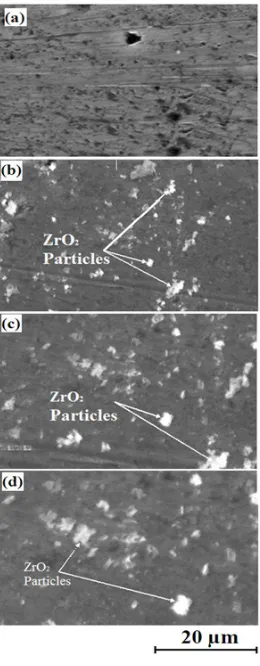
Fig. 3 shows the SEM images of the different percentage of volume content of reinforcement composite samples. The composite sample image clearly shows that the ceramic particles are uniformly distributed in homogeneous manner in the matrix. The microhardness values of the processed region of composite specimen and base material are shown in Fig. 4.For all the samples the average of three hardness value has taken for experimental purpose. The hardness of the 15% Vol. ZrO2 specimen was higher than other Vol. % of ZrO2 composite samples.
There was an increase in microhardness of the friction stir processed composite as compared base alloy. This might be attributed to sufficient formation of refined grain structure due to the restrain of grain boundary and the improvement of the induced strain. Similar types of results are reported by various researchers21,22. The well-known Hall petchindicates that the smaller grain size of the alloy has higher the hardness23.
The rotating tool pin provides sufficient mixing of ceramic particles with the base alloy through stirring action. The composite sample grain size is further reduced due to addition of hard nano TiC particles. The ceramic particles act as a pinning effect and preventing from the grain growth of base alloy. The temperature of the FSP zone was measured by using Fluke Ti400 thermal imaging camera(Fig. 5 (a)). The maximum peak temperature of 463oC was observed during FSP and this temperature was insufficient to melt the ceramic particles. No intermetallic formed only uniform dispersion of
ceramic particles occurred in the matrix(Fig.5 (b)). The reinforcement particles are not deformed only dislocations occurred during FSP. In addition, uniform distribution of ceramic particles in the aluminium alloy and good bonding between the base alloy and hard nano reinforcements improves the hardness. Higher
Fig. 3: SEM micrograph of Al6082/ZrO2 surface
composite (a) Base material (b) 5% Vol. ZrO2
(c) 10% Vol. ZrO2 (d) 15% Vol. ZrO2
Fig. 4: Effect of ZrO2 (Vol.%) content on microhardness of Al6082 / ZrO2
surface composite
Fig. 5: (a) Thermal imaging camera (b) Temperature measurement
during FSP experiment
Fig. 6: Wear test experimental setup
number of FSP passes and tool rotational direction changing between the FSP passes increases the good bonding of reinforcements with alloy also responsible for enhancement of hardness.
Wear Properties
Fig. 6 shows the wear test experimental setup and Fig.7 shows the wear test results of the Aluminum alloy and composite samples. The composite sample consists of 15% Vol. has the maximum wear resistance. The wear resistance is increasing with increase in volume % of ceramic particles. The major contributions for enhancement of the wear properties of the surface composite are formation of finer grain size, fine dispersion of nano reinforcements particles. The ceramic particles act as a load bearing element and load is transferring from Aluminum alloy to ceramic particles. The average coefficient of friction observed for base, FSPed-Al/ZrB2-0%, FSPed-Al/ZrB2-5%, FSPed-Al/ZrB2-10% and FSPed-Al/ZrB2-15% are 0.68, 0.58, 0.52, 0.48 and 0.45 respectively. The lower coefficient of friction was observed in higher volume content of the composite due to higher amount of iron particles which was pull out from hard steel disc and mixed with oxides which forms iron oxide layer. The iron oxide layer forms tribo film which lowers the friction coefficient. The material was removed from the base material and composite samples due to oxidation, abrasion and delamination process. With increase in sliding distance the frictional heat increases and softening of matrix phase takes place due to plastic deformation. The plastically deformed matrix material
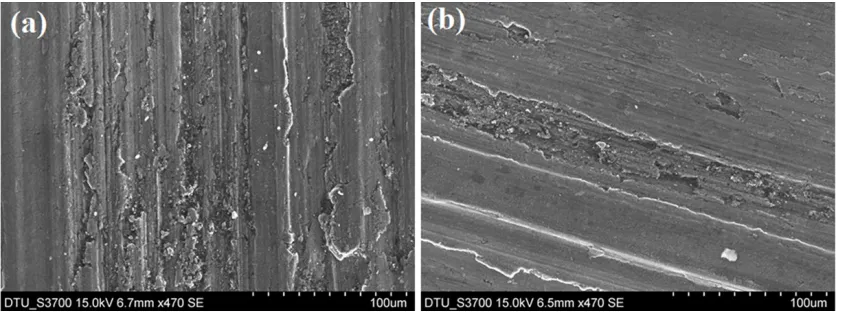
removed by the counter disc material and the wear mechanism changes from abrasion to adhesion. Fig. 8 shows the SEM images of worn surface of the Aluminium alloy and composite samples. In the base alloy, severe damage occurs on the surface due to lesser hardness of the material. Because of the soft matrix, the formation of abrasive grooves and cracks are very deep in the base material. In the composite specimen, the worn damages are lesser in compare to base alloy. Higher % of the ceramic particles in the composite has lower wear rate due to their higher hardness of the material. Similar type of results was reported by Dinaharan et al24. for rice husk reinforced copper matrix composites fabricated through FSP. As per Archard’s relationship higher hardness material has high wear resistance25. These are the main reasons for improvement of the wear resistance of the composite specimens.
Conclusions
In this study the Al/ZrO2 surface composite were fabricated through FSP and studied the effects of different volume percentage of ceramic particles on hardness and wear properties of composite. With increase in volume fraction of the ceramic particles in the matrix the wear properties of the composite specimen were increased. The ZrO2 particles were act as a strengthening element in the Aluminum matrix composite. The composite specimens contain15% ZrO2 particles has higher hardness value of 110Hv &lower wear rate of 4.6 x 10⁻³ mg/m due to uniform distribution of reinforcement particles in the matrix and refinement of the grain size. During
the wear test oxidation, abrasive and severe plastic deformation wear mechanisms were observed in the composite samples.
Acknowledgement
The author is thankful to Prof. S. Aravindan, Department of Mechanical Engineering, Indian Institute of Technology, Delhi for his valuable guidance to execute the work.
Funding Source
The author declares that the funding is done by author only.
Conflict of Interest
The author(s) declare(s) that there is no conflict of interests regarding the publication of this article.
references
1. D. B. Miracle, Metal matrix composites–From science to technological significance. Comp. Sci. Technol. 65, 2526-2540 (2005).
2. A. V. Muley, S. Aravindan, I. P. Singh, Nano and hybrid aluminum-based metal matrix composites: an overview. Manuf. Rev. 2, 1-13 (2015).
3. A. kohli, H. S. Bains, S. Jain, D. Priyadarshi, Machinability and Wear of Aluminium based Metal Matrix Composites by MQL - A Review,
Mat. Sci. Res. India. 14, 194-203 (2017). 4. P. K. Jain, S. C. Soni, P. V. Baredar, Review
on Machining of Aluminium Metal Matrix Composites, Mat. Sci. Res. India.11, 114-120 (2014).
5. H. C. Ananda Murthy, Electroanalytical Study on the Corrosion Behaviour of Tio2 Particulate Reinforced Al 6061 Composites,
Mat. Sci. Res. India. 12, 112-126 (2015). 6. S. J. D. Quadros, N. L. Vaishak, Evaluation
and Characterization of Tensile Properties of Short Coated Carbon Fiber Reinforced Aluminium7075 Alloy Metal Matrix Composites via Liquid Stir Casting Method, Mat. Sci. Res. India. 13, 66-73 (2016).
7. V. Sharma, U. Prakash, B. V. M. Kumar, Surface composites by friction stir processing: A review. J Mater. Proc. Tech. 224, 117-134 (2015).
8. N. Gangil, A. N. Siddiquee, S. Maheshwari, Aluminium based in-situ composite fabrication through friction stir processing: A review. J Alloys Camp. 715, 91-104 (2017).
9. M. S. Weglowski, Friction stir processing - State of the art. Arch. Civil Mech. Eng. 18, 114-129 (2018).
10. O. Badran, N. Al-Kloub, A. M. Hassan, J. A. Al-Jarrah, S. K. Khrais, Effect of friction stir
welding processing parameters on Abrasion wear Resistance of AA5083 welded joints,
Mat. Sci. Res. India. 8, (2018).
11. V. Kishan, A. Devaraju, L. P. Lakshmi, Influence of volume percentage of NanoTiB2 particles on tribological & mechanical behavior of 6061-T6 Al alloy nano-surface composite layer prepared via friction stir process. Def. Technol. 13, 16-21 (2017).
12. F. Khodabakhshi, M. Noskob, A. P. Gerlich, Effects of graphenenano-platelets (GNPs) on the microstructural characteristics and textural development of an Al-Mg alloy during friction stir processing. Surf. Coat. Technol.
335, 288–305 (2018).
13. N. Yuvaraj, S. Aravindan, Vipin, Wear Characteristics of Al5083 Surface Hybrid Nano-composites by Friction Stir Processing.
Trans. Ind. Inst. Met. 70, 1111–1129. (2017). 14. A. Devaraju, A. Kumar, B. Kotiveerachari,
Influence of rotational speed and reinforcement on wear & mechanical Properties of aluminium hybrid composites via FSP. Mater. Desi. 45, 576-585 (2013).
15. S. Shahraki, S. Khorasani, R. A. Behnagh, Y. Fotouhi, H. Bisadi, Producing of AA5083/ZrO2 Nanocomposite by Friction Stir Processing (FSP). Metall. Mater. Trans. B. 44, 1546-1553 (2013).
16. F. Khodabakhshi, A. Simchi, A. H. Kokabi, M. Nosko, F. Simancik, P. Svec, Microstructure and texture development during friction stir processing of Al-Mg alloy sheets with TiO2 nano particles. Mater. Sci. Eng. 605, 108-118 (2014).
by friction stir processing. Mater. Sci. Eng. A 702, 189-195 (2017).
18. A. Thangarasu, N. Murugan, I. Dinaharan, S. J. Vijay, Synthesis and characterization of titanium carbide particulate reinforced AA6082 aluminium alloy composites via friction stir processing. Arch. Civil Mech. Eng.
15, 324-334 (2015).
19. H. Zhu, J. Min, Y. L. Ai, D. C. H. Wang, H. Wang, The reaction mechanism and mechanical properties of the composites fabricated in an Al–ZrO2–C system. Mater Sci. Eng. A 527, 6178-6183 (2010).
20. R. Sathiskumar, N. Murugan, I. Dinaharan, S. J. Vijay, Characterization of boron carbide particulate reinforced in situ copper surface composites synthesized using friction stir processing. Mater. Char. 84, 16-27 (2013). 21. M. Amra, K. Ranjbar, R. Dehmolaei, Mechanical
Properties and Corrosion Behavior of CeO2 and SiC incorporated Al5083 Alloy Surface
Composites. J. Mater. Eng. Perform. 24, 3169-3179 (2015).
22. N. Yuvaraj, S. Aravindan, Vipin, Comparison studies on mechanical and wear behavior of fabricated aluminum surface nano composites by fusion and solid-state processing. Surf. Coat. Technol. 309, 309-331 (2017).
23. H. Izadi, R. Sandstrom, A. P. Gerlich, Grain Growth Behavior and Hall–Petch Strengthening in Friction Stir Processed Al 5059. Metall. Mater. Trans. A, 45A, 5635-5644 (2014).
24. I. Dinaharan, K. Kalaiselvan, E. T. Akinlabi, J. Paulo Davim, Microstructure and wear characterization of rice husk ash reinforced copper matrix composites prepared using friction stir processing. J. Alloys Comp. 718, 150-160 (2017).