Published online October 30, 2013 (http://www.sciencepublishinggroup.com/j/ijiis) doi: 10.11648/j.ijiis.20130205.13
Algorithms for trade modeling with agent-based systems
Monica Dascalu
1, Lucian Milea
2, Gabriela Ivanus
1, Mihail Teodorescu
3, Eduard Franti
31
Politehnica University of Bucharest, Romania 2
Solaris Consult S.R.L., Bucharest, Romania 3
Research Institute for Artificial Intelligence, Bucuresti, Romania
Email address:
[email protected](M. Dascalu), [email protected](L. Milea), [email protected](G. Ivanus), [email protected](M. Teodorescu), [email protected](E. Franti)
To cite this article:
Monica Dascalu, Lucian Milea, Gabriela Ivanus, Mihail Teodorescu, Eduard Franti. Algorithms for Trade Modeling with Agent-Based Systems.International Journal of Intelligent Information Systems. Vol. 2, No. 5, 2013, pp. 87-93. doi: 10.11648/j.ijiis.20130205.13
Abstract:
This paper presents a set of algorithms for trade modeling with cellular automata (CA). The cellular automata simulator developed for this purpose has allowed the study of phenomena that occur within groups of agents that operate in a dynamic resource field. With this cellular automata simulator algorithms have been developed and tested for clustering of agents in agencies and for studying phenomena within agencies. It was thus evident that within agencies the agents try to group in the neighborhood of leading and rich agents with high performance, in order to learn from them the best rules. In terms of hierarchy, the results show that the places in the immediate neighborhood of the agents with leading positions can be occupied only by agents with wealth.Keywords:
Cellular Automata, Agent-Based Systems, Trade Modeling1. Introduction
Agent-based models (ABM) were designed and developed to study the evolution of large populations of individuals based on direct interactions between them and their interaction with the environment in which they act. Unlike the "equations- based modeling" that uses differential equations to describe the interactions between individuals, agent-based modeling is based on the implementation of individual characteristics of agents, which also have a certain degree of freedom in decision-making according to the environment and the state of other agents with which it interacts [1]. The two methods are essentially different, ABM being much more effective in modeling the evolution of large populations of individuals where the complexity of interactions increases very much. Researches in ABM are currently oriented to study different communities of beings, animals, etc., in order to identify their individual behaviors (how they "move, fly, and cooperate") and then implement them in the model of agent from the simulation environment [2]. From a technical standpoint all a-life “creatures” consist of a few software codes and “live” in virtual environments composed of pixels and databases. In these virtual environments that are populated by thousands of agents, a set of rules is defined that they must follow, a program is written that simulates
simple interaction rules in the elements’ behavior and then the program is run for many times with different random numbers, in order to understand the ways in which simple rules lead to complex global behaviors [3]. In this way there are identified levers and individual parameters that will lead precisely, by appropriate change and after specific times of running the programs, to accurate finalities at the global level with a high degree of complexity. Predicting evolutions of these complex environments is very difficult by differential equations - based method which is efficient only on small populations [4].
2. Agent-Based Modeling of the
Economic Phenomena
2.1. Methodology
through activities of commerce with other agents or agencies [6].
In the implementation of features in the agents’ model a very special role is represented by the initial package of features for agents. This package refers to those initial characteristics and skills that each agent has got from the first simulation cycle. Depending on the phenomena that are targeted to be studied and modeled, the original package may be the same for all agents or it may differ from agent to agent. In ABM systems designed to study the processes of formation of social classes and the emergence and development of surplus product (profit), the initial package is the same for all agents [7]. In ABM systems designed to study the phenomena typical for crisis using catastrophe theory the initial package of features vary depending on the social class that each agent belongs to. The initial package of features includes all internal rules of behavior, the way of learning, the way of adaptation, as well as the agent's internal memory where all information about himself is being stored. Interactions between agents will lead, according to each specific context, to the development of new skills and features through which agents will become more efficient in accordance with performance criteria established in the ABM system.
Agents acting in the environment fall into two categories: those that act individually and those that manage to maintain complex relationships with both macro entities (companies or agencies) and with other agents, such interaction ranging from competitiveness to cooperation according to the various models of cooperation and rivalry in the society [8],[9]. One of the important keys to modeling interactions between agents is the cooperation between them in some new or old actions. Cooperation means that agents work together in the same way / direction or they interact repeatedly. A key role is played here by the norms / rules and limitations within which they perform their activity. Experts that aim at identifying norms of behavior needed to lead to the collaboration between large masses of agents stated that there are certain rules that lead even the most selfish agents to cooperate [10]. Agents that manage to join the agencies either have already accumulated some wealth and they are attracted to a different type of resources that only agencies can offer (prestige resources), or join the agencies to offer their workforce. The agent targeting the prestige resource has already got the wealth to provide him for long periods of time the satisfaction of his metabolism [11]. In the event that an agent has not got a certain wealth that it had accumulated by individual activities of collecting resources or by exchange activities, it first joins a group of agents where it may stay as a worker or it may begin to accumulate some wealth and then it might join an agency based on similarity and consistency between its personal interests and those of the agency members. In this situation it will share some of the profit that it would get with other members but will retain its previously accumulated wealth.
2.2. Algorithms for Modeling the Economic Phenomena
Rules library within each agency quantify the specific ways of interaction between agents in direct correlation with the agency profile, with the economic segment in which it performs activities and with the management policy of the agency [12], [13]. One of the main advantages of the ABM systems is that they allow the implementation on agents of development and learning processes based on interactions or their previous experience. These features can be implemented in different ways, the basic idea being that agents can change their own rules according to various algorithms that choose from the libraries the most efficient rules that lead to good results. The rules that prove to be inefficient over time or even worse, in terms of achieving the targeted goal are penalized according to the results obtained and then, from a certain limit no agents will apply them in those contexts [14],[15]. Learning process for agents is related both to the environment in which they work by its successive and gradual exploration as well as to the nature and attributes of other agents with whom they interact. In order to implement the learning function on agents they must be conceived with a flexible structure that can change within certain limits, both in terms of possibilities to adapt to changing external circumstances and in terms of the way and especially the processing time of the rules that they have in libraries. Agents are thus able to learn from their actions and from other agents’ responses. ABM systems in which these features are implemented are often called classifiers systems [16]. Another method of implementation of learning process refers to the transmission of the best features from parents to offspring for the latter to get a higher capacity of adaptation to the environmental changes. Although this method is specific to genetic algorithms it can be easily implemented in populations of agents that have the capacity to multiply and lead to the achievement of highly performance and efficiency generations of agents. Learning process involves that, based on action rules that have already been implemented in his personal memory each agent will develop, according to the result of interactions with other agents, new rules of behavior that would make his actions become more efficient according to certain criteria of performance [17]. Within the first systems used to represent and implement the learning function there are the genetic algorithms. In the case of genetic algorithms there are different learning strategies that are continuously improved in relation to the general criteria of "fitness" (efficiency). Efficiency criteria are defined in relation to the specific of the activity of each agent. Thus, for the agents that collect resources the efficiency is counted in several stages:
• orientation on the field to find resources • the amount of resources that it can pick
• the ratio of the amount of resources harvested and the amount of resources it consumes to survive.
wealth in the neighborhood [18]. This is one of the reasons that agents that have already accumulated some wealth are almost constantly surrounded by poorer agents.
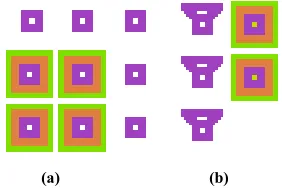
Implementation with the aid of CA of a particular configuration is achieved by establishing correspondences between the value of each cell’s state of the CA and the the amount of resources from that environment. For easy viewing and also to make the difference between different types of resources, different colors were set for each type of resource. According to existing resources map, a two-dimensional CA is used with a specific topology. Each cell of the CA has a distinctive representation depending on the type of the existing resource, while its associated state indicates the value of that resource’s wealth. Although schematic, this method of graphical representation of resources is very attractive because it allows an efficient disposition of natural resources in the studied environment and also allows direct visualization during simulation of the dynamics of resources when they are exploited by agents.
A fruit tree is placed on the surface of four cells, which allows four agents to collect fruits. Resources of potatoes occupy only a cell of the CA used for environment.
(a)
(b)
Figure 1. Action environment with resources: potatoes (a) and fruits (b)
When an agent reaches a free cell where this resource is found, then it can occupy that cell and in the next step it can begin the action to collect that resource.
3. Implementation of Goods Trades
Using ABM Systems
Implementation within ABM systems of goods trades aims to identify mechanisms of regulation and control of goods markets. The most effective way to study the mechanisms within goods trades is the one in which agents endowed with at least one commodity seek for different exchange methods, negotiate prices and then trade with other agents out of which they choose the one which
provides the best price and which is also the most accessible one. Within each agency, the leading agents apply some incentives for those who manage to obtain the greatest benefit on a standard time for trade.
Figure 2. Agents with type 1 and type 2 of products offered for sale
This standard time is closely related to the product’s availability which, if exceeded, the product could not be sold anymore. Agents with products have both a wealth and a certain amount of products being offered for sale. The agent with products acquires a certain percentage Pcom of what he sells while the remaining benefit is automatically counted in the agency account where he belongs to. In the simulations within this stage there were carried out different experiments with two agencies. Each of these agencies produces, based on a type of resource a distinct class of products which are then offered for sale through agents specialized in commercial activities.
Figure 3. Commercial activities between agents selling different products, represented with different colours
Agencies are considered in ABM systems as macro entities in which there are certain objectives (and therefore certain criteria for meeting these objectives) that are above individual goals. The agency’s objectives also include as a fragment the individual goals. Agencies are able, as Norbert Simon highlighted, of unitary behavior that can lead in some cases to the emergence of different types of collective intelligence, they often developing their own mechanisms to adapt to the environment, in order to ensure their survival. From this point of view the literature mentions that one of the structures with the highest skill in developing rules for both the survival and evolution is bureaucracy.
in the population of agents from each ABM system. Although it is difficult to program it from the beginning of the application, the degree of self-organization increases in large and hybrid populations of agents. It was noted that, within large populations, certain groups of agents occur even from early running cycles of the application, groups that begin to cooperate based on affinity of interest (foraging, exchanges of the same type of resources etc.). Agents which are grouped based on various emergent properties begin to develop rules of cooperation and then rules to respect simple hierarchies based on the accumulation of resources (wealth), or increased efficiency in different actions (prestige).
There are several types of agencies depending on their specialty:
• resources collection agencies – these agencies collect resources and provide them to production agencies;
• production agencies, that use resources received from the collection agencies, bring new products on market that are sold to consumers agents;
• financial agencies, that set the rules for exchanging products between agents, between agents and agencies, etc..
During the first simulation cycles it was found that the phenomena of cooperation and competition occurs among agents that lead, in time, first to the grouping of agents based on affinities and then to the emergence of new features and different types of agencies in which agents learn to act unitary.
4. The Library of Modeling Rules
The experiments undertaken implied the generation of different libraries for environments, resources, evolution rules for cell-sites and agents.
The movement rules for the agents provide them the opportunity to find and collect various types of resources that are available in the learning environment. Each agent is designed to travel in search for food in an environment with a certain configuration and certain resources, that are sometimes defined as different types of food for agents. In this simple example, the agent will travel and will collect any resource it would find. Some of the resource found will be used to satisfy its own metabolic needs in order to ensure its survival for a period of time Tmet.
The motion rules of each agent involve the following: - IF in the neighborhood crowd there is an unoccupied cell with the resource I turn to it
- IF the way towards the free cell with resource is free I move with maximum speed Vmax to it in the next stage of simulation
- IF there is no cell with resource I go just like all the other agents in the neighborhood
The movement rules for agents involve searching for resources (in the example above were implemented two places with different resources) or jobs. Jobs are offered by the two agencies that have been implemented and that will
get agents as workforce.
Agents’ movement is made based on “area of sight” defined for each agent. This area has been implemented as having the diameter value D. The motion rule implies that each agent should decide to move according to the following factors:
- What it perceives due to the sight area
- Direction of movement of the neighbors in its neighborhood crowd MV.
Figure 4. The population of agents move towards the two places with resources
The rule for searching, finding and collecting resources is: - IF I come to a location (cell) in which there is a resource THEN I stop, THEN with every new cycle I collect a unit from the resource I found. Representation of agents differs, depending on the level of wealth (resources) that each of them had accumulated. Agents that began to collect a resource from a certain location have a graphical representation different from agents that have a level of wealth to the limit of metabolism and, in turn, they differ from agents that have the level of wealth zero.
(a) (b)
Figure 5. Interactions between wealthy agents and poor ones (a), and between employed agents and wealthy ones (b)
5. Experiments and Results
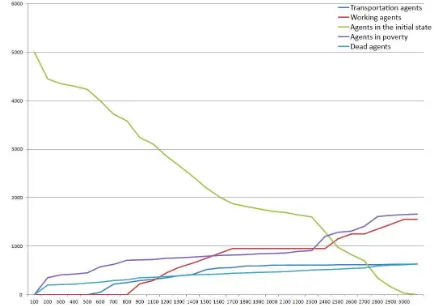
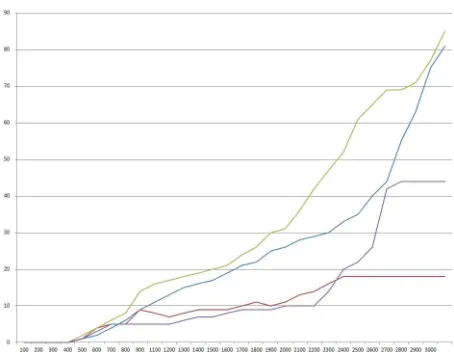
employed of being employers, they can accumulate resources or trade them and so on. Various experiments can be undertaken in this context. The figures below illustrate mainly the social effects of economic processes, i.e. evolution of social categories.
Figure 6. Evolution during 3000 simulation cycles of the agents from the categories corresponding to middle and lower classes in terms of wealth. The initial population counts 9000 agents
Figure 7. Evolution during 3000 simulation cycles of the agents from the categories corresponding to superior classes in terms of wealth. The initial population counts 9000 agents
Figure 8. Evolution during 3000 simulation cycles of the agents from the categories corresponding to middle and lower classes in terms of wealth. The initial population counts 5000 agents
Figure 9. Evolution during 3000 simulation cycles of the agents from the categories corresponding to superior classes in terms of wealth. The initial population counts 5000 agents
Figure 10. Evolution during 3000 simulation cycles of the agents from the categories corresponding to middle and lower classes in terms of wealth. The initial population counts 21000 agents
During this phase there were identified, implemented and tested libraries of rules for modeling of various economic phenomena. During the simulations performed one could have seen the influence of the rules implemented in the agents level on the processes of formation of the social classes and their evolution in time. The figures above illustrate only the social effects of economic processes, i.e. evolution of social categories, but also different conclusions may be underlined. Simulator developed at this stage provided through the functions that had been implemented the identification of different methods of adjustments and control over economic processes. In trade actions, for instance, it was found that when negotiating agents are penalized or rewarded with certain incentives based on their performance during negotiations, their results improve proportionally to the number of negotiations in which they participate. A significant result obtained from the simulations within this project is that when a new product is introduced, the market reaches to a saturation level for old products and the profit increases for the agents that offer new products for sale. If the new product differs from another product on the market only on a single feature, it was found that the demand for old products decreases very much while the new product brings a huge profit.
6. Implementing Rules for Agencies
Producing Goods
For agencies with more working agents, efficiency is defined according to the relative profitability of the company. Agents that manage to join agencies where activities are subject to very demanding performance criteria, seek to group around agents with wealth and high performance. Places in the neighborhood of leading agents and of agents with wealth are the most popular, as shown in the figure below. In terms of hierarchy, it was found that the places in the immediate neighborhood of the agents with leading positions can be occupied only by agents with wealth. Learning process is implemented in different agencies as distinct options for agents:
- To learn from experienced and high performance agents (by serving them in exchange for rules that can provide them the gaining of increasingly wealth);
- To move to production work involving the acquisition of resources from agents that carry them and give them to the agency;
- After gaining a certain wealth that also indicates high performance he can take up leadership in a group or within the agency as shown above.
Leading agents’ activities might converge to the same way and then all agents with leading positions are grouped in the center of the agency and lead all the productive agents from the agency as a unit. In this case the agency develops and becomes very profitable. If the leading agents do not unite then more divisions occur within the agency
which leads the agency to bankruptcy after several cycles of simulation.
Agents with leading positions have also the biggest wealth, the best performance against the criteria set out in the agency and the largest influence on the agents. Thus, a decision taken by one of the leading agents has tremendous impact on all agents of the agency.
The neighborhood crowd in case of each agent varies depending on his wealth. Thus the neighborhood crowd for leading agents Vcond is the largest, having a double effect:
- The first effect is that their sphere of influence is much higher including a lot of agents to influence:
• determine agents from the neighborhood crowd to work;
• evaluates agents of neighborhood crowd giving penalties or rewards based on performances they have achieved within the agency;
• teach the agents from the neighborhood crowd to improve production rules in order to become more efficient;
- The second effect consists in collecting the profit from the agents from the neighborhood crowd that they must give to the agency.
(a)
(b)
Figure 13. Evolution during the simulation cycles of the number of transactions within the two strategies in column (blue line and green line) and in triangle (red line and purple line)
7. Conclusion
Within simulations agents applied different selling strategies eventually choosing the parallel negotiation strategy in column. In this strategy the negotiator agent stays in the middle and does not allow the two agents to communicate directly like the triangle strategy. Negotiator agent thus gets a better price for the sale claiming that if its bid is not accepted he will provide it to the other agent who has already agreed to the bid. Considering the fact that the goods offered for sale are perishable this strategy has led to increasing performance for negotiating agents who approached this strategy.
Acknowledgements
The work reported in this paper was done with financial support from 1253/2008 IDEI project.
References
[1] R. J. Brooks, and D. Shi. "The calibration of agent based simulation models and their use for prediction". In S. Robinson et al., editors, Proceedings of the 2006 OR Society Simulation Workshop (SW06). Warwick, UK.
[2] Axelrod, R. "On six advances in cooperation theory. Analyse & Kritik", 22, 130-151 (2000).
[3] Engelen, G., R. White, I. Uljee, and P. Drazan, "Using Cellular Automata for Integrated Modelling of Socio-environmental Systems", Environmental Monitoring and Assessment, 30, 203-214, 2005.
[4] Miller, R.E. and P.D. Blair, "Input-Output Analysis: Foundations and Extensions", Cambridge University Press, New York, 2009.
[5] R.U. Ayres, "The minimum complexity of endogenous growth models: the role of physical resource flows", Energy, 26(9), 817-838, 2008.
[6] P.O. Siebers, U. Aickelin, H. Celia, and C. W.Clegg. "A multi-agent simulation of retail management practices" in Proceedings of the 2007 Summer Computer Simulation Conference (SCSC2007). San Diego, USA.,
[7] M. López-Sánchez, X. Noria, J. A. Rodríquez, N. Gilbert, S. Shuster, "Multi Agent Simulation Applied to On-line Music Distribution Market", Proceedings of the 4th International Conference on Web Delivering of Music, WEDELMUSIC 2004, Barcelona, 13th-14th September 2004. Pp 151-154. IEEE Computer Society. 2004
[8] Carlsson, B., Acs, Z. J., Audretsch, D. B., Braunerhjelm, P. (2009). "Knowledge Creation, Entrepreneurship, and Economic Growth", DRUID conference, Copenhagen, June 18-20, 2006 (6 ed., vol. 18, pp. 1193-1229). Industrial & Corporate Change.
[9] Carlsson, B. (2011). In D.B. Audretsch, O. Falck, S. Heblich and A. Lederer (Ed.), "New Knowledge: The Driving Force of Innovation, Entrepreneurship, and Economic Development" (pp. 214-228). Cheltenham: Edward Elgar.
[10] Acs, Z. J., Braunerhjelm, P., Audretsch, D. B., Carlsson, B. (2010). In Zoltan J. Acs (Ed.), "The Knowledge Spillover Theory of Entrepreneurship" (pp. 137-152). Cheltenham: Edward Elgar.
[11] F. Simon, and J.-C. Usunier. "Cognitive, demographic and situational determinants of service customer preference for personnel-in contact over self-service technology". International Journal of Research in Marketing, 24(2):163-173, 2007.
[12] P.O. Siebers, U. Aickelin, H. Celia, and C. W. Clegg. "Using intelligent agents to understand management practices and retail productivity". In S. G. Henderson et al., editors, Proceedings of the 2007 Winter Simulation Conference (WSC2007). Washington D.C., USA, forthcoming.
[13] P.O. Siebers. "Worker performance modeling in manufacturing systems simulation: proposal for an agent-based approach" in J. P. Rennard, editor, Handbook of Research on Nature Inspired Computing for Economics and Management, Idea Group Publishing, 2006.
[14] Frank, Kenneth A, Yasumoto, Jeffrey Y., Linking action to social structure within a system: social capital within and between subgroups, The American Journal of Sociology [AJS], 104(3), 642 - 86.
[15] Nelson, R.R. and S. Winter, "An evolutionary theory of economic change", Harvard University Press, Cambridge University MA, 2006.
[16] J.E. Reynolds, D. Howard, B.Dragun, B.Rosewell, and P. Ormerod, "Assessing the productivity of the UK retail sector. International Review of Retail, Distribution and Consumer Research", 15:237-280, 2005.
[17] S. Broadberry, and M. O’Mahony, "Britain’s productivity gap with the United States and Europe: A historical perspective", National Institute of Economic Review, 189(1):72-85, 2004.