http://www.sciencepublishinggroup.com/j/ogce doi: 10.11648/j.ogce.20180603.12
ISSN: 2376-7669(Print); ISSN: 2376-7677(Online)
Current Situation and Development Trend of Gas Storage
Solution Mining Technology in Salt Cavern
Ban Fansheng
CNPC Engineering Technology R&D Company Limited, Beijing, China
Email address:
To cite this article:
Ban Fansheng. Current Situation and Development Trend of Gas Storage Solution Mining Technology in Salt Cavern. International Journal of Oil, Gas and Coal Engineering. Vol. 6, No. 3, 2018, pp. 39-43. doi: 10.11648/j.ogce.20180603.12
Received: May 23, 2018; Accepted: June 8, 2018; Published: July 6, 2018
Abstract:
The main solution mining method of gas storage in salt cavern is positive cycle in China. The solution mining speed is low which need from four years to five years to build a cavern with the volume of 200000 cubic meters. The method of solution mining is single. It is difficult to adapt to the rapid development of domestic underground gas storage. Many kinds of solution mining methods are required to be studied in order to increase the solution mining speed. By numerical calculation and field application, the process and advantages & disadvantages of all sorts of solution mining modes are described, the reasean to increase solution mining speed are analyzed such as reverse circulation, large hole, double well, double strings and so on. Research shows that the main solution mining modes of gas storage in salt cavern in the future are reverse circulation, large hole, double well and double strings, which can increase solution mining speed effectively. There are some shortcomings and difficulties of solution mining with large hole cavity and double well and double strings. Many key technologies need to be studied. Cementing is difficult for large hole method, it is difficult to control cavity for double well method, production casing is vulnerable to brine corrosion for double well method. The solution mining of reverse circulation is relatively mature with cavity controlling and cushion detection, which can improve solution mining peed effectively by more than 20% and can advance the construction process of gas storage in china.Keywords:
Gas Storage, Solution Mining, Salt Cavern, Reverse Circulation, Large Hole, Double Well, Double Strings1. Introduction
Gas storage in salt cavern is constructed in layered salt layer with low grade salt rock and thick layers in China. These gas storages use solution minning with single well convection method that the oil cushion is used as the protective liquid and the positive circulation is the main cycle [1-3]. Compared with foreign salt mound [4-5], the domestic cavity is complex and diverse, the actual shape and volume of the dissolved cavity are different from the designed cavern, the cavity is not easy to control. Solution mining time is long and there are accidents in the process of solution mining such as string bending and clogging [6-11].
Many domestic scholars have analyzed various problems existing in salt cave cavity, and they concentrate on interlayer collapse, string bending, large hole solution mining, constructing groove rapidly, etc. Jiang Deyi [12-14] has revealed the relationship between mechanical properties of insoluble interlayer and brine immersion time in the process of
of solution mining technology in China, it is the main trend of the development of gas storage in salt cavern that solution mining with reverse circulation, large borehole, dual wells, directional well and double strings can improve the solution mining speed effectively.
2. Current Situation of Solution Mining
2.1. Harsh Geological Conditions
The geological condition of constucting cavern is harsh with bedded salt layer and low salt rock grade in Domestic places such as Jintan, Pingdingshan, Chuzhou, Qianjiang, Huaian, Yunying and so on. Salt layer thickness is 60 ~ 250 m, insolubles content of salt rock is 15% ~ 15%, interlayer is more and thick, part of gas storage in salt cavern is deep that objective layeris 700 ~ 2 200 m depth.
2.2. Single Solution Mining Method
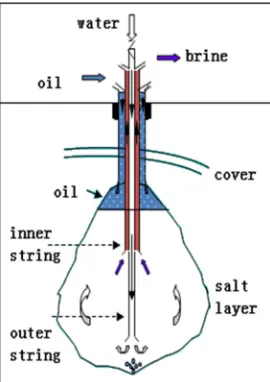
The mainly solution mining method of gas strorage in salt cavern in China is the single well convection method [20-21] (Figure 1), production casing diameter is 244.5mm, the cavity string is composed of the outer string (diameter 177.8 mm) and the inner string (diameter 114.3mm), the oil cushion is used as the protective liquid injecting from annulus between the production casing and the outer string, the positive circulation is the main cycle. The adjustment frequency of solution mining string is 2 ~ 3 times per year and the workover is more and the cost is high.
Figure 1. Schematic diagram of solution minning with single well convection method of gas storage in salt cavern.
2.3. Long Solution Mining Time
The shape of salt cavern is complex and diverse, and there is a miscible phenomenon [6-7] in part of salt caverns. The actual volume of salt caverm is quite different from the designed volume. The solution mining time of single well is about 5 to 7 years. The single cavity consumes electricity about 1,000 × 104 degrees.
2.4. More Solution Mining Accidents
Solution mining in deep salt layer is complex that there are more accidents in the well, salt crystallization is powerful, brine string is easy to be blocked, string bending phenomenon is common. Oil cushion is used as the protective liquid in the process of solution mining. The oil cushion is detected by many instrument with wire transmission such as multi-sensor interface detector, optical fiber interface instrument and so on. The cable or fiber are easily worn or broken while they enters into well with the string.
3. Development Trend of Solution Mining
Technology
The study on the use of salt caverns in China began in 1998 that it develops late compared with foreign countries. Solution minning is used by the method of single well convection, solution time is low and it is difficult to adapt to the demand for rapid development of domestic storage. It is the main trend of the development of gas storage in salt cavern that solution mining with reverse circulation, large borehole, dual wells, and double strings can improve the cavity speed effectively and reduce construction cost.
3.1. Solution Mining Technology with Reverse Circulation
Solution mining with reverse circulation is the main method in China after constucting groove of gas storage in salt cavern. The technology has absorbed the foreign salt cavern building, domestic salt extraction experience. Cavity control and detection technology are mature that have applied to the site. Compared with the mainly cycle of positive circulation, reverse circulation has the following characteristics.
(1)The mainly cycle of reverse circulation. The mainly reverse circulation is used in the middle and late stage of solution mining, and positive circulation is used to repair cavity and to flushing with water in order to destory crystal.
(2)Large water injectiong velocity. Solution mining speed can be increased and the brine concentration from the cavity is large used by solution mining with reverse circulation. Larger water injection rate can be used and the maximum rate is up to 150 m3/h in the later stage in the process of solution mining.
(3)Lower string lifting times. We reduce times to lifting string in the solution mining of gas storage in salt cavern. More string lifting times improves cost and time of solution mining and lift the bottom of the cavity. (4)Higher solution mining velocity. It can improve solution
85 m3/d with positive circulation that the water injection displacement is 100 m3/h.
3.2. Solution Mining with Dual Wells
Single cavity with dual wells drills two wells on the same salt layer, and one well is used for water injection, and another well is used for brine production. The solution mining with dual wells is suitable for solution mining in the thin salt layer. According to the well spacing, there are two types of single cavity with dual wells: dual straight well and horizontal Wells + straight Wells. The advantage of solution mining with dual wells is to reduce the circulation pressure and increase water injection displacement and shorten solution mining time, and the disadvantage is that it is difficult to control cavity shape and lacking monitoring technique for cavity shape.
3.2.1. Double Vertical Wells
The solution mining with double vertical wells of gas storage in salt cavern is the method that two vertical wells are drilled with 15~30 m distance and two solution mining strings are put in each well after two wells connected. Water is injected in one well and brine is discharged from another well. Two wells are drilled in the same salt layer that can forms good cavity in the aspect of stability. The cavity volume is small in thin salt layer. The method has been applied in Yunying.
Energy consumption is small and large water injection rate (up to 400 m3/h) is allowed and solution mining rate can be
increased obviously with double vertical wells of gas storage in salt cavern. As an example of cavern construction in 1000m salt layer in Jintan, the solution mining time of cavern with the 20×104 m3 volume is shortened nearly 50% compared with the single well convection method based on the numerical simulation.
3.2.2. Horizontal Wells and Straight Wells
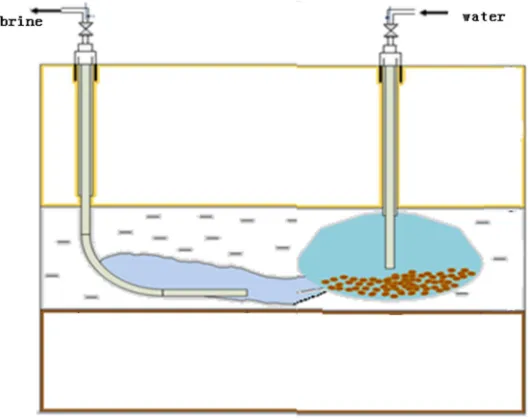
The solution mining of single cavern formed with horizontal docking well is the method that one vertical wells is drilled first and another horizontal well is drilled to connect with another cavity in the vertical well by constructing groove (Figure 2). Horizontal docking production group is formed and inner pipe is put in the vertical well. In the early stage of two wells connecting, water is injected in horizontal well in order to flush the sidewall and enlarge the cavity. Then cavern is solution minied by injecting water and brine alternatlely in two wells. Diesel is injected into vertical well to control cavity dissolved upward.
The horizontal well (directional well) and vertical well are drilled in the same salt layer that the advantage is to make full use of the salt layer to form a large cavity. For vertical well, the diameter of the casing pipe is 244.5mm and the diameter of the brine column is 177.8mm. For horizontal well, the diameter of casing pipe is 177.8mm. With small circulation pressure, the water injection displacement can reach 300 m3/h, and the speed is obviously improved. Currently, this method has not been applied in the field.
Figure 2. Horizontal and vertical well solution mining schematic diagram.
3.3. Solution Mining with Large Hole
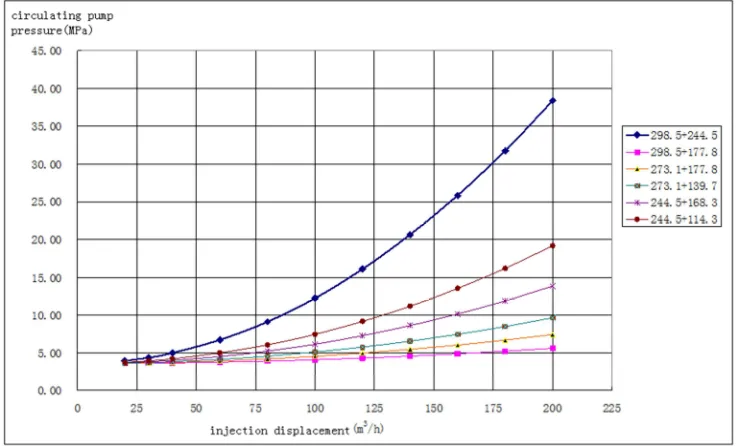
Solution mining with large hole is a common method of gas storage in salt cavern in foreign countries. Water solution mining with single well convection method is used. The diameter of production casing pipe is 339.7 mm. The solution mining string with the outer tube (273.05 mm diameter) + the inner tube (177.8 mm diameter) is adopted that the advantage is small solution mining energy consumption and larger
Figure 3. The relationship between water injection displacement and circulating pump pressure in two solution mining strings.
3.4. Solution Mining with Double Strings
The diameter of production casing pipe of solution mining with double strings is 193.7mm. The solution mining string with the outer tube (193.7 mm diameter) and the inner tube (114.3 mm diameter) is adopted. Diesel is used as protective layer before solution mining. Compared to the current solution mining method with the outer tube (177.8mm diameter) and the inner tube (114.3mm diameter) in China, the solution miming with double strings can reduce machine pump equipment load and reduce the energy consumption in the process of solution mining. It also has the following advantages. It is beneficial to the large water injecting displacement because of larger diameter of inner tube that can shorten construction time. The pressure in the larger diameter tube is small in the same injection displacement which can reduce water hammer and vibration. It can improve pipe life and reduce accident risk. The
gap between the two pipes is large, which is beneficial to the operation of the inner tube and the outer tube.
It can be seen from the relationship between water injection rate and circulating pump pressure (Figure 4) of two kinds of solution mining strings that the solution mining with double strings can reduce pressure consumption and increase solution mining speed and allow larger injection displacement, compared to current solution mining string in Jintan. The solution mining string combination in Jintan is the outer tube (diameter 177.8mm) and the inner tube (diameter 114.3mm). The solution mining string combin nation with double strings is the outer tube (193.7mm diameter) and the inner tube (114.3mm diameter). At the same time, production casing brine corrosion need to be studied because no enough diesel as protective layer controls dissolution upward. The solution method with double strings has been applied in Jintan.
Figure 4. The relationship between water injection displacement and circulating pump pressure of two solution mining strings.
4. Conclusion
(1)The main solution mining method of gas storage in salt cavern is positive cycle in China. The solution mining
purpose of gas storage in salt cavern. The development trend of gas storage solution mining in salt cavern are reverse circulation, large hole, double well and double strings, which can increase solution mining speed effectively and reduce solution mining cost.
(3)Well cementing is difficult for solution mining with large hole. It is difficult to detect and control cavity shape by the means of solution mining with double wells. The production casing brine is easy to be corroded because no enough diesel as protective layer to control dissolution upward. Each solution mining method has own shortcomings and difficulties and many key technologies need to be solved further.
(4)Field application shows that the solution mining of reverse circulation is relatively mature, which can improve solution mining peed effectively by more than 20% and can advance the construction process of gas storage in china.
References
[1] YANG H J. Construction key technologies and challenges of salt-cavern gas storage in China. Oil & Gas Storage and Transportation, Vol. 36, No. 7, 2017, pp. 747-753.
[2] BAN F S, YUAN G J, SHEN R C. Research on multi-interbed salt cavern shape control technology. Journal of Oil and Gas Technology, Vol. 32, No. 1, 2010, pp. 362-364.
[3] GUANGJIE Y, SHEN R, TIAN Z, et al. Review of underground gas storage in the bedded salt deposit in China. Calgary: SPE Gas Technology Symposium, 2006:SPE100385.
[4] QUIRIJN H, HENK D, FRITZ W, et al. Gas Storage in Salt Caverns Zuidwending-The Netherlands. Leipzig: Solution Mining Research Institute Fall Conference, 2010, pp. 241-250.
[5] AMER A H, MOHD A, VOLKER. Theoretical and experimental basics for a new tightness test method to enable testing of gas storage caverns during gas storage operation. San Antonio: Solution Mining Research institute Spring Conference, 2014, pp. 130-149.
[6] LI J J, WANG L D, LIU C, et al. Factors affecting cavities distortion of Jintan Salt Cavern Gas Storage [J]. Oil & Gas Storage and Transportation, Vol. 33, No. 3, 2014, pp. 269-273.
[7] YANG H J, YU S N. Relationship between salt cavern partial melting and well deviation of Jintan Underground Gas Storage. Oil & Gas Storage and Transportation, Vol. 34, No. 2, 2015, pp. 145-149.
[8] DAI X, MA J J, DING S L, et al. Analysis on cavity building abnormal of JT1 well of the gas storage of Jintan Salt Cavern. China Well and Rock Salt, Vol. 46, No. 1, 2015, pp. 26-29.
[9] DAI X, ZHANG G, MA J J, et al. Causes analysis and solutions of JT2 well blocking in Jintan Salt-cavern Gas Storage. China Well and Rock Salt, 2017 (1): 13-15.
[10] ZHENG Y L, ZHAO Y J, DING G S, et al. Solution mining technology of enlarging space for thick-sandwich salt cavern storage. Petroleum Exploration and Development, 2017 (1): 1-7.
[11] LIU J Q, JIAO Y J, LI J J, et al. Back-leaching technology in the construction of underground salt cavern gas storage. Journal of Southwest Petroleum University (Science & Technology Edition), 2016 (5): 122-128.
[12] JIANG D Y, ZHANG J W, CHEN J, et al. Research on softening law of insoluble interlayer during salt cavern building. Chinese Journal of Rock Mechanics and Engineering, 2014, 33 (5): 865-873.
[13] LIANG W G, ZHANG C D, GAO H B, et al. Experimental study of mechanical properties of gypsum saturated in brine. Chinese Journal of Rock Mechanics and Engineering, 2010, 29 (6): 1156-1162.
[14] SHI X L, LI Y P, YANG C H, et al. Research on mechanical mechanism of interlayer collapse in solution mining for salt cavern gas storage. Rock and Soil Mechanics, 2009, 30 (12): 3615-3620.
[15] LI Y P, YANG C H, QU D A, et al. Preliminary study of dynamic characteristics of tubing string for solution mining of oil/gas storage salt caverns. Rock and Soil Mechanics, 2012, 33 (3): 681-686.
[16] YUAN G J, SHEN R C, TIAN Z L, et al. Research and field application of quick-speed solution mining technology. Acta Petrolei Sinica, 2006, 27 (4): 139-142.
[17] ZHENG Y L, WANYAN Q Q, DING G S, et al. Effect analysis of cavity building with large-size pipe string for underground salt cavern gas storage. Oil & Gas Storage and Transportation, 2015, 34 (2): 158-161.
[18] BAN F S, XIAO L Z, YUAN G J, et al. Rapid solution mining technology for underground gas storage in salt caverns and case histories. Natural Gas Industry, 2012, 32 (9): 77-79.
[19] LI Y P, SHI X L, LIU W, et al. Motion of insoluble subsidence during leaching sump for salt cavern storage. Chinese Journal of Rock Mechanics and Engineering, 2016, 35 (1): 23-31.
[20] ZHENG Y L, ZHAO Y J, DING G S. Solution mining technology of enlarging space for thick-sandwich salt cavern storage. Petroleum Exploration and Development, 2017, 44 (1): 137-143.
[21] LI J J, CHEN J C, LIU J P, et al. Re-leaching solution mining technology under natural gas for salt-cavern gas storage. Oil & Gas Storage and Transportation, 2017, 36 (7): 816-824.