SHIV SHAKTI
International Journal in Multidisciplinary and
Academic Research (SSIJMAR)
Vol. 6, No. 2, April 2017 (ISSN 2278 – 5973)
Estimation of Age Group using Histogram of Oriented
gradients and Neural Network
Arpit Kumar Sharma
Mobile No. 9414342366
Impact Factor = 3.133 (Scientific Journal Impact Factor Value for 2012 by Inno Space
Scientific Journal Impact Factor)
Global Impact Factor (2013)= 0.326 (By GIF)
Indexing:
ABSTRACT
Requirement of Project: Face images are being increasingly used as additional means of authentication in applications of high security zone. But with age progression the facial features changes and the database needs to be updated regularly which is a tedious task.
So we need to address the issue of facial aging and come up with a mechanism that identifies a person in spite of aging. In my project, effective age group estimation using face features like texture and shape from human face image are proposed[2]. For better performance, the geometric features of facial image like wrinkle geography, face angle, left to right eye distance, eye to nose distance, eye to chin distance and eye to lip distance are calculated. Based on the texture and shape information, age classification is done using KNN & SVM algorithm (Best algorithm according to many research paper during my research)."
Proposed System: "In this report, few classification and feature extraction techniques used for age group classification. In this report first we attempt to combining two type of face features using haar features extraction (Wrinkle features and Geometrical Features) also used viola Jones for face detection. Age estimation based on the graphical model structure is proposed. Three popular features, PCA (Principal Component analysis), HOG and Haarfeatures, are exploited in our work, and three different graphical model structures considering spatial information and hidden topics are proposed and implemented. The experimental results showed that our model performs classification techniques like SVM (support vector machine), KNN and Neural network and the comparisons between features extraction algorithm and classification techniques in order to obtain best output. features are also presented and discussed. Until now, the model we proposed hasn’t been well-tuned, and we’ll try to improve it for the future works." Research in those areas has been conducted for more than 30 years. "Traditionally, face recognition uses for identification of documents such as land registration, passports, driver’s licenses, and recognition of a human in a security area. [22]
1.1 GENERAL INTRODUCTION
phase we used two techniques 1) Wrinkle features and 2) Geometrical features for the face pattern recognition [11]. We know that Wrinkle features are well enough to differentiate between the adult and senior, Geometrical features is good to create difference between child and adult/senior. That is why we used a combine technique of wrinkle and geometrical so that they can solve each other problems and provide the best output. These two approaches are defined below:
1.1.1) Geometrical features
This include face angle, left eye to right eye distance, eyeball, eye to nose distance, eye to chin distance and eye to lip distance that is further calculated by making use of the best feature selection algorithm
1.1.2) Wrinkle features
Age classification based on the texture and shape information is done by using suggested hybrid algorithm which includes Fuzzy logic and Neural Network. Depending on a number of groups age ranges are then classified dynamically using hybridization algorithms individually.
years. Face recognition is beneficial for identification of documents such as for land registration, passports, driver’s licenses, and recognition of a human in a security area [84]. Face images are highly used as additional means of authentication in applications having high security zone. But with increase in age the facial features also keep on changes and the database needs to be updated regularly which is one very tedious task. Hence we need to address this issue of facial aging and come up with a solution that identifies a person without any age limits. In this thesis, effective age group estimation using face features like texture and shape from human face image is proposed. For getting efficient results, the geometric features of the facial image like wrinkle geography, face angle, left to right eye distance, eye to nose distance, eye to chin distance and eye to lip distance are calculated [90]. Based on the texture and shape information, age classification is done by making use of classification algorithms
2. EXISTING SYSTEM
Block diagram of proposed work
3.3 FLOW CHART OF AGE CLASSIFICATION
The brief description of each block is described below:
IMAGE
DATA
PREPROCESS
USING
GEOMETRICAL
AND WRINKLE
FEATURE
CLASSIFICATI
ON USING
KNN
CLASSIFI
CATION
PERFOM
ANCE
Image aquisition
• Dataset from THE OPEN UNIVERSITY, ISRAEL
Data preprocess
• Face detect viola jone apply
Find Parts
• Find face parts
Data prepration
• Find the face features of the images(Haar feature, PCA and HOG)
Classificati on
• Apply classification(KNN, SVM and Neural Network.
Performance
FLOW CHART OF PROPOSED SYSTEM
`
Start
Preprocess and feature extraction
Insert 3class AGE
classification
dataset
Detect Face
Resize image
Performance
Apply
Classification
Exit
Face Detectio
n
Data Divide
Yes NoNOT A VALID
2.1 FEATURE EXTRACTION
One of the main key issue of any characterization frameworks is to locate an arrangement of reliable features as the basis for classification. In general these features cam be categorized into two categories. These are wrinkle features and geometric features. Let us discuss each one of them in detail[59].
2.2 WRINKLE FEATURES
One of the most important property of wrinkle features is that it determines the age of a person. Estimation of feature F5 can be done as follows :
F5= (sum of pixels in forehead region / number of pixels in forehead region) + (sum of pixels in left eyelid region / number of pixels in left eyelid region) + (sum of pixels in right eyelid region / number of pixels in right eyelid region) + (sum of pixels in left eye corner region / number of pixels in left eye corner region) + (sum of pixels in right eye corner region / number of pixels in right eye corner region).
F5 can be estimated by making use of the grid features of face image that is completely dependent on the wrinkle geography in face image.
For the estimation of F5 features, a few steps have to be followed as discussed below: As the age keeps on increasing, wrinkles on face turn out to be clearer. Aged individuals regularly have clear wrinkles on the face in the following areas as mentioned below : a) The forehead has horizontal furrows.
b) The eye corners have crow’s feet.
c) The cheeks have clear cheekbones, sickle molded pouches, and profound lines between the cheeks and the upper lips.
2.3 GEOMETRICAL FEATURES
As indicated by the investigations of facial representation and emotional cosmetics, there occurs a lot of change in the facial features as the age keeps on increasing. In this phase, global features in combination with the grid features are extracted from the face images. The global features include the distance between two eye balls, chin to eye, nose tip to eye and eye to lip[76].
By making use of four distance values, there occurs calculation of four features namely F1, F2, F3 and F4 as mentioned below:
F1 = (distance from left to right eye ball) / (distance from eye to nose). F2 = (distance from left to right eye ball) / (distance from eye to lip). F3 = (distance from eye to nose) / (distance from eye to chin). F4 = (distance from eye to nose) / (distance from eye to lip).
It is clear that new born babies have a number of wrinkles on their faces. The head bone structure in new born ones is not fully grown. Moreover the ration of primary features is highly different from those in other life spans. Hence we can conclude that it is more reliable to use geometric features as compared to wrinkle features when it is to be judged that whether an image is a baby or not[82].
3. CLASSIFICATION (KNN ALGORITHMS)
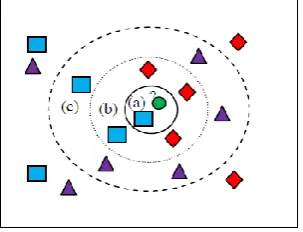
3.3.1 KNN Classification: The k-nearest neighbor algorithm is a classification algorithm which classifies an object on the basis of where the majority of the neighbor belongs to [76]. To choose the number of neighbors is optional and it depends on the users. If k is equal to 1 then it is classified [10] as a class of neighbor is nearest. Normally the object is classified on the basis of labels of its k nearest neighbors by finding out the majority vote. If k is 1, the object is classified as the class of the object which is nearest to it. When there are two classes, it is considered that k must be an odd integer. However, there can still be times when k is an odd integer while performing multiclass classification. After converting each image to a vector image of fixed-length having real numbers, we will then use the most common distance function for KNN that is Euclidean distance [85].
Fig 3.8 :KNN classification. At the query point of the circle depending on the k value of 1, 5, or 10, the query point can be a rectangle at (a), a diamond at (b), and a triangle at (c).
The KNN is classifies an object where the majority of the neighbor belongs to. The choice of the number of neighbors is discretionary and up to the choice of the users. If k is 1 then it is classified [10] whichever class of neighbor is nearest[13].
result = knnclassify(Sample, Training, Group, k)
3.2 Histogram of Oriented Gradients(HoG):
The implementation method of the HoG algorithm descriptor is given as follows. Firstly, the cells are divided into smallest possible regions of an image. These regions are called
cells. For each of these cells, a histogram of of gradient orientations or edge orientations is computed. Each cell is separated and discreted into corresponding angular bins in accordance with its gradient orientation. The weighted gradient of each cell is contributed to its respective angular bin. The adjacent cell with same gradient orientation are grouped together and these spatial regions are known as blocks[57]. These groupings into blocks is the basis for histograms' normalization. The normalized group represents the block histogram which in turn represent the descriptor [21].
3.3) Principal Component Analysis(PCA)
PCA is one of the best available statistical methods available that is used for image compression and gesture recognition. The basic ideology behind the PCA algorithm is the reduction of the dimensionality of an image and also maintaining maximum variance. The features which remain then are the ones relevant for recognition[59].
Whenever there is 2-dimensional data, then due to the presence of more than 2 variables, the visualization of of the relationships becomes complex. PCA reduces the dimensionality of the data such that the two actual variables are reduced to less number of new one dimensional variables which are called Principal Components. This is done by using a single variable for a group of variables. The principal components are a linear representation of the actual variables[64].
These principal components can also be represented in the form of vectors called Eigen Vectors. The Eigen Vectors collectively create a feature space known as Eigen space which is calculated by the eigen vectors of a co-variance matrix derived from a hand gesture set. Each input gesture image corresponds to eigen vectors which represents the feature vector of the image[79].
3.4 SVM (Support Vector Machine)
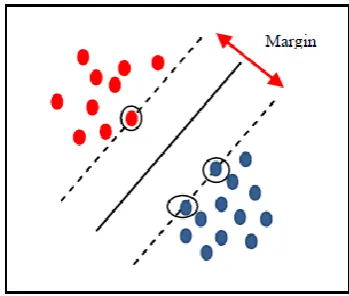
good separation is obtained by a hyper plane that is very far from any data point of each class [11], since further the separation of the data, better the performance[64].
Fig 3.6.4: Shows the formation of hyperplane and also the how the image is classified between red and blue using SVM.
CONCLUSION
This thesis thoroughly explains a novel method for the age group classification. Proposed technique based on wrinkle and geometrical features provides a robust method that identifies the age group of individuals from a set of different images capturing various aged faces. From these images features are then extracted such as distances between various face elements, analysis of wrinkle geography and then calculation are performed for finding out face angles. The results are then compared at the end to find the best way to calculate age ranges for the face images present in the database. Based on the observed results, images are further classified into 3 groups on the basis of SVM and KNN algorithm. It is normally observed that wrinkle geography feature i.e., F5 provides better results to predict human age range in comparison to other features. Hence we can conclude that wrinkle geography analysis is one good approach to estimate human age range for an individual. For better eye and eyeball detection, images should be captured without spectacles. Viola Jone algorithm focuses on the front face that is why the image needs to be a straight frontal face. As we are working on the individual face age group identification so for that purpose image should contain single human face only. This thesis has shown results with 76% accuracy for two age group, 64% accuracy for three age group. As the numbers of group are increased for classification the accuracy of classification is decreased. There is a strong possibility for further extension of the work which includes extracting more feature points that can improve accuracy of age group classification. By introducing more features the age range can also be further enhanced.
FUTURE SCOPE
REFERENCE
BIBILOGRAHY
Books:
1. Jang, J.S.R., Sun, C.T. and Mizutani, E. (1997) Neuro Fuzzy and Soft Computing: A Computational Approach to Learning and Machine Intelligence. United States of America: Prentice-Hall.
2. Mitra, S.K. (2006) Digital Signal Processing: A Computer-Based Approach. New York:McGraw-Hill.
3. proaktis, J G. and Manolakis D.G. (2007) Digital Signal Processing: PrinciplesAlgorithms and Application, New Jersey: Prentice-Hall.Tournals and Conferences
REFERENCE
[1] A.Lanitis and C.J.Taylor, “Towards Automatic Face Identification Robust to Ageing Variation”, IEEE Trans. on Pattern Analysis and Machine Intelligence, vol.24, no.24, p.442-455, 2002.
[2] A.Lanitis, C.Draganova, and C.Christodoulou, “Comparing different classifiers for automatic age estimation”, IEEE Trans.Syst.Man, Cybern.B, Cybern, vol34, no.1, pp.621-628, Feb.2004.
[3] V. Blanz and T. Vetter, “Face recognition based on fitting a 3D morphable model”, IEEE Transactions on Pattern Analysis and Machine Intelligence, 25(9):1063 –1074, September 2003.
[5] N.Ramanathan and R. Chellappa, “Face verification across age progression”, in Proc. IEEE Conf. Computer Vision and Pattern Recognition, San Diego, CA, 2005, vol.2, pp.462-469.
[6] N.Ramanathan and R. Chellappa, “Modeling Age Progression in young faces”, in Proc. IEEE Conf. Computer Vision and Pattern Recognition (CVPR), vol.1, pp.387-394, 2006.
[7] G. Guo, A. Jain, W. Ma, and H. Zhang, “Learning similarity measure for natural image retrieval with relevance feedback,” IEEE Trans.Neural Netw., vol. 13, no. 4, pp. 811–820, Apr. 2002.
[8] G. Guo and S. Li, “Content-based audio classification and retrieval by support vector machines,” IEEE Trans. Neural Netw., vol. 14, no. 1,pp. 209–215, Jan. 2003.
[9] G. Guo, S. Li, and K. Chan, “Support vector machines for face recognition,” Image Vis. Comput., vol. 19, no. 9-10, pp. 631–638, 2001.
[10] G. Guo, S. Li, and K. Chan, “Face recognition by support vector machines,” in Proc. IEEE Conf. FG, 2000, pp. 196–201.
[11] [X. F. He and P. Niyogi, “Locality preserving projections,” presented at the NIPS, 2003.
[12] T. Joachims, “Making large-scale SVM learning practical,” in Advances in Kernel Methods—Support Vector Learning, B. Schölkopf,C. Burges, and A. Smola, Eds. Cambridge, MA: MIT Press, 1999.
[13] Y. Kwon and N. Lobo, “Age classification from facial images,” Comput. Vis. Image Understand., vol. 74, no. 1, pp. 1–21, 1999.
[14] A. Lanitis, C. Taylor, and T. Cootes, “Toward automatic simulation of aging effects on face images,” IEEE Trans. Pattern Anal. Mach. Intell.,vol. 24, no. 4, pp. 442–455, Apr. 2002.
[16] [Gundogan, K. K., Alatas, B., &Karci, A. (2004). Mining classification rules by using genetic algorithms with non-random initial population and uniform operator. Turk J Elec Engin, 12(1)
.
[17] Maulik, U., &Bandyopadhyay, S. (2000). Genetic algorithm-based clustering technique. Pattern recognition, 33(9), 1455-1465.
[18] Kwan, H. K., &Cai, Y. (1994). A fuzzy neural network and its application to pattern recognition. Fuzzy Systems, IEEE Transactions on, 2(3), 185-193.
[19] Karnik, N. N., & Mendel, J. M. (1998, May). Introduction to type-2 fuzzy logic systems.In Fuzzy Systems Proceedings, 1998. IEEE World Congress on Computational Intelligence., The 1998 IEEE International Conference on (Vol. 2, pp. 915-920). IEEE.
[20] Castillo, O., &Melin, P. (2008). Type-2 Fuzzy Logic: Theory and Applications. Heidelberg, Germany: Springer-Verlag.
[21] Melin, P., & Castillo, O. (2005). Hybrid intelligent systems for pattern recognition using soft computing: an evolutionary approach for neural networks and fuzzy systems (Vol. 172). Springer Science & Business Media.
[22] Tizhoosh, H. R. (2005). Image thresholding using type II fuzzy sets. Pattern recognition, 38(12), 2363-2372.
Abiyev, R. H., &Kaynak, O. (2010).Type 2 fuzzy neural structure for identification and
control of time-varying plants. Industrial Electronics, IEEE Transactions on, 57(12),
4147-4159.
[23] Mitchell, H. B. (2005). Pattern recognition using type-II fuzzy sets. Information Sciences, 170(2), 409-418.
Wang, C. H., Cheng, C. S., & Lee, T. T. (2004).Dynamical optimal training for interval
type-2 fuzzy neural network (Ttype-2FNN). Systems, Man, and Cybernetics, Part B: Cybernetics, IEEE
Transactions on, 34(3), 1462-1477.
[24] Ozkan, I. (2004, July). Entropy assessment for type-2 fuzziness.In Fuzzy Systems, 2004.Proceedings.2004 IEEE International Conference on (Vol. 2, pp. 1111-1115).IEEE.
[25] Zeng, J., & Liu, Z. Q. (2004, August). Type-2 fuzzy hidden Markov models to phoneme
recognition.In Pattern Recognition, 2004.ICPR 2004.Proceedings of the 17th International
Conference on (Vol. 1, pp. 192-195).IEEE.
[26] Zeng, J., & Liu, Z. Q. (2004, August). Type-2 fuzzy hidden Markov models to phoneme
recognition.In Pattern Recognition, 2004.ICPR 2004.Proceedings of the 17th International
Conference on (Vol. 1, pp. 192-195).IEEE.
[27] Rhee, F. C. H., & Choi, B. I. (2007, July). Interval type-2 fuzzy membership function
design and its application to radial basis function neural networks. InFuzzy Systems
[28] Park, K. J., Oh, S. K., &Pedrycz, W. (2009, August). Design of interval type-2 fuzzy
neural networks and their optimization using real-coded genetic algorithms.In Fuzzy Systems,
2009.FUZZ-IEEE 2009. IEEE International Conference on (pp. 2013-2018). IEEE.
[29] Own, C. M. On the switch between Type-2 fuzzy sets and intuitionistic fuzzy sets. In 12 th conference on Artificial intelligence & applications (TAAI 2007).
[30] Mendoza, O., Melín, P., & Castillo, O. (2009). Interval type-2 fuzzy logic and modular
neural networks for face recognition applications. Applied Soft Computing, 9(4), 1377-1387.
[31] Own, C. M. (2009). Switching between type-2 fuzzy sets and intuitionistic fuzzy sets: an
application in medical diagnosis. Applied Intelligence, 31(3), 283-291.
[32] Bandyopadhyay, S., Murthy, C. A., & Pal, S. K. (1998). Pattern classification using
genetic algorithms: Determination of H. Pattern Recognition Letters,19(13), 1171-1181.
[33] Alfehaid, W. M., Khan, A. I., & Amin, A. H. M. (2012, December). A combined pattern recognition scheme with genetic algorithms for robot guidance using Wireless Sensor
Networks. In Control Automation Robotics & Vision (ICARCV), 2012 12th International
Conference on (pp. 759-764). IEEE.
[34] Melin, P. (2010, August). Interval type-2 fuzzy logic applications in image processing
and pattern recognition.In 2010 IEEE International Conference on Granular Computing (pp.
728-731).IEEE.
[35] Zhenjiang, M., &Baozong, Y. (1993). A new analytical method for AM neural networks
and its application to pattern recognition. In Neural Networks, 1993., IEEE International
Conference on (pp. 1570-1575). IEEE.
Lin, C. J., Wang, J. G., & Lee, C. Y. (2009). Pattern recognition using neural-fuzzy networks
based on improved particle swam optimization. Expert Systems with Applications, 36(3),
5402-5410.
[36] Zhao, W., Chellappa, R., Phillips, P. J., & Rosenfeld, A. (2003). Face recognition: A
literature survey. ACM computing surveys (CSUR), 35(4), 399-458.
[37] Darwish, S. M., & Mohammed, A. H. (2014). Interval Type-2 Fuzzy Logic to the
Treatment of Uncertainty in 2D Face Recognition Systems. International Journal of Machine
Learning and Computing, 4(1), 24-30.
Begum, S. A., & Devi, O. M. (2011).Fuzzy algorithms for pattern recognition in medical
diagnosis. Assam University Journal of Science and Technology, 7(2), 1-12.
[38] Al-Allaf, O. N. (2014). Review of face detection systems based artificial neural
networks algorithms. arXiv preprint arXiv:1404.1292.
[39] Schmalzel, J. L., & Johnson, J. F. (1993, May). Pattern recognition based on fuzzy logic. In Instrumentation and Measurement Technology Conference, 1993.IMTC/93. Conference Record., IEEE (pp. 681-684). IEEE.
[40] Kwan, H. K., &Cai, Y. (1994). A fuzzy neural network and its application to pattern
[41] Mahdy, Y. B., & El-Melegy, M. T. (1996, October). Encoding patterns for efficient classification by nearest neighbor classifiers and neural networks with application to
handwritten Hindi numeral recognition. In Signal Processing, 1996., 3rd International
Conference on (Vol. 2, pp. 1362-1365). IEEE.
[42] Niño-de-Rivera, L., Nakano-Miyatake, M., Sánchez, J. C., Perez-Meana, H., & Sanchez-Sinencio, E. (1995, August). VLSI implementation of an extended Hamming neural network
for non-binary pattern recognition. In Circuits and Systems, 1995., Proceedings., Proceedings
of the 38th Midwest Symposium on (Vol. 2, pp. 973-977). IEEE.
Kandel, A., Zhang, Y. Q., &Bunke, H. (1997, July).A genetic fuzzy neural network for
pattern recognition. In Fuzzy Systems, 1997., Proceedings of the Sixth IEEE International
Conference on (Vol. 1, pp. 75-78). IEEE.
[43] Melin, P. (2010, August). Interval type-2 fuzzy logic applications in image processing
and pattern recognition.In 2010 IEEE International Conference on Granular Computing (pp.
728-731).IEEE.
[44] Budiwati, S. D., Haryatno, J., & Dharma, E. M. (2011, July). Japanese character (Kana)
pattern recognition application using neural network. InElectrical Engineering and
Informatics (ICEEI), 2011 International Conference on (pp. 1-6). IEEE.
[45] Alfehaid, W. M., Khan, A. I., & Amin, A. H. M. (2012, December). A combined pattern recognition scheme with genetic algorithms for robot guidance using Wireless Sensor
Networks. In Control Automation Robotics & Vision (ICARCV), 2012 12th International
Conference on (pp. 759-764). IEEE.
[46] Jun, T. (2012, October). Genetic optimization of BP neural network in the Application of
Suspicious Financial Transactions Pattern Recognition.InManagement of Commerce and
e-Government (ICMeCG), 2012 International Conference on (pp. 280-284). IEEE.
[47] Silva, W. L. S., & de Oliveira Serra, G. L. (2012, November). Proposal of an Intelligent
Speech Recognition System.In Intelligent Systems (GCIS), 2012 Third Global Congress
on (pp. 356-359).IEEE.
[48] Alhusain, S., Coupland, S., John, R., & Kavanagh, M. (2013, November). Design pattern
recognition by using adaptive neuro fuzzy inference system. InTools with Artificial
Intelligence (ICTAI), 2013 IEEE 25th International Conference on (pp. 581-587). IEEE.
[49] Silva, W. L. S., & de Oliveira Serra, G. L. (2014, July). A novel intelligent system for
speech recognition.In Neural Networks (IJCNN), 2014 International Joint Conference on (pp.
3599-3604).IEEE.
[50] Silva, W. L. S., & de Oliveira Serra, G. L. (2014, July). A novel intelligent system for
speech recognition.In Neural Networks (IJCNN), 2014 International Joint Conference on (pp.
3599-3604).IEEE.
[51] Shelke, S., &Apte, S. (2015, January). A fuzzy based classification scheme for
unconstrained handwritten Devanagari character recognition.InCommunication, Information
[52] Chengjian, S., Zhu, S., & Shi, Z. (2015, May). Image annotation via deep neural
network.In Machine Vision Applications (MVA), 2015 14th IAPR International Conference
on (pp. 518-521).IEEE.
[53] Ren, J., Jiang, X., & Yuan, J. QUANTIZED FUZZY LBP FOR FACE RECOGNITION.
[54] Weng, C., Yu, D., Seltzer, M. L., &Droppo, J. (2015). Deep neural networks for
single-channel multi-talker speech recognition. IEEE/ACM Transactions on Audio, Speech and
Language Processing (TASLP), 23(10), 1670-1679.
[55] Taylor, C. E., & Meldrum, D. R. (2000). Algorithm design, user interface, and optimization procedure for a fuzzy logic ramp metering algorithm: A training manual for
freeway operations engineers (No. WA-RD 481.1,).Washington State Department of
Transportation.
[56] Kóczy, L. T., Vámos, T., &Biró, G. (1999). Fuzzy signatures. Proceedings of
EUROFUSESIC, 99, 210-217
Gedeon, T. D., Kóczy, L. T., Wong, K. W., & Liu, P. (2001). Effective fuzzy systems for
complex structured data. In Proceedings of IASTED International Conference Control and
Applications (pp. 184-187).
[57] Vámos, T., Kóczy, L. T., &Biró, G. (2001, July). Fuzzy signatures in data
mining.In IFSA World Congress and 20th NAFIPS International Conference, 2001. Joint
9th (pp. 2842-2846). IEEE.
[58] Zhu, D., Mendis, B. S. U., Gedeon, T., Asthana, A., &Goecke, R. (2009). A hybrid
fuzzy approach for human eye gaze pattern recognition. In Advances in Neuro-Information
Processing (pp. 655-662).Springer Berlin Heidelberg.
[59] Mendis, B. S. U., &Gedeon, T. D. (2008, June). A comparison: Fuzzy signatures and
choquet integral. In Fuzzy Systems, 2008. FUZZ-IEEE 2008.(IEEE World Congress on
Computational Intelligence). IEEE International Conference on (pp. 1464-1471). IEEE.
[60] Zhu, D., &Gedeon, T. (2008). Fuzzy logic for cooperative robot communication. In Agent and Multi-Agent Systems: Technologies and Applications (pp. 401-410). Springer Berlin Heidelberg.
[61] Kulkarni, G. H., &Waingankar, P. G. (2007, August). Fuzzy logic based traffic light
controller. In Industrial and Information Systems, 2007.ICIIS 2007. International Conference
on (pp. 107-110). IEEE.
[62] Ambre, M. S. (2004). A Design Methodology for the Implementation of Fuzzy Logic Traffic Controller using Field Programmable Gate Arrays.
[63] Khalid, M., Liang, S. C., &Yusof, R. (2004, July). Control of a complex traffic junction
using fuzzy inference.In Control Conference, 2004.5th Asian (Vol. 3, pp. 1544-1551).IEEE.
[64] Niittymäki, J. (2001). Installation and experiences of field testing a fuzzy signal
[65] Khalid, M. B. Module 1: Basics of Fuzzy Sets and Fuzzy Relations.Unpublished Course Notes, UniversitiTeknologi Malaysia.
[66] Islam, M. S., Bhuyan, M. S., Azim, M. A., Teng, L. K., & Othman, M. (2006, September). Hardware Implementation of Traffic Controller using Fuzzy Expert System. In Evolving Fuzzy Systems, 2006 International Symposium on (pp. 325-330).IEEE.
[67] Azim, M. A., & Huda, M. N. Fuzzy Traffic Control System.
[68] Walker, M. (2001). Introduction to genetic programming. Tech. Np: University of Montana.
[69] Koza, J. R. (1992). Genetic programming: on the programming of computers by means of natural selection (Vol. 1). MIT press.
[70] Duda, R. O., & Hart, P. E. (1973). Pattern recognition and scene analysis.
[71] Tou, J. T., & Gonzales, R. C. (1974). Pattern Recognition
Principles.Addison-Weley. Reading, MA.
[72] Fukunaga, K. (2013). Introduction to statistical pattern recognition.Academic press.
[73] Konar, A. (2006). Computational intelligence: principles, techniques and applications. Springer Science & Business Media.
[74] Haykin, S., & Lippmann, R. (1994). Neural Networks, A Comprehensive
Foundation. International Journal of Neural Systems, 5(4), 363-364.
[75] Klir, G., & Yuan, B. (1995). Fuzzy sets and fuzzy logic (Vol. 4). New Jersey: Prentice Hall.
[76] Golberg, D. E. (1989). Genetic algorithms in search, optimization, and machine
learning. Addionwesley, 1989.
[77] Burke, E. K., & Kendall, G. (2005). Search methodologies. Springer Science+ Business Media, Incorporated.
Jain, A. K., Mao, J., &Mohiuddin, K. M. (1996). Artificial neural networks: A
tutorial. Computer, (3), 31-44.
Kohonen, T. (1995).Self-Organing Maps-Springer Series in Information Sciences, vol. 30. Berlim: Springer Verlag.
[78] Shah, S. A. A., ulAsar, A., &Shaukat, S. F. (2009). Neural network solution for secure
interactive voice response. World Applied Sciences Journal, 6(9), 1264-1269.
[79] Guo, X., Liang, X., & Li, X. (2007, August). A stock pattern recognition algorithm
based on neural networks. In Natural Computation, 2007.ICNC 2007.Third International
[80] Dai, W., & Wang, P. (2007, August). Application of pattern recognition and artificial
neural network to load forecasting in electric power system.In Natural Computation,
2007.ICNC 2007.Third International Conference on (Vol. 1, pp. 381-385).IEEE.
[81] He, L., Hou, W., Zhen, X., & Peng, C. (2006, October). Recognition of ECG patterns
using artificial neural network. In Intelligent Systems Design and Applications,
2006.ISDA'06.Sixth International Conference on (Vol. 2, pp. 477-481).IEEE.
[82] Mani, N., & Srinivasan, B. (1997, October). Application of artificial neural network
model for optical character recognition.In Systems, Man, and Cybernetics, 1997.
Computational Cybernetics and Simulation., 1997 IEEE International Conference on (Vol. 3, pp. 2517-2520). IEEE.
[83] Han, Y. S., Min, S. S., Choi, W. H., & Cho, K. B. (1992, November). A learning pattern recognition system using neural network for diagnosis and monitoring of aging of electrical
motor.In Industrial Electronics, Control, Instrumentation, and Automation, 1992. Power
Electronics and Motion Control., Proceedings of the 1992 International Conference on (pp. 1074-1077). IEEE.
[84] Ozdemir, E., &Gunduz-Demir, C. (2013). A hybrid classification model for digital
pathology using structural and statistical pattern recognition. Medical Imaging, IEEE
Transactions on, 32(2), 474-483.
[85] Ma, H., Chan, J. C., Saha, T. K., &Ekanayake, C. (2013). Pattern recognition techniques and their applications for automatic classification of artificial partial discharge
sources. Dielectrics and Electrical Insulation, IEEE Transactions on,20(2), 468-478.
[86] Phadik, S., &Sil, J. (2008, December). Rice disease identification using pattern
recognition techniques.In Computer and Information Technology, 2008.ICCIT 2008. 11th
International Conference on (pp. 420-423). IEEE.
[87] Phadik, S., &Sil, J. (2008, December). Rice disease identification using pattern
recognition techniques.In Computer and Information Technology, 2008.ICCIT 2008. 11th
International Conference on (pp. 420-423). IEEE.
[88] Chandra, M., &Langari, R. (2006, July). Gearbox degradation identification using
pattern recognition techniques.In Fuzzy Systems, 2006 IEEE International Conference on (pp.
1520-1526).IEEE.
[89] Cao, L. (2002, November). Circuit power estimation using pattern recognition
techniques. In Proceedings of the 2002 IEEE/ACM international conference on
Computer-aided design (pp. 412-417). ACM.
[90] Liu, J., & Zhou, P. (2013). A novel myoelectric pattern recognition strategy for hand
function restoration after incomplete cervical spinal cord injury. Neural Systems and
Rehabilitation Engineering, IEEE Transactions on, 21(1), 96-103.
[91] Srihari, S. N., Cha, S. H., & Lee, S. (2001). Establishing handwriting individuality using
pattern recognition techniques.In Document Analysis and Recognition, 2001.Proceedings.