Volume 57, 2018, Pages 488–497
LPAR-22. 22nd International Conference on Logic for Programming, Artificial Intelligence and Reasoning
Is Satisfiability of Quantified Bit-Vector Formulas
Stable Under Bit-Width Changes?
∗
Martin Jon´
aˇs and Jan Strejˇ
cek
Masaryk University, Brno, Czech Republic
{xjonas, strejcek}@fi.muni.cz
Abstract
In general, deciding satisfiability of quantified bit-vector formulas becomes harder with increasing maximal allowed bit-width of variables and constants. However, this does not have to be the case for formulas that come from practical applications. For example, software bugs often do not depend on the specific bit-width of the program variables and would manifest themselves also with much lower bit-widths. We experimentally evaluate this thesis and show that satisfiability of the vast majority of quantified bit-vector formulas from thesmt-librepository remains the same even after reducing bit-widths of variables to a very small number. This observation may serve as a starting-point for development of heuristics or other techniques that can improve performance of smtsolvers for quantified bit-vector formulas.
1
Introduction
In the modern world, as the computer software becomes still more ubiquitous and complex, there is an increasing need to test it and formally verify its correctness. Several approaches to software verification, such as symbolic execution or bounded model checking, rely on the ability to decide whether a given first-order formula in a suitable logical theory is satisfiable. To this end, many of the verifiers use Satisfiability Modulo Theories (smt) solvers, which can solve precisely the task of checking satisfiability of a given first-order formula in a given logical theory. For describing software, the natural choice of a logical theory is the theory offixed-size bit-vectors in which the objects are vectors of bits and the operations on them precisely reflect operations performed by computers. Moreover, in applications such as synthesis of invariants, ranking functions, or loop summaries, the formulas in question also naturally contain quantifiers [10, 21,6,16,17].
For most of the decision procedures for satisfiability of quantifier-free bit-vector formulas, their time and space complexities grow with the increasing bit-widths of used variables. This is caused by the conversion of the input formula to the equisatisfiable propositional formula (bit-blasting), which is a fall-back strategy for most of the decision procedures. The problem with growing bit-width in turn applies to decision procedures for quantified bit-vectors based on the quantifier-instantiation used by Boolector [18], CVC4 [19], and Z3 [22], which employ a
32 bits
0 10 20 30
0 20 40 60
Reduced bit−width
CPU time [s]
64 bits
0 20 40 60
0 10 20 30 40 50
Reduced bit−width
CPU time [s]
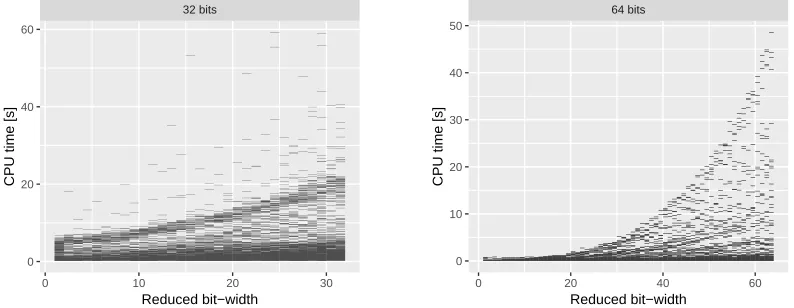
Figure 1: The scatter plots showcputimes of the solver CVC4 on a subset of 32bit and 64bit formulas from thesmt-librepository after changing their bit-width to the bit-width specified on thex-axis. The formulas are divided according to the original bit-width.
solver for quantifier-free formulas as a black box. The approach to quantified bit-vector formulas based on binary decision diagrams used by the solver Q3B [14] is sensitive to bit-width as well: as the bit-width increases, so do the sizes of the produced binary decision diagrams. These claims are supported by plots in Figure 1, which show solving times of the solver CVC4 on almost all 32bit and 64bit quantified bit-vector formulas from thesmt-librepository [2] after reducing their bit-widths to all values between 1 and the original bit-width. Details concerning the selection of benchmarks and reduction of their bit-widths are described in Section3.
Under reasonable complexity-theory assumptions, the effect of increasing bit-width is also observable from the complexity-theory point of view. For both quantifier-free and quantified formulas, the respective complexity classes of deciding satisfiability of formulas with bit-widths encoded in unary and in binary differ: NPvs.NEXPTIMEfor quantifier-free formulas and
PSPACEvs. AEXP(poly) for quantified formulas [15,13]. Therefore, the decision problem has to become harder with the increasing bit-width, otherwise the complexity classes for unary and binary encoding would coincide.
original formula by reducing the bit-widths used for floating-point variables. After solving the mixed-approximation, the solver checks its result against the original formula and if it fails, it refines the approximation [25,23]. In general, this approach works for arbitrary quantifier-free theory, but as far as we know, it has been implemented only for floating-point arithmetic.
For quantified bit-vector formulas, only one existing smtsolver tries to reduce bit-widths of some variables of the input formula: the solver Q3B uses approximations inspired by the abstractions by Bryant et al. and computes underapproximations and overapproximations by reducing bit-widths of existentially and universally quantified variables, respectively [14].
In this paper, we experimentally evaluate the thesis that the satisfiability of only a small number of quantified bit-vector formulas changes as the bit-widths of their variables decrease. We show that the satisfiability of the vast majority of quantified bit-vector formulas from the smt-librepository remains the same even after reducing bit-widths of their variables to a very small number of bits. Therefore, the results of this experimental paper suggest that extending the techniques described for quantifier-free formulas to quantified formulas or designing novel techniques for reducing bit-widths of quantified bit-vector formulas could be worthwhile. These techniques could allow smt solvers both solving more quantified bit-vector formulas and to solving them more quickly.
The paper is structured as follows: Section 2 provides the necessary background and no-tation for the bit-vector theory, Section 3 describes how we obtain formulas with reduced bit-widths, and Section 4 presents our experiments with the reduced formulas and results of these experiments. The following Section5 discusses challenges arising from these results.
2
Preliminaries
This section briefly recalls thetheory of fixed-size bit-vectors(BV orbit-vector theoryfor short). In the description, we assume familiarity with standard notions of many-sorted logic.
The bit-vector theory is a many-sorted first-order theory with infinitely many sorts corre-sponding to bit-vectors of various lengths, which are called theirbit-widths. We denote a variable
xof a sort corresponding to the bit-widthn≥1 asx[n]. The BV theory uses only three pred-icates, namelyequality (=),unsigned inequality of binary-encoded natural numbers (≤u), and
signed inequalityof integers in two’s complement representation (≤s). The theory also contains
various functions includingaddition (+),multiplication (·),unsigned division (÷u),signed
di-vision(÷s),unsigned remainder (%), bit-wiseand(&), bit-wiseor (|), bit-wiseexclusive or(ˆ),
left-shift (),right-shift (),concatenation (concat),zero extension extending the argument with n most-significant zero bits (zeroExtn), sign extension extending the argument withn
copies of the sign bit (signExtn), andextraction ofnbits starting from positionp(extractnp). The signature of BV theory also contains numerals for constantsm[n] for each bit-widthn >0 and each number 0≤m≤2n−1. Each term has an associated bit-width, which is denoted as bw(t).
For a valuationµthat assigns to each variable a value in its domain,J Kµdenotes the
evalu-ation function, which assigns to each termtthe bit-vector obtained by substituting variables in
tby their values given byµand evaluating all functions. Similarly, the functionJ Kµassigns to
each formulaϕthe value obtained by substituting free variables inϕwith values given byµand evaluating all functions, predicates, logic operators etc. A formulaϕis satisfiable ifJϕKµ = 1
for some valuationµ; it isunsatisfiable otherwise.
3
Obtaining Formulas with Reduced Bit-Widths
This section describes how we obtain formulas with the reduced bit-width from the original benchmarks. Given a formula ϕ and a desired bit-width bw ≥ 1, the following procedure produces the formula reduceF(ϕ, bw) in which all subterms have bit-width at most bw. In particular,reduceF(ϕ, bw) is obtained fromϕby:
• decreasing bit-width of all variables with bit-width more thanbwtobw,
• replacing all numerals with bit-width more thanbw by theirbw least-significant bits,
• decreasing the numbers of added bits by all zeroExtandsignExtfunctions so that the bit-width of the result is at mostbw.
Formally, we introduce the following recursive function reduceT that performs the above-described reduction of maximal bit-width on terms:
reduceT(m[n], bw) = (mmod 2min(n,bw))[min(n,bw)],
reduceT(x[n], bw) =x[min(n,bw)],
reduceT(t1t2, bw) =reduceT(t1, bw)reduceT(t2, bw) for ∈ {+,·,÷s,÷u,%,&,|,ˆ,,},
reduceT(extn(t), bw) =
(
reduceT(t, bw) if bw(t)≥bw, extmin(n,bw−bw(t))(t) if bw(t)< bw,
forext∈ {zeroExt,signExt}.
By using the functionreduceT on arguments of relation symbols in the formula, we obtain the functionreduceF that reduces maximal bit-widths in arbitrary formulas:
reduceF(t11t2, bw) =reduceT(t1, bw)1reduceT(t2, bw) for1∈ {=,≤u,≤s},
reduceF(¬ϕ, bw) =¬reduceF(ϕ, bw),
reduceF(ϕ1ϕ2, bw) =reduceF(ϕ1, bw)reduceF(ϕ2, bw) for ∈ {∧,∨}, reduceF(Qx[n].ϕ, bw) =Qx[min(n,bw)].reduceF(ϕ, bw) forQ∈ {∀,∃}.
Note that the functionreduceT is undefined on terms that contain extraction or concatenation. We have decided to exclude formulas that contain these operations for the following reasons. For extraction, there are multiple arbitrary choices of bits to extract: for example, the extraction of the middle (i.e. the third) bit from a 5bit variable reduced to 3 bits could extract the middle (i.e. the second) bit or the third bit. Reduction of a formula containing concatenation may require reducing a single variable to multiple different bit-widths – although this is possible to achieve by adding extractions, this would change the semantics of the formula beyond merely changing the bit-widths of variables in which we are interested. For example, after reducing the formulaconcat(x[4], y[4]) =concat(y[4], x[4]) to 6 bits, the variablexwould get reduced to 2 bits on the left-hand side, but would stay 4bit on the right-hand side.
We have written a simple tool that for an input formulaϕin thesmt-lib[1] format generates formulasreduceF(ϕ, i) for all i between 1 and the maximal bit-width (included) of a subterm of the formula ϕ. The tool uses api of the smt solver Z3 [7] and it is available at https:
//gitlab.fi.muni.cz/xjonas/FormulaReducer. Using this tool, we have generated reduced
versions of all quantified bit-vector formulas from thesmt-librepository except for
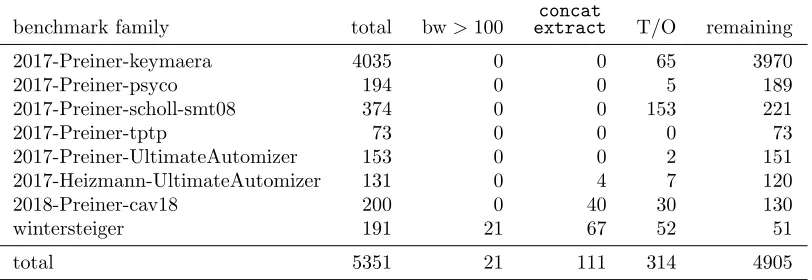
Table 1: The table shows the formulas excluded from our evaluation according to their families. The column total shows a total number of formulas in each family (except for 2018-Preiner-cav18, where all 4bit and 32bit benchmarks have been excluded). Next three columns show numbers of formulas excluded because of too large bit-width, use of operations concat and extract, and timeout of the solver for any of the reduced versions of the formula, respectively. The last column shows the number of remaining formulas on which the evaluation of effects of bit-width reduction on satisfiability was performed.
benchmark family total bw>100 extractconcat T/O remaining
2017-Preiner-keymaera 4035 0 0 65 3970
2017-Preiner-psyco 194 0 0 5 189
2017-Preiner-scholl-smt08 374 0 0 153 221
2017-Preiner-tptp 73 0 0 0 73
2017-Preiner-UltimateAutomizer 153 0 0 2 151
2017-Heizmann-UltimateAutomizer 131 0 4 7 120
2018-Preiner-cav18 200 0 40 30 130
wintersteiger 191 21 67 52 51
total 5351 21 111 314 4905
• 21 formulas that contain subterms of bit-width larger than 100 to keep the solving time reasonable;
• 111 formulas that use operationsconcator extract.
Table1shows the numbers of such excluded benchmarks according to their families.
From the set of 5219 non-excluded original formulas, we have generated in total 173 105 corresponding formulas with the reduced bit-widths. An archive containing all these generated formulas can be found athttp://fi.muni.cz/~xstrejc/lpar2018/ReducedBW.tar.gz.
4
Experimental Evaluation
Table 2: The table shows the numbers of benchmarks in the individual families whose satisfia-bility status is different for the original formula and for any reduced formula with bit-width at least 1, 2, 4, and 8 bits, respectively.
benchmark family benchmarks ≥1b ≥2b ≥4b ≥8b
2017-Preiner-keymaera 3970 64 19 12 4
2017-Preiner-psyco 189 49 5 0 0
2017-Preiner-scholl-smt08 221 1 0 0 0
2017-Preiner-tptp 73 20 10 3 0
2017-Preiner-UltimateAutomizer 151 41 32 3 0
2017-Heizmann-UltimateAutomizer 120 29 20 6 5
2018-Preiner-cav18 130 4 3 3 3
wintersteiger 51 8 6 5 2
total 4905 216 95 32 14
% 4.4 1.9 0.65 0.29
4.1
Satisfiability of Formulas with Reduced Bit-Widths
From the 4905 formulas, only 4.4% have a different satisfiability status for any of their reduced version. Moreover, only 1.9% have a different satisfiability status after reducing to 2 bits or more, 0.65% have a different satisfiability status after reducing to 4 bits or more, and only 0.29% have a different satisfiability status after reducing to 8 bits or more. Table2shows the numbers of such benchmarks precisely after grouping the formulas to their respective families. For example, the table shows that all decided formulas from the family 2017-Preiner-scholl-smt08, which contains the largest number of undecided benchmarks, have the same satisfiability status for all bit-widths from 2 to the original bit-width and all decided formulas from the family 2017-Preiner-psyco have the same satisfiability status for all bit-widths from 4 to the original bit-width. Note that the original bit-width of all benchmarks from these families is 32 bits.
Figure2presents these results graphically for all widths between 1 and the original bit-width. The figure shows the results only for formulas with the original bit-width of 32 or 64 bits as the number of benchmarks of other bit-widths is negligible. It can be seen that only under 0.25% of 32bit formulas change their satisfiability status after reducing their bit-width to 6 bits or more.
Figure3presents the satisfiability status of each reduction for all 32 formulas that changed the status after reducing the bit-width to 4 bits or more. Although the plot does not show names of the respective formulas due to the available space, the names can be found at the accompanying web page. Note that most of these formulas are unsatisfiable; this is caused by the fact that most of the formulas in the whole benchmark set are unsatisfiable. The plot contains four outstanding groups of formulas:
• Formulas 7–10 (intersection-example-onelane.proof-node{19355,20770,46589,54847}from 2017-Preiner-keymaera). These formulas are unsatisfiable for even bit-widths and satis-fiable for odd bit-widths because they contain subformulas equivalent to
(c[n]= (x[n]·x[n])÷s(2[n]·y[n])) ∧ (0[n] ≤sy[n]) ∧ (y[n]>sy[n]+c[n]) ∧ (y[n] ≤sc[n]).
Forn≥2, this subformula entails the formula
(x[n]·x[n])÷s(2[n]·y[n])≥s(2n−2)
[n]
0.0% 0.5% 1.0% 1.5% 2.0% 2.5% 3.0% 3.5% 4.0% 4.5%
0 2 4 6 8 10 12 14 16 18 20 22 24 26 28 30 32 34 36 38 40 42 44 46 48 50 52 54 56 58 60 62 64
Bit−width
P
ercentage of f
or m ulas Original bit−width 32 64
Figure 2: The plot shows the percentage of 32bit and 64bit benchmarks (y-axis) whose satis-fiability status is different for the original formula and for any reduced formula with a given (x-axis) or a larger bit-width.
● ● ● ● ● ● ● ● ● ● ● ● ● ● ● ● ● ● ● ● ● ● ● ● ● ● ● ● ● ● ● ● ● ● ● ● ● ● ● ● ● ● ● ● ● ● ● ● ● ● ● ● ● ● ● ● ● ● ● ● ● ● ● ● ● ● ● ● ● ● ● ● ● ● ● ● ● ● ● ● ● ● ● ● ● ● ● ● ● ● ● ● ● ● ● ● ● ● ● ● ● ● ● ● ● ● ● ● ● ● ● ● ● ● ● ● ● ● ● ● ● ● ● ● ● ● ● ● ● ● ● ● ● ● ● ● ● ● ● ● ● ● ● ● ● ● ● ● ● ● ● ● ● ● ● ● ● ● ● ● ● ● ● ● ● ● ● ● ● ● ● ● ● ● ● ● ● ● ● ● ● ● ● ● ● ● ● ● ● ● ● ● ● ● ● ● ● ● ● ● ● ● ● ● ● ● ● ● ● ● ● ● ● ● ● ● ● ● ● ● ● ● ● ● ● ● ● ● ● ● ● ● ● ● ● ● ● ● ● ● ● ● ● ● ● ● ● ● ● ● ● ● ● ● ● ● ● ● ● ● ● ● ● ● ● ● ● ● ● ● ● ● ● ● ● ● ● ● ● ● ● ● ● ● ● ● ● ● ● ● ● ● ● ● ● ● ● ● ● ● ● ● ● ● ● ● ● ● ● ● ● ● ● ● ● ● ● ● ● ● ● ● ● ● ● ● ● ● ● ● ● ● ● ● ● ● ● ● ● ● ● ● ● ● ● ● ● ● ● ● ● ● ● ● ● ● ● ● ● ● ● ● ● ● ● ● ● ● ● ● ● ● ● ● ● ● ● ● ● ● ● ● ● ● ● ● ● ● ● ● ● ● ● ● ● ● ● ● ● ● ● ● ● ● ● ● ● ● ● ● ● ● ● ● ● ● ● ● ● ● ● ● ● ● ● ● ● ● ● ● ● ● ● ● ● ● ● ● ● ● ● ● ● ● ● ● ● ● ● ● ● ● ● ● ● ● ● ● ● ● ● ● ● ● ● ● ● ● ● ● ● ● ● ● ● ● ● ● ● ● ● ● ● ● ● ● ● ● ● ● ● ● ● ● ● ● ● ● ● ● ● ● ● ● ● ● ● ● ● ● ● ● ● ● ● ● ● ● ● ● ● ● ● ● ● ● ● ● ● ● ● ● ● ● ● ● ● ● ● ●● ● ● ● ● ● ● ● ● ● ● ● ● ● ● ● ● ● ● ● ● ● ● ● ● ● ● ● ● ● ● ● ● ● ● ● ● ● ● ● ● ● ● ● ● ● ● ● ● ● ● ● ● ● ● ● ● ● ● ● ● ● ● ● ● ● ● ● ● ● ● ● ● ● ● ● ● ● ● ● ● ● ● ● ● ● ● ● ● ● ● ● ● ● ● ● ● ● ● ● ● ● ● ● ● ● ● ● ● ● ● ● ● ● ● ● ● ● ● ● ● ● ● ● ● ● ● ● ● ● ● ● ● ● 0 20 40 60
1 2 3 4 5 6 7 8 9 10 11 12 13 14 15 16 17 18 19 20 21 22 23 24 25 26 27 28 29 30 31 32 Benchmark ID
Bit−width
Satisfiability status
● sat
unsat
which is unsatisfiable for even bit-widths, but satisfiable for odd bit-widths by setting
x[n] 7→(2(n−1)/2)[n] andy[n] 7→(2(n−1)−1)[n].
• Formulas 11–15 (jain 7 true unreach-call true-no-overflow i{215,242,245,262,475} from 2017-Heizmann-UltimateAutomizer). Satisfiability of these formulas differs for bit-widths less than 23 and at least 23, because these formulas contain the numeral (presented here in binary)
1111 1111 1100 0000 0000 0000 0000 0000,
which gets reduced to 0 after reduction to less then 23 bits.
• Formulas 27–29 (check eq bvashr0 64bit and check ne{bvlshr0,bvshl0} 64bit from 2018-Preiner-cav18). Satisfiability of these formulas is different for the original bit-width of 64 bits and for almost all smaller bit-widths because the formulas contain a subformula similar to (x[64]<u64[64])→ψ, whereψcontains a subterm of the form tx[64].
• Formula 30 (mmedia gsm610 gsm6102.cfromwintersteiger). Satisfiability of this formula is different for reduction to 31 bits, as it contains a subformula of the form
x[32]≤s0100 0000 0000 0000 0000 0000 0000 0000,
in which the second argument has a negative sign-bit precisely for the reduction to 31 bits.
Detailed results together with the raw data files and scripts we used to produce them can be found at: http://fi.muni.cz/~xstrejc/lpar2018/
5
Discussion
The experimental evaluation in the previous section shows that the satisfiability of the vast majority of quantified bit-vector formulas remains the same even after reducing their maximal bit-widths to a very small number of bits. In our opinion, this observation can be helpful in several ways:
• Similarly to the case of the approximation framework of Zelji´c et al. for quantifier-free formulas, the performance of smtsolvers for quantified bit-vectors could be improved by first solving a reduced version of the input formula and then checking the result against the original formula. For example, the solver Boolector computes symbolically expressed Skolem functions, which certify satisfiability, and Herbrand functions, which certify un-satisfiability [20]. These functions can be computed from a reduced formula and their validity can be checked against the original formula. More generally, in an smt solver based on quantifier instantiation such as Boolector, CVC4 [19], or Z3 [22], the set of quantifier instances that are sufficient to decide satisfiability of the reduced formula can be checked against the original formula.
• As a practical use of the previous point, it could be possible for some formulas to compute a width for which the reduced formula is equisatisfiable to the input one. Such a bit-width could be used to decide the satisfiability without using the original bit-bit-width.
6
Conclusions
We have experimentally evaluated the effect of reducing width of variables in quantified bit-vector formulas fromsmt-librepository and have shown that satisfiability of the vast majority of these formulas remains the same even after reducing bit-widths of variables to a very small number of bits.
References
[1] Clark Barrett, Pascal Fontaine, and Cesare Tinelli. The SMT-LIB Standard: Version 2.5. Tech-nical report, Department of Computer Science, The University of Iowa, 2015. Available at
www.SMT-LIB.org.
[2] Clark Barrett, Pascal Fontaine, and Cesare Tinelli. The Satisfiability Modulo Theories Library (SMT-LIB). www.SMT-LIB.org, 2016.
[3] Clark W. Barrett, Roberto Sebastiani, Sanjit A. Seshia, and Cesare Tinelli. Satisfiability Modulo Theories. InHandbook of Satisfiability, pages 825–885. IOS Press, 2009.
[4] Dirk Beyer, Stefan L¨owe, and Philipp Wendler. Benchmarking and Resource Measurement. In
Model Checking Software - 22nd International Symposium, SPIN 2015, Proceedings, volume 9232 ofLecture Notes in Computer Science, pages 160–178. Springer, 2015.
[5] Randal E. Bryant, Daniel Kroening, Jo¨el Ouaknine, Sanjit A. Seshia, Ofer Strichman, and Bryan A. Brady. An abstraction-based decision procedure for bit-vector arithmetic. STTT, 11(2):95–104, 2009.
[6] Byron Cook, Daniel Kroening, Philipp R¨ummer, and Christoph M. Wintersteiger. Ranking func-tion synthesis for bit-vector relafunc-tions.Formal Methods in System Design, 43(1):93–120, 2013. [7] Leonardo Mendon¸ca de Moura and Nikolaj Bjørner. Z3: An efficient SMT solver. InTools and
Algorithms for the Construction and Analysis of Systems, 14th International Conference, TACAS 2008, Held as Part of the Joint European Conferences on Theory and Practice of Software, ETAPS 2008, Budapest, Hungary, March 29-April 6, 2008. Proceedings, volume 4963 ofLecture Notes in Computer Science, pages 337–340. Springer, 2008.
[8] Leonardo Mendon¸ca de Moura and Dejan Jovanovic. A model-constructing satisfiability calcu-lus. InVerification, Model Checking, and Abstract Interpretation, 14th International Conference, VMCAI 2013, Rome, Italy, January 20-22, 2013. Proceedings, pages 1–12, 2013.
[9] Andreas Fr¨ohlich, Armin Biere, Christoph M. Wintersteiger, and Youssef Hamadi. Stochastic Local Search for Satisfiability Modulo Theories. InProceedings of the Twenty-Ninth AAAI Conference on Artificial Intelligence, January 25-30, 2015, Austin, Texas, USA., pages 1136–1143, 2015. [10] Sumit Gulwani, Saurabh Srivastava, and Ramarathnam Venkatesan. Constraint-based invariant
inference over predicate abstraction. In Verification, Model Checking, and Abstract Interpreta-tion, 10th International Conference, VMCAI 2009, Savannah, GA, USA, January 18-20, 2009. Proceedings, pages 120–135, 2009.
[11] Peer Johannsen. Reducing bitvector satisfiability problems to scale down design sizes for RTL property checking. InProceedings of the Sixth IEEE International High-Level Design Validation and Test Workshop 2001, Monterey, California, USA, November 7-9, 2001, pages 123–128, 2001. [12] Peer Johannsen. Speeding up hardware verification by automated data path scaling. PhD thesis,
[13] Martin Jon´aˇs and Jan Strejˇcek. On the Complexity of the Quantified Bit-Vector Arithmetic with Binary Encoding. Inf. Process. Lett., 135:57–61, 2018.
[14] Martin Jon´aˇs and Jan Strejˇcek. Solving Quantified Bit-Vector Formulas Using Binary Decision Diagrams. InTheory and Applications of Satisfiability Testing - SAT 2016 - 19th International Conference, Bordeaux, France, July 5-8, 2016, Proceedings, volume 9710 ofLecture Notes in Com-puter Science, pages 267–283. Springer, 2016.
[15] Gergely Kov´asznai, Andreas Fr¨ohlich, and Armin Biere. Complexity of fixed-size bit-vector logics.
Theory Comput. Syst., 59(2):323–376, 2016.
[16] Daniel Kroening, Matt Lewis, and Georg Weissenbacher. Under-approximating loops in C pro-grams for fast counterexample detection. In Computer Aided Verification - 25th International Conference, CAV 2013, volume 8044 ofLNCS, pages 381–396. Springer, 2013.
[17] Jan Mr´azek, Petr Bauch, Henrich Lauko, and Jiˇr´ı Barnat. SymDIVINE: Tool for control-explicit data-symbolic state space exploration. InModel Checking Software - 23rd International Sympo-sium, SPIN 2016, Co-located with ETAPS 2016, Eindhoven, The Netherlands, April 7-8, 2016, Proceedings, pages 208–213, 2016.
[18] Aina Niemetz, Mathias Preiner, and Armin Biere. Propagation based local search for bit-precise reasoning. Formal Methods in System Design, 51(3):608–636, 2017.
[19] Aina Niemetz, Mathias Preiner, Andrew Reynolds, Clark Barrett, and Cesare Tinelli. Solving quantified bit-vectors using invertibility conditions. In Computer Aided Verification - 30th In-ternational Conference, CAV 2018, Held as Part of the Federated Logic Conference, FloC 2018, Oxford, UK, July 14-17, 2018, Proceedings, Part II, pages 236–255, 2018.
[20] Mathias Preiner, Aina Niemetz, and Armin Biere. Counterexample-Guided Model Synthesis. In
Tools and Algorithms for the Construction and Analysis of Systems - 23rd International Confer-ence, TACAS 2017, Held as Part of the European Joint Conferences on Theory and Practice of Software, ETAPS 2017, Uppsala, Sweden, April 22-29, 2017, Proceedings, Part I, volume 10205 ofLecture Notes in Computer Science, pages 264–280. Springer, 2017.
[21] Saurabh Srivastava, Sumit Gulwani, and Jeffrey S. Foster. From program verification to pro-gram synthesis. InProceedings of the 37th ACM SIGPLAN-SIGACT Symposium on Principles of Programming Languages, POPL 2010, Madrid, Spain, January 17-23, 2010, pages 313–326, 2010. [22] Christoph M. Wintersteiger, Youssef Hamadi, and Leonardo Mendon¸ca de Moura. Efficiently
solving quantified bit-vector formulas. Formal Methods in System Design, 42(1):3–23, 2013. [23] Aleksandar Zeljic, Peter Backeman, Christoph M. Wintersteiger, and Philipp R¨ummer. Exploring
Approximations for Floating-Point Arithmetic Using UppSAT. In Automated Reasoning - 9th International Joint Conference, IJCAR 2018, Held as Part of the Federated Logic Conference, FloC 2018, Oxford, UK, July 14-17, 2018, Proceedings, pages 246–262, 2018.
[24] Aleksandar Zeljic, Christoph M. Wintersteiger, and Philipp R¨ummer. Deciding Bit-Vector For-mulas with mcSAT. InTheory and Applications of Satisfiability Testing - SAT 2016 - 19th Inter-national Conference, Bordeaux, France, July 5-8, 2016, Proceedings, pages 249–266, 2016. [25] Aleksandar Zeljic, Christoph M. Wintersteiger, and Philipp R¨ummer. An Approximation