IJHR
Open Access
Abstract
Background and Objectives: Effective nurse-physician communication is essential for provision of high quality clini-cal care. Research into nurse-physician communication is a new field in Iran, and the importance of the issue clini-calls for further investigation. In response to this necessity, this study aimed to assess nurses’ perception of nurse-physician communication in teaching hospitals affiliated with Hormozgan University of Medical Sciences, situated in Bandar Ab-bas, at the shore of the Persian Gulf.
Methods: In this cross-sectional study, 155 nurses were invited to complete the Persian version of the nurse-physician communication questionnaire, originally developed by Schmidt and Svarstad [Soc Sci Med 2002, 54:1767-1777.] The questionnaire comprises 18 items related to four dimensions of the construct, including Frustration with Interaction, Mutual Understanding, Openness, and Relevance and Satisfaction. One hundred and thirty valid questionnaires were returned and used for data analysis (response rate = 83.8%). Data were summarized using descriptive statistics, and t test and ANOVA were used to compare the mean scores between demographic groups. Data were analyzed using SPSS Version 13 Software. P < 0.05 was considered as statistically significant.
Findings: Nurse-physician communication scored marginally higher than mid-level (53.8%). The dimensions of nurse-physician communication (sub-scales) were rated as follows: Frustration with Interaction: 77%; Mutual Understanding 65%; Openness: 47%, and Relevance and Satisfaction: 42%. Hence, the two latter dimensions can be considered as the prime points of focus for interventions, based on both absolute and relative ratings. In comparison with their male counterparts female nurses perceived their communication with physicians to be more positive (P = 0.017). Nurses with professional work experience more than 20 years had a better perception of nurse-physician communication relative to other work experience groups (P < 0.01). No significant difference in perception of nurse-physician communication was identified between different educational and age groups.
Conclusions: Within the limitations of the study, this quantitative evaluation of nurse-physician communication in Iran does not represent a satisfactory outlook. Survey results indicate the need for large-scale and in-depth studies to determine the nationwide situation of this important health care issue.
Keywords: Nurse-physician Communication, Hospital, Healthcare Quality, Patient Safety
Background and Objectives
Communication and collaboration between differ-ent health professionals is a hallmark of health care quality [1], and a determinant of patients’ wellbeing [2]. Among the most extensively explored health care interprofessional communications is communi-cation between physician and nurse, given their pri-mary responsibilities for patient care [3]. Evidence shows that successful Nurse-physician
Communi-cation (NPC) is associated with positive attitudes of nurses and physicians towards patients [4], and consequently higher quality of health care [5, 6]. Conversely, breakdown of coordinated and positive interaction between these two groups of profession-als has been shown to lead to unhealthy work envi-ronments and poor patient outcomes [7-9]. A particu-lar aspect of health care that is severely affected by NPC is the safety of patient care [1, 9-12]. Combined qualitative and quantitative analyses link the status of safety culture to the level of nurse satisfaction in their communication with physicians [13]. It is evi-dent that many hazards of patient care can be elimi-nated if NPC difficulties are reduced [8, 11, 14].
Nurses’ Perception of Nurse-physician
Communication: A Questionnaire-based
Study in Iran
Teamur Aghamolaei
1, Sedigheh Sadat Tavafian
2*, Laleh Hasani
1, Babak Moeini
31Department of Health Services, School of Health, Hormozgan University of Medical Sciences, Bandar Abbas, Iran. 2Department of Health Education, School of Medical Sciences, Tarbiat Modares University, Tehran, Iran. 3 Department of Public Health, School of Health, Hamadan University of Medical Sciences, Hamadan, Iran.
In addition to safety, studies also identified links between NPC and other dimensions of health care. Several investigations indicated the association of nurses’ satisfaction and perception of their work-life quality with their perceived communication with phy-sicians [15, 16]. The importance of these factors to nurse recruitment, retention and productivity, thereby the performance of health care, has been established [15, 17]. Communication skills are also a critical prerequisite to successful interprofessional teamwork and collaborative process that are crucial to both clinical practice and health care outcomes [18, 19]. These facts point to NPC as a clinical factor of ex-treme importance needing substantial support from clinical managers if they aim to realize efficient and high quality health care.
Despite that the impact of interdisciplinary commu-nication on safe and effective care is well recognized [20, 21], building good communication between phy-sicians and nurses remains a persistent challenge [8, 16, 20]. Studies show that establishing a clear and complete communication between these two groups of professionals is not easy to achieve [22], and an inadequate nurse-physician relationship will continue to produce adverse outcomes for patients [23]. To understand the reason, the complexity of NPC [22] should be recognized in terms of both context and content [9, 13]. Patient care creates a difficult and stressful work context, which makes nurse-physician relationship prone to daily conflicts [24, 25]. A major-ity of these conflicts is induced by disparate expecta-tions of nurses and physicians concerning roles and responsibilities of themselves and the other group [26]. In addition, it is now revealed that nurses and physicians have discrepant views on several respects such as the extent to which collaboration and joint decision-making are valued, the way that appropriate interprofessional communication should be defined, the quality of nurse-physician interactions, and the understanding of patient goals [7]. Added to these sources of conflict can be physicians’ disruptive be-havior, their reluctance to communicate with nurses, and their emotional difficulties [27]. The multiplicity of the factors influencing NPC and their root in complex-ities concerning human psychology and patient care dynamics renders development of high quality NPC a formidable task [22]. This challenge calls for high commitment of healthcare organization to develop appropriate strategies and procedures to effectively address NPC barriers [3].
Successful physician-nurse communication can be defined as transferring correct information in an open and timely manner [5]. Besides that, however, the
construct can be described in terms of other dimen-sions such as mutual understanding, mutual respect, mutual satisfaction, and conflict management [5, 6, 28]. This multifaceted nature of the NPC makes it vul-nerable to many psychological, environmental, orga-nizational, and demographic factors. Similar to many other constructs, addressing NPC challenges relies on evaluating its constituting dimensions to enable developing and prioritizing intervention strategies.
Despite the fact that NPC has been the focus of much attention for decades [2], research into nurse-physi-cian communication is new in Iran. Recently, Farahani
et al. (2011) conducted a qualitative study to explore
communication barriers from the perspective of mul-tiple players in cardiac care settings including nurses, physicians, patients, and families [29]. They identified lack of nurse-physician collegiality, problematic com-munication between the healthcare team, patients and their families, and cultural challenges as the major causative themes. Another qualitative study by Vais-moradi et al. (2011) indicated lack of independence in decision-making, inadequate acknowledgment of nurs-es, and unequal support by the healthcare system as the significant experiences of Iranian nurses regarding NPC [30]. While these studies provided valuable infor-mation about the main challenges facing development of high quality NPC in Iran, they were not designed to quantify the status of the phenomenon in comparison with the other countries. In addition, both studies were conducted in Tehran, the metropolitan capital of Iran, hence they do not necessarily reflect the opinions of health care professionals across the country. To con-tribute to providing provincial data on the status of NPC in Iran, we surveyed nurses’ perceptions of their communication with physicians in hospitals affiliated with Hormozgan University of Medical Sciences, us-ing a quantitative approach. Hormozgan is a southern Iranian province situated at the shores of the Persian Gulf. The comparative analysis of the results and their policy implications is reported in this paper. We believe that conducting such studies and their accumulation will contribute to developing a nationwide perspective of the nurse-physician relationship, which in turn would aid policymakers in planning insightful interventional strategies.
Methods
Study Design and Settings
Population and Sampling
All nurses at the hospitals with a work experience of at least one year were targeted as the study population. Firstly, in order to select the participants, a compre-hensive list of all eligible nurses in each hospital was provided. The respondents were selected from the list by simple random sampling, resulting in a sample of 155 subjects. Data was collected using a self-admin-istered questionnaire. Twenty-five of the participants were then excluded since they either did not return the questionnaires or filled them out incompletely. There-fore, finally, a total of 130 remaining questionnaires were analyzed (response rate = 83.8%).
Measuring Instrument
The questionnaire developed by Schmidt and Svarstad [31] was used to assess the quality of communication between nurses and physicians. The scale was used by these authors to measure the quality of NPC in Swedish nursing homes. This questionnaire comprises 18 items re-lated to four dimensions of NPC, including Openness (four items), Relevance and Satisfaction (eight items), Mutual Understanding (two items), and Frustration with Interaction (four items). The items were measured on a five-point Lik-ert scale ranging from 1 = ‘none’/’not at all’/’very difficult’ to 5 = ‘a lot’/’extremely’/’very easy’. To avoid halo effect, some questions were negatively worded.
The questionnaire was translated into Persian us-ing a backward-forward translation technique [32]. A panel of experts was asked to translate the items from English into Persian and vice versa. Minor trans-lation adjustments were carried out by contribution of the authors, and the two versions were finally found to be equal.
Data Analysis
Data was summarized using descriptive statistics. The scores of the negatively worded items were reversed so that a higher score always corresponds to a more positive perception of nurses towards NPC. The Likert type scale was converted to a 100-point scale (1 = ‘100’, 2 = ‘75’, 3 = ‘50’, 4 = ‘25’, 5 = ‘0’) to facilitate comparison of the results with previous studies. Scores above 75 were taken to rep-resent ‘good’ or ‘satisfactory’ levels of perception towards NPC, within 50-75 were considered as ‘moderate’, and be-low 50 were considered as ‘inadequate’ or ‘unsatisfactory’. The internal consistency reliability for the scale was mea-sured by Cronbach’s alpha. The reliability of the original scale has been reported 0.92 [31]. In this study, an internal consistency reliability of 0.76 was obtained for the 18-item questionnaire. In addition, Cronbach’s alpha for each di-mension of NPC was calculated to be: 0.72 for Relevance
and satisfaction, 0.83 for Openness, 0.77 for Mutual Un -derstanding, and 0.89 for Frustration with Interaction. The fact that all alpha coefficients were above the 0.7 criterion ensures sufficient reliability of the scale and its subscales.
T test and ANOVA were used to compare mean nurses’ perception of NPC between demographic groups. Data were analyzed using SPSS Version 13 Software and P < 0.05 was considered as statisti -cally significant.
Ethics
Before administering the questionnaires, nurses were informed regarding the purpose of the study and writ
-ten consent was obtained for their participation. To ensure confidentiality, the respondents were asked to complete the questionnaire anonymously.
Results
Participant Demographics
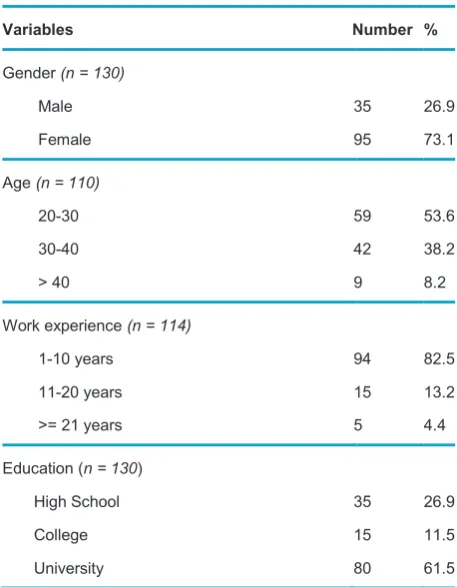
Table 1 summarizes the professional and demographic information of the participants. Among total subjects, 73.1% were female, 82.5% had hospital work experi -ence of 1-10 years, and 61.5% had a university de -gree. The respondents’ ages varied between 20 and 48 averaging ~ 30 years.
Table 1 Demographic and professional characteristics of the participants
Variables Number %
Gender (n = 130)
Male 35 26.9
Female 95 73.1
Age (n = 110)
20-30 59 53.6
30-40 42 38.2
> 40 9 8.2
Work experience (n = 114)
1-10 years 94 82.5
11-20 years 15 13.2
>= 21 years 5 4.4
Education (n = 130)
High School 35 26.9
College 15 11.5
Survey Findings
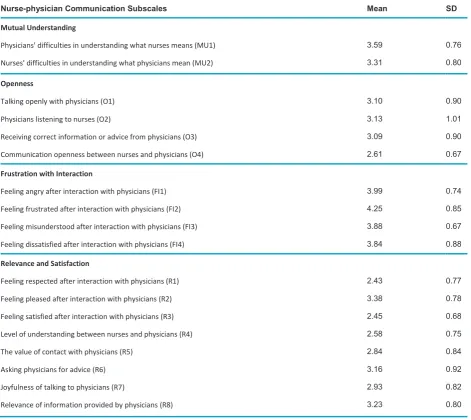
The score means of the total scale and its four subscales are displayed in Table 2. The overall measure of NPC av-eraged 53.8% ranging from 32.2% to 84.7%.
Among NPC dimensions, the highest score mean was obtained by Frustration with Interaction (77.5%), where ‘Feeling frustrated after interaction with phy-sicians’ was the highest scoring item (81.25%), and ‘Feeling dissatisfied after interaction with physician’ was the lowest scoring item (71%). The second high-est score was given to Mutual Understanding (65%) where ‘Physicians’ difficulties to understand what nurses mean’ was rated the highest (64.7%), and ‘Nurses’ difficulty in understanding what physicians mean’ was rated the lowest (57.7%). The dimension Openness achieved the third rank (47.5%) with the highest score (53.2%) received by ‘Physicians listen-ing to nurse’, and the lowest score (40.2%) received by ‘Communication openness between nurses and
physicians’. Finally, the dimension Relevance and Satisfaction was rated at the lowest level (42.5%) with ‘Feeling pleased after interaction with physician’ scor-ing the highest (57%), and ‘Feelscor-ing respected after interaction with physician’ scoring the lowest (35.7%).
Comparison between Demographic Groups
Table 3 compares perceived NPC quality between male and female nurses. The two genders showed strong significant differences in their perception of Mutual Un-derstanding and Frustration with Interaction (P < 0.01). In addition, female nurses assessed total quality of NPC significantly higher as compared with their male counter-parts (P < 0.05).
In addition, ANOVA indicated that nurses with work ex-perience > 20 years had significantly better perception of NPC quality compared with other groups (F = 5.22, P = 0.007). No significant difference in perception of NPC was identified between education and age groups.
Table 2 Score Mean and Standard Deviation of Nurse-physician Communication Subscales
Nurse-physician Communication Subscales Mean SD
Mutual Understanding
Physicians' difficulties in understanding what nurses means (MU1) 3.59 0.76
Nurses' difficulties in understanding what physicians mean (MU2) 3.31 0.80
Openness
Talking openly with physicians (O1) 3.10 0.90
Physicians listening to nurses (O2) 3.13 1.01
Receiving correct information or advice from physicians (O3) 3.09 0.90
Communication openness between nurses and physicians (O4) 2.61 0.67
Frustration with Interaction
Feeling angry after interaction with physicians (FI1) 3.99 0.74
Feeling frustrated after interaction with physicians (FI2) 4.25 0.85
Feeling misunderstood after interaction with physicians (FI3) 3.88 0.67
Feeling dissatisfied after interaction with physicians (FI4) 3.84 0.88
Relevance and Satisfaction
Feeling respected after interaction with physicians (R1) 2.43 0.77
Feeling pleased after interaction with physicians (R2) 3.38 0.78
Feeling satisfied after interaction with physicians (R3) 2.45 0.68
Level of understanding between nurses and physicians (R4) 2.58 0.75
The value of contact with physicians (R5) 2.84 0.84
Asking physicians for advice (R6) 3.16 0.92
Joyfulness of talking to physicians (R7) 2.93 0.82
Discussion
The aim of this study was to provide insight into Iranian nurses’ perception of nurse-physician communication using a sample from teaching hospitals of Hormozgan University of Medical Sciences. While our participants had a moderate assessment of NPC, their assessment was lower than that reported by Schmidt and Svarstad [31] (53.8% and 74.5%, respectively). In addition, all dimensions of nurse-physician communication were rated lower in our study as compared with the Swed-ish study [31], with the exception of Frustration with Interaction that scored marginally higher in our survey. Moreover, the order of scores was not similar in the two studies, indicating that the evaluation of the NPC by Iranian nurses does not match the pattern of the corresponding ratings in Sweden.
Frustration with Interaction was found to be the highest rated dimension of NPC in our survey. The need to cope with frustrating communication prob-lems results in undesirable emotional over notes, which in turn may induce or intensify other problems [8]. Although nurses’ perception of frustration in inter-action with doctors fell within the ‘good’ range of scor-ing, the distance from the ideal condition still leaves room for improvements.
The second highest rated factor was Mutual Un-derstanding, which fell within the moderate range of scoring. This factor is rated 14% lower by Iranian nurses than by Swedish nurses [31]. Mutual under-standing is presumably the most fundamental factor for a successful communication [5]. Hence, hospital leadership should attempt to facilitate this crucial communicational dimension, even though the related rating is not unsatisfactory.
The dimension Openness fell short of even a mod-erate assessment with a ~ 24% lower rating as com-pared with the Scandinavian study [31]. Studies show that communication openness is strongly influenced
by management support, and in turn, strongly influ-ences different dimensions of health care quality [33, 34]. Lack of adequate openness in the studied hospi-tals, therefore, calls for investigation of causative fac-tors to guide development of interventional programs.
Another dimension evaluated lower than moder-ate was Relevance and Satisfaction, which also dis-played the largest negative deviation from the study of Schmidt and Svarstad (32.5%) [31]. This dimension accounted for the lowest rated measures of NPC, in-cluding nurses’ perceptions of respect, satisfaction, and openness in interaction with physicians, all being descriptors of an efficient communication and collab-orative process [19, 35]. In addition, the importance of these measures to nurses’ job satisfaction, and nurses’ perception of work-life quality and patient safety is well documented [17]. Moreover, measures of the value of contact with physicians, enjoyment of talking with physicians, and feeling pleased after in-teracting with physicians, all scored below the 50% level. Physicians’ sense of humor, which can poten-tially enhance nurses’ enjoyment of interaction with them, has been shown to be a predictor of nurses’ job satisfaction [36]. In addition, a positive correlation between nurses’ perceptions of physicians’ use of nurse-centered communication practices and patient-centered communication practices is demonstrated [36]. Given these facts, the poor rating of ‘Relevance and satisfaction’, highlights the need for investigation into causative factors.
Our study identified a significantly higher per-ceived NPC by female nurses than by male nurses. The difference arose from more positive perception of female nurses towards ‘Frustration with Interac-tion and Mutual Understanding relative to their mail colleagues. This result, besides the fact that a re-verse evaluation pattern was not observed in any dimensions, introduces male nurses as the prime focus group for NPC improvement plans.
Nonethe-Table 3 Comparison of mean nurses’ perceptions of NPC subscales between males and females
Subscale Total Male Female Test of difference
Mean SD Mean SD Mean SD t df Sig
Mutual Understanding 3.6 0.61 3.2 0.58 3.7 0.60 -3.79 128 0.000
Openness 2.9 0.62 2.8 0.66 2.9 0.61 1.73 128 0.086
Frustration with Interaction 4.1 0.59 3.7 0.59 4.2 0.56 -2.94 127 0.004
Relevance and Satisfaction 2.7 0.58 2.6 0.64 2.7 0.57 -0.316 128 0.753
less, difference in evaluation of NPC quality by the two genders did not extend to the rating pattern of the construct’s dimensions; the order of dimension scores remained identical between the genders. This indicates that there is no fundamental cross-gender difference in nurses’ perception of their communica-tion with physicians. Therefore, similar intervencommunica-tion strategies are likely to work for both populations, but a higher focus on male nurses would yield more effective results.
Our study also identified a significant difference in nurses’ perception of NPC based on their length of experience. Nurses with over 20 years of experience had a more positive perception of NPC. This observa-tion contrasts with precedent studies in which years of experience and satisfaction with communication were found inversely related [37, 38]. In addition, lack of significant difference in NPC perception between education groups was found inconsistent with previ-ous findings [16].
Identifying the reasons for unsatisfactory nurse per-ception of some NPC factors – Relevance and Satis-faction and Openness – was beyond the scope of this study. Previous studies, however, identified factors such as poor communication skills, misunderstanding of roles, perceived differences in position of nurses and physicians, differences in educational level, role expectations, and gender issues as potential barri-ers to effective nurse-physician communication [16]. While the same factors may underlie nurses’ inade-quate perception of NCP in our study, more specific data is required to attribute them to the Iranian nurse community.
Through their literature review and interview with 141 American physicians, managers and nurses, Schmalenberg et al. concluded that joint nurse/ physician practice committees, integrated patient records, joint practice record reviews, and the use of protocols or critical pathways in caring specific patient groups, assist communication between nurs-es and physicians [39]. The authors also identified trust, respect, shared leadership, and recognition of unique contribution, collegiality, and open com-munication, as enablers of improved communication [39]. Excellent listening skills, superb administrative support, and collective commitment to overcome traditional hierarchy and professional stereotyping, has been identified as requirements for develop-ment of successful communications [1]. Our results reflect the usefulness of promoting similar factors to enhance NPC in the studied hospitals.
Conclusions
Marginally higher than mid-way, the nurses’ perception of nurse-physician communication fell within the ‘mod-erate’ range of scoring. The score mean of the NPC also fell considerably short of the corresponding rating in Sweden. Considering the well-established impact of NPC quality on patient outcomes, our findings high-light the need for developing and implementing NPC improvement strategies to enhance quality of health care in the studied hospital. Frustration with Interac-tion was the only satisfactory dimension of NPC, with ‘Mutual understanding’ being assessed at the moder-ate level, and ‘Openness’ and ‘Relevance and satis-faction’ scoring below mid-level. Hence, the two latter factors represent the prioritized point of focus for NPC interventional programs. The study also found a sig-nificantly higher perception of NPC by female nurses than by their male counterparts. However, the order of ratings remained identical across genders. In ad-dition, a significantly higher perception of NPC was identified for the nurses of over 20 years of experience compared with other work experience groups. While this study provides an initial quantitative evaluation of perceived Iranian nurses’ communication with physi-cians, the study limitations, including limited sample size, having enrolled only teaching hospitals’ nurses, and limited geographic diversity of the involved hospi-tals advise caution in the generalization of the results to an overall Iranian context. The study findings, how-ever, have adequate resolution to indicate the need for in-depth and nationwide inquiry into NPC.
Abbreviations
(NPC): nurse-physician communication
Competing Interests
The authors declare no competing interests.
Authors’ Contributions
TA designed the study and contributed to data analysis, in
-terpretation of the results and manuscript preparation. SST was involved in data analysis, interpretation of the results and revision of the manuscript. LA collected the data. BM con tributed to manuscript preparation. All authors read and ap proved the final manuscript.
Acknowledgements
lationship between job stress, quality of working life and turnover intention among hospital employees. Health Serv Manage Res 2011, 24(4):170-81.
18. Thomas EJ, Sexton JB, Helmreich RL. Discrepant atti-tudes about teamwork among critical care nurses and physicians. Crit Care Med 2003, 31(3):956-59.
19. Lockhart-Wood K. Collaboration between nurses and doctors in clinical practice. Br J Nurs 2000 9(5):276-80. 20. O'Leary KJ, Thompson JA, Landler MP, Kulkarni N,
Havi-ley C, Hahn K, Jeon J, Wayne DB, Baker DW, Williams MV. Patterns of nurse–physician communication and agreement on the plan of care. Qual Saf Health Care 2010, 19(3):195-99.
21. Martin JS, Ummenhofer W, Manser T, Spirig R. Interpro-fessional collaboration among nurses and physicians: mak-ing a difference in patient outcome. Swiss Med Wkly 2010 140:w13062.
22. Manning ML. Improving clinical communication through structured conversation. Nurs Econ 2006, 24(5):268-71. 23. Greenfield LJ. Doctors and Nurses: A Troubled Partnership.
Ann Surg 1999, 230(3):279.
24. Vivar CG. Putting conflict management into practice: a nursing case study. J Nurs Manag 2006, 14(3):201-06. 25. Keenan GM, Cooke R, Hillis SL. Norms and nurse
manage-ment of conflicts: Keys to understanding nurse–physician collaboration. Res Nurs Health 1998, 21(1):59-72.
26. Reichman S. Conflicts and collaboration: nurse-phy-sician issues in the hospital. Bull N Y Acad Med 1984 60(8):819-24.
27. Morinaga K, Ohtsubo Y, Yamauchi K, Shimada Y. Doc-tors’ traits perceived by Japanese nurses as communica-tion barriers: A quescommunica-tionnaire survey. Int J Nurs Stud 2008, 45(5):740-49.
28. Cadogan MP, Franzi C, Osterweil D, Hill T. Barriers to effec-tive communication in skilled nursing facilities: differences in perception between nurses and physicians. J Am Geriatr Soc 1999 47(1):71-75.
29. Farahani MA, Sahragard R, Carroll JK, Mohammadi E. Communication barriers to patient education in cardiac in-patient care: A qualitative study of multiple perspectives. Int J Nurs Pract 2011, 17(3):322-28.
30. Vaismoradi M, Salsali M, Esmaeilpour M, Cheraghi MA. Perspectives and experiences of Iranian nurses regarding nurse-physician communication: a content analysis study. Jpn J Nurs Sci 2011 8(2):184-93.
31. Schmid IK, Svarstad BL. Nurse–physician communication and quality of drug use in Swedish nursing homes. Soc Sci Med 2002, 54(12):1767-77.
32. Sperber AD. Translation and validation of study instru-ments for cross-cultural research. Gastroenterology 2004, 126:S124-S28.
33. Frankel AS, Leonard MW, Denham CR. Fair and Just Cul-ture, Team Behavior, and Leadership Engagement: The Tools to Achieve High Reliability. Health Serv Res 2006 41(4 Pt 2):1690-709.
34. Arabloo J, Rezapour A, Ebadi Fard Azar F, Safari H, Mo-basheri Y. Measuring Patient Safety Culture in Iran Using Received: 15 October 2012 Revised: 13 November 2012
Ac-cepted: 20 December 2012
References
1. Lyndon A, Zlatnik MG, Wachter RM. Effective physician-nurse communication: a patient safety essential for labor and delivery. Am J Obstet Gynecol 2011, 205(2):91-96. 2. Weeks MB. Nurse physician communication--discourse
analysis. Can Oper Room Nurs J 2004, 22(4):33-37. 3. Rosenstein AH, O'Daniel M. Invited article: Managing
disruptive physician behavior: impact on staff relation-ships and patient care. Neurology 2008 70(17):1546. 4. Nievaard AC. Communication climate and patient care:
Causes and effects of nurses' attitudes to patients. Soc Sci Med 1987, 24(9):777-84.
5. McMahan EM, Hoffman K, McGee GW. Physician-nurse relationships in clinical settings: a review and critique of the literature, 1966-1992. Med Care Rev 1994, 51(1):83-112.
6. Shortell SM, O'Brien JL, Carman JM, Foster RW, Hughes EF, Boerstler H, O'Connor E. Assessing the impact of continuous quality improvement/total quality manage-ment: concept versus implementation. Health Serv Res 1995, 30(2):377.
7. Larson E. The Impact of Physician-Nurse Interaction on Patient Care. Holist Nurs Pract 1999, 13(2):38-46. 8. Christman LP. NUrse-physician communications in the
hospital. JAMA: The Journal of the American Medical As-sociation 1965, 194(5):539-44.
9. Manojlovich M. Nurse/Physician Communication Through a Sensemaking Lens: Shifting the Paradigm to Improve Patient Safety. Med Care 2010, 48(11):941-46 10.1097/MLR.0b013e3181eb31bd.
10. Knaus WA, Draper EA, Wagner DP, Zimmerman JE. An Evaluation of Outcome from Intensive Care in Major Medical Centers. Ann Intern Med 1986, 104(3):410-18. 11. Arford PH. Nurse-physician communication: an
organi-zational accountability. Nurs Econ 2005 23(2):72-77, 55. 12. Caris-Verhallen WMCM, De Gruijter IM, Kerkstra A,
Bensing JM. Factors related to nurse communication with elderly people. J Adv Nurs 1999, 30(5):1106-17. 13. Manojlovich M, Saint S, Forman J, Fletcher CE, Keith
R, Krein S. Developing and Testing a Tool to Measure Nurse/Physician Communication in the Intensive Care Unit. Journal of Patient Safety 2011, 7(2):80-84 10.1097/ PTS.0b013e3182192463.
14. Manojlovich M, DeCicco B. Healthy Work Environments, Nurse-Physician Communication, and Patients’ Out-comes. Am J Crit Care 2007, 16(6):536-43.
15. Rosenstein AH. Nurse-Physician Relationships: Impact on Nurse Satisfaction and Retention. AJN The American Journal of Nursing 2002, 102(6):26-34.
16. Mannahan CA. Different Worlds: A Cultural Perspective on Nurse-Physician Communication. Nurs Clin North Am 2010, 45(1):71-79.
re-the Hospital Survey on Patient Safety Culture (HSOPS): an Exploration of Survey Reliability and Validity. Int J Hops Res 2012, 1(1):15-28.
35. Robinson FP, Gorman G, Slimmer LW, Yudkowsky R. Perceptions of Effective and Ineffective Nurse–Physician Communication in Hospitals. Nurs Forum (Auckl) 2010, 45(3):206-16.
36. Wanzer MB, Wojtaszczyk AM, Kelly J. Nurses' Perceptions of Physicians' Communication: The Relationship Among Communication Practices, Satisfaction, and Collaboration. Health Commun 2009, 24(8):683-91.
37. Sterchi LS. Perceptions That Affect Physician-Nurse Col-laboration in the Perioperative Setting. AORN J 2007, 86(1):45-57.
38. Manojlovich M, Antonakos C. Satisfaction of Inten-sive Care Unit Nurses With Nurse-Physician Commu-nication. J Nurs Adm 2008, 38(5):237-43 10.1097/01. NNA.0000312769.19481.18.
39. Kramer M, Maguire P, Schmalenberg CE, Andrews B, Burke R, Chmielewski L, Donohue MAT, Ellsworth M, Poduska D, Smith ME et al. Excellence Through Evi-dence: Structures Enabling Clinical Autonomy. J Nurs Adm 2007, 37(1):41-52.
Please cite this article as: