http: // www.gjesrm.com © Global Journal of Engineering Science and Research Management [9]
COMPARATIVE ANALYSIS OF SWARM INTELLIGENCE TECHNIQUES
Dr.V. Selvi*1
1*Assistant professor, Computer Science Department, Mother Teresa Women’s University, Kodaikanal.
Tamilnadu. India.
KEYWORDS
:
Particle swarm optimization, Swarm intelligence, Ant Colony Optimization, cuckoo search algorithmABSTRACT
For a decade swarm Intelligence, an artificial intelligence discipline, is concerned with the design of intelligent multi-agent systems by taking inspiration from the collective behaviors social insects and other animal societies. Swarm Intelligence is a successful paradigm for the algorithm with complex problems. This paper focuses on the comparative analysis of most successful methods of optimization techniques inspired by Swarm Intelligence (SI): Ant Colony Optimization (ACO), Particle Swarm Optimization (PSO) and Cuckoo search (CS). In this paper, an elaborative comparative analysis is carried out and plans to endow these algorithms with fitness sharing, aiming to investigate whether this helps in improving performance can be implemented in the evolutionary algorithms.
INTRODUCTION
http: // www.gjesrm.com © Global Journal of Engineering Science and Research Management [10]
this paper, the algorithmic concepts of the Cuckoo-search (Cs), Particle swarm optimization (PSO), Ant Colony Optimization algorithms have been analyzed.
The main properties of the collective behavior can be pointed out as follows and is summarized.
Homogeneity: ever bird in flock has the same behavioral model. The flock moves without a leader, even though temporary leaders seem to appear.
Locality: its nearest flock mates only influence the motion of each bird. Vision is considered to be the most important senses for flock organization.
Collision Avoidance: avoid colliding with nearby flock mates.
Velocity Matching: attempt to match velocity with nearby flock mates.
Flock Centering: attempt to stay close to nearby flock mates
The ability of Particle Swarm Optimization (PSO), heuristic technique for search of optimal solutions based on the concept of swarm, to efficiently face classification of multiclass database instances. PSO reveals itself very effective in facing multivariable problems in which any variable takes on real values. It has roots in two methodologies. Its links to Artificial Life in general, and with bird flocks, fish schools and swarm theory in particular are very evident. Nonetheless, PSO is also tied to Evolutionary Computation, namely to Genetic Algorithms (GA) and to Evolutionary Programming. The ACO and PSO can be analyzed for future enhancements such that new research could be focused to produce better solution by implementing the effectiveness and reducing the limitations of PSO.Plans to endow PSO with fitness sharing, aiming to investigate whether this helps in improving performance can be implemented in the evolutionary algorithms.
http: // www.gjesrm.com © Global Journal of Engineering Science and Research Management [11]
The rest of this paper is organized as follows: Section 2 describeAnt Colony Optimization. In Section 3 describes Basic particle swarm optimization. In Section 4 Cuckoo search, in Section 5 presents an Advantages and Disadvantages of ACO, PSO and CS. In Section 6presents an Analysis of ACO, PSO and CS. In Section 7presents anApplications of ACO, PSO and CS. In Section 8concludes this paper and Future Work.
ANT COLONY OPTIMIZATION
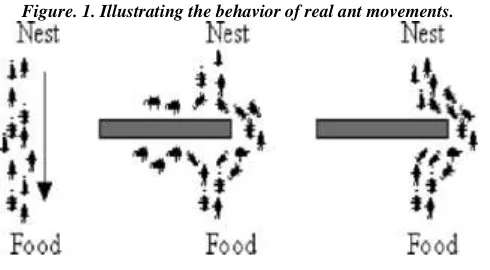
The Ant Colony Systems The basic idea of a real ant system is illustrated in Figure 1. In the left picture, the ants move in a straight line to the food. The middle picture illustrates the situation soon after an obstacle is inserted between the nest and the food. To avoid the obstacle, initially each ant chooses to turn left or right at random. Let us assume that ants move at the same speed depositing pheromone in the trail uniformly. However, the ants that, by chance, choose to turn left will reach the food sooner, whereas the ants that go around the obstacle turning right will follow a longer path, and so will take longer time to circumvent the obstacle. As a result, pheromone accumulates faster in the shorter path around the obstacle. Since ants prefer to follow trails with larger amounts of pheromone, eventually all the ants converge to the shorter path around the obstacle, as shown in Figure 1
Figure. 1. Illustrating the behavior of real ant movements.
http: // www.gjesrm.com © Global Journal of Engineering Science and Research Management [12]
The main idea of ACO is to model a problem as the search for a minimum cost path in a graph. Artificial ants as if walk on this graph, looking for cheaper paths. Each ant has a rather simple behavior capable of finding relatively costlier paths. Cheaper paths are found as the emergent result of the global cooperation among ants in the colony. The behavior of artificial ants is inspired from real ants: they lay pheromone trails (obviously in a mathematical form) on the graph edges and choose their path with respect to probabilities that depend on pheromone trails. These pheromone trails progressively decrease by evaporation. In addition, artificial ants have some extra features not seen in their counterpart in real ants. In particular, they live in a discrete world (a graph) and their moves consist of transitions from nodes to nodes.
The ACO differs from the classical ant system in the sense that here the pheromone trails are updated in two ways. Firstly, when ants construct a tour they locally change the amount of pheromone on the visited edges by a local updating role.
Secondly, after all the ants have built their individual tours, a global updating rule is applied to modify the pheromone level on the edges that belong to the best ant tour found so far.
BASIC PARTICLE SWARM OPTIMIZATION
Particle swarm optimization (PSO) is an algorithm modeled on swarm intelligence, that finds a solution to an optimization problem in a search space, or model and predict social behavior in the presence of objectives. The PSO is a stochastic, population-based computer algorithm modeled on swarm intelligence. Swarm intelligence is based on social-psychological principles and provides insights into social behavior, as well as contributing to engineering applications.
The particle swarm optimization algorithm was first described in 1995 by James Kennedy and Russell C. Eberhart. The particle swarm simulates this kind of social optimization. A problem is given, and some way to evaluate a proposed solution to it exists in the form of a fitness function. A communication structure or social network is also defined, assigning neighbors for each individual to interact with. Then a population of individuals defined as random guesses at the problem solutions is initialized. These individuals are candidate solutions. They are also known as the particles, hence the name particle swarm. An iterative process to improve these candidate solutions is set in motion. The particles iteratively evaluate the fitness of the candidate solutions and remember the location where they had their best success. The individual's best solution is called the particle best or the local best. Each particle makes this information available to their neighbors.
http: // www.gjesrm.com © Global Journal of Engineering Science and Research Management [13]
problem. The position of a particle is influenced by the best position visited by itself i.e. its own experience and the position of the best particle in its neighborhood i.e. the experience of neighboring part icles. When the neighborhood of a particle is the entire swarm, the best position in the neighborhood is referred to as the global best particle, and the resulting algorithm is referred to as the gbest PSO. When smaller neighborhoods are used, the algorithm is generally referred to as the lbest PSO. The performance of each particle is measured using a fitness function that varies depending on the optimization problem.
Each Particle in the swarm is represented by the following characteristics: 1. The current position of the particle
2. The current velocity of the particle
The particle swarm optimization which is one of the latest evolutionary optimization techniques conducts searches uses a population of particles.
Each particle corresponds to individual in evolutionary algorithm. Each particle has an updating position vector and updating velocity vector by moving through the problem space.
Vik+1 = wVik +c1 rand1( ) x (pbesti-sik) + c2
rand2( ) x (gbest-si k) --- Eq (1)
Sik+1 = Sik + Vik+1 --- Eq (2)
Where,
Vik is the velocity of i at iteration k, sik is the current position of i at iteration k. c1 and c2 are positive constants and rand1 and rand2 are uniformly distributed random number in [0,1]. The velocity vector is range of [-Vmax,Vmax]. In Velocity updating eq (1), eq (3) terms that creates new velocity are,
1. Inertia term, forces the particle to move in the same direction as before by adjusting the old velocity. 2. Cognitive term (Personal best), forces the particle to go back to the previous best position.
3. Social Learning term, forces the particle to move to the best previous position of its neighbors.
CUCKOO SEARCH (CS)
http: // www.gjesrm.com © Global Journal of Engineering Science and Research Management [14]
host birds can engage direct conflict with the intruding cuckoos. For example, if a host bird discovers the eggs are not their own, it will either throw these alien eggs away or simply abandon its nest and build a new nest elsewhere. Some cuckoo species such as the New World brood-parasitic Tapera have evolved in such a way that female parasitic cuckoos are often very specialized in the mimicry in colors and pattern of the eggs of a few chosen host species.
Cuckoo search idealized such breeding behavior, and thus can be applied for various optimization problems. It seems that it can outperform other met heuristic algorithms in applications.
Cuckoo search (CS) uses the following representations:
Each egg in a nest represents a solution, and a cuckoo egg represents a new solution. The aim is to use the new and potentially better solutions (cuckoos) to replace a not-so-good solution in the nests. In the simplest form, each nest has one egg. The algorithm can be extended to more complicated cases in which each nest has multiple eggs representing a set of solutions.
CS is based on three idealized rules:
1. Each cuckoo lays one egg at a time, and dumps its egg in a randomly chosen nest; 2. The best nests with high quality of eggs will carry over to the next generation;
3. The number of available host’s nests is fixed, and the egg laid by a cuckoo is discovered by the host bird with a probability pa ∈ [0, 1]. Discovering operates on some set of worst nests, and discovered solutions dumped from farther calculations.
In addition, Yang and Deb discovered that the random-walk style search is better performed by Lévy flights rather than simple random walk.
Lévy Flights A Lévy flight is a random walk in which the step-lengths are distributed according to a heavy-tailed probability distribution. After a large number of steps, the distance from the origin of the random walk tends to a stable distribution. Some of the new solutions should be generated by L´evy walk around the best solution obtained so far, this will speed up the local search. Levy Flights However, a substantial fraction of the new solutions should be generated by far field randomization and whose locations should be far enough from the current best solution; this will make sure the system will not be trapped in a local optimum.
Based on the above-mentioned rules, the basic steps of the CS can be summarized as the pseudo code, can be summarized as:
Objective function:f(x),x=(x1,x2,x3…,xd);
http: // www.gjesrm.com © Global Journal of Engineering Science and Research Management [15]
While(t<Maxgeneration) or stop criterion
Get a cuckoo randomly (say ,i) and replace its solution by performing Lévy flights; Evaluate its quality/fitness Fi
For maximization,Fi ∝ f(xi) ;
Choose a nest among n (say, j) randomly
If (Fi>Fj)
Replace j by the new solution
End if;
A fraction (Pa) of the worse nests are abandoned and new ones are built Keep the best solutions/nests
Rank the solutions/nests and find the current best Pass the current best solutions to the next generation
End while
ADVANTAGES AND DISADVANTAGES
An Analysis on the Advantages and Disadvantages of the Basic Particle Swarm Optimization Algorithm.
Advantages of the basic particle swarm optimization algorithm:
1) PSO is based on the intelligence. It can be applied into both scientific research and engineering use.
2) PSO have no overlapping and mutation calculation. The search can be carried out by the speed of the particle. During the development of several generations, only the most optimist particle can transmit information onto the other particles, and the speed of the researching is very fast.
3) The calculation in PSO is very simple. Compared with the other developing calculations, it occupies the bigger optimization ability and it can be completed easily.
http: // www.gjesrm.com © Global Journal of Engineering Science and Research Management [16]
Disadvantages of the basic particle swarm optimization algorithm:
1) The method easily suffers from the partial optimism, which causes the less exact at the regulation of its speed and the direction.
2) The method cannot work out the problems of scattering and optimization(Chen Yonggang,Yang Fengjie,Sun Jigui ,2006,(In Chinese)).
3) The method cannot work out the problems of non-coordinate system, such as the solution to the energy field and the moving rules of the particles in the energy field
An Analysis on the Advantages and Disadvantages of the Ant Colony Optimization.
Advantages of the Ant Colony Optimization
1. Inherent parallelism
2. Positive Feedback accounts for rapid discovery of good solutions 3. Efficient for Traveling Salesman Problem and similar problems
4. Can be used in dynamic applications (adapts to changes such as new distances, etc)
Disadvantages of the Ant Colony Optimization
1. Theoretical analysis is difficult
2. Sequences of random decisions (not independent) 3. Probability distribution changes by iteration 4. Research is experimental rather than theoretical
5. Time to convergence uncertain (but convergence is guaranteed!)
An Analysis on the Advantages and Disadvantages of the Cuckoo search Algorithm.
Advantages of Cuckoo search
1. CS is based on the intelligence. It can be applied into both scientific research and engineering optimization problems.
2. Cuckoo search is adapted to solve NP-hard combinatorial optimization problems
3. Cuckoo search has also been used to optimize web service composition process and planning graphs. 4. Cuckoo search was developed to solve Knapsack problems.
Disadvantages of Cuckoo search.
http: // www.gjesrm.com © Global Journal of Engineering Science and Research Management [17]
ANALYSIS OF ACO, PSO and CS
The ACO is inspired by the foraging behaviors of ant colonies. At the core of this behavior the indirect communication between the ants enables them to find short paths between their nest and food sources. This characteristic of real ant colonies is exploited in ACO algorithm to solve, discrete optimization problems. The PSO technique modeled on the social behaviors observed is animals or insects, PCO has gained increasing popularity among researches and practitioners as a robust and efficient technique for solving difficult robust and population n-based stochastic optimization problems.
Both the ACO and PSO algorithm are the data clustering algorithms by implementing swarm behavior. Whereas the ACO is more applicable for problems where source and destination are predefined and specific. At the same time PSO is a clustering algorithm in the areas of mutli-objective, dynamic optimization and constraint handling. The ACO is more applicable for problems that require crisps results and PSO is applicable for problems that are fuzzy is nature. All these characteristic of the ACO and PSO are implicitly evident in the following applications.
Some cuckoo species have evolved in such a way that female parasitic cuckoos are often very specialized in the mimicry in color and pattern of the eggs of a few chosen host species. This reduces the probability of eggs being abandoned and increases their reproductively. Parasitic cuckoos often choose a nest where the host bird just laid its own eggs. In general, the cuckoo eggs hatch slightly earlier than their host eggs. Once the first cuckoo chick is hatched, the first instinct action it will take is to evict the host eggs by blindly propelling the eggs out of the nest, which increases the cuckoo chick’s share of food provided by its host bird.
APPLICATIONS OF ACO, PSO and CS
Ant colony optimization algorithms have been applied to many combinatorial optimization problems, ranging from quadratic assignment to fold protein or routing vehicles and a lot of derived methods have been adapted to dynamic problems in real variables, stochastic problems, multi-targets and parallel implementations. It has also been used to produce near-optimal solutions to the travelling salesman problem. They have an advantage over simulated annealing and genetic algorithm approaches of similar problems when the graph may change dynamically; the ant colony algorithm can be run continuously and adapt to changes in real time. This is of interest in network routing and urban transportation systems.
http: // www.gjesrm.com © Global Journal of Engineering Science and Research Management [18]
single-objective optimization problems, PSO algorithms have been developed to solve constrained problems, multi-objective optimization problems, problems with dynamically changing landscapes, and to find multiple solutions. Cuckoo search is adapted to solve NP-hard combinatorial optimization problems like travelling salesman problem. And dynamic problems like Knapsack problems, which show its effectiveness. Cuckoo search can also be used to efficiently in software testing, neural networks and Cuckoo search has also been used to optimize web service composition process and planning graphs.
CONCLUSIONS AND FUTURE WORK
This paper represents the comparative study between swarm intelligence the ACO, PSO and CS can be analyzed for future enhancement such that new research could be focused to produce better solution by improving the effectiveness and reducing the limitations. More possibilities for dynamically determining the best destination through ACO can be evolved and a plan to endow PSO with fitness sharing aiming to investigate whether this helps in improving performance. The major problem in the ACO is that, the ant will walk through the path where the chemical substances called pheromone is deposited. This acts as if it lures the artificial ants. Cuckoo search can perform the local search more efficiently and there is only a single parameter apart from the population size. It an extensive detailed study of various structural optimization problems suggests that cuckoo search obtains better results than Particle swarm optimization and Ant Colony Optimization.
REFERENCES
1. Ajith Abraham, Swagatam Das, Sandip Roy, “Swarm Intelligence Algorithms for Data Cluctering.
2. E.Corchado, PSO and ACO in Optimization Problems, Publishers: Springer - Verlag, pp. 1390 – 1398, 2006.
3. Tsang W and Kwongs S, Ant Colony Clustering and Feature Extraction for Anomaly Intrusion Detection, in Swarm intelligence in Data Mining, Abraham A,(2006).
4. Macro Dorigo, The Ant System: Optimization by a colony of cooperating agents. 5. Christian Blum and Xiaodong Li, Swarm Intelligence in Optimization.
6. P.Mathiyalagan, Grid scheduling Using Enhanced PSO Algorithm International Journal on Computer Science and Engineering,Vol. 02, No. 02, 2010, 140-145
7. R. S. Parpinelli, H. S. Lopes, and A.A. Freiatas. Data mining with an ant colony optimization algorithm. IEEE Transactions on evolutionary computation, 6(4):321-332, 2002
8. De Falco, A. Della Cioppa, and E. Tarntino, “Evalution of Particle Swarm Optimization Effectiveness in Classification.
9. Qinghai Bai, Analysis of Particle Swarm Optimization Algorithm Computer and Information Science Vol:3 ,No.1,February 2010.
http: // www.gjesrm.com © Global Journal of Engineering Science and Research Management [19]
11. A. P. Engelbrecht, Fundamentals of computational Swarm Intelligence, JohnWiley & Sons, Hoboken, NJ, USA, 2009.
12. M. Tuba, M. Subotic, and N. Stanarevic, Modified Cuckoo search algorithm for Unconstrained optimization problems, Proc. of the 5th European Conference on European Computing Conference (ECC'11), 2011, pp.263-268.
13. Civicioglu, P., Besdok, E.: A conceptual comparison of the cuckoo-search, particle swarm optimization, differential evolution and artificial bee colony algorithms. Artif. Intell. Rev.39, 315–346 (2013).
14. Gandomi, A.H., Yang, X.S., Alavi, A.H.: Cuckoo search algorithm: a metaheuristic approach to solve structural optimization problems. Eng. Comput.29, 17–35 (2013).
15. Derrac, J., Garcia, S., Molina, D., Herrera, F.: A practical tutorial on the use of nonparametric statistical tests as a methodology for comparing evolutionary and swarm intelligence algorithms. Swarm Evol. Comput.1, 3–18 (2011).
16. Xin-She Yang, Swarm intelligence based algorithms: a critical analysis, Evolutionary Intelligence April 2014,Volume 7, Issue 1,pp 17-28 Date: 17 Dec 2013.
17. Xin-She Yang, Xingshi He , Swarm Intelligence and Evolutionary Computation: Overview and
Analysis, Recent Advances in Swarm Intelligence and Evolutionary ComputationStudies in Computational Intelligence Volume 585,2015,pp 1-23 Dec 2014.