47 Available online at www.ijiere.com
International Journal of Innovative and Emerging
Research in Engineering
e-ISSN: 2394 - 3343 p-ISSN: 2394 - 5494
A Comparative Study of Seismic Response of Flat Slab
Structure and Conventional RC Framed Structure
Abhijit Salunkhe
aand Dr.D.N.Shinde
ba
P.G. Student, Department of Civil Engineering, P.V.P.I.T. Budhgaon, Sangli, India
bAssociate Professor, Department of Civil Engineering, P.V.P.I.T. Budhgaon, Sangli, IndiaABSTRACT:
Flat slabs is system of construction is one in which the beams used in the conventional methods of constructions are done away with, Flat slab structure have advantages over conventional structure such as economy in construction, its architectural appearance, flexibility and speed of the construction. However because of removal of beams from flat slab, lateral stiffness is considerably reduced hence flat slab structure more flexible to seismic loading as compare with conventional structure. This objective of this work is to compare the seismic behavior of flat slab structure with conventional R.C.C. Structure. This work also study effect shear wall on seismic performance of flat slab structure.
Keywords:Flat slab RC structure, Seismic response, Static analysis, Dynamic analysis.
I. INTRODUCTION
Flat slabs is system of construction is one in which slab is directly rest on the column. The slab directly rests on the column and load from the slab is directly transferred to the columns and then to the foundation. To support heavy loads, the thickness of slab near the support with the column is increased and these are called drops, or columns are generally provided with enlarged heads called column heads or capitals [1]. These increasing thickness of flat slab in the region supporting columns provide adequate strength in shear and to increase the amount perimeter of the critical section, for shear and hence, increasing the capacity of the slab for resisting two-way shear and to reduce negative bending moment at the support. Flat slab structure is preferred over conventional structure in construction due to their advantages in reducing storey height and construction period as compared with conventional structure, leading to reduction of construction costs. Provision of the flat slab building in which slab is directly rested on columns, have been adopted in many buildings constructed recently due to the advantage of reduced floor to floor heights to meet the economical and architectural demands [2].
Because of absence of deep beam Flat slab building structures which are more significantly flexible than conventional concrete than traditional structures, thus becoming more vulnerable to seismic loading. Thus the seismic analysis of these structures is necessary to know the vulnerability of these structures to seismic loading. [3]
The flat slab structure are more respond to seismic loading as compare with conventional structure hence additional measure are required to improve their seismic performance. Therefore, flat slab structure constructed in earthquake prone region additional measures should be taken such as provision of shear wall in order to reduce the seismic response of flat slab RC structure.
II. METHODS OF DESIGN OF FLAT SLAB
Following are the methods used for analysis
1. The direct design method 2. The equivalent frame method
METHODS OF SEISMIC ANALYSIS
Volume 3, Issue 6, 2016
48 III.PROBLEMFORMULATION,MODELLINGANDANALYSIS
Following are the models used for analysis
Case 1)-
i. 8 storey Flat Slab RC structure having plan dimensions 30 m x36 m.
ii. 8 storey conventional RC Framed structure having plan dimensions 30 m x36 m. iii. 8 storey flat slab structure with shear wall having plan dimensions 30 m x36 m. Case 2)-
i. 12 storey Flat Slab RC structure having plan dimensions30 m x36 m.
ii. 12 storey conventional RC Framed structure having plan dimensions 30 m x36 m. iii. 12 storey flat slab structure with shear wall having plan dimensions 30 m x36 m. Case 3)-
i. 18 storey Flat Slab RC structure having plan dimensions 30 m x36 m.
ii. 18 storey conventional RC Framed structure having plan dimensions 30 m x36 m. iii. 18 storey flat slab structure with shear wall having plan dimensions 30 m x36 m.
All above model are analysed and comparison is made between these analyses. To know vulnerability of the structure to seismic loading [4]
Details of Modelling: i.Storey height -3.2m ii.Plinth level-0.8m
iii.Thickness of flat slab- 220mm iv.Thickness of drop is -270mm.
v.Thickness of shear wall is- 150mm. vi.Size of column -0.45m to 1.2m. vii. Size of beam -300mm to 600mm.
Loading Details:
1. Gravity loads-
i. Live load at typical floor-4 kN/m2 ii. Live load at top floor -2 kN/m2
iii. Floor finish load at typical floor -1.0 kN/m2 iv. Floor finish load at top floor -2.0 kN/m2 2. Detail of Earthquake loading-
1. Static analysis
a. Location of zone- IV. b. The direction of excitation -X. c. Importance factor -1
d. Response reduction factors- 5
2. Dynamic analysis-
a. Location of zone- IV.
b. The direction of excitation -X.
49 IV.RESULTS
1. Base shear - Base shear is the total design lateral force (VB) along any principal direction, which is determined by
following expression
V
B=A
hW
Where
Ah = Design horizontal acceleration spectrum
W = Seismic weight of building.
TABLE I
BASE SHEAR COMPARISON of above models [4]
From above result it is observe that flat slab structure are more flexible than conventional structure. The flexibility of flat slab can be reduced by providing shear wall.
2. Storey drift-
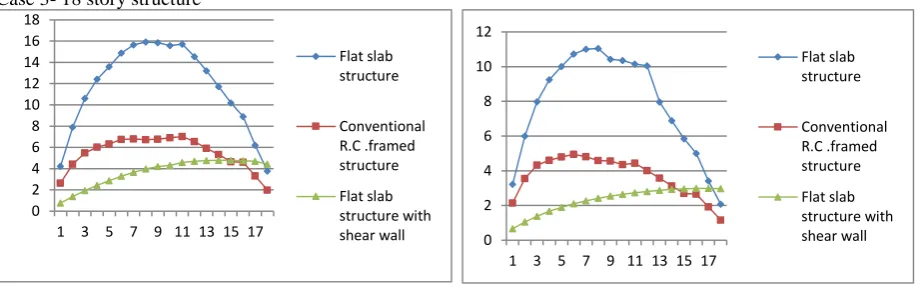
Storey drift is computed as a difference between lateral displacement of one floors to the other floor. It is one of the important response quantity and which is indictor of structural performance of multi-storey buildings. According IS 1893 (Part 1): 2002 maximum allowable storey drift in any storey due to minimum specified design lateral load factor 1.00 should not be exceed shall 0.004 times the storey height under consideration. For the analysis of all above model storey drift should not exceed 12.8mm. Drift control is necessary to limit damage to interior partition, elevator and stair enclosure, glass and cladding system [5].
Model Linear static
analysis
Response spectrum analysis
Case 1- 8 storey Structure
Flat slab structure 1647.89 1523.60
Conventional Structure 3359.37 3080.21
Flat slab structure with shear wall 5392.65 4631.04
Case 2- 12 storey Structure
Flat slab structure 2190.05 1845.76
Conventional Structure 3965.41 3531.30
Flat slab structure with shear wall 5618.61 4930.89
Case 3- 18 storey Structure
Flat slab structure 3380.73 2647.29
Conventional Structure 3818.78 3183.94
Volume 3, Issue 6, 2016
50
Comparison of Storey Drift for different cases
Case 1- 8 storey structure
Figure 1. Linear Static Analysis Figure 2. Linear Dynamic Analysis.
The plot of drift values shows that provision of shear wall imparts uniform stiffness to the flat slab structure and it reduces the drift values of mid-storey almost by 50%, thus proving the reliability of shear wall in case of multi-storey structures.
Case 2- 12 storey structure
Figure 3. Linear Static Analysis. Figure 4.Linear Dynamic Analysis
The plot of drift values shows that provision of shear wall imparts uniform stiffness to the flat slab structure and it reduces the drift values of mid-storeys almost by 50%, thus proving the reliability of shear wall in case of multi-storey structures.
Case 3- 18 story structure
Figure5. Linear Static Analysis Figure 6. Linear Dynamic Analysis 0 1 2 3 4 5 6 7 8 9
1 2 3 4 5 6 7 8
Flat slab structure
Conventiona l R.C .framed structure Flat slab structure with shear wall 0 1 2 3 4 5 6 7
1 2 3 4 5 6 7 8
Flat slab structure Conventional R.C .framed structure Flat slab structure with shear wall 0 2 4 6 8 10 12
1 3 5 7 9 11
Flat slab structure Conventional R.C .framed structure Flat slab structure with shear wall 0 1 2 3 4 5 6 7 8 9
1 3 5 7 9 11
Flat slab structure Conventional R.C .framed structure Flat slab structure with shear wall 0 2 4 6 8 10 12 14 16 18
1 3 5 7 9 11 13 15 17
Flat slab structure Conventional R.C .framed structure Flat slab structure with
shear wall 0
2 4 6 8 10 12
1 3 5 7 9 11 13 15 17
51 In case of 18 storey structure in zone IV, Storey drift of flat slab structure differs very much from conventional RC framed structure and exceed permissible values (storey drift being more than 12 mm) when analyzed by linear static analysis. Thus, multi-storey flat slab structure essentially demand lateral load resisting system such as in-plane shear wall in order to bring storey drift values within permissible limits.
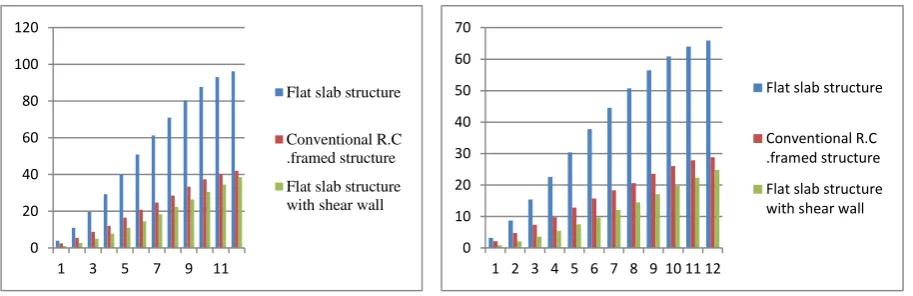
Comparison of Displacement for different cases
Case 1 -8 storey structure
Figure 7. Linear Static Analysis. Figure 8. Linear Dynamic Analysis
Maximum displacement attained by flat slab structure with shear wall is much lesser than that in case of flat slab
structure without shear wall. Both the analysis viz. linear static analysis and linear dynamic analysis emphasis that multi-storey flat slab structures are to be accompanied with the shear wall for better performance of flat slab structure during earthquake.Case 2-12 storey structure
Figure 9. Linear Static Analysis Figure10. Linear Static Analysis.
Figure 9 and figure 10 shows the significant reduction in maximum displacement of flat slab structure after the
application of shear wall.
Case 3- 18 storey structure 0
10 20 30 40 50 60
1 2 3 4 5 6 7 8
Flat slab structure
Conventional R.C .framed structure
Flat slab structure with shear wall
0 5 10 15 20 25 30 35 40
1 2 3 4 5 6 7 8
Flat slab structure
Conventional R.C .framed structure
Flat slab structure with shear wall
0 20 40 60 80 100 120
1 3 5 7 9 11
Flat slab structure
Conventional R.C .framed structure
Flat slab structure with shear wall
0 10 20 30 40 50 60 70
1 2 3 4 5 6 7 8 9 10 11 12
Flat slab structure
Conventional R.C .framed structure
Volume 3, Issue 6, 2016
52
Figure11. Linear Static Analysis. Figure12. Linear Dynamic Analysis
Maximum displacement attained by flat slab structure with shear wall found to be reduced by more than 60% than that in
case of flat slab structure without shear wall. Hence such a multi-storey structure having 18 numbers of storeys must be
accompanied with lateral load resisting element such as shear wall to bring the displacement values to the desired level as
in this case.
V. CONCLUSION
1. For all case, flat slab structure without shear wall design base shear less as compare with conventional structure
which is due to the flexibility of flat slab structure.
2. In case of flat slab storey drift is more as compare with conventional RC framed structure. This storey drift can be
reduced by provision of shear wall to flat slab structure.
3. From analysis result it seen that displacement of the flat slab structure is more as compare with conventional
structure.
4. The displacement of the flat slab structure is reduced by provision of shear wall.
REFERENCES
Format of Reference
[1] Dr. U. Gupta, S. Ratnaparkhe, P. Gome, “ Seismic behavior of buildings having flat slabs with drops”, IJETAE volume 2, October 2012.
[2] S.Pahwa, V. Tiwari. M. Prajapati, “Comparative Study of Flat Slab with Old Traditional Two Way Slab” IJLTET, volume 4, 2 July 2014.
[3] Navyashree K., T. Sahana, “Use of flat slab in multi-storey commercial building situated in high seismic zone,” International journal of research in engineering and technology.
[4] Dhanagar A.L.,Narule G.N. “ A comparative study of seismic response of flat slab structure and conventional structure” International journal of latest trends in engineering and technology.
[5] Alkarani, R Ravindra., “Evaluation of Punching Shear In Flat Slabs” International Journal of Research in Engineering and Technology Nov. 2013.
[6] Dr. V. Varghese, S. Bothara, “ Dynamic analysis of moment resisting frame building with Flat slab and Grid slab”, IJERA volume 2, July-August 2012.
[7] Prof. K. S. Sable, Er. V. A. Ghodechor, Prof. S B Kandekar, “Comparative Study of Seismic Behavior of Multistory Flat Slab and Conventional Reinforced Concrete Framed Structures”, IJCTEE, Volume 2, issue 3, June 2012. [8] IS 1893 (Part 1) 2002, “Criteria for Earthquake Resistant Design of Structure,” BIS 2002.
[9] IS-456:2000, “Code of practice for plain and reinforced concrete”, code practice fourth revision, Bureau of Indian Standards, New Delhi, July2000.
0 50 100 150 200 250
1 3 5 7 9 11 13 15 17
Flat slab structure
Flat slab structure with opening
Flat slab structure with shear wall
0 20 40 60 80 100 120 140 160
1 3 5 7 9 11 13 15 17
Flat slab structure
Conventional RC framed structure
![TABLE I BASE SHEAR COMPARISON of above models [4]](https://thumb-us.123doks.com/thumbv2/123dok_us/8875140.1816404/3.595.132.463.282.495/table-i-base-shear-comparison-models.webp)