e- ISSN 0975 – 9328 Print ISSN 2229 – 7472
International Journal of Phytopharmacology
Journal homepage:
www.onlineijp.com
EFFECT OF ETHANOLIC AND AQUEOUS EXTRACT OF
CENTELLA ASIATICA
ON MARBLE-BURYING BEHAVIOUR IN
MICE
Neeraj Kumar*
1, Rajnish Kumar
2, Kamal Kishore Maheshwari
31,2
Shri Ram Murti Smarak college of engineering and technology, Bareilly-243202, UP, India.
3Department of Pharmacy, Rohilkhand University, Bareilly-243001, UP, India.
ABSTRACT
Obsessive compulsive disorder (OCD) is a wide spread disorder in about 2-3% of the population worldwide, 0.6% of Indians and the present effective treatment of OCD is selective serotonin reuptake inhibitor (SSRIs) demonstrate selective efficacy in any about 40-60 % of patient while 30 % of patients failing to respond to conventional treatment. The aim of study was the pre-clinical screening of anticompulsive effect by marble-burying model in mice. Study of marble-burying behaviour with locomotor activity in albino mice was carried out by specially designed model for anticompulsive activity and actophotometer for locomotor activity. For marble burying study, 7 groups (n=6) for control, test (50 and 100 mg/kg of aqueous and ethanolic extract) and standard drug (5 and 10 mg/kg of fluoxetine) while another 7 groups for control, test (50 and 100 mg/kg of aqueous and ethanolic extract) and standard drug (5 and 10 mg/kg of fluoxetine), of mice were used for locomotor activity. The data was analyzed by one way analysis of variance followed by Dunnett’s test (P < 0.01). The ethanolic extract of Centella asiatica (50 and 100 mg/kg) was found significant in dose dependently (p<0.01), reduced the number of marbles buried without affecting the motor activity. The aqueous extract (100 mg/kg) also reduced (P<0.01) the number of marbles buried with slight reduction (13%) in locomotor activity when compared with fluoxetine. The finding of this study was suggested that ethanolic extract of Centella asiatica may significantly reduce anticompulsive behaviour comparable as fluoxetine.
Key words: Obsessive compulsive disorder, Fluoxetine, Marble-burying, Mandukaparni, Gotu kola.
INTRODUCTION
Centella asiatica (Linn.) (Family-Apiaceae)
commonly known as ‘Brahmi’ in unani medicine, ‘Mandukaparni’ in Ayurveda and ‘Gotu kola’ in western world, consist of dried, fragmented aerial parts preferably leaves (Bhavna and Jyoti, 2011; Jamil et al., 2007). It is creeping plant, leaves with bigger and long petiolate, entire, crenate, orbicular and reniform, 1.5-6.5 cm of diameter, found in marshy areas of all over India, Sri Lanka, Madagascar and Africa upto an altitude of 650 m. The principle chemical constituents are reported from
Corresponding Author
Neeraj Kumar
Email: [email protected]
Centella asiatica are asiaticosides, madecassoide,
madecassic acid, asiatic acid, brahmosides, brahmic acid, brahminosides, thankuniside, isothankunoside, centelloside, madasiatic acid, centic acid, cenellic acid, betulinic acid, indocentic acid, glucose, rhamanose, terpenoids (Kuroda et al., 2001), sitosterol, stigmasterol with calcium, iron and phosphate (Jiang et al., 2005). It is mainly used as brain tonic and claimed to possesses a wide range of pharmacological effects like wound healing (Suguna et al., 1996; Shetty et al., 2006), mental disorder (Appa Rao et al., 1977) like antidepressant (Qin et al., 1998),antitumour (Huang et al., 2004; Babu et al., 1995), atherosclerosis (Brinkhaus et al., 2000), fungicidal (Jagtap et al., 2009), antibacterial (Oyedeji et al., 2005), antioxidant (Jayashree et al., 2003; Zainol et al., 2003;), anticancer (Bunpo et al., 2004; Park et al., 2005),
antinociceptive, ulcer (Shetty et al., 2006), anti-inflammatory (Somchit et al., 2004) and hepatoprotective activity (Antony et al., 2006). The triterpenoids present in this plant may change gene expression in human fibroblast cells and can be used in treatment of oedema with capillary filtration in venous hypertension (De Sanctis et al., 2001; Coldren et al., 2003).The study of
Rao et al., 2005 was suggested that Centella asiatica
treatment during postnatal period may enhance learning and memory in mice while its extract also helps in healing (Cheng et al., 2004)
Obsessive compulsive disorder (OCD) is a wide spread disorder in about 2-3% of the population worldwide and 0.6% of Indians (Doshi, 2009), characterized by recurring obsessions and compulsions that significantly interrupt the daily functioning of the patient (Matsushima et al., 2010) with co-morbidity and major depression considered as an anxiety disorder (Girdhar et al., 2010). Neuropsychological studies suggested that an imbalance in activity between the direct (excitatory) and the indirect (inhibitory) pathways within fronto-striatal circuitry leads to the development of OCD and cognitions (Saxena et al., 1998, 2001).Its life time prevalence rate is about 1-3 % (Prajapati et al., 2011).
The present effective treatment of OCD is selective serotonin reuptake inhibitor (SSRIs) demonstrate selective efficacy in any about 40-60 % of patient with 30 % of patients failing to respond to conventional treatment (Mishra et al., 2007). This data is suggests that herbal treatment of OCD may be useful so the influence of aqueous and ethanolic extract of Centella
asiatica was investigated for the marble burying
behaviour and actophotometric activity, methods commonly used for anticompulsive activity screening in mice (Mohandas et al., 2008).
MATERIAL AND METHODS Plant material
Centella asiatica, whole plant obtained from
herbal garden of department of pharmacy, Shri ram murti smarak college of engineering and technology (Pharmacy), Bareilly, UP, India in the month of February 2011 (Figure 1), was identified by its morphological characteristics (Zainol et al., 2008). A voucher specimen (srmscet/Pharma/11/063) was submitted in the pharmacognogy department of same institution.
Preparation of ethanolic and aqueous extract of Centella asiatica
Ethanolic and aqueous extract of Centella
asiatica whole plant were prepared by hot soxhlet
extraction method. The whole plant was collected, washed and shade dried then crushed using an electric grinder. The coarse powder was extracted with ethanol
(EECA) and distilled water contains small amount of ethanol (AQCA).
Drugs and chemical
Fluoxetine, AQCA and EECA were dissolved in 0.9% saline for pharmacological studies.
Animals
Male Swiss albino mice (25-30 g) were used in this study was housed in poly propylene cages, under 12 hour light/dark cycle, controlled condition of temperature and humidity (25±2 0C, 55±2 % respectively). Mice received standard rodent chow and water ad libitum.
The experiments were carried between 9.00 AM to 03.00 PM in a noise free room. The animal studies were approved by institutional animal ethical committee constituted for the purpose of control and supervision of experiment on animals (715/02/C/CPCSEA).
Treatment
Mice were divided into four groups (n=6) for AQCA and EECA (50, 100 mg/kg), two groups for fluoxetine (5, 10 mg/kg) administered orally 30 min prior to the assessment of marble burying behaviour and same groups was also formed for locomotor activity study and one control group was formed to receive 0.9% normal saline.
Assessment of marble burying behaviour
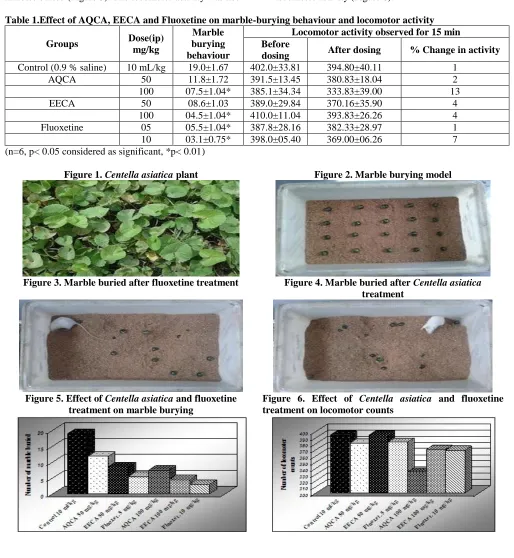
Marble burying behaviour model was used for screening of obsessive compulsive disorder in mice (Njung'e et al., 1991). Mice were individually placed in separate plastic cages (21×38×14 cm) containing 20 clean glass marbles (10 mm diameter) evenly spaced on 5 cm deep saw dust (Figure 2, 3, 4). After 30 min exposure to the marbles, mice were removed and results were expressed as number of marbles buried at least two-third in saw dust (Girdhar et al., 2010).
Assessment of motor activity
As OCD is influenced by motor activity, the same was assessed by using actophotometer (Inco instruments and chemicals pvt. Ltd., India) with rectangular arena, and equipped with six photo cells and receptors. Motor activity was assessed in terms of total number of counts of light beam interruptions in 15 min. An acquisition period of 5 min was given to each mouse before assessment of motor activity (Girdhar et al., 2010).
Statistical analysis
RESULTS
Effect of AQCA, EECA and fluoxetine on marble-burying behaviour and motor activity
One-way ANOVA exhibited that EECA significantly influenced marble-burying behaviour (p<0.01) (Table 1) and the Dennett’s test showed that EECA (50 and 100 mg/kg) was found significant in dose dependent manner (p<0.01) and reduced the number of marbles buried (Figure 5). The locomotor activity was not
affected by EECA (50, 100 mg/kg) (p<0.001) (Figure 6) and similarly, fluoxetine significantly influenced marble-burying behaviour (p<0.01) and the Dennett’s test showed that fluoxetine (5 and 10 mg/kg) dose dependently reduced (p<0.01) (Figure 5) marble burying behaviour in mice without any effect on motor activity (Figure 6). The AQCA (100 mg/kg) also reduced (P<0.01) (Figure 5) the number of marbles buried with slight reduction (13%) in locomotor activity (Figure 6).
Table 1.Effect of AQCA, EECA and Fluoxetine on marble-burying behaviour and locomotor activity
Groups Dose(ip) mg/kg
Marble burying behaviour
Locomotor activity observed for 15 min Before
dosing After dosing % Change in activity Control (0.9 % saline) 10 mL/kg 19.0±1.67 402.0±33.81 394.80±40.11 1
AQCA 50 11.8±1.72 391.5±13.45 380.83±18.04 2 100 07.5±1.04* 385.1±34.34 333.83±39.00 13 EECA 50 08.6±1.03 389.0±29.84 370.16±35.90 4
100 04.5±1.04* 410.0±11.04 393.83±26.26 4 Fluoxetine 05 05.5±1.04* 387.8±28.16 382.33±28.97 1 10 03.1±0.75* 398.0±05.40 369.00±06.26 7 (n=6, p< 0.05 considered as significant, *p< 0.01)
Figure 1. Centella asiatica plant Figure 2. Marble burying model
Figure 3. Marble buried after fluoxetine treatment Figure 4. Marble buried after Centella asiatica treatment
Figure 5. Effect of Centella asiatica and fluoxetine treatment on marble burying
DISCUSSION
The present study was designed to investigate the effect of EECA on marble burying behaviour as compare with the effect of fluoxetine. The results were revealed that EECA exhibited anticompulsive effect by inhibiting marble burying behaviour and it was comparable to the inhibiting effect of fluoxetine which is used in OCD pharmacotherapy (Table 1). The dose of fluoxetine was set based on the finding of Girdhar et al., 2010. The EECA at a dose of 50 mg/kg showed a trend toward inhibited marble burying behaviour while a dose 100 mg/kg significantly reduce the number of buried marbles (Figure 5) with very less reduction (4%) in locomotor activity when compared with control. The AQCA at a dose 100 mg/kg was also reduced the marble burying behaviour with 13% reduction in locomotor activity. The fluoxetine at a dose of 5 mg/kg significantly reduced marble burying behaviour without reduction (1%) in locomotor activity and at a dose of 10 mg/kg was highly significant for reduction in marble burying behaviour with non significant reduction (7%) in locomotor activity (Figure 6). Four plants were screened for anticompulsive behaviour which have active ingredient that have been found to modulate serotonergic
activity were located in Hypericum perfirmatum, Silybum
morianum (Prajapati et al., 2011) Benicasa hipsida
(Girdhar et al., 2010), Psilocybe argentipes (Matsushima
et al., 2009) and Lagenaria siceraria (Prajapati et al.,
2011) as described in literature. Mechanism of action associated with active constituents of these plants may includes monoamine oxidase, serotonin inhibition, nor-epinephrine and dopamine reuptake (Girdhar et al., 2010).
CONCLUSION
The Centella asiatica significantly reduce marble
burying behaviour in mice, the animal model of anticompulsive activity without adversely affecting locomotor activity almost same effectively as authentic fluoxetine so these finding suggests that Centella asiatica
may exhibit anticompulsive activity in clinical use.
ACKNOWLEDGEMENT
Authors are thankful to Mr. Dev Murti, chairman, Dr. Jagannth Sahoo, director, Dr. MM Abdullah, HOD, SRMS College of Engineering & Technology (Pharmacy), Bareilly for his encouragement and providing research facilities and SRMS trust for financial support.
REFERENCES
Antony B, Santhakumari G, Merina B, Sheeba V, Mukkadan J. Hepatoprotective effect of Centella asiatica (L) in carbon tetrachloride-induced liver injury in rats. Indian Journal of Pharmaceutical Sciences, 68(6), 2006, 772-776.
Appa Rao MVR, Srinivasan K, Koteswara Rao T. The effect of Centella asiatica on the general mental ability of mentally retarded children. Indian Journal of Psychiatry, 19(4), 1977, 54-59.
Babu TD, Kuttan G, Padikkala J. Cytotoxic and anti-tumour properties of certain taxa of Umbelliferae with special reference
to Centella asiatica (L.) Urban. Journal of Ethnopharmacology, 48(1), 1995, 53-57.
Bhavna D, Jyoti K. Centella asiatica: The elixier of life. International Journal of Research in Ayurveda and Pharmacy, 2(2), 2011, 431-438.
Brinkhaus B, Lindner M, Schuppan D, Hahn EG. Chemical, pharmacological and clinical profile of the East Asian medical plant Centella asiatica. Phytomedicine, 7(5), 2000, 427-448.
Bunpo P, Kataoka K, Arimochi H, Nakayama H, Kuwahara T, Bando Y, Izumi K, Vinitketkumnuen U, Ohnishi Y. Inhibitory effects of Centella asiatica on azoxymethane-induced aberrant crypt focus formation and carcinogenesis in the intestines of F344 rats. Food and Chemical Toxicology, 42(12), 2004, 1987-1997.
Cheng CL, Guo JS, Luk J, Koo MW. The healing effects of Centella extract and asiaticoside on acetic acid induced gastric ulcers in rats. Life Sciences, 74(18), 2004, 2237-2249.
Coldren CD, Hashim P, Ali JM, Oh SK, Sinskey AJ, Rha C. Gene expression changes in the human fibroblast induced by
Centella asiatica triterpenoids. Planta Medica, 69(8), 2003, 725-732.
De Sanctis MT, Belcaro G, Incandela L,Cesarone MR, Griffin M, Ippolito E, Cacchio M. Treatment of edema and increased capillary filtration in venous hypertension with total triterpenic fraction of Centella asiatica: a clinical, prospective, placebo-controlled, randomized, dose-ranging trial. Angiology, 52(Suppl 2), 2001, S55-59.
Doshi Paresh K. Surgical treatment of obsessive compulsive disorders: Current status. Indian Journal Psychiatry, 51(3), 2009, 216-221.
Girdhar S, Wanjari MM, Prajapati SK, Girdhar A,. Evaluation of anti-compulsive effect of methanolic extract of Benincasa
hispida Cogn. fruit in mice. Acta Pol Pharm, 67(4), 2010, 417-421.
Huang YH, Zhang SH, Zhen RX, Xu XD, Zhen YS. Asiaticoside inducing apoptosis of tumor cells and enhancing anti-tumor activity of vincristine. Ai Zheng (Chinese Journal of Cancer), 23(12), 2004, 1599-1604.
Jagtap NS, Khadabadi SS, Ghorpade DS, Banarase NB, Naphade SS. Antimicrobial and antifungal activity of Centella
asiatica (L.) urban, Umbeliferae. Research Journal of Pharmacy and Technology, 2(2), 2009, 328-330.
Jayashree G, Kurup Muraleedhara G, Sudarslal S, Jacob VB. Anti-oxidant activity of Centella asiatica on lymphoma-bearing mice. Fitoterapia, 74(5), 2003, 431-434.
Jiang ZY, Zhang XM, Zhou J. New triterpenoid glycosides from Centella asiatica. Helvetica Chimica Acta, 88(2), 2005, 297-303.
Kuroda M, Mimaki Y, Harada H, Sakagami H, Sashida Y. Five new triterpene glycosides from Centella asiatica. Nature
Medicine, 55(3), 2001, 134-138.
Matsushima Y, Shirota O, Kikura-Hanajiri R, Goda Y, Eguchi F. Effects of Psilocybe argentipes on marble-burying behavior in mice. Biosci Biotechnol Biochem, 73(8), 2009, 1866-1868.
Mishra B, Sahoo S, Mishra Baikunthanath. Management of treatment-resistant obsessive-compulsive disorder: An update on therapeutic strategies. Annals of Indian Academy of Neurology, 10(3), 2007, 145-153.
Mohandas Rao KG, Muddanna Rao S. Gurumadhva Rao S. Centella asiatica (linn) induced behavioural changes during growth spurt period in neonatal rats. Neuroanatomy, 4(1), 2005, 18-23.
Njung'e K, Handley SL. Evaluation of marble-burying behavior as a model of anxiety. Pharmacology Biochemistry and
Behavior, 38(1), 1991, 63-67.
Oyedeji OA, Afolayan AJ. Chemical composition and antibacterial activity of the essential oil of Centella asiatica growing in South Africa. Pharmaceutical Biology, 43(3), 2005, 249-252.
Park BC, Bosire KO, Lee ES, Lee YS, Kim JA. Asiatic acid induces apoptosis in SK-MEL-2 human melanoma cells. Cancer
Letters, 218(1), 2005, 81-90.
Prajapati RP, Kalaria MV, Karkare VP, Parmar SK, Sheth NR. Effect of methanolic extract of Lagenaria siceraria (Molina) Standley fruits on marble-burying behavior in mice: Implications for obsessive-compulsive disorder.
Pharmacognosy Res, 3(1), 2011, 62-66.
Quin LP, Ling RX, Zhang WD. Essential oil from Centella asiatica and its antidepressant activity. Dier Junyi Daxue Xuebao
(Academic Journal of Second Military Medical College), 19(2), 1998, 186-187.
Rao SB, Chetana M, Uma Devi P. Centella asiatica treatment during postnatal period enhances learning and memory in mice. Physiol Behav, 86(4), 2005, 449-457.
Saxena S, Brody AL, Schwartz JM, Baxter LR. Neuroimaging and frontal-subcortical circuitry in obsessive-compulsive disorder. The British journal of psychiatry, (35), 1998, 26-37.
Saxena S, Bota RG, Brody AL. Brain-behavior relationships in obsessive-compulsive disorder. Semin Clin Neuropsychiatry, 6(2), 2001, 82-101.
Shetty BS, Udupa SL, Udupa AL, Somayaji SN. Effect of Centella asiatica L (Umbelliferae) on normal and dexamethasone-suppressed wound healing in Wistar albino rats. The International Journal of Lower Extremity Wounds, 5(3), 2006, 137-143.
Somchit MN, Sulaiman MR, Zuraini A, Samsuddin L, Somchit N, Israf DA, Moin S. Antinociceptive and anti-inflammatory affects of Centella asiatica. Indian Journal of Pharmacology, 36(6), 2004, 377-380.
Suguna L, Sivakumar P, Chandrakasan G. Effects of Centella asiatica extract on dermal wound healing in rats. Indian
Journal of Experimental Biology, 34(12), 1996, 1208-1211.
Zainol MK, Abd-Hamid A , Yusof S, Muse R. Antioxidative activity and total phenolic compounds of leaf, root and petiole of four accessions of Centella asiatica (L.) Urban. Food Chemistry, 81(4), 2003, 575-581.
Zainol NA, Voo SC, Sarmidi MR, Aziz RA. Profiling of Centella asiatica (L.) urban extract. The Malaysian Journal of