HUMAN-CENTRIC INNOVATION ECOSYSTEMS
Keisha LaRaine Ingram
Mykolas Romeris University, Lithuania [email protected]
Abstract
Purpose – To explore how innovation ecosystems have advanced to become more human-centric based innovation ecosystem. The purpose was achieved by carrying out the following tasks:
1. An analysis of the effects of the changing labour markets on innovation
ecosystemswhich have resulted in the formation of human-centric innovation ecosystems. 2. Demonstrating how human-centric innovation ecosystems have evolved from innovation ecosystems, how they work (operate) hypothetically and interact strategically.
3. Analyzing literature which has validated that ‘human-centric innovation ecosystems’ is a new paradigm.
Design/methodology/approach – A document analysis is used to assess and understand how innovation ecosystems have evolved towards human-centric innovation ecosystems.
Practical implications – The literature analysis offers new insights on how innovation ecosystems have evolved, as well as why more research is required as labour markets continue to be influenced by internal and external factors, as it trends towards a more human-centric based innovation ecosystem.
Originality/Value – The analysis presented insights about the evolution of innovation ecosystem towards ‘human-centric innovation ecosystems’ and the changing trends of regional labour markets that influences it.
Keywords: Human-centric innovation, innovation ecosystems, human capital Research type: literature review
Introduction
is a need to implement incentives that nurture and retain skilled workers, which ultimately reduce brain drain. In terms of innovation ecosystem, the evolution of labour markets is affected by its rate of development, labour markets and the market demand for highly skilled workers in knowledge-based, advanced economies.
Towards the late 1960s and towards the early 1970s, there has been an increased interest in investing more in the human capital (Becker, 1993/1964), primarily due to growth of physical capital in proportional to growth of income in most countries. Becker’s theory of human capital highlights specific differences between firm-specific and general human capital, where ‘general human capital’ refers to transferable knowledge and skills while ‘specific human capital’ relates to knowledge and skills, which are less transferable and have a narrow scope of applicability (Ucbasaran et al, 2008). Although traditional innovation theory literature measures human capital according to the level of formal education acquired, the higher education policy of national governments affects the rate and development of the human capital in innovation ecosystems (Romer, 1990; Cohen and Soto, 2007).
In developing a creative economy built entirely on uniquely human capacities of rational analysis and creativity, innovation needs to be viewed in a much more human-centered way, conceptualized as a complex responsive process of relating people to organizational, inter-organizational and national/regional innovation ecosystems (Fonseca, 2002). The analysis of this work aims to present insights into the theories surrounding innovation ecosystems and the impact of the political, economic, legal, social, external and technological factors that affect the human- factor in human-centric innovation ecosystems.
Theoretical Framework on the Development of Innovation Ecosystems
According to Bruland and Mowery, (2008) innovation is everywhere and historically more associated with technology. Exhaustive discussions pertaining to innovation have been presented within the fields of social sciences (management and economics) and history (humanities); extensive scientific literature written about innovation, and the concept has become the main idea in popular imagery, the media, and public policy. Innovation processes shaped by social contexts and social conditions do indeed affect innovation change over time and varies across productive activities. The heterogeneous nature of economic activity as well as the diversity of the creation of technological processes across sectors creates certain characteristics that make it difficult to construct the relevant schemas of the historical development of innovation (Bruland and Mowery, 2008). Nonetheless some historians and analysts of innovation have developed a classification system on the eras of innovation that is predominantly based ‘critical technologies’ which defines the period of innovation development.
economy and society. As a result of this, the terms invention, ingenuity, imagination, came to be collectively termed to describe “innovation”, with talent or creative abilities of individuals placed in the service of organization and institutions.
Another definition for innovation when applied to the intellectual is the applying of new ideas to the products, processes, or other aspects of the activities with a firm or institution that result in ‘value-added’ processes, or ‘value-creation’. Value creation adds higher value for firms or increased customer benefits to clients. Innovation at the organizational level for firms and companies can result in organizational changes within the firm or institutions and can be classified as a ‘process innovation’. On the other hand, product innovations are tangible manufactured goods, or intangible services, or a mixture of both systems. While innovation can be viewed as a novelty resulting from creating or improving existing processes, or the generation of new ideas then question is how much novelty is required to identify any change as “innovation.” Innovation should not be confused with invention as an invention is the enhancement of current knowledge that does not instantaneously become novel product or process. The key feature of innovation that distinguishes innovation from invention is that it happens when new products and processes are produced from either combining existing ideas or the application of new knowledge to solve a problem. Therefore, when analyzed schematically, innovation results from the heart of a complex processes which when preceded by inventions and succeeded by the widespread adoption of a new genre of products, or adoption of best-practice processes in firms, results in final stage diffusion, which portrays the true benefits of innovation.
In reference to correlating ‘strategic infant industries’, development blocks’ and ‘clusters’ and to innovation ecosystems’ it is presumed that 90% of those former concepts are what innovation ecosystems are based from (Anderson, 2011). Innovation ecosystems are successful examples of geographic, economic, industrial or entrepreneurial agglomerations (Bruland and Mowery, 2008). Innovation ecosystems are primarily about successful innovative regions, successful Information and Communication Technologies (ICT) platforms or new industries (Schumpeter, 1934). An innovation ecosystem refers to the large number and diverse nature of participants and resources that are necessary for innovation (Autio, 2013).
an interactive network that breeds innovation(Porter 1998; Hautamäki and Oksanen, 2015)
Human-centric Innovation
Traditionally, it is common for innovative companies to focus on advanced, technological products as the vision of success, however this perspective is wrong when it comes to innovation, as the focus of innovation should be on people or the human factor of innovation (Fujitsu Technology and Service Vision, 2014).
Innovation in its true sense is not created by technology rather it is created by people, usually “a process undertaken by people to create new value for people”. When one refers to the human factor in innovation, developing talented human capital is the first step. This can be done primarily through a national scheme where nations attempt to create the necessary infrastructure such as research and development institutions or centers and investing more in higher education. Another method can be attracting talented human capital from other regions of the world and then training and employing them in various innovation activities. Western countries such as the United States of America have successfully attracted prominent persons or talent from all over the world and have simultaneously created an ecosystem in which innovation is first priority (Cornell University, INSEAD, and WIPO, 2014)
Source: Global Innovation Index, 2014
Figure 1: Education as a human aspect of innovation with Top 10 high- and top 10 middle-income economies
Since the financial crisis in 2008, the global economy has strengthened, economic growth has become more balanced across emerging markets and high-income countries (Bruland and Mowery, 2008) and there has been an increased confidence in the private sector and investors. In the last five years, the United States of America, Europe and Japan have experienced positive economic growth (Dutta, 2013). Since then the projections of leading economic institutions in 2015 were positive, although affected by the high unemployment rates. Therefore, the need to gather more knowledge and better understanding the role of the human factor in innovation is critical. From a statistical and analytical standpoint, capturing the contribution and nurturing the human factor through adequate education, training, and motivation in schools, universities, businesses, civil society, and the government has become a challenge to contend with (Global Innovation Index, 2014).
skills that increase the productivity of the worker within firms and ultimately the overall production process of nations (Becker, 1993/1964). Though difficult to specifically define its role in production processes, human capital can be perceived as the stock of knowledge, skills that positively impact economic output. Developing on the notion that ‘educated people make good innovators’ and as such education speeds the process of technological diffusion where education and experience are the main sources of skills and knowledge of human capital (Global Innovation Index, 2014). From this, growth rates between nations and regions have varied according to the difference in the levels of human capital as well as the capacity of those territories to retain, attract, and expand on their abilities. Economic growth according to Schumpeterian growth literature, is driven by the available stock of human capital, which potentially affects a country’s ability to innovate or keep in pace with more advanced, innovation-efficient economies (Schumpeter, 1934). Furthermore, the OECD’s Oslo Manual states that the most significant innovation capability is knowledge accumulated by the firm, embedded in human resources, procedures, routines and other characteristics of the firm (Global Innovation Index, 2014). Therefore, innovation capabilities are the result knowledge which when defined is termed as the conscious and purposeful learning processes that emerge from the complex thinking, acting, and interacting of people going about their everyday work under certain framework conditions. Successful innovation relies on other actors in the society actors in society that will be the recipients and users. Therefore, the human factor in innovation do not end at the supply side rather it extends out to how innovation is diffused, received and accepted; with the advent of globalized processes, the mobility of people across geographic and cultural boundaries have been significantly altered, ultimately creating a paradigm shift in the way the human factor in innovation ecosystems are perceived.
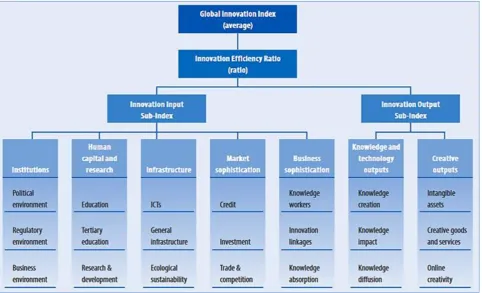
The Innovation Input Sub-Index and the Innovation Output Sub-Index are two sub-indices, built around pillars that calculates the Innovation Efficiency Ratio (see figure 2, page 9). The Innovation Input Sub Index comprise of five input pillars that capture the elements of the national economy that enable innovative activities. These include:
(1) Institutions;
(2) Human capital and research; (3) Infrastructure;
(4) Market sophistication; (5) Business sophistication
The Innovation Output Sub Index measures the innovation outputs that are the results of innovative activities within the economy. From these sub-indices there are two output pillars:
(6) Knowledge and technology outputs; (7) Creative outputs.
literacy levels of 15-year-old students’ and performance in area of sciences mathematics as well. Furthermore, higher education is construed as the crucial element for advancing economies up the value chain beyond simple production processes and products, and that innovation is highly dependent on people that possess the ability to apply knowledge and ideas in the workplace and in society. From this perspective, it one can interpret and reason that explicit links innovation and specific skills are difficult to establish as to date there exist a relative scarcity of innovation-specific empirical studies which proves and identifies of such relationships. Furthermore, a lack of connection between innovation and skilled workers could potentially refute the theory that skills and knowledge primarily the input factors of innovation; specific types of innovation require a substantial amount of training and developing human resources.
Source: Global Innovation Index, 2014
Figure 2: Innovation Efficiency Ratio
activities as the current situation tertiary education may change significantly in the years to come.
Human-centric Innovation Ecosystems
In an aim to achieve sustainable growth it is important to realize that we are living in a hyper-connected era. In today’s world, goods and services, processes and things are linked together; from these relations, value is created by this connectivity. The main challenge however is how to develop from a traditional one-dimensional concept of innovation towards a more holistic approach, which captures and analyzes all the multi-dimensional facets that drives the innovation process. The most important thing is identifying how, using digital technologies, ways to leverage human creativity to highlight that people are the key to innovation (Cornell University, INSEAD, and WIPO, 2014). The human is the primary factor for developing the innovation process, although the quality of the human capital is linked to the level of innovation activities carried out. Other factors, such as technology and capital do influence the innovation process. Additionally, they do correlate with the human factor. Therefore, as mentioned earlier it is important to nurture the human capital at all levels and sections of society as it is crucial for developing the foundation for innovation. Talented human capital can be formed from two primary means: when countries create infrastructures such as schools, colleges, scientific research centers and facilities to develop the knowledge and skills of its citizens locally or by attracting foreign talent from abroad. Governments, industry, academia, and other key factors such as business incubation and mentoring, research and development, are crucial in any innovation ecosystem, yet at the heart of innovation lies the human factor. Therefore, in order foster an innovation-driven society we need to educate our human resources very well and provide enough resources and incentives to build up their ideas. Creating an environment that fosters creativity ensures that innovation will follow. Such a society is termed as the knowledge economy.
Politicians, scientists and academics have stressed for more than a decade that innovation is the key to the future. Currently, there are excess amount of innovation initiatives that range from the mission statements of organizations and companies to the content of the higher education curricula. Due to economic downturn, the need to innovate has increased exponentially. “Design Thinking”, is a new approach to innovation, a model that is more human-centric based, where multifunctional teams would tackle through exploring the underlying needs by persons that are mostly affected by those problems, then based on observations would define the root causes or key elements of the problem and attempt to resolve it through active ideation, prototyping or testing potential solutions. While the process is very well defined and understood, its implementation by managers’ call for further exploration (Cabello, 2015).
Leave No One Behind and Work Differently To End Need”. Other organizations such as UNICEF, UNOCHA, The Red Cross, UNHCR and WFP have been building been building innovation units, adapted to similar approaches from the corporate world, which rooted in the Human-Centered Design method, speak directly on the importance of understanding people’s needs and aspirations and foster their creativity to solve complex problems. Using the UN humanitarian approach towards innovation, human-centered innovation ecosystems are more simplified in that it works easily in practice when all stakeholders collaborate and brainstormed approaches that aimed at involving communities to develop solutions for community-based problems. An example of this is where joint UNHCR, Mercy Corps, and Google initiatives created ‘Translation Cards’, for improving communication between aid workers and migrants (Cornell University, INSEAD, and WIPO, 2016). This initiative due to its user-centric not only embraced a “radical collaboration” model, its flexibility and iterative-ness evolutionary feature made it more suitable than other traditional approaches.
However, for a particular type of innovation to be implemented, training the workforce on that given innovation, implementing it in the production process and then later when it is consumed can give rise to incremental improvements to the original innovation (Toner, 2011). On the other hand, the most important condition must be met, which is the presence of a large, well-educated stock of human capital, as it assists countries to accelerate in the technological catch-up. According to the UIS Data Centre the ‘gross enrolment ratio’ (GER) for tertiary education is defined as: “the number of students enrolled in tertiary education, regardless of age, expressed as a percentage of the five-year age group starting from the official secondary school graduation age”. From this definition, it is assumed that the connection between human capital and innovation in low to middle-income countries, its impact on productivity levels is from the contribution of skilled workers focused on adapting to existing technologies through education (Lopez, 2009). Although a large, un-educated population is the main disadvantage of poor innovative performance, the positive externalities from higher educational attainment are seen in higher rate of innovation activities and technology transfer characteristic of developed societies (Bilbao-Osorio and Rodríguez-Pose, 2004). Therefore, continuous improvement of the human capital through formal education and constant R&D activities contributes to increased absorptive capacity of innovation in organizations, which produces an at the end-point a more highly skilled labour force capable of fostering and generating more progress and follow-up innovations in the future (Goedhuys, 2008).
economy’s transitional curve strategies to a more post-industrial, innovation-based economic model.
Conclusions
1. In analyzing the evolutionary context of innovation, it is clear that innovation is a complex process. In terms of global economics, the genesis of innovation derives from a wide range of sources. Innovation development involves various stages, involves considerable investment, non-linear progression, and constant feedback of vital information in the whole process. Throughout its history, innovation has been broadly defined as containing certain kind of novelty: artistic, scientific, technological, organizational, cultural, social or individual, has been the premise to many theories and recognized as the key feature of the inventor, scientist, entrepreneur or the firm. From the institutional aspect, innovation is recognized as a key characteristic of the individual, and in the main subject fields of psychology, philosophy and sociology. The new paradigm shifts towards the concept of a more ‘human-centric based innovation system is as a result of several economic factors: the political and economic contexts, the industrial and consumer revolutions, the impacts of technologies on individuals and societies, technology as a source of economic growth and productivity and the institutionalization of technological invention through patenting and patent laws, and industrial development through R&D laboratories. From this view innovation, innovation has thus shifted to become more industrially and economically driven due to focusing on the key and most important element that prompts its initial start- the human factor.
2. The literature analyzed confirms the main preconceptions about the link between innovation and skills. Clearly for more human-centric innovation, a correlation between the educational attainment and level of economic development needs to be established. The more developed a country is, the higher the percentage of the population that have completed tertiary education. Furthermore, the regions with the highest numbers of people with tertiary education and with the highest enrolment ratios in higher education are also those with the most researchers as a proportion of the total population. This can be explained in part by the fact that economies that are catching up are more dependent on technology transfer than they are on original R&D. On the other hand, countries with a low economic development do not provide enough incentives for young people to pursue higher education and from that results in economies that cannot grow due to the lack of skill labour market. In order to answer the questions how skills relate to innovation, more research is needed about the type of skills required by employers and as well as the supply of these skills by highly educated people. To that extent, these researches should ask more questions about the requisite skills needed and how those skills relate to firm performance. Moreover, surveys carried out at the individual level are required in order to understand the link between innovation and quality of available human resources. The information gathered from those research activities will require an analysis at the microdata level using econometric methods resources and methods.
engage innovative activities that lead to more technological breakthroughs. From the literature review highly innovative countries of the world invest heavily towards improving education systems so that it fosters creative thinking, develops skills and talent to emerge and promotes and supports entrepreneurship activities. Rather than investing heavily in capital and technology, the education policy can be structured to amend and reform towards the support the development of skills within arts, science, technology and digital media of the human capital which in true essence is the heart and soul of the entire innovation process, and moreover the condition of the higher education do impact the development of such systems. To a greater extent individual is the creator of innovation and from an economic perspective the originator of commercialized innovation that we are familiar with today. Furthermore, the sociologist E.M. Rogers states, “the adoption of a new idea almost always entails the sale of a new product”. This is why it is necessary to develop a human-centered ecosystem, which is focuses on the invaluable and most important factor of innovation- the human capital.
References
Andersen, J.B. What Are Innovation Ecosystems and How To Build and Use Them [interactive] [accessed on 29-08-2016]. Online Learning From Innovation Management. Retrieved from http://www.innovationmanagement.se/2011/05/16/what-are-innovation-ecosystems-and-how-to-build-and-use-them/
Autio, E., and Thomas, L.D.W., The Oxford Handbook of Innovation Management. Edited by Mark Dodgson, David M. Gann, and Nelson Phillips. Business and Management, Entrepreneurship, Social Issues, 2013.
Becker, G. S. Human Capital, Chicago and London: The University of Chicago Press, 1993/1964. Bilbao-Osorio, B. and Rodríguez-Pose, A. 2004. ‘From R&D to Innovation and Economic Growth in the EU’. Growth and Change 35 (4): 434–55. Available at http://onlinelibrary.wiley.com/ doi/10.1111/j.1468-2257.2004.00256.x/pdf.Bruland, K. 2003. ‘Education’. The Oxford Encyclopedia of Economic History, Volume 2, ed. J. Mokyr. New York: Oxford University Press. 160–70.
Bruland, K., and Mowery, D. Innovation Through Time- Globelics Academy, 2008.
Cabello Llamas, A. Human-centered Innovation Processes: The Case of Design Thinking in Nascent and Large Firms. Thèse No. 6506. École Polytechnique Fèdèrale De Lausanne, 2015.
Cohen, D. and Soto, M. (2007) 'Growth and human capital: good data, good results', Journal of Economic Growth, 12, 51-76.
Cornell University, INSEAD, and WIPO, 2014. The Global Innovation Index 2014: The Human Factor In innovation, second printing. Fontainebleau, Ithaca, and Geneva, 2014.
Cornell University, INSEAD, and WIPO, 2016. The Global Innovation Index 2016: Winning with Global Innovation, Ithaca, Fontainebleau, and Geneva, 2016.
Dutta, S., Benavente, D., Lanvin, B., and WunschVincent, S., The Global Innovation Index 2013: Local Dynamics Keep Innovation Strong in the Face of the Crisis. In The Global Innovation Index 2013: The Local Dynamics of Innovation, eds. S. Dutta and B. Lanvin. Geneva, Ithaca, and Fontainebleau: Cornell, INSEAD, and WIPO. 3–67, 2013.
Fujitsu Technology and Service Vision, 2014 Report.
Godin, B. (2008) Innovation: The History of a Category. Project on the Intellectual History of Innovation Working Paper No. 1.
Goedhuys, M., Janz, N., and P. Mohnen Knowledge-Based Productivity in “Low-Tech” Industries: Evidence from Firms in Developing Countries. UNU-MERIT Working Paper 2008007. Maastricht: UNU-MERIT, 2008.
Cornell University, INSEAD, and WIPO (2016): The Global Innovation Index 2016: Winning with Global Innovation, Ithaca, Fontainebleau, and Geneva.
Grant, R. M. (1996) 'Toward a Knowledge-Based Theory of the Firm', Strategic Management Journal, 17, 109-122, 1996
Hautamäki, A. and Oksanen, K. (2015). Sustainable Innovation: Competitive Advantage for Knowledge Hubs. Pia Lappalainen, Markku Markkula, Hank Kune: Orchestrating Regional Innovation, Espoo Innovation Garden, Aalto Univeristy, 87-10, 2015.
López Boo, F. Human Capital and Productivity. Unpublished paper. Washington, DC: InterAmerican Development Bank, 2009.
Porter, M. (1990). The Competitive Advantage of Nations. Harvard Business Review March-April 1990.
Rogers, E. M. Diffusion of Innovations, New York: The Free Press, 1962.
Romer, P. (1990). 'Endogenous technological change', Journal of Political Economy, 198, S7-S102 Schumpeter, J. (1934). The Theory of Economic Development, New Brunswick: Transaction Publishers, 1934.
Sergio, F. Human Centered Innovation For A World In Need. World Humanitarian Summit. May 23-24, 2016, [Interactive]. [Accessed on 25-11-2016]. https://designmind.frogdesign.com/2016/06/human-centered-innovation-world-humanitarian-summit/
Toner, P. Workforce Skills and Innovation: An Overview of Major Themes in the Literature. STI and OECD Education Working Paper, SG/ INNOV (2011)1. Paris: OECD, 2011.
Ucbasaran, D., Westhead, P., Wright, M., (2008). ‘Opportunity Identification and Pursuit: Does an Entrepreneur’s Human Capital Matter?’ Small Business Economics 30(2), 153-173.
This work is licensed under a Creative Commons