www.biogeosciences.net/12/3695/2015/ doi:10.5194/bg-12-3695-2015
© Author(s) 2015. CC Attribution 3.0 License.
Modelling the climatic drivers determining photosynthesis and
carbon allocation in evergreen Mediterranean forests using
multiproxy long time series
G. Gea-Izquierdo1, F. Guibal2, R. Joffre3, J. M. Ourcival3, G. Simioni4, and J. Guiot1 1CEREGE UMR7330, CNRS/Aix-Marseille Université, Europole de l’Arbois, BP 80 13545, Aix-en-Provence CEDEX 4, France
2IMBE, CNRS/Aix-Marseille Université, UMR7263 Europole de l’Arbois, BP 8013545, Aix-en-Provence CEDEX 4, France
3Centre d’Ecologie Fonctionnelle et Evolutive CEFE, UMR5175, CNRS, Université de Montpellier, Université Paul-Valéry Montpellier, EPHE, 1919 Route de Mende, 34293 Montpellier CEDEX 5, France 4Ecologie des Forêts Méditerranéennes, INRA UR629, Domaine Saint Paul, 84914 Avignon CEDEX 9, France Correspondence to: G. Gea-Izquierdo ([email protected]; [email protected])
Received: 28 December 2014 – Published in Biogeosciences Discuss.: 6 February 2015 Revised: 10 May 2015 – Accepted: 18 May 2015 – Published: 17 June 2015
Abstract. Climatic drivers limit several important physio-logical processes involved in ecosystem carbon dynamics including gross primary productivity (GPP) and carbon al-location in vegetation. Climatic variability limits these two processes differently. We developed an existing mechanis-tic model to analyse photosynthesis and variability in car-bon allocation in two evergreen species at two Mediterranean forests. The model was calibrated using a combination of eddy covariance CO2 flux data, dendrochronological time series of secondary growth and forest inventory data. The model was modified to be climate explicit in the key pro-cesses addressing the acclimation of photosynthesis and the pattern of C allocation, particularly to water stress. It suc-ceeded in fitting both the high- and the low-frequency re-sponse of stand GPP and carbon allocation to stem growth. This would support its capability to address both C-source and C-sink limitations. Simulations suggest a decrease in mean stomatal conductance in response to a recent enhance-ment in water stress and an increase in mean annual intrin-sic water use efficiency (iWUE) in both species during the last 50 years. However, this was not translated into a parallel increase in ecosystem water use efficiency (WUE). The in-terannual variability in WUE closely followed that in iWUE at both sites. Nevertheless, long-term decadal variability in WUE followed the long-term decrease in annual GPP
match-ing the local trend in annual precipitation observed since the late 1970s at one site. In contrast, at the site where long-term precipitation remained stable, GPP and WUE did not show a negative trend and the trees buffered the climatic variability. In our simulations these temporal changes were related to ac-climation processes at the canopy level, including modifica-tions in LAI and stomatal conductance, but also partly related to increasing [CO2] because the model includes biochemical equations where photosynthesis is directly linked to [CO2]. Long-term trends in GPP did not match those in growth, in agreement with the C-sink hypothesis. The model has great potential for use with abundant dendrochronological data and analyse forest performance under climate change. This would help to understand how different interfering environ-mental factors produce instability in the pattern of carbon allocation and, hence, the climatic signal expressed in tree rings.
1 Introduction
car-bon allocation within plants (Breda et al., 2006; Niinemets, 2007; Chen et al., 2013). Many factors affect the different physiological processes driving forest performance. Among them, the net effect of the rising CO2mixing ratio ([CO2]) and climate change is meaningful when determining the forests’ capacity of acclimation to enhanced xericity (Peñue-las et al., 2011; Keenan et al., 2011; Fatichi et al., 2014). Forest process-based models have been developed to mimic these mechanisms. They can include different levels of com-plexity but generally implement calculations of leaf photo-synthesis upscaled to the canopy and carbon allocated to dif-ferent plant compartments (Le Roux et al., 2001; Schaefer et al., 2012; De Kauwe et al., 2013). Although there is evidence that the tree performance depends to some extent on stored carbohydrates (Breda et al., 2006; McDowell et al., 2013; Dickman et al., 2015), these models have received some crit-icism when used to understand plant performance in response to climate change. This is in part because they are C-source oriented, therefore can exhibit certain limitations to repre-sent the C-sink hypothesis (i.e. that growth rates are limited by environmental factors such as water stress, minimum tem-perature or nutrient availability rather than by carbohydrate availability) and address dysfunctions related to the tree hy-draulics (Millard et al., 2007; Breshears et al., 2009; Sala et al., 2012; Körner, 2013; McDowell et al., 2013; Fatichi et al., 2014).
Complex process-based models benefit from multiproxy calibration, particularly when such data are applied on dif-ferent spatio-temporal scales (Peng et al., 2011). The tem-poral scale can be approached using time growth series of dendrochronological data. However, the analysis of the past always adds uncertainties related to the influence of unknown stand conditions to properly scale productivity. Flux data, in-cluding stand productivity, can be estimated using the eddy covariance technique (Baldocchi, 2003). These data over-come many of the limitations of dendroecological data (e.g. intra-annual resolution, control of stand conditions and scal-ing of net productivity), but they lack their spatial and tempo-ral coverage. Thus, CO2flux data can be used to implement unbiased models of canopy photosynthesis and can then be combined with dendroecological data to study how carbon is allocated to stem growth as a function of environmental forc-ing (Friedlforc-ingstein et al., 1999; Chen et al., 2013, McMurtrie and Dewar, 2013).
Mechanistic models can also be used to analyse the en-vironmental factors determining instability in the climate-growth response (D’Arrigo et al., 2008). Different process-based models have been applied with dendroecological data used either in forward or inverse mode (see Guiot et al., 2014, for a review). Among these models, the process-based model MAIDEN (Modeling and Analysis In DENdroecol-ogy). (Misson, 2004) was originally developed using den-droecological data. The model explicitly includes [CO2] to calculate photosynthesis (hence its influence on carbon allo-cation) and includes a carbohydrate storage reservoir, this
be-ing one of its strengths compared to other models (Vaganov et al., 2006; Sala et al., 2012; Guiot et al., 2014). It has been previously employed to analyse growth variability in one temperate and two Mediterranean species (Misson et al., 2004; Gaucherel et al., 2008) and recently, in inverse mode (also including C and O stable isotopes), to reconstruct past climate (Boucher et al., 2014). However, it requires further development to ensure that it provides unbiased estimates of forest productivity and assesses uncertainties in the response of trees to climatic variability on a greater spatial scale at the regional level. In particular, its parameterization would need improvement if the model is applied to assess how climate modulates forest performance and the pattern of C allocation within plants (Niinemets and Valladares, 2004; Fatichi et al., 2014).
In this study we use multiproxy data to develop a process-based model and investigate how evergreen Mediterranean forests have modified stand photosynthesis and carbon al-location in response to interacting climatic factors and en-hanced [CO2] in the recent past. The first objective was to develop a process-based model based on MAIDEN (Misson, 2004). Within the new version of the model, photosynthe-sis, carbon allocation, canopy turnover and phenology are now calculated using climate-explicit functions with a mech-anistic basis. The model is adapted to give unbiased esti-mates of canopy photosynthesis and stem growth using in-strumental data. Specifically, within the new model formu-lation, (1) photosynthesis is penalized by prolonged water stress conditions through reductions in leaf area index (LAI) and maximum photosynthetic capacity; (2) the pattern of car-bon allocation is directly determined by soil water content (i.e. water stress) and temperature through nonlinear relation-ships; (3) these relationships can be contrasting for different phenophases and affect photosynthesis and the pattern of C allocation independently. Once the model was developed, a second objective was to analyse how [CO2] and climatic vari-ability affect the temporal instvari-ability in annual forest produc-tivity, water use efficiency and carbon allocation. We hypoth-esize that they will exhibit differences in their long-term vari-ability in relation to recent climate change driven by different functional acclimation processes within trees.
2 Material and methods
2.1 Study sites and climatic data
The study sites were two evergreen Mediterranean moni-tored forests in Southern France where CO2, water vapour and energy fluxes are measured using the Eddy covari-ance technique (Baldocchi, 2003). Both sites are included in FLUXNET (http://fluxnet.ornl.gov/). The first site, Font-blanche (43.2◦N, 5.7◦E; 420 m), is a mixed stand where
Pi-nus halepensis Mill. dominates the open-top canopy layer
layer, reaching about 6 m, and there is a sparse shrub under-story which includes Quercus coccifera L. (Simioni et al., 2013). The second site, Puechabon (43.4◦N, 3.4◦E; 270 m), is a dense coppice in which overstorey is dominated by Q.
ilex with a density of around 6000 stems ha−1 (Rambal et al., 2004; Limousin et al., 2012). Both forests grow on rocky and shallow soils that have a low retention capacity and are of Jurassic limestone origin. The climate is Mediterranean, with a water stress period in summer, cold or mild win-ters and most precipitation occurring between September and May. Meteorological data were obtained from the neighbour-ing stations of St. Martin de Londres (for Puechabon) and Aubagne (for Fontblanche). According to those data Puech-abon is colder and receives more precipitation than Font-blanche (Table 1). Meteorological data showed a decrease in total rainfall since the 1970s in Puechabon but no trend in Fontblanche. Both sites exhibit a positive trend in tempera-tures more evident for the maximum values (Fig. A1).
We assumed that GPP (gross primary productivity) is driven by the top pine and/or oak layers and that the per-centage of LAI related to the understory shrub layer will behave like that of the oak species (evergreen, shrubby). For Fontblanche we considered a maximum leaf area index (LAImax)of 2.2 m2m−2 (3 m2m−2 plant area index, PAI), composed of 70 % pine and 30 % oak (Simioni et al., 2013). For Puechabon we considered an LAImax of 2.0 m2m−2 (2.8 m2m−2PAI) monospecific to Q. ilex (Baldocchi et al., 2010; Limousin et al., 2012). The specific leaf area (SLA) considered was 0.0045 m2g−1for Q. ilex and 0.0037 m2g−1 for P. halepensis (Hoff and Rambal, 2003; Maseyk et al., 2008).
2.2 The model
We used MAIDEN (Misson, 2004), a stand productivity mechanistic model driven by a number of functions and pa-rameters representing different processes. The model inputs are precipitation, maximum and minimum temperature, and [CO2] with a daily time step. This model has been previ-ously implemented for monospecific forests, including two oaks and one pine species, using dendroecological chronolo-gies of growth and, when available, stand transpiration esti-mates from sap-flow sensors (Misson et al., 2004; Gaucherel et al., 2008). However, the model has never been compared to actual CO2flux data to ensure that it provides unbiased esti-mates of forest productivity. In this study, the model was fur-ther developed to match ground-based observations and gen-eralize model use by modifying the photosynthesis and allo-cation modules (including the different phenophases) in rela-tion to climatic drivers. To properly scale model outputs and get unbiased estimates of stand productivity, we used CO2 eddy covariance fluxes (Baldocchi, 2003). Different parame-ters were calibrated to different data sources, including some species-dependent and some site-dependent parameters, as follows. The transpiration rate (E) of dayiis calculated
us-ing a conductance approach:E(i)=gs(i)×VPD(i)/Patm(i), where Patm is atmospheric pressure and gs and VPD are stomatal conductance and vapour pressure deficit, respec-tively, as described below (Misson, 2004). The other equa-tions used to calculate micrometeorological covariates, soil humidity and photosynthetic active radiation, as well as those functions describing the water cycle (including soil evapo-ration and plant transpievapo-ration) are explained in the original model formulation by Misson (2004). Therefore, they will not be described here. The rest of the model was modified as follows.
2.3 Modelling the effect of climatic forcing on photosynthesis
Leaf photosynthesis (An) is calculated based on the
bio-chemical model of Farquhar et al. (1980).Anis a function of
the carboxylation (Vc), oxygenation (Vo)and leaf dark respi-ration rates (Rd):An=Vc−0.5Vo−Rd, where photosynthe-sis during the dayiis limited by either the rate of carboxyla-tion when Rubisco is saturated (Wc)or when it is limited by electron transport (Wj), i.e.Ac=Vc−0.5Vo=min{Wc, Wj}.
Rd was considered a fixed function ofAc (0.006×Ac) be-cause this formulation performed better than an exponential function of temperature (Sala and Tenhunen, 1996; De Pury and Farquhar, 1997; Bernacchi et al., 2001). Following De Pury and Farquhar (1997):
Wc(i)= Vcmax(i)·(Ci(i)−0(i)) Ci(i)+Kc(i)
1+ [O2]
Ko(i)
, (1)
Wj(i)=
Jmax(i)·(Ci(i)−0(i))
4Ci(i)+80(i)
, (2)
where Ci is the CO2 intercellular concentration, 0 is the [CO2] compensation point for photosynthesis in the absence of dark respiration, andKcandKoare the kinetic Michaelis– Menten constants for carboxylation and oxygenation, respec-tively. Vcmax and Jmax are temperature-dependent parame-ters, as outlined below. Photosynthesis is known to respond to the carbon concentration within chloroplasts Cc rather than toCi. Throughout the paper we retain the notation pre-sented here in Eqs. (1) and (2) but discuss below how meso-phyll conductance is taken into account empirically in rela-tion to water stress when calculatinggsand acknowledge the possible limitations of our approach (Reichstein et al., 2002; Grassi and Magnani, 2005; Flexas et al., 2006; Sun et al., 2014).
Table 1. Characteristics of mean annual gross primary productivity, climatic (annual means) and growth data. Standard deviations are shown in parentheses. Precipitation: mean annual precipitation;Tmax: annual mean of mean daily maximum temperature;Tmin: annual mean of mean daily minimum temperature; length: chronology year replicated with more than 5 radii; RW: mean annual ring width; Rbs: mean correlation between series; AR: mean autocorrelation of raw series; MS: mean sensitivity; EPS: mean expressed population signal. Rbs, AR, MS and EPS are classical statistics to characterize growth chronologies, and they follow Fritts (1976).
Fontblanche Puechabon
Flux data Period 2008–2012 2001–2013
GPP annual 1431.4 1207.3
(g C m−2year−1) (305.4) (206.7)
Climate Period 1964–2012 1954–2013
Precipitation (mm) 642.7 (169.7) 1002.6 (328.2) Tmax(◦C) 20.6 (0.9) 17.8 (1.26)
Tmin(◦C) 8.8 (0.5) 8.1 (0.8)
Growth data Species P. halepensis Q. ilex Q.ilex No. of trees/radii 25/47 15/30 17/32 Length 1910–2013 1941–2013 1941–2005 RW (mm) 2.19 (1.1) 1.25 (0.7) 1.13 (0.7)
MS 0.308 0.372 0.443
AR 0.684 0.591 0.436
Rbs 0.541 0.281 0.457
EPS 0.963 0.884 0.949
1997; Maseyk et al., 2008). The model behaviour was better when the temperature dependence of Vcmax was modelled using a logistic function (Gea-Izquierdo et al., 2010) rather than an exponential function as in Misson (2004):
Vcmax(i)=
Vmax
(1+exp(Vb·((Tday(i)+273)−Vip)))
·θp. (3)
Vmax,Vb andVipare parameters to be estimated, withVmax being the asymptote andVipthe inflection point.θpis a soil water stress function dependent on the soil moisture condi-tions of the previous year. It takes into account the downreg-ulation of photosynthesis in response to protracted drought through its impact on the photosynthetic capacity of active LAI in evergreen species caused by constraints inVcmax, in turn produced by irreversible photoinhibition, modifications in leaf stoichiometry and/or the aging of standing foliage through lower leaf replacement rates in response to long-term water stress (Sala and Tenhunen, 1996; Niinemets and Val-ladares, 2004; Niinemets, 2007; Vaz et al., 2010).
θp=1−exp(pstr·SWC180), (4)
wherepstris a parameter to be estimated and SWC180is the mean soil water content (mm) from July to December of the previous year.
Photosynthesis is coupled to the calculation of stomatal conductance, which is estimated using a modified version of the Leuning (1995) equation:
gs(i)= g1·An(i)
(Cs(i)−0(i))·(1+VPD(i)/VPD0)·θg(i), (5)
where g1and VPD0are parameters; VPD(i) is daily vapour pressure deficit;Cs is the leaf surface [CO2]; θg is a non-linear soil water stress function calculated as
θg(i)=
1
1+exp(soilb·(SWC(i)−soilip))
; (6)
Day of Year
1 365
An
NSC
An
NSC
d12 d23 d34 d45 d51
GDDl
+GDD
An
NSC
An + NSC
Cstem Ccanopy
Croots -‐Ccanopy
An
Cstem NSC
f4 f3
An
[image:5.612.47.286.68.172.2]NSC -‐Croots
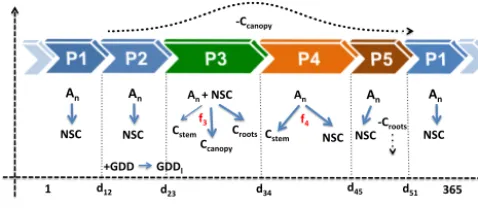
Figure 1. Outline of the different phenological phases (P1 to P5) and carbon allocation in the model within a given year.An: net daily carbon assimilation; NSC: storage (non-structural carbohydrates); GDD: growing degree days; GDDl=parameter determining shift from P2 to P3 (see text); C: carbon allocated either to the stem, canopy or roots;d: day of year. Solid arrows correspond to alloca-tion within the plant, whereas dashed arrows correspond to litterfall (canopy or roots).f3andf4are nonlinear functions of soil water content and temperature, determining carbon allocation to different compartments (see text for more details).
2.4 Modelling the effect of climatic forcing on carbon allocation
The model allocates daily carbon assimilated either to the canopy, stem, roots or storage of non-structural carbohy-drates (NSC) to mimic intra-annual carbohydrate dynam-ics (Misson, 2004; Dickman et al., 2015). Although trees can store carbon within different above-ground and below-ground compartments (Millard et al., 2007), carbon storage is treated as a single pool within the model. Tree autotrophic respiration (Ra,in addition toRd)is modelled as a function f (i) of daily photosynthesis and maximum daily tempera-ture (Tmax; Sala and Tenhunen, 1996; Nobel, 2009):
Ra(i)=An(i)·max{0.3, f (i)}, withf (i)=0.47
·(1−exp(prespi·Tmax(i)), (7)
whereprespiis a parameter. Net photosynthesis is calculated for dayiasAN(i)=An(i)−Ra(i). This assumption means
that respiration would be considered zero when there is no photosynthesis; hence, maintenance respiration would not be taken into account those days. Although this could bias the overall carbon balance, we assume that this effect will be very reduced in the studied forests because they present pho-tosynthetic activity all year round (see results). The model simulates several phenological phases during the year (see Fig. 1):
(P1) winter period where all photosynthates assimilated daily, AN(i), are allocated to the storage reservoir (NSCs) but there is no accumulation of growing degree days (GDD).
(P2) winter period where allAN(i)are allocated to storage (i.e. the same as in (P1)), but in contrast to (P1) there is
active accumulation of GDD, which defines the thresh-old GDD1 to trigger the next phenophase (P3) (bud-burst, leaf flush).
(P3) budburst, where carbon-availableCT(i)=AN(i)+Cbud (Cbudis daily C storage utilized from buds, a parameter) is either allocated to the canopy, to roots or to the stem. (P4) once the canopy has been completed in (P3), the next phenophase (P4) starts; in this period, daily photosyn-thatesAN(i)are allocated either to the stem or to stor-age;
(P5) the last phenophase (P5) starts when the photoperiod (parameter) crosses a minimum threshold in fall. In this phase, root mortality occurs. Otherwise (P5) is similar to (P1) and (P2) in the sense that allAN(i)is used for storage until next year’s (P3) starts.
The allocation of carbon to different plant compartments is complex because it can be decoupled from photosynthetic production depending on different factors, some of them cli-matic, acting on different temporal scales (Friedlingstein et al., 1999; Sala et al., 2012; Chen et al., 2013; McMurtrie and Dewar, 2013). In this new version of the model, we set the different allocation relationships as nonlinear func-tions of temperature and soil water content,h(i)=f1(Tmax)· f2(SWC), in (P3) and (P4) following the functional relation-ships described in Gea-Izquierdo et al. (2013). This means that now we take into account homeostatic acclimation pro-cesses at the canopy level related to LAI dependence on wa-ter availability (Hoff and Rambal, 2003; Sala and Tenhunen, 1996; Reichstein et al., 2003). LAI is negatively related to long-term drought because litterfall is negatively linked to water stress (Limousin et al., 2009; Misson et al., 2011) and bud size depends on the climate influencing the pe-riod of bud formation (Montserrat-Marti et al., 2009). There-fore, the actual carbon that can be allocated to the canopy in (P3) of year j (AlloCcanopy(j )) was set as a function of the previous year’s moisture conditions (θLAI(j )) and the maximum carbon that can be allocated to the canopy (MaxCcanopy). MaxCcanopy is calculated from LAImax and SLA, and AlloCcanopy(j )=θLAI(j )×MaxCcanopy, where
θLAI(j )=(1−2·pLAI−SWC250 pLAI
),
constrained toθLAI(j )∈ [0.7,1.0]. (8) pLAIis a parameter to be calibrated representing the thresh-old over whichθLAI(j )=1 and SWC250is mean soil water content for May–December of the previous year.
et al. (2008) and Limousin et al. (2009; Fig. 1). C alloca-tion to the canopy (i.e. including primary growth) in (P3) is calculated as Ccanopy(i)=CT(i)×(1−0.2×h3_1(i))×
Ratio−root/leaf1 ; Ratioroot/leaf was fixed to 1.5 for both species (Misson et al., 2004; Ourcival, unpublished data), and h3_1(i)=(1−exp(p3moist·SWC(i)))
· exp −0.5·
Tmax(i)−p3temp
p3sd
2!!
, (9)
wherep3moist,p3temp andp3sd are parameters representing the scale of the SWC and the optimum and dispersion of the Tmaxfunctions, respectively. The carbon allocated to the stem (Cstem)in (P3) isCstem(i)=CT(i)×0.2×h3_1(i)×h3_2(i), where
h3_2(i)=(1−exp(st3moist·SWC(i))) · exp −0.5·
T
max(i)−st3temp st3sd_temp
2!!
, (10)
withh3_1(i)as in Eq. (9); st3moist, st3temp and st3sd_temp are parameters as in h31(i). The carbon allocated to roots in (P3) is set complementary to that of the other compartments to close the carbon budget within the tree, i.e. Croots(i)= CT(i)−Cstem(i)−Ccanopy(i).
Finally, in (P4) carbon-assimilated dailyAN(i)is allocated either to stem growth or to storage until changing to (P5). In (P4), the amount of carbon to be allocated to stem growth is also set as a function of climatic forcing:
Cstem(i)=AN(i)×(1−h4(i)) and Cstor(i)=AN(i)× h4(i), with
h4(i)=(1−exp(st4temp·Tmax(i))) · exp −0.5·
SWC(i)
st4sd_moist
2!!
, (11)
where st4tempand st4sd_tempare parameters. 2.5 Eddy covariance CO2flux and
dendrochronological data
The process-based model was calibrated using daily gross primary productivity (GPP), dendrochronological data and inventory data. To develop the model, those functions used to model daily stand photosynthesis (i.e. Eq. 1 to 9) were first calibrated against GPP values. GPP estimates were ob-tained from half-hourly net CO2flux measurements (NEP). GPP was obtained as the difference between measured net ecosystem productivity and calculated ecosystem respiration (Reichstein et al., 2005). Negative GPP values were corrected following Schaefer et al. (2012). Half-hourly GPP data were integrated to obtain daily estimates for the period 2001–2013 (Puechabon, methods detailed in Allard et al., 2008) and 2008–2012 (Fontblanche, Table 1).
0 10 20 30 40 0 10 20 30 40
1920 1940 1960 1980 2000
PIHA QUIL (a) Fontblanche B a s a l A r e a I n c r e m e n t ( c m 2 y e a r − 1 ) B i o m a s s ( g C m − 2y e a r − 1) 0 50 100 150 200 250 300 Total
Total (no release) PIHA QUIL (b) Fontblanche 0 10 20 30 40
[image:6.612.309.546.64.329.2]1920 1940 1960 1980 2000 Year B a s a l A r e a I n c r e m e n t ( c m 2 y e a r − 1 ) B i o m a s s ( g C m − 2y e a r − 1) 0 50 100 150 200 250 300 (c) Puechabon BAI Biomass BAI Biomass
Figure 2. Growth (basal area increment, BAI, cm2yr−1) and
biomass allocated to the tree stem (g C m−2yr−1)of Q. ilex and P. halepensis at Fontblanche (growth shown in a, biomass in b) and Q. ilex at Puechabon (growth and stem biomass shown in c). A ver-tical dashed line marks the release event in Fontblanche produced by the enhanced winter mortality in 1985 in (a). Dark lines for BAI correspond to yearly means while grey polygons show confidence intervals (at 95 %) on the standard errors of the mean.
In the second step, those functions used to model how carbon assimilated and/or storage is allocated to the growth of the tree stem (i.e. Eqs. 10 and 11) were developed us-ing calculated annual stem biomass increment time series. Stem biomass increment chronologies were built combining dendroecological data and forest inventory data collected at each site. We built one chronology for Q. ilex in Puechabon, a second for Q. ilex in Fontblanche and a third one for P.
halepensis at Fontblanche (Fig. 2). For pines, two
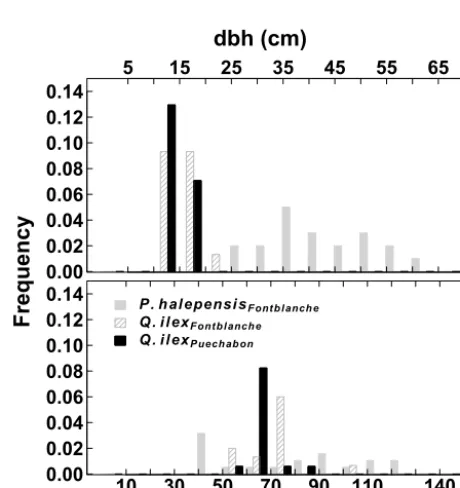
perpendic-ular cores were extracted using an increment borer from 25 trees in fall 2013, whereas for oaks we used cross sections. In Fontblanche, 15 oak stems were felled and basal sections collected in spring 2014. A total of 17 oak stems from Puech-abon were logged in 2005 and 2008. The age and diameter distributions of the studied forests are depicted in Fig. A2.
In Fontblanche, BAI during the period 1987–1995 was stan-dardized relative to the mean calculated after excluding that period (Fig. 2). BAI data were standardized because we did not find a climatic explanation for the abrupt growth peak ob-served in Fontblanche during that period (Fig. 2). Therefore, we assumed that it had been caused by a release event (i.e. reduction in competition) produced by the death of neigh-bours as a consequence of winter frost during 1985 and 1987 (Vennetier, personal communication, 2014). These two frosts were reflected by the presence of characteristic frost rings in most individuals from Fontblanche.
To scale BAI chronologies to the same units as annual stem biomass (which is an output of the model), we used plot in-ventory data collected around the flux towers at the two sites. Inventory data included stem diameter for all trees and tree height collected for a subsample every 2 years during 2007– 2011 in Fontblanche as well as annual diameter estimates for the period 1986–2011 for Puechabon. Individual annual biomass increments were estimated by subtracting the stem biomass of one year from that of the next; then, stand stem biomass increments (SBIs, g C m−2yr−1)were calculated by integrating plot data. Stem biomass was calculated using al-lometric functions. For pines, we calculated stem biomass us-ing diameter and estimated stem height assumus-ing that the tree bole follows a paraboloid shape (Li et al., 2014). For oaks, stem biomass was calculated following Rambal et al. (2004). Once SBI had been estimated for the years when we had available inventory data, BAI chronologies were correla-tively scaled to SBI units (g C m−2yr−1). We built two mean stand SBI chronologies, one for each site, meaning that we analysed carbon allocation within stands, not differentiating between species in Fontblanche. These two SBI chronologies were used to calibrate sitewise Eqs. (10) and (11).
2.6 Model development and analyses
Parameters were selected according to the ecological charac-teristics of the species, exploring the model using compre-hensive sensitivity analysis to sequentially optimize groups of parameters. In a first step, a group of common parame-ters was selected using GPP data from Fontblanche (Table 2). The species-dependent parameters selected for Q. ilex in this first step (those parameters in Table 2 which are common to the two sites) were independently validated when applied in Puechabon. In a second step, a subset of site-dependent parameters was calibrated against GPP and SBI data. Four parameters from Eqs. (6) and (9) were calibrated using GPP data, and five parameters in Eqs. (10) and (11) were cali-brated using stem biomass increment data (Table 2). The lo-cal parameters were lo-calibrated constrained to an ecologilo-cally realistic range and using a global optimization algorithm and maximum likelihood principles (Gaucherel et al., 2008).
To compare model output with stem biomass chronolo-gies as estimated from dendroecological data, we used only the period for which we had available daily meteorological
data (1960–2013), which was also a period that did not in-clude juvenile years with increasing BAI (BAIs reached an asymptote after increasing for the first 15–20 juvenile years; Fig. 2). The model does not take into account how size dif-ferences in allometry or ontogeny affect carbon allocation (Chen et al., 2013). We tried to keep the model as simple as possible also because we had no such data to calibrate onto-genic effects. Hence, the model is designed for non-juvenile stands with canopies that reached a steady state with asymp-totic LAImax. For the same reasons it does not take into ac-count how changes in management affect carbon allocation. The model was analysed in terms of goodness of fit. Addi-tionally, for the period for which we had available daily me-teorological data, we simulated time series of GPP, ecosys-tem water use efficiency (WUE=GPP/ET, with ET being actual evapotranspiration) and intrinsic water use efficiency of sun leaves (iWUE=AN/gs) calculated following Beer et al. (2009).
3 Results
The studied evergreen forests exhibit a bimodal pattern in GPP with maxima in spring and autumn (Fig. 3) as of-ten observed in Mediterranean ecosystems (e.g. Baldocchi et al., 2010). GPP was above 0 almost every day of the year, including in winter, particularly at the milder site, Fontblanche (Table 1). This means that there is active pho-tosynthesis all year round in these evergreen forests, in-cluding during both periods of climatic stress, i.e. those with low temperature and short photoperiod in winter and with low moisture availability in summer (Fig. 3). Mean annual GPP was 1431.4±305.4 g C m−2yr−1 and precipitation 642.7±169.7 mm in Fontblanche, whereas it was 1207.3±206.7 g C m−2yr−1 and 1002.6±328.2 mm in Puechabon (see Table 1 for more details). Mean GPP was higher at Fontblanche because carbon assimilation was greater in the low-temperature winter period but similar the rest of the year (Fig. 3). Stem growth did not show any long-term (decadal) growth trend for any of the species studied (Fig. 2).
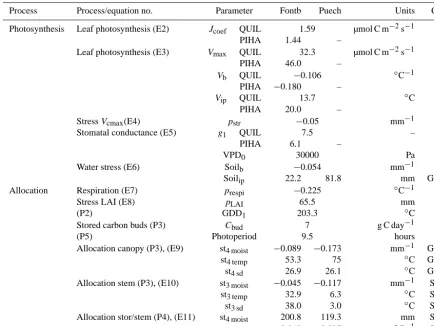
Table 2. Model parameters. Those parameter differing between sites were optimized either with GPP data (photosynthesis and allocation module) or with growth-based biomass increment chronologies (allocation module). The rest were common parameters for both sites and selected while developing the model in the first step for Fontblanche using GPP data (represented in the “Cal” column by “–”). Meaning of parameters, equation number (E) and phenophase (P) are as in the Material and Methods section. Fontb: Fontblanche; Puech: Puechabon; Cal: local parameters to be calibrated with GPP or stem biomass increment data (SBI); PIHA: Pinus halepensis; QUIL: Quercus ilex.
Process Process/equation no. Parameter Fontb Puech Units Cal
Photosynthesis Leaf photosynthesis (E2) Jcoef QUIL 1.59 µmol C m−2s−1 –
PIHA 1.44 –
Leaf photosynthesis (E3) Vmax QUIL 32.3 µmol C m−2s−1 –
PIHA 46.0 –
Vb QUIL −0.106 ◦C−1 –
PIHA −0.180 –
Vip QUIL 13.7 ◦C –
PIHA 20.0 –
StressVcmax(E4) pstr −0.05 mm−1 –
Stomatal conductance (E5) g1 QUIL 7.5 – –
PIHA 6.1 –
VPD0 30000 Pa –
Water stress (E6) Soilb −0.054 mm−1 –
Soilip 22.2 81.8 mm GPP
Allocation Respiration (E7) prespi −0.225 ◦C−1 –
Stress LAI (E8) pLAI 65.5 mm –
(P2) GDD1 203.3 ◦C –
Stored carbon buds (P3) Cbud 7 g C day−1 –
(P5) Photoperiod 9.5 hours –
Allocation canopy (P3), (E9) st4 moist −0.089 −0.173 mm−1 GPP
st4 temp 53.3 75 ◦C GPP
st4 sd 26.9 26.1 ◦C GPP
Allocation stem (P3), (E10) st3 moist −0.045 −0.117 mm−1 SBI
st3 temp 32.9 6.3 ◦C SBI
st3 sd 38.0 3.0 ◦C SBI
Allocation stor/stem (P4), (E11) st4 moist 200.8 119.3 mm SBI
st4 temp 0.060 −0.097 ◦C−1 SBI
0 2 4 6 8 10
0 2
4 6 8 10
0 50 100 150 200 250 300 350
DOY
G
P
P
(
g
C
m
−
2d
a
y
−
1)
Puechabon Fontblanche Puechabon Fontblanche
Figure 3. Daily gross primary productivity (GPP) at Puechabon (2001–2013, black dots, blue line) and Fontblanche (2008–2012, orange dots, red line). DOY: day of year. Thick lines correspond to smoothers fitted to the mean to highlight seasonal trends at the two sites.
Observed R2=0.522
ρ = 0.722
(a) Fontblanche
50
75 100
125 150 175 200
1960 1970 1980 1990 2000 2010
Observed
Simulated Observed Estimated R2=0.462 ρ = 0.690 ρlow15 = 0.855
2002 2006 2010 2014
0 2 4
6
8 10 (b) Fontblanche
Estimated R2=0.528
ρ = 0.741 (c)
Puechabon 1960 1970 1980 1990 2000 2010
50 75 100 125 150
175 200
S
t
e
m
B
i
o
m
a
s
s
I
n
c
r
e
m
e
n
t
(
g
C
m
−
2 y
e
a
r
−
1
)
R2=0.587ρ = 0.773 ρlow15 = 0.857
2002 2006 2010 2014
0 2 4 6 8 10
G
P
P
(
g
C
m
−
2 d
a
y
−
1
)
Time
[image:9.612.128.471.63.266.2](d) Puechabon
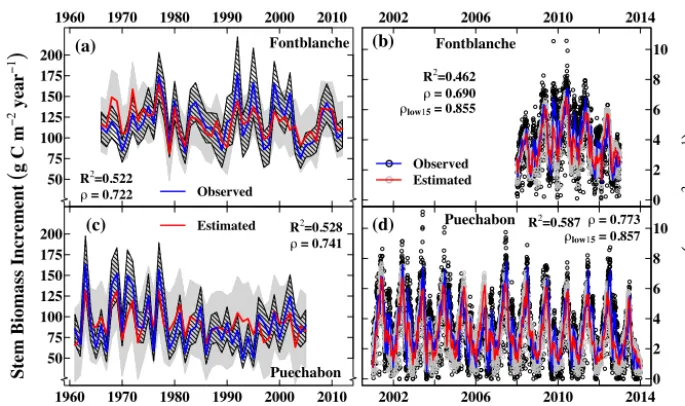
Figure 4. Model fit to stem biomass increment (a) and GPP (b) in Fontblanche and stem biomass increment (c) and GPP (d) in Puechabon.
R2: coefficient of determination;ρ: linear correlation between estimated and observed data;ρlow15: linear correlation between estimated and observed data smoothed with a 15-year low-pass filter (blue and red lines in b and c). Polygons behind the estimated values in (a) and (c) correspond to confidence intervals of the mean: solid grey polygons for estimated values and dashed polygons for observed stem biomass increment values.
Figure 5. Modelled carbon allocation trajectory to the stem when leaf flush has finished in phenological period (P4). We show the unitless modifier 1−h4(i)(i.e.h4(i)is the portion of carbon allo-cated to storage) fromCstem(i)=AN(i)×[(1−h4(i))] in Eq. (11). The modifier [0,1] is a function of soil water content (SWC) and maximum temperature (Tmax); multiplied with available daily car-bon, it gives the distribution of daily carbon allocated to secondary growth and storage.
(Fig. A3; Limousin et al., 2009; Misson et al., 2011). Simu-lated long-term decadal trends in mean annual stomatal con-ductance were similar and decreased at the two sites with greater water stress as a consequence of enhanced tempera-tures (Fig. 6). The two species studied showed a long-term increase in simulated iWUE (Fig. 7) following the decrease in simulatedgs(Fig. 6). The interannual variability in WUE and iWUE were highly and positively correlated (Fig. 7). However, in the long-term they followed a different pattern, particularly in Puechabon, where there was a recent decline
in WUE (not observed in iWUE) forced by trends in ET and GPP (Fig. 7). This means that the recent reduction in simu-lated GPP was proportionally greater than that of simusimu-lated ET (Figs. 6; A3).
4 Discussion
4.1 Linking photosynthetic production to carbon allocation as a function of climate
[image:9.612.48.289.353.474.2]800 1000 1200 1400 1600 gspiha gsquil
Smooth gspiha
Smooth gsquil GPP Smooth GPP
1960 1970 1980 1990 2000 2010
80 100 120 140 160 180 200 (a) Fontblanche 800 1000 1200 1400 1600
GPP
SmoothGPP
gsquil
Smooth gsquil 80 100 120 140 160 180 200
1960 1970 1980 1990 2000 2010
[image:10.612.309.545.64.280.2]g s ( m m o l C m 2 s − 1 ) G P P ( g C m − 2 y e a r − 1 ) Year (b) Puechabon
Figure 6. Modelled total annual stand gross primary productivity (GPP) and mean stomatal conductance of sun leaves (gs) for Font-blanche (a) and Puechabon (b) for the period for which meteorolog-ical data were available. To show the influence of the precipitation decline observed in Puechabon on GPP, we run a sensitivity simula-tion in which precipitasimula-tion was fixed for 1980–2012 on the basis of precipitation in 1960–1979 (Fig. A1) and all other input variables (Tmin,Tmax, [CO2]) were actual values. GPP values from this sim-ulation are depicted as dashed grey lines in (b).
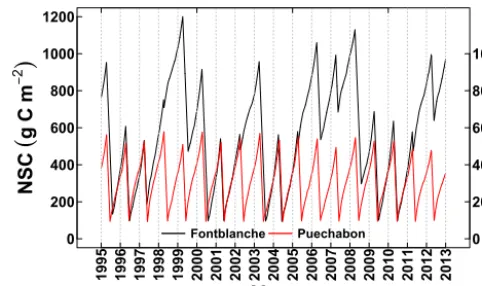
can be related to climatic variability differently from photo-synthetic production (Sala et al., 2012). The model showed C limitation (for primary growth) in the years when LAImax was not achieved (i.e. a limitation in LAI is driven by limita-tions in the C supply in spring), e.g. all years in Puechabon for the period shown in Fig. A5 (1995–2012) but only those years in Fontblanche when the minimum value considered as a threshold was reached. Therefore, both C-source (pho-tosynthesis) and C-sink (just related to growth; other sinks such as volatile organic compounds or root exudates are not explicitly included in the model) limitations can be assessed in different years within one site and even at different peri-ods within the same year (Millard et al., 2007; Sala et al., 2012; Chen et al., 2013; Fatichi et al., 2014). This hypothesis seems plausible as drought stress affects both C-source (e.g. through reduced stomatal conductance) and C-sink limita-tions (e.g. cell water turgor, hydraulic performance; McDow-ell et al., 2013). Whether the pattern of C storage simulated is realistic is something that needs to be validated against actual data. However, the flexible way in which stored C is modelled has much potential to improve ecosystem models that only view a carbon-source limitation (Sala et al., 2012; Friend et al., 2014).
Water stress is generally considered the greatest limitation for Mediterranean ecosystems, driving a close relationship between precipitation and both growth and photosynthesis (Breda et al., 2006; Pereira et al., 2007; Baldocchi et al., 2010; Gea-Izquierdo and Cañellas, 2014). Our results show
2.0 2.5 3.0
3.5
iWUEpiha
iWUEquil
Smooth iWUEpiha Smooth iWUEquil
1960 1970 1980 1990 2000 2010
40 60 80 100 120 Fontblanche (a) 2.0 2.5 3.0 3.5
Smooth WUEecosys WUEecosys
40 60
80
100
120
1960 1970 1980 1990 2000 2010
i W U E
(
µ m o l m o l − 1)
W UEec
o s y s
(
g C m − 2 m m − 1)
Year Puechabon (b)Figure 7. Ecosystem WUE (integral annual) and iWUE for sun leaves (mean daily, for PIHA and QUIL separated in Fontblanche) for (a) Fontblanche and (b) Puechabon for the period for which we had available meteorological data.
that a long-term decrease in precipitation triggered a decrease in simulated GPP at the rainier and coldest site. However, this decline was not expressed in the growth trends. This means that long-term productivity and the allocation of C to sec-ondary growth were decoupled and did not match (Sala et al., 2012; Chen et al., 2013; Fatichi et al., 2014). The existence of trade-offs between carbon assimilation and allocation in rela-tion to environmental variability suggests exercising caurela-tion when using growth as a direct proxy to investigate stand pro-ductivity dynamics (e.g. Piovesan et al., 2008; Peñuelas et al., 2008; Gea-Izquierdo and Cañellas, 2014). GPP was greater at the site receiving less precipitation, which could be related to differences in soil retention capacity. However, both soils are calcareous, shallow and stony, and differences in GPP were, to a large part, explained by less limitation for car-bon assimilation of low winter temperatures at the warmest site (Fontblanche). They can also be a result of a different species composition (oak vs. pine oak). LAI is greater at the site yielding higher annual GPP. Nonetheless, had this factor been responsible for the observed differences in winter pho-tosynthesis, there would also have been differences in spring photosynthesis, which was not the case (Fig. 3).
[image:10.612.50.287.65.251.2]2008; Vaz et al., 2010). Daily climatic data are readily avail-able on a greater spatial scale than data with a higher tem-poral resolution, which increases the applicability of daily models. Model performance could be improved by address-ing respiration changes related to ontogeny, allometry and nutrient limitations (e.g. N/P) on photosynthesis or by in-cluding more complex upscaling of leaf-level photosynthe-sis (Niinemets et al., 1999; Niinemets, 2007; Chen et al., 2013; McMurtrie and Dewar, 2013). However, it is difficult to find suitable data to calibrate such processes. Similarly, it would be challenging to include allocation to reproduc-tive effort in the carbon budget. This is because, even if it is influenced by water stress in the studied forests (Pérez-Ramos et al., 2010), there is still great uncertainty regarding the causal factors driving multi-annual variability in fruit pro-duction (Koenig and Knops, 2000). Addressing stand dynam-ics would also help to generalize model applicability. Stand disturbances modifying stand competition can leave an im-print on growth for more than a decade whereas they do not seem to affect stand GPP over more than 1 or 2 years if the disturbance is moderate (Misson et al., 2005; Granier et al., 2008). In response to changes in competition, the trees mod-ify the carbon allocation pattern or keep the root : shoot ratio constant to enhance productivity on a per-tree basis but up to an asymptotic stand GPP. Still, the model behaviour was good compared with other studies that addressed ontogenic changes in the carbon allocation response to photosynthesis (Li et al., 2014) and similar or better than that of other mech-anistic approaches calibrated to standardized dendroecologi-cal data (Misson et al., 2004; Evans et al., 2006; Gaucherel et al., 2008; Tolwinski-Ward et al., 2011; Touchan et al., 2012). 4.2 Forest performance in response to recent climate
change and [CO2] enhancement
Few studies under natural conditions have observed a net in-crease in growth rates in response to enhanced [CO2] levels since the late 1800s, meaning that other factors, such as wa-ter stress and/or N or P, were more limiting for photosynthe-sis and/or allocation to growth than [CO2] (Niinemets et al., 1999; Peñuelas et al., 2011; McMurtrie and Dewar, 2013; Lévesque et al., 2014). Yet the forests have increased their iWUE. This can be partly a passive consequence of enhanced [CO2], but higher iWUE observed in more water-stressed sites suggests that climate is co-responsible for an active ac-climation of physiological plant processes (Keenan et al., 2013; Leonardi et al., 2012; Saurer et al., 2014). These pro-cesses would include a higher stomatal control, like in our re-sults, where, in turn, we did not observe any increase in long-term carbon assimilation. The mean annual stomatal conduc-tance simulated was driven by climate but also decreased si-multaneously in time with increasing [CO2] (Fig. A4). Fur-thermore, there is debate on whether there has been an in-crease in ecosystem WUE in response to recent changes in [CO2] under a warming climate (Beer et al., 2009;
Reich-stein et al., 2002; Keenan et al., 2013). In our results the high frequency of WUE followed that of iWUE, but there was some mismatch between the two traits in the low frequency. We observed no dominant time trends in simulated annual WUE for the period 1980–2000 at the site where precipita-tion remained stable, whereas a decrease in WUE following that in GPP was particularly evident at the site experiencing a drier climate in recent years. This trend was not observed in iWUE, which means that reductions in GPP andgs were proportionally greater than those in ET (Figs. 6, 7, A3).
flexi-bility for investigating growth trends and forest performance in response to global change on a larger scale.
5 Conclusions
Appendix A
500
1000
1500 2000
P
re
ci
p
itati
on
(mm)
1960 1970 1980 1990 2000 2010
Fontblanche Puechabon
(a)
6 7 8 9 10
Tm
i
n
(
º
C
)
16 18 20 22
Tm
a
x
(
º
C
)
Tmin Tmax
Fontblanche (b)
6 7 8 9 10
Tm
i
n
(
º
C
)
16
18 20 22
Tm
a
x
(
º
C
)
Year
1960 1970 1980 1990 2000 2010
[image:13.612.193.405.99.355.2](c) Puechabon
Figure A1. Mean climatic time series of the last 50 years. (a) Annual precipitation; and annual maximum (Tmax) and minimum (Tmin)
temperatures for Fontblanche (b) and Puechabon (c).
5 15 25 35 45 55 65
0.00 0.02
0.04 0.06 0.08 0.10 0.12 0.14
Frequency
dbh (cm)
P. halepensisFontblanche
Q.ilexFontblanche
Q. ilexPuechabon
10 30 50 70 90 110 140
0.00 0.02 0.04 0.06 0.08 0.10 0.12 0.14
Age (Years)
[image:13.612.184.414.413.657.2]1.4 1.6 1.8 2.0 2.2
1960 1970 1980 1990 2000 2010
300 350 400
450
500 550
(a) Fontblanche
1.4 1.6 1.8 2.0
2.2 LAI
Smooth LAI E
Smooth E
300 350 400 450
500 550
1960 1970 1980 1990 2000 2010
E
(
m
m
y
e
a
r
−
1 )
L
A
I
(
m
2 m
−
2 y
e
a
r
−
1 )
(b)
[image:14.612.179.415.65.263.2]Puechabon
Figure A3. Simulated maximum annual leaf area index LAI (m2m−2)and total annual stand transpiration E (mm yr−1) in Fontblanche
(a) and Puechabon (b).
0.08 0.10 0.12 0.14
0.16
0.18 0.20
Fontblanche
Puechabon
320 340 360 380 400
(a)
CO2 (ppm
)
16 18 20 22
0.08 0.10
0.12 0.14 0.16 0.18
0.20
(b)
Tmax (ºC
)
gs(
m
m
o
l
C
m
2 s
−
1
)
[image:14.612.184.408.320.553.2]0 200 400
600 800 1000 1200
Fontblanche Puechabon 0
200
400 600
800 1000
1995 1996 1997 1998 1999 2000 2001 2002 2003 2004 2005 2006 2007 2008 2009 2010 2011 2012 2013
N
S
C
(
g
C
m
−
2
)
[image:15.612.177.418.65.208.2]Year
Acknowledgements. G. Gea-Izquierdo was funded by the Labex OT-Med (no. ANR-11-LABEX-0061) from the “Investissements d’Avenir” program of the French National Research Agency through the A*MIDEX project (no. ANR-11-IDEX-0001-02). Federation de Recherche FR3098 ECCOREV, the labex IRDHEI and OHM-BMP also supported the study. We are grateful to Roland Huc for sharing data from Fontblanche.
Edited by: Akihiko Ito
References
Allard, V., Ourcival, J. M., Rambal, S., Joffre, R. and Rocheteau, A.: Seasonal and annual variation of carbon exchange in an ev-ergreen Mediterranean forest in southern France, Glob. Change Biol., 14, 714–725, 2008.
Baldocchi, D. D.: Assessing the eddy covariance technique for evaluating carbon dioxide exchange rates of ecosystems: Past, present and future, Glob. Change Biol., 9, 479–492, 2003. Baldocchi, D. D., Ma, S. Y., Rambal, S., Misson, L., Ourcival, J. M.,
Limousin, J. M., Pereira, J., and Papale, D.: On the differential advantages of evergreenness and deciduousness in mediterranean oak woodlands: a flux perspective, Ecol. Appl., 20, 1583–1597, 2010.
Beer, C., Ciais, P., Reichstein, M., Baldocchi, D., Law, B. E., Pa-pale, D., Soussana, J.-F., Ammann, C., Buchmann, N., Frank, D., Gianelle, D., Janssens, I. A., Knohl, a., Köstner, B., Moors, E., Roupsard, O., Verbeeck, H., Vesala, T., Williams, C. A., and Wohlfahrt, G.: Temporal and among-site variability of inherent water use efficiency at the ecosystem level, Global Biogeochem. Cy., 23, GB2018, doi:10.1029/2008GB003233, 2009.
Bernacchi, C. J., Singsaas, E. L., Pimentel, C., Portis, A. R., and Long, S. P.: Improved temperature response functions for models of Rubisco-limited photosynthesis, Plant Cell Environ., 24, 253– 259, 2001.
Bigler, C., Braker, O. U., Bugmann, H., Dobbertin, M., and Rigling, A.: Drought as an inciting mortality factor in Scots pine stands of the Valais, Switzerland, Ecosystems, 9, 330–343, 2006. Boucher, É., Guiot, J., Hatté, C., Daux, V., Danis, P.-A., and
Dus-souillez, P.: An inverse modeling approach for tree-ring-based climate reconstructions under changing atmospheric CO2 con-centrations, Biogeosciences, 11, 3245–3258, doi:10.5194/bg-11-3245-2014, 2014.
Breda, N., Huc, R., Granier, A., and Dreyer, E.: Temperate forest trees and stands under severe drought: a review of ecophysiologi-cal responses, adaptation processes and long-term consequences, Ann. For. Sci., 63, 625–644, 2006.
Breshears, D. D., Myers, O. B., Meyer, C. W., Barnes, F. J., Zou, C. B., Allen, C. D., McDowell, N. G., and Pockman, W. T.: Tree die-off in response to global change-type drought: mortal-ity insights from a decade of plant water potential measurements, Front. Ecol. Environ., 7, 185–189, 2009.
Chen, G., Yang, Y., and Robinson, D.: Allocation of gross primary production in forest ecosystems: allometric constraints and envi-ronmental responses, New Phytol., 200, 1176–1186, 2013. D’Arrigo, R., Wilson, R., Liepert, B., and Cherubini, P.: On the
“Di-vergence Problem” in Northern Forests: A review of the tree-ring
evidence and possible causes, Global Planet. Change, 60, 289– 305, 2008.
De Pury, D. G. G. and Farquhar, G. D.: Simple scaling of photo-synthesis from leaves to canopies without the errors of big-leaf models, Plant Cell Environ., 20, 537–557, 1997.
De Kauwe, M. G., Medlyn, B. E., Zaehle, S., Walker, A. P., Dietze, M. C., Hickler, T., Jain, A. K., Luo, Y. Q., Parton, W. J., Pren-tice, I. C., Smith, B., Thornton, P. E., Wang, S. S., Wang, Y. P., Warlind, D., Weng, E. S., Crous, K. Y., Ellsworth, D. S., Han-son, P. J., Seok Kim, H., Warren, J. M., Oren, R., and Norby, R. J.: Forest water use and water use efficiency at elevated CO2: a model-data intercomparison at two contrasting temperate forest FACE sites, Glob. Change Biol., 19, 1759–1779, 2013.
Dickman, L. T., McDowell, N. G., Sevanto, S., Pangle, R. E., and Pockman, W. T.: Carbohydrate dynamics and mortality in a piñon-juniper woodland under three future precipitation sce-narios, Plant. Cell Environ., 729–739, 2015.
Evans, M. N., Reichert, B. K., Kaplan, A., Anchukaitis, K. J., Vaganov, E. A., Hughes, M. K., and Cane, M. A.: A forward modeling approach to paleoclimatic interpreta-tion of tree-ring data, J. Geophys. Res., 111, G03008, doi:10.1029/2006JG000166, 2006.
Farquhar, G. D., von Caemmerer, S., and Berry, J. A.: A biochem-ical model of photosynthetic CO2assimilation in leaves of C3 species, Planta, 149, 78–90, 1980.
Fatichi, S., Leuzinger, S., and Körner, C.: Moving beyond photo-synthesis: from carbon source to sink-driven vegetation model-ing, New Phytol., 201, 1086–1095, 2014.
Flexas, J., Bota, J., Galmes, J., Medrano, H., and Ribas-Carbo, M.: Keeping a positive carbon balance under adverse conditions: re-sponses of photosynthesis and respiration to water stress, Phys-iol. Plant., 127, 343–352, 2006.
Friedlingstein, P., Joel, G., Field, C. B., and Fung, I. Y.: Toward an allocation scheme for global terrestrial carbon models, Glob. Change Biol., 5, 755–770, 1999.
Fritts, H.C,: Tree Rings and Climate, Blackburn Press, 567 pp., 1976.
Gaucherel, C., Campillo, F., Misson, L., Guiot, J., and Boreux, J. J.: Parameterization of a process-based tree-growth model: Compar-ison of optimization, MCMC and Particle Filtering algorithms, Environ. Model. Softw., 23, 1280–1288, 2008.
Gea-Izquierdo, G., Mäkelä, A., Margolis, H., Bergeron, Y., Black, T. A., Dunn, A., Hadley, J., Kyaw Tha Paw U, Falk, M., Whar-ton, S., Monson, R., Hollinger, D. Y., Laurila, T., Aurela, M., McCaughey, H., Bourque, C., Vesala, T., and Berninger, F.: Mod-eling acclimation of photosynthesis to temperature in evergreen conifer forests, New Phytol., 188, 175–186, 2010.
Gea-Izquierdo, G., Fernández-de-uña, L., and Cañellas, I.: Growth projections reveal local vulnerability of Mediterranean oaks with rising temperatures, Forest Ecol. Manag., 305, 282–293, 2013. Gea-Izquierdo, G. and Cañellas, I.: Long-term climate forces
in-stability in long-term productivity of a Mediterranean oak along climatic gradients, Ecosystems, 17, 228–241, 2014.
Granier, A., Breda, N., Longdoz, B., Gross, P., and Ngao, J.: Ten years of fluxes and stand growth in a young beech forest at Hesse, North-eastern France, Ann. For. Sci., 64, 704, 2008.
Grassi, G. and Magnani, F.: Stomatal, mesophyll conductance and biochemical limitations to photosynthesis as affected by drought and leaf ontogeny in ash and oak trees, Plant Cell Environ., 28, 834–849, 2005.
Guiot, J., Boucher, E., and Gea-Izquierdo, G.: Process models and model-data fusion in dendroecology, Front. Ecol. Evol., 2, 1–12, 2014.
Hoff, C. and Rambal, S.: An examination of the interaction between climate, soil and leaf area index in a Quercus ilex ecosystem, Ann. For. Sci., 60, 153–161, 2003.
IPCC: Climate Change: The Physical Science Basis, Summary for policymakers, edited by: Stocker, T. F., Qin, D., Plattner, G.-K., Tignor, M., Allen, S. K., Boschung, J., Nauels, A., Xia, Y., Bex, V., and Midgley, P. M., IPCC, Geneva, Switzerland, 33 pp., 2013. Keenan, T., Maria Serra, J., Lloret, F., Ninyerola, M., and Sabate, S.: Predicting the future of forests in the Mediterranean under climate change, with niche- and process-based models: CO2 mat-ters!, Glob. Change Biol., 17, 565–579, 2011. Keenan, T. F., Hollinger, D. Y., Bohrer, G., Dragoni, D., Munger, J. W., Schmid, H. P. ,and Richardson, A. D.: Increase in forest water-use effi-ciency as atmospheric carbon dioxide concentrations rise, Na-ture, 499, 324–7, 2013.
Koenig, W. D. and Knops, M. H.: Patterns of annual seed production by Northern Hemisphere trees: a global perspective, Am. Nat., 155, 59–69, 2000.
Körner, C.: Growth Controls Photosynthesis – Mostly, Nova Acta Leopoldina, 283, 273–283, 2013.
Leonardi, S., Gentilesca, T., Guerrieri, R., Ripullone, F., Magnani, F., Mencuccini, M., Noije, T. V., and Borghetti, M.: Assessing the effects of nitrogen deposition and climate on carbon isotope dis-crimination and intrinsic water-use efficiency of angiosperm and conifer trees under rising CO2conditions, Glob. Change Biol., 18, 2925–2944, 2012.
Le Roux, X., Lacointe, A., Escobar-Gutierrez, A., and Le Dizes, S.: Carbon-based models of individual tree growth: A critical ap-praisal, Ann. For. Sci., 58, 469–506, 2001.
Leuning, R.: A critical appraisal of a combined stomatal-photosynthesis model for C3 plants, Plant Cell Environ., 18, 339–355, 1995.
Lévesque, M., Siegwolf, R., Saurer, M., Eilmann, B., and Rigling, A.: Increased water-use efficiency does not lead to enhanced tree growth under xeric and mesic conditions, New Phytol., 203, 94– 109, 2014.
Li, G., Harrison, S. P., Prentice, I. C., and Falster, D.: Simula-tion of tree-ring widths with a model for primary producSimula-tion, carbon allocation, and growth, Biogeosciences, 11, 6711–6724, doi:10.5194/bg-11-6711-2014, 2014.
Limousin, J. M., Rambal, S., Ourcival, J. M., Rocheteau, A., Joffre, R., and Rodriguez-Cortina, R.: Long-term transpiration change with rainfall decline in a Mediterranean Quercus ilex forest, Glob. Change Biol., 15, 2163–2175, 2009.
Limousin, J. M., Longepierre, D., Huc, R., and Rambal, S.: Change in hydraulic traits of Mediterranean Quercus ilex subjected to long-term throughfall exclusion, Tree Physiol., 30, 1026–1036, 2010.
Limousin, J.-M., Rambal, S., Ourcival, J.-M., Rodriguez-Calcerrada, J., Perez-Ramos, I. M., Rodriguez-Cortina, R., Misson, L., and Joffre, R.: Morphological and phenological shoot plasticity in a Mediterranean evergreen oak facing long-term increased drought, Oecologia, 169, 565–577, 2012. Maseyk, K. S., Lin, T., Rotenberg, E., Grünzweig, J. M., Schwartz,
A., and Yakir, D.: Physiology-phenology interactions in a pro-ductive semi-arid pine forest, New Phytol., 178, 603–16, 2008. McDowell, N.G., Fisher, R.A., Xu, C., Domec, J., Höltta, T.,
Mackay, D.S., Sperry, J. S., Boutz, A., Dickman, L., Gehres, N., Limousin, J.M., Macalady, A., Pangle, R. E., Rasse, D.P., Ryan, M.G., Sevanto, S., Waring, R.H., Williams, A.P., Yepez, E. A., and Pockman, W.T.: Evaluating theories of drought-induced veg-etation mortality using a multimodel – experiment framework, New Phytol., 200, 304–321, 2013.
McMurtrie, R. E. and Dewar, R. C.: New insights into carbon allo-cation by trees from the hypothesis that annual wood production is maximized, New Phytol., 199, 981–990, 2013.
Millard, P., Sommerkorn, M., and Grelet, G. A.: Environmental change and carbon limitation in trees: A biochemical, ecophysio-logical and ecosystem appraisal, New Phytol., 175, 11–28, 2007. Misson, L.: MAIDEN: a model for analyzing ecosystem processes
in dendroecology, Can. J. For. Res., 34, 874–887, 2004. Misson, L., Rathgeber, C., and Guiot, J.: Dendroecological analysis
of climatic effects on Quercus petraea and Pinus halepensis radial growth using the process-based MAIDEN model, Can. J. For. Res., 34, 888–898, 2004.
Misson, L., Tang, J., Xu, M., Mckay, M. ,and Goldstein, A.: Influ-ences of recovery from clear-cut , climate variability , and thin-ning on the carbon balance of a young ponderosa pine plantation, Agric. Fore, 130, 207–222, 2005.
Misson, L., Degueldre, D., Collin, C., Rodriguez, R., Rocheteau, A., Ourcival, J.-M., and Rambal, S.: Phenological responses to extreme droughts in a Mediterranean forest, Glob. Change Biol., 17, 1036–1048, 2011.
Montserrat-Marti, G., Camarero, J. J., Palacio, S., Perez-Rontome, C., Milla, R., Albuixech, J., and Maestro, M.: Summer-drought constrains the phenology and growth of two coexisting Mediter-ranean oaks with contrasting leaf habit: implications for their per-sistence and reproduction, Trees-Structure Funct., 23, 787–799, 2009.
Niinemets, U.: Photosynthesis and resource distribution through plant canopies, Plant. Cell Environ., 30, 1052–71, 2007. Niinemets, U. and Valladares, F.: Photosynthetic acclimation to
si-multaneous and interacting environmental stresses along natural light gradients: optimality and constraints, Plant Biol. (Stuttg), 6, 254–68, 2004.
Niinemets, Ü., Tenhunen, J. D., Canta, N. R., Chaves, M. M., Faria, T., Pereira, J. S., and Reynolds, J. F.: Interactive effects of ni-trogen and phosphorus on the acclimation potential of foliage photosynthetic properties of cork oak, Q. suber, to elevated at-mospheric CO2concentrations, Glob. Change Biol., 5, 455–470, 1999.
Nobel, P. S.: Physicochemical and environmental plant physiology. 4th edn. Academic Press, Elsevier, Oxford UK, 568 pp., 2009. Peng, C. H., Guiot, J., Wu, H. B., Jiang, H., and Luo, Y. Q.:
Peñuelas, J., Hunt, J. M., Ogaya, R., and Jump, A. S.: Twentieth century changes of tree-ring delta C-13 at the southern range-edge of Fagus sylvatica: increasing water-use efficiency does not avoid the growth decline induced by warming at low altitudes, Glob. Change Biol., 14, 1076–1088, 2008.
Peñuelas, J., Canadell, J. G., and Ogaya, R.: Increased water-use efficiency during the 20th century did not translate into enhanced tree growth, Glob. Ecol. Biogeogr., 20, 597–608, 2011. Pereira, J. S., Mateus, J. A., Aires, L. M., Pita, G., Pio, C., David,
J. S., Andrade, V., Banza, J., David, T. S., Paço, T. A., and Ro-drigues, A.: Net ecosystem carbon exchange in three contrast-ing Mediterranean ecosystems – the effect of drought, Biogeo-sciences, 4, 791–802, doi:10.5194/bg-4-791-2007, 2007. Pérez-Ramos, I. M., Ourcival, J. M., Limousin, J. M., and Rambal,
S.: Mast seeding under increasing drought: results from a long-term data set and from a rainfall exclusion experiment, Ecology, 91, 3057–3068, 2010.
Piovesan, G., Biondi, F., Di Filippo, A., Alessandrini, A., and Maugeri, M.: Drought-driven growth reduction in old beech (Fa-gus sylvatica L.) forests of the central Apennines, Italy, Glob. Change Biol., 14, 1265–1281, 2008.
Rambal, S., Joffre, R., Ourcival, J. M., Cavender-Bares, J. ,and Ro-cheteau, a.: The growth respiration component in eddy CO2 flux from a Quercus ilex mediterranean forest, Glob. Change Biol., 10, 1460–1469, 2004.
Reichstein, M., Tenhunen, J. D., Roupsard, O., Ourcival, J. M., Rambal, S., Miglietta, F., Peressotti, A., Pecchiari, M., Tirone, G., and Valentini, R.: Severe drought effects on ecosystem CO2 and H2O fluxes at three Mediterranean evergreen sites: revision of current hypotheses?, Glob. Change Biol., 6, 999–1017, 2002. Reichstein, M., Tenhunen, J., Roupsard, O., Ourcival, J. M.,
Ram-bal, S., Miglietta, F., Peressotti, A., Pecchiari, M., Tirone, G., and Valentini, R.: Inverse modeling of seasonal drought effects on canopy CO2/H2O exchange in three Mediterranean ecosys-tems, J. Geophys. Res., 108, 4726, doi:10.1029/2003JD003430, 2003.
Reichstein, M., Falge, E., Baldocchi, D., Papale, D., Aubinet, M., Berbigier, P., Bernhofer, C., Buchmann, N., Gilmanov, T., Granier, A., Grünwald, T., Havránková, K., Ilvesniemi, H., Janous, D., Knohl, A., Laurila, T., Lohila, A., Loustau, D., Mat-teucci, G., Meyers, T., Miglietta, F., Ourcival, J. M., Pumpanen, J., Rambal, S., Rotenberg, E., Sanz, M., Tenhunen, J., Seufert, G., Vaccari, F., Vesala, T., Yakir, D., and Valentini, R.: On the sep-aration of net ecosystem exchange into assimilation and ecosys-tem respiration: Review and improved algorithm, Glob. Change Biol., 11, 1424–1439, 2005.
Sala, A. and Tenhunen, J. D.: Simulations of canopy net photosyn-thesis and transpiration in Quercus ilex L. under the influence of seasonal drought, Agric. For. Meteorol., 78 203–222, 1996. Sala, A., Woodruff, D. R., and Meinzer, F. C.: Carbon dynamics in
trees: feast or famine?, Tree Physiol., 32, 764–75, 2012. Salzer, M. G., Hughes, M. K., Bunn, A. G., and Kipfmueller, K. F.:
Recent unprecedented tree-ring growth in bristlecone pine at the highest elevations and possible causes, P. Natl. Acad. Sci., 106, 20348–20353, 2009.
Saurer, M., Spahni, R., Frank, D.C., Joos, F., Leuenberger, M., Loader, N.J., McCarroll, D., Gagen, M., Poulter, B., Siegwolf, R. T. W., Andreu-Hayles, L., Boettger, T., Dorado, I., Fairchild, I. J., Friedrich, M., Gutierrez, E., Haupt, M., Hilasvuori, E., Heinrich, I., Helle, G., Grudd, H., Jalkanen, R., Levaniˇc, T., Linderholm, H. W., Robertson, I., Sonninen, E., Treydte, K., Waterhouse, J. S., Woodley, E. J., Wynn, P. M., and Young, G. H. F.: Spatial vari-ability and temporal trends in water-use efficiency of European forests, Glob. Change Biol., 20, 3700–3712, 2014.
Schaefer, K., Schwalm, C. R., Williams, C., Arain, M. A., Barr, A., Chen, J. M., Davis, K. J., Dimitrov, D., Hilton, T. W., Hollinger, D. Y., Humphreys, E., Poulter, B., Raczka, B. M., Richardson, A. D., Sahoo, A., Thornton, P., Vargas, R., Verbeeck, H., Anderson, R., Baker, I., Black, T.A., Bolstad, P., Chen, J., Curtis, P.S., Desai, A. R., Dietze, M., Dragoni, D., Gough, C., Grant, R. F., Gu, L., Jain, A., Kucharik, C., Law, B., Liu, S., Lokipitiya, E., Margo-lis, H.A., Matamala, R., McCaughey, J. H., Monson, R., Munger, J.W., Oechel, W., Peng, C., Price, D. T., Ricciuto, D., Riley, W. J., Roulet, N., Tian, H., Tonitto, C., Torn, M., Weng, E., and Zhou, X.: A model-data comparison of gross primary productivity: Re-sults from the North American Carbon Program site synthesis, J. Geophys. Res., 117, G03010, doi:10.1029/2012JG001960, 2012. Simioni, G., Durand-Gillmann, M., and Huc, R.: Asymmetric com-petition increases leaf inclination effect on light absorption in mixed canopies, Ann. For. Sci., 70, 123–131, 2013.
Sun, Y., Gu, L., Dickinson, R. E., Norby, R. J., Pallardy, S. G., and Hoffman, F. M.: Impact of mesophyll diffusion on esti-mated global land CO2fertilization, P. Natl. Acad. Sci. USA, 111, 15774–15779, 2014.
Tolwinski-Ward, S. E., Evans, M. N., Hughes, M. K., and An-chukaitis, K. J.: An efficient forward model of the climate con-trols on interannual variation in tree-ring width, Clim. Dyn., 36, 2419–2439, 2011.
Touchan, R., Shishov, V. V., Meko, D. M., Nouiri, I., and Grachev, A.: Process based model sheds light on climate sensitivity of Mediterranean tree-ring width, Biogeosciences, 9, 965–972, doi:10.5194/bg-9-965-2012, 2012.
Vaganov, E. A., Hughes, M. K., and Shashkin, A. V.: Growth Dy-namics of Conifer Tree Rings: Images of Past and Future Envi-ronments, Springer, New York, 354 pp., 2006.
Vaz, M., Pereira, J. S., Gazarini, L. C., David, T. S., David, J. S., Rodrigues, A., Maroco, J., and Chaves, M. M.: Drought-induced photosynthetic inhibition and autumn recovery in two Mediter-ranean oak species (Quercus ilex and Quercus suber), Tree Phys-iol., 30, 946–956, 2010.