R E S E A R C H A R T I C L E
Open Access
The effect of an internet option and single-sided
printing format to increase the response rate to a
population-based study: a randomized
controlled trial
Elisa Flüß
1, Christine M Bond
2, Gareth T Jones
1and Gary J Macfarlane
1*Abstract
Background:Paper questionnaires are a common means to collect self-reported information in population-based
epidemiological studies. Over the past decades, the response rates to epidemiological studies have been decreasing which can affect the selection process of eligible subjects and lead to non-response bias. Hence, research into strategies to increase questionnaire response rates is crucial. The aim of this study was therefore to explore the effectiveness of single-sided questionnaires and an internet option for response in increasing response rates to a population-based study.
Methods:A 2×2 factorial experiment was embedded within a large population-based study of pain and pain
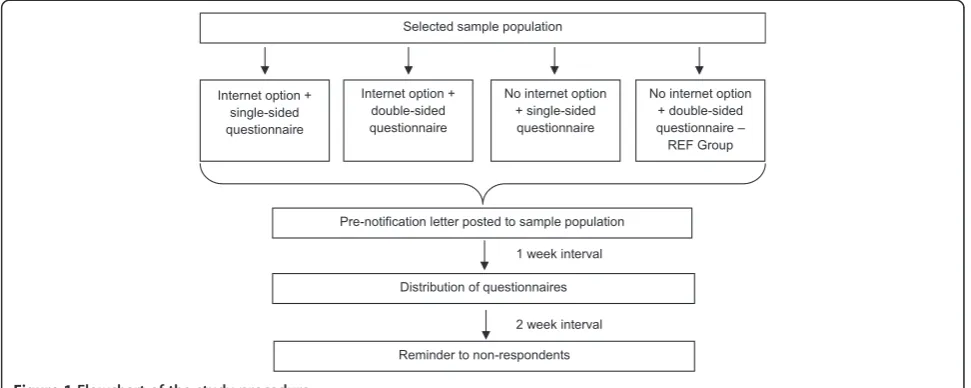
management. Persons in the study sample were 4600 residents in Grampian (north of Scotland) aged 25 years and over who were randomly selected from health board records. Sampled persons were randomly assigned to either receive a single-sided or double-sided questionnaire with or without an internet option to respond. The study questionnaire was distributed via post.
Results:The overall study response rate was 36.3%. When compared to the reference group that received no
intervention (response rate = 35.5%), the response rate changed only marginally when single-sided questionnaires were distributed (35.8%) or when an option to reply via the internet was provided (34.3%). A somewhat higher increase in response rates was achieved when both strategies were employed (39.6%). Overall, no significant effect on response rate was determined for each strategy or their interaction.
Conclusions:Evidence from this study suggests that neither single-sided questionnaires nor the option to reply via the internet resulted in a significant increase in response rates to population-based studies.
Keywords:Response rate, Randomized controlled trial, Postal questionnaires, Health surveys, Data collection, Internet
Background
Questionnaires to collect self-reported information are one of the key elements in population-based studies. A common means to conduct these studies is the use of pos-tally distributed questionnaires which are a convenient way to reach a large number of people in a short period of time [1]. While population studies are less prone to
selection bias, low study response rates and selective participation can result in non-response bias which can threaten a study’s validity [2].
It has been widely observed that response rates to epi-demiological studies have been decreasing over the past decades [3,4]. A retrospective review to investigate the change in study participation over time, reported that between 1970 and 2003 the response rates to cohort and cross-sectional studies decreased by−0.54% (95 CI:−1.33, 0.24) and −0.67% (95% CI:−1.91, 0.56) per year, respect-ively [4]. According to current predictions, response rates * Correspondence:[email protected]
1
Epidemiology Group, University of Aberdeen, Polwarth Building, Foresterhill, Aberdeen AB25 2ZD, UK
Full list of author information is available at the end of the article
population studies.
Much research has already been done to explore methods to improve response rates to postal question-naires [5,6]. To date, the most effective strategies are known to be incentives, the use of special or certified deliv-ery services or shorter questionnaires [5]. Pre-notification of receiving a questionnaire, reminder mailings and personalization methods can also increase question-naire response rates significantly. However there are limitations to the existing literature on response rates. It is not clear to what extent methods that have proven to be effective for specific groups, for example, physi-cians or students are effective for general populations. Secondly, evidence collected previously for approaches based on newer technologies such as the internet may no longer be valid due to the wider use of those tech-nologies within society. Finally the cost-effectiveness of different methods should also be assessed to allow researchers to choose the most appropriate overall approach.
A method that can easily be applied in population-based studies is to change the printing format of the questionnaire. As yet, four randomized controlled trials (RCTs) have examined the effect on response rates when questionnaires were printed single-sided versus double-sided [5]. Their findings suggest that the distri-bution of single-sided questionnaires leads to a small but significant effect on response rates (OR = 1.22; 95% CI: 1.01, 1.47). This may seem counter-intuitive since shorter questionnaires have shown to increase response rates. However, it may be speculated that questionnaire respondents felt more encouraged to complete the in-strument after noticing that only the first side of the questionnaire pages was printed. They may have be-lieved that its completion would not take up too much of their time after all, hence filled it in and returned it. None of the four trials were conducted within a general population sample. It would therefore be interesting to test this strategy in a population-based study.
The provision of an internet option to respond to a paper questionnaire may be another potential method to increase the response rate to population-based studies if prospective respondents prefer one administration mode over the other. The effect on response rates when partic-ipants received an option to reply via the internet was summarized in a recent meta-analysis [7]. Only four out of twelve peer-reviewed studies were RCTs that were
[12]), it is possible that an additional response option could become more acceptable and in this way increase questionnaire response rates.
The aims of the current study were to explore the effectiveness of printing the questionnaires single-sided and providing an internet option to respond and to assess the cost-effectiveness of both methods in a population-based study. It was hypothesized that the distribution of single-sided questionnaires and the provision of an internet option have an independent effect on questionnaire response rates, while no in-teraction effect between methods was expected. A secondary aim was to use additional data collected in this study to update an earlier meta-analysis of the evidence on the effect of an internet option in popula-tion studies [7].
Methods
Study design
A 2×2 factorial experiment was embedded within a cross-sectional population-based study of pain and pain management in 2012/2013. Using an electronic randomization program, persons in the study sample were randomly allocated to either receive (1) a single-sided or double-single-sided questionnaire and (2) an option or no option to reply via the internet.
Study procedure
Study questionnaire
The 20-page study questionnaire included questions on participants’ demographic characteristics (gender, age, and educational background), their health, pain and pain management. Validated standard question-naires were used to collect information on participants’ health (SF-36 [13]) and pain status (set of pain ques-tions with manikins and Chronic Pain Grade [14]). The questionnaire to collect pain management information was validated within a small population sample before the conduct of the study (Results to be published). De-pending on their randomization, persons in the study sample either received a 10-sheet (double-sided) or a 20-sheet (single-sided) questionnaire.
Statistical analysis
The main outcome of interest was questionnaire re-sponse rate; defined as the percentage of completed and partially completed questionnaires returned after excluding from the denominator those which were invalid (e.g. change of address or death). With ques-tionnaire response as the dependent variable, logistic regression models were performed in order to deter-mine predictors for questionnaire response. Odds Ratios and 95% Confidence Intervals were calculated in order to quantify the effect of the strategies on the questionnaire response rate. A meta-analysis was performed to summarize the current evidence on the effectiveness of an internet option in increasing re-sponse rates to population-based studies. Additionally, the cost-effectiveness of single-sided questionnaires and an internet option was investigated by determining the cost per additional response.
Ethical approval
The study was approved by the North of Scotland National Health Service Research Ethics Committee (REC reference: 12/NS/0079).
Results
Response rate
The response rate before the reminder surveys were distributed to non-respondents was 21.4%. At the end of data collection, 183 questionnaires were found invalid (for example, due to an invited participant being deceased or no longer resident at the given address) and 1604 completed questionnaires were returned giving an overall study re-sponse rate of 36.3% (1604/4417). Out of the respondents who were offered an internet option, 60 completed the electronic questionnaire (7.3%).
Time to respond
Completed study questionnaires were returned a median of 10 days (Interquartile range (IQR): 7, 20) after their distri-bution. Electronic questionnaires were received earlier than paper questionnaires (median, web: 7 days; median, paper: 10 days; Mann–Whitney test: p < 0.001).
Respondents’demographic characteristics
Response rate by study group
There were small differences in response rates between the four study groups. The reference group achieved a response rate of 35.5%. When sampled persons were provided with an internet option, this dropped to 34.3%. In contrast, the response rate increased to 35.8% when participants were sent a single-sided questionnaire with no option to respond via the internet. A greater increase in response rate of 4.1% was determined when partici-pants received both interventions (39.6%).
The effectiveness of the strategies in increasing response rates
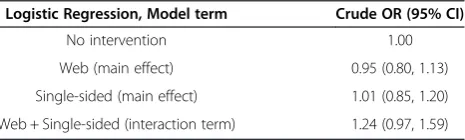
From the logistic model there was no “main” effect on response rates when an internet option was provided (OR = 0.95, 95% CI = 0.80, 1.13) or when single-sided questionnaires were distributed (OR = 1.01, 95% CI = 0.85, 1.20). Moreover, the interaction between both strat-egies led to a larger, albeit not statistically significant, ef-fect (OR = 1.24, 95% CI = 0.97, 1.59, Table 1).
When comparing the response rates of those who were randomized to receive an internet option and those who were not, the strategy of providing an internet op-tion increased the response rate non-significantly by 1.3% (OR = 1.06; 95% CI: 0.94, 1.20). A somewhat larger, yet non-significant effect was determined when the re-sponse rates of those who were allocated to receive a single-sided questionnaire and those who were allocated to be sent a double-sided questionnaire were compared: the response rate increased by 2.8% when participants received a single-sided questionnaire (OR = 1.13; 95% CI: 0.998, 1.28).
Internet option–summary of evidence
When the results of the current study were added to those reported in previous population studies (Figure 2), there no effect on response rates when an internet op-tion versus no internet opop-tion was provided for partici-pants (OR = 0.95; 0.83, 1.10). There was no obvious
single-sided questionnaires led to increased cost for printing (since the required number of pages doubled) and postage (because the survey packs were heavier). The implementation of an electronic version of the study questionnaire resulted in extra costs due to pro-gramming time and set up cost. Due to the low uptake rate of the internet option, differences in data entry costs were minimal. It was therefore decided not to include the data entry costs in the cost-effectiveness analysis. As outlined in Table 2, the cost per response was the lowest in the reference group that did not receive either inter-vention (£6.64). An additional cost of at least £1.02 per response was spent for the employment of the interven-tions. The internet option resulted in lower response at greater cost when double-sided questionnaires were distributed. The use of single-sided rather than double-sided questionnaires cost £119.19 per additional response. The combination of both methods was more cost-effective: Distributing single-sided questionnaire with an option to reply via the internet cost £25.20 per extra response.
Discussion
Main findings
Overall, neither the use of single-sided questionnaires nor the provision to reply via the internet significantly improved the questionnaire response rate in the current study. A small but non-significant interaction effect was determined when both strategies were used in combination.
The current study was the first study that explored the ef-fectiveness of single-sided questionnaires in a population-based sample. We found no effect on response rates when questionnaires were printed single-sided (OR = 1.13; 95% CI: 0.998, 1.28). Likewise, no effect on response rates was determined when an internet option was provided for the sampled persons (OR = 1.06; 95% CI: 0.94, 1.20). An up-dated meta-analysis confirmed that based on the current evidence of five studies, an option to reply via the internet does not improve response rates to a population study (OR = 0.95; 0.83, 1.10).
Strengths and limitations
The current study had several strengths. Firstly, we used a randomized controlled study design. Secondly, the use of a two by two factorial design enabled us to test the independ-ent and the combined effect of two differindepend-ent methods to in-crease questionnaire response rates. Thirdly, we conducted a subsequent cost-effectiveness analysis which provided
Table 1 The effect of the strategies on response rates
Logistic Regression, Model term Crude OR (95% CI)
No intervention 1.00
Web (main effect) 0.95 (0.80, 1.13)
Single-sided (main effect) 1.01 (0.85, 1.20)
insight into the expenses that were associated with the re-spective strategies under investigation.
A limitation of the study was that it was a sub-study within a large cross-sectional study. The study sample size was therefore powered on the main outcome vari-ables and not on the difference in questionnaire re-sponse rates. Nevertheless, the main effects of both strategies on questionnaire response rates were very small and insufficient power to detect a meaningful dif-ference is unlikely to have been a reason for observed lack of effect. It is probable however, that there was a lack of power to detect a significant interaction effect between both studies. Secondly, due to a small number of electronic responses the interpretation of some results was limited. It was determined that electronic respon-dents were significantly younger and more highly edu-cated when compared to paper respondents. While a higher proportion of electronic respondents were male and living in an urban area (information provided by the sampling frame), these differences were not statistically significant–most probably due to a lack of power.
Findings in relation to previous studies
Out of the 824 respondents who were randomized to the internet option groups, only 60 (7.3%) used the elec-tronic version to respond to the questionnaire. The low uptake rate of the internet option was similar to that ob-served in the population study by Ziegenfuss et al. [9], in which only 8.0% of the web option respondents used the electronic questionnaire. While a lack of internet cover-age was not a concern in the current study, it is likely that the initial mode of contact caused the low internet uptake rate. Since all prospective respondents were sent
a paper questionnaire, they may have been more inclined to complete and return the paper version.
A couple of hypotheses have been discussed in the literature to explain why an internet option is ineffective in increasing response rates [7]. Firstly, when approached by mail, the completion of an electronic questionnaire requires additional effort for participants since they have to‘switch task mode’. It can be hypothesized that a number of people may initially have decided to use the electronic question-naire but never actually logged on to complete and submit. Secondly, long and complicated URLs (e.g. those containing numbers and case sensitive letters) may make it more diffi-cult for participants to access the online questionnaire and appear off-putting. As a result, fewer participants may con-sider completing the online version. Nevertheless, the URL in the current study was reasonably short and only con-tained lowercase letters). Thirdly, people may be less likely to respond when provided with an internet option because they are required to make a choice at the very beginning. According to Schwartz [15], offering choices has negative effects on people’s decision-making. Since every choice is associated with opportunity costs, one must consider the trade-offs concerned with each option they are offered. This, in turn, makes it less appealing to choose either one. It remains uncertain why the use of single-sided naires was ineffective in the current study. The question-naire in the current study consisted of 20 pages and appeared very bulky when printed single-sided. It can be as-sumed that people might have felt discouraged when they received the questionnaire. Surprisingly, we established that although not statistically significant, there was an effect on questionnaire response rate that laid in the interaction of both strategies (OR = 1.24, 95% CI = 0.97, 1.59). It remains questionable why the response rates were only increased
Table 2 Strategies to improve questionnaire response: Cost-effectiveness
No internet option & Double-sided
Internet option & Double-sided
No internet option & Single-sided
Internet option & Single-sided
Response rate (in %) 35.5 34.3 35.8 39.4
Nr. of respondents 393 382 387 442
Nr. of eligible participants 1106 1082 1113 1116
Cost per response (£) 6.64 8.59 7.67 8.36
Cost per additional response (£) – – 119.19 25.20
We added our findings to the results of previous population studies that were summarized in a recent meta-analysis by Medway and Fulton [7]. In order to ac-count for any studies that were published after 2011, we conducted a comprehensive literature search. However, no additional papers were identified.
Conclusions
Taken as a whole, neither an option to reply via the internet nor the use of single-sided questionnaires were effective methods to significantly increase the response rates to a population-based sample. The results derived from the web option comparison were in agreement with the pooled effect size of the current evidence. Fur-thermore, it has been demonstrated that the cost per additional response was high, even when both methods were combined. As result of the current findings, re-searchers should be aware that neither method is effect-ive in increasing response rates to future population studies. Besides, researchers should be alerted to select the methods to increase questionnaire response rates in consideration of their effectiveness and the costs con-cerned. Due to the current trend of decreasing response rates, further research into strategies to increase those remains important. Future studies should always provide sufficient information on the cost-effectiveness of each employed strategy in order to allow an appropriate as-sessment of these.
Competing interests
The authors declare that they have no competing interests.
Authors’contributions
This study was conceived by GJM, GTJ and CMB. It was planned by all the authors and EF conducted the study. EF drafted the manuscript and all other authors critically reviewed the manuscript and provided important intellectual content. All authors read and approved the final manuscript.
Acknowledgements
We would like to thank the Institute of Applied Health Sciences (IAHS) at the University of Aberdeen for funding the PhD studentship of EF. Furthermore, we would like to thank everyone who was involved in the study, including Professor Sir Lewis Ritchie (Director of Public Health, NHS Grampian), John Lemon (University of Aberdeen), Dr. Fiona Garton (University of Aberdeen) and the Aberdeen Service User Group. Lastly, we would like to acknowledge all data entry clerks (Maxx Livingstone, Rory Macfarlane, Georgia Mannion-Krase and Hazel Reilly) and participants of the study.
Author details
1Epidemiology Group, University of Aberdeen, Polwarth Building, Foresterhill,
Aberdeen AB25 2ZD, UK.2Centre for Academic Primary Care, University of Aberdeen, Polwarth Building, Foresterhill, Aberdeen AB25 2ZD, UK.
17(9):643.
4. Morton LM:Reporting participation in epidemiologic studies: a survey of practice.Am J Epidemiol2006,163(3):197.
5. Edwards PJ, Roberts I, Clarke MJ, Diguiseppi C, Wentz R, Kwan I, Cooper R, Felix LM, Pratap S:Methods to increase response to postal and electronic questionnaires.Cochrane Database Syst Rev2009,3. MR000008.
6. Nakash R:Maximising response to postal questionnaires–a systematic review of randomised trials in health research.BMC Med Res Methodol 2006,6(1):5.
7. Medway RL, Fulton J:When more gets you less: a meta-analysis of the effect of concurrent web options on mail survey response rates.
Public Opin Q2012,76(4):733–746.
8. Brogger J, Nystad W, Cappelen I, Bakke P:No increase in response rate by adding a web response option to a postal population survey: a randomized trial.J Med Internet Res2007,9(5):e40.
9. Ziegenfuss JY, Beebe TJ, Rey E, Schleck C, Locke GR, Talley NJ:Internet option in a mail survey: More harm than good?Epidemiology2010,
21(4):585–586.
10. Schneider SJ, Cantor D, Malakhoff L, Arieira C, Segel P, Nguyen K, Tancreto JG:Telephone, internet, and paper data collection modes for the Census 2000 short form.J Official Stat2005,21(1):89–101.
11. Smyth JD, Dillman DA, Christian LM, O'Neill AC:Using the internet to survey small towns and communities: limitations and possibilities in the early 21st century.Am Behav Sci2010,53(9):1423–1448.
12. Widen use of the internet; http://www.scotland.gov.uk/About/Performance/ scotPerforms/indicator/internet.
13. Ware JE Jr, Sherbourne CD:The MOS 36-item short-form health survey (SF-36): I. Conceptual framework and item selection.Med Care1992,
30(6):473–483.
14. Von Korff M, Dworkin SF, Le Resche L:Graded chronic pain status: an epidemiologic evaluation.Pain1990,40(3):279–291.
15. Schwartz B:The paradox of choice.New York: Harper Perennial; 2004.
doi:10.1186/1471-2288-14-104
Cite this article as:Flüßet al.:The effect of an internet option and single-sided printing format to increase the response rate to a population-based study: a randomized controlled trial.BMC Medical Research Methodology201414:104.
Submit your next manuscript to BioMed Central and take full advantage of:
• Convenient online submission
• Thorough peer review
• No space constraints or color figure charges
• Immediate publication on acceptance
• Inclusion in PubMed, CAS, Scopus and Google Scholar
• Research which is freely available for redistribution