R E V I E W
Open Access
Array-based techniques for fingerprinting
medicinal herbs
Linhai Niu
1†, Nitin Mantri
1†, Chun Guang Li
2, Charlie Xue
2and Edwin Pang
1*Abstract
Poor quality control of medicinal herbs has led to instances of toxicity, poisoning and even deaths. The
fundamental step in quality control of herbal medicine is accurate identification of herbs. Array-based techniques have recently been adapted to authenticate or identify herbal plants. This article reviews the current array-based techniques,egoligonucleotides microarrays, gene-based probe microarrays, Suppression Subtractive Hybridization (SSH)-based arrays, Diversity Array Technology (DArT) and Subtracted Diversity Array (SDA). We further compare these techniques according to important parameters such as markers, polymorphism rates, restriction enzymes and sample type. The applicability of the array-based methods for fingerprinting depends on the availability of
genomics and genetics of the species to be fingerprinted. For the species with few genome sequence information but high polymorphism rates, SDA techniques are particularly recommended because they require less labour and lower material cost.
Background
Bioactive compounds in certain medicinal herbs affect cell communication and signalling [1], induce inflamma-tory responses [2] and help prevent diseases [3]. Chinese medicinal herbs such as ginseng (Panax ginseng), Dan-shen (Salvia miltiorrhiza), Korean Mint (Agastache rugosa), Chinese motherwort (Leonurus japonicus) are globally recognized for treating human disorders. Cur-rently, the global market for medicinal herbs currently is valued over $60 billion a year and growing at an annual rate of 6.4% [4].
Development and acceptance of herbal medicine are hindered by misidentification and adulteration of medic-inal herbs which may lead to loss of therapeutic potency and potential intoxication [5]. Authentication of medic-inal herbs ensures their therapeutic potency.
Morphological and histological methods, which have been used for authentication, are subjective and ineffec-tive [6]. Chromatographic fingerprinting (egHPLC) can be affected by the variations in growing conditions, har-vesting periods and processing methods of the herbs [7]. Genomic tools were developed to fingerprint herbal
plants as genomic information is more specific and does not readily change with environmental factors. Polymer-ase chain reaction (PCR)-bPolymer-ased techniques, eg random amplified polymorphic DNA (RAPD) [8-10], amplified fragment length polymorphism (AFLP) [11] and sequen-cing-based techniques based on species-specific sequences, eg internal transcribed spacer (ITS) [12], have also been used to identify herbal species. PCR-based methods are limited by agarose gel electrophoresis which is time consuming and not feasible for large scale genotyping operations [13]. Moreover, some PCR-based methods such as microsatellites and sequence charac-terised amplified regions (SCAR) require prior sequence information and may not be suitable for fingerprinting the species with poor genomic resources [13,14].
DNA microarrays were used to identify medicinal herbs by detecting the hybridisation between fluorescent targets and probes spotted on the microarray [15,16]. In comparison with PCR-based techniques, array-based techniques enable a larger number of DNA probes (or targets) to hybridise with labelled targets (or probes); thus they are more accurate, less time consuming and labour intensive. Array-based techniques include sequence-dependent microarrays and sequence-indepen-dent microarrays. Sequence-depensequence-indepen-dent microarrays are subdivided by type into oligonucleotide microarrays [17,18] and gene-based probe microarrays [6];
sequence-* Correspondence: [email protected] †Contributed equally
1
School of Applied Sciences, Health Innovations Research Institute, RMIT University, Melbourne, Victoria 3000, Australia
Full list of author information is available at the end of the article
techniques will be reviewed in subsequent sections of this article.
Array-based fingerprinting has not been thoroughly reviewed in literature. For instance, while nine PCR-based methods used for identifying Chinese medicinal materials were reviewed, array-based fingerprinting was only discussed briefly [22]. Another review cov-ered recent patents on DNA extraction, DNA amplifi-cation, the generation of DNA sequences and fingerprints and high-throughput authentication meth-ods [23]. Two other reviews discussed various finger-printing techniques for the authentication of herbal species [24,25]. These reviews, however, did not pro-vide details about the latest array-based techniques like the SDA technique.
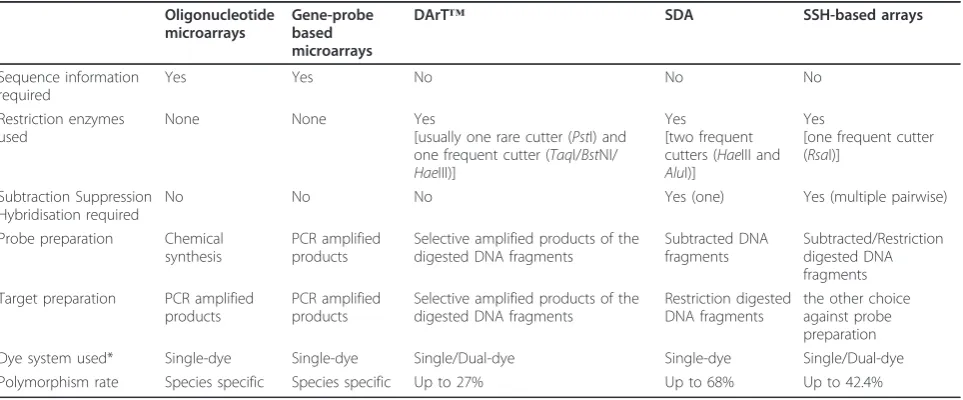
The present article reviews sequence-dependent and sequence-independent array techniques for fingerprint-ing medicinal herbs [6,14,15,17-21,24,26,27] (Additional file 1) and compares these techniques according to important parameters such as sample conditions, mar-kers, polymorphism rates, restriction enzymes and hybridisation techniques (Table 1).
Sequence-dependent microarrays
This type of microarrays is dependent on availability of genomic sequence information for the species of inter-est. Genomic sequences are compared for identification of non-redundant sequences unique to a particular spe-cies. Hundreds and thousands of such species-specific
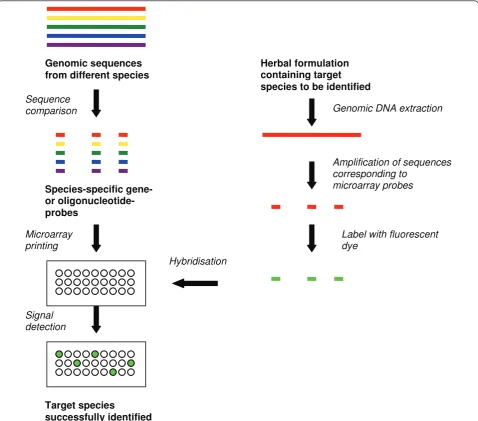
In an oligonucleotide microarray, unique 25 to 60 nucleotide species-specific probes are printed on a glass or quartz platform. The probe sequences are either from coding or non-coding regions of a plant’s genome. Each oligonucleotide microarray may potentially have probes from hundreds of herbal plant species. A herbal plant species to be authenticated is referred to as a target spe-cies. Genomic DNA is extracted from the target species; the sequences corresponding to the oligonucleotide probes are amplified, fluorescently labelled and hybri-dised onto the oligonucleotide array under highly-strin-gent conditions. The hybridisation is then quantified by laser-based detection for determination of relative abun-dance of target species-specific sequences on the array (Figure 1). This technique was successfully applied in the identification of eight toxic medicinal plant species using oligonucleotide probes based on spacer region between the coding regions of the 5S rRNA gene [17]. In another study, 33 species-specific oligonucleotide probes based on the 18S rRNA gene of 13Panax spe-cies were successfully used to differentiate closely relatedPanaxspecies [18].
Gene-based probe microarrays
This type of microarrays is similar to oligonucleotide microarrays except that these arrays are made of unique sequences from coding regions of the plant genomes and the probe size can potentially span the whole gene length (between 0.5 and 1.5 kb). For example, the internal tran-scribed spacer (ITS) ribosomal DNA sequences, which
Table 1 Comparison of the array-based techniques used for fingerprinting medicinal plants
Oligonucleotide microarrays
Gene-probe based microarrays
DArT™ SDA SSH-based arrays
Sequence information required
Yes Yes No No No
Restriction enzymes used
None None Yes
[usually one rare cutter (PstI) and one frequent cutter (TaqI/BstNI/
HaeIII)]
Yes [two frequent cutters (HaeIII and
AluI)]
Yes
[one frequent cutter (RsaI)]
Subtraction Suppression Hybridisation required
No No No Yes (one) Yes (multiple pairwise)
Probe preparation Chemical synthesis
PCR amplified products
Selective amplified products of the digested DNA fragments
Subtracted DNA fragments
Subtracted/Restriction digested DNA fragments Target preparation PCR amplified
products
PCR amplified products
Selective amplified products of the digested DNA fragments
Restriction digested DNA fragments
the other choice against probe preparation
Dye system used* Single-dye Single-dye Single/Dual-dye Single-dye Single/Dual-dye
Polymorphism rate Species specific Species specific Up to 27% Up to 68% Up to 42.4%
are usually species-specific, are amplified from different herbal species and subsequently spotted as probes on glass slides. Extraction of genomic DNA from target spe-cies, hybridisation and detection steps are similar to oli-gonucleotide arrays (Figure 1). However, compared to oligonucleotide microarrays, a single gene fragment is used as a probe on gene-based probe microarrays instead of several oligos from a gene sequence. These microar-rays may also be more specific since larger DNA frag-ments are used as probes. A study using this technique obtained distinctive signals for the five medicinal Dendro-biumspecies listed in the Chinese Pharmacopoeia [6]. This type of microarray was sensitive enough for
detecting the presence of Dendrobium nobile in a Chinese medicinal formulation containing nine herbal components [6]. While both oligonucleotide and gene-based microarrays can differentiate herbal plants at the species level, they may not be appropriate for fingerprint-ing herbal species with poor genomic information as both types of techniques require prior sequence informa-tion for primer or oligo design.
Sequence-independent arrays
An alternative to sequence-dependent microarrays is sequence-independent microarrays constructed by reduction of genome complexity.
Amplification of sequences corresponding to
microarray probes
Label with fluorescent dye
Genomic sequences
from different species
Species-specific gene- or oligonucleotide- probes
Herbal formulation containing target species to be identified
Genomic DNA extraction
Hybridisation Microarray
printing
Signal detection Sequence comparison
Target species
successfully identified
such as wheat [28] and sugarcane [29]. This technique uses a combination of restriction endonucleases, usually
PstI along with a frequent cutter such as AluI,BstNI, or
TaqI to produce genomic representations of genomic DNA samples from the species to be fingerprinted. A
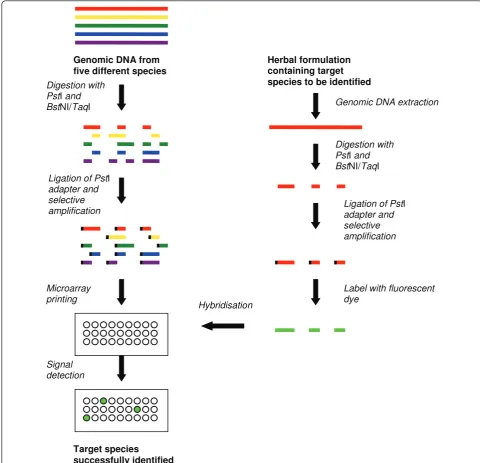
PstI adapter with an overhang is subsequently ligated to the restriction fragments which then are selectively PCR amplified and cloned into vectors. These representative clones are spotted on microarray glass slides as probes. When an unknown specimen is to be identified, the tar-get DNA is digested with the same restriction enzymes, ligated with PstI adapters, PCR amplified, labelled with fluorescent dyes and hybridised onto the DArT array (Figure 2). This technique reduces the genomic com-plexity by 100- to 1000-fold of the original genomic DNA pool and allows fingerprinting of any organism or a group of organisms belonging to the same genome pool from which the microarray was developed [30]. DArT was used to fingerprint Eucalyptus grandis, a medicinal plant [19].
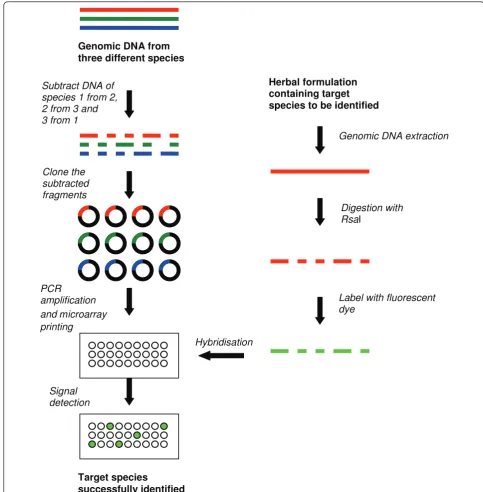
Compared with the sequence-dependent microarrays, the DArT™ is labour intensive due to the requirement of restriction digestion, adaptor ligation and selective amplification (Table 1). These steps increase the level of technical difficulty especially when a large number of species are fingerprinted. Moreover, comparatively low level of polymorphism rates (between 3% and 27%) were reported in the previous DArT™ studies, which is a potential weakness of this technique [13,28,29,31,32]. Suppression subtractive hybridization (SSH)-based arrays SSH procedure was first commercialised by Clontech® (USA) through the development of PCR-Select™cDNA subtraction kit to enrich for rare sequences over 1,000-fold using subtractive hybridization. In this method, the cDNA containing specific (differentially expressed) genes is referred to as‘tester’and the reference cDNA as‘ dri-ver’. The tester and driver cDNAs are separately digested with a frequent cutting restriction enzyme, namelyRsaI to generate shorter blunt-end fragments. The tester cDNA is subsequently divided into half and ligated with two different sets of adapters. TheRsaI digested driver cDNA is then added in excess to both the tester cDNA pools and two different hybridisation reactions are per-formed to selectively amplify the differentially expressed cDNA sequences from the tester pool. In one of the first uses of this technique, testis-specific cDNA fragments were extracted and used as probes to identify homolo-gous sequences in a human Y chromosome cosmid library [33]. SSH has since been widely used for gene expression studies and modified for DNA fingerprinting
species of the genusDendrobiumviz., namelyD. auran-tiacumKerr, D. officinale Kimura et Migo,D. nobile
Lindl.,D. chrysotoxumLindl. andD. fimbriatumHook were successfully fingerprinted [14,21].
However, this method is costly and labour intensive, and perhaps impractical for fingerprinting a large num-ber of species. In the study by Liet al. [14], four sub-tractions were performed to fingerprint only six species ofDendrobium.
Subtracted diversity array (SDA)
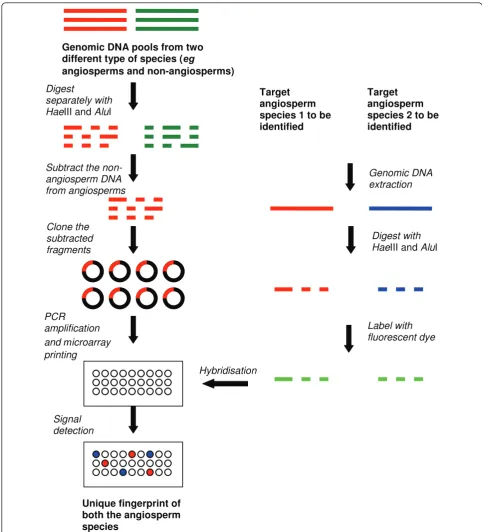
SDA, a novel microarray, was constructed based on a modified SSH-based array technique [34]. Instead of making pair-wise subtractions between the species to be fingerprinted [14], Jayasinghe et al. pooled genomic DNA from 49 representative angiosperm species and subtracted this DNA from pooled genomic DNA of five representative non-angiosperm species to extract angios-perm-specific DNA fragments [34]. The angiosperm-specific DNA fragments were printed on microarray glass slides and used as probes to fingerprint species from different angiosperm clades (Figure 4). SDA suc-cessfully discriminated species from all the six main clades of APG II classification system [35] and correctly clustered nine species at the family level [20]. SDA was used to discriminate dried herbal samples including a few closely related species, eg Magnolia denudata and
Magnolis biondii,Panax ginseng andPanax quinquefo-lius [36]. Furthermore, this technique was sensitive enough to identify a 10% deliberate contamination of
Panax quinquefoliusDNA in purePanax ginsengDNA [36]. SDA may be suitable for detecting DNA poly-morphisms as it is cost-effective compared with DArT™ and SSH-based techniques for fingerprinting a large number of samples.
Comparison of array-based techniques Type of herbal plant samples
Restriction enzymes
Sequence-dependent microarrays use amplified products of species-specific sequences as probes and do not require restriction enzymes. On the other hand, in sequence-independent arrays, using appropriate restric-tion enzymes to generate sufficient number of poly-morphic sequences is critical for the fingerprinting. For this reason, some DArT™ studies initially compared restriction enzyme sets [29,32], which is a time- and
cost- consuming process. By contrast, SSH-based arrays and SDA do not require enzyme comparisons and only use frequent cutting enzymes as compared to DArT™. Frequent cutter(s) used in SDA (AluI and HaeIII) and SSH-based (RsaI) arrays recognize 4 bp sequences and be beneficial for target preparation in comparison with rare (6 bp) cutters (PstI; EcoRI) used in DArT™. Fre-quent cutters generate more fragments of smaller sizes than restriction enzymes recognizing 6 bp sequences.
Label with fluorescent dye
Genomic DNA from five different species
Ligation of PstI adapter and selective amplification
Herbal formulation containing target species to be identified
Genomic DNA extraction
Hybridisation Microarray
printing
Signal detection Digestion with PstI and BstNI/TaqI
Target species
successfully identified
Ligation of PstI adapter and selective amplification Digestion with PstI and BstNI/TaqI
Longer fragments have less potential of generating poly-morphic sequences than shorter ones as there are less selective nucleotides for selective amplification. This may explain why SDA generated higher polymorphism compared with previous DArT™studies [20]. Moreover, restriction enzyme combination resulting in more com-plex genomic sequences is likely to generate more mar-kers and reduce redundancy. Combination of frequent
cutters, namely HaeIII and AluI may be used in future studies with DArT™.
Markers
Generation of molecular markers is a critical step for fingerprinting studies. Usually, sequence-dependent microarrays generate probes by amplifying the regions of species-specific nuclear or chloroplast genes. For instance, the species-specific oligonucleotide probes
Label with fluorescent dye
Genomic DNA from three different species
Clone the subtracted fragments
Herbal formulation containing target species to be identified
Genomic DNA extraction
Hybridisation PCR
amplification and microarray printing
Signal detection Subtract DNA of species 1 from 2, 2 from 3 and 3 from 1
Target species
successfully identified
Digestion with RsaI
Label with fluorescent dye
Genomic DNA pools from two
different type of species (eg
angiosperms and non-angiosperms)
Clone the subtracted fragments
Target angiosperm species 1 to be identified
Genomic DNA extraction
Hybridisation PCR
amplification and microarray printing
Signal detection Digest
separately with HaeIII and AluI
Unique fingerprint of both the angiosperm species
Digest with HaeIII and AluI Subtract the
non-angiosperm DNA from angiosperms
Target angiosperm species 2 to be identified
Figure 4Method of manufacturing a subtracted diversity array and using it for fingerprinting herbal plants. The method shown in the figure is for subtraction of non-angiosperm DNA from angiosperm DNA which is a broad subtraction. This subtraction was capable of
fingerprinting species from different angiosperm clades and orders with high (68%) polymorphism [20] but showed lower (10-22%)
were employed as the species-specific probes to identify each individual species [18]. While these microarrays are cheap and not labour intensive, large number of PCR amplifications used in these methods may lead to arte-facts thus affecting the fingerprinting results. Moreover, as closely related species have been found to possess identical sequence at the same loci [24], probes gener-ated in those arrays may be insufficient for bar-coding purposes of all herbal plants. Therefore, sequence-inde-pendent arrays with multiple markers have recently been widely used to fingerprint herbal plants [19,20].
Sequencing of polymorphic markers from sequence-independent arrays has identified gene- and retroele-ment-based sequences. For instance, the sequences of many features on a DArT™ were revealed to match genes such as‘GGPP synthase’and possible retrotran-sposons [27]. Sequences of many probes on SDA have also been reported to match ‘retroelements’, ‘genes’and
‘putative uncharacterized proteins’[20]; however, the markers used to fingerprint plant species may have been different as different restriction enzymes were used in these studies. These restriction enzymes recognize dif-ferent sequences and produce markers of varied lengths. For example, probes between 83 bp to 453 bp were used as markers in a SSH-based array [37] whereas mar-kers ranging from 147 bp to 880 bp were used in a SDA [20] and markers with average length of 563 bp have also been reported [38].
Since a sufficient number of unique polymorphic mar-kers is critical for generating reliable results, detecting redundancy level of those markers is a crucial step for sequence-independent arrays. Based on a literature search only five of eleven DArT™ studies reported the redundancy level, with redundancy levels being between 14% and 56%. Differences in redundancy levels may be attributed to different restriction enzymes and target/ probe preparation methods used in these studies. Polymorphism rates
Polymorphism rate refers to the percentage of poly-morphic features (that discriminate between species) out of the total number tested. Polymorphism rates obtained with sequence-dependent microarrays cannot be directly compared with those of sequence-independent arrays as these arrays use different methodologies for target/probe preparation. Markers of sequence-dependent microar-rays are designed or synthesised based on species-speci-fic sequences. Thus, the polymorphic probes used may be sufficient for discriminating the species being finger-printed, resulting in a high polymorphism rate. By con-trast, markers of sequence-independent arrays are
mic DNA pool. Fragments produced are cloned and PCR-amplified to generate probes. As the identity of these fragments is not known when they are spotted on the microarray, many of these probes are expected to be the same (redundant) thus reducing the polymorphic frequency.
Various polymorphism rates have been reported for sequence-independent arrays. In general, SSH-based arrays generated higher polymorphism rates than DArT™. For instance, a polymorphism rate of 42.4% was reported for a SSH-based array fingerprinting six
Dendrobium species [14]. This number is higher than the polymorphism rate of 3 to 27% reported in DArT™ studies [13,19,29,32]. The possible reason is that the common sequences between testers and dri-vers were removed by SSH, thereby enriching the probe library with polymorphic sequences for the spe-cies of interest. Compared with SSH-based arrays, SDA showed a higher polymorphism rate of 68% when used to fingerprint medicinal plant species representing six different clades of the flowering plants [20]. This may be attributed to the wide subtraction of 49 angiosperm genomic DNA from five non-angiosperm genomic DNA performed during the development of SDA, as a comparison to the close pair-wise subtraction of spe-cies from the same genera performed for SSH-based array construction. Moreover, the species that were fingerprinted with SDA were significantly different from each other (belonging to six different clades) compared to those fingerprinted with SSH (belonging to the same genera). This argument is supported by low polymorphism rates of 22.3% and 10.5% obtained from fingerprinting (with SDA) closely related species, namely Magnolia biondii and Magnolia denudata,
Panax ginseng and Panax quinquefolius respectively [36]. To overcome this, Mantriet al. performed a clo-ser subtraction by subtracting genomic DNA of asterid species (asterid angiosperms and non-angiosperms) from genomic DNA of asterid species to fingerprint herbal plants from the asterid clade of plants. A polymorphism rate of 50% was obtained with this array to fingerprint 25 Asterid species from 20 families [Mantri, unpublished data].
suitable for direct comparison because these studies used different labelling methods or thresholds to score the ratios. For instance, previous SDA studies used a threshold of 2.0 (signal≥2 background) to define ‘ posi-tive’ features (features considered to show true signal) [20] while the DArT™ studies subtracted background from the signal to call‘positive’features [19]. Moreover, DArT™ studies used either a single-dye system invol-ving Cy3 [19] or a dual-dye dye system using Cy3 with Cy5/FAM [28,29] to label the targets and the ratio of signal intensities between samples to score features. By contrast, a single-dye system using Cy3 to label targets and signal to background ratio within the sample was used to score features in the SDA studies [20]. Further-more, compared to SDA and DArT™, SSH-based arrays used DIG to prepare targets for investigating the rela-tionship ofDendrobium species and did not assess the spot intensities with laser-based scanning [14,21]. In SSH-based arrays, the ratio of signal intensity of one spot for two species is the signal intensity for one spe-cies divided by that for the other [14], which was used to replace the Cy3/Cy5 ratio to score the spots. Conse-quently, valid comparisons cannot be made between the methods to define the ‘positive’ features in different microarray studies.
Discussion
The choice among these methods mainly depends on the genomics and genetics of the species to be finger-printed. Sequence-dependent microarrays are fast and cheap, and capable of fingerprinting the species with sequence information available in the existing databases. In contrast, sequence-independent arrays are laborious and costly but suitable for identifying a large number of species which lack sequence information in the existing databases. Further, the sequence-independent arrays are less affected by the artefacts caused by large number of PCR amplifications during target preparation. SDA is advantageous over SSH-based arrays as SDA does not require multiple SSH for probe preparation. Further, SDA is also advantageous over DArT™ as SDA does not require adapter ligation and selective amplification for target preparation. As SDA is also sensitive enough for fingerprinting dried herbal samples, its use in finger-printing of herbal plants is more versatile.
Conclusion
The applicability of the array-based methods for finger-printing depends on the availability of genomics and genetics of the species to be fingerprinted. For the spe-cies with few genome sequence information but high polymorphism rates, SDA techniques are particularly recommended because they require less labour and lower material cost.
Additional material
Additional file 1: Summary of array-based methods for the studies of herbal plants. The different array-based method used for
fingerprinting medicinal plants are compared based on array method, kind of tissue used for DNA extraction, and substrate/platform used for microarray printing. The species that were fingerprinted and results obtained are highlighted.
Abbreviations
AFLP: Amplified Fragment Length Polymorphism; cDNA: complementary DNA (deoxyribonucleic acid); Cy3: cyanine 3; Cy5: cyanine 5; DArT: Diversity Array Technology; DIG: Digoxigenin; DNA: Deoxyribonucleic acid; FAM: carboxyfluorescein; HPLC: High-performance liquid chromatography; ITS: Internal transcribed spacer; PCR: Polymerase chain reaction; RAPD: Random Amplified Polymorphic DNA; rRNA: ribosomal RNA (ribonucleic acid); SCAR: Sequence Characterised Amplified Regions; SDA: Subtracted Diversity Array; SSH: Suppression Subtractive Hybridization;
Acknowledgements
The authors wish to gratefully acknowledge the RMIT Health Innovation Research Institute PhD Scholarship, and the funding of this research by a Rural Industries Research Development Corporation and a RMIT University VRI grant (# VRI-43).
Author details
1School of Applied Sciences, Health Innovations Research Institute, RMIT
University, Melbourne, Victoria 3000, Australia.2Division of Chinese Medicine, School of Health Sciences, Health Innovations Research Institute, RMIT University, Melbourne, Victoria 3000, Australia.
Authors’contributions
NM and LN share equal first authorship and wrote the article with inputs from EP, CGL and CX. NM prepared the figures. All authors read and approved the final version of the manuscript.
Competing interests
The authors declare that they have no competing interests.
Received: 8 October 2010 Accepted: 18 May 2011 Published: 18 May 2011
References
1. Ralt D:Intercellular communication, NO and the biology of Chinese medicine.Cell Commun Signal2005,3(1):8.
2. Yeh CC, Lin CC, Wang SD, Hung CM, Yeh MH, Liu CJ, Kao ST:Protective and immunomodulatory effect of Gingyo-san in a murine model of acute lung inflammation.J Ethnopharmacol2007,111(2):418-426. 3. An W, Yang J:Protective effects of Ping-Lv-Mixture (PLM), a medicinal
formula on arrhythmias induced by myocardial ischemia-reperfusion.J Ethnopharmacol2006,108(1):90-95.
4. Sharma A, Shanker C, Tyagi KL, Singh M, Rao CV:Herbal medicine for market potential in India: an overview.Acad J Plant Sci2008,1(2):26-36. 5. Zhu YP:Toxicity of the Chinese herb mu tong (Aristolochia
manshuriensis): What history tells us.Adverse Drug React Toxicol Rev2002, 21(4):171-177.
6. Zhang YB, Wang J, Wang ZT, But PP, Shaw PC:DNA microarray for identification of the herb ofdendrobiumspecies from Chinese medicinal formulations.Planta Med2003,69(12):1172-1174.
7. Zhang YB, Shaw PC, Sze CW, Wang ZT, Tong Y:Molecular authentication of Chinese herbal materials.J Food Drug Anal2007,15(1):1-9.
8. Um JY, Chung HS, Kim MS, Na HJ, Kwon HJ, Kim JJ, Lee KM, Lee SJ, Lim JP, Do KR, Hwang WJ, Lyu YS, An NH, Kim HM:Molecular authentication of
Panax ginsengspecies by RAPD analysis and PCR-RFLP.Biol Pharm Bull
2001,24(8):872-875.
9. Dangi RS, Lagu MD, Choudhary LB, Ranjekar PK, Gupta VS:Assessment of genetic diversity inTrigonella foenum-graecumandTrigonella caerulea
(AFLP) and directed amplification of minisatellite region DNA (DAMD).J Agric Food Chem2002,50(7):1871-1875.
12. Xu H, Wang Z, Ding X, Zhou K, Xu L:Differentiation ofDendrobium
species used as“Huangcao Shihu”by rDNA ITS sequence analysis.Planta Med2006,72(1):89-92.
13. Jaccoud D, Peng KM, Feinstein D, Kilian A:Diversity array: a solid state technology for sequence information independent genotyping.Nucleic Acids Res2001,29(4):e25.
14. Li TX, Wang JK, Bai YF, Lu ZH:Diversity suppression-subtractive hybridization array for profiling genomic DNA polymorphisms.J Integr Plant Biol2006,48(4):460-467.
15. Carles M, Cheung MK, Moganti S, Dong TT, Tsim KW, Ip NY, Sucher NJ:A DNA microarray for the authentication of toxic traditional Chinese medicinal plants.Planta Med2005,71(16):580-584.
16. Sze SC, Zhang KY, Shaw PC, But PP, Ng TB, Tong Y:A DNA microarray for differentiation of Fengdou Shihu by its 5S ribosomal DNA intergenic spacer region.Biotechnol Appl Biochem2008,49(2):149-154.
17. Carles M, Lee T, Moganti S, Lenigk R, Tsim KW, Ip NY, Hsing IM, Sucher NJ: Chips and Qi: microcomponent-based analysis in traditional Chinese medicine.Fresenius J Anal Chem2001,371(2):190-194.
18. Zhu S, Fushimi H, Komatsu K:Development of a DNA microarray for authentication of ginseng drugs based on 18S rRNA gene sequence.J Agric Food Chem2008,56(11):3953-3959.
19. Lezar S, Myburg AA, Berger DK, Wingfield MJ, Wingfield BD:Development and assessment of microarray-based DNA fingerprinting inEucalyptus grandis.Theor Appl Genet2004,109(7):1329-1336.
20. Jayasinghe R, Hai NL, Coram TE, Kong S, Kaganovitch J, Xue CC, Li CG, Pang ECK:Effectiveness of an innovative prototype Subtracted Diversity Array (SDA) for fingerprinting plant species of medicinal importance.
Planta Med2009,75(10):1180-1185.
21. Li TX, Wang JK, Bai YF, Sun XD, Lu ZH:A novel method for screening species-specific gDNA probes for species identification.Nucleic Acids Res
2004,32(4):e45.
22. Yip PY, Chau CF, Mak CY, Kwan HS:DNA methods for identification of Chinese medicinal materials.Chin Med2007,2:9.
23. Shaw PC, Wong KL, Chan A, Wong WC, But P:Patent applications for using DNA technologies to authenticate medicinal herbal material.Chin Med2009,4:21.
24. Sucher NJ, Carles MC:Genome-based approaches to the authentication of medicinal plants.Planta Med2008,74(6):603-623.
25. Chavan P, Joshi K, Patwardhan B:DNA microarrays in herbal drug research.Evid Based Complement Alternat Med2006,3(4):447-457. 26. Barthelson RA, Sundareshan P, Galbraith DW, Woosley RL:Development of
a comprehensive detection method for medicinal and toxic plant species.Am J Bot2006,93(4):566-574.
27. James KE, Schneider H, Ansell SW, Evers M, Robba L, Uszynski G, Pedersen N, Newton AE, Russell SJ, Vogel JC, Kilian A:Diversity arrays technology (DArT) for pan-genomic evolutionary studies of non-model organisms.PLoS One2008,3(2):e1682.
28. Akbari M, Wenzl P, Caig V, Carling J, Xia L, Yang S, Uszynski G, Mohler V, Lehmensiek A, Kuchel H, Hayden MJ, Howes N, Sharp P, Vaughan P, Rathmell B, Huttner E, Kilian A:Diversity arrays technology (DArT) for high-throughput profiling of the hexaploid wheat genome.Theor Appl Genet2006,113:1409-1420.
29. Heller-Uszynska K, Uszynski G, Huttner E, Evers M, Carlig J, Caig V, Aitken K, Jackson P, Piperidis G, Cox M, Gilmour R, D’Hont A, Butterfield M, Glaszmann J-C, Kilian A:Diversity arrays technology effectively reveals DNA polymorphism in a large and complex genome of sugarcane.Mol Breed2010.
30. Xie P, Chen S, Liang YZ, Wang X, Tian R, Upton R:Chromatographic fingerprint analysis-a rational approach for quality assessment of traditional Chinese herbal medicine.J Chromatogr A2006, 1112(1-2):171-180.
31. Wenzl P, Li H, Carling J, Zhou M, Raman H, Paul E, Hearnden P, Maier C, Xia L, Caig V, Ovesná J, Cakir M, Poulsen D, Wang J, Raman R, Smith KP, Muehlbauer GJ, Chalmers KJ, Kleinhofs A, Huttner E, Kilian A:A
high-Genet2006,113:585-595.
33. Diatchenko L, Lau YF, Campbell AP, Chenchik A, Moqadam F, Huang B, Lukyanov S, Lukyanov K, Gurskaya N, Sverdlov ED, Siebert PD:Suppression subtractive hybridization: a method for generating differentially regulated or tissue-specific cDNA probes and libraries.Proc Natl Acad Sci USA1996,93(12):6025-6030.
34. Jayasinghe R, Kong S, Coram TE, Kaganovitch J, Xue CC, Li CG, Pang ECK: Construction and validation of an innovative microarray for novel application of efficient and high-throughput genotyping of Angiosperms.Plant Biotechnol J2007,5(2):282-289.
35. Chase MW, Bremer B, Bremer K, Reveal JL, Soltis DE, Soltis PS, Stevens PF, Anderberg AA, Michael FF, Peter G, Judd WS, Källersjö M, Kårehed J, Kron KA, Lundberg J, Nickrent DL, Olmstead RG, Oxelman B, Pires JC, Rodman JE, Rudall PJ, Savolainen V, Sytsma KJ, van der Bank M, Wurdack K, Xiang JQY, Zmarzty S:An update of the Angiosperm Phylogeny Group classification for the orders and families of flowering plants: APG II.Bot J Linn Soc2003,141:399-436.
36. Linhai Niu:Effectiveness of an innovative prototype subtracted diversity array (SDA) for fingerprinting commercial Chinese herbal medicines.Phd thesisRMIT University Melbourne, School of Applied Sciences; 2009. 37. Li TX, Wang JK, Lu ZH:Accurate identification of closely related
Dendrobiumspecies with multiple species-specific gDNA probes.J Biochem Biophys Methods2005,62(2):111-123.
38. Nouzová M, Neumann P, Navrátilová A, Galbraith DW, Macas J: Microarray-based survey of repetitive genomic sequences inViciaspp.Plant Mol Biol
2001,45(2):229-244.
doi:10.1186/1749-8546-6-18
Cite this article as:Niuet al.:Array-based techniques for fingerprinting medicinal herbs.Chinese Medicine20116:18.
Submit your next manuscript to BioMed Central and take full advantage of:
• Convenient online submission
• Thorough peer review
• No space constraints or color figure charges
• Immediate publication on acceptance
• Inclusion in PubMed, CAS, Scopus and Google Scholar
• Research which is freely available for redistribution